

ASTM C185-20
(Test Method)Standard Test Method for Air Content of Hydraulic Cement Mortar
General Information
- Abstract
SIGNIFICANCE AND USE
5.1 The purpose of this test method is to determine whether or not the hydraulic cement under test meets the air-entraining or non-air-entraining requirements of the applicable hydraulic cement specification for which the test is being made. The air content of concrete is influenced by many factors other than the potential of the cement for air entrainment.
SCOPE
1.1 This test method covers the determination of the air content of hydraulic cement mortar under the conditions hereinafter specified.
1.2 The values stated in SI units are to be regarded as standard. No other units of measurement are included in this standard.
1.3 Values in SI shall be obtained by measurement in SI units or by appropriate conversion, using the Rules for Conversion and Rounding in IEEE/ASTM SI 10, of measurements made in other units.
1.4 This standard does not purport to address all of the safety concerns, if any, associated with its use. It is the responsibility of the user of this standard to establish appropriate safety, health, and environmental practices and determine the applicability of regulatory limitations prior to use.
1.5 Warning—Fresh hydraulic cementitious mixtures are caustic and may cause chemical burns to skin and tissue upon prolonged exposure.2
1.6 This international standard was developed in accordance with internationally recognized principles on standardization established in the Decision on Principles for the Development of International Standards, Guides and Recommendations issued by the World Trade Organization Technical Barriers to Trade (TBT) Committee.
- Status
- Published
- Publication Date
- 31-Mar-2020
- Technical Committee
- C01 - Cement
- Drafting Committee
- C01.21 - Air Entrainment

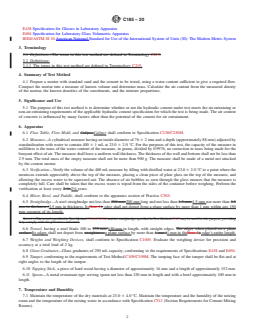
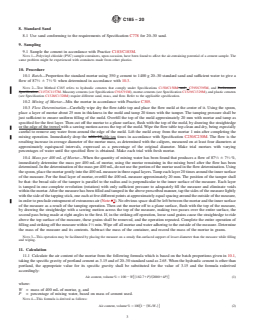
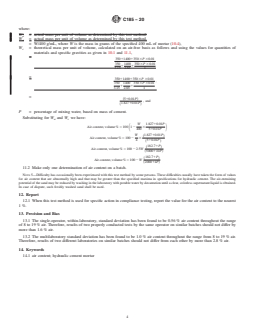
Overview
ASTM C185-20: Standard Test Method for Air Content of Hydraulic Cement Mortar describes procedures for determining the air content in hydraulic cement mortar. Accurate measurement of air content is essential for assessing whether hydraulic cements meet the air-entraining or non-air-entraining requirements specified for construction and material performance. This standard applies to hydraulic cement mortars, referencing the use of SI units as standard measurements and requiring careful attention to laboratory safety due to the caustic nature of fresh cementitious mixtures.
Key Topics
- Purpose and Scope
- Determines whether hydraulic cement meets air-entraining specifications.
- Focuses on mortar made from cement and standard sand with water adjusted for required flow.
- Test Method Summary
- Mortar is prepared to a standardized consistency and placed in a mold of known volume.
- The mass and volume measurements enable calculation of air content by comparing theoretical and actual density values.
- Apparatus and Materials
- Use of standardized equipment: flow table, flow mold, caliper, measure, mixer, trowel, straightedge, tamper, and standardized sand.
- Units and Measurements
- Results and materials are specified solely in SI units for consistency and accuracy as per IEEE/ASTM SI 10.
- Safety Considerations
- Users must establish proper safety and health practices. Fresh mixtures are caustic and can cause chemical burns.
Applications
The ASTM C185-20 test method is widely used in the construction materials industry and research laboratories for:
- Quality Control in Cement Manufacturing
- Ensuring cements conform to specific air-entraining requirements.
- Assessing the performance of cements in different mortar mixes to predict concrete durability.
- Specification Compliance
- Providing test results required for certification against standards, such as those for portland cement and blended hydraulic cements.
- Research and Product Development
- Comparing air-entraining capabilities among different cements or admixture formulations.
- Mix Design Verification
- Fine-tuning mortar and concrete mix designs where air content impacts workability and freeze-thaw resistance.
The method is referenced by government agencies, regulatory bodies, and construction contractors needing consistent mortar and concrete quality, especially where frost resistance and workability are critical.
Related Standards
The ASTM C185-20 standard interacts with and references several other standards, essential for comprehensive cement and mortar testing:
- ASTM C150/C150M - Specification for Portland Cement
- ASTM C595/C595M - Specification for Blended Hydraulic Cements
- ASTM C91/C91M - Specification for Masonry Cement
- ASTM C1329/C1329M - Specification for Mortar Cement
- ASTM C109/C109M - Test Method for Compressive Strength of Hydraulic Cement Mortars
- ASTM C305 - Practice for Mechanical Mixing of Hydraulic Cement Pastes and Mortars
- ASTM C511 - Specification for Mixing Rooms, Moist Cabinets, and Storage Tanks
- ASTM C778 - Specification for Standard Sand
Familiarity with these related standards ensures more robust testing programs and enhances overall quality control and compliance in cement and mortar applications.
Keywords: ASTM C185, air content, hydraulic cement mortar, air-entraining cement, mortar testing, quality control, construction materials.
Relations
- Effective Date
- 01-Apr-2020
- Effective Date
- 01-Apr-2024
- Effective Date
- 01-Feb-2024
- Effective Date
- 01-Feb-2024
- Effective Date
- 15-Dec-2023
- Effective Date
- 01-Aug-2020
- Effective Date
- 15-Jul-2020
- Effective Date
- 01-Apr-2020
- Effective Date
- 15-Nov-2019
- Effective Date
- 01-Jun-2019
- Effective Date
- 01-Apr-2019
- Effective Date
- 01-May-2018
- Effective Date
- 01-Jan-2018
- Effective Date
- 01-Jan-2018
- Effective Date
- 15-Jun-2017
Get Certified
Connect with accredited certification bodies for this standard

DIBt (Deutsches Institut für Bautechnik)
German Institute for Building Technology.
DIN CERTCO
DIN Group product certification.

Aboma Certification B.V.
Specialized in construction, metal, and transport sectors.
Sponsored listings
Frequently Asked Questions
ASTM C185-20 is a standard published by ASTM International. Its full title is "Standard Test Method for Air Content of Hydraulic Cement Mortar". This standard covers: SIGNIFICANCE AND USE 5.1 The purpose of this test method is to determine whether or not the hydraulic cement under test meets the air-entraining or non-air-entraining requirements of the applicable hydraulic cement specification for which the test is being made. The air content of concrete is influenced by many factors other than the potential of the cement for air entrainment. SCOPE 1.1 This test method covers the determination of the air content of hydraulic cement mortar under the conditions hereinafter specified. 1.2 The values stated in SI units are to be regarded as standard. No other units of measurement are included in this standard. 1.3 Values in SI shall be obtained by measurement in SI units or by appropriate conversion, using the Rules for Conversion and Rounding in IEEE/ASTM SI 10, of measurements made in other units. 1.4 This standard does not purport to address all of the safety concerns, if any, associated with its use. It is the responsibility of the user of this standard to establish appropriate safety, health, and environmental practices and determine the applicability of regulatory limitations prior to use. 1.5 Warning—Fresh hydraulic cementitious mixtures are caustic and may cause chemical burns to skin and tissue upon prolonged exposure.2 1.6 This international standard was developed in accordance with internationally recognized principles on standardization established in the Decision on Principles for the Development of International Standards, Guides and Recommendations issued by the World Trade Organization Technical Barriers to Trade (TBT) Committee.
SIGNIFICANCE AND USE 5.1 The purpose of this test method is to determine whether or not the hydraulic cement under test meets the air-entraining or non-air-entraining requirements of the applicable hydraulic cement specification for which the test is being made. The air content of concrete is influenced by many factors other than the potential of the cement for air entrainment. SCOPE 1.1 This test method covers the determination of the air content of hydraulic cement mortar under the conditions hereinafter specified. 1.2 The values stated in SI units are to be regarded as standard. No other units of measurement are included in this standard. 1.3 Values in SI shall be obtained by measurement in SI units or by appropriate conversion, using the Rules for Conversion and Rounding in IEEE/ASTM SI 10, of measurements made in other units. 1.4 This standard does not purport to address all of the safety concerns, if any, associated with its use. It is the responsibility of the user of this standard to establish appropriate safety, health, and environmental practices and determine the applicability of regulatory limitations prior to use. 1.5 Warning—Fresh hydraulic cementitious mixtures are caustic and may cause chemical burns to skin and tissue upon prolonged exposure.2 1.6 This international standard was developed in accordance with internationally recognized principles on standardization established in the Decision on Principles for the Development of International Standards, Guides and Recommendations issued by the World Trade Organization Technical Barriers to Trade (TBT) Committee.
ASTM C185-20 is classified under the following ICS (International Classification for Standards) categories: 91.100.10 - Cement. Gypsum. Lime. Mortar. The ICS classification helps identify the subject area and facilitates finding related standards.
ASTM C185-20 has the following relationships with other standards: It is inter standard links to ASTM C185-19, ASTM C219-24, ASTM E694-18(2024), ASTM E438-92(2024), ASTM C109/C109M-23, ASTM C219-20a, ASTM C305-20, ASTM C219-20, ASTM C219-19a, ASTM C219-19, ASTM C150/C150M-19, ASTM C1005-18, ASTM E438-92(2018), ASTM E694-18, ASTM C1157/C1157M-17. Understanding these relationships helps ensure you are using the most current and applicable version of the standard.
ASTM C185-20 is available in PDF format for immediate download after purchase. The document can be added to your cart and obtained through the secure checkout process. Digital delivery ensures instant access to the complete standard document.
Standards Content (Sample)
This international standard was developed in accordance with internationally recognized principles on standardization established in the Decision on Principles for the
Development of International Standards, Guides and Recommendations issued by the World Trade Organization Technical Barriers to Trade (TBT) Committee.
Designation: C185 − 20 American Association State
Highway and Transportation Officials Standard
AASHTO No.: T137
Standard Test Method for
Air Content of Hydraulic Cement Mortar
This standard is issued under the fixed designation C185; the number immediately following the designation indicates the year of
original adoption or, in the case of revision, the year of last revision.Anumber in parentheses indicates the year of last reapproval.A
superscript epsilon (´) indicates an editorial change since the last revision or reapproval.
This standard has been approved for use by agencies of the U.S. Department of Defense.
1. Scope* C109/C109MTest Method for Compressive Strength of
Hydraulic Cement Mortars (Using 2-in. or [50-mm] Cube
1.1 This test method covers the determination of the air
Specimens)
content of hydraulic cement mortar under the conditions
C150/C150MSpecification for Portland Cement
hereinafter specified.
C183/C183MPractice for Sampling and the Amount of
1.2 The values stated in SI units are to be regarded as
Testing of Hydraulic Cement
standard. No other units of measurement are included in this
C219Terminology Relating to Hydraulic and Other Inor-
standard.
ganic Cements
1.3 Values in SI shall be obtained by measurement in SI C230/C230MSpecification for Flow Table for Use in Tests
of Hydraulic Cement
units or by appropriate conversion, using the Rules for Con-
version and Rounding in IEEE/ASTM SI 10, of measurements C305Practice for Mechanical Mixing of Hydraulic Cement
Pastes and Mortars of Plastic Consistency
made in other units.
C511Specification for Mixing Rooms, Moist Cabinets,
1.4 This standard does not purport to address all of the
Moist Rooms, and Water Storage Tanks Used in the
safety concerns, if any, associated with its use. It is the
Testing of Hydraulic Cements and Concretes
responsibility of the user of this standard to establish appro-
C595/C595MSpecification for Blended Hydraulic Cements
priate safety, health, and environmental practices and deter-
C778Specification for Standard Sand
mine the applicability of regulatory limitations prior to use.
C1005Specification for Reference Masses and Devices for
1.5 Warning—Fresh hydraulic cementitious mixtures are
Determining Mass and Volume for Use in the Physical
caustic and may cause chemical burns to skin and tissue upon
Testing of Hydraulic Cements
prolonged exposure.
C1157/C1157MPerformance Specification for Hydraulic
1.6 This international standard was developed in accor-
Cement
dance with internationally recognized principles on standard-
C1328/C1328MSpecification for Plastic (Stucco) Cement
ization established in the Decision on Principles for the
C1329/C1329MSpecification for Mortar Cement
Development of International Standards, Guides and Recom-
E438Specification for Glasses in Laboratory Apparatus
mendations issued by the World Trade Organization Technical
E694Specification for Laboratory Glass Volumetric Appa-
Barriers to Trade (TBT) Committee.
ratus
IEEE/ASTM SI 10American National Standard for Use of
2. Referenced Documents
theInternationalSystemofUnits(SI):TheModernMetric
2.1 ASTM Standards:
System
C91/C91MSpecification for Masonry Cement
3. Terminology
3.1 Definitions:
ThistestmethodisunderthejurisdictionofASTMCommitteeC01onCement
3.1.1 The terms in this test method are defined inTerminol-
and is the direct responsibility of Subcommittee C01.21 on Air Entrainment.
ogy C219.
Current edition approved April 1, 2020. Published April 2020. Originally
approved in 1944. Last previous edition approved in 2019 as C185–19. DOI:
10.1520/C0185-20.
4. Summary of Test Method
Refer to the section on Safety Precautions, “Manual of Cement Testing,”
Annual Book of ASTM Standards, Vol 04.01.
4.1 Prepare a mortar with standard sand and the cement to
For referenced ASTM standards, visit the ASTM website, www.astm.org, or
be tested, using a water content sufficient to give a required
contact ASTM Customer Service at service@astm.org. For Annual Book of ASTM
flow.Compactthemortarintoameasureofknownvolumeand
Standards volume information, refer to the standard’s Document Summary page on
the ASTM website. determine mass. Calculate the air content from the measured
*A Summary of Changes section appears at the end of this standard
Copyright © ASTM International, 100 Barr Harbor Drive, PO Box C700, West Conshohocken, PA 19428-2959. United States
C185 − 20
density of the mortar, the known densities of the constituents, 6.11 Spoon—Ametal restaurant-type serving spoon not less
and the mixture proportions. than230mminlengthandwithabowlapproximately100mm
in length.
5. Significance and Use
7. Temperature and Humidity
5.1 The purpose of this test method is to determine whether
7.1 Maintain the temperature of the dry materials at 23.0 6
or not the hydraulic cement under test meets the air-entraining
4.0°C. Maintain the temperature and the humidity of the
or non-air-entraining requirements of the applicable hydraulic
mixing room and the temperature of the mixing water in
cement specification for which the test is being made. The air
accordancewithSpecificationC511(SectionRequirementsfor
contentofconcreteisinfluencedbymanyfactorsotherthanthe
Cement Mixing Rooms).
potential of the cement for air entrainment.
8. Standard Sand
6. Apparatus
8.1 Use sand conforming to the requirements of Specifica-
6.1 Flow Table, Flow Mold, and Caliper shall conform to
tion C778 for 20–30 sand.
Specification C230/C230M.
6.2 Measure—Acylindricalmeasurehavinganinsidediam-
9. Sampling
eter of 76 6 2 mm and a depth (approximately 88 mm)
9.1 Sample the cement in accordance with Practice C183/
adjusted by standardization with water to contain 400 61mL
C183M.
at 23.0 6 2.0 °C. For the purposes of this test, the capacity of
NOTE 1—Polyvinyl chloride (PVC) sample containers, upon occasion,
themeasureinmillilitresisthemassofthewatercontentofthe
have been found to affect the air-entraining potential of a cement sample.
measure, in grams, divided by 0.9976, no correction in mass
Thesameproblemmightbeexperiencedwithcontainersmadefromother
being made for the buoyant effect of air. The measure shall
plastics.
have a uniform wall thickness. The thickness of the wall and
10. Procedure
bottom shall not be less than 2.9 mm. The total mass of the
emptymeasureshallnotbemorethan900g.Themeasureshall
10.1 Batch—Proportion the standard mortar using 350 g
be made of a metal not attacked by the cement mortar.
cement to 1400 g 20–30 standard sand and sufficient water to
1 1
give a flow of 87 ⁄2 6 7 ⁄2% when determined in accordance
6.3 Verification—Verify the volume of the 400 mLmeasure
with 10.3.
byfillingwithdistilledwaterat23.0 62.0°Ctoapointwhere
themeniscusextendsappreciablyabovethetopofthemeasure,
NOTE 2—Test Method C185 refers to hydraulic cements that comply
placing a clean piece of plate glass on the top of the measure,
under Specifications C150/C150M, C595/C595M, and C1157/C1157M.
and allowing the excess water to be squeezed out.The absence Masonry cements (see Specification C91/C91M), mortar cements (see
Specification C1329/C1329M), and plastic cements (see Specification
of air bubbles as seen through the glass ensures that the
C1328/C1328M) require different sand, mass, and flow. Refer to the
measure is completely full. Care shall be taken that the excess
applicable specification.
wateriswipedfromthesidesofthecontainerbeforeweighing.
10.2 Mixing of Mortar—Mix the mortar in accordance with
Perform the verification at least every 2½ years.
Practice C305.
6.4 Mixer, Bowl, and Paddle,shallconformtotheapparatus
10.3 Flow Determination—Carefully wipe dry the flow-
section of Practice C305.
table top and place the flow mold at the center of it. Using the
6.5 Straightedge—A steel straightedge not less than
spoon, place a layer of mortar about 25 mm in thickness in the
200mm long and not less than 1.5mm nor more than 3.5mm
moldandtamp20timeswiththetamper.Thetampingpressure
in thickness. Its edge shall not depart from a plane surface by
shall be just sufficient to ensure uniform filling of the mold.
more than 1 mm within any 150 mm segment of its length.
Overfill the top of the mold approximately 20 mm with mortar
6.6 Trowel, having a steel blade 100 to 150mm in length,
andtampasspecifiedforthefirstlayer.Thencutoffthemortar
with straight edges. Its edges shall not depart from a plane to a plane surface, flu
...
This document is not an ASTM standard and is intended only to provide the user of an ASTM standard an indication of what changes have been made to the previous version. Because
it may not be technically possible to adequately depict all changes accurately, ASTM recommends that users consult prior editions as appropriate. In all cases only the current version
of the standard as published by ASTM is to be considered the official document.
Designation: C185 − 19 C185 − 20 American Association State
Highway and Transportation Officials Standard
AASHTO No.: T137
Standard Test Method for
Air Content of Hydraulic Cement Mortar
This standard is issued under the fixed designation C185; the number immediately following the designation indicates the year of
original adoption or, in the case of revision, the year of last revision. A number in parentheses indicates the year of last reapproval. A
superscript epsilon (´) indicates an editorial change since the last revision or reapproval.
This standard has been approved for use by agencies of the U.S. Department of Defense.
1. Scope*
1.1 This test method covers the determination of the air content of hydraulic cement mortar under the conditions hereinafter
specified.
1.2 The values stated in SI units are to be regarded as standard. No other units of measurement are included in this standard.
1.3 Values in SI shall be obtained by measurement in SI units or by appropriate conversion, using the Rules for Conversion and
Rounding in IEEE/ASTM SI 10, of measurements made in other units.
1.4 This standard does not purport to address all of the safety concerns, if any, associated with its use. It is the responsibility
of the user of this standard to establish appropriate safety, health, and environmental practices and determine the applicability of
regulatory limitations prior to use.
1.5 Warning—Fresh hydraulic cementitious mixtures are caustic and may cause chemical burns to skin and tissue upon
prolonged exposure.
1.6 This international standard was developed in accordance with internationally recognized principles on standardization
established in the Decision on Principles for the Development of International Standards, Guides and Recommendations issued
by the World Trade Organization Technical Barriers to Trade (TBT) Committee.
2. Referenced Documents
2.1 ASTM Standards:
C91/C91M Specification for Masonry Cement
C109/C109M Test Method for Compressive Strength of Hydraulic Cement Mortars (Using 2-in. or [50-mm] Cube Specimens)
C150/C150M Specification for Portland Cement
C183/C183M Practice for Sampling and the Amount of Testing of Hydraulic Cement
C185 Test Method for Air Content of Hydraulic Cement Mortar
C219 Terminology Relating to Hydraulic and Other Inorganic Cements
C230/C230M Specification for Flow Table for Use in Tests of Hydraulic Cement
C305 Practice for Mechanical Mixing of Hydraulic Cement Pastes and Mortars of Plastic Consistency
C511 Specification for Mixing Rooms, Moist Cabinets, Moist Rooms, and Water Storage Tanks Used in the Testing of Hydraulic
Cements and Concretes
C595/C595M Specification for Blended Hydraulic Cements
C778 Specification for Standard Sand
C1005 Specification for Reference Masses and Devices for Determining Mass and Volume for Use in the Physical Testing of
Hydraulic Cements
C1157/C1157M Performance Specification for Hydraulic Cement
C1328/C1328M Specification for Plastic (Stucco) Cement
C1329/C1329M Specification for Mortar Cement
This test method is under the jurisdiction of ASTM Committee C01 on Cement and is the direct responsibility of Subcommittee C01.21 on Air Entrainment.
Current edition approved Dec. 1, 2019April 1, 2020. Published December 2019April 2020. Originally approved in 1944. Last previous edition approved in 20152019 as
C185 – 15a.C185 – 19. DOI: 10.1520/C0185-19.10.1520/C0185-20.
Refer to the section on Safety Precautions, “Manual of Cement Testing,” Annual Book of ASTM Standards, Vol 04.01.
For referenced ASTM standards, visit the ASTM website, www.astm.org, or contact ASTM Customer Service at service@astm.org. For Annual Book of ASTM Standards
volume information, refer to the standard’s Document Summary page on the ASTM website.
*A Summary of Changes section appears at the end of this standard
Copyright © ASTM International, 100 Barr Harbor Drive, PO Box C700, West Conshohocken, PA 19428-2959. United States
C185 − 20
E438 Specification for Glasses in Laboratory Apparatus
E694 Specification for Laboratory Glass Volumetric Apparatus
IEEE/ASTM SI 10 American National Standard for Use of the International System of Units (SI): The Modern Metric System
3. Terminology
3.1 Definitions—The terms in this test method are defined in Terminology C219.
3.1 Definitions:
3.1.1 The terms in this test method are defined in Terminology C219.
4. Summary of Test Method
4.1 Prepare a mortar with standard sand and the cement to be tested, using a water content sufficient to give a required flow.
Compact the mortar into a measure of known volume and determine mass. Calculate the air content from the measured density
of the mortar, the known densities of the constituents, and the mixture proportions.
5. Significance and Use
5.1 The purpose of this test method is to determine whether or not the hydraulic cement under test meets the air-entraining or
non-air-entraining requirements of the applicable hydraulic cement specification for which the test is being made. The air content
of concrete is influenced by many factors other than the potential of the cement for air entrainment.
6. Apparatus
6.1 Flow Table, Flow Mold, and Caliper,Caliper shall conform to Specification C230/C230M.
6.2 Measure—A cylindrical measure having an inside diameter of 76 6 2 mm and a depth (approximately 88 mm) adjusted by
standardization with water to contain 400 6 1 mL at 23.0 6 2.0 °C. For the purposes of this test, the capacity of the measure in
millilitres is the mass of the water content of the measure, in grams, divided by 0.9976, no correction in mass being made for the
buoyant effect of air. The measure shall have a uniform wall thickness. The thickness of the wall and bottom shall not be less than
2.9 mm. The total mass of the empty measure shall not be more than 900 g. The measure shall be made of a metal not attacked
by the cement mortar.
6.3 Verification—Verify the volume of the 400 mL measure by filling with distilled water at 23.0 6 2.0 °C to a point where the
meniscus extends appreciably above the top of the measure, placing a clean piece of plate glass on the top of the measure, and
allowing the excess water to be squeezed out. The absence of air bubbles as seen through the glass ensures that the measure is
completely full. Care shall be taken that the excess water is wiped from the sides of the container before weighing. Perform the
verification at least every 2 ½ 2½ years.
6.4 Mixer, Bowl, and Paddle, shall conform to the apparatus section of Practice C305.
6.5 Straightedge—A steel straightedge not less than 200 mm 200 mm long and not less than 1.5 mm 1.5 mm nor more than 3.5
mm in thickness (3.5 mm in thickness. ItsNote 1). edge shall not depart from a plane surface by more than 1 mm within any 150
mm segment of its length.
NOTE 1—The trowel specified in Test Method C109/C109M and the straightedge specified in Test Method C185 may be used for this purpose, providing
they comply with the planeness indicated.
6.6 Trowel, having a steel blade 100 to 150 mm 150 mm in length, with straight edges. The edges when placed on a plane
surface Its edges shall not depart from straightness a plane surface by more than 1 mm (1 mm in theNote 1). edge’s entire length.
6.7 Weights and Weighing Devices, shall conform to Specification C1005. Evaluate the weighing device for precision and
accuracy at a total load of 2 kg.
6.8 Glass Graduates—Glass graduates of 250 mL capacity, conforming to the requirements of Specifications E438 and E694.
6.9 Tamper, conforming to the requirements of Test Method C109/C109M. The tamping face of the tamper shall be flat and at
right angles to the length of the tamper.
6.10 Tapping Stick, a piece of hard wood having a diameter of approximately 16 mm and a length of approximately 152 mm.
6.11 Spoon—A metal restaurant-type serving spoon not less than 230 mm in length and with a bowl approximately 100 mm in
length.
7. Temperature and Humidity
7.1 Maintain the temperature of the dry materials at 23.0 6 4.0 °C. Maintain the temperature and the humidity of the mixing
room and the temperature of the mixing water in accordance with Specification C511 (Section Requirements for Cement Mixing
Rooms).
C185 − 20
8. Standard Sand
8.1 Use sand conforming to the requirements of Specification C778 for 20–30 sand.
9. Sampling
9.1 Sample the cement in accordance with Practice C183/C183M.
NOTE 1—Polyvinyl chloride (PVC) sample containers, upon occasion, have been found to affect the air-entraining potential of a cement sample. The
same problem might be experienced with containers made from other plastics.
10. Procedure
10.1 Batch—Proportion the standard mortar using 350 g cement to 1400 g 20–30 standard sand and sufficient water to give a
1 1
flow of 87 ⁄2 6 7 ⁄2 % when determined in accordance with 10.3.
NOTE 2—Test Method C185 ref
...