

ASTM F1989-05(2020)
(Specification)Standard Specification for Cooking Fire Suppression Blankets
General Information
- Abstract
ABSTRACT
This specification covers the physical and performance requirements for fire suppression blankets used to extinguish accidental fires that occur during cooking. This specification, however, does not apply to cooking fire suppression blankets that: are made from asbestos; have sides of differing appearance, finish or color; have a performance that differs according to which side is used; or are of metallic construction or component. The blankets shall adhere to physical requirements as to size and shape, mass, hand holding devices, appearance and bi-lateral use, and resistance to fraying or tearing. The blankets should also pass tests for flexibility, ease of removal, electrical resistance, and fire performance.
SCOPE
1.1 This specification covers requirements for cooking fire suppression blankets to extinguish accidental cooking fires.
1.2 This specification does not apply to cooking fire suppression blankets that: are made from asbestos; have sides of differing appearance, finish or color; have a performance that differs according to which side is used; or, are of metallic construction or component.
1.3 The values stated in SI units are to be regarded as standard. The values given in parentheses after SI units are provided for information only and are not considered standard.
1.4 The following safety hazards caveat pertains only to the test methods portion of this specification, Section 4: This standard does not purport to address all of the safety concerns, if any, associated with its use. It is the responsibility of the user of this standard to establish appropriate safety, health, and environmental practices and determine the applicability of regulatory limitations prior to use.
1.5 This international standard was developed in accordance with internationally recognized principles on standardization established in the Decision on Principles for the Development of International Standards, Guides and Recommendations issued by the World Trade Organization Technical Barriers to Trade (TBT) Committee.
- Status
- Published
- Publication Date
- 30-Apr-2020
- Technical Committee
- F15 - Consumer Products
- Drafting Committee
- F15.46 - Fire Suppression Towels
Overview
ASTM F1989-05(2020) is the internationally recognized standard specification for cooking fire suppression blankets. Published by ASTM International, this document outlines comprehensive physical and performance requirements for fire suppression blankets designed to extinguish accidental cooking fires. The standard ensures that these safety devices are reliable and effective in kitchen fire emergencies, offering clear criteria for manufacturers and quality assurance professionals.
This specification does not address blankets made from asbestos, blankets with sides of differing appearance or function, blankets with metallic components, or those whose performance varies by side. Instead, it ensures consistency, bi-lateral use, and material safety for products aimed at controlling accidental fires in cooking environments.
Key Topics
Physical Requirements
- Blankets must be rectangular or square with each edge no less than 0.91 meters (36 inches).
- Maximum mass should not exceed 2 kg (4.4 lbs).
- Hand holding devices, if provided, must be sturdy, securely sewn, and easily graspable for quick emergency response.
- Both sides of the blanket must have an identical appearance, finish, and color to avoid user confusion during emergencies.
- Resistance to fraying or tearing is mandatory, ensuring the blanket's integrity during and after use.
Performance Criteria
- Flexibility: Must be rollable without permanent deformation.
- Ease of Removal: Designed for fast extraction from packaging (within 4 seconds, no more than 80 Newtons of force required).
- Electrical Resistance: Must achieve a minimum of 1 MΩ to ensure safety during use.
- Fire Suppression Testing: Thoroughly tested on volatile liquids and cooking oil fires to ensure effectiveness. The blanket must extinguish the fire while remaining intact and not ignite.
Marking and Packaging
- Clear instructions for use and mounting, ideally with pictograms for quick reference.
- Product must be instantly identifiable and accessible in an emergency setting.
- Maintenance, inspection, and disposal guidance included with each unit.
- Shipping containers and blankets must be labeled with the ASTM standard, manufacturer information, and product details.
Applications
This standard is essential for manufacturers, suppliers, and quality control professionals involved in the production and distribution of fire suppression blankets intended for kitchen and cooking settings. Key applications include:
- Residential Kitchens: Fire blankets meeting ASTM F1989-05(2020) specifications provide a reliable first line of defense against common stovetop fires.
- Commercial Food Preparation: Restaurants, cafeterias, and institutional kitchens benefit from enhanced safety and compliance with recognized fire safety standards.
- Consumer Product Safety: Retailers and distributors rely on ASTM-compliant blankets to offer consumers trustworthy fire suppression solutions, reducing liability and product recall risks.
Utilizing fire suppression blankets that comply with this ASTM standard supports safer kitchen environments, reduces the risk of fire-related injuries, and helps satisfy local or international regulatory requirements.
Related Standards
Organizations and professionals referencing ASTM F1989-05(2020) for fire blanket safety should also be aware of related standards and regulations, including:
- ASTM E84: Standard Test Method for Surface Burning Characteristics of Building Materials
- NFPA 10: Standard for Portable Fire Extinguishers
- ISO 1869: Fire Protection - Fire Blankets
- EN 1869: European Standard Specification for Fire Blankets
Understanding and integrating these related standards helps ensure a comprehensive approach to kitchen fire safety, product compliance, and international market acceptance.
Keywords: cooking fire suppression blankets, fire blankets, ASTM F1989-05(2020), kitchen fire safety, fire suppression standards, fire safety in kitchens, performance requirements, fire blanket specifications.
Relations
- Effective Date
- 01-May-2020
Get Certified
Connect with accredited certification bodies for this standard

CIS Institut d.o.o.
Personal Protective Equipment (PPE) certification body. Notified Body NB-2890 for EU Regulation 2016/425 PPE.

Kiwa BDA Testing
Building and construction product certification.
Kmetijski inštitut Slovenije
Agricultural Institute of Slovenia. Soil testing, plant health, agricultural product analysis.
Sponsored listings
Frequently Asked Questions
ASTM F1989-05(2020) is a technical specification published by ASTM International. Its full title is "Standard Specification for Cooking Fire Suppression Blankets". This standard covers: ABSTRACT This specification covers the physical and performance requirements for fire suppression blankets used to extinguish accidental fires that occur during cooking. This specification, however, does not apply to cooking fire suppression blankets that: are made from asbestos; have sides of differing appearance, finish or color; have a performance that differs according to which side is used; or are of metallic construction or component. The blankets shall adhere to physical requirements as to size and shape, mass, hand holding devices, appearance and bi-lateral use, and resistance to fraying or tearing. The blankets should also pass tests for flexibility, ease of removal, electrical resistance, and fire performance. SCOPE 1.1 This specification covers requirements for cooking fire suppression blankets to extinguish accidental cooking fires. 1.2 This specification does not apply to cooking fire suppression blankets that: are made from asbestos; have sides of differing appearance, finish or color; have a performance that differs according to which side is used; or, are of metallic construction or component. 1.3 The values stated in SI units are to be regarded as standard. The values given in parentheses after SI units are provided for information only and are not considered standard. 1.4 The following safety hazards caveat pertains only to the test methods portion of this specification, Section 4: This standard does not purport to address all of the safety concerns, if any, associated with its use. It is the responsibility of the user of this standard to establish appropriate safety, health, and environmental practices and determine the applicability of regulatory limitations prior to use. 1.5 This international standard was developed in accordance with internationally recognized principles on standardization established in the Decision on Principles for the Development of International Standards, Guides and Recommendations issued by the World Trade Organization Technical Barriers to Trade (TBT) Committee.
ABSTRACT This specification covers the physical and performance requirements for fire suppression blankets used to extinguish accidental fires that occur during cooking. This specification, however, does not apply to cooking fire suppression blankets that: are made from asbestos; have sides of differing appearance, finish or color; have a performance that differs according to which side is used; or are of metallic construction or component. The blankets shall adhere to physical requirements as to size and shape, mass, hand holding devices, appearance and bi-lateral use, and resistance to fraying or tearing. The blankets should also pass tests for flexibility, ease of removal, electrical resistance, and fire performance. SCOPE 1.1 This specification covers requirements for cooking fire suppression blankets to extinguish accidental cooking fires. 1.2 This specification does not apply to cooking fire suppression blankets that: are made from asbestos; have sides of differing appearance, finish or color; have a performance that differs according to which side is used; or, are of metallic construction or component. 1.3 The values stated in SI units are to be regarded as standard. The values given in parentheses after SI units are provided for information only and are not considered standard. 1.4 The following safety hazards caveat pertains only to the test methods portion of this specification, Section 4: This standard does not purport to address all of the safety concerns, if any, associated with its use. It is the responsibility of the user of this standard to establish appropriate safety, health, and environmental practices and determine the applicability of regulatory limitations prior to use. 1.5 This international standard was developed in accordance with internationally recognized principles on standardization established in the Decision on Principles for the Development of International Standards, Guides and Recommendations issued by the World Trade Organization Technical Barriers to Trade (TBT) Committee.
ASTM F1989-05(2020) is classified under the following ICS (International Classification for Standards) categories: 13.220.10 - Fire-fighting. The ICS classification helps identify the subject area and facilitates finding related standards.
ASTM F1989-05(2020) has the following relationships with other standards: It is inter standard links to ASTM F1989-05(2013). Understanding these relationships helps ensure you are using the most current and applicable version of the standard.
ASTM F1989-05(2020) is available in PDF format for immediate download after purchase. The document can be added to your cart and obtained through the secure checkout process. Digital delivery ensures instant access to the complete standard document.
Standards Content (Sample)
This international standard was developed in accordance with internationally recognized principles on standardization established in the Decision on Principles for the
Development of International Standards, Guides and Recommendations issued by the World Trade Organization Technical Barriers to Trade (TBT) Committee.
Designation:F1989 −05 (Reapproved 2020)
Standard Specification for
Cooking Fire Suppression Blankets
This standard is issued under the fixed designation F1989; the number immediately following the designation indicates the year of
original adoption or, in the case of revision, the year of last revision. A number in parentheses indicates the year of last reapproval. A
superscript epsilon (´) indicates an editorial change since the last revision or reapproval.
1. Scope 3.2 Mass—Cooking fire suppression blankets shall have a
mass not exceeding 2 kg (4.4 lb).
1.1 This specification covers requirements for cooking fire
suppression blankets to extinguish accidental cooking fires.
3.3 Hand Holding Devices:
3.3.1 Hand holding devices, if provided, shall consist of
1.2 This specification does not apply to cooking fire sup-
sewn in straps on both sides of the blanket to facilitate quick
pression blankets that: are made from asbestos; have sides of
release.The strap length shall not be less than 100 mm (3.9 in.)
differing appearance, finish or color; have a performance that
ormorethan200mm(7.8in.)inlength,andeasilygraspedand
differs according to which side is used; or, are of metallic
released when applying the blanket over a cooking fire. The
construction or component.
straps may be made of any high strength material and shall be
1.3 The values stated in SI units are to be regarded as
of contrasting color from the blanket itself.
standard. The values given in parentheses after SI units are
3.3.2 Attention shall be paid to the design of any holding
provided for information only and are not considered standard.
device to ensure ease of handling and hand release.
1.4 The following safety hazards caveat pertains only to the
3.4 Appearance and Bi-Lateral Use—The two sides of a fire
test methods portion of this specification, Section 4: This
blanket shall be of identical appearance, finish or color and
standard does not purport to address all of the safety concerns,
shall give the equivalent results when tested for compliance
if any, associated with its use. It is the responsibility of the user
with Section 4.
of this standard to establish appropriate safety, health, and
environmental practices and determine the applicability of
NOTE 1—It is important not only that either side of fire blanket can be
regulatory limitations prior to use. exposed to the fire or other hazard with equal effectiveness, but also that
no doubt be created in the mind of the user at the moment of emergency
1.5 This international standard was developed in accor-
use as to which side of the fire blanket to apply to the hazard.
dance with internationally recognized principles on standard-
3.5 Resistance to Fraying or Tearing—The edges of cook-
ization established in the Decision on Principles for the
ing fire suppression blankets shall not fray or tear during
Development of International Standards, Guides and Recom-
mendations issued by the World Trade Organization Technical testing for compliance with 4.3.1, 4.3.2, 4.4.4, and 4.5.1.5.
Barriers to Trade (TBT) Committee.
4. Test Methods
2. Terminology
4.1 Sampling and Sequence of Testing:
2.1 Definitions—For the purpose of this specification, the
4.1.1 A minimum of nine cooking fire suppression blankets
following definition applies:
is required. Identify and mark the cooking fire suppression
2.1.1 fire blanket, n—flexible sheet(s) of material intended
blankets as No. 1 to 9 and the two sides as (a) and (b).
to be used to extinguish small fires by smothering.
4.1.1.1 Cooking fire suppression blankets which contain a
seam shall be tested both on and off the seam and, where the
3. Physical Properties
seamistested,inthemostunfavorablecondition.Testsshallbe
carried out using a single thickness of cooking fire suppression
3.1 SizeandShape—Cookingfiresuppressionblanketsshall
blankets.
be rectangular or square, with no edge less than 0.91 6 0.05 m
4.1.2 Use any fire blanket as required for the nondestructive
(36 6 2 in.).
examinations required in Section 4. Use cooking fire suppres-
sionblanketsNo.1,2,and3fortestingto4.5.1inthesequence
of 1(a), 2(b), 3(a). Use cooking fire suppression blankets 4, 5
This specification is under the jurisdiction of ASTM Committee F15 on
and 6 for testing to 4.4 in sequence of 4(a), 5(b), and 6(a). Use
Consumer Products and is the direct responsibility of Subcommittee F15.46 on Fire
cooking fire suppression blankets 7, 8 and 9 for testing to 4.5.2
Suppression Towels.
Current edition approved May 1, 2020. Published June 2020. Originally
in sequence of 7(a), 8(b), and 9(a).
approved in 1999. Last previous edition approved in 2013 as F1989 – 05 (2013).
DOI: 10.1520/F1989-05R20. 4.2 Conditioning:
Copyright © ASTM International, 100 Barr Harbor Drive, PO Box C700, West Conshohocken, PA 19428-2959. United States
F1989−05 (2020)
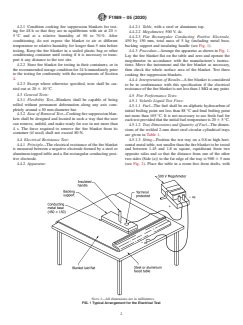
4.2.1 Condition cooking fire suppression blankets for test- 4.4.2.1 Table, with a steel or aluminum top.
ing for 48 h so that they are in equilibrium with air at 20 6 4.4.2.2 Megohmeter, 500 V, dc.
5 °C and at a relative humidity of 50 to 70 %. After
4.4.2.3 Flat Rectangular Conducting Positive Electrode,
conditioning, do not expose the blanket to air at different
450 by 150 mm, total mass of 5 kg (including metal base,
temperature or relative humidity for longer than 5 min before
backing support and insulating handle (see Fig. 1).
testing. Keep the fire blanket in a sealed plastic bag or other
4.4.3 Procedure—Arrange the apparatus as shown in Fig. 1.
conditioning container until testing if it is necessary to trans-
Lay the fire blanket flat on the table and zero and operate the
port it any distance to the test site.
megohmeter in accordance with the manufacturer’s instruc-
4.2.2 Store fire blanket for testing in their containers, or in
tions. Move the instrument and the fire blanket as necessary,
the recommended storage condition for 24 h immediately prior
then check the whole surface area of the blanket. Test three
to the testing for conformity with the requirements of Section
cooking fire suppression blankets.
4.
4.4.4 Interpretation of Results—Afire blanket is considered
4.2.3 Except where otherwise specified, tests shall be car-
to be in conformance with this specification if the electrical
ried out at 20 6 10 °C.
resistance of the fire blanket is not less than 1 MΩ at any point.
4.3 General Tests:
4.5 Fire Performance Tests:
4.3.1 Flexibility Test—Blankets shall be capable of being
4.5.1 Volatile Liquid Test Fires:
rolled without permanent deformation along any axis com-
4.5.1.1 Fuel—The fuel shall be an aliphatic hydrocarbon of
pletely around a 50 mm diameter bar.
initial boiling point not less than 88 °C and final boiling point
4.3.2 Ease of Removal Test—Cooking fire suppression blan-
not more than 105 °C. It is not necessary to use fresh fuel for
kets shall be designed and located in such a way that the user
eachtestprovidedthattheinitialfueltemperatureis20 65 °C.
can remove, unfold, and make ready for use in not more than
4.5.1.2 Tray Dimensions and Quantity of Fuel—The dimen-
4 s. The force required to remove the fire blanket from its
sions of the welded 2-mm sheet steel circular cylindrical trays
container (if used) shall not exceed 80 N.
are given in Table 1.
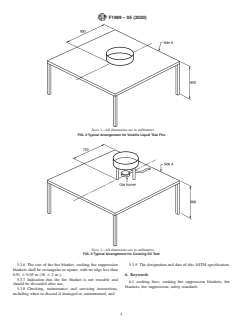
4.4 Electrical Resistance Test: 4.5.1.3 Siting—Position the test tray on a 0.8-m high hori-
4.4.1 Principle—The electrical resistance of the fire blanket zontal metal table, not smaller than the fire blanket to be tested
is measured between a negative electrode formed by a steel or and between 1.45 and 1.8 m square, equidistant from two
aluminum-topped table and a flat rectangular conducting posi- opposite sides and so that the distance from one of the other
tive electrode. two sides (Side (a)) to the far edge of the tray is 900 65mm
4.4.2 Apparatus: (see Fig. 2). Place the table in a room free from drafts, with
NOTE 1—All dimensions are in millimetres.
FIG. 1Typical Arrangement for the Electrical Test
F1989−05 (2020)
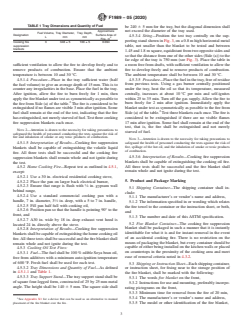
TABLE 1 Tray Dimensions and Quantity of Fuel
be 240 6 5 mm for the tray, but the diagonal dimension shall
Approximate not exceed the diameter of the tray used.
Fuel Volume, Tray Diameter, Tray Depth,
Designation Surface Area of
4.5.3.4 Siting—Position the test tray centrally on the sup
...