

ASTM D3489-23
(Test Method)Standard Test Methods for Microcellular Urethane Materials
General Information
- Abstract
SIGNIFICANCE AND USE
5.1 Tests made on materials herein prescribed have the potential to give considerable value in comparing physical properties of different materials, in controlling manufacturing processes, and as a basis for writing specifications.
5.2 Before proceeding with these test methods, if appropriate, make reference to the specification associated with the material or product being tested. Any test specimen preparation, conditioning, dimensions, testing parameters, or combination thereof, covered in the ASTM materials or product specification shall take precedence over those mentioned in these test methods. If there are no relevant ASTM specifications, then the default conditions apply.
SCOPE
1.1 These test methods cover the preparation of a standard-size test sample and basic tests for physical property determinations of microcellular urethane materials.
1.2 The values stated in SI units are to be regarded as standard. The values given in parentheses are for information only.
1.3 This standard does not purport to address all of the safety concerns, if any, associated with its use. It is the responsibility of the user of this standard to establish appropriate safety, health, and environmental practices and determine the applicability of regulatory limitations prior to use.
Note 1: There is no known ISO equivalent to this standard.
1.4 This international standard was developed in accordance with internationally recognized principles on standardization established in the Decision on Principles for the Development of International Standards, Guides and Recommendations issued by the World Trade Organization Technical Barriers to Trade (TBT) Committee.
- Status
- Published
- Publication Date
- 31-Jul-2023
- Technical Committee
- D20 - Plastics
- Drafting Committee
- D20.22 - Cellular Materials - Plastics and Elastomers

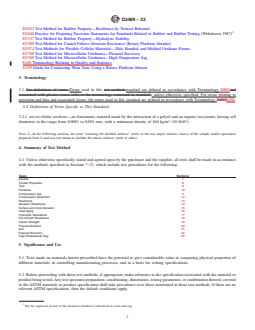
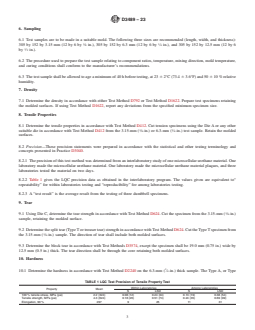
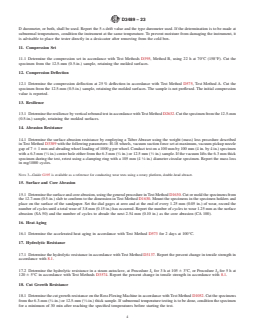
Overview
ASTM D3489-23: Standard Test Methods for Microcellular Urethane Materials is an international standard developed by ASTM International, under Committee D20 on Plastics. This standard provides detailed methodologies for preparing standard test samples and performing basic physical property determinations on microcellular urethane materials. Microcellular urethane is an elastomeric material formed from polyol and isocyanate, recognized for its unique cellular structure and versatile performance attributes.
This standard is essential for manufacturers, quality control laboratories, and material specifiers who require consistent, reliable methods to characterize and compare the physical properties of urethane materials in various applications, ensure process control, and support the development of product specifications.
Key Topics
ASTM D3489-23 covers a wide range of critical test methods and definitions essential to evaluating microcellular urethane materials. Key focus areas include:
- Sample Preparation: Guidance on recommended specimen sizes and preparation techniques to ensure reliable, replicable testing conditions.
- Physical Property Testing: Established methods for density, tensile properties, tear strength, hardness, compression set, compression deflection, resilience, impact strength, abrasion resistance, and flexural modulus.
- Durability and Environmental Resistance: Procedures for heat aging, hydrolytic resistance, and cut growth resistance, helping to assess material sustainability and performance under stress.
- Surface and Core Abrasion: Standardized approaches to distinguish between surface and core wear attributes.
- Reporting and Precision: Instructions on substantive reporting requirements and referencing precision statements included within the standard for consistent interpretation and reproducibility.
- Terminology: Reference to ASTM D883 for general plastics terminology, ensuring clear and unified definitions across all related tests.
Applications
The practical value of ASTM D3489-23 is most apparent in industries where the mechanical performance of microcellular urethane is critical. Its test methods support:
- Material Comparison: Facilitates direct, objective comparison of physical properties across different formulations and suppliers.
- Process Control: Helps manufacturers monitor and adjust key variables in the production of microcellular urethane to maintain product quality.
- Specification Compliance: Serves as an authoritative basis for writing, evaluating, and verifying product specifications for commercial and industrial uses.
- Quality Assurance: Supports internal and external quality audits by providing recognized, repeatable test procedures.
- Performance Assessment: Used by designers and engineers to select urethane materials based on empirical data relevant to end-use conditions, such as abrasion resistance or hydrolytic stability.
- Research and Development: Enables R&D teams to develop improved materials or identify new applications through standardized property evaluation.
Related Standards
Several ASTM standards are referenced within ASTM D3489-23, adding additional context and test capability for comprehensive evaluation. Key related standards include:
- ASTM D412 - Test Methods for Vulcanized Rubber and Thermoplastic Elastomers-Tension
- ASTM D2240 - Test Method for Rubber Property-Durometer Hardness
- ASTM D395 - Test Methods for Rubber Property-Compression Set
- ASTM D624 - Test Method for Tear Strength of Conventional Vulcanized Rubber and Thermoplastic Elastomers
- ASTM D790 - Test Methods for Flexural Properties of Plastics
- ASTM D792/D1622 - Test Methods for Density and Specific Gravity of Plastics
- ASTM D3389/D1630 - Test Methods for Abrasion Resistance
- ASTM D3768/D3769 - Methods specific to microcellular urethane-flexural recovery and high-temperature sag
- ASTM D883 - Terminology Relating to Plastics
These related standards are integral for users seeking a comprehensive approach to the physical and mechanical testing of microcellular urethane materials, in line with globally recognized best practices and consistent terminology.
Keywords: microcellular urethane, ASTM D3489, physical property testing, urethane materials, standard test methods, abrasion resistance, flexural modulus, compression set, tensile strength, material comparison, process control, ASTM standards
Relations
- Effective Date
- 01-Feb-2024
- Effective Date
- 01-Nov-2023
- Effective Date
- 01-Apr-2022
- Effective Date
- 15-Jul-2020
- Effective Date
- 01-Jan-2020
- Effective Date
- 01-Aug-2019
- Effective Date
- 15-Apr-2019
- Effective Date
- 01-Feb-2019
- Effective Date
- 01-Dec-2018
- Effective Date
- 01-Nov-2018
- Effective Date
- 15-Sep-2018
- Effective Date
- 01-Oct-2017
- Effective Date
- 01-Oct-2017
- Effective Date
- 15-Aug-2017
- Effective Date
- 01-Jul-2017
Get Certified
Connect with accredited certification bodies for this standard

DIN CERTCO
DIN Group product certification.

Smithers Quality Assessments
US management systems and product certification.
Sponsored listings
Frequently Asked Questions
ASTM D3489-23 is a standard published by ASTM International. Its full title is "Standard Test Methods for Microcellular Urethane Materials". This standard covers: SIGNIFICANCE AND USE 5.1 Tests made on materials herein prescribed have the potential to give considerable value in comparing physical properties of different materials, in controlling manufacturing processes, and as a basis for writing specifications. 5.2 Before proceeding with these test methods, if appropriate, make reference to the specification associated with the material or product being tested. Any test specimen preparation, conditioning, dimensions, testing parameters, or combination thereof, covered in the ASTM materials or product specification shall take precedence over those mentioned in these test methods. If there are no relevant ASTM specifications, then the default conditions apply. SCOPE 1.1 These test methods cover the preparation of a standard-size test sample and basic tests for physical property determinations of microcellular urethane materials. 1.2 The values stated in SI units are to be regarded as standard. The values given in parentheses are for information only. 1.3 This standard does not purport to address all of the safety concerns, if any, associated with its use. It is the responsibility of the user of this standard to establish appropriate safety, health, and environmental practices and determine the applicability of regulatory limitations prior to use. Note 1: There is no known ISO equivalent to this standard. 1.4 This international standard was developed in accordance with internationally recognized principles on standardization established in the Decision on Principles for the Development of International Standards, Guides and Recommendations issued by the World Trade Organization Technical Barriers to Trade (TBT) Committee.
SIGNIFICANCE AND USE 5.1 Tests made on materials herein prescribed have the potential to give considerable value in comparing physical properties of different materials, in controlling manufacturing processes, and as a basis for writing specifications. 5.2 Before proceeding with these test methods, if appropriate, make reference to the specification associated with the material or product being tested. Any test specimen preparation, conditioning, dimensions, testing parameters, or combination thereof, covered in the ASTM materials or product specification shall take precedence over those mentioned in these test methods. If there are no relevant ASTM specifications, then the default conditions apply. SCOPE 1.1 These test methods cover the preparation of a standard-size test sample and basic tests for physical property determinations of microcellular urethane materials. 1.2 The values stated in SI units are to be regarded as standard. The values given in parentheses are for information only. 1.3 This standard does not purport to address all of the safety concerns, if any, associated with its use. It is the responsibility of the user of this standard to establish appropriate safety, health, and environmental practices and determine the applicability of regulatory limitations prior to use. Note 1: There is no known ISO equivalent to this standard. 1.4 This international standard was developed in accordance with internationally recognized principles on standardization established in the Decision on Principles for the Development of International Standards, Guides and Recommendations issued by the World Trade Organization Technical Barriers to Trade (TBT) Committee.
ASTM D3489-23 is classified under the following ICS (International Classification for Standards) categories: 83.100 - Cellular materials. The ICS classification helps identify the subject area and facilitates finding related standards.
ASTM D3489-23 has the following relationships with other standards: It is inter standard links to ASTM D883-24, ASTM D883-23, ASTM E456-13a(2022)e1, ASTM D1622-20, ASTM D883-20, ASTM D883-19c, ASTM D883-19a, ASTM D883-19, ASTM D883-18a, ASTM D883-18, ASTM D2584-18, ASTM E456-13A(2017)e1, ASTM E456-13A(2017)e3, ASTM D883-17, ASTM D790-17. Understanding these relationships helps ensure you are using the most current and applicable version of the standard.
ASTM D3489-23 is available in PDF format for immediate download after purchase. The document can be added to your cart and obtained through the secure checkout process. Digital delivery ensures instant access to the complete standard document.
Standards Content (Sample)
This international standard was developed in accordance with internationally recognized principles on standardization established in the Decision on Principles for the
Development of International Standards, Guides and Recommendations issued by the World Trade Organization Technical Barriers to Trade (TBT) Committee.
Designation: D3489 − 23
Standard Test Methods for
Microcellular Urethane Materials
This standard is issued under the fixed designation D3489; the number immediately following the designation indicates the year of
original adoption or, in the case of revision, the year of last revision. A number in parentheses indicates the year of last reapproval. A
superscript epsilon (´) indicates an editorial change since the last revision or reapproval.
1. Scope* D790 Test Methods for Flexural Properties of Unreinforced
and Reinforced Plastics and Electrical Insulating Materi-
1.1 These test methods cover the preparation of a standard-
als
size test sample and basic tests for physical property determi-
D792 Test Methods for Density and Specific Gravity (Rela-
nations of microcellular urethane materials.
tive Density) of Plastics by Displacement
1.2 The values stated in SI units are to be regarded as
D883 Terminology Relating to Plastics
standard. The values given in parentheses are for information
D1052 Test Method for Measuring Rubber Deterioration—
only.
Cut Growth Using Ross Flexing Apparatus
1.3 This standard does not purport to address all of the
D1622 Test Method for Apparent Density of Rigid Cellular
safety concerns, if any, associated with its use. It is the Plastics
responsibility of the user of this standard to establish appro-
D1630 Test Method for Rubber Property—Abrasion Resis-
priate safety, health, and environmental practices and deter- tance (Footwear Abrader)
mine the applicability of regulatory limitations prior to use.
D2240 Test Method for Rubber Property—Durometer Hard-
ness
NOTE 1—There is no known ISO equivalent to this standard.
D2584 Test Method for Ignition Loss of Cured Reinforced
1.4 This international standard was developed in accor-
Resins
dance with internationally recognized principles on standard-
D2632 Test Method for Rubber Property—Resilience by
ization established in the Decision on Principles for the
Vertical Rebound
Development of International Standards, Guides and Recom-
D3040 Practice for Preparing Precision Statements for Stan-
mendations issued by the World Trade Organization Technical
dards Related to Rubber and Rubber Testing (Withdrawn
Barriers to Trade (TBT) Committee. 3
1987)
D3137 Test Method for Rubber Property—Hydrolytic Sta-
2. Referenced Documents
bility
2.1 ASTM Standards:
D3389 Test Method for Coated Fabrics Abrasion Resistance
D256 Test Methods for Determining the Izod Pendulum (Rotary Platform Abrader)
Impact Resistance of Plastics
D3574 Test Methods for Flexible Cellular Materials—Slab,
D395 Test Methods for Rubber Property—Compression Set Bonded, and Molded Urethane Foams
D412 Test Methods for Vulcanized Rubber and Thermoplas-
D3768 Test Method for Microcellular Urethanes—Flexural
tic Elastomers—Tension Recovery
D573 Test Method for Rubber—Deterioration in an Air
D3769 Test Method for Microcellular Urethanes—High-
Oven Temperature Sag
D575 Test Methods for Rubber Properties in Compression
E456 Terminology Relating to Quality and Statistics
D624 Test Method for Tear Strength of Conventional Vul- G195 Guide for Conducting Wear Tests Using a Rotary
canized Rubber and Thermoplastic Elastomers
Platform Abraser
3. Terminology
1 3.1 Terms used in this standard are defined in accordance
These test methods are under the jurisdiction of ASTM Committee D20 on
Plastics and are the direct responsibility of Subcommittee D20.22 on Cellular
with Terminology D883, unless otherwise specified. For terms
Materials - Plastics and Elastomers.
relating to precision and bias and associated issues, the terms
Current edition approved Aug. 1, 2023. Published August 2023. Originally
used in this standard are defined in accordance with Terminol-
approved in 1976. Last previous edition approved in 2017 as D3489 - 17. DOI:
ogy E456.
10.1520/D3489-23.
For referenced ASTM standards, visit the ASTM website, www.astm.org, or
contact ASTM Customer Service at service@astm.org. For Annual Book of ASTM
Standards volume information, refer to the standard’s Document Summary page on The last approved version of this historical standard is referenced on
the ASTM website. www.astm.org.
*A Summary of Changes section appears at the end of this standard
Copyright © ASTM International, 100 Barr Harbor Drive, PO Box C700, West Conshohocken, PA 19428-2959. United States
D3489 − 23
3.2 Definitions of Terms Specific to This Standard: 6.2 The procedure used to prepare the test sample relating to
3.2.1 microcellular urethane—an elastomeric material made component ratios, temperature, mixing direction, mold
by the interaction of a polyol and an organic isocyanate, having temperature, and curing conditions shall conform to the manu-
cell diameters in the range from 0.0001 to 0.001 mm, with a facturer’s recommendations.
3 3
minimum density of 160 kg/m (10 lb/ft ).
6.3 The test sample shall be allowed to age a minimum of
40 h before testing, at 23 6 2°C (73.4 6 3.6°F) and 50 6 10 %
NOTE 2—In the following sections, the term “retaining the molded
surfaces” refers to the two major surfaces (faces) of the sample and/or
relative humidity.
specimens prepared from it and was not meant to include the minor
surfaces (ends or sides).
7. Density
4. Summary of Test Method 7.1 Determine the density in accordance with either Test
Method D792 or Test Method D1622. Prepare test specimens
4.1 Unless otherwise specifically stated and agreed upon by
retaining the molded surfaces. If using Test Method D1622,
the purchaser and the supplier, all tests shall be made in
report any deviations from the specified minimum specimen
accordance with the methods specified in Sections 7-23, which
size.
include test procedures for the following:
Tests Sections
8. Tensile Properties
Density 7
Tensile Properties 8
8.1 Determine the tensile properties in accordance with Test
Tear 9
Method D412. Cut tension specimens using the Die A or any
Hardness 10
Compression Set 11
other suitable die in accordance with Test Method D412 from
Compression Deflection 12
1 1
the 3.15-mm ( ⁄8-in.) or 6.3-mm ( ⁄4-in.) test sample. Retain the
Resilience 13
molded surfaces.
Abrasion Resistance 14
Surface and Core Abrasion 15
8.2 Precision—These precision statements were prepared in
Heat Aging 16
Hydrolytic Resistance 17 accordance with the statistical and other testing terminology
Cut Growth Resistance 18
and concepts presented in Practice D3040.
Impact Strength 19
8.2.1 The precision of this test method was determined from
Flexural Modulus 20
Ash 21
an interlaboratory study of one microcellular urethane material.
Flexural Recovery 22
One laboratory made the microcellular urethane material. One
High-Temperature Sag 23
laboratory made the microcellular urethane material plaques,
and three laboratories tested the material on two days.
5. Significance and Use
8.2.2 Table 1 gives the LQC precision data as obtained in
5.1 Tests made on materials herein prescribed have the
the interlaboratory program. The values given are equivalent
potential to give considerable value in comparing physical
to“ repeatability” for within laboratories testing and “reproduc-
properties of different materials, in controlling manufacturing
ibility” for among laboratories testing.
processes, and as a basis for writing specifications.
8.2.3 A “test result” is the average result from the testing of
5.2 Before proceeding with these test methods, if
three dumbbell specimens.
appropriate, make reference to the specification associated with
the material or product being tested. Any test specimen
9. Tear
preparation, conditioning, dimensions, testing parameters, or
9.1 Using Die C, determine the tear strength in accordance
combination thereof, covered in the ASTM materials or prod-
with Test Method D624. Cut the specimen from the 3.15-mm
uct specification shall take precedence over those mentioned in
( ⁄8-in.) sample, retaining the molded surface.
these test methods. If there are no relevant ASTM
9.2 Determine the split tear (Type T or trouser tear) strength
specifications, then the default conditions apply.
in accordance with Test Method D624. Cut the Type T
6. Sampling specimen from the 3.15-mm ( ⁄8-in.) sample. The direction of
tear shall include both molded surfaces.
6.1 Test samples are to be made in a suitable mold. The
following three sizes are recommended (length, width, and 9.3 Determine the block tear in accordance with Test
thickness): 305 by 152 by 3.15 mm (12 by 6 by ⁄8 in.), 305 by Methods D3574, except the specimen shall be 19.0 mm (0.75
152 by 6.3 mm (12 by 6 by ⁄4 in.), and 305 by 152 by 12.5 mm in.) wide by 12.5 mm (0.5 in.) thick. The tear d
...
This document is not an ASTM standard and is intended only to provide the user of an ASTM standard an indication of what changes have been made to the previous version. Because
it may not be technically possible to adequately depict all changes accurately, ASTM recommends that users consult prior editions as appropriate. In all cases only the current version
of the standard as published by ASTM is to be considered the official document.
Designation: D3489 − 17 D3489 − 23
Standard Test Methods for
Microcellular Urethane Materials
This standard is issued under the fixed designation D3489; the number immediately following the designation indicates the year of
original adoption or, in the case of revision, the year of last revision. A number in parentheses indicates the year of last reapproval. A
superscript epsilon (´) indicates an editorial change since the last revision or reapproval.
1. Scope*
1.1 These test methods cover the preparation of a standard-size test sample and basic tests for physical property determinations
of microcellular urethane materials.
1.2 The values stated in SI units are to be regarded as standard. The values given in parentheses are for information only.
1.3 This standard does not purport to address all of the safety concerns, if any, associated with its use. It is the responsibility
of the user of this standard to establish appropriate safety and healthsafety, health, and environmental practices and determine
the applicability of regulatory limitations prior to use.
NOTE 1—There is no known ISO equivalent to this standard.
1.4 This international standard was developed in accordance with internationally recognized principles on standardization
established in the Decision on Principles for the Development of International Standards, Guides and Recommendations issued
by the World Trade Organization Technical Barriers to Trade (TBT) Committee.
2. Referenced Documents
2.1 ASTM Standards:
D256 Test Methods for Determining the Izod Pendulum Impact Resistance of Plastics
D395 Test Methods for Rubber Property—Compression Set
D412 Test Methods for Vulcanized Rubber and Thermoplastic Elastomers—Tension
D573 Test Method for Rubber—Deterioration in an Air Oven
D575 Test Methods for Rubber Properties in Compression
D624 Test Method for Tear Strength of Conventional Vulcanized Rubber and Thermoplastic Elastomers
D790 Test Methods for Flexural Properties of Unreinforced and Reinforced Plastics and Electrical Insulating Materials
D792 Test Methods for Density and Specific Gravity (Relative Density) of Plastics by Displacement
D883 Terminology Relating to Plastics
D1052 Test Method for Measuring Rubber Deterioration—Cut Growth Using Ross Flexing Apparatus
D1622 Test Method for Apparent Density of Rigid Cellular Plastics
D1630 Test Method for Rubber Property—Abrasion Resistance (Footwear Abrader)
D2240 Test Method for Rubber Property—Durometer Hardness
D2584 Test Method for Ignition Loss of Cured Reinforced Resins
These test methods are under the jurisdiction of ASTM Committee D20 on Plastics and are the direct responsibility of Subcommittee D20.22 on Cellular Materials -
Plastics and Elastomers.
Current edition approved March 1, 2017Aug. 1, 2023. Published March 2017August 2023. Originally approved in 1976. Last previous edition approved in 20112017 as
D3489 - 11.D3489 - 17. DOI: 10.1520/D3489-17.10.1520/D3489-23.
For referenced ASTM standards, visit the ASTM website, www.astm.org, or contact ASTM Customer Service at service@astm.org. For Annual Book of ASTM Standards
volume information, refer to the standard’s Document Summary page on the ASTM website.
*A Summary of Changes section appears at the end of this standard
Copyright © ASTM International, 100 Barr Harbor Drive, PO Box C700, West Conshohocken, PA 19428-2959. United States
D3489 − 23
D2632 Test Method for Rubber Property—Resilience by Vertical Rebound
D3040 Practice for Preparing Precision Statements for Standards Related to Rubber and Rubber Testing (Withdrawn 1987)
D3137 Test Method for Rubber Property—Hydrolytic Stability
D3389 Test Method for Coated Fabrics Abrasion Resistance (Rotary Platform Abrader)
D3574 Test Methods for Flexible Cellular Materials—Slab, Bonded, and Molded Urethane Foams
D3768 Test Method for Microcellular Urethanes—Flexural Recovery
D3769 Test Method for Microcellular Urethanes—High-Temperature Sag
E456 Terminology Relating to Quality and Statistics
G195 Guide for Conducting Wear Tests Using a Rotary Platform Abraser
3. Terminology
3.1 For definitions of terms Terms used in this test method standard are defined in accordance with Terminology D883and
associated with plastics issues refer to the terminology contained in standard , unless otherwise specified. For terms relating to
precision and bias and associated issues, the terms used in this standard are defined in accordance with Terminology D883E456.
3.2 Definitions of Terms Specific to This Standard:
3.2.1 microcellular urethane—an elastomeric material made by the interaction of a polyol and an organic isocyanate, having cell
3 3
diameters in the range from 0.0001 to 0.001 mm, with a minimum density of 160 kg/m (10 lb/ft ).
NOTE 2—In the following sections, the term “retaining the molded surfaces” refers to the two major surfaces (faces) of the sample and/or specimens
prepared from it and was not meant to include the minor surfaces (ends or sides).
4. Summary of Test Method
4.1 Unless otherwise specifically stated and agreed upon by the purchaser and the supplier, all tests shall be made in accordance
with the methods specified in Sections 7-23, which include test procedures for the following:
Tests Sections
Density 7
Tensile Properties 8
Tear 9
Hardness 10
Compression Set 11
Compression Deflection 12
Resilience 13
Abrasion Resistance 14
Surface and Core Abrasion 15
Heat Aging 16
Hydrolytic Resistance 17
Cut Growth Resistance 18
Impact Strength 19
Flexural Modulus 20
Ash 21
Flexural Recovery 22
High-Temperature Sag 23
5. Significance and Use
5.1 Tests made on materials herein prescribed have the potential to give considerable value in comparing physical properties of
different materials, in controlling manufacturing processes, and as a basis for writing specifications.
5.2 Before proceeding with these test methods, if appropriate, make reference to the specification associated with the material or
product being tested. Any test specimen preparation, conditioning, dimensions, testing parameters, or combination thereof, covered
in the ASTM materials or product specification shall take precedence over those mentioned in these test methods. If there are no
relevant ASTM specifications, then the default conditions apply.
The last approved version of this historical standard is referenced on www.astm.org.
D3489 − 23
6. Sampling
6.1 Test samples are to be made in a suitable mold. The following three sizes are recommended (length, width, and thickness):
1 1
305 by 152 by 3.15 mm (12 by 6 by ⁄8 in.), 305 by 152 by 6.3 mm (12 by 6 by ⁄4 in.), and 305 by 152 by 12.5 mm (12 by 6
by ⁄2 in.).
6.2 The procedure used to prepare the test sample relating to component ratios, temperature, mixing direction, mold temperature,
and curing conditions shall conform to the manufacturer’s recommendations.
6.3 The test sample shall be allowed to age a minimum of 40 h before testing, at 23 6 2°C (73.4 6 3.6°F) and 50 6 10 % relative
humidity.
7. Density
7.1 Determine the density in accordance with either Test Method D792 or Test Method D1622. Prepare test specimens retaining
the molded surfaces. If using Test Method D1622, report any deviations from the specified minimum specimen size.
8. Tensile Properties
8.1 Determine the tensile properties in accordance with Test Method D412. Cut tension specimens using the Die A or any other
1 1
suitable die in accordance with Test Method D412 from the 3.15-mm ( ⁄8-in.) or 6.3-mm ( ⁄4-in.) test sample. Retain the molded
surfaces.
8.2 Precision—These precision statements were prepared in accordance with the statistical and other testing terminology and
concepts presented in Practice D3040.
8.2.1 The precision of this test method was determined from an interlaboratory study of one microcellular urethane material. One
laboratory made the microcellular urethane material. One laboratory made the microcellular urethane material plaques, and three
laboratories tested the material on two days.
8.2.2 Table 1 gives the LQC precision data as obtained in the interlaboratory program. The values given are equivalent to“
repeatability” for within laboratories testing and “reproducibility” for among laboratories testing.
8.2.3 A “test result” is the average result from the testing of three dumbbell specimens.
9. Tear
9.1 Using Die C, determine the tear strength in accordance with Test Method D624. Cut the specimen from the 3.15-mm ( ⁄8-in.)
sample, retaining the molded surface.
9.2 Determine the split tear (Type T or trouser tear) strength in accordance with Test Method D624. Cut the Type T specimen from
the 3.15-mm ( ⁄8-in.) sample. The direction of tear shall include both molded surfaces.
9.3 Determine the block tear in accordance with Test Methods D3574, except the specimen shall be 19.0 mm (0.75 in.) wide by
12.5 mm (0.5 in.) thick. The tear direction shall be through the core retaining both molded surfaces.
10. Hardness
10.1 Determine the
...