

ASTM F1011-22
(Guide)Standard Guide for Developing a Hazardous Materials Training Curriculum for Initial Response Personnel
General Information
- Abstract
SIGNIFICANCE AND USE
4.1 This guide summarizes the typical contents of a course to aid emergency response team training organizations in selecting important subjects for inclusion in existing or new training programs.
SCOPE
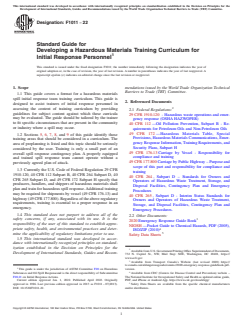
1.1 This guide covers a format for a hazardous materials spill initial response team training curriculum. This guide is designed to assist trainers of initial response personnel in assessing the content of training curriculum by providing guidelines for subject content against which these curricula may be evaluated. The guide should be tailored by the trainer to fit specific circumstances that are present in the community or industry where a spill may occur.
1.2 Sections 5, 6, 7, 8, and 9 of this guide identify those training areas that should be considered in a curriculum. The area of preplanning is listed and this topic should be seriously considered by the user. Training is only a small part of an overall spill response contingency plan. A properly equipped and trained spill response team cannot operate without a previously agreed plan of attack.
1.3 Currently the U.S. Code of Federal Regulation 29 CFR 1910.120, 40 CFR 112 Subpart B, 40 CFR 264 Subpart D, 40 CFR 265 Subpart D, and 49 CFR 172 Subpart H specify that producers, handlers, and shippers of hazardous materials shall plan and train for hazardous spill response. Additional training may be required for shipments by vessel (49 CFR 176.13) and highway (49 CFR 177.800). Regardless of the above regulatory requirements, training is essential to a proper response in an emergency.
1.4 This standard does not purport to address all of the safety concerns, if any, associated with its use. It is the responsibility of the user of this standard to establish appropriate safety, health, and environmental practices and determine the applicability of regulatory limitations prior to use.
1.5 This international standard was developed in accordance with internationally recognized principles on standardization established in the Decision on Principles for the Development of International Standards, Guides and Recommendations issued by the World Trade Organization Technical Barriers to Trade (TBT) Committee.
- Status
- Published
- Publication Date
- 31-Dec-2021
- Technical Committee
- F20 - Hazardous Substances and Oil Spill Response
- Drafting Committee
- F20.21 - Initial Response Actions
Buy Documents
ASTM F1011-22 - Standard Guide for Developing a Hazardous Materials Training Curriculum for Initial Response Personnel
REDLINE ASTM F1011-22 - Standard Guide for Developing a Hazardous Materials Training Curriculum for Initial Response Personnel
Overview
ASTM F1011-22, published by ASTM International, is a standard guide for developing a hazardous materials training curriculum focused on initial response personnel. This document provides comprehensive guidelines to help organizations and trainers structure effective training programs for hazardous materials spill response teams. It outlines essential curriculum elements and aids response agencies, industrial facilities, and community planners in ensuring compliance with regulatory requirements while equipping responders with the knowledge and skills needed for safe and effective intervention during hazardous materials incidents.
Key Topics
The standard identifies and organizes critical subject areas that a robust hazardous materials training curriculum should address:
Preplanning
- Assessing potential spill locations (fixed facilities and transportation routes)
- Identifying types and quantities of hazardous materials
- Determining available mitigation resources and response equipment
- Evaluating at-risk populations and environmental considerations
- Developing evacuation and response plans
Initial Assessment
- Procedures for incident assessment upon arrival
- Identification and classification of spilled materials
- Emergency site information gathering (location, weather, population impact)
- Establishing on-scene authority and command structure
Personal Safety Equipment
- Selection of appropriate levels of personal protective equipment (PPE)
- Fit testing and correct usage based on hazard assessment
- Breathing protection options and limitations
- Selection of detection instruments and laboratory resources
Training
- Planning, scheduling, and evaluating training exercises
- Scenario development, participant selection, and drill evaluation
- Reviewing and revising standard operating procedures based on training outcomes
Implementation of Response Plan
- Establishing command posts and communication systems
- Public protection actions, including evacuation and shelter-in-place
- Incident stabilization and containment measures
- Decontamination and incident closure procedures
Applications
ASTM F1011-22 is a valuable tool for:
Emergency Response Organizations
Facilitates development of training curricula tailored to local risks and regulatory requirements.Industrial Facilities Handling Hazardous Materials
Ensures employee preparedness and regulatory compliance for spill response teams.Community Emergency Planners
Supports municipal planning for hazardous materials preparedness and integrates response training into wider emergency management strategies.HazMat Trainers and Course Developers
Provides a checklist of content to build or evaluate training programs for first responders, ensuring all critical topics are addressed.Health, Safety, and Environmental (HSE) Professionals
Allows comprehensive assessment and enhancement of existing hazardous materials response plans, helping to mitigate workplace and community hazards.
By structuring a curriculum in line with ASTM F1011-22, organizations can improve safety, respond effectively to spills, and meet OSHA and other federal requirements such as 29 CFR 1910.120 and 49 CFR 172 Subpart H.
Related Standards
For a holistic approach to hazardous materials safety and emergency planning, the following national and international standards and guidance documents are frequently referenced alongside ASTM F1011-22:
- OSHA 29 CFR 1910.120 - Hazardous Waste Operations and Emergency Response (HAZWOPER)
- 49 CFR 172 Subpart H - Hazardous materials training requirements
- 40 CFR 112, 264, 265 - EPA regulations on oil pollution prevention and hazardous material contingency planning
- ISO/ZIP (2010) - International guidelines for emergency handling of hazardous materials in surface transportation
- ANSI/ASSP Z490.1-2016 - American National Standard for safety, health, and environmental training practices
- Emergency Response Guidebook (2020) - Primary US guide for first responders during hazmat incidents
- NIOSH/OSHA Pocket Guide to Chemical Hazards
- National Incident Management System (NIMS) Guidance
Integrating these standards with ASTM F1011-22 ensures a comprehensive, industry-accepted approach to hazardous materials training and emergency preparedness, supporting both regulatory compliance and best practice in incident response.
Buy Documents
ASTM F1011-22 - Standard Guide for Developing a Hazardous Materials Training Curriculum for Initial Response Personnel
REDLINE ASTM F1011-22 - Standard Guide for Developing a Hazardous Materials Training Curriculum for Initial Response Personnel
Get Certified
Connect with accredited certification bodies for this standard

CIS Institut d.o.o.
Personal Protective Equipment (PPE) certification body. Notified Body NB-2890 for EU Regulation 2016/425 PPE.

Kiwa BDA Testing
Building and construction product certification.
Kmetijski inštitut Slovenije
Agricultural Institute of Slovenia. Soil testing, plant health, agricultural product analysis.
Sponsored listings
Frequently Asked Questions
ASTM F1011-22 is a guide published by ASTM International. Its full title is "Standard Guide for Developing a Hazardous Materials Training Curriculum for Initial Response Personnel". This standard covers: SIGNIFICANCE AND USE 4.1 This guide summarizes the typical contents of a course to aid emergency response team training organizations in selecting important subjects for inclusion in existing or new training programs. SCOPE 1.1 This guide covers a format for a hazardous materials spill initial response team training curriculum. This guide is designed to assist trainers of initial response personnel in assessing the content of training curriculum by providing guidelines for subject content against which these curricula may be evaluated. The guide should be tailored by the trainer to fit specific circumstances that are present in the community or industry where a spill may occur. 1.2 Sections 5, 6, 7, 8, and 9 of this guide identify those training areas that should be considered in a curriculum. The area of preplanning is listed and this topic should be seriously considered by the user. Training is only a small part of an overall spill response contingency plan. A properly equipped and trained spill response team cannot operate without a previously agreed plan of attack. 1.3 Currently the U.S. Code of Federal Regulation 29 CFR 1910.120, 40 CFR 112 Subpart B, 40 CFR 264 Subpart D, 40 CFR 265 Subpart D, and 49 CFR 172 Subpart H specify that producers, handlers, and shippers of hazardous materials shall plan and train for hazardous spill response. Additional training may be required for shipments by vessel (49 CFR 176.13) and highway (49 CFR 177.800). Regardless of the above regulatory requirements, training is essential to a proper response in an emergency. 1.4 This standard does not purport to address all of the safety concerns, if any, associated with its use. It is the responsibility of the user of this standard to establish appropriate safety, health, and environmental practices and determine the applicability of regulatory limitations prior to use. 1.5 This international standard was developed in accordance with internationally recognized principles on standardization established in the Decision on Principles for the Development of International Standards, Guides and Recommendations issued by the World Trade Organization Technical Barriers to Trade (TBT) Committee.
SIGNIFICANCE AND USE 4.1 This guide summarizes the typical contents of a course to aid emergency response team training organizations in selecting important subjects for inclusion in existing or new training programs. SCOPE 1.1 This guide covers a format for a hazardous materials spill initial response team training curriculum. This guide is designed to assist trainers of initial response personnel in assessing the content of training curriculum by providing guidelines for subject content against which these curricula may be evaluated. The guide should be tailored by the trainer to fit specific circumstances that are present in the community or industry where a spill may occur. 1.2 Sections 5, 6, 7, 8, and 9 of this guide identify those training areas that should be considered in a curriculum. The area of preplanning is listed and this topic should be seriously considered by the user. Training is only a small part of an overall spill response contingency plan. A properly equipped and trained spill response team cannot operate without a previously agreed plan of attack. 1.3 Currently the U.S. Code of Federal Regulation 29 CFR 1910.120, 40 CFR 112 Subpart B, 40 CFR 264 Subpart D, 40 CFR 265 Subpart D, and 49 CFR 172 Subpart H specify that producers, handlers, and shippers of hazardous materials shall plan and train for hazardous spill response. Additional training may be required for shipments by vessel (49 CFR 176.13) and highway (49 CFR 177.800). Regardless of the above regulatory requirements, training is essential to a proper response in an emergency. 1.4 This standard does not purport to address all of the safety concerns, if any, associated with its use. It is the responsibility of the user of this standard to establish appropriate safety, health, and environmental practices and determine the applicability of regulatory limitations prior to use. 1.5 This international standard was developed in accordance with internationally recognized principles on standardization established in the Decision on Principles for the Development of International Standards, Guides and Recommendations issued by the World Trade Organization Technical Barriers to Trade (TBT) Committee.
ASTM F1011-22 is classified under the following ICS (International Classification for Standards) categories: 13.300 - Protection against dangerous goods. The ICS classification helps identify the subject area and facilitates finding related standards.
ASTM F1011-22 is available in PDF format for immediate download after purchase. The document can be added to your cart and obtained through the secure checkout process. Digital delivery ensures instant access to the complete standard document.
Standards Content (Sample)
This international standard was developed in accordance with internationally recognized principles on standardization established in the Decision on Principles for the
Development of International Standards, Guides and Recommendations issued by the World Trade Organization Technical Barriers to Trade (TBT) Committee.
Designation: F1011 − 22
Standard Guide for
Developing a Hazardous Materials Training Curriculum for
Initial Response Personnel
This standard is issued under the fixed designation F1011; the number immediately following the designation indicates the year of
original adoption or, in the case of revision, the year of last revision. A number in parentheses indicates the year of last reapproval. A
superscript epsilon (´) indicates an editorial change since the last revision or reapproval.
1. Scope mendations issued by the World Trade Organization Technical
Barriers to Trade (TBT) Committee.
1.1 This guide covers a format for a hazardous materials
spill initial response team training curriculum. This guide is
2. Referenced Documents
designed to assist trainers of initial response personnel in
assessing the content of training curriculum by providing
2.1 Federal Regulations:
guidelines for subject content against which these curricula
29 CFR 1910.120 - Hazardous waste operations and emer-
may be evaluated. The guide should be tailored by the trainer
gency response (OSHA HAZWOPER)
to fit specific circumstances that are present in the community
40 CFR 112 —Oil Pollution Prevention, SubpartB-Re-
or industry where a spill may occur.
quirements for Petroleum Oils and Non-Petroleum Oils
49 CFR 172 —Hazardous Materials Table, Special
1.2 Sections 5, 6, 7, 8, and 9 of this guide identify those
Provisions, Hazardous Materials Communications, Emer-
training areas that should be considered in a curriculum. The
gency Response Information, Training Requirements, and
area of preplanning is listed and this topic should be seriously
Security Plans, Subpart H
considered by the user. Training is only a small part of an
49 CFR 176.13 Carriage by Vessel - Responsibility for
overall spill response contingency plan. A properly equipped
compliance and training
and trained spill response team cannot operate without a
49 CFR 177.800 Carriage by Public Highway – Purpose and
previously agreed plan of attack.
scope of this part and responsibility for compliance and
1.3 Currently the U.S. Code of Federal Regulation 29 CFR
training
1910.120, 40 CFR 112 Subpart B, 40 CFR 264 Subpart D, 40
40 CFR 264 , Subpart D – Standards for Owners and
CFR 265 Subpart D, and 49 CFR 172 Subpart H specify that
Operators of Hazardous Waste Treatment, Storage, and
producers, handlers, and shippers of hazardous materials shall
Disposal Facilities, Contingency Plan and Emergency
plan and train for hazardous spill response.Additional training
Procedures
may be required for shipments by vessel (49 CFR 176.13) and
40 CFR 265 , Subpart D - Interim Status Standards for
highway(49CFR177.800).Regardlessoftheaboveregulatory
Owners and Operators of Hazardous Waste Treatment,
requirements, training is essential to a proper response in an
Storage, and Disposal Facilities, Contingency Plan and
emergency.
Emergency Procedures.
1.4 This standard does not purport to address all of the
2.2 Other Documents:
safety concerns, if any, associated with its use. It is the 3
2020 Emergency Response Guide Book
responsibility of the user of this standard to establish appro-
NIOSH —Pocket Guide to Chemical Hazards, PDF (2005),
priate safety, health, and environmental practices and deter- 4
ISO/ZIP (2010)
mine the applicability of regulatory limitations prior to use.
Safety Data Sheets
1.5 This international standard was developed in accor-
dance with internationally recognized principles on standard-
ization established in the Decision on Principles for the
AvailablefromU.S.GovernmentPrintingOfficeSuperintendentofDocuments,
Development of International Standards, Guides and Recom-
732 N. Capitol St., NW, Mail Stop: SDE, Washington, DC 20401, https://
www.ecfr.gov
Available from Transport Canada’s Website (last revised 2020) https://
tc.canada.ca/en/dangerousgoods/canutec/2020-emergency-response-guidebook-pdf-
This guide is under the jurisdiction of ASTM Committee F20 on Hazardous version.
Substances and Oil Spill Responseand is the direct responsibility of Subcommittee Available from CDC (Centers for Disease Control and Prevention) website –
F20.21 on Initial Response Actions. The National Institute for Occupational Safety and Health as updated online guide,
Current edition approved Jan. 1, 2022. Published April 2022. Originally PDF, and iPhone or Android App. https://www.cdc.gov/niosh/npg/
approved in 1986. Last previous edition approved in 2013 as F1011 – 07(2013). Safety Data Sheets are available from the specific chemical manufacturers
DOI: 10.1520/F1011-22. and/or distributors.
Copyright © ASTM International, 100 Barr Harbor Drive, PO Box C700, West Conshohocken, PA 19428-2959. United States
F1011 − 22
Science and Technology – First Responders, Department of 5.1.1 Fixed facilities that store or produce hazardous mate-
Homeland Security rials.
Hazardous Materials Release, Department of Homeland 5.1.2 Routes that are used by carriers to transport hazardous
Security materials.
ANSI/ASSPZ490.1-2016 American National Standard Cri-
5.2 Determine the type of hazardous material:
teria for Accepted Practices in Safety, Health, and Envi-
5.2.1 Stored or produced.
ronmental Training
5.2.2 Transported:
HazardousMaterialsGuideforFirstResponders(2000),US
5.2.2.1 Contact truck companies.
Fire Administration
5.2.2.2 Contact rail companies.
Guide to Developing a Hazardous Materials Training
5.3 Identify physical, chemical, and hazardous characteris-
Program, US DOT
tics of each material
Wireless Information System for Emergency Responders
5.3.1 Obtain OSHA 20 or Materials Safety Data Sheets for
(WISER), National Library of Medicine
each hazardous material identified.
5.3.2 Suggested reference documents for data include the
3. Summary of Guide
following:
3.1 This guide covers the following areas:
5.3.2.1 American National Standard Criteria for Accepted
3.1.1 Preplanning,
Practices in Safety, Health, and Environmental Training.
3.1.2 Initial Assessment,
5.3.2.2 Chemical handbooks; for example, Condensed
3.1.3 Personal Safety Equipment,
Chemical Dictionary.
3.1.4 Training, and
5.3.2.3 2020 Emergency Response Guide Book.
3.1.5 Implementation of Plan of Attack.
5.3.2.4 NIOSH Pub#2005–149, NIOSH/OSHA Pocket
3.2 Preplanning covers the aspects of pre-accident planning
Guide to Chemical Hazards, U. S. Department of Health and
that should be considered by the response team members. This
Human Services, U. S. Department of Labor. https://
includes identification of potential hazardous chemicals, spill
www.cdc.gov/niosh/docs/2005-149/default.html
locations, and resource identification.
5.3.2.5 Emergency Handling of Hazardous Materials in
Surface Transportation, Bureau of Explosives/Association of
3.3 Initialassessmentoutlinesthoseassessmentsthatshould
American Railroads.
be made when arriving at the accident location to assist in the
development of a plan of attack.
5.4 Determinethemitigationresourcesavailabletorespond.
5.4.1 A suggested reference is Manual 10 MNL10-2nd.
3.4 Personal Safety Equipment discusses those safety de-
5.4.2 Determine the number, qualifications, and location of
vices and their limitations that are available to the response
knowledgeable personnel:
team members.
5.4.2.1 Local community.
3.5 Training describes the activities that could be conducted
5.4.2.2 Private industry.
by the team on a regular basis and the improvement of training
5.4.3 Determine type and quantity of mitigation equipment
plans after training exercises are completed.
available:
3.6 Implementation of plans describes how and in what
5.4.3.1 Neutralizer.
order the plan of attack should be implemented.
5.4.3.2 Foams.
5.4.3.3 Water sources.
4. Significance and Use
5.4.3.4 Sorbents.
5.4.3.5 Dispensing equipment.
4.1 This guide summarizes the typical contents of a course
5.4.3.6 Containment equipment.
to aid emergency response team training organizations in
5.4.4 Determinethetype,location,andmethodofactivation
selecting important subjects for inclusion in existing or new
of all automatic response systems at the potential spill site.
training programs.
5.5 Identify critical population and environment areas adja-
5. Preplanning
cent to hazardous material sites or routes:
5.1 Identify all areas subject to hazardous materials spills:
5.5.1 Schools, hospitals, shopping centers, etc.
5.5.2 Water supplies, soil conditions, recreational areas, etc.
5.6 Estimate the volume of the potential spill as follows:
Available from the Department of Homeland Security at https://www.dhs.gov/
5.6.1 Obtain potential spill volume estimates from storer,
science-and-technology/firstresponders
Available from the Department of Homeland Security at https://www.dhs.gov/ producer, or carrier.
hazardous-materials-release#
5.6.2 Calculate spill volume from tankage sizes.
Available from American Society of Safety Professionals, at https://
5.7 Determine spill drainage path for site or route as
store.assp.org/PersonifyEbusiness/Store/Product-Details/productId/29237745.
Available from the Homeland Security Digital Library, at https://www.hsdl.org/
follows:
?view&did=1258
Available from the U.S. Departmen
...
This document is not an ASTM standard and is intended only to provide the user of an ASTM standard an indication of what changes have been made to the previous version. Because
it may not be technically possible to adequately depict all changes accurately, ASTM recommends that users consult prior editions as appropriate. In all cases only the current version
of the standard as published by ASTM is to be considered the official document.
Designation: F1011 − 07 (Reapproved 2013) F1011 − 22
Standard Guide for
Developing a Hazardous Materials Training Curriculum for
Initial Response Personnel
This standard is issued under the fixed designation F1011; the number immediately following the designation indicates the year of
original adoption or, in the case of revision, the year of last revision. A number in parentheses indicates the year of last reapproval. A
superscript epsilon (´) indicates an editorial change since the last revision or reapproval.
1. Scope
1.1 This guide covers a format for a hazardous materials spill initial response team training curriculum. This guide is designed
to assist trainers of initial response personnel in assessing the content of training curriculum by providing guidelines for subject
content against which these curricula may be evaluated. The guide should be tailored by the trainer to fit specific circumstances
that are present in the community or industry where a spill may occur.
1.2 Sections 5, 6, 7, 8, and 9 of this guide identify those training areas that should be considered in a curriculum. The area of
preplanning is listed and this topic should be seriously considered by the user. Training is only a small part of an overall spill
response contingency plan. A properly equipped and trained spill response team cannot operate without a previously agreed plan
of attack.
1.3 Currently the U.S. Code of Federal Regulation 29 CFR 1910.120, 40 CFR 112, 40 CFR 265, 112 Subpart B, 40 CFR 264
Subpart D, 40 CFR 265 Subpart D, and 49 CFR 173 172 Subpart H specify that producers, handlers, and shippers of hazardous
materials shall plan and train for hazardous spill response. The broad interpretation of these regulations could include the
requirement to train state and local response organizations who Additional training may be required to handle hazardous materials
in an emergency spill situation. for shipments by vessel (49 CFR 176.13) and highway (49 CFR 177.800). Regardless of the above
regulatory requirements, training is essential to a proper response in an emergency.
1.4 This standard does not purport to address all of the safety concerns, if any, associated with its use. It is the responsibility
of the user of this standard to establish appropriate safety safety, health, and healthenvironmental practices and determine the
applicability of regulatory limitations prior to use.
1.5 This international standard was developed in accordance with internationally recognized principles on standardization
established in the Decision on Principles for the Development of International Standards, Guides and Recommendations issued
by the World Trade Organization Technical Barriers to Trade (TBT) Committee.
2. Referenced Documents
2.1 Federal Regulations:
29 CFR 1910.120 - Hazardous waste operations and emergency response (OSHA HAZWOPER)
40 CFR 112 CFR 112—Oil —Oil Pollution Prevention, Subpart
B - Requirements for Petroleum Oils and Non-Petroleum Oils
This guide is under the jurisdiction of ASTM Committee F20 on Hazardous Substances and Oil Spill Responseand is the direct responsibility of Subcommittee F20.21
on Initial Response Actions.
Current edition approved April 1, 2013Jan. 1, 2022. Published April 2013April 2022. Originally approved in 1986. Last previous edition approved in 20072013 as
F1011 – 07.F1011 – 07(2013). DOI: 10.1520/F1011-07R13.10.1520/F1011-22.
Available from U.S. Government Printing Office Superintendent of Documents, 732 N. Capitol St., NW, Mail Stop: SDE, Washington, DC 20401, http://
www.access.gpo.gov. https://www.ecfr.gov
Copyright © ASTM International, 100 Barr Harbor Drive, PO Box C700, West Conshohocken, PA 19428-2959. United States
F1011 − 22
49 CFR 172 —Hazardous Materials Table, Special Provisions, Hazardous Materials Communications, Emergency Response
Information, Training Requirements, and Security Plans, Subpart H
49 CFR 176.13 Carriage by Vessel - Responsibility for compliance and training
49 CFR 177.800 Carriage by Public Highway – Purpose and scope of this part and responsibility for compliance and training
40 CFR 264 , Subpart D – Standards for Owners and Operators of Hazardous Waste Treatment, Storage, and Disposal Facilities,
Contingency Plan and Emergency Procedures
40 CFR 265 CFR 265—Interim , Subpart D - Interim Status Standards for Owners and Operators of Hazardous Waste Treatment,
Storage, and Disposal Facilities, Contingency Plan and Emergency Procedures.
49 CFR 173—Shippers—General Requirements for Shipments and Packagings
2.2 Other Documents:
20042020 Emergency Response Guide Book
NIOSH Pub#2005–149,
NIOSH/OSHA—Pocket Guide to Chemical Hazards, (September 2005)—Pocket Guide to Chemical Hazards, PDF (2005),
ISO/ZIP (2010)
Emergency Handling of Hazardous Materials in Surface Transportation
Materials Safety Data Sheets
Science and Technology – First Responders, Department of Homeland Security
National Response Plan, Release Number: FNF-07–032, Hazardous Materials Release, Department of Homeland Security
ANSI/ASSP Z490.1-2016 American National Standard Criteria for Accepted Practices in Safety, Health, and Environmental
Training
Hazardous Materials Guide for First Responders (2000), US Fire Administration
Guide to Developing a Hazardous Materials Training Program, US DOT
Wireless Information System for Emergency Responders (WISER), National Library of Medicine
3. Summary of Guide
3.1 This guide covers the following areas:
3.1.1 Preplanning,
3.1.2 Initial Assessment,
3.1.3 Personal Safety Equipment,
3.1.4 Training, and
3.1.5 Implementation of Plan of Attack.
3.2 Preplanning covers the aspects of pre-accident planning that should be considered by the response team members. This
includes identification of potential hazardous chemicals, spill locations, and resource identification.
3.3 Initial assessment outlines those assessments that should be made when arriving at the accident location to assist in the
development of a plan of attack.
Available from Government of Canada (to be revised in 2008), http://hazmat.dot.gov/pubs/erg/gydebook.htm. Transport Canada’s Website (last revised 2020)
https://tc.canada.ca/en/dangerousgoods/canutec/2020-emergency-response-guidebook-pdf-version.
Available from U. S. Department of Health and Human Services, 200 Independence Ave, S.W., Washington, DC 20201. Or available from U. S. Department of Labor,
200 Constitution Avenue, N.W., Washington, DC 20210.CDC (Centers for Disease Control and Prevention) website – The National Institute for Occupational Safety and
Health as updated online guide, PDF, and iPhone or Android App. https://www.cdc.gov/niosh/npg/
Available from the Association of American Railroads/Bureau of Explosives, 1920 L Street, N.W., Washington, DC 20036.Department of Homeland Security at
https://www.dhs.gov/science-and-technology/firstresponders
OSHA 20 or Materials Safety Data Sheets are available from the specific chemical manufacturers.
Safety Data Sheets are available from the specific chemical manufacturers and/or distributors.
Available from the Department of Homeland Security at http://www.dhs.gov/xprepresp/committees/editorial_0566.shtm. https://www.dhs.gov/hazardous-materials-
release#
Available from American Society of Safety Engineers, 1800 East Oakton St., Des Plaines, IL 60018–2187, approved July 2002.Professionals, at https://store.assp.org/
PersonifyEbusiness/Store/Product-Details/productId/29237745.
Available from the Homeland Security Digital Library, at https://www.hsdl.org/?view&did=1258
Available from the U.S. Department of Transportation, Pipeline and Hazardous Materials Safety Administration, at https://www.phmsa.dot.gov/training/hazmat/guide-
developing-hazmat-training-program
Available from the National Library of Medicine, at https://wiser.nlm.nih.gov
F1011 − 22
3.4 Personal Safety Equipment discusses those safety devices and their limitations that are available to the response team
members.
3.5 Training describes the activities that could be conducted by the team on a regular basis and the improvement of training plans
after training exercises are completed.
3.6 Implementation of plans describes how and in what order the plan of attack should be implemented.
4. Significance and Use
4.1 This guide summarizes the typical contents of a course to aid emergency response team training organizations in selecting
important subjects for inclusion in existing or new training programs.
5. Preplanning
5.1 Identify all areas subject to hazardous materials spills:
5.1.1 Fixed facilities that store or produce hazardous materials.
5.1.2 Routes that are used by carriers to transport hazardous materials.
5.2 Determine the type of hazardous material:
5.2.1 Stored or produced.
5.2.2 Transported:Transported:
5.2.2.1 Contact truck companies.
5.2.2.2 Contact rail companies.
5.3 Identify physical, chemical, and hazardous characteristics of each material:material
5.3.1 Obtain OSHA 20 or Materials Safety Data Sheets for each hazardous material identified.
5.3.2 Suggested reference documents for data include the following:
5.3.2.1 American National Standard Criteria for Accepted Practices in Safety, Health, and Environmental Training.
5.3.2.2 Chemical handbooks; for example, Condensed Chemical Dictionary.
5.3.2.3 20042020 Emergency Response Guide Book.
5.3.2.4 NIOSH Pub#2005–149, NIOSH/OSHA Pocket Guide to Chemical Hazards, U. S. Department of Health and Human
Services, U. S. Department of Labor. https://www.cdc.gov/niosh/docs/2005-149/default.html
5.3.2.5 Emergency Handling of Hazardous Materials in Surface Transportation, Bureau of Explosives/Association of American
Railroads.
5.4 Determine the mitigation resources available to respond.
5.4.1 A suggested reference is ASTM STP 825.Manual 10 MNL10-2nd.
A Guide to the Safe Handling of Hazardous Materials Accidents, ASTM STP 825,Second Edition, ASTM MNL10-2ND-EB, ASTM, 1983.1990.
F1011 − 22
5.4.2
...