

ASTM E681-09(2023)
(Test Method)Standard Test Method for Concentration Limits of Flammability of Chemicals (Vapors and Gases)
General Information
- Abstract
SIGNIFICANCE AND USE
5.1 The LFL and UFL of gases and vapors define the range of flammable concentrations in air.
5.2 This method measures the LFL and UFL for upward (and partially outward) flame propagation. The limits for downward flame propagation are narrower.
5.3 Limits of flammability may be used to determine guidelines for the safe handling of volatile chemicals. They are used particularly in assessing ventilation requirements for the handling of gases and vapors. NFPA 69 provides guidance for the practical use of flammability limit data, including the appropriate safety margins to use.
5.4 As discussed in Brandes and Ural,4 there is a fundamental difference between the ASTM and European methods for flammability determination. The ASTM methods aim to produce the best representation of flammability parameters, and rely upon the safety margins imposed by the application standards, such as NFPA 69. On the other hand, European test methods aim to result in a conservative representation of flammability parameters. For example, in this standard, LFL is the calculated average of the lowest go and highest no-go concentrations while the European test methods report the LFL as the minimum of the five highest no-go concentrations.
Note 2: For hydrocarbons, the break point between nonflammability and flammability occurs over a narrow concentration range at the lower flammability limit, but the break point is less distinct at the upper limit. For materials found to be non-reproducible per 13.1.1 that are likely to have large quenching distances and may be difficult to ignite, such as ammonia and certain halogenated hydrocarbon, the lower and upper limits of these materials may both be less distinct. That is, a wider range exists between flammable and nonflammable concentrations (see Annex A1).
SCOPE
1.1 This test method covers the determination of the lower and upper concentration limits of flammability of chemicals having sufficient vapor pressure to form flammable mixtures in air at atmospheric pressure at the test temperature. This test method may be used to determine these limits in the presence of inert dilution gases. No oxidant stronger than air should be used.
Note 1: The lower flammability limit (LFL) and upper flammability limit (UFL) are sometimes referred to as the lower explosive limit (LEL) and the upper explosive limit (UEL), respectively. However, since the terms LEL and UEL are also used to denote concentrations other than the limits defined in this test method, one must examine the definitions closely when LEL and UEL values are reported or used.
1.2 This test method is based on electrical ignition and visual observations of flame propagation. Users may experience problems if the flames are difficult to observe (for example, irregular propagation or insufficient luminescence in the visible spectrum), if the test material requires large ignition energy, or if the material has large quenching distances.
1.3 Annex A1 provides a modified test method for materials (such as certain amines, halogenated materials, and the like) with large quenching distances which may be difficult to ignite.
1.4 In other situations where strong ignition sources (such as direct flame ignition) is considered credible, the use of a test method employing higher energy ignition source in a sufficiently large pressure chamber (analogous, for example, to the methods in Test Method E2079 for measuring limiting oxygen concentration) may be more appropriate. In this case, expert advice may be necessary.
1.5 The flammability limits depend on the test temperature and pressure. This test method is limited to an initial pressure of the local ambient or less, with a practical lower pressure limit of approximately 13 kPa (100 mm Hg). The maximum practical operating temperature of this equipment is approximately 150 °C.
1.6 The values stated in SI units are to be regarded as standard. No other units of measuremen...
- Status
- Published
- Publication Date
- 30-Apr-2023
- Technical Committee
- E27 - Hazard Potential of Chemicals
- Drafting Committee
- E27.04 - Flammability and Ignitability of Chemicals
Overview
ASTM E681-09(2023), Standard Test Method for Concentration Limits of Flammability of Chemicals (Vapors and Gases), outlines procedures to determine the lower and upper concentration limits of flammability-known as the LFL (Lower Flammability Limit) and UFL (Upper Flammability Limit)-for gases and vapors. This flammability testing method provides critical data for understanding the safe handling, storage, and use of volatile chemicals, especially in environments where explosive atmospheres may develop.
This ASTM standard is widely used in chemical safety, process industries, and research settings to establish the flammable concentration range under controlled laboratory conditions. It supports regulatory compliance, hazard assessment, and the design of safety measures such as ventilation and explosion prevention systems.
Key Topics
- Flammability Limits: Defines and measures the minimum (LFL) and maximum (UFL) concentrations of combustible gases and vapors in air capable of sustaining flame propagation.
- Testing Method: Relies on electrical ignition and visual observations of flame propagation in a closed vessel, with procedures adapted for materials with large quenching distances or those difficult to ignite.
- Test Conditions: Standardized at atmospheric pressure or below, and up to 150°C, ensuring consistent and comparable results across laboratories.
- Safety Margins: Provides guidance for safe operation by identifying explosive atmospheres and informing process safety measures, referencing application guidelines such as NFPA 69.
- Variability and Limitations: Discusses factors like vessel size, ignition energy, and irregular flame propagation that can influence measured limits, highlighting the importance of expert evaluation for ambiguous results.
- Reporting and Units: Requires results to be reported in SI units and includes protocols for reporting test variability and uncertainty, particularly with materials where flammable limits are less distinct.
Applications
ASTM E681-09(2023) is essential for practical safety management and risk assessments in environments where volatile chemicals are used or stored. Typical applications include:
- Process Safety and Hazard Analysis: Establishing LFL and UFL values helps in designing safe chemical processes, identifying explosion risks, and implementing adequate ventilation systems.
- Regulatory Compliance: Used to ensure compliance with occupational health, environmental, and fire safety regulations.
- Design of Explosion Prevention Systems: Forms the basis for selecting appropriate explosion prevention and mitigation strategies in line with standards like NFPA 69.
- Ventilation Design: Assists engineers in determining ventilation requirements for spaces handling flammable vapors or gases.
- Product Safety and Incident Investigation: Provides validated data for hazard communication, safety data sheets, and the investigation of fire or explosion incidents.
- Comparison of International Methods: Helps organizations understand differences between ASTM and European methodologies, thereby facilitating international trade and compliance.
Related Standards
ASTM E681-09(2023) is frequently used alongside, and cross-references the following standards and guidelines:
- NFPA 69: Standard on Explosion Prevention Systems, offering practical guidance on the use of flammability data in engineering controls.
- ASTM E2079: Test Methods for Limiting Oxygen (Oxidant) Concentration in Gases and Vapors.
- ASTM E1515: Test Method for Minimum Explosible Concentration of Combustible Dusts.
- ASTM E582: Test Method for Minimum Ignition Energy and Quenching Distance in Gaseous Mixtures.
- ASTM E1445: Terminology Relating to Hazard Potential of Chemicals.
Understanding and applying ASTM E681 flammability test methods is critical for chemical industry professionals, safety engineers, and environmental health specialists tasked with preventing fire and explosion hazards in workplaces handling volatile chemicals. This standard ensures a high level of safety, consistency, and reliability in flammability limit determination and risk assessment.
Relations
- Effective Date
- 15-Nov-2023
- Effective Date
- 01-Jul-2019
- Effective Date
- 01-Feb-2015
- Effective Date
- 01-Oct-2013
- Effective Date
- 15-May-2008
- Refers
ASTM E1515-07 - Standard Test Method for Minimum Explosible Concentration of Combustible Dusts - Effective Date
- 01-Oct-2007
- Effective Date
- 01-Apr-2007
- Effective Date
- 01-Jan-2007
- Effective Date
- 01-Jan-2007
- Effective Date
- 01-Dec-2004
- Effective Date
- 10-Jul-2003
- Refers
ASTM E1515-03 - Standard Test Method for Minimum Explosible Concentration of Combustible Dusts - Effective Date
- 10-Jul-2003
- Effective Date
- 10-Jun-2002
- Effective Date
- 10-Oct-2001
- Effective Date
- 10-Oct-2001
Get Certified
Connect with accredited certification bodies for this standard

CIS Institut d.o.o.
Personal Protective Equipment (PPE) certification body. Notified Body NB-2890 for EU Regulation 2016/425 PPE.

Kiwa BDA Testing
Building and construction product certification.
Kmetijski inštitut Slovenije
Agricultural Institute of Slovenia. Soil testing, plant health, agricultural product analysis.
Sponsored listings
Frequently Asked Questions
ASTM E681-09(2023) is a standard published by ASTM International. Its full title is "Standard Test Method for Concentration Limits of Flammability of Chemicals (Vapors and Gases)". This standard covers: SIGNIFICANCE AND USE 5.1 The LFL and UFL of gases and vapors define the range of flammable concentrations in air. 5.2 This method measures the LFL and UFL for upward (and partially outward) flame propagation. The limits for downward flame propagation are narrower. 5.3 Limits of flammability may be used to determine guidelines for the safe handling of volatile chemicals. They are used particularly in assessing ventilation requirements for the handling of gases and vapors. NFPA 69 provides guidance for the practical use of flammability limit data, including the appropriate safety margins to use. 5.4 As discussed in Brandes and Ural,4 there is a fundamental difference between the ASTM and European methods for flammability determination. The ASTM methods aim to produce the best representation of flammability parameters, and rely upon the safety margins imposed by the application standards, such as NFPA 69. On the other hand, European test methods aim to result in a conservative representation of flammability parameters. For example, in this standard, LFL is the calculated average of the lowest go and highest no-go concentrations while the European test methods report the LFL as the minimum of the five highest no-go concentrations. Note 2: For hydrocarbons, the break point between nonflammability and flammability occurs over a narrow concentration range at the lower flammability limit, but the break point is less distinct at the upper limit. For materials found to be non-reproducible per 13.1.1 that are likely to have large quenching distances and may be difficult to ignite, such as ammonia and certain halogenated hydrocarbon, the lower and upper limits of these materials may both be less distinct. That is, a wider range exists between flammable and nonflammable concentrations (see Annex A1). SCOPE 1.1 This test method covers the determination of the lower and upper concentration limits of flammability of chemicals having sufficient vapor pressure to form flammable mixtures in air at atmospheric pressure at the test temperature. This test method may be used to determine these limits in the presence of inert dilution gases. No oxidant stronger than air should be used. Note 1: The lower flammability limit (LFL) and upper flammability limit (UFL) are sometimes referred to as the lower explosive limit (LEL) and the upper explosive limit (UEL), respectively. However, since the terms LEL and UEL are also used to denote concentrations other than the limits defined in this test method, one must examine the definitions closely when LEL and UEL values are reported or used. 1.2 This test method is based on electrical ignition and visual observations of flame propagation. Users may experience problems if the flames are difficult to observe (for example, irregular propagation or insufficient luminescence in the visible spectrum), if the test material requires large ignition energy, or if the material has large quenching distances. 1.3 Annex A1 provides a modified test method for materials (such as certain amines, halogenated materials, and the like) with large quenching distances which may be difficult to ignite. 1.4 In other situations where strong ignition sources (such as direct flame ignition) is considered credible, the use of a test method employing higher energy ignition source in a sufficiently large pressure chamber (analogous, for example, to the methods in Test Method E2079 for measuring limiting oxygen concentration) may be more appropriate. In this case, expert advice may be necessary. 1.5 The flammability limits depend on the test temperature and pressure. This test method is limited to an initial pressure of the local ambient or less, with a practical lower pressure limit of approximately 13 kPa (100 mm Hg). The maximum practical operating temperature of this equipment is approximately 150 °C. 1.6 The values stated in SI units are to be regarded as standard. No other units of measuremen...
SIGNIFICANCE AND USE 5.1 The LFL and UFL of gases and vapors define the range of flammable concentrations in air. 5.2 This method measures the LFL and UFL for upward (and partially outward) flame propagation. The limits for downward flame propagation are narrower. 5.3 Limits of flammability may be used to determine guidelines for the safe handling of volatile chemicals. They are used particularly in assessing ventilation requirements for the handling of gases and vapors. NFPA 69 provides guidance for the practical use of flammability limit data, including the appropriate safety margins to use. 5.4 As discussed in Brandes and Ural,4 there is a fundamental difference between the ASTM and European methods for flammability determination. The ASTM methods aim to produce the best representation of flammability parameters, and rely upon the safety margins imposed by the application standards, such as NFPA 69. On the other hand, European test methods aim to result in a conservative representation of flammability parameters. For example, in this standard, LFL is the calculated average of the lowest go and highest no-go concentrations while the European test methods report the LFL as the minimum of the five highest no-go concentrations. Note 2: For hydrocarbons, the break point between nonflammability and flammability occurs over a narrow concentration range at the lower flammability limit, but the break point is less distinct at the upper limit. For materials found to be non-reproducible per 13.1.1 that are likely to have large quenching distances and may be difficult to ignite, such as ammonia and certain halogenated hydrocarbon, the lower and upper limits of these materials may both be less distinct. That is, a wider range exists between flammable and nonflammable concentrations (see Annex A1). SCOPE 1.1 This test method covers the determination of the lower and upper concentration limits of flammability of chemicals having sufficient vapor pressure to form flammable mixtures in air at atmospheric pressure at the test temperature. This test method may be used to determine these limits in the presence of inert dilution gases. No oxidant stronger than air should be used. Note 1: The lower flammability limit (LFL) and upper flammability limit (UFL) are sometimes referred to as the lower explosive limit (LEL) and the upper explosive limit (UEL), respectively. However, since the terms LEL and UEL are also used to denote concentrations other than the limits defined in this test method, one must examine the definitions closely when LEL and UEL values are reported or used. 1.2 This test method is based on electrical ignition and visual observations of flame propagation. Users may experience problems if the flames are difficult to observe (for example, irregular propagation or insufficient luminescence in the visible spectrum), if the test material requires large ignition energy, or if the material has large quenching distances. 1.3 Annex A1 provides a modified test method for materials (such as certain amines, halogenated materials, and the like) with large quenching distances which may be difficult to ignite. 1.4 In other situations where strong ignition sources (such as direct flame ignition) is considered credible, the use of a test method employing higher energy ignition source in a sufficiently large pressure chamber (analogous, for example, to the methods in Test Method E2079 for measuring limiting oxygen concentration) may be more appropriate. In this case, expert advice may be necessary. 1.5 The flammability limits depend on the test temperature and pressure. This test method is limited to an initial pressure of the local ambient or less, with a practical lower pressure limit of approximately 13 kPa (100 mm Hg). The maximum practical operating temperature of this equipment is approximately 150 °C. 1.6 The values stated in SI units are to be regarded as standard. No other units of measuremen...
ASTM E681-09(2023) is classified under the following ICS (International Classification for Standards) categories: 13.300 - Protection against dangerous goods. The ICS classification helps identify the subject area and facilitates finding related standards.
ASTM E681-09(2023) has the following relationships with other standards: It is inter standard links to ASTM E1445-08(2023), ASTM E2079-19, ASTM E1445-08(2015), ASTM E2079-07(2013), ASTM E1445-08, ASTM E1515-07, ASTM E171-94(2007), ASTM E582-07, ASTM E2079-07, ASTM E582-04, ASTM E1445-03, ASTM E1515-03, ASTM E1445-02, ASTM E2079-00, ASTM E2079-01. Understanding these relationships helps ensure you are using the most current and applicable version of the standard.
ASTM E681-09(2023) is available in PDF format for immediate download after purchase. The document can be added to your cart and obtained through the secure checkout process. Digital delivery ensures instant access to the complete standard document.
Standards Content (Sample)
This international standard was developed in accordance with internationally recognized principles on standardization established in the Decision on Principles for the
Development of International Standards, Guides and Recommendations issued by the World Trade Organization Technical Barriers to Trade (TBT) Committee.
Designation: E681 − 09 (Reapproved 2023)
Standard Test Method for
Concentration Limits of Flammability of Chemicals (Vapors
and Gases)
This standard is issued under the fixed designation E681; the number immediately following the designation indicates the year of
original adoption or, in the case of revision, the year of last revision. A number in parentheses indicates the year of last reapproval. A
superscript epsilon (´) indicates an editorial change since the last revision or reapproval.
1. Scope 1.6 The values stated in SI units are to be regarded as
standard. No other units of measurement are included in this
1.1 This test method covers the determination of the lower
standard.
and upper concentration limits of flammability of chemicals
having sufficient vapor pressure to form flammable mixtures in 1.7 This test method should be used to measure and describe
air at atmospheric pressure at the test temperature. This test the properties of materials, products, or assemblies in response
method may be used to determine these limits in the presence to heat and flame under controlled laboratory conditions and
of inert dilution gases. No oxidant stronger than air should be should not be used to describe or appraise the fire hazard or fire
used. risk of materials, products, or assemblies under actual fire
conditions. However, results of this test method may be used as
NOTE 1—The lower flammability limit (LFL) and upper flammability
elements of a fire risk assessment that takes into account all of
limit (UFL) are sometimes referred to as the lower explosive limit (LEL)
and the upper explosive limit (UEL), respectively. However, since the the factors pertinent to an assessment of the fire hazard of a
terms LEL and UEL are also used to denote concentrations other than the
particular end use.
limits defined in this test method, one must examine the definitions closely
1.8 This standard may involve hazardous materials,
when LEL and UEL values are reported or used.
operations, and equipment. This standard does not purport to
1.2 This test method is based on electrical ignition and
address all of the safety concerns, if any, associated with its
visual observations of flame propagation. Users may experi-
use. It is the responsibility of the user of this standard to
ence problems if the flames are difficult to observe (for
establish appropriate safety, health, and environmental prac-
example, irregular propagation or insufficient luminescence in
tices and determine the applicability of regulatory limitations
the visible spectrum), if the test material requires large ignition
prior to use. Specific precautionary statements are given in
energy, or if the material has large quenching distances.
Section 8.
1.3 Annex A1 provides a modified test method for materials
1.9 This international standard was developed in accor-
(such as certain amines, halogenated materials, and the like)
dance with internationally recognized principles on standard-
with large quenching distances which may be difficult to ignite.
ization established in the Decision on Principles for the
Development of International Standards, Guides and Recom-
1.4 In other situations where strong ignition sources (such
mendations issued by the World Trade Organization Technical
as direct flame ignition) is considered credible, the use of a test
Barriers to Trade (TBT) Committee.
method employing higher energy ignition source in a suffi-
ciently large pressure chamber (analogous, for example, to the
2. Referenced Documents
methods in Test Method E2079 for measuring limiting oxygen
concentration) may be more appropriate. In this case, expert
2.1 ASTM Standards:
advice may be necessary.
E171 Practice for Conditioning and Testing Flexible Barrier
Packaging
1.5 The flammability limits depend on the test temperature
E582 Test Method for Minimum Ignition Energy and
and pressure. This test method is limited to an initial pressure
Quenching Distance in Gaseous Mixtures
of the local ambient or less, with a practical lower pressure
E1445 Terminology Relating to Hazard Potential of Chemi-
limit of approximately 13 kPa (100 mm Hg). The maximum
cals
practical operating temperature of this equipment is approxi-
E1515 Test Method for Minimum Explosible Concentration
mately 150 °C.
of Combustible Dusts
This test method is under the jurisdiction of ASTM Committee E27 on Hazard
Potential of Chemicals and is the direct responsibility of Subcommittee E27.04 on
Flammability and Ignitability of Chemicals. For referenced ASTM standards, visit the ASTM website, www.astm.org, or
Current edition approved May 1, 2023. Published May 2023. Originally contact ASTM Customer Service at service@astm.org. For Annual Book of ASTM
approved in 1979. Last previous edition approved in 2015 as E681 – 09 (2015). Standards volume information, refer to the standard’s Document Summary page on
DOI: 10.1520/E0681-09R23. the ASTM website.
Copyright © ASTM International, 100 Barr Harbor Drive, PO Box C700, West Conshohocken, PA 19428-2959. United States
E681 − 09 (2023)
E2079 Test Methods for Limiting Oxygen (Oxidant) Con- methods aim to result in a conservative representation of
centration in Gases and Vapors flammability parameters. For example, in this standard, LFL is
the calculated average of the lowest go and highest no-go
2.2 NFPA Standard:
NFPA 69 Standard on Explosion Prevention Systems concentrations while the European test methods report the LFL
as the minimum of the five highest no-go concentrations.
3. Terminology
NOTE 2—For hydrocarbons, the break point between nonflammability
and flammability occurs over a narrow concentration range at the lower
3.1 Definitions:
flammability limit, but the break point is less distinct at the upper limit.
3.1.1 lower limit of flammability or lower flammable limit
For materials found to be non-reproducible per 13.1.1 that are likely to
(LFL)—the minimum concentration of a combustible sub-
have large quenching distances and may be difficult to ignite, such as
ammonia and certain halogenated hydrocarbon, the lower and upper limits
stance that is capable of propagating a flame in a homogeneous
of these materials may both be less distinct. That is, a wider range exists
mixture of the combustible and a gaseous oxidizer under the
between flammable and nonflammable concentrations (see Annex A1).
specified conditions of test.
3.1.2 propagation of flame—as used in this test method, the
6. Interferences
upward and outward movement of the flame front from the
6.1 This test method is not applicable to certain readily
ignition source to the vessel walls or at least to within 13 mm
oxidized chemicals. If significant oxidation takes place when
( ⁄2 in.) of the wall, which is determined by visual observation.
the vapors are mixed with air, unreliable results may be
By outward, it is meant a flame front that has a horizontal
obtained. Flow systems designed to minimize hold-up time
component to the movement away from the ignition source.
may be required for such materials.
3.1.3 upper limit of flammability or upper flammable limit
6.2 Measured flammable limits are influenced by flame
(UFL)—the maximum concentration of a combustible sub-
quenching effects of the test vessel walls. The test vessel
stance that is capable of propagating a flame in a homogeneous
employed in this test method is of sufficient size to eliminate
mixture of the combustible and a gaseous oxidizer under the
the effects of the flame quenching for most materials (and
specified conditions of test.
conditions).
3.2 Additional terms can be found in Terminology E1445.
NOTE 3—There may be quenching effects, particularly on tests run at
subambient pressures. For materials that may be difficult to ignite (see
4. Summary of Test Method
Note 2), tests in a larger vessel or different ignition sources (see Annex
4.1 A uniform mixture of a gas or vapor with air is ignited
A1, 12 L flask) may show flame propagation that is not seen in the 5 L
flask with spark or exploding wire igniters. This test method is a small
in a closed vessel, and the upward and outward propagation of
scale test and this possible limitation must be considered in hazard
the flame away from the ignition source is noted by visual
assessments.
observation. The concentration of the flammable component is
6.3 The oxygen concentration in the air has an important
varied between trials until the composition that will just sustain
effect on the UFL. Typically, room air is used. If cylinder air is
propagation of the flame is determined.
used to simulate room air it must have an oxygen concentration
5. Significance and Use
of 20.94 % 6 0.1 %. Reconstituted air in cylinders has vari-
ability in the oxygen concentration and must be verified for
5.1 The LFL and UFL of gases and vapors define the range
oxygen concentration.
of flammable concentrations in air.
5.2 This method measures the LFL and UFL for upward
7. Apparatus
(and partially outward) flame propagation. The limits for
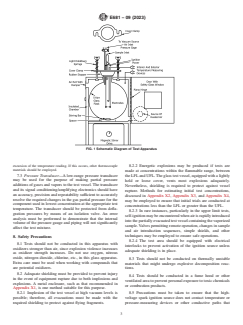
7.1 Fig. 1 is a schematic diagram of the apparatus; details
downward flame propagation are narrower.
and dimensions are presented in Appendix X1. The apparatus
5.3 Limits of flammability may be used to determine guide-
consists of a glass test vessel, an insulated chamber equipped
lines for the safe handling of volatile chemicals. They are used
with a source of controlled-temperature air, an ignition device
particularly in assessing ventilation requirements for the han-
with an appropriate power supply, a magnetic stirrer, and a
dling of gases and vapors. NFPA 69 provides guidance for the
cover equipped with the necessary operating connections and
practical use of flammability limit data, including the appro-
components.
priate safety margins to use.
7.2 If tests are to be conducted at an elevated temperature,
5.4 As discussed in Brandes and Ural, there is a fundamen-
the test vessel may be heated as described in Appendix X1. The
tal difference between the ASTM and European methods for
heating system must be capable of controlling the gas tempera-
flammability determination. The ASTM methods aim to pro-
ture inside the test vessel to within 63 °C both temporally and
duce the best representation of flammability parameters, and
spatially. An appropriate device such as a thermocouple must
rely upon the safety margins imposed by the application
be used to monitor the gas temperature within the test vessel.
standards, such as NFPA 69. On the other hand, European test
Active (connected) volumes beyond the test vessel itself should
be held above the condensation temperature of all components
in the material being tested. Electrical heating tapes must be
Available from National Fire Protection Association (NFPA), 1 Batterymarch
Park, Quincy, MA 02169-7471, http://www.nfpa.org.
employed for heating components to the desired temperature.
Brandes, E., and Erdem, A. U., “Towards a Global Standard for Flammability
Determination,” 42nd Annual Loss Prevention Symposium, New Orleans, LA, April NOTE 4—Certain bare wire thermocouples may cause catalytic oxida-
2008. tion of test vapors, as evidenced by a persistent high-temperature
E681 − 09 (2023)
FIG. 1 Schematic Diagram of Test Apparatus
excursion of the temperature reading. If this occurs, other thermocouple
8.2.2 Energetic explosions may be produced if tests are
materials should be employed.
made at concentrations within the flammable range, between
7.3 Pressure Transducer—A low-range pressure transducer
the LFL and UFL. The glass test vessel, equipped with a lightly
may be used for the purpose of making partial pressure
held or loose cover, vents most explosions adequately.
additions of gases and vapors to the test vessel. The transducer
Nevertheless, shielding is required to protect against vessel
and its signal conditioning/amplifying electronics should have
rupture. Methods for estimating initial test concentrations,
an accuracy, precision and repeatability sufficient to accurately
discussed in Appendix X2, Appendix X3, and Appendix X4,
resolve the required changes in the gas partial pressure for the
may be employed to ensure that initial trials are conducted at
component used in lowest concentration at the appropriate test
concentrations less than the LFL or greater than the UFL.
temperature. The transducer should be protected from defla-
8.2.3 In rare instances, particularly in the upper limit tests,
gration pressures by means of an isolation valve. An error
self-ignition may be encountered when air is rapidly introduced
analysis must be performed to demonstrate that the internal
into the partially evacuated test vessel containing the vaporized
volume of the pressure gauge and piping will not significantly
sample. Valves permitting remote operation, changes in sample
affect the test mixture.
and air introduction sequences, simple shields, and other
techniques may be employed to ensure safe operations.
8. Safety Precautions
8.2.4 The test area should be equipped with electrical
8.1 Tests should not be conducted in this apparatus with
interlocks to prevent activation of the ignition source unless
oxidizers stronger than air, since explosion violence increases
adequate shielding is in place.
as oxidizer strength increases. Do not use oxygen, nitrous
oxide, nitrogen dioxide, chlorine, etc., in this glass apparatus.
8.3 Tests should not be conducted on thermally unstable
Extra care must be used when working with compounds that
materials that might undergo explosive decomposition reac-
are potential oxidizers.
tions.
8.2 Adequate shielding must be provided to prevent injury
8.4 Tests should be conducted in a fume hood or other
in the event of equipment rupture due to both implosions and
ventilated area to prevent personal exposure to toxic chemicals
explosions. A metal enclosure, such as that recommended in
or combustion products.
Appendix X1, is one method suitable for this purpose.
8.5 Precautions must be taken to ensure that the high-
8.2.1 Implosion of the test vessel at high vacuum levels is
voltage spark ignition source does not contact temperature or
possible; therefore, all evacuations must be made with the
required shielding to protect against flying fragments. pressure-measuring devices or other conductive paths that
E681 − 09 (2023)
could create an electrical hazard to personnel or instrumenta- necessary to heat or insulate cover components and feed lines
tion outside the shielded area. Careful attention to electrical separately to prevent vapor condensation.
insulation integrity can reduce the possibility of hazard. Dis-
10.3 Record the actual barometric pressure at the test
connects for all instrumentation lines will provide positive
location.
protection.
10.4 Double-check to make certain that all safety precau-
9. Calibration
tions have been taken.
9.1 Accurate determination of the flask volume is necessary
10.5 Procedure for Sample Introduction As a Liquid:
for the calculation of flammable limits when the sample
10.5.1 Ensure that sample and any combustion products
measurement is on a weight or volume basis.
from previous runs have been removed. This may be accom-
9.1.1 Determine the total volume of the flask as follows:
plished by evacuating the flask to a pressure of less than
Weigh a clean, dry flask with all components installed. Fill the
2.7 kPa (20 mm Hg).
flask with distilled water. Reinsert the cover, allowing the
10.5.2 Place the desired liquid volume in a hypodermic
excess water to overflow, dry the outside of the flask, and
syringe of appropriate size. Liquid volumes for initial trials
reweigh. Record the difference in grams as the net volume of
may be estimated by methods given in Appendix X2. Transfer
the flask in cubic centimeters. (Slight errors associated with
the liquid to the inlet separatory funnel (see 10.5.4.1).
water density differences are beyond the accuracy of this test
10.5.3 Turn on the stirrer at a minimum speed of 400 rpm.
method.)
A lower speed is adequate if the optional propeller mixer is
9.2 Calibrate pressure-, temperature-, and liquid-measuring
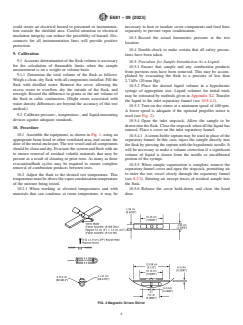
used (see Fig. 2).
devices against adequate standards.
10.5.4 Open the inlet stopcock. Allow the sample to be
drawn into the flask. Close the stopcock when all the liquid has
10. Procedure
entered. Place a cover on the inlet separatory funnel.
10.1 Assemble the equipment, as shown in Fig. 1, using an
10.5.4.1 A serum-bottle septum may be used in place of the
appropriate fume hood or other ventilated area, and secure the
separatory funnel. In this case, inject the sample directly into
door of the metal enclosure. The test vessel and all components
the flask by piercing the septum with the hypodermic needle. It
should be clean and dry. Evacuate the system and flush with air
will be necessary to make a volume correction if a significant
to ensure removal of residual volatile materials that may be
volume of liquid is drawn from the needle or uncalibrated
present as a result of cleaning or prior tests. As many as three
portion of the syringe.
evacuation/flush cycles may be required to ensure complete
10.5.5 When sample vaporization is complete, remove the
removal of combustion products between tests.
separatory funnel cover and open the stopcock, permitting air
to enter the test vessel slowly through the separatory funnel
10.2 Adjust the flask to the desired test temperature. This
(see 8.2.3). Entering air sweeps traces of residual sample into
temperature must be above the vapor condensation temperature
the flask.
of the mixture being tested.
10.2.1 When working at elevated temperatures and with 10.5.6 Release the cover hold-down, and close the hood
materials that can condense at room temperature, it may be door.
FIG. 2 Magnetic Driven Stirrer
E681 − 09 (2023)
10.5.7 Continue stirring for at least 5 min to obtain complete capable of reading to the nearest 0.07 kPa (0.5 mm Hg) or 1 %
mixing and attainment of thermal equilibrium. Final trials for the reading, whichever is larger. The system must also be
should be made at longer mixing times to ensure optimal capable of maintaining a vacuum of 0.067 kPa (0.5 mm Hg), or
mixing conditions are achieved. less.
10.5.8 Turn off the stirrer. 10.6.2 Evacuate vessel and sample lines to a pressure of
10.5.9 Record the test temperature, T. 1.33 kPa (10.0 mm Hg, or less). Ensure that the samples and
10.5.10 Disconnect instrumentation lines as required. the products of previous combustions have been removed.
10.5.11 Darken the viewing area. Activate the ignition
NOTE 7—The vessel must not leak, isolated under vacuum, more than
source. Observe for ignition and flame propagation away from
0.1 kPa (1 mm Hg) /min.
the ignition source. See 3.1.2 for definition of flame propaga-
10.6.3 Introduce the sample as a vapor through an appro-
tion. A limit determining concentration is called nonflammable
priate inlet valve until the desired pressure is achieved.
only if it cannot be ignited after at least one repetition of the
Introduce air as in 10.5.5, raising the pressure to atmospheric.
measurement (see 10.5.1 – 10.5.11).
10.6.4 Carry out 10.5.6 – 10.5.17 as needed.
NOTE 5—Mixtures having a composition just outside the flammable
10.7 Procedure for Sample Introduction As a Solid:
range exhibit a small cap of flame above the igniter position; in some
10.7.1 Chemicals with melting points above room tempera-
cases, a vertical streak of flame may propagate to the vessel cover.
ture but that totally melt and vaporize or totally sublime at the
(Absence of a flame cap may be an indication of insufficient ignition
energy.) The onset of upward and partial outward flame propagation
test conditions may be added to the test vessel as solids.
signifies a limit or near-limit mixture. It is suggested that detailed
10.7.2 Bring the test vessel to atmospheric pressure. (Prior
observation of flame behavior be recorded on all trials. Include such notes
5 evacuation must be employed, as in 10.1, to ensure cleanli-
as flame cap, upward and outward propagation, downward propagation,
ness.)
etc. These observations can serve as a guide to narrowing the region of
uncertainty between go and no-go trials. 10.7.3 Place the desired sample weight in the flask by
raising the cover and inserting the sample.
10.5.12 Vary sample size as required to find the minimum
10.7.4 Carry out 10.5.6 – 10.5.17 as needed.
sample size, L , that gives flame propagation and the maximum
sample size, L , below L , that does not give flame propaga-
2 1 NOTE 8—A small portion of the sample may be lost from the test vessel
tion. (The difference between L and L is a measure of the as the sample vaporizes and warms up to the test temperature. Losses are
1 2
minimized by delaying the start of stirring until vaporization is complete.
variability of the procedure for the material being studied.)
Maximum theoretical sample loss, which is small, may be readily
10.5.13 If numerous trials are required for a given series of
calculated.
tests, it may be necessary to remove the vessel for cleaning
periodically, particularly for upper limit studies.
11. Calculation
10.5.14 Final trials shall be made in a clean vessel.
11.1 Calculate the sample quantity, L or U, as follows:
NOTE 6—Ignition failures and inconsistent performance are occasion-
ally encountered, for example, when high dielectric strength or very high
L 5 L 1L (1)
~ !
1 2
ignition energy materials are tested using a spark ignition source. Limits 2
for these materials should be determined using a fuse wire ignition source.
Fuse wire ignition should also be used to confirm reduced pressure limit
U 5 ~U 1U ! (2)
1 2
values arrived at on the basis of spark ignition source trials. Good
electrical contacts in the circuit of the fused wire are indicated by
where:
complete vaporization of the copper wire. If complete vaporization is not
accomplished, the ignition trial should be disregarded (unless it was a L = sample quantity used to calculate the LFL by Eq 3, and
propagation). The ignition trial should be repeated after ensuring that good
U = sample quantity used to calculate the UFL by Eq 3.
electrical contacts have been established in the fused wire circuit.
11.1.1 For L and L , see 10.5.12. For U and U , see
1 2 1 2
10.5.15 Record the values of the sample volume L and L .
1 2
10.5.17.
If partial propagation occurs over a range of sample sizes
11.2 Calculate the LFL and UFL from the sample quantities.
greater than 10 % of the sample size, the range should be
Ideal vapor phase behavior is assumed. (See X5.2 for a sample
specified in the report, for example, LFL = 5.4 % 6 0.6 %.
calculation and X5.1 for development of Eq 3.)
10.5.16 Commence upper limit tests at a concentration
11.2.1 Liquid Samples (Ideal Vapor Phase Behavior Is
greater than U , as defined in 10.5.17. Sample size for initial
Assumed):
trial may be determined by methods given in Appendix X3.
10.5.17 Record the values for the greatest sample quantity
~L !~d!~T! ~V !~P !~100 %!
v o o
LFL 5 × (3)
U that will propagate a flame, and the least quantity U above MW P V T
~ !~ ! ~ !~ !
1 2 o
U that will not propagate a flame.
where:
10.6 Procedure for Sample Introduction As a Vapor:
V = volume of flask, L,
10.6.1 Sample concentrations can be measured for gases
LFL = lower flammable limit, mol or volume, %,
and readily vaporized liquids on the basis of partial pressure. In
L = L = sample volume from Eq 1, cm ,
v
these instances, equip the vessel with a pressure transducer
d = sample density, g/cm ,
T = test t
...