

ASTM E519/E519M-22
(Test Method)Standard Test Method for Diagonal Tension (Shear) in Masonry Assemblages
General Information
- Abstract
SIGNIFICANCE AND USE
3.1 This test method was developed to measure more accurately the diagonal tensile (shear) strength of masonry than was possible with other available methods. The specimen size was selected as being the smallest that would be reasonably representative of a full-size masonry assemblage and that would permit the use of testing machines such as are used by many laboratories.
Note 1: As a research test method used only for the purpose of evaluating the effects of variables such as type of masonry unit, mortar, workmanship, etc., a smaller size specimen could be used if the available testing equipment will not accommodate a 1.2-m [4-ft] square specimen. However, there is a lack of experimental data that would permit an evaluation of the effect of specimen size on the shear strength or to permit a correlation between the results of small-scale specimen tests and larger specimens.
SCOPE
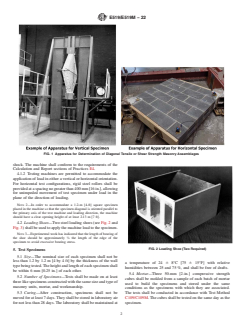
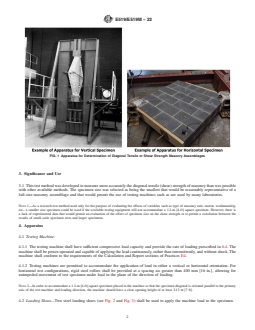
1.1 This test method covers determination of the diagonal tensile or shear strength of masonry assemblages by loading them in compression along one diagonal (see Fig. 1), thus causing a diagonal tension failure with the specimen splitting apart parallel to the direction of load.
FIG. 1 Apparatus for Determination of Diagonal Tensile or Shear Strength Masonry Assemblages
1.2 Annex A1 provides requirements regarding the determination of the diagonal-tension strength of masonry under combined diagonal-tension and compressive loading.
1.3 The text of this standard refers to notes and footnotes that provide explanatory material. These notes and footnotes (excluding those in tables and figures) shall not be considered as requirements of the standard.
1.4 These test methods cover the application of the tests using either inch-pound or SI units. The values stated in either SI units or inch-pound units are to be regarded separately as standard. Within the text, the inch-pound units are shown in brackets. The values stated in each system may not be exact equivalents; therefore, each system shall be used independently of the other. Combining values from the two systems may result in nonconformance with the standard.
1.5 This standard may involve hazardous materials, operations, and equipment. This standard does not purport to address all of the safety concerns, if any, associated with its use. It is the responsibility of the user of this standard to establish appropriate safety, health, and environmental practices and determine the applicability of regulatory limitations prior to use.
1.6 This international standard was developed in accordance with internationally recognized principles on standardization established in the Decision on Principles for the Development of International Standards, Guides and Recommendations issued by the World Trade Organization Technical Barriers to Trade (TBT) Committee.
- Status
- Published
- Publication Date
- 30-Nov-2022
- Technical Committee
- C15 - Masonry – Manufactured Masonry Units, Mortars and Grouts
- Drafting Committee
- C15.04 - Research for Masonry Units and Assemblies
Overview
ASTM E519/E519M-22: Standard Test Method for Diagonal Tension (Shear) in Masonry Assemblages is an internationally recognized method developed by ASTM International. This standard provides procedures for accurately determining the diagonal tensile (shear) strength of masonry assemblages by loading specimens in compression along one diagonal. The goal is to measure the diagonal tension failure under controlled conditions, making it widely applicable for quality assessment and research involving masonry materials, mortar, and construction practices.
This standard is significant for the construction and civil engineering industries as it offers a reliable means to quantify the shear strength of masonry walls, which is crucial for evaluating structural integrity and seismic performance. The test method utilizes specimen sizes that are representative of full-scale masonry walls while being compatible with laboratory testing equipment.
Key Topics
Purpose and Scope
- Determines diagonal tensile or shear strength of masonry assemblages.
- Applicable to both research and quality control settings.
- Covers testing using both inch-pound and SI units.
Test Specimen Requirements
- Standard specimen size: no less than 1.2 m x 1.2 m [4 ft x 4 ft] by wall thickness.
- At least three similar specimens with identical materials and workmanship are required.
- Specimens must be adequately cured before testing.
Testing Procedure
- Specimens are loaded diagonally in compression until a diagonal tension failure occurs.
- Provision for loading with either vertical or horizontal testing machines.
- Use of steel loading shoes and capping materials or neoprene pads to distribute the load.
- Instrumentation is recommended for measuring deformations and strains.
Data and Reporting
- Results include shear stress calculation, stress-strain curves, and failure mode documentation.
- Detailed reporting of materials, specimen construction, testing methods, and results is required.
Safety and Compliance
- Addresses safety, health, and environmental practices.
- Developed in line with WTO Technical Barriers to Trade (TBT) principles.
Applications
The ASTM E519/E519M-22 test method is utilized in a variety of applications within the construction, research, and materials testing sectors:
Structural Performance Assessment
Accurately determines the diagonal tensile (shear) strength of masonry assemblages, essential for evaluating structural systems in buildings subject to lateral forces such as wind or earthquakes.Quality Control
Provides a standardized approach for testing new masonry materials, mortars, and construction methods, supporting quality assurance in manufacturing and construction.Research and Development
Used by laboratories and universities to research the effects of masonry unit types, mortar variations, workmanship, and reinforcement on the shear performance of walls.Design Validation
Supports engineering design practices by supplying quantitative data for the safe design of masonry shear walls.
Related Standards
For comprehensive masonry testing, the following ASTM standards are often referenced alongside ASTM E519/E519M-22:
- ASTM C67/C67M: Test Methods for Sampling and Testing Brick and Structural Clay Tile
- ASTM C109/C109M: Test Method for Compressive Strength of Hydraulic Cement Mortars
- ASTM C140/C140M: Test Methods for Sampling and Testing Concrete Masonry Units
- ASTM C1019: Test Method for Sampling and Testing Grout for Masonry
- ASTM E4: Practices for Force Calibration and Verification of Testing Machines
- ASTM E575: Practice for Reporting Data from Structural Tests of Building Constructions, Elements, Connections, and Assemblies
These referenced standards ensure best practices in specimen preparation, compressive strength measurement, and reporting accuracy, thereby enhancing the reliability of the ASTM E519/E519M-22 test results.
Keywords: ASTM E519, diagonal tension, shear strength, masonry assemblages, masonry testing, masonry units, mortar, structural integrity, compressive strength, construction materials standards, ASTM standards
Relations
- Effective Date
- 15-Dec-2023
- Effective Date
- 01-Dec-2023
- Refers
ASTM C67/C67M-19 - Standard Test Methods for Sampling and Testing Brick and Structural Clay Tile - Effective Date
- 01-Jul-2019
- Effective Date
- 15-Jul-2018
- Effective Date
- 01-Jul-2018
- Refers
ASTM C67/C67M-18 - Standard Test Methods for Sampling and Testing Brick and Structural Clay Tile - Effective Date
- 01-Feb-2018
- Effective Date
- 01-Jan-2018
- Effective Date
- 15-Dec-2017
- Effective Date
- 01-Jun-2017
- Effective Date
- 01-Feb-2017
- Effective Date
- 01-Jun-2016
- Effective Date
- 01-Jan-2016
- Effective Date
- 15-Dec-2015
- Effective Date
- 15-Dec-2015
- Effective Date
- 01-Jul-2015
Get Certified
Connect with accredited certification bodies for this standard

DIBt (Deutsches Institut für Bautechnik)
German Institute for Building Technology.
DIN CERTCO
DIN Group product certification.

Aboma Certification B.V.
Specialized in construction, metal, and transport sectors.
Sponsored listings
Frequently Asked Questions
ASTM E519/E519M-22 is a standard published by ASTM International. Its full title is "Standard Test Method for Diagonal Tension (Shear) in Masonry Assemblages". This standard covers: SIGNIFICANCE AND USE 3.1 This test method was developed to measure more accurately the diagonal tensile (shear) strength of masonry than was possible with other available methods. The specimen size was selected as being the smallest that would be reasonably representative of a full-size masonry assemblage and that would permit the use of testing machines such as are used by many laboratories. Note 1: As a research test method used only for the purpose of evaluating the effects of variables such as type of masonry unit, mortar, workmanship, etc., a smaller size specimen could be used if the available testing equipment will not accommodate a 1.2-m [4-ft] square specimen. However, there is a lack of experimental data that would permit an evaluation of the effect of specimen size on the shear strength or to permit a correlation between the results of small-scale specimen tests and larger specimens. SCOPE 1.1 This test method covers determination of the diagonal tensile or shear strength of masonry assemblages by loading them in compression along one diagonal (see Fig. 1), thus causing a diagonal tension failure with the specimen splitting apart parallel to the direction of load. FIG. 1 Apparatus for Determination of Diagonal Tensile or Shear Strength Masonry Assemblages 1.2 Annex A1 provides requirements regarding the determination of the diagonal-tension strength of masonry under combined diagonal-tension and compressive loading. 1.3 The text of this standard refers to notes and footnotes that provide explanatory material. These notes and footnotes (excluding those in tables and figures) shall not be considered as requirements of the standard. 1.4 These test methods cover the application of the tests using either inch-pound or SI units. The values stated in either SI units or inch-pound units are to be regarded separately as standard. Within the text, the inch-pound units are shown in brackets. The values stated in each system may not be exact equivalents; therefore, each system shall be used independently of the other. Combining values from the two systems may result in nonconformance with the standard. 1.5 This standard may involve hazardous materials, operations, and equipment. This standard does not purport to address all of the safety concerns, if any, associated with its use. It is the responsibility of the user of this standard to establish appropriate safety, health, and environmental practices and determine the applicability of regulatory limitations prior to use. 1.6 This international standard was developed in accordance with internationally recognized principles on standardization established in the Decision on Principles for the Development of International Standards, Guides and Recommendations issued by the World Trade Organization Technical Barriers to Trade (TBT) Committee.
SIGNIFICANCE AND USE 3.1 This test method was developed to measure more accurately the diagonal tensile (shear) strength of masonry than was possible with other available methods. The specimen size was selected as being the smallest that would be reasonably representative of a full-size masonry assemblage and that would permit the use of testing machines such as are used by many laboratories. Note 1: As a research test method used only for the purpose of evaluating the effects of variables such as type of masonry unit, mortar, workmanship, etc., a smaller size specimen could be used if the available testing equipment will not accommodate a 1.2-m [4-ft] square specimen. However, there is a lack of experimental data that would permit an evaluation of the effect of specimen size on the shear strength or to permit a correlation between the results of small-scale specimen tests and larger specimens. SCOPE 1.1 This test method covers determination of the diagonal tensile or shear strength of masonry assemblages by loading them in compression along one diagonal (see Fig. 1), thus causing a diagonal tension failure with the specimen splitting apart parallel to the direction of load. FIG. 1 Apparatus for Determination of Diagonal Tensile or Shear Strength Masonry Assemblages 1.2 Annex A1 provides requirements regarding the determination of the diagonal-tension strength of masonry under combined diagonal-tension and compressive loading. 1.3 The text of this standard refers to notes and footnotes that provide explanatory material. These notes and footnotes (excluding those in tables and figures) shall not be considered as requirements of the standard. 1.4 These test methods cover the application of the tests using either inch-pound or SI units. The values stated in either SI units or inch-pound units are to be regarded separately as standard. Within the text, the inch-pound units are shown in brackets. The values stated in each system may not be exact equivalents; therefore, each system shall be used independently of the other. Combining values from the two systems may result in nonconformance with the standard. 1.5 This standard may involve hazardous materials, operations, and equipment. This standard does not purport to address all of the safety concerns, if any, associated with its use. It is the responsibility of the user of this standard to establish appropriate safety, health, and environmental practices and determine the applicability of regulatory limitations prior to use. 1.6 This international standard was developed in accordance with internationally recognized principles on standardization established in the Decision on Principles for the Development of International Standards, Guides and Recommendations issued by the World Trade Organization Technical Barriers to Trade (TBT) Committee.
ASTM E519/E519M-22 is classified under the following ICS (International Classification for Standards) categories: 91.060.10 - Walls. Partitions. Facades. The ICS classification helps identify the subject area and facilitates finding related standards.
ASTM E519/E519M-22 has the following relationships with other standards: It is inter standard links to ASTM C109/C109M-23, ASTM C140/C140M-23a, ASTM C67/C67M-19, ASTM C140/C140M-18, ASTM E575-05(2018), ASTM C67/C67M-18, ASTM C1019-18, ASTM C140/C140M-17b, ASTM C140/C140M-17a, ASTM C140/C140M-17, ASTM C140/C140M-16, ASTM C1019-16, ASTM C140/C140M-15a, ASTM C140/C140M-15ae1, ASTM C140/C140M-15. Understanding these relationships helps ensure you are using the most current and applicable version of the standard.
ASTM E519/E519M-22 is available in PDF format for immediate download after purchase. The document can be added to your cart and obtained through the secure checkout process. Digital delivery ensures instant access to the complete standard document.
Standards Content (Sample)
This international standard was developed in accordance with internationally recognized principles on standardization established in the Decision on Principles for the
Development of International Standards, Guides and Recommendations issued by the World Trade Organization Technical Barriers to Trade (TBT) Committee.
Designation: E519/E519M − 22
Standard Test Method for
Diagonal Tension (Shear) in Masonry Assemblages
This standard is issued under the fixed designation E519/E519M; the number immediately following the designation indicates the year
of original adoption or, in the case of revision, the year of last revision. A number in parentheses indicates the year of last reapproval.
A superscript epsilon (´) indicates an editorial change since the last revision or reapproval.
1. Scope* 2. Referenced Documents
2.1 ASTM Standards:
1.1 This test method covers determination of the diagonal
C67/C67M Test Methods for Sampling and Testing Brick
tensile or shear strength of masonry assemblages by loading
and Structural Clay Tile
them in compression along one diagonal (see Fig. 1), thus
C109/C109M Test Method for Compressive Strength of
causing a diagonal tension failure with the specimen splitting
Hydraulic Cement Mortars (Using 2-in. or [50 mm] Cube
apart parallel to the direction of load.
Specimens)
1.2 AnnexA1 provides requirements regarding the determi-
C140/C140M Test Methods for Sampling and Testing Con-
nation of the diagonal-tension strength of masonry under
crete Masonry Units and Related Units
combined diagonal-tension and compressive loading.
C1019 Test Method for Sampling and Testing Grout for
Masonry
1.3 The text of this standard refers to notes and footnotes
E4 Practices for Force Calibration and Verification of Test-
that provide explanatory material. These notes and footnotes
ing Machines
(excluding those in tables and figures) shall not be considered
E575 Practice for Reporting Data from Structural Tests of
as requirements of the standard.
Building Constructions, Elements, Connections, and As-
1.4 These test methods cover the application of the tests
semblies
using either inch-pound or SI units. The values stated in either
3. Significance and Use
SI units or inch-pound units are to be regarded separately as
standard. Within the text, the inch-pound units are shown in
3.1 This test method was developed to measure more
brackets. The values stated in each system may not be exact
accuratelythediagonaltensile(shear)strengthofmasonrythan
equivalents;therefore,eachsystemshallbeusedindependently
was possible with other available methods. The specimen size
of the other. Combining values from the two systems may
was selected as being the smallest that would be reasonably
result in nonconformance with the standard.
representative of a full-size masonry assemblage and that
would permit the use of testing machines such as are used by
1.5 This standard may involve hazardous materials,
many laboratories.
operations, and equipment. This standard does not purport to
address all of the safety concerns, if any, associated with its NOTE 1—As a research test method used only for the purpose of
evaluating the effects of variables such as type of masonry unit, mortar,
use. It is the responsibility of the user of this standard to
workmanship, etc., a smaller size specimen could be used if the available
establish appropriate safety, health, and environmental prac-
testing equipment will not accommodate a 1.2-m [4-ft] square specimen.
tices and determine the applicability of regulatory limitations
However, there is a lack of experimental data that would permit an
prior to use.
evaluation of the effect of specimen size on the shear strength or to permit
a correlation between the results of small-scale specimen tests and larger
1.6 This international standard was developed in accor-
specimens.
dance with internationally recognized principles on standard-
ization established in the Decision on Principles for the
4. Apparatus
Development of International Standards, Guides and Recom-
4.1 Testing Machine:
mendations issued by the World Trade Organization Technical
4.1.1 The testing machine shall have sufficient compressive
Barriers to Trade (TBT) Committee.
load capacity and provide the rate of loading prescribed in 6.4.
The machine shall be power-operated and capable of applying
the load continuously, rather than intermittently, and without
This test method is under the jurisdiction of ASTM Committee C15 on
Manufactured Masonry Units and is the direct responsibility of Subcommittee
C15.04 on Research. For referenced ASTM standards, visit the ASTM website, www.astm.org, or
Current edition approved Dec. 1, 2022. Published December 2022. Originally contact ASTM Customer Service at service@astm.org. For Annual Book of ASTM
approved 1974. Last previous edition approved in 2021 as E519/E519M – 21. DOI: Standards volume information, refer to the standard’s Document Summary page on
10.1520/E0519_E0519M-22. the ASTM website.
*A Summary of Changes section appears at the end of this standard
Copyright © ASTM International, 100 Barr Harbor Drive, PO Box C700, West Conshohocken, PA 19428-2959. United States
E519/E519M − 22
FIG. 1 Apparatus for Determination of Diagonal Tensile or Shear Strength Masonry Assemblages
shock. The machine shall conform to the requirements of the
Calculation and Report sections of Practices E4.
4.1.2 Testing machines are permitted to accommodate the
application of load in either a vertical or horizontal orientation.
For horizontal test configurations, rigid steel rollers shall be
providedataspacingnogreaterthan400mm[16in.],allowing
for unimpeded movement of test specimen under load in the
plane of the direction of loading.
NOTE 2—In order to accommodate a 1.2-m [4-ft] square specimen
placed in the machine so that the specimen diagonal is oriented parallel to
the primary axis of the test machine and loading direction, the machine
should have a clear opening height of at least 2.13 m [7 ft].
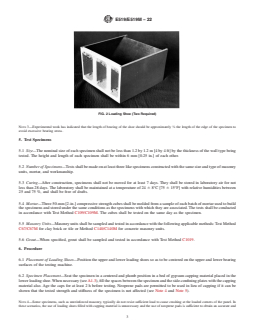
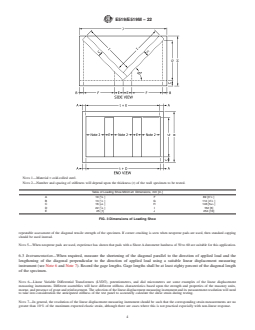
4.2 LoadingShoes—Two steel loading shoes (see Fig. 2 and
Fig.3)shallbeusedtoapplythemachineloadtothespecimen.
NOTE 3—Experimental work has indicated that the length of bearing of
the shoe should be approximately ⁄8 the length of the edge of the
specimen to avoid excessive bearing stress.
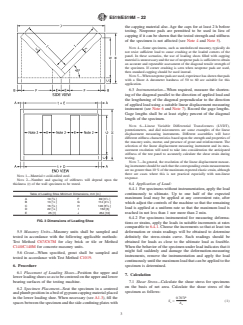
FIG. 2 Loading Shoe (Two Required)
5. Test Specimens
5.1 Size—The nominal size of each specimen shall not be
less than 1.2 by 1.2 m [4 by 4 ft] by the thickness of the wall
a temperature of 24 6 8°C [75 6 15°F] with relative
type being tested.The height and length of each specimen shall
humidities between 25 and 75 %, and shall be free of drafts.
be within 6 mm [0.25 in.] of each other.
5.4 Mortar—Three 50-mm [2-in.] compressive strength
5.2 Number of Specimens—Tests shall be made on at least
cubes shall be molded from a sample of each batch of mortar
threelikespecimensconstructedwiththesamesizeandtypeof
used to build the specimens and stored under the same
masonry units, mortar, and workmanship.
conditions as the specimens with which they are associated.
5.3 Curing—After construction, specimens shall not be The tests shall be conducted in accordance with Test Method
moved for at least 7 days.They shall be stored in laboratory air C109/C109M.The cubes shall be tested on the same day as the
for not less than 28 days. The laboratory shall be maintained at specimen.
E519/E519M − 22
the capping material also. Age the caps for at least 2 h before
testing. Neoprene pads are permitted to be used in lieu of
capping if it can be shown that the tested strength and stiffness
of the specimen is not affected (see Note 4 and Note 5).
NOTE 4—Some specimens, such as unreinforced masonry, typically do
not resist sufficient load to cause crushing at the loaded corners of the
panel. In these scenarios, the use of loading shoes filled with capping
material is unnecessary and the use of neoprene pads is sufficient to obtain
an accurate and repeatable assessment of the diagonal tensile strength of
the specimen. If corner crushing is seen when neoprene pads are used,
then standard capping should be used instead.
NOTE5—Whenneoprenepadsareused,experiencehasshownthatpads
with a Shore A durometer hardness of 50 to 60 are suitable for this
application.
6.3 Instrumentation—When required, measure the shorten-
ing of the diagonal parallel to the direction of applied load and
the lengthening of the diagonal perpendicular to the direction
of applied load using a suitable linear displacement measuring
instrument (see Note 6 and Note 7). Record the gage lengths.
Gage lengths shall be at least eighty percent of the diagonal
length of the specimen.
NOTE 6—Linear Variable Differential Transformers (LVDT),
potentiometers, and dial micrometers are some examples of the linear
displacement measuring instruments. Different assemblies will have
different stiffness characteristics based upon the strength and properties of
the masonry units, mortar, and presence of grout and reinforcement. The
selection of the linear displacement measuring instrument and its mea-
surement resolution will need to take into consideration the
...
This document is not an ASTM standard and is intended only to provide the user of an ASTM standard an indication of what changes have been made to the previous version. Because
it may not be technically possible to adequately depict all changes accurately, ASTM recommends that users consult prior editions as appropriate. In all cases only the current version
of the standard as published by ASTM is to be considered the official document.
Designation: E519/E519M − 21 E519/E519M − 22
Standard Test Method for
Diagonal Tension (Shear) in Masonry Assemblages
This standard is issued under the fixed designation E519/E519M; the number immediately following the designation indicates the year
of original adoption or, in the case of revision, the year of last revision. A number in parentheses indicates the year of last reapproval.
A superscript epsilon (´) indicates an editorial change since the last revision or reapproval.
1. Scope*
1.1 This test method covers determination of the diagonal tensile or shear strength of masonry assemblages by loading them in
compression along one diagonal (see Fig. 1), thus causing a diagonal tension failure with the specimen splitting apart parallel to
the direction of load.
1.2 Annex A1 provides requirements regarding the determination of the diagonal-tension strength of masonry under combined
diagonal-tension and compressive loading.
1.3 The text of this standard refers to notes and footnotes that provide explanatory material. These notes and footnotes (excluding
those in tables and figures) shall not be considered as requirements of the standard.
1.4 These test methods cover the application of the tests using either inch-pound or SI units. The values stated in either SI units
or inch-pound units are to be regarded separately as standard. Within the text, the inch-pound units are shown in brackets. The
values stated in each system may not be exact equivalents; therefore, each system shall be used independently of the other.
Combining values from the two systems may result in nonconformance with the standard.
1.5 This standard may involve hazardous materials, operations, and equipment. This standard does not purport to address all
of the safety concerns, if any, associated with its use. It is the responsibility of the user of this standard to establish appropriate
safety, health, and environmental practices and determine the applicability of regulatory limitations prior to use.
1.6 This international standard was developed in accordance with internationally recognized principles on standardization
established in the Decision on Principles for the Development of International Standards, Guides and Recommendations issued
by the World Trade Organization Technical Barriers to Trade (TBT) Committee.
2. Referenced Documents
2.1 ASTM Standards:
C67/C67M Test Methods for Sampling and Testing Brick and Structural Clay Tile
C109/C109M Test Method for Compressive Strength of Hydraulic Cement Mortars (Using 2-in. or [50 mm] Cube Specimens)
C140/C140M Test Methods for Sampling and Testing Concrete Masonry Units and Related Units
C1019 Test Method for Sampling and Testing Grout for Masonry
E4 Practices for Force Calibration and Verification of Testing Machines
E575 Practice for Reporting Data from Structural Tests of Building Constructions, Elements, Connections, and Assemblies
This test method is under the jurisdiction of ASTM Committee C15 on Manufactured Masonry Units and is the direct responsibility of Subcommittee C15.04 on Research.
Current edition approved June 1, 2021Dec. 1, 2022. Published June 2021December 2022. Originally approved 1974. Last previous edition approved in 20202021 as
E519/E519M – 20.E519/E519M – 21. DOI: 10.1520/E0519_E0519M-21.10.1520/E0519_E0519M-22.
For referenced ASTM standards, visit the ASTM website, www.astm.org, or contact ASTM Customer Service at service@astm.org. For Annual Book of ASTM Standards
volume information, refer to the standard’s Document Summary page on the ASTM website.
*A Summary of Changes section appears at the end of this standard
Copyright © ASTM International, 100 Barr Harbor Drive, PO Box C700, West Conshohocken, PA 19428-2959. United States
E519/E519M − 22
FIG. 1 Apparatus for Determination of Diagonal Tensile or Shear Strength Masonry Assemblages
3. Significance and Use
3.1 This test method was developed to measure more accurately the diagonal tensile (shear) strength of masonry than was possible
with other available methods. The specimen size was selected as being the smallest that would be reasonably representative of a
full-size masonry assemblage and that would permit the use of testing machines such as are used by many laboratories.
NOTE 1—As a research test method used only for the purpose of evaluating the effects of variables such as type of masonry unit, mortar, workmanship,
etc., a smaller size specimen could be used if the available testing equipment will not accommodate a 1.2-m [4-ft] square specimen. However, there is
a lack of experimental data that would permit an evaluation of the effect of specimen size on the shear strength or to permit a correlation between the
results of small-scale specimen tests and larger specimens.
4. Apparatus
4.1 Testing Machine:
4.1.1 The testing machine shall have sufficient compressive load capacity and provide the rate of loading prescribed in 6.4. The
machine shall be power-operated and capable of applying the load continuously, rather than intermittently, and without shock. The
machine shall conform to the requirements of the Calculation and Report sections of Practices E4.
4.1.2 Testing machines are permitted to accommodate the application of load in either a vertical or horizontal orientation. For
horizontal test configurations, rigid steel rollers shall be provided at a spacing no greater than 400 mm [16 in.], allowing for
unimpeded movement of test specimen under load in the plane of the direction of loading.
NOTE 2—In order to accommodate a 1.2-m [4-ft] square specimen placed in the machine so that the specimen diagonal is oriented parallel to the primary
axis of the test machine and loading direction, the machine should have a clear opening height of at least 2.13 m [7 ft].
4.2 Loading Shoes—Two steel loading shoes (see Fig. 2 and Fig. 3) shall be used to apply the machine load to the specimen.
E519/E519M − 22
FIG. 2 Loading Shoe (Two Required)
NOTE 3—Experimental work has indicated that the length of bearing of the shoe should be approximately ⁄8 the length of the edge of the specimen to
avoid excessive bearing stress.
5. Test Specimens
5.1 Size—The nominal size of each specimen shall not be less than 1.2 by 1.2 m [4 by 4 ft] by the thickness of the wall type being
tested. The height and length of each specimen shall be within 6 mm [0.25 in.] of each other.
5.2 Number of Specimens—Tests shall be made on at least three like specimens constructed with the same size and type of masonry
units, mortar, and workmanship.
5.3 Curing—After construction, specimens shall not be moved for at least 7 days. They shall be stored in laboratory air for not
less than 28 days. The laboratory shall be maintained at a temperature of 24 6 8°C [75 6 15°F] with relative humidities between
25 and 75 %, and shall be free of drafts.
5.4 Mortar—Three 50-mm [2-in.] compressive strength cubes shall be molded from a sample of each batch of mortar used to build
the specimens and stored under the same conditions as the specimens with which they are associated. The tests shall be conducted
in accordance with Test Method C109/C109M. The cubes shall be tested on the same day as the specimen.
5.5 Masonry Units—Masonry units shall be sampled and tested in accordance with the following applicable methods: Test Method
C67/C67M for clay brick or tile or Method C140/C140M for concrete masonry units.
5.6 Grout—When specified, grout shall be sampled and tested in accordance with Test Method C1019.
6. Procedure
6.1 Placement of Loading Shoes—Position the upper and lower loading shoes so as to be centered on the upper and lower bearing
surfaces of the testing machine.
6.2 Specimen Placement—Seat the specimen in a centered and plumb position in a bed of gypsum capping material placed in the
lower loading shoe. When necessary (see A1.3), fill the spaces between the specimen and the side-confining plates with the capping
material also. Age the caps for at least 2 h before testing. Neoprene pads are permitted to be used in lieu of capping if it can be
shown that the tested strength and stiffness of the specimen is not affected (see Note 4 and Note 5).
NOTE 4—Some specimens, such as unreinforced masonry, typically do not resist sufficient load to cause crushing at the loaded corners of the panel. In
these scenarios, the use of loading shoes filled with capping material is unnecessary and the use of neoprene pads is sufficient to obtain an accurate and
E519/E519M − 22
NOTE 1—Material = cold-rolled steel.
NOTE 2—Number and spacing of stiffeners will depend upon the thickness (t) of the wall specimen to be tested.
Table of Loading Shoe Minimum Dimensions, mm [in.]
3 1
A 10 [ ⁄8 ] F 89 [3 ⁄2 ]
1 1
B 13 [ ⁄2 ] G 114 [4 ⁄2 ]
5 3
C 16 [ ⁄8 ] H 146 [5 ⁄4 ]
D 22 [ ⁄8 ] I 152 [6]
E 25 [1] J 254 [10]
FIG. 3 Dimensions of Loading Shoe
repeatable assessment of the diagonal tensile strength of the specimen. If corner crushing is seen when neoprene pads are used, then standard capping
should be used instead.
NOTE 5—When neoprene pads are used, experience has shown that pads with a Shore A durometer hardness of 50 to 60 are suitable for this application.
6.3 Instrumentation—When required, measure the shortening of the diagonal parallel to the direction of applied load and the
lengthening o
...