

ASTM D4495-21
(Test Method)Standard Test Method for Impact Resistance of Poly(Vinyl Chloride) (PVC) Rigid Profiles by Means of a Falling Weight
General Information
- Abstract
SIGNIFICANCE AND USE
5.1 The impact strength of PVC profiles relates to suitability for service and to quality of processing. Impact tests are used for quality-control purposes and as an indication that products can withstand handling during assembling, installation, or in service.
5.2 Results obtained by use of this test method are used in two ways:
5.2.1 As the basis for establishing impact-test requirements in product standards, and
5.2.2 To measure the effect of changes in materials or processing.
SCOPE
1.1 This test method covers the determination of the energy required to crack or break rigid poly(vinyl chloride) (PVC) profile under specified conditions of impact by means of a falling weight.
1.2 This test method is used either by itself or in conjunction with other methods for measuring PVC product toughness.
1.3 Because of the wide variety of profile sizes and shapes and the wide variety of manufacturing procedures and field abuse, this test method does not correlate universally with all types of abuse. Therefore, correlations must be established as needed.
1.4 The text of this standard references notes and footnotes which provide explanatory material. These notes and footnotes (excluding those in tables and figures) shall not be considered as requirements of this standard.
1.5 The values stated in inch-pound units are to be regarded as the standard.
1.6 This standard does not purport to address all of the safety concerns, if any, associated with its use. It is the responsibility of the user of this standard to establish appropriate safety, health, and environmental practices and determine the applicability of regulatory limitations prior to use.
Note 1: There is no known ISO equivalent to this standard.
1.7 This international standard was developed in accordance with internationally recognized principles on standardization established in the Decision on Principles for the Development of International Standards, Guides and Recommendations issued by the World Trade Organization Technical Barriers to Trade (TBT) Committee.
- Status
- Published
- Publication Date
- 30-Nov-2021
- Technical Committee
- D20 - Plastics
- Drafting Committee
- D20.24 - Plastic Building Products
Buy Documents
ASTM D4495-21 - Standard Test Method for Impact Resistance of Poly(Vinyl Chloride) (PVC) Rigid Profiles by Means of a Falling Weight
REDLINE ASTM D4495-21 - Standard Test Method for Impact Resistance of Poly(Vinyl Chloride) (PVC) Rigid Profiles by Means of a Falling Weight
Overview
ASTM D4495-21 is the standard test method established by ASTM International for measuring the impact resistance of rigid poly(vinyl chloride) (PVC) profiles using a falling weight mechanism. This method is vital in determining the energy required to crack or break PVC profiles under specified impact conditions. The standard is widely used in quality control, research, and product development across industries that manufacture or utilize rigid PVC profiles for construction and other applications.
Impact resistance is a critical property for PVC profiles, correlating directly with their suitability for service, handling, and installation. Assessing PVC impact strength ensures materials meet performance requirements, withstand real-world handling, and maintain longevity in service environments. ASTM D4495-21 sets consistent procedures for stakeholders to evaluate PVC profile toughness accurately.
Key Topics
- Purpose and Scope: The standard outlines procedures for the determination of the impact energy required to crack or break PVC profiles under controlled conditions. This assessment may be conducted standalone or in conjunction with other test methods to evaluate PVC toughness.
- Relevance: Testing impact resistance supports quality control protocols and informs product standards by establishing minimum requirements. It also serves as a measure of the effect of any changes in PVC materials or manufacturing processes.
- Limitations: Due to the diversity in PVC profile sizes, shapes, and manufacturing techniques, universal correlation with all field abuse types is not guaranteed. Correlation must be specifically established when applying the results to unique use cases.
- Test Overview: The method involves using a standardized falling weight, dropped from incrementally adjusted heights, to determine the minimum energy needed to cause failure in a sample. The mean failure height and energy are calculated for reporting.
Applications
ASTM D4495-21 has several real-world applications, providing value across the plastic and building products sectors:
- Quality Control for PVC Manufacturers: The test method is integral for routine quality checks during extrusion and profile fabrication, ensuring products can handle conditions experienced during shipping, handling, and installation.
- Product Development and Research: When developing new rigid PVC profiles or altering material formulations, the method offers a reliable means of evaluating how such changes influence impact performance.
- Compliance and Standardization: The method is cited within product standards, helping manufacturers demonstrate conformance to industry or client specifications concerning impact toughness.
- Installation and Construction Safety: Specifiers and buyers can use test data to select products best suited for specific installation environments or where handling impact resistance is a critical requirement.
Related Standards
Several ASTM standards provide complementary guidance and definitions relevant to the application of ASTM D4495-21:
- ASTM D618 - Practice for Conditioning Plastics for Testing
- ASTM D883 - Terminology Relating to Plastics
- ASTM E178 - Practice for Dealing With Outlying Observations
While there is no known ISO equivalent to ASTM D4495-21, the standard aligns with internationally recognized principles for developing robust and unbiased test methods. Referencing and employing related standards contributes to a comprehensive approach to PVC profile impact testing, enhancing consistency and reliability in both domestic and global markets.
Keywords: ASTM D4495-21, PVC impact resistance, falling weight test, rigid PVC profiles, impact test method, quality control, plastics testing standards, product toughness, ASTM standards
Relations
- Effective Date
- 01-Feb-2024
- Effective Date
- 01-Nov-2023
- Effective Date
- 01-Jan-2020
- Effective Date
- 01-Aug-2019
- Effective Date
- 15-Apr-2019
- Effective Date
- 01-Feb-2019
- Effective Date
- 01-Dec-2018
- Effective Date
- 01-Nov-2018
- Effective Date
- 15-Aug-2017
- Effective Date
- 01-Jun-2016
- Effective Date
- 15-Nov-2012
- Effective Date
- 15-May-2011
- Effective Date
- 01-Nov-2008
- Effective Date
- 01-Oct-2008
- Effective Date
- 01-Mar-2008
Buy Documents
ASTM D4495-21 - Standard Test Method for Impact Resistance of Poly(Vinyl Chloride) (PVC) Rigid Profiles by Means of a Falling Weight
REDLINE ASTM D4495-21 - Standard Test Method for Impact Resistance of Poly(Vinyl Chloride) (PVC) Rigid Profiles by Means of a Falling Weight
Get Certified
Connect with accredited certification bodies for this standard

DIN CERTCO
DIN Group product certification.

Smithers Quality Assessments
US management systems and product certification.
Sponsored listings
Frequently Asked Questions
ASTM D4495-21 is a standard published by ASTM International. Its full title is "Standard Test Method for Impact Resistance of Poly(Vinyl Chloride) (PVC) Rigid Profiles by Means of a Falling Weight". This standard covers: SIGNIFICANCE AND USE 5.1 The impact strength of PVC profiles relates to suitability for service and to quality of processing. Impact tests are used for quality-control purposes and as an indication that products can withstand handling during assembling, installation, or in service. 5.2 Results obtained by use of this test method are used in two ways: 5.2.1 As the basis for establishing impact-test requirements in product standards, and 5.2.2 To measure the effect of changes in materials or processing. SCOPE 1.1 This test method covers the determination of the energy required to crack or break rigid poly(vinyl chloride) (PVC) profile under specified conditions of impact by means of a falling weight. 1.2 This test method is used either by itself or in conjunction with other methods for measuring PVC product toughness. 1.3 Because of the wide variety of profile sizes and shapes and the wide variety of manufacturing procedures and field abuse, this test method does not correlate universally with all types of abuse. Therefore, correlations must be established as needed. 1.4 The text of this standard references notes and footnotes which provide explanatory material. These notes and footnotes (excluding those in tables and figures) shall not be considered as requirements of this standard. 1.5 The values stated in inch-pound units are to be regarded as the standard. 1.6 This standard does not purport to address all of the safety concerns, if any, associated with its use. It is the responsibility of the user of this standard to establish appropriate safety, health, and environmental practices and determine the applicability of regulatory limitations prior to use. Note 1: There is no known ISO equivalent to this standard. 1.7 This international standard was developed in accordance with internationally recognized principles on standardization established in the Decision on Principles for the Development of International Standards, Guides and Recommendations issued by the World Trade Organization Technical Barriers to Trade (TBT) Committee.
SIGNIFICANCE AND USE 5.1 The impact strength of PVC profiles relates to suitability for service and to quality of processing. Impact tests are used for quality-control purposes and as an indication that products can withstand handling during assembling, installation, or in service. 5.2 Results obtained by use of this test method are used in two ways: 5.2.1 As the basis for establishing impact-test requirements in product standards, and 5.2.2 To measure the effect of changes in materials or processing. SCOPE 1.1 This test method covers the determination of the energy required to crack or break rigid poly(vinyl chloride) (PVC) profile under specified conditions of impact by means of a falling weight. 1.2 This test method is used either by itself or in conjunction with other methods for measuring PVC product toughness. 1.3 Because of the wide variety of profile sizes and shapes and the wide variety of manufacturing procedures and field abuse, this test method does not correlate universally with all types of abuse. Therefore, correlations must be established as needed. 1.4 The text of this standard references notes and footnotes which provide explanatory material. These notes and footnotes (excluding those in tables and figures) shall not be considered as requirements of this standard. 1.5 The values stated in inch-pound units are to be regarded as the standard. 1.6 This standard does not purport to address all of the safety concerns, if any, associated with its use. It is the responsibility of the user of this standard to establish appropriate safety, health, and environmental practices and determine the applicability of regulatory limitations prior to use. Note 1: There is no known ISO equivalent to this standard. 1.7 This international standard was developed in accordance with internationally recognized principles on standardization established in the Decision on Principles for the Development of International Standards, Guides and Recommendations issued by the World Trade Organization Technical Barriers to Trade (TBT) Committee.
ASTM D4495-21 is classified under the following ICS (International Classification for Standards) categories: 83.140.01 - Rubber and plastics products in general. The ICS classification helps identify the subject area and facilitates finding related standards.
ASTM D4495-21 has the following relationships with other standards: It is inter standard links to ASTM D883-24, ASTM D883-23, ASTM D883-20, ASTM D883-19c, ASTM D883-19a, ASTM D883-19, ASTM D883-18a, ASTM D883-18, ASTM D883-17, ASTM E178-16, ASTM D883-12e1, ASTM D883-11, ASTM D618-08, ASTM E178-08, ASTM D883-08. Understanding these relationships helps ensure you are using the most current and applicable version of the standard.
ASTM D4495-21 is available in PDF format for immediate download after purchase. The document can be added to your cart and obtained through the secure checkout process. Digital delivery ensures instant access to the complete standard document.
Standards Content (Sample)
This international standard was developed in accordance with internationally recognized principles on standardization established in the Decision on Principles for the
Development of International Standards, Guides and Recommendations issued by the World Trade Organization Technical Barriers to Trade (TBT) Committee.
Designation:D4495 −21 An American National Standard
Standard Test Method for
Impact Resistance of Poly(Vinyl Chloride) (PVC) Rigid
Profiles by Means of a Falling Weight
This standard is issued under the fixed designation D4495; the number immediately following the designation indicates the year of
original adoption or, in the case of revision, the year of last revision. A number in parentheses indicates the year of last reapproval. A
superscript epsilon (´) indicates an editorial change since the last revision or reapproval.
1. Scope* 2. Referenced Documents
2.1 ASTM Standards:
1.1 This test method covers the determination of the energy
required to crack or break rigid poly(vinyl chloride) (PVC) D618 Practice for Conditioning Plastics for Testing
D883 Terminology Relating to Plastics
profile under specified conditions of impact by means of a
falling weight. E178 Practice for Dealing With Outlying Observations
1.2 Thistestmethodisusedeitherbyitselforinconjunction
3. Terminology
with other methods for measuring PVC product toughness.
3.1 Definitions—Definitions are in accordance with Termi-
1.3 Because of the wide variety of profile sizes and shapes
nology D883, unless otherwise indicated.
and the wide variety of manufacturing procedures and field
3.2 Definitions of Terms Specific to This Standard:
abuse, this test method does not correlate universally with all
3.2.1 failure—the presence of a brittle failure readily visible
types of abuse. Therefore, correlations must be established as
by the naked eye, including a sharp crack, split, or shatter in
needed.
any part of the profile as a result of the impact of the falling
1.4 The text of this standard references notes and footnotes
weight. Failure does not include ductile tears (where the
which provide explanatory material. These notes and footnotes
surfaces at the tip of the crack have a greater than 0° angle), or
(excluding those in tables and figures) shall not be considered
ductile breaks (hinged breaks where the cracked part remains
as requirements of this standard.
joined to the unbroken part throughout the length of the
cracked part or section), (Fig. 1).
1.5 The values stated in inch-pound units are to be regarded
as the standard. 3.2.2 mean failure height—the height from which the
falling weight will cause 50 % of the specimens to fail.
1.6 This standard does not purport to address all of the
safety concerns, if any, associated with its use. It is the 3.2.3 mean failure energy—energy required to produce
50 % failures. The product of the weight and mean failure
responsibility of the user of this standard to establish appro-
priate safety, health, and environmental practices and deter- height.
mine the applicability of regulatory limitations prior to use.
3.2.4 outlier—an observation that appears to deviate mark-
edly from other members of the sample in which it occurs.
NOTE 1—There is no known ISO equivalent to this standard.
1.7 This international standard was developed in accor-
4. Summary of Test Method
dance with internationally recognized principles on standard-
4.1 The profile is cut into lengths of at least 6 in. The test
ization established in the Decision on Principles for the
method establishes the height from which a standard falling
Development of International Standards, Guides and Recom-
weight will cause 50 % of the specimens to fail.
mendations issued by the World Trade Organization Technical
Barriers to Trade (TBT) Committee.
5. Significance and Use
5.1 TheimpactstrengthofPVCprofilesrelatestosuitability
for service and to quality of processing. Impact tests are used
This test method is under the jurisdiction ofASTM Committee D20 on Plastics
and is the direct responsibility of Subcommittee D20.24 on Plastic Building
Products. For referenced ASTM standards, visit the ASTM website, www.astm.org, or
Current edition approved Dec. 1, 2021. Published December 2021. Originally contact ASTM Customer Service at service@astm.org. For Annual Book of ASTM
approved in 1985. Last previous edition approved in 2016 as D4495 – 16. DOI: Standards volume information, refer to the standard’s Document Summary page on
10.1520/D4495-21. the ASTM website.
*A Summary of Changes section appears at the end of this standard
Copyright © ASTM International, 100 Barr Harbor Drive, PO Box C700, West Conshohocken, PA 19428-2959. United States
D4495−21
FIG. 1 Types of Breaks
for quality-control purposes and as an indication that products use environments. However, this test method is intended
can withstand handling during assembling, installation, or in primarily for rating materials under specific impact conditions.
service.
6.3 When placed on the support plate, the specimen must lie
flat. Bowed samples will affect test results.
5.2 Results obtained by use of this test method are used in
two ways:
7. Apparatus
5.2.1 As the basis for establishing impact-test requirements
7.1 General—One type of impact tester is illustrated in Fig.
in product standards, and
2.
5.2.2 To measure the effect of changes in materials or
processing.
7.2 Falling Weight, shall be cylindrical and 2 ⁄2 in. in
diameter, with a flat-bottom surface that strikes the test
6. Interferences
specimen.
6.1 Falling-weight-impact types of tests are not suitable for
NOTE 2—It is suggested that the striking portion of the weight be made
predicting the relative ranking of materials at impact velocities of scratch-resistant steel to reduce damage to the striking surface. Badly
scarred surfaces may affect test results.
differing greatly from those imposed by these test methods.
7.2.1 The mass of the falling weight shall be 10 6 0.5 lb.
6.2 Impact properties of plastic materials can be very
sensitive to temperature. This test can be carried out at any 7.3 Drop Tube, shall be of sufficient length (approximately
reasonable temperature and humidity thus representing actual 12 ft (4 m)) to provide for a fall of at least 10 ft (3 m) and shall
D4495−21
7.4 Specimen Holder—The flat plate shall be used as a
specimen holder.
7.4.1 The rigid steel flat-plate holder shall consist of a plate
approximately 8 by 12 by 1 in. (200 by 300 by 25 mm). The
specimen holder shall be fastened to a concrete slab (floor).
Meansshallbeprovidedtocenterthespecimensunderthedrop
tube.
8. Test Specimens
8.1 The profile shall be not less than 6 in. (150 mm) in
length.
8.2 When the approximate mean-failure height for a given
sample is known, 20 specimens usually yield sufficiently
precise results. If the mean failure height is not able to be
approximated, six or more specimens shall be used to deter-
mine the appropriate starting point of the test.
NOTE 5—As few as five specimens often yield sufficiently reliable
estimatesofthemeanfailureheight.However,insuchcases,theestimated
standard deviation will be relatively large.
8.3 Specimens shall lie flat on the sample holder. Bowed
samples will affect test results.
9. Conditioning
9.1 Unless otherwise specified, condition the test specimens
at 73.4 6 3.6°F (23 6 2°C) and 50 6 10 % relative humidity
fornotlessthan24hpriortotestinaccordancewithProcedure
A of Methods D618. In cases of disagreement, the tolerance
shall be 61.8°F (61°C) and 65 % relative humidity.
9.2 Quality-Control Tests—Condition the test specimens at
73.4 6 3.6°F (23 6 2°C) for4hinair.
10. Procedure
10.1 Cut the profile into samples 6 in. (152 mm) long.
10.2 Choose a specimen at random from the sample.
10.3 After raising the weight, place the specimen on the
FIG. 2 Testing Apparatus
specimen holder between two pair of snug-fitting right-angle-
slotted brackets in such a way that it re
...
This document is not an ASTM standard and is intended only to provide the user of an ASTM standard an indication of what changes have been made to the previous version. Because
it may not be technically possible to adequately depict all changes accurately, ASTM recommends that users consult prior editions as appropriate. In all cases only the current version
of the standard as published by ASTM is to be considered the official document.
Designation: D4495 − 16 D4495 − 21 An American National Standard
Standard Test Method for
Impact Resistance of Poly(Vinyl Chloride) (PVC) Rigid
Profiles by Means of a Falling Weight
This standard is issued under the fixed designation D4495; the number immediately following the designation indicates the year of
original adoption or, in the case of revision, the year of last revision. A number in parentheses indicates the year of last reapproval. A
superscript epsilon (´) indicates an editorial change since the last revision or reapproval.
1. Scope*
1.1 This test method covers the determination of the energy required to crack or break rigid poly(vinyl chloride) (PVC) profile
under specified conditions of impact by means of a falling weight.
1.2 This test method is used either by itself or in conjunction with other methods for measuring PVC product toughness.
1.3 Because of the wide variety of profile sizes and shapes and the wide variety of manufacturing procedures and field abuse, this
test method does not correlate universally with all types of abuse. Therefore, correlations must be established as needed.
1.4 The text of this standard references notes and footnotes which provide explanatory material. These notes and footnotes
(excluding those in tables and figures) shall not be considered as requirements of this standard.
1.5 The values stated in inch-pound units are to be regarded as the standard.
1.6 This standard does not purport to address all of the safety concerns, if any, associated with its use. It is the responsibility
of the user of this standard to establish appropriate safety safety, health, and healthenvironmental practices and determine the
applicability of regulatory limitations prior to use.
NOTE 1—There is no known ISO equivalent to this standard.
1.7 This international standard was developed in accordance with internationally recognized principles on standardization
established in the Decision on Principles for the Development of International Standards, Guides and Recommendations issued
by the World Trade Organization Technical Barriers to Trade (TBT) Committee.
2. Referenced Documents
2.1 ASTM Standards:
D618 Practice for Conditioning Plastics for Testing
D883 Terminology Relating to Plastics
E178 Practice for Dealing With Outlying Observations
This test method is under the jurisdiction of ASTM Committee D20 on Plastics and is the direct responsibility of Subcommittee D20.24 on Plastic Building Products.
Current edition approved May 1, 2016Dec. 1, 2021. Published May 2016December 2021. Originally approved in 1985. Last previous edition approved in 20122016 as
D4495 – 12.D4495 – 16. DOI: 10.1520/D4495-16.10.1520/D4495-21.
For referenced ASTM standards, visit the ASTM website, www.astm.org, or contact ASTM Customer Service at service@astm.org. For Annual Book of ASTM Standards
volume information, refer to the standard’s Document Summary page on the ASTM website.
*A Summary of Changes section appears at the end of this standard
Copyright © ASTM International, 100 Barr Harbor Drive, PO Box C700, West Conshohocken, PA 19428-2959. United States
D4495 − 21
3. Terminology
3.1 Definitions—Definitions are in accordance with Terminology D883, unless otherwise indicated.
3.2 Definitions of Terms Specific to This Standard:
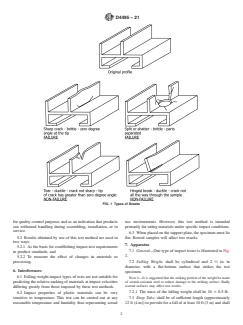
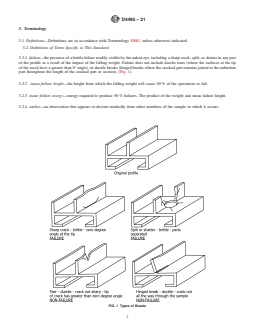
3.2.1 failure—the presence of a brittle failure readily visible by the naked eye, including a sharp crack, split, or shatter in any part
of the profile as a result of the impact of the falling weight. Failure does not include ductile tears (where the surfaces at the tip
of the crack have a greater than 0° angle), or ductile breaks (hinged breaks where the cracked part remains joined to the unbroken
part throughout the length of the cracked part or section), (Fig. 1).
3.2.2 mean failure height—the height from which the falling weight will cause 50 % of the specimens to fail.
3.2.3 mean failure energy—energy required to produce 50 % failures. The product of the weight and mean failure height.
3.2.4 outlier—an observation that appears to deviate markedly from other members of the sample in which it occurs.
FIG. 1 Types of Breaks
D4495 − 21
4. Summary of Test Method
4.1 The profile is cut into lengths of at least 6 in. The test method establishes the height from which a standard falling weight will
cause 50 % of the specimens to fail.
5. Significance and Use
5.1 The impact strength of PVC profiles relates to suitability for service and to quality of processing. Impact tests are used for
quality-control purposes and as an indication that products can withstand handling during assembling, installation, or in service.
5.2 Results obtained by use of this test method are used in two ways:
5.2.1 As the basis for establishing impact-test requirements in product standards, and
5.2.2 To measure the effect of changes in materials or processing.
6. Interferences
6.1 Falling-weight-impact types of tests are not suitable for predicting the relative ranking of materials at impact velocities
differing greatly from those imposed by these test methods.
6.2 Impact properties of plastic materials can be very sensitive to temperature. This test can be carried out at any reasonable
temperature and humidity thus representing actual use environments. However, this test method is intended primarily for rating
materials under specific impact conditions.
6.3 When placed on the support plate, the specimen must lie flat. Bowed samples will affect test results.
7. Apparatus
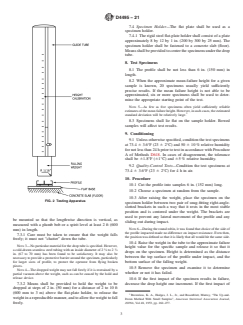
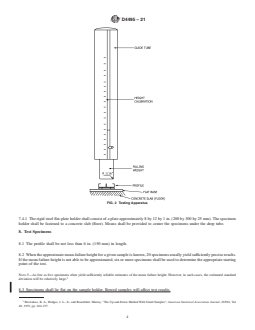
7.1 General—One type of impact tester is illustrated in Fig. 2.
7.2 Falling Weight, shall be cylindrical and 2 ⁄2 in. in diameter, with a flat-bottom surface that strikes the test specimen.
NOTE 2—It is suggested that the striking portion of the weight be made of scratch-resistant steel to reduce damage to the striking surface. Badly scarred
surfaces may affect test results.
7.2.1 The mass of the falling weight shall be 10 6 0.5 lb.
7.3 Drop Tube, shall be of sufficient length (approximately 12 ft (4 m)) to provide for a fall of at least 10 ft (3 m) and shall be
mounted so that the lengthwise direction is vertical, as measured with a plumb bob or a spirit level at least 2 ft (600 mm) in length.
7.3.1 Care must be taken to ensure that the weight falls freely; it must not “chatter” down the tube.
5 3
NOTE 3—No particular material for the drop tube is specified. However, a cold-drawn seamless steel tubing with an inside diameter of 2 ⁄8 to 2 ⁄4 in.
(67 to 70 mm) has been found to be satisfactory. It may also be necessary to provide a protective barrier around the specimen, particularly for larger sizes
of profile, to protect the operator from flying broken pieces.
NOTE 4—The dropped weight may not fall freely if it is restrained by a partial vacuum above the weight, such as can be caused by the hold and release
device.
7.3.2 Means shall be provided to hold the weight to be dropped at steps of 2 in. (50 mm) for a distance of 2 to 10 ft (600 mm
to 3 m) above the flat-plate holder, to release the weight in a reproducible manner, and to allow the weight to fall freely.
7.4 Specimen Holder—The flat plate shall be used as a specimen holder.
D4495 − 21
FIG. 2 Testing Apparatus
7.4.1 The rigid steel flat-plate holder shall consist of a plate approximately 8 by 12 by 1 in. (200 by 300 by 25 mm). The specimen
holder shall be fastened to a concrete slab (floor). Means shall be provided to center the specimens under the drop tube.
8. Test Specimens
8.1 The profile shall be not less than 6 in. (150 mm) in length.
8.2 When the approximate mean-failure height for a given sample is known, 20 specimens usually yield sufficiently precise results.
If the mean failure height is not able to be approximated, six or more spe
...