

ASTM D4803-24
(Test Method)Standard Test Method for Predicting Heat Buildup in PVC Building Products
General Information
- Abstract
SIGNIFICANCE AND USE
5.1 Heat buildup in PVC exterior building products due to absorption of the energy from the sun may lead to distortion problems. Heat buildup is affected by the color, emittance, absorptance, and reflectance of a product. Generally, the darker the color of the product, the more energy is absorbed and the greater is the heat buildup. However, even with the same apparent color, the heat buildup may vary due to the specific pigment system involved. The greatest heat buildup generally occurs in the color black containing carbon black pigment. The black control sample used in this test method contains 2.5 parts of furnace black per 100 parts of PVC suspension resin. The maximum temperature rise above ambient temperature for this black is 90°F (50°C) for a 45° or horizontal surface when the sun is perpendicular to the surface and 74°F (41°C) for a vertical surface assuming that the measurements were done on a cloudless day with no wind and heavy insulation on the back of the specimen.4
5.2 This test method allows the measurement of the temperature rise under a specific type heat lamp, relative to that of a black reference surface, thus predicting the heat buildup due to the sun's energy.
5.3 The test method allows prediction of heat buildup of various colors or pigment systems, or both.
5.4 This test method gives a relative heat buildup compared to black under certain defined severe conditions but does not predict actual application temperatures of the product. These will also depend on air temperature, incident angle of the sun, clouds, wind velocity, insulation, installation behind glass, etc.
SCOPE
1.1 This test method covers prediction of the heat buildup in rigid and flexible PVC building products above ambient air temperature, relative to black, which occurs due to absorption of the sun's energy.
Note 1: This test method is expected to be applicable to all types of colored plastics. The responsible subcommittee intends to broaden the scope beyond PVC when data on other materials is submitted for review.
Note 2: There are no ISO standards covering the primary subject matter of this test method.
1.2 Rigid PVC exterior profile extrusions for assembled windows and doors are covered in Specification D4726.
1.3 Rigid PVC exterior profiles for fencing are covered in Specification F964.
1.4 Rigid PVC siding profiles are covered in Specification D3679.
1.5 Rigid PVC soffit profiles are covered in Specification D4477.
1.6 Rigid PVC and Rigid CPVC plastic building products compounds are covered in Specification D4216.
1.7 The text of this test method references notes and footnotes which provide explanatory material. These notes and footnotes (excluding those in tables and figures) shall not be considered as requirements of this test method.
1.8 Units—The values stated in inch-pound units are to be regarded as the standard. The values given in parentheses are mathematical conversions to SI units that are provided for information only and are not considered standard.
1.9 This standard does not purport to address all of the safety concerns, if any, associated with its use. It is the responsibility of the user of this standard to establish appropriate safety, health, and environmental practices and determine the applicability of regulatory limitations prior to use. Specific safety hazard statements are given in Section 7.
1.10 This international standard was developed in accordance with internationally recognized principles on standardization established in the Decision on Principles for the Development of International Standards, Guides and Recommendations issued by the World Trade Organization Technical Barriers to Trade (TBT) Committee.
- Status
- Published
- Publication Date
- 31-Jan-2024
- Technical Committee
- D20 - Plastics
- Drafting Committee
- D20.24 - Plastic Building Products

Overview
ASTM D4803-24: Standard Test Method for Predicting Heat Buildup in PVC Building Products provides a recognized methodology for evaluating the heat buildup in rigid and flexible polyvinyl chloride (PVC) building products. Heat absorption from sunlight can cause significant temperature rises in exterior building products, potentially leading to warping, distortion, or other forms of material degradation. ASTM D4803-24 uses laboratory testing under controlled conditions to predict the potential for heat buildup by measuring temperature rise relative to a black control sample. This standard is crucial for manufacturers, material scientists, and construction professionals who aim to enhance the performance and durability of exterior PVC building materials.
Key Topics
- Heat Buildup Prediction: The standard establishes a method to assess the temperature increase in PVC products due to solar energy absorption. This is especially critical for products exposed to external environments.
- Influence of Color and Pigments: It details how color, emittance, absorptance, and reflectance of PVC products affect heat absorption, with darker colors-particularly black containing carbon black pigment-resulting in more significant heat buildup.
- Laboratory Testing Protocol: Specimens are exposed to a specific heat lamp, and the resulting temperature rise above ambient conditions is compared to that of a standard black control sample.
- Relative, Not Absolute Temperatures: The method predicts heat buildup relative to controlled conditions; it does not directly estimate actual field temperatures, as real-world factors such as wind, sun angle, and insulation can influence actual outcomes.
- Safety and Reporting: The document emphasizes proper safety protocols during testing and outlines mandatory data reporting, including specimen identification, temperature measurements, and calculated heat buildup.
Applications
ASTM D4803-24 has wide applicability in the building and construction materials industry:
- Product Development and Quality Control: Manufacturers use this standard to evaluate new PVC formulations or colors for use in exterior profiles such as siding, fencing, windows, doors, and soffits.
- Material Selection: Architects and building designers rely on predicted heat buildup data to select suitable PVC products for climates or applications where solar heating may be a concern.
- Comparative Assessments: The method enables direct comparisons between different color or pigment systems to optimize material performance for weathering and heat resistance.
- Testing for Compliance and Durability: The test results support claims of product durability and weathering performance, aiding compliance with other relevant ASTM specifications for outdoor building products.
Related Standards
Several other standards complement the guidance offered in ASTM D4803-24:
- ASTM D3679 - Specification for Rigid Poly(Vinyl Chloride) (PVC) Siding
- ASTM D4216 - Specification for Rigid PVC and CPVC Building Products Compounds
- ASTM D4477 - Specification for Rigid Unplasticized PVC Soffit Profiles
- ASTM D4726 - Specification for Rigid PVC Exterior Profile Extrusions for Windows and Doors
- ASTM F964 - Specification for Rigid PVC Exterior Profiles for Fencing and Railing
- ASTM D4703 - Practice for Compression Molding Thermoplastic Materials for Testing
Note: ASTM D4803-24 currently addresses PVC products, but the methodology may be extended to other colored plastics as supporting data becomes available. There are currently no ISO standards that directly cover this subject matter.
By following ASTM D4803-24, stakeholders in the plastics and construction industries can better predict, compare, and document the heat buildup characteristics of exterior PVC products, leading to informed material selection and improved product durability for sun-exposed applications.
Relations
- Effective Date
- 01-Feb-2024
- Effective Date
- 01-Apr-2024
- Refers
ASTM D4477-24 - Standard Specification for Rigid (Unplasticized) Poly(Vinyl Chloride) (PVC) Soffit - Effective Date
- 01-Apr-2024
- Effective Date
- 01-Feb-2024
- Effective Date
- 01-Feb-2024
- Effective Date
- 01-Nov-2023
- Refers
ASTM D4477-22 - Standard Specification for Rigid (Unplasticized) Poly(Vinyl Chloride) (PVC) Soffit - Effective Date
- 01-May-2022
- Effective Date
- 01-Apr-2022
- Effective Date
- 01-Apr-2022
- Effective Date
- 01-Sep-2021
- Effective Date
- 01-Aug-2018
- Effective Date
- 01-Feb-2024
Get Certified
Connect with accredited certification bodies for this standard

DIN CERTCO
DIN Group product certification.

Smithers Quality Assessments
US management systems and product certification.
Sponsored listings
Frequently Asked Questions
ASTM D4803-24 is a standard published by ASTM International. Its full title is "Standard Test Method for Predicting Heat Buildup in PVC Building Products". This standard covers: SIGNIFICANCE AND USE 5.1 Heat buildup in PVC exterior building products due to absorption of the energy from the sun may lead to distortion problems. Heat buildup is affected by the color, emittance, absorptance, and reflectance of a product. Generally, the darker the color of the product, the more energy is absorbed and the greater is the heat buildup. However, even with the same apparent color, the heat buildup may vary due to the specific pigment system involved. The greatest heat buildup generally occurs in the color black containing carbon black pigment. The black control sample used in this test method contains 2.5 parts of furnace black per 100 parts of PVC suspension resin. The maximum temperature rise above ambient temperature for this black is 90°F (50°C) for a 45° or horizontal surface when the sun is perpendicular to the surface and 74°F (41°C) for a vertical surface assuming that the measurements were done on a cloudless day with no wind and heavy insulation on the back of the specimen.4 5.2 This test method allows the measurement of the temperature rise under a specific type heat lamp, relative to that of a black reference surface, thus predicting the heat buildup due to the sun's energy. 5.3 The test method allows prediction of heat buildup of various colors or pigment systems, or both. 5.4 This test method gives a relative heat buildup compared to black under certain defined severe conditions but does not predict actual application temperatures of the product. These will also depend on air temperature, incident angle of the sun, clouds, wind velocity, insulation, installation behind glass, etc. SCOPE 1.1 This test method covers prediction of the heat buildup in rigid and flexible PVC building products above ambient air temperature, relative to black, which occurs due to absorption of the sun's energy. Note 1: This test method is expected to be applicable to all types of colored plastics. The responsible subcommittee intends to broaden the scope beyond PVC when data on other materials is submitted for review. Note 2: There are no ISO standards covering the primary subject matter of this test method. 1.2 Rigid PVC exterior profile extrusions for assembled windows and doors are covered in Specification D4726. 1.3 Rigid PVC exterior profiles for fencing are covered in Specification F964. 1.4 Rigid PVC siding profiles are covered in Specification D3679. 1.5 Rigid PVC soffit profiles are covered in Specification D4477. 1.6 Rigid PVC and Rigid CPVC plastic building products compounds are covered in Specification D4216. 1.7 The text of this test method references notes and footnotes which provide explanatory material. These notes and footnotes (excluding those in tables and figures) shall not be considered as requirements of this test method. 1.8 Units—The values stated in inch-pound units are to be regarded as the standard. The values given in parentheses are mathematical conversions to SI units that are provided for information only and are not considered standard. 1.9 This standard does not purport to address all of the safety concerns, if any, associated with its use. It is the responsibility of the user of this standard to establish appropriate safety, health, and environmental practices and determine the applicability of regulatory limitations prior to use. Specific safety hazard statements are given in Section 7. 1.10 This international standard was developed in accordance with internationally recognized principles on standardization established in the Decision on Principles for the Development of International Standards, Guides and Recommendations issued by the World Trade Organization Technical Barriers to Trade (TBT) Committee.
SIGNIFICANCE AND USE 5.1 Heat buildup in PVC exterior building products due to absorption of the energy from the sun may lead to distortion problems. Heat buildup is affected by the color, emittance, absorptance, and reflectance of a product. Generally, the darker the color of the product, the more energy is absorbed and the greater is the heat buildup. However, even with the same apparent color, the heat buildup may vary due to the specific pigment system involved. The greatest heat buildup generally occurs in the color black containing carbon black pigment. The black control sample used in this test method contains 2.5 parts of furnace black per 100 parts of PVC suspension resin. The maximum temperature rise above ambient temperature for this black is 90°F (50°C) for a 45° or horizontal surface when the sun is perpendicular to the surface and 74°F (41°C) for a vertical surface assuming that the measurements were done on a cloudless day with no wind and heavy insulation on the back of the specimen.4 5.2 This test method allows the measurement of the temperature rise under a specific type heat lamp, relative to that of a black reference surface, thus predicting the heat buildup due to the sun's energy. 5.3 The test method allows prediction of heat buildup of various colors or pigment systems, or both. 5.4 This test method gives a relative heat buildup compared to black under certain defined severe conditions but does not predict actual application temperatures of the product. These will also depend on air temperature, incident angle of the sun, clouds, wind velocity, insulation, installation behind glass, etc. SCOPE 1.1 This test method covers prediction of the heat buildup in rigid and flexible PVC building products above ambient air temperature, relative to black, which occurs due to absorption of the sun's energy. Note 1: This test method is expected to be applicable to all types of colored plastics. The responsible subcommittee intends to broaden the scope beyond PVC when data on other materials is submitted for review. Note 2: There are no ISO standards covering the primary subject matter of this test method. 1.2 Rigid PVC exterior profile extrusions for assembled windows and doors are covered in Specification D4726. 1.3 Rigid PVC exterior profiles for fencing are covered in Specification F964. 1.4 Rigid PVC siding profiles are covered in Specification D3679. 1.5 Rigid PVC soffit profiles are covered in Specification D4477. 1.6 Rigid PVC and Rigid CPVC plastic building products compounds are covered in Specification D4216. 1.7 The text of this test method references notes and footnotes which provide explanatory material. These notes and footnotes (excluding those in tables and figures) shall not be considered as requirements of this test method. 1.8 Units—The values stated in inch-pound units are to be regarded as the standard. The values given in parentheses are mathematical conversions to SI units that are provided for information only and are not considered standard. 1.9 This standard does not purport to address all of the safety concerns, if any, associated with its use. It is the responsibility of the user of this standard to establish appropriate safety, health, and environmental practices and determine the applicability of regulatory limitations prior to use. Specific safety hazard statements are given in Section 7. 1.10 This international standard was developed in accordance with internationally recognized principles on standardization established in the Decision on Principles for the Development of International Standards, Guides and Recommendations issued by the World Trade Organization Technical Barriers to Trade (TBT) Committee.
ASTM D4803-24 is classified under the following ICS (International Classification for Standards) categories: 83.140.01 - Rubber and plastics products in general; 83.140.99 - Other rubber and plastics products. The ICS classification helps identify the subject area and facilitates finding related standards.
ASTM D4803-24 has the following relationships with other standards: It is inter standard links to ASTM D4803-18, ASTM D3679-24, ASTM D4477-24, ASTM D883-24, ASTM D4726-24, ASTM D883-23, ASTM D4477-22, ASTM E456-13a(2022)e1, ASTM E456-13a(2022), ASTM D3679-21, ASTM D4726-18, ASTM D7990-21. Understanding these relationships helps ensure you are using the most current and applicable version of the standard.
ASTM D4803-24 is available in PDF format for immediate download after purchase. The document can be added to your cart and obtained through the secure checkout process. Digital delivery ensures instant access to the complete standard document.
Standards Content (Sample)
This international standard was developed in accordance with internationally recognized principles on standardization established in the Decision on Principles for the
Development of International Standards, Guides and Recommendations issued by the World Trade Organization Technical Barriers to Trade (TBT) Committee.
Designation: D4803 − 24 An American National Standard
Standard Test Method for
Predicting Heat Buildup in PVC Building Products
This standard is issued under the fixed designation D4803; the number immediately following the designation indicates the year of
original adoption or, in the case of revision, the year of last revision. A number in parentheses indicates the year of last reapproval. A
superscript epsilon (´) indicates an editorial change since the last revision or reapproval.
1. Scope* 1.10 This international standard was developed in accor-
dance with internationally recognized principles on standard-
1.1 This test method covers prediction of the heat buildup in
ization established in the Decision on Principles for the
rigid and flexible PVC building products above ambient air
Development of International Standards, Guides and Recom-
temperature, relative to black, which occurs due to absorption
mendations issued by the World Trade Organization Technical
of the sun’s energy.
Barriers to Trade (TBT) Committee.
NOTE 1—This test method is expected to be applicable to all types of
colored plastics. The responsible subcommittee intends to broaden the
2. Referenced Documents
scope beyond PVC when data on other materials is submitted for review.
2.1 ASTM Standards:
NOTE 2—There are no ISO standards covering the primary subject
D883 Terminology Relating to Plastics
matter of this test method.
D1600 Terminology for Abbreviated Terms Relating to Plas-
1.2 Rigid PVC exterior profile extrusions for assembled
tics (Withdrawn 2024)
windows and doors are covered in Specification D4726.
D3679 Specification for Rigid Poly(Vinyl Chloride) (PVC)
1.3 Rigid PVC exterior profiles for fencing are covered in
Siding
Specification F964.
D4216 Specification for Rigid Poly(Vinyl Chloride) (PVC)
and Related PVC and Chlorinated Poly(Vinyl Chloride)
1.4 Rigid PVC siding profiles are covered in Specification
(CPVC) Building Products Compounds
D3679.
D4477 Specification for Rigid (Unplasticized) Poly(Vinyl
1.5 Rigid PVC soffit profiles are covered in Specification
Chloride) (PVC) Soffit
D4477.
D4703 Practice for Compression Molding Thermoplastic
1.6 Rigid PVC and Rigid CPVC plastic building products
Materials into Test Specimens, Plaques, or Sheets
compounds are covered in Specification D4216.
D4726 Specification for Rigid Poly(Vinyl Chloride) (PVC)
Exterior-Profile Extrusions Used for Assembled Windows
1.7 The text of this test method references notes and
and Doors
footnotes which provide explanatory material. These notes and
E456 Terminology Relating to Quality and Statistics
footnotes (excluding those in tables and figures) shall not be
E631 Terminology of Building Constructions
considered as requirements of this test method.
F964 Specification for Rigid Poly (Vinyl Chloride) (PVC)
1.8 Units—The values stated in inch-pound units are to be
Exterior Profiles Used for Fencing and Railing
regarded as the standard. The values given in parentheses are
mathematical conversions to SI units that are provided for
3. Terminology
information only and are not considered standard.
3.1 Definitions—Terms used in this standard are defined in
1.9 This standard does not purport to address all of the
accordance with Terminology D883, unless otherwise speci-
safety concerns, if any, associated with its use. It is the
fied. For terms relating to precision and bias and associated
responsibility of the user of this standard to establish appro-
issues, the terms used in this standard are defined in accordance
priate safety, health, and environmental practices and deter-
with Terminology E456. Any abbreviations used in this stan-
mine the applicability of regulatory limitations prior to use.
dard are in accordance with Terminology D1600.
Specific safety hazard statements are given in Section 7.
3.2 Definitions of Terms Specific to This Standard:
1 2
This test method is under the jurisdiction of ASTM Committee D20 on Plastics For referenced ASTM standards, visit the ASTM website, www.astm.org, or
and is the direct responsibility of Subcommittee D20.24 on Plastic Building contact ASTM Customer Service at service@astm.org. For Annual Book of ASTM
Products. Standards volume information, refer to the standard’s Document Summary page on
Current edition approved Feb. 1, 2024. Published February 2024. Originally the ASTM website.
approved in 1989. Last previous edition approved in 2018 as D4803 - 18. DOI: The last approved version of this historical standard is referenced on
10.1520/D4803-24. www.astm.org.
*A Summary of Changes section appears at the end of this standard
Copyright © ASTM International, 100 Barr Harbor Drive, PO Box C700, West Conshohocken, PA 19428-2959. United States
D4803 − 24
3.2.1 heat buildup—the increase in temperature above that
of ambient air due to the amount of energy absorbed by a
specimen from the sun.
3.2.2 temperature rise—the increase in temperature above
that of ambient (laboratory) air due to absorption of energy
from a heating lamp (source).
4. Summary of Test Method
4.1 The PVC product (extruded product, injection molded
part, or compression molded) is cut apart to obtain a flat test
specimen at least 3 by 3 by 0.060 6 0.020 in. (76 by 76 by 1.5
6 0.5 mm).
4.2 The test specimen is heated under the infrared reflective
heat lamp to determine the temperature rise above ambient
(laboratory) temperature relative to a black control sample.
4.3 The temperature rise data, obtained in the laboratory for
a given test specimen, is then used to predict the heat buildup,
which may occur outdoors due to the sun.
5. Significance and Use
5.1 Heat buildup in PVC exterior building products due to
absorption of the energy from the sun may lead to distortion
problems. Heat buildup is affected by the color, emittance,
absorptance, and reflectance of a product. Generally, the darker
the color of the product, the more energy is absorbed and the
greater is the heat buildup. However, even with the same
apparent color, the heat buildup may vary due to the specific
pigment system involved. The greatest heat buildup generally
FIG. 1 Apparatus for Measuring Temperature Rise
occurs in the color black containing carbon black pigment. The
black control sample used in this test method contains 2.5 parts
of furnace black per 100 parts of PVC suspension resin. The
6.1.1 Wooden Box, open at the top and the front and lined
maximum temperature rise above ambient temperature for this
with 1-in. (25.4-mm) thick white rigid hydrous calcium silicate
black is 90°F (50°C) for a 45° or horizontal surface when the
heat insulation.
sun is perpendicular to the surface and 74°F (41°C) for a
6.1.2 White Infrared Heat Lamp, 250-W.
vertical surface assuming that the measurements were done on
6.1.3 Thermocouple, Twisted pair typically Type K, J, T, or
a cloudless day with no wind and heavy insulation on the back
equivalent.
of the specimen.
6.1.4 Adhesive Tape, to ensure the thermocouple remains in
contact with the back surface of the specimen.
5.2 This test method allows the measurement of the tem-
6.1.5 Digital Read-Out Temperature Meter, consistent with
perature rise under a specific type heat lamp, relative to that of
the thermocouple type chosen.
a black reference surface, thus predicting the heat buildup due
to the sun’s energy.
NOTE 3—The type of insulation may affect absolute temperature rise.
However, the calculated values of predicted maximum heat buildup,
5.3 The test method allows prediction of heat buildup of
relative to a black does not appear to be affected, based on a laboratory
various colors or pigment systems, or both.
study comparing white rigid hydrous calcium silicate heat insulation with
aluminum foil insulation having equivalent thermal resistance.
5.4 This test method gives a relative heat buildup compared
NOTE 4—The intensity of the heat lamp has an effect on absolute
to black under certain defined severe conditions but does not
temperature rise, however, it does not appear to influence the calculated
predict actual application temperatures of the product. These
values of predicted maximum heat buildup relative to the black control.
will also depend on air temperature, incident angle of the sun,
The 250-W infrared heat lamp was selected because a higher intensity
lamp results in excessive temperature rise. This leads to excessive
clouds, wind velocity, insulation, installation behind glass, etc.
softening of the specimen under study, especially in the case
...
This document is not an ASTM standard and is intended only to provide the user of an ASTM standard an indication of what changes have been made to the previous version. Because
it may not be technically possible to adequately depict all changes accurately, ASTM recommends that users consult prior editions as appropriate. In all cases only the current version
of the standard as published by ASTM is to be considered the official document.
Designation: D4803 − 18 D4803 − 24 An American National Standard
Standard Test Method for
Predicting Heat Buildup in PVC Building Products
This standard is issued under the fixed designation D4803; the number immediately following the designation indicates the year of
original adoption or, in the case of revision, the year of last revision. A number in parentheses indicates the year of last reapproval. A
superscript epsilon (´) indicates an editorial change since the last revision or reapproval.
1. Scope*
1.1 This test method covers prediction of the heat buildup in rigid and flexible PVC building products above ambient air
temperature, relative to black, which occurs due to absorption of the sun’s energy.
NOTE 1—This test method is expected to be applicable to all types of colored plastics. The responsible subcommittee intends to broaden the scope beyond
PVC when data on other materials is submitted for review.
NOTE 2—There are no ISO standards covering the primary subject matter of this test method.
1.2 Rigid PVC exterior profile extrusions for assembled windows and doors are covered in Specification D4726.
1.3 Rigid PVC exterior profiles for fencing are covered in Specification F964.
1.4 Rigid PVC siding profiles are covered in Specification D3679.
1.5 Rigid PVC soffit profiles are covered in Specification D4477.
1.6 Rigid PVC and Rigid CPVC plastic building products compounds are covered in Specification D4216.
1.7 The text of this test method references notes and footnotes which provide explanatory material. These notes and footnotes
(excluding those in tables and figures) shall not be considered as requirements of this test method.
1.8 Units—The values stated in inch-pound units are to be regarded as the standard. The values given in parentheses are
mathematical conversions to SI units that are provided for information only and are not considered standard.
1.9 This standard does not purport to address all of the safety concerns, if any, associated with its use. It is the responsibility
of the user of this standard to establish appropriate safety, health, and environmental practices and determine the applicability of
regulatory limitations prior to use. Specific safety hazard statements are given in Section 7.
1.10 This international standard was developed in accordance with internationally recognized principles on standardization
established in the Decision on Principles for the Development of International Standards, Guides and Recommendations issued
by the World Trade Organization Technical Barriers to Trade (TBT) Committee.
This test method is under the jurisdiction of ASTM Committee D20 on Plastics and is the direct responsibility of Subcommittee D20.24 on Plastic Building Products.
Current edition approved Oct. 1, 2018Feb. 1, 2024. Published October 2018February 2024. Originally approved in 1989. Last previous edition approved in 2018 as
ɛ1
D4803 - 10D4803 - 18.(2018) . DOI: 10.1520/D4803-18.10.1520/D4803-24.
*A Summary of Changes section appears at the end of this standard
Copyright © ASTM International, 100 Barr Harbor Drive, PO Box C700, West Conshohocken, PA 19428-2959. United States
D4803 − 24
2. Referenced Documents
2.1 ASTM Standards:
D883 Terminology Relating to Plastics
D1600 Terminology for Abbreviated Terms Relating to Plastics (Withdrawn 2024)
D4703 Practice for Compression Molding Thermoplastic Materials into Test Specimens, Plaques, or Sheets
D3679 Specification for Rigid Poly(Vinyl Chloride) (PVC) Siding
D4216 Specification for Rigid Poly(Vinyl Chloride) (PVC) and Related PVC and Chlorinated Poly(Vinyl Chloride) (CPVC)
Building Products Compounds
D4477 Specification for Rigid (Unplasticized) Poly(Vinyl Chloride) (PVC) Soffit
D4703 Practice for Compression Molding Thermoplastic Materials into Test Specimens, Plaques, or Sheets
D4726 Specification for Rigid Poly(Vinyl Chloride) (PVC) Exterior-Profile Extrusions Used for Assembled Windows and Doors
E456 Terminology Relating to Quality and Statistics
E631 Terminology of Building Constructions
F964 Specification for Rigid Poly (Vinyl Chloride) (PVC) Exterior Profiles Used for Fencing and Railing
3. Terminology
3.1 Definitions—Definitions are Terms used in this standard are defined in accordance with TerminologiesTerminology D883 or
, unless otherwise specified. For terms relating to precision and bias and associated issues, the terms used in this standard are
defined in accordance with Terminology E631E456 and abbreviations . Any abbreviations used in this standard are in accordance
with Terminology D1600 unless otherwise indicated.
3.2 Definitions of Terms Specific to This Standard:
3.2.1 heat buildup—the increase in temperature above that of ambient air due to the amount of energy absorbed by a specimen
from the sun.
3.2.2 temperature rise—the increase in temperature above that of ambient (laboratory) air due to absorption of energy from a
heating lamp (source).
4. Summary of Test Method
4.1 The PVC product (extruded product, injection molded part, or compression molded) is cut apart to obtain a flat test specimen
at least 3 by 3 by 0.060 6 0.020 in. (76 by 76 by 1.5 6 0.5 mm).
4.2 The test specimen is heated under the infrared reflective heat lamp to determine the temperature rise above ambient
(laboratory) temperature relative to a black control sample.
4.3 The temperature rise data, obtained in the laboratory for a given test specimen, is then used to predict the heat buildup, which
may occur outdoors due to the sun.
5. Significance and Use
5.1 Heat buildup in PVC exterior building products due to absorption of the energy from the sun may lead to distortion problems.
Heat buildup is affected by the color, emittance, absorptance, and reflectance of a product. Generally, the darker the color of the
product, the more energy is absorbed and the greater is the heat buildup. However, even with the same apparent color, the heat
buildup may vary due to the specific pigment system involved. The greatest heat buildup generally occurs in the color black
containing carbon black pigment. The black control sample used in this test method contains 2.5 parts of furnace black per 100
parts of PVC suspension resin. The maximum temperature rise above ambient temperature for this black is 90°F (50°C) for a 45°
or horizontal surface when the sun is perpendicular to the surface and 74°F (41°C) for a vertical surface assuming that the
measurements were done on a cloudless day with no wind and heavy insulation on the back of the specimen. See Appendix X1.
For referenced ASTM standards, visit the ASTM website, www.astm.org, or contact ASTM Customer Service at service@astm.org. For Annual Book of ASTM Standards
volume information, refer to the standard’s Document Summary page on the ASTM website.
The last approved version of this historical standard is referenced on www.astm.org.
Summers and Brown, SPE Technical Papers, XXV, 1979, p. 403.
D4803 − 24
5.2 This test method allows the measurement of the temperature rise under a specific type heat lamp, relative to that of a black
reference surface, thus predicting the heat buildup due to the sun’s energy.
5.3 The test method allows prediction of heat buildup of various colors or pigment systems, or both.
5.4 This test method gives a relative heat buildup compared to black under certain defined severe conditions but does not predict
actual application temperatures of the product. These will also depend on air temperature, incident angle of the sun, clouds, wind
velocity, insulation, installation behind glass, etc.
6. Apparatus
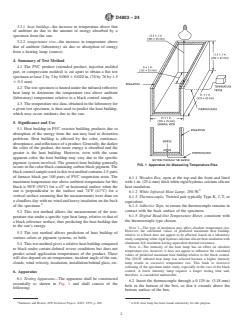
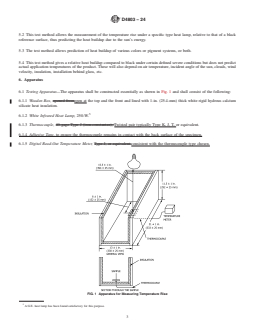
6.1 Testing Apparatus—The apparatus shall be constructed essentially as shown in Fig. 1 and shall consist of the following:
6.1.1 Wooden Box, opened fromopen at the top and the front and lined with 1-in. (25.4-mm) thick white rigid hydrous calcium
silicate heat insulation.
6.1.2 White Infrared Heat Lamp, 250-W.
6.1.3 Thermocouple, 40-gage Type J (iron-constantan); Twisted pair typically Type K, J, T, or equivalent.
6.1.4 Adhesive Tape, to ensure the thermocouple remains in contact with the back surface of the specimen.
6.1.5 Digital Read-Out Temperature Meter, Type J; or equivalent.consistent with the thermocouple type chosen.
FIG. 1 Apparatus for Measuring Temperature Rise
A G.E. heat lamp has been found satisfactory for this purpose.
D4803 − 24
NOTE 3—The type of insulation may affect absolute temperature rise. However, the calculated values of predicted maximum heat buildup, relative to a
black does not appear to be affected, based on a laboratory study comparing white rigid hydrous calcium silicate heat insulation with aluminum foil
insulation having equivalent thermal resistance.
NOTE 4—The intensity of the heat lamp has an effect on absolute temperature rise, however, it does not appear to influence the calculated values of
predicted maximum heat buildup relative to the black control. The 250-W infrared heat lamp was selected because a higher intensity lamp results in
excessive temperature rise. This leads to excessive softening of the specimen under study, especially in the case of the black control. A lower intensity
lamp requires a longer testing time and, therefore, is considered undesirable.
6.2 The thermocouple shall be inserted Insert the thermocouple through a 0.125-in. (3.18-mm) hole in the bottom of the box, so
that it extends 0.25 in. (6.35 mm) above the bottom surface of the box. The thermocouple bends under the weight of the specimen,
but shall retain contact with the specimen when the specimen is in place. The lamp shall be installed perpendicular to the
thermocouple.
6.2.1 The thermocouple bends under the weight
...