


ASTM D5075-01(2022)
(Test Method)Standard Test Method for Nicotine and 3-Ethenylpyridine in Indoor Air
Standard Test Method for Nicotine and 3-Ethenylpyridine in Indoor Air
SIGNIFICANCE AND USE
5.1 In order to estimate ETS concentrations, there needs to be a marker or tracer for ETS that is unique or highly specific to tobacco smoke, in sufficient concentrations in air to be measured easily at realistic smoking rates, and in constant proportion to the other components of ETS for a variety of tobacco blends and environmental conditions. Nicotine and 3-ethenylpyridine have been used as tracers of the vapor phase of ETS. Nicotine is the major alkaloid of tobacco and a major constituent of ETS. The determination of nicotine concentration has often been used to estimate the concentration of ETS; however, due to its unpredictable decay kinetics, nicotine may not be an ideal tracer. Because nicotine readily adsorbs to building materials and room furnishings and is depleted from ETS at a rate faster than most other components, some have suggested that nicotine concentrations underestimate ETS concentrations. Although this is true in many environments during the generation of smoke, the converse is true in environments with a recent past history of smoking. The adsorbed nicotine slowly desorbs over time, resulting in an overestimation of ETS concentrations. Thus, measured concentrations of nicotine precisely assess only airborne nicotine and indicate only that smoking has taken place; they do not necessarily indicate the presence, and certainly not the concentrations, of other ETS constituents. 3-Ethenylpyridine, on the other hand, has been shown to track exactly the vapor phase of ETS as measured by CO and FID response (3). It is for these reasons that 3-ethenylpyridine may be a better tracer of ETS (1, 4, 5). The ETS at high concentrations is known to be annoying and irritating to individuals, and concerns over potential health effects have also been expressed. There is a definite need to have reliable methods for the estimation of ETS levels in order to evaluate its effect. The NIOSH has previously set a recommended exposure limit (REL) for nicotine in the workp...
SCOPE
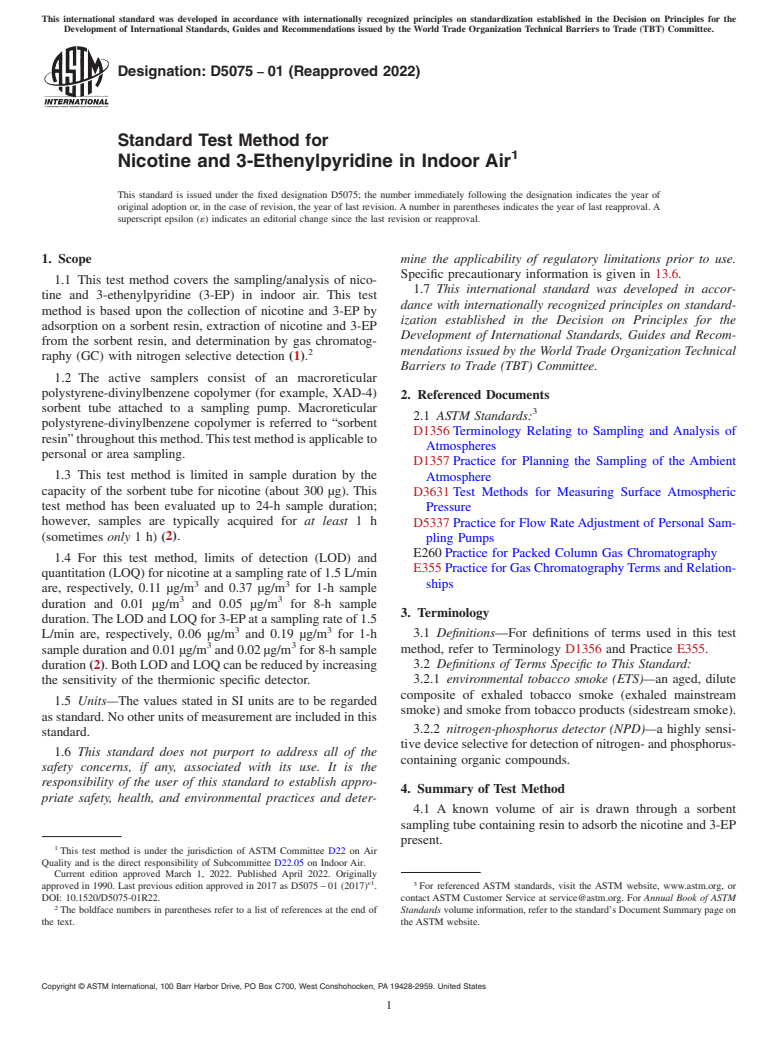
1.1 This test method covers the sampling/analysis of nicotine and 3-ethenylpyridine (3-EP) in indoor air. This test method is based upon the collection of nicotine and 3-EP by adsorption on a sorbent resin, extraction of nicotine and 3-EP from the sorbent resin, and determination by gas chromatography (GC) with nitrogen selective detection (1).2
1.2 The active samplers consist of an macroreticular polystyrene-divinylbenzene copolymer (for example, XAD-4) sorbent tube attached to a sampling pump. Macroreticular polystyrene-divinylbenzene copolymer is referred to “sorbent resin” throughout this method. This test method is applicable to personal or area sampling.
1.3 This test method is limited in sample duration by the capacity of the sorbent tube for nicotine (about 300 μg). This test method has been evaluated up to 24-h sample duration; however, samples are typically acquired for at least 1 h (sometimes only 1 h) (2).
1.4 For this test method, limits of detection (LOD) and quantitation (LOQ) for nicotine at a sampling rate of 1.5 L/min are, respectively, 0.11 μg/m3 and 0.37 μg/m 3 for 1-h sample duration and 0.01 μg/m3 and 0.05 μg/m3 for 8-h sample duration. The LOD and LOQ for 3-EP at a sampling rate of 1.5 L/min are, respectively, 0.06 μg/m 3 and 0.19 μg/m3 for 1-h sample duration and 0.01 μg/m3 and 0.02 μg/m3 for 8-h sample duration (2). Both LOD and LOQ can be reduced by increasing the sensitivity of the thermionic specific detector.
1.5 Units—The values stated in SI units are to be regarded as standard. No other units of measurement are included in this standard.
1.6 This standard does not purport to address all of the safety concerns, if any, associated with its use. It is the responsibility of the user of this standard to establish appropriate safety, health, and environmental practices and determine the applicability of regulatory limitations prior to use. Specific precautionary infor...
General Information
Relations
Standards Content (Sample)
This international standard was developed in accordance with internationally recognized principles on standardization established in the Decision on Principles for the
Development of International Standards, Guides and Recommendations issued by the World Trade Organization Technical Barriers to Trade (TBT) Committee.
Designation: D5075 − 01 (Reapproved 2022)
Standard Test Method for
1
Nicotine and 3-Ethenylpyridine in Indoor Air
This standard is issued under the fixed designation D5075; the number immediately following the designation indicates the year of
original adoption or, in the case of revision, the year of last revision.Anumber in parentheses indicates the year of last reapproval.A
superscript epsilon (´) indicates an editorial change since the last revision or reapproval.
1. Scope mine the applicability of regulatory limitations prior to use.
Specific precautionary information is given in 13.6.
1.1 This test method covers the sampling/analysis of nico-
1.7 This international standard was developed in accor-
tine and 3-ethenylpyridine (3-EP) in indoor air. This test
dance with internationally recognized principles on standard-
method is based upon the collection of nicotine and 3-EP by
ization established in the Decision on Principles for the
adsorption on a sorbent resin, extraction of nicotine and 3-EP
Development of International Standards, Guides and Recom-
from the sorbent resin, and determination by gas chromatog-
2 mendations issued by the World Trade Organization Technical
raphy (GC) with nitrogen selective detection (1).
Barriers to Trade (TBT) Committee.
1.2 The active samplers consist of an macroreticular
polystyrene-divinylbenzene copolymer (for example, XAD-4)
2. Referenced Documents
sorbent tube attached to a sampling pump. Macroreticular
3
2.1 ASTM Standards:
polystyrene-divinylbenzene copolymer is referred to “sorbent
D1356Terminology Relating to Sampling and Analysis of
resin”throughoutthismethod.Thistestmethodisapplicableto
Atmospheres
personal or area sampling.
D1357Practice for Planning the Sampling of the Ambient
1.3 This test method is limited in sample duration by the
Atmosphere
capacity of the sorbent tube for nicotine (about 300 µg). This
D3631Test Methods for Measuring Surface Atmospheric
test method has been evaluated up to 24-h sample duration;
Pressure
however, samples are typically acquired for at least 1h
D5337Practice for Flow RateAdjustment of Personal Sam-
(sometimes only1h) (2).
pling Pumps
E260Practice for Packed Column Gas Chromatography
1.4 For this test method, limits of detection (LOD) and
E355PracticeforGasChromatographyTermsandRelation-
quantitation(LOQ)fornicotineatasamplingrateof1.5L/min
3 3
ships
are, respectively, 0.11 µg/m and 0.37 µg/m for 1-h sample
3 3
duration and 0.01 µg/m and 0.05 µg/m for 8-h sample
3. Terminology
duration.TheLODandLOQfor3-EPatasamplingrateof1.5
3 3
3.1 Definitions—For definitions of terms used in this test
L/min are, respectively, 0.06 µg/m and 0.19 µg/m for 1-h
3 3
sampledurationand0.01µg/m and0.02µg/m for8-hsample method, refer to Terminology D1356 and Practice E355.
3.2 Definitions of Terms Specific to This Standard:
duration (2).BothLODandLOQcanbereducedbyincreasing
the sensitivity of the thermionic specific detector. 3.2.1 environmental tobacco smoke (ETS)—an aged, dilute
composite of exhaled tobacco smoke (exhaled mainstream
1.5 Units—The values stated in SI units are to be regarded
smoke) and smoke from tobacco products (sidestream smoke).
asstandard.Nootherunitsofmeasurementareincludedinthis
3.2.2 nitrogen-phosphorus detector (NPD)—a highly sensi-
standard.
tivedeviceselectivefordetectionofnitrogen-andphosphorus-
1.6 This standard does not purport to address all of the
containing organic compounds.
safety concerns, if any, associated with its use. It is the
responsibility of the user of this standard to establish appro-
4. Summary of Test Method
priate safety, health, and environmental practices and deter-
4.1 A known volume of air is drawn through a sorbent
samplingtubecontainingresintoadsorbthenicotineand3-EP
present.
1
This test method is under the jurisdiction of ASTM Committee D22 on Air
Quality and is the direct responsibility of Subcommittee D22.05 on Indoor Air.
Current edition approved March 1, 2022. Published April 2022. Originally
ɛ1
3
approved in 1990. Last previous edition approved in 2017 as D5075–01 (2017) . For referenced ASTM standards, visit the ASTM website, www.astm.org, or
DOI: 10.1520/D5075-01R22. contact ASTM Customer Service at service@astm.org. For Annual Book of ASTM
2
The boldface numbers in parentheses refer to a list of references at the end of Standards volume information, refer to the standard’s Document Summary page on
the text. the ASTM website.
Copyright © ASTM International, 100 Barr Harbor Drive, PO Box C700, West Conshohocken, PA 19428-2959. United States
1
---------------------- Page: 1 ----------------------
D5075 − 01 (2022)
4.2 The sorbent tube contents are transferred to a 2-mL val
...
Questions, Comments and Discussion
Ask us and Technical Secretary will try to provide an answer. You can facilitate discussion about the standard in here.