


ASTM F3024-13
(Guide)Standard Guide for Training of a Land Search and Rescue (SAR) Strike Team/Task Force Leader
Standard Guide for Training of a Land Search and Rescue (SAR) Strike Team/Task Force Leader
SIGNIFICANCE AND USE
4.1 This guide establishes the minimum standard for training Land Search and Rescue Strike Team/Task Force Leaders as it relates to their general, field, and search and rescue specific knowledge, skills, and abilities.
4.2 This guide is to be used by individuals and AHJs that wish to identify the minimum training required for a Land Search and Rescue Strike Team/Task Force Leader.
4.3 Every person who is identified as a Land Search and Rescue Strike Team/Task Force Leader shall have met the requirements in this guide.
4.4 It is the responsibility of the AHJ to determine the depth or detail of training needed to meet the requirements in this guide and it may include additional requirements for its own members.
4.5 This guide by itself is not a training document. It is an outline of the topics required for training or evaluating a Land Search and Rescue Strike Team/Task Force Leader. It can, however, be used to develop, or as part of, a training document or program.
4.6 This guide does not stand alone and must be used with the referenced documents to provide specific information needed by a Land Search and Rescue Strike Team/Task Force Leader.
4.7 This guide can be used to evaluate a document to determine if its content includes the topics necessary for training a Land Search and Rescue Strike Team/Task Force Leader. Likewise, this guide may be used to evaluate an existing training program to see if it meets the requirements in this guide.
4.8 The knowledge, skills, and abilities presented in the following sections are not in any particular order, and do not represent a training sequence.
4.9 The AHJ will determine the evaluation process to assess a person’s knowledge. This may be by written exam, oral exam, demonstration, or other means specified by the AHJ.
SCOPE
1.1 This guide establishes the minimum training for Land SAR Strike Team/Task Force Leaders as it relates to their general, field, and search and rescue specific knowledge, skills, and abilities.
1.2 A Land SAR Strike Team Leader/Task Force Leader is responsible for direct supervision, general leadership, wellness, and safety of multiple SAR teams and resources operating on all land and water environments, including intertidal areas, but not oceans or swiftwater.
1.3 Type I-IV teams which may utilize personnel trained to this guide are Kind A (wilderness), Kind B (urban), and Kind C (mountainous/alpine), Kind D (disaster/collapse), Kind E (inland water), Kind G (cave), Kind H (mine), Kind I (avalanche), Kind J (evidence/cadaver), Kind K (aircraft), and/or Kind L (unclassified). See ASTM F1993.
1.4 A Land SAR Strike Team Leader/Task Force Leader may work in remote areas including urban or disaster areas that may be isolated or have lost their infrastructure.
1.5 Further training may be required depending on the regulations or policies of the Authority Having Jurisdiction (AHJ).
1.6 This standard does not purport to address all of the safety concerns, if any, associated with its use. It is the responsibility of the user of this standard to establish appropriate safety and health practices and determine the applicability of regulatory limitations prior to use or as defined within a (regional or geographical) response region or by the AHJ.
General Information
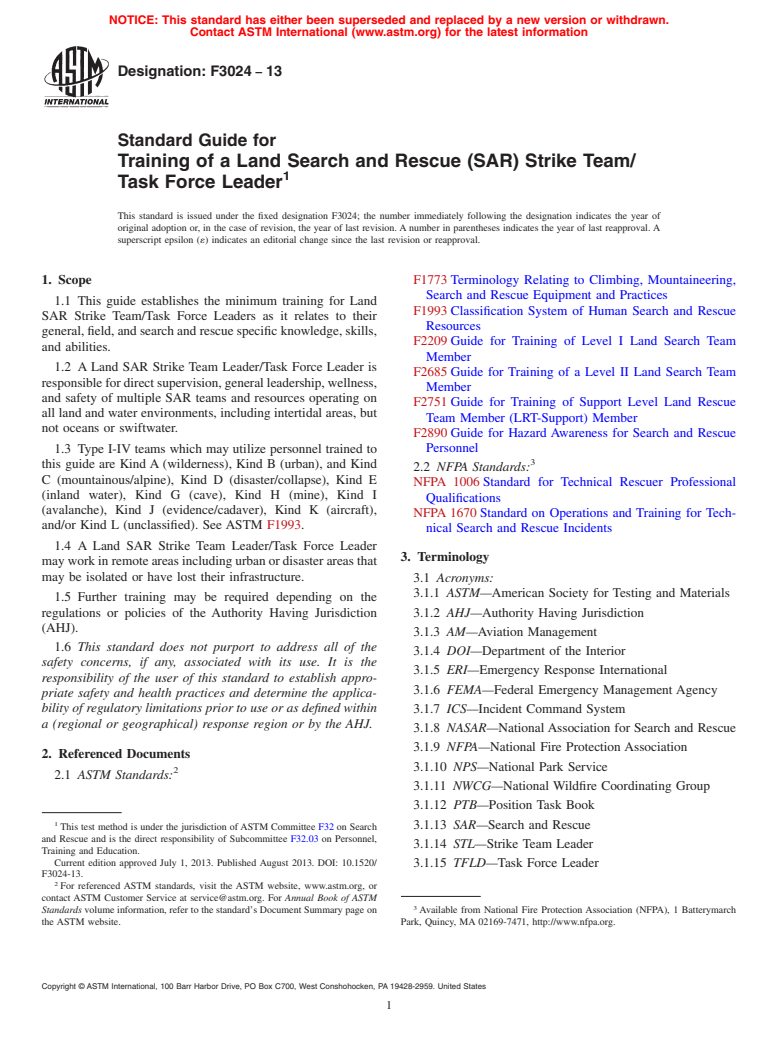
Standards Content (Sample)
NOTICE: This standard has either been superseded and replaced by a new version or withdrawn.
Contact ASTM International (www.astm.org) for the latest information
Designation: F3024 − 13
Standard Guide for
Training of a Land Search and Rescue (SAR) Strike Team/
1
Task Force Leader
This standard is issued under the fixed designation F3024; the number immediately following the designation indicates the year of
original adoption or, in the case of revision, the year of last revision. A number in parentheses indicates the year of last reapproval. A
superscript epsilon (´) indicates an editorial change since the last revision or reapproval.
1. Scope F1773 Terminology Relating to Climbing, Mountaineering,
Search and Rescue Equipment and Practices
1.1 This guide establishes the minimum training for Land
F1993 Classification System of Human Search and Rescue
SAR Strike Team/Task Force Leaders as it relates to their
Resources
general, field, and search and rescue specific knowledge, skills,
F2209 Guide for Training of Level I Land Search Team
and abilities.
Member
1.2 A Land SAR Strike Team Leader/Task Force Leader is
F2685 Guide for Training of a Level II Land Search Team
responsiblefordirectsupervision,generalleadership,wellness,
Member
and safety of multiple SAR teams and resources operating on
F2751 Guide for Training of Support Level Land Rescue
all land and water environments, including intertidal areas, but
Team Member (LRT-Support) Member
not oceans or swiftwater.
F2890 Guide for Hazard Awareness for Search and Rescue
Personnel
1.3 Type I-IV teams which may utilize personnel trained to
3
this guide are Kind A (wilderness), Kind B (urban), and Kind
2.2 NFPA Standards:
C (mountainous/alpine), Kind D (disaster/collapse), Kind E
NFPA 1006 Standard for Technical Rescuer Professional
(inland water), Kind G (cave), Kind H (mine), Kind I
Qualifications
(avalanche), Kind J (evidence/cadaver), Kind K (aircraft),
NFPA 1670 Standard on Operations and Training for Tech-
and/or Kind L (unclassified). See ASTM F1993.
nical Search and Rescue Incidents
1.4 A Land SAR Strike Team Leader/Task Force Leader
3. Terminology
mayworkinremoteareasincludingurbanordisasterareasthat
may be isolated or have lost their infrastructure. 3.1 Acronyms:
3.1.1 ASTM—American Society for Testing and Materials
1.5 Further training may be required depending on the
regulations or policies of the Authority Having Jurisdiction 3.1.2 AHJ—Authority Having Jurisdiction
(AHJ).
3.1.3 AM—Aviation Management
1.6 This standard does not purport to address all of the
3.1.4 DOI—Department of the Interior
safety concerns, if any, associated with its use. It is the
3.1.5 ERI—Emergency Response International
responsibility of the user of this standard to establish appro-
3.1.6 FEMA—Federal Emergency Management Agency
priate safety and health practices and determine the applica-
bility of regulatory limitations prior to use or as defined within
3.1.7 ICS—Incident Command System
a (regional or geographical) response region or by the AHJ.
3.1.8 NASAR—National Association for Search and Rescue
3.1.9 NFPA—National Fire Protection Association
2. Referenced Documents
3.1.10 NPS—National Park Service
2
2.1 ASTM Standards:
3.1.11 NWCG—National Wildfire Coordinating Group
3.1.12 PTB—Position Task Book
1
This test method is under the jurisdiction of ASTM Committee F32 on Search 3.1.13 SAR—Search and Rescue
and Rescue and is the direct responsibility of Subcommittee F32.03 on Personnel,
3.1.14 STL—Strike Team Leader
Training and Education.
Current edition approved July 1, 2013. Published August 2013. DOI: 10.1520/
3.1.15 TFLD—Task Force Leader
F3024-13.
2
For referenced ASTM standards, visit the ASTM website, www.astm.org, or
contact ASTM Customer Service at service@astm.org. For Annual Book of ASTM
3
Standards volume information, refer to the standard’s Document Summary page on Available from National Fire Protection Association (NFPA), 1 Batterymarch
the ASTM website. Park, Quincy, MA 02169-7471, http://www.nfpa.org.
Copyright © ASTM International, 100 Barr Harbor Drive, PO Box C700, West Conshohocken, PA 19428-2959. United States
1
---------------------- Page: 1 ----------------------
F3024 − 13
3.2 Definitions: 4.7 This guide can be used to evaluate a document to
3.2.1 authority having jurisdiction, n—an organization, determine if its content includes the topics necessary for
office, or individual responsible for enforcing the requirements training a Land Search and Rescue Strike Team/Task Force
of a code or standard, or for approving equipment, materials, Leader. Likewise, this guide may be used to evaluate an
and installation or procedure. existing training program to see if it meets the requirements in
this guide.
3.2.2 division/group supervisor, n—in ICS terms, respon-
sible for supervising equipment and personnel assigned to a
4.8 The knowledge, skills, and abilities presented in the
division or group. May also act as a Strike Team Leader/Task
following sections are not in
...
Questions, Comments and Discussion
Ask us and Technical Secretary will try to provide an answer. You can facilitate discussion about the standard in here.