

ASTM E1450-16
(Test Method)Standard Test Method for Tension Testing of Structural Alloys in Liquid Helium
General Information
- Abstract
SIGNIFICANCE AND USE
4.1 Tension tests provide information on the strength and ductility of materials under uniaxial tensile stresses. This information may be useful for alloy development, comparison and selection of materials, and quality control. Under certain circumstances, the information may also be useful for design.
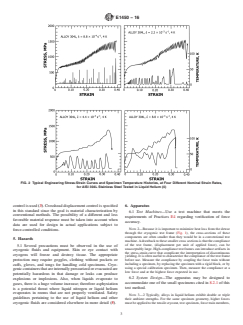
4.2 The force-time and force-extension records for some alloys tested in liquid helium using displacement control are often serrated (1).3 Serrations are formed by repeated bursts of unstable plastic flow and arrests. The unstable plastic flow (discontinuous yielding) is a free-running process occurring in localized regions of the reduced section at higher than nominal rates of strain with internal specimen heating. Examples of serrated stress-strain curves for a typical austenitic stainless steel with discontinuous yielding are shown in Fig. 2.
4.3 A constant specimen temperature cannot be maintained at all times during tests in liquid helium. The specimen temperature at local regions in the reduced section rises temporarily above 4 K during each discontinuous yielding event (see Fig. 2), owing to adiabatic heating. The number of events and the magnitude of the associated drops in magnitude of force are a function of the material composition and other factors such as specimen size and test speed. Typically, altering the mechanical test variables can modify but not eliminate the discontinuous yielding (2-4). Therefore, tensile property measurements of alloys in liquid helium (especially tensile strength, elongation, and reduction of area) lack the usual significance of property measurements at room temperature where deformation is more nearly isothermal and discontinuous yielding typically does not occur.
4.4 The stress-strain response of a material tested in liquid helium depends on whether force control or displacement control is used (3). Crosshead displacement control is specified in this standard since the goal is material characterization by convention...
SCOPE
1.1 This test method describes procedures for the tension testing of structural alloys in liquid helium. The format is similar to that of other ASTM tension test standards, but the contents include modifications for cryogenic testing which requires special apparatus, smaller specimens, and concern for serrated yielding, adiabatic heating, and strain-rate effects.
1.2 To conduct a tension test by this standard, the specimen in a tensile cryostat is fully submerged in normal liquid helium (He I) and tested using crosshead displacement control at a nominal strain rate of 10−3 mm/mm/s or less. Tests using force control or high strain rates are not considered.
1.3 This standard specifies methods for the measurement of yield strength, tensile strength, elongation, and reduction of area. The determination of the Young’s modulus is treated in Test Method E111.
Note 1: The boiling point of normal liquid helium (He I) at sea level is 4.2 K (−269°C or −452.1°F or 7.6°R). It decreases with geographic elevation and is 4.0 K (−269.2°C or −452.5°F or 7.2°R) at the National Institute of Standards and Technology in Colorado, 1677 m (5500 ft) above sea level. In this standard the temperature is designated 4 K.
1.4 Values stated in SI units are treated as primary. Values stated in U.S. customary units are treated as secondary.
1.5 This standard does not purport to address all of the safety concerns, if any, associated with its use. It is the responsibility of the user of this standard to establish appropriate safety and health practices and determine the applicability of regulatory limitations prior to use. See Section 5.
- Status
- Published
- Publication Date
- 14-Nov-2016
- Technical Committee
- E28 - Mechanical Testing
- Drafting Committee
- E28.04 - Uniaxial Testing
Buy Documents
ASTM E1450-16 - Standard Test Method for Tension Testing of Structural Alloys in Liquid Helium
REDLINE ASTM E1450-16 - Standard Test Method for Tension Testing of Structural Alloys in Liquid Helium
Overview
ASTM E1450-16: Standard Test Method for Tension Testing of Structural Alloys in Liquid Helium provides specialized procedures for evaluating the strength and ductility of structural alloys at cryogenic temperatures, specifically in liquid helium (approximately 4 K). This method builds on conventional ASTM tension test standards but incorporates modifications required for cryogenic environments, such as unique apparatus design, smaller specimen sizes, and considerations for discontinuous yielding, adiabatic heating, and strain-rate effects.
Tension testing in liquid helium is critical for applications where materials are exposed to extremely low temperatures, including advanced alloys used in superconducting magnets, cryogenic storage, and space technology. ASTM E1450-16 supports alloy development, material comparison and selection, and quality assurance processes for such demanding applications.
Key Topics
- Cryogenic Tension Testing: Detailed methodology for conducting uniaxial tensile tests on alloys fully submerged in liquid helium, using specified strain rates and system configurations.
- Measurement Parameters: Methods for determining yield strength, tensile strength, elongation, and reduction of area at 4 K, thereby assessing material performance under cryogenic conditions.
- Discontinuous Yielding and Serrated Curves: Management of unique plastic deformation phenomena (serrated yielding) that can arise when testing at liquid helium temperatures, including effects on data interpretation and test significance.
- Apparatus Requirements: Specifications for tensile cryostats, gripping devices, extensometers, and temperature maintenance to ensure accurate and reliable test results.
- Sample Preparation: Guidelines on specimen removal, machining, alignment, dimensional measurement, and marking for accurate stress-strain analysis.
- Safety Considerations: Emphasis on the hazards associated with cryogenic fluids, including liquid helium handling, pressurization risks, and asphyxiation hazards, as well as recommended safety practices.
Applications
ASTM E1450-16 is essential for industries and research sectors where material performance at cryogenic temperatures is a critical design factor, such as:
- Superconducting Systems: Evaluating the mechanical properties of alloys used in superconducting magnets and other low-temperature electrical devices.
- Aerospace and Space Exploration: Qualifying structural alloys for spacecraft, launch vehicles, and deep-space probes subjected to extreme cold environments.
- Cryogenic Storage and Transfer: Developing reliable components for storage tanks and pipelines handling liquefied gases, such as helium and hydrogen.
- Fundamental Materials Research: Supporting the comparison, development, and improvement of structural alloys intended for advanced, low-temperature applications.
- Quality Control: Providing benchmarks for alloy producers and end users seeking to verify the mechanical integrity of products intended for cryogenic service.
Related Standards
ASTM E1450-16 references and builds upon several other ASTM standards to ensure comprehensive and consistent mechanical testing under cryogenic conditions, including:
- ASTM E8/E8M – Standard Test Methods for Tension Testing of Metallic Materials
- ASTM E111 – Test Method for Young’s Modulus, Tangent Modulus, and Chord Modulus
- ASTM E4 – Practices for Force Verification of Testing Machines
- ASTM E6 – Terminology Relating to Methods of Mechanical Testing
- ASTM E29 – Practice for Using Significant Digits in Test Data to Determine Conformance with Specifications
- ASTM E83 – Practice for Verification and Classification of Extensometer Systems
- ASTM E177 – Practice for Use of the Terms Precision and Bias in ASTM Test Methods
- ASTM E691 – Practice for Conducting an Interlaboratory Study to Determine the Precision of a Test Method
- ASTM E1012 – Practice for Verification of Testing Frame and Specimen Alignment Under Tensile and Compressive Axial Force Application
For organizations engaged in the design, selection, and quality assurance of materials used in cryogenic applications, compliance with ASTM E1450-16 and its referenced standards ensures accurate, repeatable, and relevant measurement of mechanical properties at extremely low temperatures.
By following ASTM E1450-16, engineers, materials scientists, and quality control professionals can confidently assess structural alloys for cryogenic strength, ductility, and reliability, supporting innovation and safety in high-technology fields demanding robust performance at 4 K.
Relations
- Replaces
ASTM E1450-09 - Standard Test Method for Tension Testing of Structural Alloys in Liquid Helium - Effective Date
- 15-Nov-2016
- Effective Date
- 01-Mar-2024
- Effective Date
- 01-Jan-2024
- Effective Date
- 01-Jul-2019
- Refers
ASTM A370-17a - Standard Test Methods and Definitions for Mechanical Testing of Steel Products - Effective Date
- 15-Nov-2017
- Effective Date
- 01-Jan-2017
- Effective Date
- 15-Jul-2016
- Effective Date
- 01-Nov-2015
- Effective Date
- 01-Feb-2015
- Effective Date
- 01-Jun-2014
- Effective Date
- 15-May-2014
- Effective Date
- 01-May-2014
- Effective Date
- 15-Nov-2013
- Effective Date
- 01-Jun-2013
- Effective Date
- 01-May-2013
Buy Documents
ASTM E1450-16 - Standard Test Method for Tension Testing of Structural Alloys in Liquid Helium
REDLINE ASTM E1450-16 - Standard Test Method for Tension Testing of Structural Alloys in Liquid Helium
Get Certified
Connect with accredited certification bodies for this standard

Element Materials Technology
Materials testing and product certification.

Inštitut za kovinske materiale in tehnologije
Institute of Metals and Technology. Materials testing, metallurgical analysis, NDT.
Sponsored listings
Frequently Asked Questions
ASTM E1450-16 is a standard published by ASTM International. Its full title is "Standard Test Method for Tension Testing of Structural Alloys in Liquid Helium". This standard covers: SIGNIFICANCE AND USE 4.1 Tension tests provide information on the strength and ductility of materials under uniaxial tensile stresses. This information may be useful for alloy development, comparison and selection of materials, and quality control. Under certain circumstances, the information may also be useful for design. 4.2 The force-time and force-extension records for some alloys tested in liquid helium using displacement control are often serrated (1).3 Serrations are formed by repeated bursts of unstable plastic flow and arrests. The unstable plastic flow (discontinuous yielding) is a free-running process occurring in localized regions of the reduced section at higher than nominal rates of strain with internal specimen heating. Examples of serrated stress-strain curves for a typical austenitic stainless steel with discontinuous yielding are shown in Fig. 2. 4.3 A constant specimen temperature cannot be maintained at all times during tests in liquid helium. The specimen temperature at local regions in the reduced section rises temporarily above 4 K during each discontinuous yielding event (see Fig. 2), owing to adiabatic heating. The number of events and the magnitude of the associated drops in magnitude of force are a function of the material composition and other factors such as specimen size and test speed. Typically, altering the mechanical test variables can modify but not eliminate the discontinuous yielding (2-4). Therefore, tensile property measurements of alloys in liquid helium (especially tensile strength, elongation, and reduction of area) lack the usual significance of property measurements at room temperature where deformation is more nearly isothermal and discontinuous yielding typically does not occur. 4.4 The stress-strain response of a material tested in liquid helium depends on whether force control or displacement control is used (3). Crosshead displacement control is specified in this standard since the goal is material characterization by convention... SCOPE 1.1 This test method describes procedures for the tension testing of structural alloys in liquid helium. The format is similar to that of other ASTM tension test standards, but the contents include modifications for cryogenic testing which requires special apparatus, smaller specimens, and concern for serrated yielding, adiabatic heating, and strain-rate effects. 1.2 To conduct a tension test by this standard, the specimen in a tensile cryostat is fully submerged in normal liquid helium (He I) and tested using crosshead displacement control at a nominal strain rate of 10−3 mm/mm/s or less. Tests using force control or high strain rates are not considered. 1.3 This standard specifies methods for the measurement of yield strength, tensile strength, elongation, and reduction of area. The determination of the Young’s modulus is treated in Test Method E111. Note 1: The boiling point of normal liquid helium (He I) at sea level is 4.2 K (−269°C or −452.1°F or 7.6°R). It decreases with geographic elevation and is 4.0 K (−269.2°C or −452.5°F or 7.2°R) at the National Institute of Standards and Technology in Colorado, 1677 m (5500 ft) above sea level. In this standard the temperature is designated 4 K. 1.4 Values stated in SI units are treated as primary. Values stated in U.S. customary units are treated as secondary. 1.5 This standard does not purport to address all of the safety concerns, if any, associated with its use. It is the responsibility of the user of this standard to establish appropriate safety and health practices and determine the applicability of regulatory limitations prior to use. See Section 5.
SIGNIFICANCE AND USE 4.1 Tension tests provide information on the strength and ductility of materials under uniaxial tensile stresses. This information may be useful for alloy development, comparison and selection of materials, and quality control. Under certain circumstances, the information may also be useful for design. 4.2 The force-time and force-extension records for some alloys tested in liquid helium using displacement control are often serrated (1).3 Serrations are formed by repeated bursts of unstable plastic flow and arrests. The unstable plastic flow (discontinuous yielding) is a free-running process occurring in localized regions of the reduced section at higher than nominal rates of strain with internal specimen heating. Examples of serrated stress-strain curves for a typical austenitic stainless steel with discontinuous yielding are shown in Fig. 2. 4.3 A constant specimen temperature cannot be maintained at all times during tests in liquid helium. The specimen temperature at local regions in the reduced section rises temporarily above 4 K during each discontinuous yielding event (see Fig. 2), owing to adiabatic heating. The number of events and the magnitude of the associated drops in magnitude of force are a function of the material composition and other factors such as specimen size and test speed. Typically, altering the mechanical test variables can modify but not eliminate the discontinuous yielding (2-4). Therefore, tensile property measurements of alloys in liquid helium (especially tensile strength, elongation, and reduction of area) lack the usual significance of property measurements at room temperature where deformation is more nearly isothermal and discontinuous yielding typically does not occur. 4.4 The stress-strain response of a material tested in liquid helium depends on whether force control or displacement control is used (3). Crosshead displacement control is specified in this standard since the goal is material characterization by convention... SCOPE 1.1 This test method describes procedures for the tension testing of structural alloys in liquid helium. The format is similar to that of other ASTM tension test standards, but the contents include modifications for cryogenic testing which requires special apparatus, smaller specimens, and concern for serrated yielding, adiabatic heating, and strain-rate effects. 1.2 To conduct a tension test by this standard, the specimen in a tensile cryostat is fully submerged in normal liquid helium (He I) and tested using crosshead displacement control at a nominal strain rate of 10−3 mm/mm/s or less. Tests using force control or high strain rates are not considered. 1.3 This standard specifies methods for the measurement of yield strength, tensile strength, elongation, and reduction of area. The determination of the Young’s modulus is treated in Test Method E111. Note 1: The boiling point of normal liquid helium (He I) at sea level is 4.2 K (−269°C or −452.1°F or 7.6°R). It decreases with geographic elevation and is 4.0 K (−269.2°C or −452.5°F or 7.2°R) at the National Institute of Standards and Technology in Colorado, 1677 m (5500 ft) above sea level. In this standard the temperature is designated 4 K. 1.4 Values stated in SI units are treated as primary. Values stated in U.S. customary units are treated as secondary. 1.5 This standard does not purport to address all of the safety concerns, if any, associated with its use. It is the responsibility of the user of this standard to establish appropriate safety and health practices and determine the applicability of regulatory limitations prior to use. See Section 5.
ASTM E1450-16 is classified under the following ICS (International Classification for Standards) categories: 77.040.10 - Mechanical testing of metals. The ICS classification helps identify the subject area and facilitates finding related standards.
ASTM E1450-16 has the following relationships with other standards: It is inter standard links to ASTM E1450-09, ASTM A370-24, ASTM E8/E8M-24, ASTM A370-19, ASTM A370-17a, ASTM A370-17, ASTM E8/E8M-16, ASTM A370-15, ASTM E8/E8M-15, ASTM E4-14, ASTM A370-14, ASTM E177-14, ASTM A370-13, ASTM E8/E8M-13, ASTM E691-13. Understanding these relationships helps ensure you are using the most current and applicable version of the standard.
ASTM E1450-16 is available in PDF format for immediate download after purchase. The document can be added to your cart and obtained through the secure checkout process. Digital delivery ensures instant access to the complete standard document.
Standards Content (Sample)
This international standard was developed in accordance with internationally recognized principles on standardization established in the Decision on Principles for the
Development of International Standards, Guides and Recommendations issued by the World Trade Organization Technical Barriers to Trade (TBT) Committee.
Designation: E1450 − 16
Standard Test Method for
Tension Testing of Structural Alloys in Liquid Helium
This standard is issued under the fixed designation E1450; the number immediately following the designation indicates the year of
original adoption or, in the case of revision, the year of last revision.Anumber in parentheses indicates the year of last reapproval.A
superscript epsilon (´) indicates an editorial change since the last revision or reapproval.
1. Scope E4Practices for Force Verification of Testing Machines
E6Terminology Relating to Methods of MechanicalTesting
1.1 This test method describes procedures for the tension
E8/E8MTest Methods for Tension Testing of Metallic Ma-
testing of structural alloys in liquid helium. The format is
terials
similar to that of other ASTM tension test standards, but the
E29Practice for Using Significant Digits in Test Data to
contents include modifications for cryogenic testing which
Determine Conformance with Specifications
requires special apparatus, smaller specimens, and concern for
E83Practice for Verification and Classification of Exten-
serrated yielding, adiabatic heating, and strain-rate effects.
someter Systems
1.2 To conduct a tension test by this standard, the specimen
E177Practice for Use of the Terms Precision and Bias in
inatensilecryostatisfullysubmergedinnormalliquidhelium
ASTM Test Methods
(He I) and tested using crosshead displacement control at a
−3 E691Practice for Conducting an Interlaboratory Study to
nominal strain rate of 10 mm/mm/s or less.Tests using force
Determine the Precision of a Test Method
control or high strain rates are not considered.
E111Test Method for Young’s Modulus, Tangent Modulus,
1.3 This standard specifies methods for the measurement of
and Chord Modulus
yield strength, tensile strength, elongation, and reduction of
E1012Practice for Verification of Testing Frame and Speci-
area. The determination of the Young’s modulus is treated in
men Alignment Under Tensile and Compressive Axial
Test Method E111.
Force Application
NOTE 1—The boiling point of normal liquid helium (He I) at sea level
is 4.2 K (−269°C or −452.1°F or 7.6°R). It decreases with geographic
3. Terminology
elevation and is 4.0 K (−269.2°C or −452.5°F or 7.2°R) at the National
Institute of Standards and Technology in Colorado, 1677 m (5500 ft)
3.1 Definitions of Terms Common to Mechanical Testing—
above sea level. In this standard the temperature is designated 4 K.
3.1.1 The definitions of mechanical testing terms that ap-
1.4 Values stated in SI units are treated as primary. Values
pear in the Terminology E6 apply to this test method. These
stated in U.S. customary units are treated as secondary.
terms include bending strain, elongation, extensometer, force,
1.5 This standard does not purport to address all of the gauge length, proportional limit, reduced section, reduction of
safety concerns, if any, associated with its use. It is the
area,stress-straindiagram,tensilestrength,andYoung’smodu-
responsibility of the user of this standard to establish appro-
lus.
priate safety and health practices and determine the applica-
3.1.2 In addition, the following common terms fromTermi-
bility of regulatory limitations prior to use. See Section 5.
nology E6 are defined:
3.1.3 adjusted length of the reduced section—the length of
2. Referenced Documents
the reduced section plus an amount calculated to compensate
2.1 ASTM Standards:
for strain in the fillet region.
A370Test Methods and Definitions for Mechanical Testing
3.1.4 discontinuous yielding, n—in a uniaxial test, a hesita-
of Steel Products
tion or fluctuation of force observed at the onset of plastic
deformation, due to localized yielding.
This test method is under the jurisdiction of ASTM Committee E28 on
3.1.4.1 Discussion—The stress-strain curve need not appear
Mechanical Testing and is the direct responsibility of Subcommittee E28.04 on
to be discontinuous.
Uniaxial Testing.
Current edition approved Nov. 15, 2016. Published February 2017. Originally
3.1.5 discontinuous yielding stress,σ—thepeakstressatthe
i
approved in 1992. Last previous edition approved in 2009 as E1450–09. DOI:
initiation of the first measurable serration on the curve of
10.1520/E1450-16.
For referenced ASTM standards, visit the ASTM website, www.astm.org, or
stress-versus-strain.
contact ASTM Customer Service at service@astm.org. For Annual Book of ASTM
3.1.5.1 Discussion—The parameter σ is a function of test
Standards volume information, refer to the standard’s Document Summary page on i
the ASTM website. variables and is not a material constant.
Copyright © ASTM International, 100 Barr Harbor Drive, PO Box C700, West Conshohocken, PA 19428-2959. United States
E1450 − 16
3.1.6 gauge length, n—the original length of that portion of and selection of materials, and quality control. Under certain
thespecimenoverwhichstrain,elongation,orchangeoflength circumstances, the information may also be useful for design.
is determined.
4.2 The force-time and force-extension records for some
3.1.6.1 Discussion—Typically, this length is also the dis-
alloys tested in liquid helium using displacement control are
tance between gauge marks, if gauge marking is used to 3
often serrated (1). Serrations are formed by repeated bursts of
facilitate measurement of the elongation after fracture.
unstable plastic flow and arrests. The unstable plastic flow
3.1.6.2 Discussion—When sensing extension or motion
(discontinuous yielding) is a free-running process occurring in
with a gauge length that is predetermined by the specimen
localizedregionsofthereducedsectionathigherthannominal
geometry or specific test method, then only resolution and
rates of strain with internal specimen heating. Examples of
strainerrorforthespecifiedgaugelengthshoulddeterminethe
serrated stress-strain curves for a typical austenitic stainless
class of the extensometer system.
steel with discontinuous yielding are shown in Fig. 2.
3.1.7 length of the reduced section—the distance between
4.3 A constant specimen temperature cannot be maintained
the tangent points of the fillets that bound the reduced section.
at all times during tests in liquid helium. The specimen
3.1.8 reduced section—the central portion of the specimen
temperature at local regions in the reduced section rises
that has a cross section smaller than the gripped ends.
temporarily above 4 K during each discontinuous yielding
3.1.8.1 Discussion—The cross section is uniform within
event (see Fig. 2), owing to adiabatic heating. The number of
prescribed tolerances.
events and the magnitude of the associated drops in magnitude
of force are a function of the material composition and other
3.2 Definitions of Terms Specific to This Standard:
factorssuchasspecimensizeandtestspeed.Typically,altering
3.2.1 adiabatic heating—the internal heating of a specimen
the mechanical test variables can modify but not eliminate the
resulting from tension testing under conditions such that the
discontinuous yielding (2-4). Therefore, tensile property mea-
heat generated by plastic work cannot be quickly dissipated to
surements of alloys in liquid helium (especially tensile
the surrounding cryogen.
strength, elongation, and reduction of area) lack the usual
3.2.2 Dewar—a vacuum-insulated container for cryogenic
significance of property measurements at room temperature
fluids.
where deformation is more nearly isothermal and discontinu-
3.2.3 tensile cryostat—a test apparatus for applying tensile
ous yielding typically does not occur.
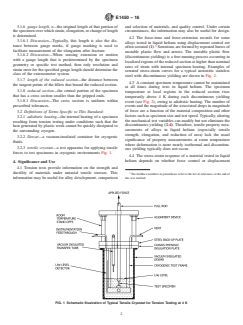
forces to test specimens in cryogenic environments Fig. 1.
4.4 The stress-strain response of a material tested in liquid
helium depends on whether force control or displacement
4. Significance and Use
4.1 Tension tests provide information on the strength and
ductility of materials under uniaxial tensile stresses. This 3
Theboldfacenumbersinparenthesesrefertothelistofreferencesattheendof
information may be useful for alloy development, comparison this test method.
FIG. 1 Schematic Illustration of Typical Tensile Cryostat for Tension Testing at 4 K
E1450 − 16
FIG. 2 Typical Engineering Stress-Strain Curves and Specimen Temperature Histories, at Four Different Nominal Strain Rates,
for AISI 304L Stainless Steel Tested in Liquid Helium (4)
controlisused (3).Crossheaddisplacementcontrolisspecified 6. Apparatus
in this standard since the goal is material characterization by
6.1 Test Machines—Use a test machine that meets the
conventional methods. The possibility of a different and less
requirements of Practices E4 regarding verification of force
favorable material response must be taken into account when
accuracy.
data are used for design in actual applications subject to
NOTE 2—Because it is important to minimize heat loss from the dewar
force-controlled conditions.
through the cryogenic test frame (Fig. 1), the cross-sections of these
components are often smaller than they would be in a conventional test
5. Hazards
machine.Adrawbacktothesesmallercrosssectionsisthatthecompliance
of the test frame, (displacement per unit of applied force), can be
5.1 Several precautions must be observed in the use of
unacceptablylarge.High-compliancetestframescanintroduceartifactsin
cryogenic fluids and equipment. Skin or eye contact with
the stress-strain curve that complicate the interpretation of discontinuous
cryogens will freeze and destroy tissue. The appropriate
yielding. It is often useful to characterize the compliance of the test frame
protection may require goggles, clothing without pockets or
before use. Measure the compliance by coupling the force train without
cuffs, gloves, and tongs for handling cold specimens. Cryo- including a specimen, by replacing the specimen with a rigid block, or by
using a special calibration specimen. Then, measure the compliance at a
geniccontainersthatareinternallypressurizedorevacuatedare
low force and at the highest force expected in use.
potentially hazardous in that damage or leaks can produce
6.2 System Design—The apparatus may be designed to
explosions or implosions. Also, when liquids evaporate to
accommodate one of the small specimens cited in 8.2.1 of this
gases, there is a huge volume increase; therefore asphyxiation
test method.
is a potential threat where liquid nitrogen or liquid helium
evaporates in rooms that are not properly ventilated. Safety
NOTE 3—2 Typically, alloys in liquid helium exhibit double or triple
guidelines pertaining to the use of liquid helium and other
their ambient strengths. For the same specimen geometry, higher forces
cryogenic fluids are considered elsewhere in more detail (5). mustbeappliedtothetensilecryostat,testspecimen,forcetrainmembers,
E1450 − 16
and grips at cryogenic temperatures. Many conventional test machines remains fully submerged throughout the test. An on-off indicator of the
haveamaximumforceof100kN(22480lbf),whichmaybeinsufficient carbon-resistor type located at some reference point in the tensile cryostat
for testing full-size specimens. can be used to verify that the liquid level always remains above the
specimen. Alternatively, the liquid level can be continuously monitored
6.3 Construction Materials—To prevent service failures,
using a superconducting wire sensor of appropriate length positioned
fabricate the grips and other force-train members using strong,
vertically inside the tensile cryostat.
tough, cryogenic alloys.
6.9 Axial Strain Measurement:
NOTE 4—Many construction materials, including the vast majority of
6.9.1 Strain-Averaging Technique—Nonaxiality of applied
ferritic steels, are brittle at 4 K. Materials that have low thermal
force (which may be introduced due to the machining of the
conductivity are desirable to reduce heat flow. Austenitic stainless steels
test specimens) is usually sufficient to introduce errors in
(AISI 304LN), maraging steels (200, 250, or 300 grades, with nickel
plating to prevent rust), and extra-low-interstitial (ELI) grade titanium tension tests at small strains when strain is measured at only
alloys (Ti-6Al-4V and Ti-5Al-2.5Sn) have been used with proper design,
one position on the specimen. Therefore measure strains at
forgrips,pullrods,andtensilecryostatframes.Nonmetallicmaterials(for
three equally spaced (or, if good alignment has been achieved,
example, glass-epoxy composites) are excellent insulators and are some-
at least two opposing) positions within the reduced section.
times used for compression members.
Report the average of the strains from the two or three
6.4 Alignment:
positions centered on the reduced section.
6.4.1 Single- and multiple-specimen systems shall meet
6.9.2 Strain Gages:
Practice E1012 Class 10 alignment at room temperature.
6.9.2.1 Precautions—Strain-gage films bonded directly to
NOTE 5—Proper system alignment is essential to avoid bending strains
thespecimensurfacemaybeusedtomeasurestrainat4K (11).
inthetensiontests.Thisrequirementwillminimizecontributionsfromthe
test apparatus to the bending strain. Tests performed with a qualified
NOTE 9—The use of bonded strain gages at 4 K, however, requires
apparatus may still vary in amount of bending strain owing to small
precautions not customarily required at room temperature. There are two
variations in the proposed test specimen configurations, or differences in
majorcomplications:thegagefactorvarieswithtemperature,andthermal
machining.
output(apparentstrain)isintroducedasthespecimen-gagecombinationis
cooled from room temperature to 4 K. Thermal output is caused by two
6.5 Gripping Mechanisms—The choice of gripping mecha-
concurrentandalgebraicallyadditiveeffectsinthestraingageinstallation:
nism to be used is influenced by specimen type. The mecha-
(1)theelectricalresistivityofthegagegridelementand (2)thedifferential
nisms described in Test Methods E8/E8M are satisfactory at 4
thermalexpansionbetweenthegagegridelementandthetestspecimento
K, but cryogenic materials shall be used in the construction of
which the gage is bonded. Failure to account for these effects can
introduce considerable error in strain measurements.
components to avoid failure in service.
NOTE 10—Gage manufacturers generally do not supply thermal output
6.6 Dimension-Measuring Devices—For measuring the di-
data at 4 K; neither do they state gage factors at 4 K. For high accuracy
mensions of specimens, use a micrometer or other device that
the user may need to perform gage factor and thermal output calibrations
is accurate and precise to at least one-half of the smallest unit for his system to establish a stable reference gage output at 4 K before
beginning tension tests. For this reason, strain gage calibrations may be
to be measured.
more difficult than extensometer calibrations (see 6.9.3.3).
6.7 Tensile Cryostats and Support Apparatus:
NOTE 11—Some gage manufacturers provide estimated values of the
6.7.1 Tensile Cryostats—The tensile cryostat may employ gage factors for the use of their products at low temperatures. Their
estimates do not necessarily agree with published research; therefore
adjustable force-columns to facilitate alignment. A Dewar
calibration by controlled experimental determinations is preferred. Gage
capable of retaining liquid helium is required.
factors at temperatures as low as 4 K for some common materials have
been published in a few studies. For example, findings for Ni-Cr alloy
NOTE 6—In general, tensile cryostat force-application frames for
gagesshowthatthegagefactorincreasesnonlinearlyby2.5or5%asthe
existing test machines are custom-built, but they may accommodate
temperature is reduced from 295 to 4 K (21.9 to −269°C or 71.3 to
commercially available Dewars. Several practical designs, including
−452.5°F) (12-14).
turret-discdesignsformultiple-specimentestingwithasinglecooling,are
discussed in Refs (6-10). Stainless steel Dewars are safer (that is, more
6.9.2.2 Selection and Characteristics—Select a satisfactory
fracture resistant) than glass Dewars and less expensive than fiberglass
combination of gage active element, backing material, and
Dewars. Generally, a single helium Dewar (see Fig. 1) is sufficient for
short-term tensile tests. Also possible is a double-Dewar arrangement in bondingagentbasedonexperienceandmanufacturer’srecom-
which an outer Dewar of liquid nitrogen surrounds the inner Dewar of
mendations.
liquid helium.
NOTE 12—Not every type of strain gage is usable at cryogenic
6.7.2 Ancillary Equipment—Dewars and transfer lines for
temperatures. A common choice for extreme cryogenic service is a
liquid helium must be vacuum insulated. Vacuum pumps,
Ni-Cr-Al-Fe alloy gage with a temperature-compensated active element
pressurized gas, and liquid nitrogen facilities are therefore
(8).Aclosed-face, (encapsulated) gage is preferable to an open-face gage
to minimize grid surface bubbling due to the strain gage excitation
required. After testing, the helium may be released to the
voltage, typically 2 V. The bubbles create a noisy strain signal. Typically
atmosphere (see Section 5), recycled as a gas, or reliquefied.
the gage resistance is 120 or 350Ω, and a low excitation voltage is used
to reduce Joule heating at 4 K.
NOTE 7—Recycling or reliquefaction requires large investments in
purification and support systems.
6.9.2.3 Wiring—Various circuits may be used for wiring
6.8 Temperature Maintenance and Liquid-Level
strain gages.
Indicators—Ensure that specimen remains fully submerged in
NOTE 13—The choice depends on purpose and accuracy desired. One
liquid helium during the test.
circuitthatissatisfactoryfortensiontestsaccordingtothisstandardisthe
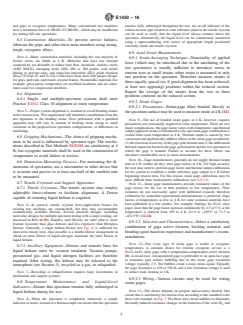
NOTE 8—When the specimen is completely immersed, a simple three-wireexample,inFig.3.Thethree-wirecircuitnullifiesoreliminates
indicatorormeter,insteadofathermocouplecanensurethatthespecimen thermally induced resistance changes in the leadwires if the wires R and
l1
E1450 − 16
its output is nonlinear, and it must be compensated for the hyperbolic
dependence of capacitance on displacement.
7. Sampling
7.1 Removesamplesfortensiontestingfromthematerialin
its final condition to ensure that the properties measured are
representative of the product.Allow for any superficial effects
introduced by the cutting operations.
7.2 Remove specimens from locations thought to be most
representative of the stock material, realizing that data for
specimens taken from selected locations of a structure or
material may not be representative of the whole. The conven-
tional locations should normally be used:
FIG. 3 A Method of Strain-Gage Wiring for Cryogenic Tests
7.2.1 For products 40 mm (1.6 in.) or less in thickness or
diameter, the location should be at the center.
7.2.2 For products over 40 mm (1.6 in.) in thickness or
R in Fig. 3 have the same resistance and experience the same tempera-
l3
turechangesalongtheirlengths.Thiscircuitcanbeusedwithcommercial
diameter, the location should be midway from the surface to
strain indicators. First, balance the Wheatstone bridge at room tempera-
the center.
ture. Then, to compensate for any apparent strain induced on cooling the
7.3 Chooseaspecimensizeandshapebasedontherequire-
specimen and gage to the test temperature, rebalance the electrical signal
after cooling before the force is applied and testing begins. Other circuits
ments necessary to obtain representative samples of the
and instruments are possible, and some techniques offer higher accuracy
material, and on the test machine’s force capacity (see 6.2).
than the illustrated example.
7.4 Using the notation in 4 of Test Method and Definitions
6.9.3 Extensometers:
A370,specifytheorientationofthespecimen’saxisrelativeto
6.9.3.1 Types—Reliable extensometers for use at 4K may
the most predominant of either the grain flow or the principal
used.
working direction of the final form of the stock.
NOTE 14—An example is the beam gage, which uses four strain-gage
bonded in a full Wheatstone bridge. Extension within the specimen gage
8. Test Specimens
length is sensed by the detachable extensometer, which is clipped to
retaining pins that are fixed to the specimen reduced section.
8.1 General:
8.1.1 Types and Specifications—Any specimen configura-
6.9.3.2 Characteristics—To measure the 0.2% offset yield
tioncitedinTestMethodsE8/E8Mmaybeused.Specifications
strength, one or more Class B-2 or better extensometers, as
for dimensions, tolerances, and surface finish are stated in 6.1
identified in Test Method E83, shall be used unless all parties
through 6.17 of those standards.
agree to an alternate method (see 9.6.2). Each extensometer
8.1.2 Size—Specimens from sheet or wire products having
shallmeettheClassB-2requirementsofTestMethodE83at4
relatively small cross-sectional areas can be tested within the
K. Whenever possible, mount the extensometer(s) directly to
force capacities of conventional apparatus. Specimens from
the specimen reduced section.
thick plate or bar products, however, shall be machined to a
NOTE15—Itmaybedesirabletouseseveralextensometerstominimize
reduced cross-sectional area so the force capacity of the
the effect of bending, especially for brittle specimens. One method for
machine is not exceeded. The specimen in this case should
obtaining multi-planar strains is to fasten a pair of collars to the specimen
have the same configuration as the standard specimen but with
reduced section, using sharpened radial thumbscrews. The collars are
made with detents (located on the inboard faces) to accept spring-loaded
an appropriately reduced cross section.
extensometer. This arrangement also serves to define a fixed gage length
8.2 Round Bar Specimens:
within the specimen reduced cross section.
8.2.1 Standard 4 K Specimens—To meet the force limita-
6.9.3.3 Calibration—Calibrate extensometers at room tem-
tionsofconventionaltestmachines,theroundbarspecimensin
perature and at 4 K. If the calibration is known and proved to
8.2.1.1 and 8.2.1.2 are defined as standard for 4 K tests. The
be accurate, linear, and reproducible, then room-temperature
required dimensions and tolerances for these specimens are
checks may be performed before each series of tests to
giveninTable1.Threadedorshoulderedendsarecommonfor
indirectly verify the 4 K calibration. However, direct calibra-
gripping the
...
This document is not an ASTM standard and is intended only to provide the user of an ASTM standard an indication of what changes have been made to the previous version. Because
it may not be technically possible to adequately depict all changes accurately, ASTM recommends that users consult prior editions as appropriate. In all cases only the current version
of the standard as published by ASTM is to be considered the official document.
Designation: E1450 − 09 E1450 − 16
Standard Test Method for
Tension Testing of Structural Alloys in Liquid Helium
This standard is issued under the fixed designation E1450; the number immediately following the designation indicates the year of
original adoption or, in the case of revision, the year of last revision. A number in parentheses indicates the year of last reapproval. A
superscript epsilon (´) indicates an editorial change since the last revision or reapproval.
1. Scope
1.1 This test method describes procedures for the tension testing of structural alloys in liquid helium. The format is similar to
that of other ASTM tension test standards, but the contents include modifications for cryogenic testing which requires special
apparatus, smaller specimens, and concern for serrated yielding, adiabatic heating, and strain-rate effects.
1.2 To conduct a tension test by this standard, the specimen in a tensile cryostat is fully submerged in normal liquid helium (He
−3 −1
I) and tested using crosshead displacement control at a nominal strain rate of 10 smm/mm/s or less. Tests using force control
or high strain rates are not considered.
1.3 This standard specifies methods for the measurement of yield strength, tensile strength, elongation, and reduction of area.
The determination of the elasticYoung’s modulus is treated in Test Method E111.
NOTE 1—The boiling point of normal liquid helium (He I) at sea level is 4.2 K (−269°C or −452.1°F or 7.6°R). It decreases with geographic elevation
and is 4.0 K (−269.2°C or −452.5°F or 7.2°R) at the National Institute of Standards and Technology in Colorado, 1677 m (5500 ft) above sea level. In
this standard the temperature is designated 4 K.
1.4 Values stated in SI units are treated as primary. Values stated in U.S. customary units are treated as secondary.
1.5 This standard does not purport to address all of the safety concerns, if any, associated with its use. It is the responsibility
of the user of this standard to establish appropriate safety and health practices and determine the applicability of regulatory
limitations prior to use. See Section 5.
2. Referenced Documents
2.1 ASTM Standards:
A370 Test Methods and Definitions for Mechanical Testing of Steel Products
E4 Practices for Force Verification of Testing Machines
E6 Terminology Relating to Methods of Mechanical Testing
E8/E8M Test Methods for Tension Testing of Metallic Materials
E29 Practice for Using Significant Digits in Test Data to Determine Conformance with Specifications
E83 Practice for Verification and Classification of Extensometer Systems
E177 Practice for Use of the Terms Precision and Bias in ASTM Test Methods
E691 Practice for Conducting an Interlaboratory Study to Determine the Precision of a Test Method
E111 Test Method for Young’s Modulus, Tangent Modulus, and Chord Modulus
E1012 Practice for Verification of Testing Frame and Specimen Alignment Under Tensile and Compressive Axial Force
Application
3. Terminology
3.1 Definitions:Definitions of Terms Common to Mechanical Testing—
3.1.1 The definitions of terms relating to tension testing mechanical testing terms that appear in the Terminology E6 shall apply
here. The definitions in this section also apply.apply to this test method. These terms include bending strain, elongation,
extensometer, force, gauge length, proportional limit, reduced section, reduction of area, stress-strain diagram, tensile strength, and
Young’s modulus.
This test method is under the jurisdiction of ASTM Committee E28 on Mechanical Testing and is the direct responsibility of Subcommittee E28.04 on Uniaxial Testing.
Current edition approved June 1, 2009Nov. 15, 2016. Published August 2009February 2017. Originally approved in 1992. Last previous edition approved in 20032009
as E1450 – 03.E1450 – 09. DOI: 10.1520/E1450-09.10.1520/E1450-16.
For referenced ASTM standards, visit the ASTM website, www.astm.org, or contact ASTM Customer Service at service@astm.org. For Annual Book of ASTM Standards
volume information, refer to the standard’s Document Summary page on the ASTM website.
Copyright © ASTM International, 100 Barr Harbor Drive, PO Box C700, West Conshohocken, PA 19428-2959. United States
E1450 − 16
3.1.2 adiabatic heating—the internal heating of a specimen resulting from tension testing under conditions such that the heat
generated by plastic work cannot be quickly dissipated to the surrounding cryogen.
3.1.2 In addition, the following common terms from Terminology E6 are defined:
3.1.3 adjusted length of the reduced section—the length of the reduced section plus an amount calculated to compensate for
strain in the fillet region.
3.1.4 axial strain—discontinuous yielding, n—the average of the longitudinal strains measured at opposite or equally spaced
surface locations on the sides of the longitudinal axis of symmetry of the specimen. The longitudinal strains are measured using
two or more strain-sensing devices located at the mid-length of the reduced section.in a uniaxial test, a hesitation or fluctuation
of force observed at the onset of plastic deformation, due to localized yielding.
3.1.4.1 Discussion—
The stress-strain curve need not appear to be discontinuous.
3.1.5 bending strain—the difference between the strain at the surface of the specimen and the axial strain (the bending strain
varies around the circumference and along the reduced section of the specimen).
3.1.6 Dewar—a vacuum-insulated container for cryogenic fluids.
3.1.5 discontinuous yielding stress, σ —the peak stress at the initiation of the first measurable serration on the curve of
i
stress-versus-strain.
3.1.5.1 Discussion—
The parameter σ is a function of test variables and is not a material constant.
i
3.1.6 gage length—gauge length, n—the original distance between gage marks made on the specimen for determining
elongation after fracture.length of that portion of the specimen over which strain, elongation, or change of length is determined.
3.1.6.1 Discussion—
Typically, this length is also the distance between gauge marks, if gauge marking is used to facilitate measurement of the elongation
after fracture.
3.1.6.2 Discussion—
FIG. 1 Schematic Illustration of Typical Tensile Cryostat for Tension Testing at 4 K
E1450 − 16
When sensing extension or motion with a gauge length that is predetermined by the specimen geometry or specific test method,
then only resolution and strain error for the specified gauge length should determine the class of the extensometer system.
3.1.7 length of the reduced section—the distance between the tangent points of the fillets that bound the reduced section.
3.1.10 maximum bending strain—the largest value of bending strain in the reduced section of the specimen.
3.1.10.1 Discussion—
Maximum bending strength is calculated from strains measured at two, three, or more circumferential positions, and at each of two
different longitudinal positions.
3.1.8 reduced section—section in the central portion of the specimen, whichspecimen that has a cross section smaller than the
gripped ends.
3.1.8.1 Discussion—
The cross section is uniform within prescribed tolerances.
3.1.12 tensile cryostat—a test apparatus for applying tensile forces to test specimens in cryogenic environments (Fig. 1).
3.2 Definitions of Terms Specific to This Standard:
3.2.1 adiabatic heating—the internal heating of a specimen resulting from tension testing under conditions such that the heat
generated by plastic work cannot be quickly dissipated to the surrounding cryogen.
3.2.2 Dewar—a vacuum-insulated container for cryogenic fluids.
3.2.3 tensile cryostat—a test apparatus for applying tensile forces to test specimens in cryogenic environments Fig. 1.
4. Significance and Use
4.1 Tension tests provide information on the strength and ductility of materials under uniaxial tensile stresses. This information
may be useful for alloy development, comparison and selection of materials, and quality control. Under certain circumstances, the
information may also be useful for design.
4.2 The force-time and force-extension records for some alloys tested in liquid helium using displacement control are often
serrated (1). Serrations are formed by repeated bursts of unstable plastic flow and arrests. The unstable plastic flow (discontinuous
yielding) is a free-running process occurring in localized regions of the reduced section at higher than nominal rates of strain with
internal specimen heating. Examples of serrated stress-strain curves for a typical austenitic stainless steel with discontinuous
yielding are shown in Fig. 2.
4.3 A constant specimen temperature cannot be maintained at all times during tests in liquid helium. The specimen temperature
at local regions in the reduced section rises temporarily above 4 K during each discontinuous yielding event (see Fig. 2), owing
to adiabatic heat.heating. The number of events and the magnitude of the associated drops in magnitude of force are a function
of the material composition and other factors such as specimen size and test speed. Typically, altering the mechanical test variables
can modify but not eliminate the discontinuous yielding (2-4). Therefore, tensile property measurements of alloys in liquid helium
(especially tensile strength, elongation, and reduction of area) lack the usual significance of property measurements at room
temperature where deformation is more nearly isothermal and discontinuous yielding typically does not occur.
4.4 The stress-strain response of a material tested in liquid helium depends on whether force control or displacement control
is used (3). Crosshead displacement control is specified in this standard since the goal is material characterization by conventional
methods. The possibility of a different and less favorable material response must be taken into account when data are used for
design in actual applications subject to force-controlled conditions.
5. Hazards
5.1 Several precautions must be observed in the use of cryogenic fluids and equipment. Skin or eye contact with cryogens will
freeze and destroy tissue. The appropriate protection may require goggles, clothing without pockets or cuffs, gloves, and tongs for
handling cold specimens. Cryogenic containers that are internally pressurized or evacuated are potentially hazardous in that
damage or leaks can produce explosions or implosions. Also, when liquids evaporate to gases, there is a huge volume increase;
therefore asphyxiation is a potential threat where liquid nitrogen or liquid helium evaporates in rooms that are not properly
ventilated. Safety guidelines pertaining to the use of liquid helium and other cryogenic fluids are considered elsewhere in more
detail (5).
The boldface numbers in parentheses refer to the list of references at the end of this test method.
E1450 − 16
FIG. 2 Typical Engineering Stress-Strain Curves and Specimen Temperature Histories, at Four Different Nominal Strain Rates,
for AISI 304L Stainless Steel Tested in Liquid Helium (4)
6. Apparatus
6.1 Test Machines—Use a test machine that meets the requirements of Practices E4 regarding verification of force accuracy.
Know
NOTE 2—Because it is important to minimize heat loss from the dewar through the cryogenic test frame (Fig. 1), the cross-sections of these components
are often smaller than they would be in a conventional test machine. A drawback to these smaller cross sections is that the compliance of the test frame,
(displacement per unit of applied force), can be unacceptably large. High-compliance test frames can introduce artifacts in the stress-strain curve that
complicate the interpretation of discontinuous yielding. It is often useful to characterize the compliance of the test frame before use. Measure the
compliance by coupling the force train without including a specimen, by replacing the specimen with a rigid block, or by using a special calibration
specimen. Then, measure the compliance at a low force and at the highest force expected in use. the test machine compliance (displacement per
unit of applied force of the apparatus itself). Measure the compliance by coupling the force train without including a specimen,
by replacing the specimen with a rigid block, or by using a special calibration specimen. Then, measure the compliance at a low
force and at the highest force used to qualify the machine, as directed in 6.4.1 of this test method.
6.2 System Design—Typically, alloys in liquid helium exhibit double or triple their ambient strengths. For the same specimen
geometry, higher forces must be applied to the cryostat, test specimen, force train members, and grips at cryogenic temperatures.
Since many conventional test machines have a maximum force of 100 kN (22 480 lbf) or less, it is recommended that the apparatus
The apparatus may be designed to accommodate one of the small specimens cited in 8.2.28.2.1 of this test method.
NOTE 3—2 Typically, alloys in liquid helium exhibit double or triple their ambient strengths. For the same specimen geometry, higher forces must be
applied to the tensile cryostat, test specimen, force train members, and grips at cryogenic temperatures. Many conventional test machines have a maximum
force of 100 kN (22 480 lbf) , which may be insufficient for testing full-size specimens.
6.3 Construction Materials—Many construction materials, including the vast majority of ferritic steels, are brittle at 4 K. To
prevent service failures, fabricate the grips and other force-train members using strong, tough, cryogenic alloys. Materials that have
low thermal conductivity are desirable to reduce heat flow. Austenitic stainless steels (AISI 304LN), maraging steels (200, 250,
or 300 grades, with nickel plating to prevent rust), and extra-low-interstitial (ELI) grade titanium alloys (Ti-6Al-4V and
E1450 − 16
Ti-5Al-2.5Sn) have been used with proper design, for grips, pull rods, and cryostat frames. Nonmetallic materials (for example,
glass-epoxy composites) are excellent insulators and are sometimes used for compression members.
NOTE 4—Many construction materials, including the vast majority of ferritic steels, are brittle at 4 K. Materials that have low thermal conductivity are
desirable to reduce heat flow. Austenitic stainless steels (AISI 304LN), maraging steels (200, 250, or 300 grades, with nickel plating to prevent rust), and
extra-low-interstitial (ELI) grade titanium alloys (Ti-6Al-4V and Ti-5Al-2.5Sn) have been used with proper design, for grips, pull rods, and tensile
cryostat frames. Nonmetallic materials (for example, glass-epoxy composites) are excellent insulators and are sometimes used for compression members.
6.4 Alignment:
6.4.1 Proper system alignment is essential to avoid bending strains in the tension tests.
6.4.1 Single-Specimen Apparatus—For a conventional single-specimen cryostat, the machine and grips should be capable of
applyingSingle- and multiple-specimen systems shall meet Practice E1012 force to a precisely machined calibration specimen so
that the maximum bending strain does not exceed 10 % of the axial strain. Reduce bending strain to an acceptable level by making
proportional adjustments to a cryostat having alignment capability, or by using spacing shims to compensate an unadjustable
fixture. Calculate the strain based on readings taken while the calibration specimen is subjected to a low force, as well as at the
highest force for which the machine and force train are being qualified. Procedures for measuring specimen alignment are given
in Practice Class 10 alignment at room temperature.E1012.
NOTE 5—Proper system alignment is essential to avoid bending strains in the tension tests. This requirement will minimize contributions from the test
apparatus to the bending strain. Tests performed with a qualified apparatus may still vary in amount of bending strain owing to small variations in the
proposed test specimen configurations, or differences in machining.
6.4.3 Multiple-Specimen Apparatus—For this type of cryostat the alignment depends on the type of fixtures used. Measure and
record the maximum bending strain.
6.4.4 Qualify the apparatus by making axiality measurements at room temperature and at 4 K. To perform axiality tests of the
apparatus, the specimen form should be the same as that used during cryogenic tests, and the specimen concentricity should be
as nearly perfect as possible. No plastic strain should occur in the reduced section of the alignment specimen during application
of force. In some cases this may necessitate the use of a relatively stiff, high-strength calibration specimen.
6.4.4.1 For cylindrical specimens, calculate the maximum bending strain defined in 3.1.10 from the strains measured at three
circumferential positions, at each of two different longitudinal positions (if length permits). Measure the strains with three
electrical-resistance strain gages, extensometers, or clip gages equally spaced around the reduced section of the specimen. The two
longitudinal positions should be as far apart as possible, but not closer than one diameter to a fillet.
6.4.4.2 For specimens of square or rectangular cross section, measure the strain at the center of two parallel (opposite) faces,
or in the case of thin cross sections, at the center of the two broad faces.
6.4.4.3 For conventional threaded or pinned grips, evaluate the effect of specimen bias as follows. Repeat the axiality
measurements with the specimen rotated 180°, but with the grips and pull rods retained in their original positions. Then calculate
the maximum bending strain and the strain at the specimen axis as the average of the two readings at the same position relative
to the machine. If other grips or methods are used to evaluate the effect of specimen bias it should be described in the report.
6.4.5 Strain-Averaging Technique—Nonaxiality of applied force (which may be introduced due to the machining of the test
specimens) is usually sufficient to introduce errors in tension tests at small strains when strain is measured at only one position
on the specimen. Therefore measure strains at three equally spaced (or, if good alignment has been achieved, at least two opposing)
positions within the reduced section. Report the average of the strains from the two or three positions centered on the reduced
section. This section may be more appropriate under the strain gage section since it is referring to measurement of strain during
the test and not alignment.
6.5 Gripping Mechanisms—The choice of gripping mechanism to be used is influenced by specimen type. The mechanisms
described in Test Methods E8/E8M are satisfactory at 4 K, but cryogenic materials mustshall be used in the construction of
components to avoid failure in service.
6.6 Dimension-Measuring Devices—For measuring the dimensions of specimens, use a micrometer or other device that is
accurate and precise to at least one-half of the smallest unit to which a given dimension must be measured.
6.7 Tensile Cryostats and Support Apparatus:
6.7.1 Cryostats—A Dewar capable of retaining liquid helium is required. In general, cryostat force-application frames for
existing test machines must be custom-built, but they may accommodate commercially available Dewars. The cryostat may employ
adjustable force-columns to facilitate alignment. Several practical designs, including turret-disc designs for multiple-specimen
testing with a single cooling, are discussed in Refs (6-10).
6.7.1 Dewars—Tensile Cryostats—Stainless steel Dewars are safer (that is, more fracture resistant) than glass Dewars and less
expensive than fiberglass Dewars. Generally, a single helium Dewar (see The Fig. 1) is sufficient for short-term tensile tests. Also
possible is a double-Dewar arrangement in which an outer Dewar of liquid nitrogen surrounds the inner Dewar of liquid
helium.tensile cryostat may employ adjustable force-columns to facilitate alignment. A Dewar capable of retaining liquid helium
is required.
NOTE 6—In general, tensile cryostat force-application frames for existing test machines are custom-built, but they may accommodate commercially
available Dewars. Several practical designs, including turret-disc designs for multiple-specimen testing with a single cooling, are discussed in Refs (6-10).
E1450 − 16
Stainless steel Dewars are safer (that is, more fracture resistant) than glass Dewars and less expensive than fiberglass Dewars. Generally, a single helium
Dewar (see Fig. 1) is sufficient for short-term tensile tests. Also possible is a double-Dewar arrangement in which an outer Dewar of liquid nitrogen
surrounds the inner Dewar of liquid helium.
6.7.2 Ancillary Equipment—Dewars and transfer lines for liquid helium must be vacuum insulated. Vacuum pumps, pressurized
gas, and liquid nitrogen facilities are therefore required. After testing, the helium may be released to the atmosphere (see Section
5), recycled as a gas, or reliquefied. Recycling or reliquefaction requires large investments in purification and support systems.
NOTE 7—Recycling or reliquefaction requires large investments in purification and support systems.
6.8 Temperature Maintenance and Liquid-Level Indicators—The intended test condition is ensured by maintaining a liquid
helium environment. With the specimen completely immersed, a thermocouple to measure its temperature is not required for
routine tests. Instead, a simple indicator or meter is required to ensure that the Ensure that specimen remains fully submerged
throughout the test. An on-off indicator of the carbon-resistor type located at some reference point in the cryostat may be used to
verify that the liquid level always remains above the specimen. Alternatively, the liquid level may be continuously monitored using
a superconducting wire sensor of appropriate length positioned vertically inside the cryostat.in liquid helium during the test.
NOTE 8—One indication of the system nearing and reaching a steady state condition is the amount of condensation flare. As liquid helium is transferred
into the cryostat, the flare becomes visible when boiled-off helium contacts room temperature air at the vent of the cryostat (When the specimen is
completely immersed, a simple indicator or meter, instead of a thermocouple can ensure that the specimen remains fully submerged throughout the test.
An on-off indicator of the carbon-resistor type located at some reference point in the tensile cryostat canFig. 1). As cool-down proceeds, the flare decreases
to a slowly issuing cloud due to less active boiling as the internal temperature of the cryostat reaches operating temperature. be used to verify that the
liquid level always remains above the specimen. Alternatively, the liquid level can be continuously monitored using a superconducting wire sensor of
appropriate length positioned vertically inside the tensile cryostat.
6.9 Axial Strain Measurement:
6.9.1 Strain-Averaging Technique—Nonaxiality of applied force (which may be introduced due to the machining of the test
specimens) is usually sufficient to introduce errors in tension tests at small strains when strain is measured at only one position
on the specimen. Therefore measure strains at three equally spaced (or, if good alignment has been achieved, at least two opposing)
positions within the reduced section. Report the average of the strains from the two or three positions centered on the reduced
section.
6.9.2 Strain Gages:
6.9.2.1 Precautions—Strain-gage films bonded directly to the specimen surface may be used to measure strain at 4 K (11). The
use of bonded strain gages at 4 K, however, requires precautions not customarily required at room temperature. There are two
major complications: the gage factor varies with temperature, and thermal output (apparent strain) is introduced as the
specimen-gage combination is cooled from room temperature to 4 K. Thermal output is caused by two concurrent and algebraically
additive effects in the strain gage installation: (1) the electrical resistivity of the gage grid element and (2) the differential thermal
expansion between the gage grid element and the test specimen to which the gage is bonded. These effects must be accounted for,
or considerable error in strain measurements may be introduced.
NOTE 9—The use of bonded strain gages at 4 K, however, requires precautions not customarily required at room temperature. There are two major
complications: the gage factor varies with temperature, and thermal output (apparent strain) is introduced as the specimen-gage combination is cooled
from room temperature to 4 K. Thermal output is caused by two concurrent and algebraically additive effects in the strain gage installation: (1) the
electrical resistivity of the gage grid element and (2) the differential thermal expansion between the gage grid element and the test specimen to which
the gage is bonded. Failure to account for these effects can introduce considerable error in strain measurements.
NOTE 10—Gage manufacturers generally do not supply thermal output data at 4 K; neither do they state gage factors at 4 K. For high accuracy the
user may need to perform gage factor and thermal output calibrations for his system to establish a stable reference gage output at 4 K before beginning
tension tests. For this reason, strain gage calibrations may be more difficult than extensometer calibrations (see 6.9.3.3).
NOTE 11—Some gage manufacturers provide estimated values of the gage factors for the use of their products at low temperatures. Their estimates
do not necessarily agree with published research; therefore calibration by controlled experimental determinations is preferred. Gage factors at
temperatures as low as 4 K for some common materials have been published in a few studies. For example, findings for Ni-Cr alloy gages show that the
gage factor increases nonlinearly by 2.5 or 5 % as the temperature is reduced from 295 to 4 K (21.9 to −269°C or 71.3 to −452.5°F) (12-14).
6.9.2.2 Gage manufacturers generally do not supply thermal output data at 4 K; neither do they state gage factors at 4 K. For
high accuracy the user may need to perform gage factor and thermal output calibrations for his system to establish a stable
reference gage output at 4 K before beginning tension tests. For this reason, strain gage calibrations may be more difficult than
extensometer calibrations (see 6.9.3.3).
6.9.2.2 Selection and Characteristics—Not every type of strain gage is usable at cryogenic temperatures. Select a satisfactory
combination of gage active element, backing material, and bonding agent based on experience and manufacturer’s recommen-
dations. A common choice for extreme cryogenic service is a Ni-Cr-Al-Fe alloy gage with a temperature-compensated active
element (8). A closed-face, (encapsulated) gage is preferable to an open-face gage to minimize grid surface bubbling due to the
strain gage excitation voltage. The bubbles create a noisy strain signal. Typically the gage resistance is 120 or 350 Ω, and a low
excitation voltage is used to reduce Joule heating at 4 K. The full-scale operating range is typically 1 % at room temperature and
2 % at 4 K.
NOTE 12—Not every type of strain gage is usable at cryogenic temperatures. A common choice for extreme cryogenic service is a Ni-Cr-Al-Fe alloy
gage with a temperature-compensated active element (8). A closed-face, (encapsulated) gage is preferable to an open-face gage to minimize grid surface
E1450 − 16
bubbling due to the strain gage excitation voltage, typically 2 V. The bubbles create a noisy strain signal. Typically the gage resistance is 120 or 350 Ω,
and a low excitation voltage is used to reduce Joule heating at 4 K.
6.9.2.3 Wiring—Various circuits may be used for wiring strain gages. The
NOTE 13—The choice depends on purpose and accuracy desired. One circuit that is satisfactory for tension tests according to this standard is the
three-wire example, in Fig. 3. The three-wire circuit nullifies or eliminates thermally induced resistance changes in the leadwires if the wires R and R
l1 l3
in Fig. 3 have the same resistance and experience the same temperature changes along their lengths. This circuit can be used with commercial strain
indicators. First, balance the Wheatstone bridge at room temperature. Then, to compensate for any apparent strain induced on cooling the specimen and
gage to the test temperature, rebalance the electrical signal after cooling before the force is applied and testing begins. Other circuits and instruments are
possible, and some techniques offer higher accuracy than the illustrated example. choice depends on purpose and accuracy desired. One circuit
that is satisfactory for tension tests according to this standard is the three-wire example, in Fig. 3. The three-wire circuit nullifies
or eliminates thermally induced resistance changes in the leadwires if the wires R and R in Fig. 3 have the same resistance and
l1 l3
experience the same temperature changes along their lengths. This circuit may be used with commercial strain indicators. First,
balance the Wheatstone bridge at room temperature. Then, to compensate for any apparent strain induced on cooling the specimen
and gage to the test temperature, rebalance the electrical signal after cooling before the force is applied and testing begins. Other
circuits and instruments are possible, and some techniques may offer higher accuracy than the illustrated example.
NOTE 4—Some gage manufacturers provide estimated values of the gage factors for the use of their products at low temperatures. Their estimates do
not necessarily agree with published research; therefore calibration by controlled experimental determinations is preferred. Gage factors at temperatures
as low as 4 K for some common materials have been published in a few studies. For example, findings for Ni-Cr alloy gages show that the gage factor
increases nonlinearly by 2.5 or 5 % as the temperature is reduced from 295 to 4 K (21.9 to −269°C or 71.3 to −452.5°F) (12-14).
6.9.3 Clip-Gage Extensometers:
6.9.3.1 Types—Reliable clip-gage extensometers for use at 4 K may be purchased or built. An example is the beam gage, which
uses four strain-gage films bonded in a full Wheatstone bridge. Extension within the specimen gage length is sensed by the
detachable extensometer, which is clipped to retaining pins that are fixed to the specimen reduced section.4 K may used.
NOTE 14—An example is the beam gage, which uses four strain-gage bonded in a full Wheatstone bridge. Extension
...