

ASTM A759-21
(Specification)Standard Specification for Carbon Steel Crane Rails
General Information
- Abstract
ABSTRACT
This specification covers for carbon steel crane rails of special designs only, and nominal weights for crane runway use. Manufacturing practice shall follow strict procedures for melting, discard, control cooling, end hardening, high strength rails, chamfering, and ends prepared for electric arc welding. The material shall undergo heat or cast analysis and product analysis shall be within the specified limits on chemical composition of carbon, manganese, phosphorus, sulfur, and silicon. Materials that fail to conform to the requirements of this specification shall be rejected and be reported to the manufacturer or supplier promptly in writing.
SCOPE
1.1 This specification covers carbon steel crane rails of special designs only, and nominal weights of 104 lb/yd (51.6 kg/m) through 175 lb/yd (86.8 kg/m) for crane runway use.
1.2 When standard tee rail sections are desired, they shall be ordered in accordance with Specification A1.
1.3 Supplementary Requirements S1 through S3 of an optional nature are provided. They shall apply only when specified by the purchaser in the order.
1.4 The values stated in inch-pound units are to be regarded as standard. The values given in parentheses are mathematical conversions to SI units that are provided for information only and are not considered standard.
1.5 This international standard was developed in accordance with internationally recognized principles on standardization established in the Decision on Principles for the Development of International Standards, Guides and Recommendations issued by the World Trade Organization Technical Barriers to Trade (TBT) Committee.
- Status
- Published
- Publication Date
- 31-Oct-2021
- Technical Committee
- A01 - Steel, Stainless Steel and Related Alloys
- Drafting Committee
- A01.01 - Steel Rails and Accessories

Overview
ASTM A759-21: Standard Specification for Carbon Steel Crane Rails specifies requirements for carbon steel rails of special designs designated for crane runway applications. Developed by ASTM International, this standard covers the manufacturing processes, dimensional tolerances, chemical composition, and inspection criteria for rails with nominal weights from 104 lb/yd (51.6 kg/m) to 175 lb/yd (86.8 kg/m). Strict manufacturing, quality control, and analytical procedures ensure the rails meet the demands of heavy-duty crane operations in industrial environments.
Key Topics
Scope and Applicability
- Covers only special-design carbon steel crane rails, not standard tee rail sections
- Rail weights: 104 lb/yd (51.6 kg/m) to 175 lb/yd (86.8 kg/m)
- Optional supplementary requirements (high strength, chamfering, end preparation)
Material and Chemical Composition
- Chemical analysis for carbon, manganese, phosphorus, sulfur, and silicon
- Both heat (cast) and product analyses required within defined limits
- Alternate chemistries may be accepted with mutual agreement
Manufacturing and Quality Control
- Steel produced via basic-oxygen or electric-furnace processes
- Rails cast by continuous or ingot processes
- Discard and reduction to ensure quality and freedom from defects
- Control cooling procedures for optimal material properties
Physical and Dimensional Requirements
- Rigorous dimensional tolerances for height, width, weight, and length
- End finish to be milled, cut, or ground with controlled squareness and without burrs
- Standard lengths specified with allowable variations
Supplementary and Testing Provisions
- High strength, head-hardened, or alloy rails available on request
- Chamfered rail ends as specified
- Ends prepared specifically for electric arc welding if required
- Brinell hardness tests for standard and high-strength rails
Identification and Documentation
- Rails marked with manufacturer, weight, designation, and traceability information
- Certification and test reports available upon request
- Bar coding as an auxiliary identification method
Applications
- Heavy-duty Crane Runways: The primary use for ASTM A759-21 carbon steel crane rails is in industrial and commercial facilities where overhead cranes, gantry cranes, and similar lifting systems require reliable and robust runway tracks.
- Manufacturing Facilities: Supports safe and efficient operation of material handling equipment.
- Ports and Terminals: Ensures durability under repetitive high-load cycles typical in shipping and freight environments.
- Steel Mills and Warehouses: Facilitates movement of heavy duties loads across large floor areas.
By adhering to ASTM A759-21, industries can maintain safety, minimize downtime, and ensure reliable crane operations. The standard’s comprehensive criteria for chemical composition, dimensional tolerance, and heat treatment result in rails built for strength, durability, and compatibility with electric arc welding installation.
Related Standards
- ASTM A1: Specification for Carbon Steel Tee Rails - for standard rail sections not covered by A759-21.
- ASTM A700: Guide for Packaging, Marking, and Loading Methods for Steel Products.
- ASTM E10: Test Method for Brinell Hardness of Metallic Materials - referenced for verifying rail hardness.
Other relevant crane rail and railway application standards may complement ASTM A759-21 to ensure comprehensive project specification and compliance with local and international requirements.
Keywords: ASTM A759-21, carbon steel crane rails, crane runway, steel rails standard, crane rail specification, industrial crane track, ASTM International, rail quality control, heavy-duty crane rails.
Relations
- Effective Date
- 01-Nov-2019
- Effective Date
- 01-Mar-2018
- Effective Date
- 01-Nov-2014
- Effective Date
- 01-May-2014
- Effective Date
- 01-Jan-2012
- Effective Date
- 01-Nov-2010
- Effective Date
- 01-Jun-2010
- Effective Date
- 01-Dec-2008
- Effective Date
- 01-Apr-2007
- Effective Date
- 01-Jan-2007
- Effective Date
- 01-Jan-2007
- Effective Date
- 01-Sep-2005
- Effective Date
- 01-Mar-2005
- Effective Date
- 10-Feb-2001
- Effective Date
- 10-Feb-2001
Get Certified
Connect with accredited certification bodies for this standard

Element Materials Technology
Materials testing and product certification.

Inštitut za kovinske materiale in tehnologije
Institute of Metals and Technology. Materials testing, metallurgical analysis, NDT.
Sponsored listings
Frequently Asked Questions
ASTM A759-21 is a technical specification published by ASTM International. Its full title is "Standard Specification for Carbon Steel Crane Rails". This standard covers: ABSTRACT This specification covers for carbon steel crane rails of special designs only, and nominal weights for crane runway use. Manufacturing practice shall follow strict procedures for melting, discard, control cooling, end hardening, high strength rails, chamfering, and ends prepared for electric arc welding. The material shall undergo heat or cast analysis and product analysis shall be within the specified limits on chemical composition of carbon, manganese, phosphorus, sulfur, and silicon. Materials that fail to conform to the requirements of this specification shall be rejected and be reported to the manufacturer or supplier promptly in writing. SCOPE 1.1 This specification covers carbon steel crane rails of special designs only, and nominal weights of 104 lb/yd (51.6 kg/m) through 175 lb/yd (86.8 kg/m) for crane runway use. 1.2 When standard tee rail sections are desired, they shall be ordered in accordance with Specification A1. 1.3 Supplementary Requirements S1 through S3 of an optional nature are provided. They shall apply only when specified by the purchaser in the order. 1.4 The values stated in inch-pound units are to be regarded as standard. The values given in parentheses are mathematical conversions to SI units that are provided for information only and are not considered standard. 1.5 This international standard was developed in accordance with internationally recognized principles on standardization established in the Decision on Principles for the Development of International Standards, Guides and Recommendations issued by the World Trade Organization Technical Barriers to Trade (TBT) Committee.
ABSTRACT This specification covers for carbon steel crane rails of special designs only, and nominal weights for crane runway use. Manufacturing practice shall follow strict procedures for melting, discard, control cooling, end hardening, high strength rails, chamfering, and ends prepared for electric arc welding. The material shall undergo heat or cast analysis and product analysis shall be within the specified limits on chemical composition of carbon, manganese, phosphorus, sulfur, and silicon. Materials that fail to conform to the requirements of this specification shall be rejected and be reported to the manufacturer or supplier promptly in writing. SCOPE 1.1 This specification covers carbon steel crane rails of special designs only, and nominal weights of 104 lb/yd (51.6 kg/m) through 175 lb/yd (86.8 kg/m) for crane runway use. 1.2 When standard tee rail sections are desired, they shall be ordered in accordance with Specification A1. 1.3 Supplementary Requirements S1 through S3 of an optional nature are provided. They shall apply only when specified by the purchaser in the order. 1.4 The values stated in inch-pound units are to be regarded as standard. The values given in parentheses are mathematical conversions to SI units that are provided for information only and are not considered standard. 1.5 This international standard was developed in accordance with internationally recognized principles on standardization established in the Decision on Principles for the Development of International Standards, Guides and Recommendations issued by the World Trade Organization Technical Barriers to Trade (TBT) Committee.
ASTM A759-21 is classified under the following ICS (International Classification for Standards) categories: 77.140.60 - Steel bars and rods. The ICS classification helps identify the subject area and facilitates finding related standards.
ASTM A759-21 has the following relationships with other standards: It is inter standard links to ASTM A700-14(2019), ASTM A1-00(2018), ASTM A700-14, ASTM E10-14, ASTM E10-12, ASTM A1-00(2010), ASTM E10-10, ASTM E10-08, ASTM E10-07a, ASTM E10-07e1, ASTM E10-07, ASTM A700-05, ASTM A1-00(2005), ASTM E10-00a, ASTM E10-00. Understanding these relationships helps ensure you are using the most current and applicable version of the standard.
ASTM A759-21 is available in PDF format for immediate download after purchase. The document can be added to your cart and obtained through the secure checkout process. Digital delivery ensures instant access to the complete standard document.
Standards Content (Sample)
This international standard was developed in accordance with internationally recognized principles on standardization established in the Decision on Principles for the
Development of International Standards, Guides and Recommendations issued by the World Trade Organization Technical Barriers to Trade (TBT) Committee.
Designation:A759 −21
Standard Specification for
Carbon Steel Crane Rails
This standard is issued under the fixed designation A759; the number immediately following the designation indicates the year of
original adoption or, in the case of revision, the year of last revision. A number in parentheses indicates the year of last reapproval. A
superscript epsilon (´) indicates an editorial change since the last revision or reapproval.
This standard has been approved for use by agencies of the U.S. Department of Defense.
1. Scope 3.1.2 ASTM designation and year of issue,
3.1.3 Complete identification of section with dimensional
1.1 This specification covers carbon steel crane rails of
drawing if required (see Section 2),
special designs only, and nominal weights of 104 lb/yd (51.6
3.1.4 Length of rails or length of runway as required (see
kg/m) through 175 lb/yd (86.8 kg/m) for crane runway use.
6.3),
1.2 Whenstandardteerailsectionsaredesired,theyshallbe
3.1.5 Arrangement of drilled bolt holes with dimensional
ordered in accordance with Specification A1.
drawing if required,
1.3 Supplementary Requirements S1 through S3 of an
3.1.6 Supplementary requirements that shall apply (see S1
optional nature are provided. They shall apply only when
through S3), and
specified by the purchaser in the order.
3.1.7 Certification and Test Report Requirements (see Sec-
tion 10).
1.4 The values stated in inch-pound units are to be regarded
as standard. The values given in parentheses are mathematical
conversions to SI units that are provided for information only 4. Manufacture
and are not considered standard.
4.1 MeltingPractice—The steel shall be made by any of the
1.5 This international standard was developed in accor-
following processes: basic-oxygen or electric-furnace.
dance with internationally recognized principles on standard-
4.1.1 The steel may be cast by a continuous process, or in
ization established in the Decision on Principles for the
ingots.
Development of International Standards, Guides and Recom-
4.2 DiscardandReduction—Asufficient discard and reduc-
mendations issued by the World Trade Organization Technical
tion (minimum reduction of 8:1) shall be made to secure
Barriers to Trade (TBT) Committee.
freedom from injurious segregation, and piping, and cast
structure.
2. Referenced Documents
4.3 Control Cooling:
2.1 ASTM Standards:
4.3.1 Rails shall be control cooled in accordance with the
A1 Specification for Carbon Steel Tee Rails
following procedure, except when produced from vacuum-
A700 Guide for Packaging, Marking, and Loading Methods
degassed steel or control cooled blooms, in which case the rails
for Steel Products for Shipment
may be air cooled and 4.3.2 – 4.3.6 are not applicable.
E10 Test Method for Brinell Hardness of Metallic Materials
4.3.2 All rails shall be cooled on hot beds or runways until
3. Ordering Information
full transformation is accomplished, and then charge immedi-
ately into the containers. In no case should the rail be charged
3.1 Orders for crane rails under this specification shall
below 725°F (386°C).
include the following information as appropriate:
4.3.3 The temperature of the rails before charging shall be
3.1.1 Quantity (tons or pieces),
determined with reliable equipment at the head of the rail at
least 12 in. (305 mm) from the end.
This specification is under the jurisdiction of ASTM Committee A01 on Steel, 4.3.4 The cover shall be placed on the container immedi-
Stainless Steel and Related Alloys and is the direct responsibility of Subcommittee
ately after completion of the charge and shall remain in place
A01.01 on Steel Rails and Accessories.
for at least 10 h. After the removal or raising of the lid of the
Current edition approved Nov. 1, 2021. Published November 2021. Originally
container, no rails shall be removed until the temperature of the
approved in 1978. Last previous edition approved in 2016 as A759 – 10 (2016).
DOI: 10.1520/A0759-21.
top layer of rails has fallen to 300°F (149°C) or lower.
For referenced ASTM standards, visit the ASTM website, www.astm.org, or
4.3.5 The temperature between an outside rail and the
contact ASTM Customer Service at service@astm.org. For Annual Book of ASTM
adjacent rail in the bottom tier of the container at a point not
Standards volume information, refer to the standard’s Document Summary page on
the ASTM website. lessthan12in.(305mm),normorethan36in.(914mm),from
Copyright © ASTM International, 100 Barr Harbor Drive, PO Box C700, West Conshohocken, PA 19428-2959. United States
A759−21
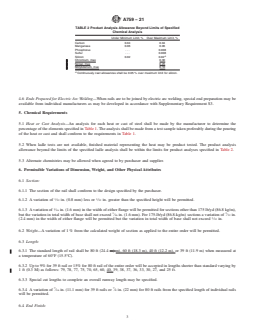
TABLE 1 Chemical Requirements,%
6. Permissible Variations of Dimension, Weight, and
Carbon 0.67 to 0.86 Other Physical Attributes
Manganese 0.70 to 1.10
6.1 Section:
Phosphorus, max 0.03
Sulfur, max 0.03
6.1.1 The section of the rail shall conform to the design
Silicon 0.10 to 0.50
specified by the purchaser.
1 1
6.1.2 A variation of ⁄32 in. (0.8 mm) less or ⁄32 in. greater
than the specified height will be permitted.
TABLE 2 Product Analysis Allowance Beyond Limits of Specified
6.1.3 A variation of ⁄16 in. (1.6 mm) in the width of either
Chemical Analysis
flange will be permitted for sections other than 175 lb/yd (86.8
Under Minimum Limit, % Over Maximum Limit, %
kg/m), but the variation in total width of base shall not exceed
Carbon 0.04 0.04
⁄16 in. (1.6 mm). For 175-lb/yd (86.8-kg/m) sections a varia-
Manganese 0.06 0.06
Phosphorus . . . 0.008
tion of ⁄32 in. (2.4 mm) in the width of either flange will be
Sulfur . . . 0.008
A permitted but the variation in total width of base shall not
Silicon 0.02 0.02
exceed ⁄32 in.
Chromium, max 0.30
Nickel, max 0.25
6.2 Weight—A variation of 1 % from the calculated weight
Molybdenum, max 0.10
of section as applied to the entire order will be permitted.
A
Continuously cast allowances shall be 0.05 % over maximum limit for silicon.
6.3 Length:
6.3.1 The standard length of rail shall be 80 ft (24.4 m), 60
ft (18.3 m), 40 ft (12.2 m), or 39 ft (11.9 m) when measured at
a temperature of 60°F (15.5°C).
the rail end shall be recorded. This temperature shall be the
6.3.2 Up to 9% for 39 ft rail or 15% for 80 ft rail of the
control for judging rate of cooling.
entire order will be accepted in lengths shorter than standard
4.3.6 The container shall be so protected and insulated that varying by 1 ft (0.3 M) as follows: 79, 78, 77, 75, 70, 65, 60,
the control temperature shall not drop below 300°F (149°C) in
40, 39, 38, 37, 36, 33, 30, 27, and 25 ft.
7 h from the time that the bottom tier is placed in the container. 6.3.3 Special cut lengths to complete an overall runway
If this cooling requirement is not met, the rails shall be
length may be specified.
7 7
considered control cooled provided the temperature at a 6.3.4 Avariation of ⁄16 in. (11.1 mm) for 39 ft rails or ⁄8 in.
location not less than 12 in. (305 mm) from the end of a rail at
(22 mm) for 80 ft rails from the specified length of individual
approximatelythecenterofthemiddletierdoesnotdropbelow rails will be permitted.
300°F (149°C) in less than 15 h.
6.4 End Finish:
4.4 High Strength Rails—When specified in accordance 6.4.1 Rails shall be milled, abrasive wheel cut, or ground to
with Supplementary Requirement S1, all or a portion of the length, with a variation in end squareness of not more than ⁄32
quantity of rails ordered shall be high strength. in. (0.8 mm) allowed.
6.4.2 Harmful burrs on the ends shall be removed.
4.5 Chamfering—When specified in accordance with
6.5 Drilling:
Supplementary Requirement S2, the ends of rails shall be
chamfered. 6.5.1 Circular holes for joint bolts, when specified, shall be
drilled to conform to the specified drawings and dimensions.
4.6 EndsPreparedforElectricArcWelding—Whenrailsare
6.5.2 Avariation of ⁄1
...
This document is not an ASTM standard and is intended only to provide the user of an ASTM standard an indication of what changes have been made to the previous version. Because
it may not be technically possible to adequately depict all changes accurately, ASTM recommends that users consult prior editions as appropriate. In all cases only the current version
of the standard as published by ASTM is to be considered the official document.
Designation: A759 − 10 (Reapproved 2016) A759 − 21
Standard Specification for
Carbon Steel Crane Rails
This standard is issued under the fixed designation A759; the number immediately following the designation indicates the year of
original adoption or, in the case of revision, the year of last revision. A number in parentheses indicates the year of last reapproval. A
superscript epsilon (´) indicates an editorial change since the last revision or reapproval.
This standard has been approved for use by agencies of the U.S. Department of Defense.
1. Scope
1.1 This specification covers carbon steel crane rails of special designs only, and nominal weights of 104 lb/yd (51.6 kg/m) through
175 lb/yd (86.8 kg/m) for crane runway use.
1.2 When standard tee rail sections are desired, they shall be ordered in accordance with Specification A1.
1.3 Supplementary Requirements S1 through S3 of an optional nature are provided. They shall apply only when specified by the
purchaser in the order.
1.4 The values stated in inch-pound units are to be regarded as standard. The values given in parentheses are mathematical
conversions to SI units that are provided for information only and are not considered standard.
1.5 This international standard was developed in accordance with internationally recognized principles on standardization
established in the Decision on Principles for the Development of International Standards, Guides and Recommendations issued
by the World Trade Organization Technical Barriers to Trade (TBT) Committee.
2. Referenced Documents
2.1 ASTM Standards:
A1 Specification for Carbon Steel Tee Rails
A700 Guide for Packaging, Marking, and Loading Methods for Steel Products for Shipment
E10 Test Method for Brinell Hardness of Metallic Materials
3. Ordering Information
3.1 Orders for crane rails under this specification shall include the following information as appropriate:
3.1.1 Quantity (tons or pieces),
3.1.2 ASTM designation and year of issue,
This specification is under the jurisdiction of ASTM Committee A01 on Steel, Stainless Steel and Related Alloys and is the direct responsibility of Subcommittee A01.01
on Steel Rails and Accessories.
Current edition approved May 1, 2016Nov. 1, 2021. Published May 2016November 2021. Originally approved in 1978. Last previous edition approved in 20102016 as
A759 – 10.A759 – 10 (2016). DOI: 10.1520/A0759-10R16.10.1520/A0759-21.
For referenced ASTM standards, visit the ASTM website, www.astm.org, or contact ASTM Customer Service at service@astm.org. For Annual Book of ASTM Standards
volume information, refer to the standard’s Document Summary page on the ASTM website.
Copyright © ASTM International, 100 Barr Harbor Drive, PO Box C700, West Conshohocken, PA 19428-2959. United States
A759 − 21
3.1.3 Complete identification of section with dimensional drawing if required (see Section 2),
3.1.4 Length of rails or length of runway as required,required (see 6.3),
3.1.5 Arrangement of drilled bolt holes with dimensional drawing if required,
3.1.6 Supplementary requirements that shall apply (see S1 through S3), and
3.1.7 Certification and Test Report Requirements (see Section 10).
4. Manufacture
4.1 Melting Practice—The steel shall be made by any of the following processes: basic-oxygen or electric-furnace.
4.1.1 The steel may be cast by a continuous process, or in ingots.
4.2 Discard— Discard and Reduction—A sufficient discard and reduction (minimum reduction of 8:1) shall be made to secure
freedom from injurious segregation and piping. segregation, and piping, and cast structure.
4.3 Control Cooling:
4.3.1 Rails shall be control cooled in accordance with the following procedure, except when produced from vacuum-degassed steel
or control cooled blooms, in which case the rails may be air cooled and 4.3.2 – 4.3.6 are not applicable.
4.3.2 All rails shall be cooled on hot beds or runways until full transformation is accomplished, and then charge immediately into
the containers. In no case should the rail be charged below 725°F (386°C).
4.3.3 The temperature of the rails before charging shall be determined with reliable equipment at the head of the rail at least 12
in. (305 mm) from the end.
4.3.4 The cover shall be placed on the container immediately after completion of the charge and shall remain in place for at least
10 h. After the removal or raising of the lid of the container, no rails shall be removed until the temperature of the top layer of
rails has fallen to 300°F (149°C) or lower.
4.3.5 The temperature between an outside rail and the adjacent rail in the bottom tier of the container at a point not less than 12
in. (305 mm), nor more than 36 in. (914 mm), from the rail end shall be recorded. This temperature shall be the control for judging
rate of cooling.
4.3.6 The container shall be so protected and insulated that the control temperature shall not drop below 300°F (149°C) in 7 h from
the time that the bottom tier is placed in the container. If this cooling requirement is not met, the rails shall be considered control
cooled provided the temperature at a location not less than 12 in. (305 mm) from the end of a rail at approximately the center of
the middle tier does not drop below 300°F (149°C) in less than 15 h.
4.4 High Strength Rails—When specified in accordance with Supplementary Requirement S1, all or a portion of the quantity of
rails ordered shall be high strength.
4.5 Chamfering—When specified in accordance with Supplementary Requirement S2, the ends of rails shall be chamfered.
TABLE 1 Chemical Requirements, %
Carbon 0.67 to 0.84
Carbon 0.67 to 0.86
Manganese 0.70 to 1.10
Phosphorus, max 0.04
Phosphorus, max 0.03
Sulfur, max 0.05
Sulfur, max 0.03
Silicon 0.10 to 0.50
A759 − 21
TABLE 2 Product Analysis Allowance Beyond Limits of Specified
Chemical Analysis
Under Minimum Limit, % Over Maximum Limit, %
Carbon 0.04 0.04
Manganese 0.06 0.06
Phosphorus . . . 0.008
Sulfur . . . 0.008
A
Silicon 0.02 0.02
Chromium, max 0.30
Nickel, max 0.25
Molybdenum, max 0.10
A
Continuously cast allowances shall be 0.05 % over maximum limit for silicon.
4.6 Ends Prepared for Electric Arc Welding—When rails are to be joined by electric arc welding, special end preparation may be
available from individual manufacturers as may be developed in accordance with Supplementary Requirement S3.
5. Chemical Requirements
5.1 Heat or Cast Analysis—An analysis for each heat or cast of steel shall be made by the manufacturer to determine the
percentage of the elements specified in Table 1. The analysis shall be made from a test sample taken preferably during the pouring
of the heat or cast and shall conform to the requirements in Table 1.
5.2 When ladle tests are not available, finished material representing the heat may be product tested. The product analysis
allowance beyond the limits of the specified ladle analysis shall be within the limits for product analyses specified in Table 2.
5.3 Alternate chemistries may be allowed when agreed to by purchaser and supplier.
6. Permissible Variations of Dimension, Weight, and Other Physical Attributes
6.1 Section:
6.1.1 The section of the rail shall conform to the design specified by the purchaser.
1 1
6.1.2 A variation of ⁄32 in. (0.8 mm) less or ⁄32 in. greater than the specified height will be permitted.
6.1.3 A variation of ⁄16 in. (1.6 mm) in the width of either flange will be permitted for sections other than 175 lb/yd (86.8 kg/m),
1 3
but the variation in total width of base shall not exceed ⁄16 in. (1.6 mm). For 175-lb/yd (86.8-kg/m) sections a variation of ⁄32 in.
(2.4 mm) in the width of either flange will be permitted but the variation in total width of base shall not exceed ⁄32 in.
6.2 Weight—A variation of 1 % from the calculated weight of section as applied to the entire order will be permitted.
6.3 Length:
6.3.1 The standard length of rail shall be 80 ft (24.4 m) m), 60 ft (18.3 m), 40 ft (12.2 m), o
...