

ASTM E3047-22
(Test Method)Standard Test Method for Analysis of Nickel Alloys by Spark Atomic Emission Spectrometry
General Information
- Abstract
SIGNIFICANCE AND USE
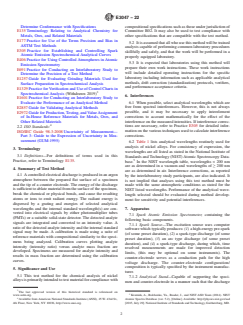
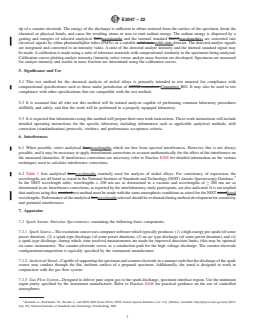
5.1 This test method for the chemical analysis of nickel alloys is primarily intended to test material for compliance with compositional specifications such as those under jurisdiction of Committee B02. It may also be used to test compliance with other specifications that are compatible with the test method.
5.2 It is assumed that all who use this method will be trained analysts capable of performing common laboratory procedures skillfully and safely, and that the work will be performed in a properly equipped laboratory.
5.3 It is expected that laboratories using this method will prepare their own work instructions. These work instructions will include detailed operating instructions for the specific laboratory including information such as applicable analytical methods, drift correction (standardization) protocols, verifiers, and performance acceptance criteria.
SCOPE
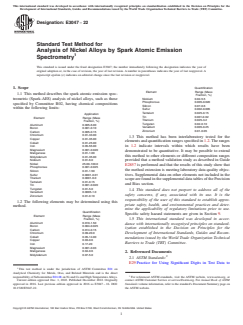
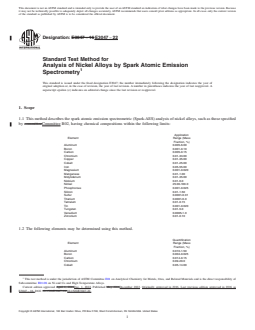
1.1 This method describes the spark atomic emission spectrometric (Spark-AES) analysis of nickel alloys, such as those specified by Committee B02, having chemical compositions within the following limits:
Element
Application Range (Mass Fraction, %)
Aluminum
0.005-6.00
Boron
0.001-0.10
Carbon
0.005-0.15
Chromium
0.01-33.00
Copper
0.01-35.00
Cobalt
0.01-25.00
Iron
0.05-55.00
Magnesium
0.001-0.020
Manganese
0.01-1.00
Molybdenum
0.01-35.00
Niobium
0.01-6.0
Nickel
25.00-100.0
Phosphorous
0.001-0.025
Silicon
0.01-1.50
Sulfur
0.0001-0.01
Titanium
0.0001-6.0
Tantalum
0.01-0.15
Tin
0.001-0.020
Tungsten
0.01-5.0
Vanadium
0.0005-1.0
Zirconium
0.01-0.10
1.2 The following elements may be determined using this method.
Element
Quantification Range (Mass Fraction, %)
Aluminum
0.010-1.50
Boron
0.004-0.025
Carbon
0.014-0.15
Chromium
0.09-20.0
Cobalt
0.05-14.00
Copper
0.03-0.6
Iron
0.17-20
Magnesium
0.001-0.03
Manganese
0.04-0.6
Molybdenum
0.07-5.0
Niobium
0.02-5.5
Phosphorous
0.005-0.020
Silicon
0.07-0.6
Sulfur
0.002-0.005
Tantalum
0.025-0.15
Tin
0.001-0.02
Titanium
0.025-3.2
Tungsten
0.02-0.10
Vanadium
0.005-0.25
Zirconium
0.01-0.05
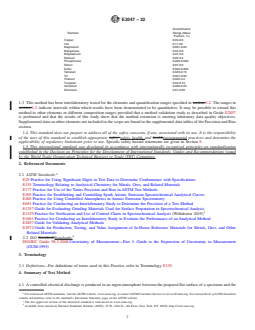
1.3 This method has been interlaboratory tested for the elements and quantification ranges specified in 1.2. The ranges in 1.2 indicate intervals within which results have been demonstrated to be quantitative. It may be possible to extend this method to other elements or different composition ranges provided that a method validation study as described in Guide E2857 is performed and that the results of this study show that the method extension is meeting laboratory data quality objectives. Supplemental data on other elements not included in the scope are found in the supplemental data tables of the Precision and Bias section.
1.4 This standard does not purport to address all of the safety concerns, if any, associated with its use. It is the responsibility of the user of this standard to establish appropriate safety, health, and environmental practices and determine the applicability of regulatory limitations prior to use. Specific safety hazard statements are given in Section 9.
1.5 This international standard was developed in accordance with internationally recognized principles on standardization established in the Decision on Principles for the Development of International Standards, Guides and Recommendations issued by the World Trade Organization Technical Barriers to Trade (TBT) Committee.
- Status
- Published
- Publication Date
- 30-Nov-2022
- Technical Committee
- E01 - Analytical Chemistry for Metals, Ores, and Related Materials
- Drafting Committee
- E01.08 - Ni and Co and High Temperature Alloys
Buy Documents
ASTM E3047-22 - Standard Test Method for Analysis of Nickel Alloys by Spark Atomic Emission Spectrometry
REDLINE ASTM E3047-22 - Standard Test Method for Analysis of Nickel Alloys by Spark Atomic Emission Spectrometry
Overview
ASTM E3047-22: Standard Test Method for Analysis of Nickel Alloys by Spark Atomic Emission Spectrometry is a crucial international standard developed by ASTM for the chemical analysis of nickel alloys. This standard outlines procedures for using Spark Atomic Emission Spectrometry (Spark-AES) to determine elemental compositions in nickel-based alloys, ensuring materials meet established compositional specifications.
Nickel alloys are widely used in industries such as aerospace, power generation, and chemical processing, where precise material composition is essential for performance and safety. This test method is specifically designed to ensure laboratories can verify alloy compliance with specification requirements, particularly those under the jurisdiction of ASTM Committee B02.
Key Topics
- Scope of Analysis: ASTM E3047-22 describes methods for determining a broad range of elements in nickel alloys, including (but not limited to) aluminum, boron, carbon, chromium, copper, cobalt, iron, magnesium, manganese, molybdenum, niobium, nickel, phosphorus, silicon, sulfur, titanium, tantalum, tin, tungsten, vanadium, and zirconium, within defined mass fraction ranges.
- Instrumental Technique: Spark-AES is used for rapid, multi-elemental analysis. The process involves ablating material from a prepared flat surface of a nickel alloy sample using a spark discharge, generating emission spectra that are characteristic of the elements present.
- Interlaboratory Validation: The quantification ranges specified in the standard are based on robust interlaboratory studies, establishing documented precision and bias for these determinations.
- Safety and Compliance: Users are responsible for following appropriate safety, health, and environmental practices. The standard provides guidance but does not address all potential safety concerns.
- Laboratory Competence: The method presumes users are skilled analysts operating in adequately equipped laboratories, with laboratory-specific work instructions incorporating analytical methods, drift correction protocols, verification routines, and acceptance criteria.
Applications
ASTM E3047-22 is applied across several industrial sectors, offering practical value in:
- Material Certification: Ensuring nickel alloy products conform to required compositional standards before use or supply.
- Quality Assurance and Control: Used by manufacturers and laboratories for incoming inspection, process control, and final product verification.
- Research and Development: Facilitating new alloy development and material comparison through precise elemental analysis.
- Regulatory and Specification Compliance: Supporting evidence for conformance with ASTM Committee B02 specifications and other compatible standards.
Industries such as aerospace, energy, automotive, and petrochemical processing rely on this method to ensure the reliability and performance of nickel alloy components, meeting both safety and technical demands.
Related Standards
ASTM E3047-22 is closely linked to several other standards for analytical chemistry and materials testing, including:
- ASTM E29 - Practice for Using Significant Digits in Test Data to Determine Conformance with Specifications
- ASTM E305 - Practice for Establishing and Controlling Spark Atomic Emission Spectrochemical Analytical Curves
- ASTM E406 - Practice for Using Controlled Atmospheres in Atomic Emission Spectrometry
- ASTM E2857 - Guide for Validating Analytical Methods (for extending method applicability)
- ISO/IEC Guide 98-3:2008 - Guide to the Expression of Uncertainty in Measurement (GUM)
These standards provide foundational terminology, procedures for calibration, validation, and interlaboratory precision assessment, ensuring a harmonized approach to material testing and quality assurance in metallurgical and analytical laboratories.
By adhering to ASTM E3047-22, laboratories and manufacturers can ensure accurate, reliable, and standardized analysis of nickel alloys, supporting high quality across supply chains and critical applications.
Relations
- Effective Date
- 01-Jan-2020
- Effective Date
- 01-Nov-2019
- Refers
ASTM E406-19 - Standard Practice for Using Controlled Atmospheres in Atomic Emission Spectrometry - Effective Date
- 01-Oct-2019
- Effective Date
- 01-Oct-2019
- Effective Date
- 15-May-2019
- Effective Date
- 15-May-2016
- Effective Date
- 01-Feb-2016
- Effective Date
- 01-Jul-2015
- Effective Date
- 15-May-2015
- Effective Date
- 15-Feb-2015
- Effective Date
- 15-Aug-2014
- Effective Date
- 01-May-2014
- Effective Date
- 01-Apr-2014
- Effective Date
- 15-Feb-2014
- Effective Date
- 01-Dec-2013
Buy Documents
ASTM E3047-22 - Standard Test Method for Analysis of Nickel Alloys by Spark Atomic Emission Spectrometry
REDLINE ASTM E3047-22 - Standard Test Method for Analysis of Nickel Alloys by Spark Atomic Emission Spectrometry
Get Certified
Connect with accredited certification bodies for this standard

Element Materials Technology
Materials testing and product certification.

Inštitut za kovinske materiale in tehnologije
Institute of Metals and Technology. Materials testing, metallurgical analysis, NDT.
Sponsored listings
Frequently Asked Questions
ASTM E3047-22 is a standard published by ASTM International. Its full title is "Standard Test Method for Analysis of Nickel Alloys by Spark Atomic Emission Spectrometry". This standard covers: SIGNIFICANCE AND USE 5.1 This test method for the chemical analysis of nickel alloys is primarily intended to test material for compliance with compositional specifications such as those under jurisdiction of Committee B02. It may also be used to test compliance with other specifications that are compatible with the test method. 5.2 It is assumed that all who use this method will be trained analysts capable of performing common laboratory procedures skillfully and safely, and that the work will be performed in a properly equipped laboratory. 5.3 It is expected that laboratories using this method will prepare their own work instructions. These work instructions will include detailed operating instructions for the specific laboratory including information such as applicable analytical methods, drift correction (standardization) protocols, verifiers, and performance acceptance criteria. SCOPE 1.1 This method describes the spark atomic emission spectrometric (Spark-AES) analysis of nickel alloys, such as those specified by Committee B02, having chemical compositions within the following limits: Element Application Range (Mass Fraction, %) Aluminum 0.005-6.00 Boron 0.001-0.10 Carbon 0.005-0.15 Chromium 0.01-33.00 Copper 0.01-35.00 Cobalt 0.01-25.00 Iron 0.05-55.00 Magnesium 0.001-0.020 Manganese 0.01-1.00 Molybdenum 0.01-35.00 Niobium 0.01-6.0 Nickel 25.00-100.0 Phosphorous 0.001-0.025 Silicon 0.01-1.50 Sulfur 0.0001-0.01 Titanium 0.0001-6.0 Tantalum 0.01-0.15 Tin 0.001-0.020 Tungsten 0.01-5.0 Vanadium 0.0005-1.0 Zirconium 0.01-0.10 1.2 The following elements may be determined using this method. Element Quantification Range (Mass Fraction, %) Aluminum 0.010-1.50 Boron 0.004-0.025 Carbon 0.014-0.15 Chromium 0.09-20.0 Cobalt 0.05-14.00 Copper 0.03-0.6 Iron 0.17-20 Magnesium 0.001-0.03 Manganese 0.04-0.6 Molybdenum 0.07-5.0 Niobium 0.02-5.5 Phosphorous 0.005-0.020 Silicon 0.07-0.6 Sulfur 0.002-0.005 Tantalum 0.025-0.15 Tin 0.001-0.02 Titanium 0.025-3.2 Tungsten 0.02-0.10 Vanadium 0.005-0.25 Zirconium 0.01-0.05 1.3 This method has been interlaboratory tested for the elements and quantification ranges specified in 1.2. The ranges in 1.2 indicate intervals within which results have been demonstrated to be quantitative. It may be possible to extend this method to other elements or different composition ranges provided that a method validation study as described in Guide E2857 is performed and that the results of this study show that the method extension is meeting laboratory data quality objectives. Supplemental data on other elements not included in the scope are found in the supplemental data tables of the Precision and Bias section. 1.4 This standard does not purport to address all of the safety concerns, if any, associated with its use. It is the responsibility of the user of this standard to establish appropriate safety, health, and environmental practices and determine the applicability of regulatory limitations prior to use. Specific safety hazard statements are given in Section 9. 1.5 This international standard was developed in accordance with internationally recognized principles on standardization established in the Decision on Principles for the Development of International Standards, Guides and Recommendations issued by the World Trade Organization Technical Barriers to Trade (TBT) Committee.
SIGNIFICANCE AND USE 5.1 This test method for the chemical analysis of nickel alloys is primarily intended to test material for compliance with compositional specifications such as those under jurisdiction of Committee B02. It may also be used to test compliance with other specifications that are compatible with the test method. 5.2 It is assumed that all who use this method will be trained analysts capable of performing common laboratory procedures skillfully and safely, and that the work will be performed in a properly equipped laboratory. 5.3 It is expected that laboratories using this method will prepare their own work instructions. These work instructions will include detailed operating instructions for the specific laboratory including information such as applicable analytical methods, drift correction (standardization) protocols, verifiers, and performance acceptance criteria. SCOPE 1.1 This method describes the spark atomic emission spectrometric (Spark-AES) analysis of nickel alloys, such as those specified by Committee B02, having chemical compositions within the following limits: Element Application Range (Mass Fraction, %) Aluminum 0.005-6.00 Boron 0.001-0.10 Carbon 0.005-0.15 Chromium 0.01-33.00 Copper 0.01-35.00 Cobalt 0.01-25.00 Iron 0.05-55.00 Magnesium 0.001-0.020 Manganese 0.01-1.00 Molybdenum 0.01-35.00 Niobium 0.01-6.0 Nickel 25.00-100.0 Phosphorous 0.001-0.025 Silicon 0.01-1.50 Sulfur 0.0001-0.01 Titanium 0.0001-6.0 Tantalum 0.01-0.15 Tin 0.001-0.020 Tungsten 0.01-5.0 Vanadium 0.0005-1.0 Zirconium 0.01-0.10 1.2 The following elements may be determined using this method. Element Quantification Range (Mass Fraction, %) Aluminum 0.010-1.50 Boron 0.004-0.025 Carbon 0.014-0.15 Chromium 0.09-20.0 Cobalt 0.05-14.00 Copper 0.03-0.6 Iron 0.17-20 Magnesium 0.001-0.03 Manganese 0.04-0.6 Molybdenum 0.07-5.0 Niobium 0.02-5.5 Phosphorous 0.005-0.020 Silicon 0.07-0.6 Sulfur 0.002-0.005 Tantalum 0.025-0.15 Tin 0.001-0.02 Titanium 0.025-3.2 Tungsten 0.02-0.10 Vanadium 0.005-0.25 Zirconium 0.01-0.05 1.3 This method has been interlaboratory tested for the elements and quantification ranges specified in 1.2. The ranges in 1.2 indicate intervals within which results have been demonstrated to be quantitative. It may be possible to extend this method to other elements or different composition ranges provided that a method validation study as described in Guide E2857 is performed and that the results of this study show that the method extension is meeting laboratory data quality objectives. Supplemental data on other elements not included in the scope are found in the supplemental data tables of the Precision and Bias section. 1.4 This standard does not purport to address all of the safety concerns, if any, associated with its use. It is the responsibility of the user of this standard to establish appropriate safety, health, and environmental practices and determine the applicability of regulatory limitations prior to use. Specific safety hazard statements are given in Section 9. 1.5 This international standard was developed in accordance with internationally recognized principles on standardization established in the Decision on Principles for the Development of International Standards, Guides and Recommendations issued by the World Trade Organization Technical Barriers to Trade (TBT) Committee.
ASTM E3047-22 is classified under the following ICS (International Classification for Standards) categories: 77.120.40 - Nickel, chromium and their alloys. The ICS classification helps identify the subject area and facilitates finding related standards.
ASTM E3047-22 has the following relationships with other standards: It is inter standard links to ASTM E135-20, ASTM E1601-19, ASTM E406-19, ASTM E2972-15(2019), ASTM E135-19, ASTM E135-16, ASTM E1257-16, ASTM E135-15a, ASTM E135-15, ASTM E2972-15, ASTM E135-14b, ASTM E177-14, ASTM E135-14a, ASTM E135-14, ASTM E135-13a. Understanding these relationships helps ensure you are using the most current and applicable version of the standard.
ASTM E3047-22 is available in PDF format for immediate download after purchase. The document can be added to your cart and obtained through the secure checkout process. Digital delivery ensures instant access to the complete standard document.
Standards Content (Sample)
This international standard was developed in accordance with internationally recognized principles on standardization established in the Decision on Principles for the
Development of International Standards, Guides and Recommendations issued by the World Trade Organization Technical Barriers to Trade (TBT) Committee.
Designation: E3047 − 22
Standard Test Method for
Analysis of Nickel Alloys by Spark Atomic Emission
Spectrometry
This standard is issued under the fixed designation E3047; the number immediately following the designation indicates the year of
original adoption or, in the case of revision, the year of last revision. A number in parentheses indicates the year of last reapproval. A
superscript epsilon (´) indicates an editorial change since the last revision or reapproval.
1. Scope
Quantification
Element Range (Mass
1.1 This method describes the spark atomic emission spec-
Fraction, %)
trometric (Spark-AES) analysis of nickel alloys, such as those Niobium 0.02-5.5
Phosphorous 0.005-0.020
specified by Committee B02, having chemical compositions
Silicon 0.07-0.6
within the following limits:
Sulfur 0.002-0.005
Tantalum 0.025-0.15
Application
Tin 0.001-0.02
Element Range (Mass
Titanium 0.025-3.2
Fraction, %)
Tungsten 0.02-0.10
Aluminum 0.005-6.00
Vanadium 0.005-0.25
Boron 0.001-0.10
Zirconium 0.01-0.05
Carbon 0.005-0.15
Chromium 0.01-33.00
1.3 This method has been interlaboratory tested for the
Copper 0.01-35.00
elements and quantification ranges specified in 1.2. The ranges
Cobalt 0.01-25.00
Iron 0.05-55.00 in 1.2 indicate intervals within which results have been
Magnesium 0.001-0.020
demonstrated to be quantitative. It may be possible to extend
Manganese 0.01-1.00
this method to other elements or different composition ranges
Molybdenum 0.01-35.00
Niobium 0.01-6.0 provided that a method validation study as described in Guide
Nickel 25.00-100.0
E2857 is performed and that the results of this study show that
Phosphorous 0.001-0.025
the method extension is meeting laboratory data quality objec-
Silicon 0.01-1.50
Sulfur 0.0001-0.01 tives. Supplemental data on other elements not included in the
Titanium 0.0001-6.0
scopearefoundinthesupplementaldatatablesofthePrecision
Tantalum 0.01-0.15
and Bias section.
Tin 0.001-0.020
Tungsten 0.01-5.0
1.4 This standard does not purport to address all of the
Vanadium 0.0005-1.0
safety concerns, if any, associated with its use. It is the
Zirconium 0.01-0.10
responsibility of the user of this standard to establish appro-
1.2 The following elements may be determined using this
priate safety, health, and environmental practices and deter-
method.
mine the applicability of regulatory limitations prior to use.
Quantification
Specific safety hazard statements are given in Section 9.
Element Range (Mass
1.5 This international standard was developed in accor-
Fraction, %)
Aluminum 0.010-1.50
dance with internationally recognized principles on standard-
Boron 0.004-0.025
ization established in the Decision on Principles for the
Carbon 0.014-0.15
Chromium 0.09-20.0 Development of International Standards, Guides and Recom-
Cobalt 0.05-14.00
mendations issued by the World Trade Organization Technical
Copper 0.03-0.6
Barriers to Trade (TBT) Committee.
Iron 0.17-20
Magnesium 0.001-0.03
Manganese 0.04-0.6
2. Referenced Documents
Molybdenum 0.07-5.0
2.1 ASTM Standards:
E29 Practice for Using Significant Digits in Test Data to
This test method is under the jurisdiction of ASTM Committee E01 on
Analytical Chemistry for Metals, Ores, and Related Materials and is the direct
responsibility of Subcommittee E01.08 on Ni and Co and HighTemperatureAlloys. For referenced ASTM standards, visit the ASTM website, www.astm.org, or
Current edition approved Dec. 1, 2022. Published December 2022. Originally contact ASTM Customer Service at service@astm.org. For Annual Book of ASTM
approved in 2016. Last previous edition approved in 2016 as E3047 – 16. DOI: Standards volume information, refer to the standard’s Document Summary page on
10.1520/E3047-22. the ASTM website.
Copyright © ASTM International, 100 Barr Harbor Drive, PO Box C700, West Conshohocken, PA 19428-2959. United States
E3047 − 22
Determine Conformance with Specifications compositionalspecificationssuchasthoseunderjurisdictionof
E135 Terminology Relating to Analytical Chemistry for Committee B02. It may also be used to test compliance with
Metals, Ores, and Related Materials other specifications that are compatible with the test method.
E177 Practice for Use of the Terms Precision and Bias in
5.2 Itisassumedthatallwhousethismethodwillbetrained
ASTM Test Methods
analysts capable of performing common laboratory procedures
E305 Practice for Establishing and Controlling Spark
skillfully and safely, and that the work will be performed in a
Atomic Emission Spectrochemical Analytical Curves
properly equipped laboratory.
E406 Practice for Using Controlled Atmospheres in Atomic
5.3 It is expected that laboratories using this method will
Emission Spectrometry
prepare their own work instructions. These work instructions
E691 Practice for Conducting an Interlaboratory Study to
will include detailed operating instructions for the specific
Determine the Precision of a Test Method
laboratory including information such as applicable analytical
E1257 Guide for Evaluating Grinding Materials Used for
methods, drift correction (standardization) protocols, verifiers,
Surface Preparation in Spectrochemical Analysis
and performance acceptance criteria.
E1329 Practice for Verification and Use of Control Charts in
Spectrochemical Analysis (Withdrawn 2019)
6. Interferences
E1601 Practice for Conducting an Interlaboratory Study to
6.1 When possible, select analytical wavelengths which are
Evaluate the Performance of an Analytical Method
free from spectral interferences. However, this is not always
E2857 Guide for Validating Analytical Methods
possible, and it may be necessary to apply interelement
E2972 Guide for Production, Testing, and ValueAssignment
corrections to account mathematically for the effect of the
of In-House Reference Materials for Metals, Ores, and
interference on the measured intensities. If interference correc-
Other Related Materials
tions are necessary, refer to Practice E305 for detailed infor-
2.2 ISO Standards:
mation on the various techniques used to calculate interference
ISO/IEC Guide 98-3:2008 Uncertainty of Measurement—
corrections.
Part 3: Guide to the Expression of Uncertainty in Mea-
surement (GUM:1995)
6.2 Table 1 lists analytical wavelengths routinely used for
analysis of nickel alloys. For consistency of expression, the
3. Terminology
wavelengths are all listed as stated in the National Institute of
3.1 Definitions—For definitions of terms used in this
Standards and Technology (NIST)Atomic Spectroscopy Data-
Practice, refer to Terminology E135.
base. In the NIST wavelength table, wavelengths < 200 nm
are as determined in a vacuum and wavelengths of ≥ 200 nm
4. Summary of Test Method
are as determined in air. Interference corrections, as reported
4.1 Acontrolled electrical discharge is produced in an argon
by the interlaboratory study participants, are also indicated. It
atmosphere between the prepared flat surface of a specimen
is not implied that analyses using this test method must be
and the tip of a counter electrode. The energy of the discharge
made with the same atmospheric conditions as stated for the
issufficienttoablatematerialfromthesurfaceofthespecimen,
NIST listed wavelengths. Performance of the analytical wave-
break the chemical or physical bonds, and cause the resulting
length selected should be evaluated during method develop-
atoms or ions to emit radiant energy. The radiant energy is
ment for sensitivity and potential interferences.
dispersed by a grating and energies of selected analytical
wavelengths and the internal standard wavelength(s) are con- 7. Apparatus
verted into electrical signals by either photomultiplier tubes
7.1 Spark Atomic Emission Spectrometer, containing the
(PMTs) or a suitable solid-state detector. The detected analyte
following basic components.
signals are integrated and converted to an intensity value. A
7.1.1 Spark Source—The excitation source uses computer
ratio of the detected analyte intensity and the internal standard
software which typically produces: (1) a high-energy pre-spark
signal may be made. A calibration is made using a suite of
(of some preset duration), (2) a spark-type discharge (of some
reference materials with compositional similarity to the speci-
preset duration), (3) an arc type discharge (of some preset
mens being analyzed. Calibration curves plotting analyte
duration), and (4) a spark-type discharge, during which, time
intensity (intensity ratio) versus analyte mass fraction are
resolved measurements are made for improved detection
developed. Specimens are measured for analyte intensity and
limits, (this may be optional on some instruments). The
results in mass fraction are determined using the calibration
counter-electrode serves as a conduction path for the high
curves.
voltage discharge. The counter-electrode configuration/
composition is typically specified by the instrument manufac-
5. Significance and Use
turer.
5.1 This test method for the chemical analysis of nickel
7.1.2 Analytical Stand—Capable of supporting the speci-
alloysisprimarilyintendedtotestmaterialforcompliancewith
men and counter-electrode in a manner such that the discharge
The last approved version of this historical standard is referenced on
www.astm.org. Kramida, A., Ralchenko, Yu., Reader, J., and NIST ASD Team (2014). NIST
Available fromAmerican National Standards Institute (ANSI), 25 W. 43rd St., Atomic Spectra Database (ver. 5.2), [Online]. Available: http://physics.nist.gov/asd
4th Floor, New York, NY 10036, http://www.ansi.org. [2015, July 29]. National Institute of Standards and Technology, Gaithersburg, MD.
E3047 − 22
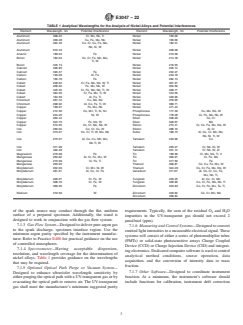
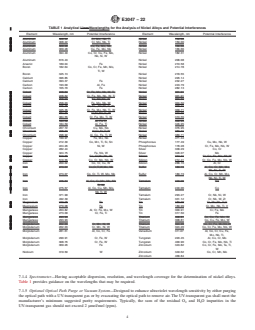
TABLE 1 Analytical Wavelengths for the Analysis of Nickel Alloys and Potential Interferences
Element Wavelength, nm Potential Interference Element Wavelength, nm Potential Interference
Aluminum 308.22 Cr, Mo, Nb, Ti Nickel 150.00
Aluminum 309.28 Cu, Fe, Mo, Nb Nickel 166.66
Aluminum 394.40 Co, Cr, Cu, Fe, Mo, Nickel 182.31
Nb, Si, W
Aluminum 616.43 Nickel 208.08
Arsenic 189.04 Fe Nickel 210.58
Boron 182.64 Co, Cr, Fe, Mn, Mo, Nickel 214.78
Ti, W
Boron 345.13 Nickel 218.55
Calcium 396.85 Nickel 226.14
Calcium 393.37 Fe Nickel 232.27
Carbon 193.09 Al, Fe Nickel 243.79
Carbon 165.70 Fe Nickel 282.13
Cobalt 228.62 Cr, Fe, Mo, Nb, W, Ti Nickel 301.91
Cobalt 258.03 Fe, Mo, Nb, W Nickel 304.50
Cobalt 345.35 Cr, Fe, Mo, Nb, Ti, W Nickel 309.71
Cobalt 384.55 Cr, Fe, Mo, Ti, W Nickel 310.55
Cobalt 184.59 Al, Fe, Ti Nickel 346.95
Chromium 267.72 Cu, Mo, Nb Nickel 376.95
Chromium 298.92 Al, Co, Fe, Ti, W Nickel 380.71
Copper 199.97 Fe, Mo, Nb Nickel 471.44
Copper 212.30 Co, Mn, Ti, Si, Sn Phosphorous 177.49 Cu, Mo, Nb, W
Copper 224.26 Ni, W Phosphorous 178.28 Cr, Fe, Mo, Nb, W
Copper 282.44 Silver 338.29 Co, Cr
Copper 324.75 Fe, Nb, W Silver 328.07 Mo
Copper 510.55 Co, Cr, Mo, Nb, W Silicon 212.41 Cr, Co, Fe, Mo, Nb, W
Iron 260.02 Co, Cr, Cu, W Silicon 288.16 Al, Cr
Iron 273.07 Co, Cr, Ti, W, Mo, Nb Sulfur 180.73 Al, Co, Cr, Mn, Mo,
Nb, Ni, Ti, W
Iron 275.57 Al, Co, Cu, Mn, Mo, Tantalum 240.06 Co
Nb Ti, W
Iron 371.99 Tantalum 293.27 Cr, Nb, Ni, W
Iron 492.39 Tantalum 331.12 Cr, Nb, W, Zr
Magnesium 279.08 Fe Tin 189.99 Cr, Mo, Nb, Ti, V
Manganese 263.82 Al, Cr, Fe, Mo, W Tin 300.91 Cr, Fe, Mo
Manganese 273.09 Cr, Fe, Ti Tin 317.50 Fe
Manganese 293.93 Titanium 308.81 Co, Cu, Fe, Mo, W
Molybdenum 202.03 Cr, Mn, Ni, W Titanium 324.20 Co, Cr, Fe, Mo, Nb, W
Molybdenum 281.61 Al, Co, Cr, Fe Vanadium 311.07 Al, Co, Cr, Cu, Fe,
Mo, Nb, Ti,
Molybdenum 290.91 Cr, Fe, W Tungsten 220.45 Al, Co, Cr, Mo
Molybdenum 308.76 Cr, Fe, W Tungsten 400.90 Co, Cr, Fe, Mo, Nb, Ti
Molybdenum 369.26 Fe Zirconium 343.82 Co, Cr, Fe, Mo, Ta, Ti,
W
Niobium 319.50 W Zirconium 349.62 Co, Cr, Mn, Mo
Zirconium 468.84
of the spark source may conduct through the flat, uniform requirements. Typically, the sum of the residual O and H O
2 2
surface of a prepared specimen. Additionally, the stand is impurities in the UV-transparent gas should not exceed 2
designed to work in conjunction with the gas flow system.
µmol/mol (ppm).
7.1.3 Gas Flow System—Designed to deliver pure argon gas
7.1.6 Measuring and Control Systems—Designed to convert
to the spark discharge, specimen interface region. Use the
emittedlightintensitiestoameasurableelectricalsignal.These
minimum argon purity specified by the instrument manufac-
systems will consist of either a series of photomultiplier tubes
turer. Refer to Practice E406 for practical guidance on the use
(PMTs) or solid-state photosensitive arrays Charge Coupled
of controlled atmospheres.
Device (CCD) or Charge Injection Device (CID) and integrat-
7.1.4 Spectrometer—Having acceptable dispersion,
ing electronics. Dedicated computer software is used to control
resolution, and wavelength coverage for the determination of
analytical method conditions, source operation, data
nickel alloys. Table 1 provides guidance on the wavelengths
acquisition, and the conversion of intensity data to mass
that may be required.
fraction.
7.1.5 Optional Optical Path Purge or Vacuum System—
7.1.7 Other Software—Designed to coordinate instrument
Designed to enhance ultraviolet wavelength sensitivity by
function. At a minimum, the instrument’s software should
either purging the optical path with a UV-transparent gas or by
include functions for calibration, instrument drift correction
evacuating the optical path to remove air. The UV-transparent
gas shall meet the manufacturer’s minimum suggested purity
E3047 − 22
(standardization) and sample measurement. Additional soft- 9. Hazards
ware features may include functionality for tasks such as
9.1 The excitation sources present a potential electrical
control charting.
shock hazard.The sample stand shall be provided with a safety
7.2 Specimen Preparation Equipment—A grinder, milling interlock system to prevent energizing the source whenever
machine or lathe capable of machining nickel alloy specimens contactwiththeelectrodeispossible.Theinstrumentshouldbe
to produce a clean, flat analytical surface. designed so access to the power supply is also restricted using
safety interlocks.
8. Reagents and Materials
9.2 Exhaust gas containing fine metallic dust generated by
8.1 Reference Materials (RMs):
the excitation process may be a health hazard. Therefore, the
8.1.1 Certified Reference Materials (CRMs) should be used
instrument should be designed with an exhaust system to
as calibration reference materials (RMs), if available. These
remove this dust in a safe manner. Some instruments are
CRMs should be of similar composition to the alloys being
equipped with a filtration system designed for this purpose.An
analyzed. If CRMs are not available for the element or alloy
acceptable alternative to the filtration system would be a
being analyzed or if available CRMs do not adequately cover
ventilation system that exhausts the powder to a “safe” area
the required analytical range, it is acceptable to use other
outside of the laboratory. If a filtration system is used, it should
reference materials for calibration.
be maintained according to the manufacturer’s recommenda-
8.1.2 In-house RMs—Some laboratories may have the re-
tions.
sources to produce in-house RMs for nickel alloys. It is
9.3 If the filtration system includes filters, the filters used to
acceptable to use these RMs for calibration of Spark-AES
collect the internal dust are likely exposed to an oxygen-
instruments provided that the in-house RMs have been devel-
depleted atmosphere. Sudden exposure of the filter to air may
oped following technically sound development protocols, such
create a fire hazard. The laboratory should assess the risks
as those described in Practice E2972.
associated with used filter disposal.
8.1.3 Instrument Manufacturer Provided RMs—Some
manufacturers perform factory calibrations which may include
10. Sampling, Test Specimens, Test Specimen Preparation
RMs owned by the manufacturer. The laboratory should make
10.1 Laboratories should follow written practices for sam-
reasonableattemptstosecurecertificatesofanalysisforeachof
pling and preparation of test specimens.
theseRMsandtoevaluatetheacceptabilityofthesecertificates
in conjunction with the laboratory’s quality policies. 10.2 Testspecimensshouldbefreeofporosityorinclusions.
8.2 Grinding Media—If grinding is used as the specimen 10.3 The test specimen must fit the specimen stand being
preparationtechnique,beltsordisksofappropriategritshallbe usedandmustbelargeenoughtocoverthespecimenorificeon
the analytical stand of the instrument.
provided. Aluminum oxide and silicon carbide based abrasive
materials have been found to be acceptable for grinding nickel
10.4 The test specimen configuration must be compatible
alloys.Typically,60gritorfinerabrasivematerialsarefoundto
with the selected specimen preparation equipment.
be acceptable. Guide E1257 may be consulted for guidance to
10.5 Prepare the specimen surface by either grinding, mill-
evaluate grinding materials.
ing or lathe turning to produce a clean, flat analytical surface.
8.3 Lathe/Milling Tooling—If lathe turning or milling is
A visual inspection for flatness is acceptable. Prepare the
used for specimen preparation then tools appropriate for
specimens, drift correction (standardization) samples, calibra-
cutting nickel alloys shall be provided.
tion RMs, and verifiers using the same procedure.
8.4 Drift Correction (Standardization) Samples—Select a
11. Preparation of Apparatus/Method Development
suite of drift correction samples. This suite of samples should
be of similar composition to the alloys being analyzed and
11.1 Analytical instrumentation and specimen preparation
should contain analyte levels near the lower and upper ex- equipment shall be installed following the manufacturer rec-
tremes of the calibration range for each analyte. Drift correc-
ommendations.
tion involves a calculated adjustment to calibration slope and
11.2 Specify the following parameters into the instrument
intercept based on intensity changes observed for the measured
software.
drift correction samples. Although in some cases CRMs may
11.2.1 The excitation source conditions.
be used for this purpose, it is not necessary or desired that
11.2.2 The analytical wavelengths and measurement condi-
CRMs be used, as drift correction does not involve calibration.
tions to be used for measurement.
Refer to Practices E305 and E1329 for a more detailed
11.2.3 The internal standard wavelength(s) and associated
discussion of the use of drift correction (standardization)
measurement parameters, if intensity ratio is to be used as the
samples in Spark-AES analysis.
expression for the measurement response. Nickel is typically
8.5 Verifiers—The verifiers should be of similar composi- used as the internal standard for the analysis of nickel alloys.
tion to the unknowns. Additionally, they should contain ana- 11.2.4 Drift correction (standardization) sample identifica-
lytes in sufficient quantity to display a significant intensity tion and associated measurement parameters. If possible, each
response when ablated, so calibration drift may be quantified. analyte should be assigned a drift correction (standardization)
Refer to Practices E305 and E1329 for a more detailed sample containing analyte mass fractions near the anticipated
discussion of the use of verifiers in Spark-AES analysis. calibration lower and upper extremes. If the software supports
E3047 − 22
the use of multiple point drift correction (standardization), the ablated areas of the burns do not overlap. Burns should be
specify additional drift correction (standardization) samples, as made approximately 6 mm from the edge of the calibration
necessary. RM. If burns are to be made near the center of the calibration
11.2.5 Calibration RM identification, analyte mass fractions RM, consider the metallurgical condition of the RM, since
and associated measurement parameters. chill-cast RMs may have a shrinkage cavity near the center of
11.2.6 Appropriate reporting parameters such as result the casting. Observe the % RSD calculated for the three burns.
format,unitofmeasure,reportingorder,reportdestination,etc. The scope elements listed in the method quantification range
11.2.7 Optimize source operating conditions, analyte lines, will typically exhibit<3%RSDforthe average of the burns.
and measuring conditions by performing test burns on calibra-
12.6 Calibration curves are calculated by calculating an
tion RMs in order to assess the sensitivity and precision of the
expression of intensity (raw intensity or ratio of raw intensity
selected measuring conditions.
to internal standard intensity) versus analyte mass fraction for
11.2.8 An examination of intensity data from the test burns
the calibration RMs. Creation of the calibration curves will
should suggest that the selected measurement conditions are
involve multivariate regression analysis, including correction
acceptable. Examine the intensity data for these attributes.
for potential interferences. As necessary, apply interelement
11.2.8.1 Thereisachangeinresponseforincreasinganalyte
corrections to mathematically correct for interferences. Refer
mass fraction.
to Practice E305 for a detailed discussion on calculating
11.2.8.2 The % relative standard deviation (RSD) of the
calibration curves for Spark-AES.
intensity multiplied by the analyte mass fraction of a calibra-
tion RM in the analytical range yields an estimated analyte
13. Procedure
standard deviation that is consistent with the laboratory’s
measurement quality objectives. 13.1 Place a prepared specimen over the orifice in the
11.2.8.3 Ultimately, the acceptability of the selected mea- instrument analytical stand. There should be no gaps at the
surement method parameters will be demonstrated by the edge of the specimen. Choose the location for measurement to
method validation study. be approximately 6 mm from the edge of the specimen. If
burns are to be made near the center of the specimen, consider
11.2.9 The laboratory should make a copy of the analytical
parameters offline for backup in the event of instrument the metallurgical condition of the specimen, since chill-cast
specimens may have a shrinkage cavity near the center of the
database corruption.
casting.
12. Calibration
13.2 Perform a minimum of two separate burns on the
12.1 Select calibration RMs which adequately define the specimen, re-positioning the specimen between burns so that
instrument response across the range of expected analyte mass
the ablated areas of the burns do not overlap.
fractions. Practice E305 provides general guidance about
13.3 Examine the calculated % RSD for the average of the
selection of RMs for calibration. The quality and number of
burns. The scope elements listed in the method quantification
these calibration RMs will have a bearing on the quality of the
range will typically exhibit<3%RSDforthe average of the
calibration curves obtained. The interlaboratory study made
burns. The laboratory may choose to make additional burns to
during the development of this method demonstrated cases
get a better estimate of the average and its variance.
where laboratories clearly did not have robust calibrations
coveringthefullrangeofspecimencompositionswhichcaused
14. Verification, Drift Correction (Standardization), Type
significant calibration biases and outlying data for some
Standardization
elements.
14.1 The laboratory shall establish procedures for control of
12.2 Prepare the drift correction (standardization) samples
instrument response drift. These procedures should involve the
and calibration RMs per 10.5.
use of a verifier and control chart to monitor drift. Refer to
12.3 Measure the drift correction (standardization) samples.
Practice E1329 for guidance in the preparation and use of
Measure each sample for a minimum of three excitation cycles
control charts. Use control chart limits equal to two times or
(burns), re-positioning the sample between burns so that the
three times the standard deviation (2 s or 3 s) to indicate the
ablated areas of the burns do not overlap. Burns should be
need for drift correction (standardization).
made approximately 6 mm from the edge of the sample. If
14.2 If the instrument software allows, it is acceptable to
burnsaretobemadenearthecenterofthesample,considerthe
apply the control strategy using the software. Calculate control
metallurgical condition of the sample, since chill-cast samples
limitsfortheverifierasdescribedinPracticeE1329andrecord
may have a shrinkage cavity near the center of the casting.
in the software.
Observethe%RSDobtainedfortheburns.Thescopeelements
listed in the method quantification range will typically exhibit
14.3 Prepare control charts/control limits for each verifier/
< 3 % RSD for the average of the burns.
element combination.
12.4 Prepare the calibration RMs and test specimens per
14.4 The laboratory shall establish a frequency of analysis
10.5.
for the verifier. Once a verifier control strategy is established,
12.5 Measure each calibration RM for a minimum of three analyze the verifier in accordance with the established protocol
burns, re-positioning the calibration RM between burns so that to evaluate instrument response drift.
E3047 − 22
14.5 Drift correct (standardize) the instrument when the individual measurements of each specimen and report the
verifiermeasurementindicatesthatthespectrometerhasdrifted result as a mass fraction, either in % or mg/kg.
to the point that one or more elements exceed the established
16.3 Rounding of test results obtained using this Test
2 s or 3 s control limits. Update the drift correction (standard-
Method shall be performed in accordance with Practice E29,
ization) using the drift correction (standardization) samples
Rounding Method, unless an alternative rounding method is
established in 12.3.
specified by the customer or applicable material specification.
14.6 Laboratories may wish to utilize type standardization
17. Report
samples to improve the accuracy of correcting calibration drift.
14.6.1 Reference materials used for type standardization
17.1 Results shall be reported following laboratory internal
updates must be compositionally very similar to the unknown requirements.
samples. Take care to properly perform type standardization
17.2 When uncertainty estimates are required, results may
updates to prevent errant correction results.
be reported in accordance with the guidance provided in
14.6.2 Create the type standard as required by the software
ISO/IEC Guide 98-3:2008. In this document, it is explained
and analyze it a minimum of three excitations.
that the user must obtain an estimate of the overall uncertainty
14.6.3 Evaluate the type standardardization by analyzing
of the result and express that uncertainty as an expanded
the verifier to ensure statistical control.
uncertainty U = ku , where u is a combined uncertainty
c c
14.7 Users of this method are discouraged from using
expressed at the level of one standard deviation (1 s), and k is
CRMs as drift correction, verifier or type standardization
an expansion factor typically chosen as k = 2 to approximate a
samples.
95 % level of confidence. It is suggested that the laboratory
includeallsignificantsourcesofuncertaintyintheirestimateof
15. Method Validation
the combined uncertainty. Express the value of U with 2
significant digits. Then, express the reported result to the same
15.1 A laboratory using this method for the first time shall
number of significant digits.
provide method validation data to demonstrate that the method
as applied in their laboratory is yielding repeatable, unbiased
18. Precision and Bias
results.
18.1 Precision—The precision of this test method is based
15.2 Guide E2857 should be consulted for guidance in
onaninterlaboratorystudyconductedin2014.Tenlaboratories
performing the method validation study. It suggests multiple
participated in this study, testing thirteen total materials of five
means of validating analytical methods. For this Spark-AES
different alloys for specified elemental contents. One labora-
validation study, the minimum expectation is that the labora-
tory submitted two datasets, making eleven datasets available
torywillprepareandanalyzesolidCRMsorRMsorbothusing
for statistical analysis in some cases. Not every laboratory was
the method to obtain the necessary validation data. Ideally
able to submit results for every alloy/element combination,
these will be RMs that are independent of the calibration. The
however each “test result” reported represents an individual
precision and bias data obtained for these RMs must then be
determination, and all participants were asked to report tripli-
compared to the precision and bias data stated in this method.
cate test results for each alloy/element pairing. The interlabo-
The interlaboratory study associated with development of this
ratorystudywasconductedinaccordancewithPracticeE1601,
test method clearly showed biases related to measurement of
the details of which are given in RR:E01-1124. Statistical
specimens with analyte composition near the extremes of
analysis of the data was performed in accordance with Practice
available calibration RMs. The laboratory should verify cali-
E691. The precision statement was determined through statis-
bration robustness by analyzing RMs near the extremes of the
tical examination of usable test results, submitted by ten
working range of the calibration.
laboratories (up to eleven datasets), measuring twenty
15.3 If the validation exercise yields precision and bias data
elements, in thirteen test materials.
worse than given in the Precision and Bias section of this
18.1.1 Repeatability (r)—The difference between repetitive
method, the laboratory should attempt to identify and correct
results obtained by the same operator in a given laboratory
any problems associated with their application of this method.
applying the same test method with the same apparatus under
constant operating conditions on an identical test material
15.4 Ultimately, the method user must weigh customer
within short intervals of time would, in the normal and correct
requirements and the laboratory’s data quality objectives to
operation of the test method, exceed the following values only
justify acceptance of the method validation data.
in one instance in 20.
15.5 The method validation study shall be documented.
18.1.1.1 Repeatability can be interpreted as maximum dif-
ference between two results, obtained under repeatability
16. Calculations
conditions, that is accepted as plausible due to random causes
16.1 Analyte results for the unknowns are determined by
under normal a
...
This document is not an ASTM standard and is intended only to provide the user of an ASTM standard an indication of what changes have been made to the previous version. Because
it may not be technically possible to adequately depict all changes accurately, ASTM recommends that users consult prior editions as appropriate. In all cases only the current version
of the standard as published by ASTM is to be considered the official document.
Designation: E3047 − 16 E3047 − 22
Standard Test Method for
Analysis of Nickel Alloys by Spark Atomic Emission
Spectrometry
This standard is issued under the fixed designation E3047; the number immediately following the designation indicates the year of
original adoption or, in the case of revision, the year of last revision. A number in parentheses indicates the year of last reapproval. A
superscript epsilon (´) indicates an editorial change since the last revision or reapproval.
1. Scope
1.1 This method describes the spark atomic emission spectrometric (Spark-AES) analysis of nickel alloys, such as those specified
by committeeCommittee B02, having chemical compositions within the following limits:
Application
Element Range (Mass
Fraction, %)
Aluminum 0.005-6.00
Boron 0.001-0.10
Carbon 0.005-0.15
Chromium 0.01-33.00
Copper 0.01-35.00
Cobalt 0.01-25.00
Iron 0.05-55.00
Magnesium 0.001-0.020
Manganese 0.01-1.00
Molybdenum 0.01-35.00
Niobium 0.01-6.0
Nickel 25.00-100.0
Phosphorous 0.001-0.025
Silicon 0.01-1.50
Sulfur 0.0001-0.01
Titanium 0.0001-6.0
Tantalum 0.01-0.15
Tin 0.001-0.020
Tungsten 0.01-5.0
Vanadium 0.0005-1.0
Zirconium 0.01-0.10
1.2 The following elements may be determined using this method.
Quantification
Element Range (Mass
Fraction, %)
Aluminum 0.010-1.50
Boron 0.004-0.025
Carbon 0.014-0.15
Chromium 0.09-20.0
Cobalt 0.05-14.00
This test method is under the jurisdiction of ASTM Committee E01 on Analytical Chemistry for Metals, Ores, and Related Materials and is the direct responsibility of
Subcommittee E01.08 on Ni and Co and High Temperature Alloys.
Current edition approved April 1, 2016Dec. 1, 2022. Published May 2016December 2022. Originally approved in 2016. Last previous edition approved in 2016 as
E3047 – 16. DOI: 10.1520/E3047–16.10.1520/E3047-22.
Copyright © ASTM International, 100 Barr Harbor Drive, PO Box C700, West Conshohocken, PA 19428-2959. United States
E3047 − 22
Quantification
Element Range (Mass
Fraction, %)
Copper 0.03-0.6
Iron 0.17-20
Magnesium 0.001-0.03
Manganese 0.04-0.6
Molybdenum 0.07-5.0
Niobium 0.02-5.5
Phosphorous 0.005-0.020
Silicon 0.07-0.6
Sulfur 0.002-0.005
Tantalum 0.025-0.15
Tin 0.001-0.02
Titanium 0.025-3.2
Tungsten 0.02-0.10
Vanadium 0.005-0.25
Zirconium 0.01-0.05
1.3 This method has been interlaboratory tested for the elements and quantification ranges specified in section 1.2. The ranges in
section 1.2 indicate intervals within which results have been demonstrated to be quantitative. It may be possible to extend this
method to other elements or different composition ranges provided that a method validation study as described in Guide E2857
is performed and that the results of this study show that the method extension is meeting laboratory data quality objectives.
Supplemental data on other elements not included in the scope are found in the supplemental data tables of the Precision and Bias
section.
1.4 This standard does not purport to address all of the safety concerns, if any, associated with its use. It is the responsibility
of the user of this standard to establish appropriate safety safety, health, and healthenvironmental practices and determine the
applicability of regulatory limitations prior to use. Specific safety hazard statements are given in Section 9.
1.5 This international standard was developed in accordance with internationally recognized principles on standardization
established in the Decision on Principles for the Development of International Standards, Guides and Recommendations issued
by the World Trade Organization Technical Barriers to Trade (TBT) Committee.
2. Referenced Documents
2.1 ASTM Standards:
E29 Practice for Using Significant Digits in Test Data to Determine Conformance with Specifications
E135 Terminology Relating to Analytical Chemistry for Metals, Ores, and Related Materials
E177 Practice for Use of the Terms Precision and Bias in ASTM Test Methods
E305 Practice for Establishing and Controlling Spark Atomic Emission Spectrochemical Analytical Curves
E406 Practice for Using Controlled Atmospheres in Atomic Emission Spectrometry
E691 Practice for Conducting an Interlaboratory Study to Determine the Precision of a Test Method
E1257 Guide for Evaluating Grinding Materials Used for Surface Preparation in Spectrochemical Analysis
E1329 Practice for Verification and Use of Control Charts in Spectrochemical Analysis (Withdrawn 2019)
E1601 Practice for Conducting an Interlaboratory Study to Evaluate the Performance of an Analytical Method
E2857 Guide for Validating Analytical Methods
E2972 Guide for Production, Testing, and Value Assignment of In-House Reference Materials for Metals, Ores, and Other
Related Materials
2.2 ISO Standard:Standards:
ISO/IEC Guide 98-3:2008 Uncertainty of Measurement—Part 3: Guide to the Expression of Uncertainty in Measurement
(GUM:1995)
3. Terminology
3.1 Definitions—For definitions of terms used in this Practice, refer to Terminology E135.
4. Summary of Test Method
4.1 A controlled electrical discharge is produced in an argon atmosphere between the prepared flat surface of a specimen and the
For referenced ASTM standards, visit the ASTM website, www.astm.org, or contact ASTM Customer Service at service@astm.org. For Annual Book of ASTM Standards
volume information, refer to the standard’s Document Summary page on the ASTM website.
The last approved version of this historical standard is referenced on www.astm.org.
Available from American National Standards Institute (ANSI), 25 W. 43rd St., 4th Floor, New York, NY 10036, http://www.ansi.org.
E3047 − 22
tip of a counter electrode. The energy of the discharge is sufficient to ablate material from the surface of the specimen, break the
chemical or physical bonds, and cause the resulting atoms or ions to emit radiant energy. The radiant energy is dispersed by a
grating and energies of selected analytical lineswavelengths and the internal standard line(s)wavelength(s) are converted into
electrical signals by either photomultiplier tubes (PMTs) or a suitable solid state solid-state detector. The detected analyte signals
are integrated and converted to an intensity value. A ratio of the detected analyte intensity and the internal standard signal may
be made. A calibration is made using a suite of reference materials with compositional similarity to the specimens being analyzed.
Calibration curves plotting analyte intensity (intensity ratio) versus analyte mass fraction are developed. Specimens are measured
for analyte intensity and results in mass fraction are determined using the calibration curves.
5. Significance and Use
5.1 This test method for the chemical analysis of nickel alloys is primarily intended to test material for compliance with
compositional specifications such as those under jurisdiction of ASTM committee Committee B02. It may also be used to test
compliance with other specifications that are compatible with the test method.
5.2 It is assumed that all who use this method will be trained analysts capable of performing common laboratory procedures
skillfully and safely, and that the work will be performed in a properly equipped laboratory.
5.3 It is expected that laboratories using this method will prepare their own work instructions. These work instructions will include
detailed operating instructions for the specific laboratory including information such as applicable analytical methods, drift
correction (standardization) protocols, verifiers, and performance acceptance criteria.
6. Interferences
6.1 When possible, select analytical lineswavelengths which are free from spectral interferences. However, this is not always
possible, and it may be necessary to apply interelement corrections to account mathematically for the effect of the interference on
the measured intensities. If interference corrections are necessary, refer to Practice E305 for detailed information on the various
techniques used to calculate interference corrections.
6.2 Table 1 lists analytical lineswavelengths routinely used for analysis of nickel alloys. For consistency of expression, the
wavelengths are all listed as stated in the National Institute of Standards and Technology (NIST) Atomic Spectroscopy Database.
In the NIST wavelength table, wavelengths < 200 nm are as determined in a vacuum and wavelengths of ≥ 200 nm are as
determined in air. Interference corrections, as reported by the interlaboratory study participants, are also indicated. It is not implied
that analyses using this standard test method must be made with the same atmospheric conditions as stated for the NIST statedlisted
wavelengths. Performance of the analytical linewavelength selected should be evaluated during method development for sensitivity
and potential interferences.
7. Apparatus
7.1 Spark Atomic Emission Spectrometer, containing the following basic components.
7.1.1 Spark Source—The excitation source uses computer software which typically produces: (1) a high-energy pre-spark (of some
preset duration), (2) a spark-type discharge (of some preset duration), (3) an arc type discharge (of some preset duration), and (4)
a spark-type discharge, during which, time resolved measurements are made for improved detection limits, (this may be optional
on some instruments). The counter-electrode serves as a conduction path for the high voltage discharge. The counter-electrode
configuration/composition is typically specified by the instrument manufacturer.
7.1.2 Analytical Stand—Capable of supporting the specimen and counter-electrode in a manner such that the discharge of the spark
source may conduct through the flat, uniform surface of a prepared specimen. Additionally, the stand is designed to work in
conjunction with the gas flow system.
7.1.3 Gas Flow System—Designed to deliver pure argon gas to the spark discharge, specimen interface region. Use the minimum
argon purity specified by the instrument manufacturer. Refer to Practice E406 for practical guidance on the use of controlled
atmospheres.
Kramida, A., Ralchenko, Yu., Reader, J., and NIST ASD Team (2014). NIST Atomic Spectra Database (ver. 5.2), [Online]. Available: http://physics.nist.gov/asd [2015,
July 29]. National Institute of Standards and Technology, Gaithersburg, MD.
E3047 − 22
TABLE 1 Analytical LinesWavelengths for the Analysis of Nickel Alloys and Potential Interferences
Element Wavelength, nm Potential Interference Element Wavelength, nm Potential Interference
Aluminum 308.22 Cr, Mo,, Nb, Ti Nickel 150.00
Aluminum 308.22 Cr, Mo, Nb, Ti Nickel 150.00
Aluminum 309.28 Cu, Fe, Mo, Nb, Nickel 166.66
Aluminum 309.28 Cu, Fe, Mo, Nb Nickel 166.66
Aluminum 394.40 Co, Cr, Cu, Fe, Mo, Nickel 182.31
Nb, Si, W
Aluminum 616.43 Nickel 208.08
Arsenic 189.04 Fe Nickel 210.58
Boron 182.64 Co, Cr, Fe, Mn, Mo, Nickel 214.78
Ti, W
Boron 345.13 Nickel 218.55
Calcium 396.85 Nickel 226.14
Calcium 393.37 Fe Nickel 232.27
Carbon 193.09 Al, Fe Nickel 243.79
Carbon 165.70 Fe Nickel 282.13
Cobalt 228.62 Cr, Fe, Mo, Nb, W, Ti, Nickel 301.91
Cobalt 228.62 Cr, Fe, Mo, Nb, W, Ti Nickel 301.91
Cobalt 258.03 Fe, Mo,Nb, W Nickel 304.50
Cobalt 258.03 Fe, Mo, Nb, W Nickel 304.50
Cobalt 345.35 Cr, Fe, ,Mo,Nb,Ti, W, Nickel 309.71
Cobalt 345.35 Cr, Fe, Mo, Nb, Ti, W Nickel 309.71
Cobalt 384.55 Cr,Fe,Mo,Ti,,W Nickel 310.55
Cobalt 384.55 Cr, Fe, Mo, Ti, W Nickel 310.55
Cobalt 184.59 Al, Fe Ti, Nickel 346.95
Cobalt 184.59 Al, Fe, Ti Nickel 346.95
Chromium 267.72 Cu, Mo, Nb Nickel 376.95
Chromium 298.92 Al,Co,Fe,Ti,W Nickel 380.71
Chromium 298.92 Al, Co, Fe, Ti, W Nickel 380.71
Copper 199.97 Fe, Mo, Nb Nickel 471.44
Copper 212.30 Co, Mn, Ti, Si, Sn Phosphorous 177.49 Cu, Mo, Nb, W
Copper 224.26 Ni, W Phosphorous 178.28 Cr, Fe, Mo, Nb, W
Copper 282.44 Silver 338.29 Co, Cr
Copper 324.75 Fe, Nb, W Silver 328.07 Mo
Copper 510.55 Co, Cr,Mo,Nb, W, Silicon 212.41 Cr, Co, Fe, Mo, Nb,W
Copper 510.55 Co, Cr, Mo, Nb, W Silicon 212.41 Cr, Co, Fe, Mo, Nb, W
Iron 260.02 Co, Cr, Cu, W Silicon 288.16 Al, Cr
Iron 273.07 Co,Cr,Ti,W,Mo, Nb Sulfur 180.73 Al, Co, Cr, Mn, Mo,
Nb, Ni, Ti, W
Iron 273.07 Co, Cr, Ti, W, Mo, Nb Sulfur 180.73 Al, Co, Cr, Mn, Mo,
Nb, Ni, Ti, W
Iron 275.57 Al, Co, Cu,Mn, Mo, Nb Tantalum 240.06 Co
Ti, W,
Iron 275.57 Al, Co, Cu, Mn, Mo, Tantalum 240.06 Co
Nb Ti, W
Iron 371.99 Tantalum 293.27 Cr, Nb, Ni, W
Iron 492.39 Tantalum 331.12 Cr, Nb, W, Zr
Magnesium 279.08 Fe Tin 189.99 Cr, Mo,Nb, Ti,V
Magnesium 279.08 Fe Tin 189.99 Cr, Mo, Nb, Ti, V
Manganese 263.82 Al, Cr, Fe, Mo, W Tin 300.91 Cr, Fe, Mo
Manganese 273.09 Cr, Fe, Ti Tin 317.50 Fe
Manganese 293.93 Titanium 308.81 Co, Cu, Fe, Mo, W,
Manganese 293.93 Titanium 308.81 Co, Cu, Fe, Mo, W
Molybdenum 202.03 Cr, Mn, Ni, W Titanium 324.20 Co, Cr, Fe, Mo,Nb,W
Molybdenum 202.03 Cr, Mn, Ni, W Titanium 324.20 Co, Cr, Fe, Mo, Nb, W
Molybdenum 281.61 Al, Co, Cr, Fe Vanadium 311.07 Al, Co, Cr, Cu, Fe,
Mo, Nb, Ti,
Molybdenum 290.91 Cr, Fe, W Tungsten 220.45 Al, Co, Cr, Mo
Molybdenum 308.76 Cr, Fe, W Tungsten 400.90 Co, Cr, Fe, Mo, Nb, Ti
Molybdenum 369.26 Fe Zirconium 343.82 Co, Cr, Fe, Mo, Ta, Ti,
W
Niobium 319.50 W Zirconium 349.62 Co, Cr, Mn, Mo
Zirconium 468.84
7.1.4 Spectrometer—Having acceptable dispersion, resolution, and wavelength coverage for the determination of nickel alloys.
Table 1 provides guidance on the wavelengths that may be required.
7.1.5 Optional Optical Path Purge or Vacuum System—Designed to enhance ultraviolet wavelength sensitivity by either purging
the optical path with a UV-transparent gas or by evacuating the optical path to remove air. The UV-transparent gas shall meet the
manufacturer’s minimum suggested purity requirements. Typically, the sum of the residual O and H O impurities in the
2 2
UV-transparent gas should not exceed 2 μmol/mol (ppm).
E3047 − 22
7.1.6 Measuring and Control Systems—Designed to convert emitted light intensities to a measurable electrical signal. These
systems will consist of either a series of photomultiplier tubes (PMT)(PMTs) or solid-state photosensitive arrays ((ChargeCharge
Coupled Device (CCD) or Charge Injection Device (CID))(CID) and integrating electronics. Dedicated computer software is used
to control analytical method conditions, source operation, data acquisition, and the conversion of intensity data to mass fraction.
7.1.7 Other Software—Designed to coordinate instrument function. At a minimum, the instrument’s software should include
functions for calibration, routine instrument drift correction (standardization) and routinesample measurement. Additional software
features may include functionality for tasks such as control charting.
7.2 Specimen Preparation Equipment—A grinder grinder, milling machine or lathe capable of machining nickel alloy specimens
to produce a clean, flat analytical surface.
8. Reagents and Materials
8.1 Reference Materials (RMs):
8.1.1 Certified Reference Materials (CRMs) should be used as calibration reference materials (RMs), if available. These certified
reference materials CRMs should be of similar composition to the alloys being analyzed. In cases where If CRMs are not available
for the element and/oror alloy being analyzed or if available CRMs do not adequately cover the intendedrequired analytical range,
it is acceptable to use other reference materials for calibration.
8.1.2 In-house RMs—Some laboratories may have the resources to produce in-house RMs for nickel alloys. It is acceptable to use
these RMs for calibration of Spark-AES instruments provided that the in-house RMs have been developed following technically
sound development protocols, such as those described in Practice E2972.
8.1.3 Instrument Manufacturer Provided RMs—Some manufacturers perform factory calibrations which may include reference
materials RMs owned by the manufacturer. The laboratory should make reasonable attempts to secure certificates of analysis for
each of these RMs and to evaluate the acceptability of these certificates in conjunction with the laboratory’s quality policies.
8.2 Grinding Media—If grinding is used as the specimen preparation technique, belts or disks of appropriate grit shall be provided.
Aluminum oxide and silicon carbide based abrasive materials have been found to be acceptable for grinding nickel alloys.
Typically, 60 grit or finer abrasive materials are found to be acceptable. Guide E1257 may be consulted for guidance in evaluatingto
evaluate grinding materials.
8.3 LatheLathe/Milling Tooling—If lathe turning or milling is used for specimen preparation then tools appropriate for cutting
nickel alloys shall be provided.
8.4 Drift Correction (Standardization) Samples—Select a suite of drift correction samples. This suite of samples should be of
similar composition to the alloys being analyzed and should contain analyte levels near the lower and upper extremes of the
calibration range for each analyte. Drift correction involves a calculated adjustment to calibration slope and intercept based on
intensity changes observed for the analyzedmeasured drift correction samples. Although in some cases reference materials CRMs
may be used for this purpose, it is not necessary that reference materials or desired that CRMs be used, as drift correction does
not involve calibration. Refer to Practices E305 and E1329 for a more detailed discussion of the use of drift correction
(standardization) samples in Spark-AES analysis.
8.5 Verifiers—The verifiers should be of similar composition to the unknowns. Additionally, they should contain analytes in
sufficient quantity as to display a significant intensity response when ablated, in order that so calibration drift may be quantified.
Refer to Practices E305 and E1329 for a more detailed discussion of the use of verifiers in Spark-AES analysis.
9. Hazards
9.1 The excitation sources present a potential electrical shock hazard. The sample stand shall be provided with a safety interlock
system to prevent energizing the source whenever contact with the electrode is possible. The instrument should be designed so
access to the power supply is also restricted by the use of using safety interlocks.
9.2 Exhaust gas containing fine metallic dust generated by the excitation process may be a health hazard. Therefore, the instrument
E3047 − 22
should be designed with an exhaust system to remove this dust in a safe manner. Some instruments are equipped with a filtration
system designed for this purpose. An acceptable alternative to the filtration system would be a ventilation system that exhausts the
powder to a “safe” area outside of the laboratory. If a filtration system is used, it should be maintained according to the
manufacturer’smanufacturer’s recommendations.
9.3 If the filtration system includes filters, the filters used to collect the internal dust are likely exposed to an oxygen-depleted
atmosphere. Sudden exposure of the filter to air may create a fire hazard. The lablaboratory should assess the risks associated with
used filter disposal.
10. Sampling, Test Specimens, Test Specimen Preparation
10.1 Laboratories should follow written practices for sampling and preparation of test specimens.
10.2 Test specimens should be free of porosity or inclusions.
10.3 The test specimen must fit the specimen stand being used and must be large enough to cover the specimen orifice on the
analytical stand of the instrument.
10.4 The test specimen configuration must be compatible with the selected specimen preparation equipment.
10.5 Prepare the specimen surface by either grinding grinding, milling or lathe turning to produce a clean, flat analytical surface.
A visual inspection for flatness is acceptable. Prepare the specimens, drift correction (standardization) samples, and calibration
RMs calibration RMs, and verifiers using the same procedure.
11. Preparation of Apparatus/Method Development
11.1 Analytical instrumentation and specimen preparation equipment shall be installed in a manner consistent with following the
manufacturer recommendations.
11.2 Specify the following parameters into the instrument software.
11.2.1 The excitation source conditions.
11.2.2 The analytical lineswavelengths and measurement conditions to be used for measurement.
11.2.3 The internal standards standard wavelength(s) and associated measurement parameters, if intensity ratio is to be used as the
expression for the measurement response. Nickel is typically used as the internal standard for the analysis of nickel alloys.
11.2.4 Drift correction (standardization) sample identification and associated measurement parameters. If possible, each analyte
should be assigned a drift correction (standardization) sample containing analyte mass fractions near the anticipated calibration
lower and upper extremes. If the software supports the use of multiple point drift correction (standardization), specify additional
drift correction (standardization) samples, as necessary.
11.2.5 Calibration reference material (RM) RM identification, analyte mass fractions and associated measurement parameters.
11.2.6 Appropriate reporting parameters such as result format, unit of measure, reporting order, report destination, etc.
11.2.7 Optimize source operating conditions, analyte lines, and measuring conditions by performing test burns on calibration RMs
in order to assess the sensitivity and precision of the selected measuring conditions.
11.2.8 A cursory An examination of intensity data from the test burns should suggest that the selected measurement conditions
are acceptable. Examine the intensity data for these attributes.
11.2.8.1 There is a change in response for increasing analyte mass fraction.
11.2.8.2 The % RSD relative standard deviation (RSD) of the intensity multiplied by the analyte concentration mass fraction of
E3047 − 22
a standard calibration RM in the analytical range yields an estimated analyte standard deviation that is consistent with the
laboratorieslaboratory’s measurement quality objectives.
11.2.8.3 Ultimately, the acceptability of the selected measurement method parameters will be demonstrated by the method
validation study.
11.2.9 The laboratory should make a copy of the analytical parameters offline in order to recover in for backup in the event of
instrument database corruption.
12. Calibration
12.1 Select calibration RMs which adequately define the instrument response across the range of expected analyte mass fractions.
Practice E305 provides general guidance about selection of reference materials RMs for calibration. The quality and number of
these calibration RMs will have a bearing on the quality of the calibration curves obtained. The interlaboratory study made during
the development of this method demonstrated cases where laboratories clearly did not have robust calibrations covering the full
range of specimen compositions which caused significant calibration biases and outlying data for some elements.
12.2 Prepare the drift correction (standardization) samples and calibration RMs usingper 10.5the same technique.
12.3 Measure the drift correction (standardization) samples. Measure each sample for a minimum of three excitation cycles
(burns), re-positioning the sample between burns so that the ablated areas of the burns do not overlap. Burns should be made
approximately 6 mm from the edge of the sample. If burns are to be made near the center of the sample, consider the metallurgical
condition of the sample, since chill-cast samples may have a shrinkage cavity near the center of the casting. Observe the % Relative
Standard Deviation (% RSD) RSD obtained for the burns. The scope elements listed in the method quantification range will
typically exhibit < 3 % RSD for the average of the burns.
12.4 Prepare the calibration RMs and test specimens usingper 10.5the same technique.
12.5 Measure each calibration reference material RM for a minimum of three burns, re-positioning the calibration RM between
burns so that the ablated areas of the burns do not overlap. Burns should be made approximately 6 mm from the edge of the
calibration RM. If burns are to be made near the center of the calibration RM, consider the metallurgical condition of the RM, since
chill-cast RMs may have a shrinkage cavity near the center of the casting. Observe the % RSD calculated for the three burns. The
scope elements listed in the method quantification range will typically exhibit < 3 % RSD for the average of the burns.
12.6 Calibration curves are calculated by plottingcalculating an expression of intensity (raw intensity or ratio of raw intensity to
internal standard intensity ratio) intensity) versus analyte mass fraction for the calibration RMs. Creation of the calibration curves
will involve multivariate regression analysis, including correction for potential interferences. As necessary, apply interelement
corrections to mathematically correct for interferences. Refer to Practice E305 for a detailed discussion on calculating calibration
curves for Spark-AES.
13. Procedure
13.1 Place a prepared specimen over the orifice in the instrument analytical stand. There should be no gaps at the edge of the
specimen. Choose the location for measurement to be approximately 6 mm from the edge of the specimen. If burns are to be made
near the center of the specimen, consider the metallurgical condition of the specimen, since chill-cast specimens may have a
shrinkage cavity near the center of the casting.
13.2 Perform a minimum of two separate burns on the specimen, re-positioning the specimen between burns so that the ablated
areas of the burns do not overlap.
13.3 Examine the calculated % RSD for the average of the burns. The scope elements listed in the method quantification range
will typically exhibit < 3 % RSD for the average of the burns. The lablaboratory may choose to make additional burns in order
to get a better estimate of the average and its variance.
E3047 − 22
14. Verification/Drift Correction (Standardization)Verification, Drift Correction (Standardization), Type
Standardization
14.1 The laboratory shall establish procedures for control of instrument response drift. These procedures should involve the use
of a verifier and control chart to monitor drift. Refer to Practice E1329 for guidance in the preparation and use of control charts.
Use control chart limits equal to 2 s (two times the standard deviation) or 3 stwo times or three times the standard deviation (2
s or 3 s) to indicate the need for drift correction (standardization).
14.2 If the instrument software allows, it is acceptable to apply the control strategy using the software. Calculate control limits
for the verifier as described in Practice E1329 and enter intorecord in the software.
14.3 Prepare control charts/control limits for each verifier/element combination.
14.4 The laboratory shall establish a frequency of analysis for the verifier. Once a verifier control strategy is established, analyze
the verifier periodically in accordance with the established protocol to evaluate instrument response drift.
14.5 Drift correct (standardize) the instrument when the verifier measurement indicates that the spectrometer has drifted to the
point that one or more elements exceed the established 2 s or 3 s control limits. Update the drift correction (standardization) using
the drift correction (standardization) samples established in 12.3.
14.6 Laboratories may wish to utilize type standardization samples to improve the accuracy of correcting calibration drift.
14.6.1 Reference materials used for type standardization updates must be compositionally very similar to the unknown samples.
Take care to properly perform type standardization updates to prevent errant correction results.
14.6.2 Create the type standard as required by the software and analyze it a minimum of three excitations.
14.6.3 Evaluate the type standardardization by analyzing the verifier to ensure statistical control.
14.7 Users of this method are discouraged from using certified reference materials CRMs as drift correction samples or routine
verifiers.correction, verifier or type standardization samples.
15. Method Validation
15.1 A laboratory using this method for the first time shall provide method validation data to demonstrate that the method as
applied in their laboratory is yielding repeatable, unbiased results.
15.2 Guide E2857 should be consulted for guidance in performing the method validation study. It suggests multiple means of
validating analytical methods. For this Spark-AES validation study, the minimum expectation is that the laboratory will prepare
and analyze solid CRMs and/oror RMs or both using the method to obtain the necessary validation data. Ideally these will be
reference materials RMs that are independent of the calibration. The precision and bias data obtained for these reference materials
RMs must then be compared to the precision and bias data stated in this method. The interlaboratory study associated with
development of this test method clearly showed biases related to measurement of specimens with analyte composition near the
extremes of available calibration materials.RMs. The laboratory should verify calibration robustness by analyzing reference
materials RMs near the extremes of the working range of the calibration.
15.3 If the validation exercise yields precision and bias data worse than given in the Precision and Bias section of this
Method,method, the laboratory should attempt to identify and correct any problems associated with their application of this
method.
15.4 Ultimately, the method user must weigh customer requirements and the laboratory’s data quality objectives in order to justify
acceptance of the method validation data.
15.5 The method validation study shall be documented.
E3047 − 22
16. Calculations
16.1 Analyte results for the unknowns are determined by comparing the intensity (raw intensity or ratio of raw intensity to internal
standard intensity) obtained for the specimen measurements to the calibration curve.
16.2 All calculations may be performed using the instrument software. Calculate the mean of the results of the individual
measurements of each specimen and report the result as a mass fraction, either in % or mg/kg.
16.3 Rounding of test results obtained using this Test Method shall be performed in accordance with Practice E29, Rounding
Method, unless an alternative rounding method is specified by the customer or applicable material specification.
17. Report
17.1 Results shall be reported in a manner consistent with following laboratory internal requirements.
17.2 When uncertainty estimates are required, results may be reported in accordance with the guidance provided in the ISO/IEC
Guide 98-3:2008. In this document, it is explained that the analystuser must obtain an estimate of the overall uncertainty of the
result and express that uncertainty as an expanded uncertainty U = ku , where u is a combined uncertainty expressed at the level
c c
of 1 s (one standard deviation),one standard deviation (1 s), and k is an expansion factor typically chosen as k = 2 to approximate
a 95 % level of confidence. It is suggested that the laboratory include all significant sources of uncertainty in their estimate of the
combined uncertainty. Express the value of U with 2 significant digits. Then, express the reported result to the same number of
decimal places.significant digits.
18. Precision and Bias
18.1 Precision—The precision of this test method is based on an interlaboratory study conducted in 2014. Ten laboratories
participated in this study, testing thirteen total materials of five different alloys for specified elemental contents. One laboratory
submitted two datasets, making eleven datasets available for statistical analysis in some cases. Not every laboratory was able to
submit results for every alloy/element combination, however each “test result” reported represents an individual determination, and
all participants were asked to report triplicate test results for each alloy/element pairing. PracticeThe E691 was followed for the
design and analysisinterlaboratory study was conducted in accordance with Practice E1601of the data; the details, the details of
which are given in RR:E01-1124. Statistical analysis of the data was performed in accordance with Practice E691. The precision
statement was determined through statistical examination of usable test results, submitted by ten laboratories (up to eleven
datasets), measuring twenty elements, in thirteen test materials.
18.1.1 Repeatability (r)—The differe
...