

ASTM B227-15(2019)
(Specification)Standard Specification for Hard-Drawn Copper-Clad Steel Wire
General Information
- Abstract
ABSTRACT
This specification covers bare hard-drawn round copper-clad steel wire. The surface of the wire shall be smooth and free from imperfections not consistent with good commercial practice. The wire shall conform to the tensile requirements. Specimens shall be twisted to destruction and shall not reveal under test any seams, pits, slivers, or surface imperfections of sufficient magnitude to indicate inherent defects or imperfections in the wire. The electrical resistance of the wire shall be determined by resistance measurements. The finished wire shall contain no joints or splices made at finished size.
SCOPE
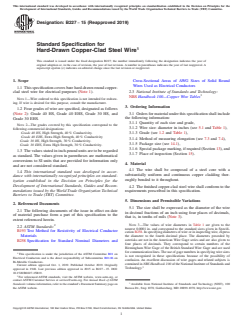
1.1 This specification covers bare hard-drawn round copper-clad steel wire for electrical purposes (Note 1).
Note 1: Wire ordered to this specification is not intended for redrawing. If wire is desired for this purpose, consult the manufacturer.
1.2 Four grades of wire are specified, designated as follows (Note 2): Grade 40 HS, Grade 40 EHS, Grade 30 HS, and Grade 30 EHS.
Note 2: The grades covered by this specification correspond to the following commercial designations:
Grade 40 HS, High Strength, 40 % Conductivity.
Grade 40 EHS, Extra High Strength, 40 % Conductivity
Grade 30 HS, High Strength, 30 % Conductivity.
Grade 30 EHS, Extra High Strength, 30 % Conductivity.
1.3 The values stated in inch-pound units are to be regarded as standard. The values given in parentheses are mathematical conversions to SI units that are provided for information only and are not considered standard.
1.4 This international standard was developed in accordance with internationally recognized principles on standardization established in the Decision on Principles for the Development of International Standards, Guides and Recommendations issued by the World Trade Organization Technical Barriers to Trade (TBT) Committee.
- Status
- Published
- Publication Date
- 30-Sep-2019
- Technical Committee
- B01 - Electrical Conductors
- Drafting Committee
- B01.06 - Bi-Metallic Conductors

Overview
ASTM B227-15(2019): Standard Specification for Hard-Drawn Copper-Clad Steel Wire establishes the requirements for bare, hard-drawn, round copper-clad steel wire primarily used for electrical purposes. Developed by ASTM International, this standard ensures wire quality through specifications covering tensile strength, electrical resistance, and material composition. The purpose is to promote uniformity and reliability in the production and performance of copper-clad steel wire, supporting industry needs for high-strength, conductive electrical conductors.
Keywords: copper-clad steel wire, hard-drawn wire, electrical conductor, ASTM B227, steel wire standards, tensile strength, electrical resistance.
Key Topics
Wire Grades and Conductivity
- Four grades specified: Grade 40 HS, Grade 40 EHS, Grade 30 HS, Grade 30 EHS
- Grades correlate with high strength (HS), extra high strength (EHS), and conductivity levels (30% or 40%)
Material Composition
- Copper-clad steel wire consists of a steel core uniformly clad with copper
- The copper layer is continuously bonded throughout the wire length
Dimensional Requirements
- Wire diameter must be specified to four decimal places in inches
- Permissible diameter variations controlled for quality assurance
Tensile and Mechanical Properties
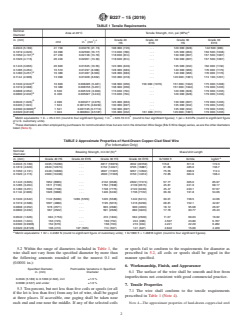
- Specific minimum tensile strength requirements for each grade and size
- Elongation and twist tests confirm mechanical integrity and absence of significant surface imperfections
Electrical Resistance
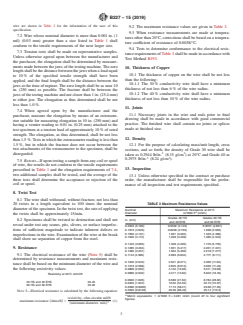
- Maximum resistance values defined for each size and grade
- Resistance measurements conducted according to prescribed test methods to ensure performance in electrical applications
Surface Quality and Workmanship
- Surface must be smooth and free from seams, pits, slivers, or defects indicating inherent problems
- Finished wire must not contain joints or splices made at final size
Applications
Hard-drawn copper-clad steel wire compliant with ASTM B227-15(2019) is mainly used in electrical and communication industries where high strength, durability, and adequate conductivity are vital. Typical applications include:
Aerial and Overhead Circuit Wiring
- Used where a combination of tensile strength and conductivity is required, such as utility or power distribution lines
Communications and Signal Transmission
- Suitable for communication lines due to high mechanical strength and sufficient signal conductivity
Grounding and Bonding Conductors
- Ideal for grounding systems, especially where resistance to breakage or stretching is important
Electric Fencing and Security Systems
- Used in security systems that demand a strong, conductive wire able to withstand environmental stresses
The standard’s specifications ensure the wire can be safely and reliably deployed in demanding outdoor and infrastructure environments.
Related Standards
ASTM B227-15(2019) references and aligns with several related standards for consistency in testing and material requirements:
- ASTM B193: Test Method for Resistivity of Electrical Conductor Materials - outlines procedures for measuring electrical resistance.
- ASTM B258: Specification for Standard Nominal Diameters and Birmingham Wire Gage - provides guidelines for wire sizing.
- NBS Handbook 100: Copper Wire Tables - useful for further information on wire gauges and related technical details.
These referenced documents support quality assurance, compatibility, and interoperability in the use of copper-clad steel electrical conductors. Following ASTM B227 ensures compliance with internationally recognized best practices within the electrical wire industry.
Relations
- Effective Date
- 01-Oct-2019
- Effective Date
- 01-Oct-2018
- Effective Date
- 01-Apr-2016
- Effective Date
- 01-Apr-2014
- Effective Date
- 01-Sep-2008
- Effective Date
- 01-Sep-2008
- Effective Date
- 10-Apr-2002
- Effective Date
- 10-Apr-2002
- Effective Date
- 10-Apr-2002
- Effective Date
- 10-Apr-2002
- Effective Date
- 10-Apr-2002
- Effective Date
- 01-Oct-2019
- Effective Date
- 01-Oct-2019
- Effective Date
- 01-Oct-2019
Get Certified
Connect with accredited certification bodies for this standard

Element Materials Technology
Materials testing and product certification.

Inštitut za kovinske materiale in tehnologije
Institute of Metals and Technology. Materials testing, metallurgical analysis, NDT.
Sponsored listings
Frequently Asked Questions
ASTM B227-15(2019) is a technical specification published by ASTM International. Its full title is "Standard Specification for Hard-Drawn Copper-Clad Steel Wire". This standard covers: ABSTRACT This specification covers bare hard-drawn round copper-clad steel wire. The surface of the wire shall be smooth and free from imperfections not consistent with good commercial practice. The wire shall conform to the tensile requirements. Specimens shall be twisted to destruction and shall not reveal under test any seams, pits, slivers, or surface imperfections of sufficient magnitude to indicate inherent defects or imperfections in the wire. The electrical resistance of the wire shall be determined by resistance measurements. The finished wire shall contain no joints or splices made at finished size. SCOPE 1.1 This specification covers bare hard-drawn round copper-clad steel wire for electrical purposes (Note 1). Note 1: Wire ordered to this specification is not intended for redrawing. If wire is desired for this purpose, consult the manufacturer. 1.2 Four grades of wire are specified, designated as follows (Note 2): Grade 40 HS, Grade 40 EHS, Grade 30 HS, and Grade 30 EHS. Note 2: The grades covered by this specification correspond to the following commercial designations: Grade 40 HS, High Strength, 40 % Conductivity. Grade 40 EHS, Extra High Strength, 40 % Conductivity Grade 30 HS, High Strength, 30 % Conductivity. Grade 30 EHS, Extra High Strength, 30 % Conductivity. 1.3 The values stated in inch-pound units are to be regarded as standard. The values given in parentheses are mathematical conversions to SI units that are provided for information only and are not considered standard. 1.4 This international standard was developed in accordance with internationally recognized principles on standardization established in the Decision on Principles for the Development of International Standards, Guides and Recommendations issued by the World Trade Organization Technical Barriers to Trade (TBT) Committee.
ABSTRACT This specification covers bare hard-drawn round copper-clad steel wire. The surface of the wire shall be smooth and free from imperfections not consistent with good commercial practice. The wire shall conform to the tensile requirements. Specimens shall be twisted to destruction and shall not reveal under test any seams, pits, slivers, or surface imperfections of sufficient magnitude to indicate inherent defects or imperfections in the wire. The electrical resistance of the wire shall be determined by resistance measurements. The finished wire shall contain no joints or splices made at finished size. SCOPE 1.1 This specification covers bare hard-drawn round copper-clad steel wire for electrical purposes (Note 1). Note 1: Wire ordered to this specification is not intended for redrawing. If wire is desired for this purpose, consult the manufacturer. 1.2 Four grades of wire are specified, designated as follows (Note 2): Grade 40 HS, Grade 40 EHS, Grade 30 HS, and Grade 30 EHS. Note 2: The grades covered by this specification correspond to the following commercial designations: Grade 40 HS, High Strength, 40 % Conductivity. Grade 40 EHS, Extra High Strength, 40 % Conductivity Grade 30 HS, High Strength, 30 % Conductivity. Grade 30 EHS, Extra High Strength, 30 % Conductivity. 1.3 The values stated in inch-pound units are to be regarded as standard. The values given in parentheses are mathematical conversions to SI units that are provided for information only and are not considered standard. 1.4 This international standard was developed in accordance with internationally recognized principles on standardization established in the Decision on Principles for the Development of International Standards, Guides and Recommendations issued by the World Trade Organization Technical Barriers to Trade (TBT) Committee.
ASTM B227-15(2019) is classified under the following ICS (International Classification for Standards) categories: 77.140.65 - Steel wire, wire ropes and link chains. The ICS classification helps identify the subject area and facilitates finding related standards.
ASTM B227-15(2019) has the following relationships with other standards: It is inter standard links to ASTM B227-15, ASTM B258-18, ASTM B193-16, ASTM B193-02(2014), ASTM B258-02(2008), ASTM B193-02(2008), ASTM B258-02, ASTM B193-00, ASTM B193-02, ASTM B193-01, ASTM B258-01, ASTM B229-12(2017), ASTM B228-11a(2021), ASTM B193-20. Understanding these relationships helps ensure you are using the most current and applicable version of the standard.
ASTM B227-15(2019) is available in PDF format for immediate download after purchase. The document can be added to your cart and obtained through the secure checkout process. Digital delivery ensures instant access to the complete standard document.
Standards Content (Sample)
This international standard was developed in accordance with internationally recognized principles on standardization established in the Decision on Principles for the
Development of International Standards, Guides and Recommendations issued by the World Trade Organization Technical Barriers to Trade (TBT) Committee.
Designation:B227 −15 (Reapproved 2019)
Standard Specification for
Hard-Drawn Copper-Clad Steel Wire
This standard is issued under the fixed designation B227; the number immediately following the designation indicates the year of
original adoption or, in the case of revision, the year of last revision. A number in parentheses indicates the year of last reapproval. A
superscript epsilon (´) indicates an editorial change since the last revision or reapproval.
1. Scope Cross-Sectional Areas of AWG Sizes of Solid Round
Wires Used as Electrical Conductors
1.1 Thisspecificationcoversbarehard-drawnroundcopper-
clad steel wire for electrical purposes (Note 1). 2.3 National Institute of Standards and Technology:
NBSHandbook 100—Copper Wire Tables
NOTE 1—Wire ordered to this specification is not intended for redraw-
ing. If wire is desired for this purpose, consult the manufacturer.
3. Ordering Information
1.2 Four grades of wire are specified, designated as follows
3.1 Orders for material under this specification shall include
(Note 2): Grade 40 HS, Grade 40 EHS, Grade 30 HS, and
Grade 30 EHS. the following information:
3.1.1 Quantity of each size and grade,
NOTE 2—The grades covered by this specification correspond to the
3.1.2 Wire size: diameter in inches (see 5.1 and Table 1),
following commercial designations:
Grade 40 HS, High Strength, 40 % Conductivity. 3.1.3 Grade (see 1.2 and Table 1),
Grade 40 EHS, Extra High Strength, 40 % Conductivity
3.1.4 Method of measuring elongation (see 7.3 and 7.4),
Grade 30 HS, High Strength, 30 % Conductivity.
3.1.5 Package size (see 14.1),
Grade 30 EHS, Extra High Strength, 30 % Conductivity.
3.1.6 Specialpackagemarking,ifrequired(Section13),and
1.3 The values stated in inch-pound units are to be regarded
3.1.7 Place of inspection (Section 15).
as standard. The values given in parentheses are mathematical
conversions to SI units that are provided for information only
4. Material
and are not considered standard.
4.1 The wire shall be composed of a steel core with a
1.4 This international standard was developed in accor-
substantially uniform and continuous copper cladding thor-
dance with internationally recognized principles on standard-
oughly bonded to it throughout.
ization established in the Decision on Principles for the
Development of International Standards, Guides and Recom-
4.2 The finished copper-clad steel wire shall conform to the
mendations issued by the World Trade Organization Technical
requirements prescribed in this specification.
Barriers to Trade (TBT) Committee.
5. Dimensions and Permissible Variations
2. Referenced Documents
5.1 The size shall be expressed as the diameter of the wire
2.1 The following documents of the issue in effect on date
in decimal fractions of an inch using four places of decimals,
of material purchase form a part of this specification to the
that is, in tenths of mils (Note 3).
extent referenced herein.
NOTE 3—The values of wire diameters in Table 1 are given to the
2.2 ASTM Standards:
nearest 0.0001 in. and correspond to the standard sizes given in Specifi-
B193 Test Method for Resistivity of Electrical Conductor
cationB258.Inspecifyingdiametersofwireorininspectingwire,express
Materials the diameter to the fourth decimal place. The diameters preceded by
asterisks are not in the American Wire Gage series and are also given to
B258 Specification for Standard Nominal Diameters and
four places of decimals. They correspond to certain numbers of the
Birmingham Wire Gage of the British Standard Wire Gage and are used
forcommunicationlines.Theuseofgagenumbersinspecifyingwiresizes
This specification is under the jurisdiction of the ASTM Committee B01 on
is not recognized in these specifications because of the possibility of
Electrical Conductors and is the direct responsibility of Subcommittee B01.06 on
confusion. An excellent discussion of wire gages and related subjects is
Bi-Metallic Conductors.
containedinNBSHandbook100oftheNationalInstituteofStandardsand
Current edition approved Oct. 1, 2019. Published October 2019. Originally
Technology.
approved in 1948. Last previous edition approved in 2015 as B227 – 15. DOI:
10.1520/B0227-15R19.
For referenced ASTM standards, visit the ASTM website, www.astm.org, or
contact ASTM Customer Service at service@astm.org. For Annual Book of ASTM
Standards volume information, refer to the standard’s Document Summary page on Available from National Institute of Standards and Technology (NIST), 100
the ASTM website. Bureau Dr., Stop 1070, Gaithersburg, MD 20899-1070, http://www.nist.gov.
Copyright © ASTM International, 100 Barr Harbor Drive, PO Box C700, West Conshohocken, PA 19428-2959. United States
B227−15 (2019)
TABLE 1 Tensile Requirements
Nominal
A
Area at 20°C Tensile Strength, min, psi (MPa)
Diameter
in. (mm) Grade 40 Grade 40 Grade 30 Grade 30
2 2 A
cmil in. (mm )
HS EHS HS EHS
0.2043 (5.189) 41 740 0.03278 (21.15) 108 000 (745) . . . 120 000 (828) 142 500 (983)
0.1819 (4.620) 33 090 0.02599 (16.77) 113 000 (780) . . . 125 000 (863) 150 500 (1038)
B
0.1650 (4.191) 27 230 0.02138 (13.79) 118 000 (814) . . . 130 000 (897) 157 500 (1087)
0.1620 (4.115) 26 240 0.02061 (13.30) 118 000 (814) . . . 130 000 (897) 157 500 (1087)
0.1443 (3.665) 20 820 0.01635 (10.55) 123 000 (849) . . . 135 000 (932) 164 000 (1132)
0.1285 (3.264) 16 510 0.01297 (8.368) 128 000 (883) . . . 140 000 (966) 170 000 (1173)
B
0.1280 (3.251) 16 380 0.01287 (8.303) 128 000 (883) . . . 140 000 (966) 170 000 (1173)
0.1144 (2.906) 13 090 0.01028 (6.632) 133 000 (918) . . . 145 000 (1001) 174 100 (1201)
B
0.1040 (2.642) 10 820 0.008495 (5.481) 138 600 (956) 156 000 (1076) 151 000 (1042) 175 000 (1208)
0.1019 (2.588) 10 380 0.008155 (5.261) 138 600 (956) . . . 151 000 (1042) 179 000 (1235)
0.0808 (2.052) 6 530 0.005129 (3.309) 115 000 (794) . . . 120 000 (828) 179 000 (1235)
B
0.0800 (2.032) 6 400 0.005027 (3.243) 115 000 (794) . . . 120 000 (828) 179 000 (1235)
B
0.0640 (1.626) 4 096 0.003217 (2.076) 125 000 (863) . . . 130 000 (897) 179 000 (1235)
0.0403 (1.024) 1 624 0.001276 (0.8232) 130 000 (897) . . . 135 000 (932) 179 000 (1235)
B
0.0390 (0.9906) 1 521 0.001195 (0.7710) 130 000 (897) . . . 135 000 (932) 179 000 (1235)
0.0320 (0.8128) 1 024 0.000804 (0.5187) 135 000 (932) 161 000 (1111) 145 000 (1001) 179 000 (1235)
A 2 2
Metric equivalents: 1 in. = 25.4 mm (round to four significant figures); 1 in. = 645.16 mm (round to four significant figures); 1 psi = 6.9 kPa (round to significant figure
of U.S. customary units).
B
ThesediametersareoftenemployedbypurchasersforcommunicationlinesbutarenotintheAmericanWireGage(B&SWireGage)series,asaretheotherdiameters
listed (Note 3).
TABLE 2 Approximate Properties of Hard-Drawn Copper-Clad Steel Wire
(For Information Only)
Nominal
A
Breaking Strength, min lbf (N) Mass/Unit Length
Diameter
A
in. (mm) Grade 40 HS Grade 40 EHS Grade 30 HS Grade 30 EHS lb/1000 ft lb/mile kg/km
0.2043 (5.189) 3435 (15280) . . . 3817 (16979) 4532 (20159) 115.8 611.6 172.3
0.1819 (4.620) 2849 (12673) . . . 3152 (14021) 3795 (16881) 91.86 485.0 136.7
0.1650 (4.191) 2448 (10889) . . . 2697 (11997) 3267 (14532) 75.55 398.9 112.4
0.1620 (4.115) 2360 (10498) . . . 2600 (11565) 3150 (14012) 72.85 384.6 108.4
0.1443 (3.665) 1952 (8683) . . . 2142 (9528) 2602 (11574) 57.77 305.0 85.97
0.1285 (3.264) 1611 (7166) . . . 1762 (7838) 2139 (9515) 45.81 241.9 68.17
0.1280 (3.251) 1598 (7108) . . . 1748 (7775) 2122 (9439) 45.47 240.1 67.67
0.1144 (2.906) 1326 (5898) . . . 1446 (6432) 1736 (7722) 36.33 191.8 54.06
0.1040 (2.642) 1142 (5080) 1286 (5720) 1245 (5538) 1442 (6414) 30.01 158.5 44.66
0.1019 (2.588) 1097 (4880) . . . 1195 (5316) 1416 (6299) 28.81 152.1 42.87
0.0808 (2.052) 578 (2571) . . . 603 (2682) 900 (4003) 18.12 95.68 26.97
0.0800 (2.032) 567 (2522) . . . 591 (2629) 882 (3923) 17.76 93.77 26.43
0.0640 (1.626) 394 (1753) . . . 410 (1824) 564 (2509) 11.37 60.03 16.92
0.0403 (1.024) 163 (725) . . . 169 (752) 224 (996) 4.507 23.80 6.707
0.0390 (0.9906) 152 (676) . . . 158 (703) 210 (934) 4.221 22.29 6.282
0.0320 (0.8126) 106 (472) 127 (565) 114 (507) 141 (627) 2.842 15.00 4.229
A
Metric equivalents: 1 lbf = 4.4482 N (round to significant figure of customary units); 1 lb/1000 ft = 1.48816 kg/km (round to four significant figures).
5.2 Within the range of diameters included in Table 1, the or spools fail to conform to the requirements for diameter as
wire shall not vary from the specified diameter by more than prescribed in 5.2, all coils or spools shall be gaged in the
the following amounts rounded off to the nearest 0.1 mil manner specified.
(0.0001 in.):
6. Workmanship,
...