

ASTM A555/A555M-23
(Specification)Standard Specification for General Requirements for Stainless Steel Wire and Wire Rods
General Information
- Abstract
ABSTRACT
This specification covers general requirements that shall apply to stainless wire and wire rods. Wire is intended primarily for cold forming, including coiling, stranding, weaving, heading and machining as covered under the required specifications. The material may be furnished in one of the conditions detailed in the applicable material specification, that is, annealed, bright annealed, or cold worked. Intergranular corrosion test, grain size test, tension test, and chemical analysis shall conform to the chemical and mechanical requirements of the material specification.
SCOPE
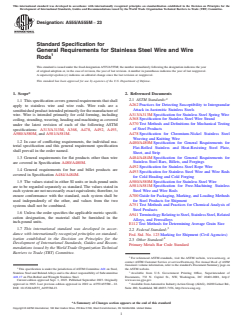
1.1 This specification covers general requirements that shall apply to stainless wire and wire rods. Wire rods are a semifinished product intended primarily for the manufacture of wire. Wire is intended primarily for cold forming, including coiling, stranding, weaving, heading and machining as covered under the latest revision of each of the following ASTM specifications: A313/A313M, A368, A478, A492, A493, A580/A580M, and A581/A581M.
1.2 In case of conflicting requirements, the individual material specification and this general requirement specification shall prevail in the order named.
1.3 General requirements for flat products other than wire are covered in Specification A480/A480M.
1.4 General requirements for bar and billet products are covered in Specification A484/A484M.
1.5 The values stated in either SI units or inch-pound units are to be regarded separately as standard. The values stated in each system are not necessarily exact equivalents; therefore, to ensure conformance with the standard, each system shall be used independently of the other, and values from the two systems shall not be combined.
1.6 Unless the order specifies the applicable metric specification designation, the material shall be furnished in the inch-pound units.
1.7 This international standard was developed in accordance with internationally recognized principles on standardization established in the Decision on Principles for the Development of International Standards, Guides and Recommendations issued by the World Trade Organization Technical Barriers to Trade (TBT) Committee.
- Status
- Published
- Publication Date
- 31-Aug-2023
- Technical Committee
- A01 - Steel, Stainless Steel and Related Alloys
- Drafting Committee
- A01.17 - Flat-Rolled and Wrought Stainless Steel
Buy Documents
ASTM A555/A555M-23 - Standard Specification for General Requirements for Stainless Steel Wire and Wire Rods
REDLINE ASTM A555/A555M-23 - Standard Specification for General Requirements for Stainless Steel Wire and Wire Rods
Overview
ASTM A555/A555M-23: Standard Specification for General Requirements for Stainless Steel Wire and Wire Rods defines the general requirements and provisions for the production, testing, and delivery of stainless steel wire and wire rods. Developed by ASTM International, this specification establishes the framework under which stainless wire materials are manufactured, inspected, and documented to ensure consistency, quality, and compliance within the steel industry. Wire is primarily intended for cold forming operations such as coiling, stranding, weaving, heading, and machining, while wire rods serve as a semifinished input for wire manufacturing.
This international standard is widely recognized for supporting effective procurement, traceability, and quality assurance in stainless steel wire product supply chains.
Key Topics
- Scope: Applies to stainless steel wire and wire rods, with wire rods primarily used to manufacture wire covered by several referenced ASTM specifications.
- Conditions of Supply: Material can be provided in annealed, bright annealed, cold worked, or other conditions specified by purchase order or product specification.
- Chemical Composition: Outlines requirements for heat analysis and product analysis to ensure conformity to stated chemical composition limits.
- Mechanical and Corrosion Testing: Specifies requirements for tension test, grain size, and intergranular corrosion resistance, as detailed in referenced standards.
- Dimensional Tolerances: Details permissible variations in wire size, diameter, width, thickness, and out-of-roundness for hot finished, cold drawn, and flat wire forms.
- Inspection and Certification: Stipulates testing frequency, sampling procedures, reporting requirements, and compliance documentation for both civilian and government procurement.
- Packaging and Identification: Provides guidance for packaging, marking, and shipment, complying with recognized federal or military standards where applicable.
- Metric and Inch-Pound Units: Materials may be ordered and furnished in either metric (SI) or inch-pound units, but the two systems are not to be combined.
Applications
Stainless steel wire and wire rods manufactured under ASTM A555/A555M-23 serve a diverse range of applications in multiple industries, including:
- Cold Forming Manufacturing: The wire is used for processes like coiling, stranding, weaving, heading, and machining to produce springs, cables, mesh, fasteners, and wire-based components.
- Automotive and Aerospace: Critical for producing robust, corrosion-resistant wire forms, springs, and assemblies.
- Construction: Utilized in reinforcement, barrier, and architectural applications due to its durability and formability.
- Industrial Equipment and Machinery: Cold-formed wire components such as pins, clips, and structural connectors.
- Medical Devices: Used for producing surgical wires, mesh, and fine tolerance components.
- Consumer Products: Essential for appliances, kitchenware, and electronics requiring stainless steel wire forms.
The standard ensures that these products meet stringent quality demands for uniformity, mechanical properties, dimensional accuracy, and resistance to corrosion.
Related Standards
ASTM A555/A555M-23 references several important companion and product-specific specifications, including:
- A313/A313M - Stainless Steel Spring Wire
- A368 - Stainless Steel Wire Strand
- A478 - Chromium-Nickel Stainless Steel Weaving and Knitting Wire
- A492 - Stainless Steel Rope Wire
- A493 - Stainless Steel Wire and Wire Rods for Cold Heading and Cold Forging
- A580/A580M - Stainless Steel Wire
- A581/A581M - Free-Machining Stainless Steel Wire and Wire Rods
- A480/A480M - General Requirements for Flat-Rolled Stainless and Heat-Resisting Steel
- A484/A484M - General Requirements for Stainless Steel Bars, Billets, and Forgings
- A262, A370, A751, E112 - Test Methods for Intergranular Attack, Mechanical Testing, Chemical Analysis, and Grain Size Determination
By referencing and complying with ASTM A555/A555M-23, manufacturers and purchasers ensure product performance, traceability, and compatibility with the wider family of ASTM stainless steel wire and rod standards.
Relations
- Effective Date
- 01-Mar-2024
- Effective Date
- 01-Mar-2024
- Effective Date
- 01-Jan-2024
- Effective Date
- 01-Nov-2023
- Effective Date
- 01-Nov-2023
- Effective Date
- 01-Sep-2023
- Effective Date
- 01-Mar-2023
- Effective Date
- 05-May-2020
- Effective Date
- 01-Nov-2019
- Effective Date
- 01-Sep-2019
- Effective Date
- 01-Sep-2019
- Effective Date
- 01-Jul-2019
- Effective Date
- 01-Mar-2019
- Effective Date
- 01-Mar-2019
- Effective Date
- 01-Mar-2019
Buy Documents
ASTM A555/A555M-23 - Standard Specification for General Requirements for Stainless Steel Wire and Wire Rods
REDLINE ASTM A555/A555M-23 - Standard Specification for General Requirements for Stainless Steel Wire and Wire Rods
Get Certified
Connect with accredited certification bodies for this standard

Element Materials Technology
Materials testing and product certification.

Inštitut za kovinske materiale in tehnologije
Institute of Metals and Technology. Materials testing, metallurgical analysis, NDT.
Sponsored listings
Frequently Asked Questions
ASTM A555/A555M-23 is a technical specification published by ASTM International. Its full title is "Standard Specification for General Requirements for Stainless Steel Wire and Wire Rods". This standard covers: ABSTRACT This specification covers general requirements that shall apply to stainless wire and wire rods. Wire is intended primarily for cold forming, including coiling, stranding, weaving, heading and machining as covered under the required specifications. The material may be furnished in one of the conditions detailed in the applicable material specification, that is, annealed, bright annealed, or cold worked. Intergranular corrosion test, grain size test, tension test, and chemical analysis shall conform to the chemical and mechanical requirements of the material specification. SCOPE 1.1 This specification covers general requirements that shall apply to stainless wire and wire rods. Wire rods are a semifinished product intended primarily for the manufacture of wire. Wire is intended primarily for cold forming, including coiling, stranding, weaving, heading and machining as covered under the latest revision of each of the following ASTM specifications: A313/A313M, A368, A478, A492, A493, A580/A580M, and A581/A581M. 1.2 In case of conflicting requirements, the individual material specification and this general requirement specification shall prevail in the order named. 1.3 General requirements for flat products other than wire are covered in Specification A480/A480M. 1.4 General requirements for bar and billet products are covered in Specification A484/A484M. 1.5 The values stated in either SI units or inch-pound units are to be regarded separately as standard. The values stated in each system are not necessarily exact equivalents; therefore, to ensure conformance with the standard, each system shall be used independently of the other, and values from the two systems shall not be combined. 1.6 Unless the order specifies the applicable metric specification designation, the material shall be furnished in the inch-pound units. 1.7 This international standard was developed in accordance with internationally recognized principles on standardization established in the Decision on Principles for the Development of International Standards, Guides and Recommendations issued by the World Trade Organization Technical Barriers to Trade (TBT) Committee.
ABSTRACT This specification covers general requirements that shall apply to stainless wire and wire rods. Wire is intended primarily for cold forming, including coiling, stranding, weaving, heading and machining as covered under the required specifications. The material may be furnished in one of the conditions detailed in the applicable material specification, that is, annealed, bright annealed, or cold worked. Intergranular corrosion test, grain size test, tension test, and chemical analysis shall conform to the chemical and mechanical requirements of the material specification. SCOPE 1.1 This specification covers general requirements that shall apply to stainless wire and wire rods. Wire rods are a semifinished product intended primarily for the manufacture of wire. Wire is intended primarily for cold forming, including coiling, stranding, weaving, heading and machining as covered under the latest revision of each of the following ASTM specifications: A313/A313M, A368, A478, A492, A493, A580/A580M, and A581/A581M. 1.2 In case of conflicting requirements, the individual material specification and this general requirement specification shall prevail in the order named. 1.3 General requirements for flat products other than wire are covered in Specification A480/A480M. 1.4 General requirements for bar and billet products are covered in Specification A484/A484M. 1.5 The values stated in either SI units or inch-pound units are to be regarded separately as standard. The values stated in each system are not necessarily exact equivalents; therefore, to ensure conformance with the standard, each system shall be used independently of the other, and values from the two systems shall not be combined. 1.6 Unless the order specifies the applicable metric specification designation, the material shall be furnished in the inch-pound units. 1.7 This international standard was developed in accordance with internationally recognized principles on standardization established in the Decision on Principles for the Development of International Standards, Guides and Recommendations issued by the World Trade Organization Technical Barriers to Trade (TBT) Committee.
ASTM A555/A555M-23 is classified under the following ICS (International Classification for Standards) categories: 77.140.65 - Steel wire, wire ropes and link chains. The ICS classification helps identify the subject area and facilitates finding related standards.
ASTM A555/A555M-23 has the following relationships with other standards: It is inter standard links to ASTM A941-24, ASTM A370-24, ASTM A484/A484M-24, ASTM A493-23, ASTM A480/A480M-23b, ASTM A484/A484M-23a, ASTM A484/A484M-23, ASTM A484/A484M-20a, ASTM A700-14(2019), ASTM A484/A484M-19, ASTM A480/A480M-19, ASTM A370-19, ASTM A492-95(2019), ASTM A368-95a(2019), ASTM A478-97(2019). Understanding these relationships helps ensure you are using the most current and applicable version of the standard.
ASTM A555/A555M-23 is available in PDF format for immediate download after purchase. The document can be added to your cart and obtained through the secure checkout process. Digital delivery ensures instant access to the complete standard document.
Standards Content (Sample)
This international standard was developed in accordance with internationally recognized principles on standardization established in the Decision on Principles for the
Development of International Standards, Guides and Recommendations issued by the World Trade Organization Technical Barriers to Trade (TBT) Committee.
Designation: A555/A555M − 23
Standard Specification for
General Requirements for Stainless Steel Wire and Wire
Rods
This standard is issued under the fixed designation A555/A555M; the number immediately following the designation indicates the year
of original adoption or, in the case of revision, the year of last revision. A number in parentheses indicates the year of last reapproval.
A superscript epsilon (´) indicates an editorial change since the last revision or reapproval.
This standard has been approved for use by agencies of the U.S. Department of Defense.
1. Scope* 2. Referenced Documents
2.1 ASTM Standards:
1.1 This specification covers general requirements that shall
A262 Practices for Detecting Susceptibility to Intergranular
apply to stainless wire and wire rods. Wire rods are a
Attack in Austenitic Stainless Steels
semifinished product intended primarily for the manufacture of
A313/A313M Specification for Stainless Steel Spring Wire
wire. Wire is intended primarily for cold forming, including
A368 Specification for Stainless Steel Wire Strand
coiling, stranding, weaving, heading and machining as covered
A370 Test Methods and Definitions for Mechanical Testing
under the latest revision of each of the following ASTM
of Steel Products
specifications: A313/A313M, A368, A478, A492, A493,
A478 Specification for Chromium-Nickel Stainless Steel
A580/A580M, and A581/A581M.
Weaving and Knitting Wire
1.2 In case of conflicting requirements, the individual ma-
A480/A480M Specification for General Requirements for
terial specification and this general requirement specification
Flat-Rolled Stainless and Heat-Resisting Steel Plate,
shall prevail in the order named.
Sheet, and Strip
A484/A484M Specification for General Requirements for
1.3 General requirements for flat products other than wire
Stainless Steel Bars, Billets, and Forgings
are covered in Specification A480/A480M.
A492 Specification for Stainless Steel Rope Wire
1.4 General requirements for bar and billet products are
A493 Specification for Stainless Steel Wire and Wire Rods
covered in Specification A484/A484M.
for Cold Heading and Cold Forging
1.5 The values stated in either SI units or inch-pound units A580/A580M Specification for Stainless Steel Wire
A581/A581M Specification for Free-Machining Stainless
are to be regarded separately as standard. The values stated in
Steel Wire and Wire Rods
each system are not necessarily exact equivalents; therefore, to
A700 Guide for Packaging, Marking, and Loading Methods
ensure conformance with the standard, each system shall be
for Steel Products for Shipment
used independently of the other, and values from the two
A751 Test Methods and Practices for Chemical Analysis of
systems shall not be combined.
Steel Products
1.6 Unless the order specifies the applicable metric specifi-
A941 Terminology Relating to Steel, Stainless Steel, Related
cation designation, the material shall be furnished in the
Alloys, and Ferroalloys
inch-pound units.
E112 Test Methods for Determining Average Grain Size
1.7 This international standard was developed in accor-
2.2 Federal Standard:
dance with internationally recognized principles on standard-
Fed. Std. No. 123 Marking for Shipment (Civil Agencies)
ization established in the Decision on Principles for the
2.3 Other Standard:
Development of International Standards, Guides and Recom-
Primary Metals Bar Code Standard
mendations issued by the World Trade Organization Technical
Barriers to Trade (TBT) Committee.
For referenced ASTM standards, visit the ASTM website, www.astm.org, or
contact ASTM Customer Service at service@astm.org. For Annual Book of ASTM
Standards volume information, refer to the standard’s Document Summary page on
This specification is under the jurisdiction of ASTM Committee A01 on Steel, the ASTM website.
Stainless Steel and Related Alloys and is the direct responsibility of Subcommittee Available from U.S. Government Printing Office, Superintendent of
A01.17 on Flat-Rolled and Wrought Stainless Steel. Documents, 732 N. Capitol St., NW, Washington, DC 20401-0001, http://
Current edition approved Sept. 1, 2023. Published September 2023. Originally www.access.gpo.gov.
approved in 1965. Last previous edition approved in 2022 as A555/A555M – 22. Available from Automotive Industry Action Group (AIAG), 26200 Lahser Rd.,
DOI: 10.1520/A0555_A0555M-23. Suite 200, Southfield, MI 48033-7156, http://www.aiag.org.
*A Summary of Changes section appears at the end of this standard
Copyright © ASTM International, 100 Barr Harbor Drive, PO Box C700, West Conshohocken, PA 19428-2959. United States
A555/A555M − 23
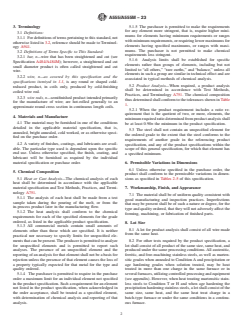
3. Terminology 5.1.5 The purchaser is permitted to make the requirements
for any element more stringent, that is, require higher mini-
3.1 Definitions:
mums for elements having minimum requirements or ranges
3.1.1 For definitions of terms pertaining to this standard, not
with minimum requirements, or requiring lower maximums for
otherwise listed in 3.2, reference should be made to Terminol-
elements having specified maximums, or ranges with maxi-
ogy A941.
mums. The purchaser is not permitted to make chemical
3.2 Definitions of Terms Specific to This Standard:
requirements less stringent.
3.2.1 bar, n—wire that has been straightened and cut (see
5.1.6 Analysis limits shall be established for specific
Specification A484/A484M); however, a straightened and cut
elements rather than groups of elements, including but not
small diameter product is often called straightened and cut
limited to “all others,” “rare earths,” and “balance,” unless all
wire.
elements in such a group are similar in technical effect and are
3.2.2 wire, n—as covered by this specification and the
associated in typical methods of chemical analysis.
specifications itemized in 1.1, is any round or shaped cold-
5.2 Product Analysis—When required, a product analysis
reduced product, in coils only, produced by cold-finishing
shall be determined in accordance with Test Methods,
coiled wire rod.
Practices, and Terminology A751. The chemical composition
3.2.3 wire rods, n—semifinished product intended primarily
thus determined shall conform to the tolerances shown in Table
for the manufacture of wire; are hot-rolled generally to an
1.
approximate round cross section in continuous length coils.
5.2.1 When the product requirement includes a ratio re-
quirement that is the quotient of two, or more, elements, the
4. Materials and Manufacture
minimum required ratio determined from product analysis shall
4.1 The material may be furnished in one of the conditions
be at least 0.90× the minimum in the product specification.
detailed in the applicable material specification, that is,
5.3 The steel shall not contain an unspecified element for
annealed, bright annealed, cold worked, or as otherwise speci-
the ordered grade to the extent that the steel conforms to the
fied on the purchase order.
requirements of another grade in the referencing product
4.2 A variety of finishes, coatings, and lubricants are avail-
specification, and any of the product specifications within the
able. The particular type used is dependent upon the specific
scope of this general specification, for which that element has
end use. Unless otherwise specified, the finish, coating, and
a specified minimum.
lubricant will be furnished as required by the individual
material specification or purchase order.
6. Permissible Variations in Dimensions
6.1 Unless otherwise specified in the purchase order, the
5. Chemical Composition
product shall conform to the permissible variations in dimen-
5.1 Heat or Cast Analysis—The chemical analysis of each
sions as specified in Tables 2-5 of this specification.
heat shall be determined in accordance with the applicable
material specification and Test Methods, Practices, and Termi- 7. Workmanship, Finish, and Appearance
nology A751.
7.1 The material shall be of uniform quality consistent with
5.1.1 The analysis of each heat shall be made from a test
good manufacturing and inspection practices. Imperfections
sample taken during the pouring of the melt, or from the
that may be present shall be of such a nature or degree, for the
in-process product later in the manufacturing flow.
type and quality ordered, that they will not adversely affect the
5.1.2 The heat analysis shall conform to the chemical
forming, machining, or fabrication of finished parts.
requirements for each of the specified elements for the grade
ordered, as listed in the applicable product specification.
8. Lot Size
5.1.3 All commercial metals contain small amounts of
8.1 A lot for product analysis shall consist of all wire made
elements other than those which are specified. It is neither
from the same heat.
practical nor necessary to specify limits for unspecified ele-
ments that can be present. The producer is permitted to analyze 8.2 For other tests required by the product specification, a
for unspecified elements and is permitted to report such lot shall consist of all product of the same size, same heat, and
analyses. The presence of an unspecified element and the produced under the same processing conditions. All austenitic,
reporting of an analysis for that element shall not be a basis for ferritic, and free-machining stainless steels, as well as marten-
rejection unless the presence of that element causes the loss of sitic grades when annealed to Condition A and precipitation or
a property typically expected for that metal for the type and age hardening grades when solution treated, may be heat
quality ordered. treated in more than one charge in the same furnace or in
5.1.4 The purchaser is permitted to require in the purchase several furnaces, utilizing controlled processing and equipment
order a maximum limit for an individual element not specified (see appendix). However, when heat treating martensitic stain-
in the product specification. Such a requirement for an element less steels to Condition T or H and when age hardening the
not listed in the product specification, when acknowledged in precipitation hardening stainless steels, a lot shall consist of the
the order acceptance, shall be treated as a specified element, same size, same heat, and the same heat treat charge in a
with determination of chemical analysis and reporting of that batch-type furnace or under the same conditions in a continu-
analysis. ous furnace.
A555/A555M − 23
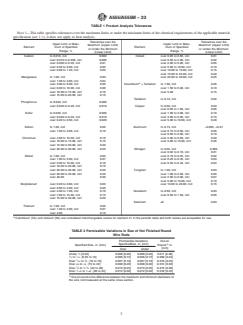
TABLE 1 Product Analysis Tolerances
NOTE 1—This table specifies tolerances over the maximum limits or under the minimum limits of the chemical requirements of the applicable material
specification (see 1.1); it does not apply to heat analysis.
Tolerances over the Tolerances over the
Upper Limit or Maxi- Upper Limit or Maxi-
Maximum (Upper Limit) Maximum (Upper Limit)
Element mum of Specified Element mum of Specified
or Under the Minimum or Under the Minimum
Range, % Range, %
(Lower Limit) (Lower Limit)
Carbon to 0.010, incl 0.002 Cobalt over 0.05 to 0.50, incl 0.01
over 0.010 to 0.030, incl 0.005 over 0.50 to 2.00, incl 0.02
over 0.030 to 0.20, incl 0.01 over 2.00 to 5.00, incl 0.05
over 0.20 to 0.60, incl 0.02 over 5.00 to 10.00, incl 0.10
over 0.60 to 1.20, incl 0.03 over 10.00 to 15.00, incl 0.15
over 15.00 to 22.00, incl 0.20
Manganese to 1.00, incl 0.03 over 22.00 to 30.00, incl 0.25
over 1.00 to 3.00, incl 0.04
A
over 3.00 to 6.00, incl 0.05 Columbium + Tantalum to 1.50, incl 0.05
over 6.00 to 10.00, incl 0.06 over 1.50 to 5.00, incl 0.10
over 10.00 to 15.00, incl 0.10 over 5.00 0.15
over 15.00 to 20.00, incl 0.15
Tantalum to 0.10, incl 0.02
Phosphorus to 0.040, incl 0.005
over 0.040 to 0.20, incl 0.010 Copper to 0.50, incl 0.03
over 0.50 to 1.00, incl 0.05
Sulfur to 0.040, incl 0.005 over 1.00 to 3.00, incl 0.10
over 0.040 to 0.20, incl 0.010 over 3.00 to 5.00, incl 0.15
over 0.20 to 0.50, incl 0.020 over 5.00 to 10.00, incl 0.20
Silicon to 1.00, incl 0.05 Aluminum to 0.15, incl −0.005, +0.01
over 1.00 to 3.00, incl 0.10 over 0.15 to 0.50, incl 0.05
over 0.50 to 2.00, incl 0.10
Chromium over 4.00 to 10.00, incl 0.10 over 2.00 to 5.00, incl 0.20
over 10.00 to 15.00, incl 0.15 over 5.00 to 10.00, incl 0.35
over 15.00 to 20.00, incl 0.20
over 20.00 to 30.00, incl 0.25 Nitrogen to 0.02, incl 0.005
over 0.02 to 0.19, incl 0.01
Nickel to 1.00, incl 0.03 over 0.19 to 0.25, incl 0.02
over 1.00 to 5.00, incl 0.07 over 0.25 to 0.35, incl 0.03
over 5.00 to 10.00, incl 0.10 over 0.35 to 0.45, incl 0.04
over 10.00 to 20.00, incl 0.15
over 20.00 to 30.00, incl 0.20 Tungsten to 1.00, incl 0.03
over 30.00 to 40.00, incl 0.25 over 1.00 to 2.00, incl 0.05
over 40.00 0.30 over 2.00 to 5.00, incl 0.07
over 5.00 to 10.00, incl 0.10
Molybdenum over 0.20 to 0.60, incl 0.03 over 10.00 to 20.00, incl 0.15
over 0.60 to 2.00, incl 0.05
over 2.00 to 7.00, incl 0.10 Vanadium to 0.50, incl 0.03
over 7.00 to 15.00, incl 0.15 over 0.50 to 1.50, incl 0.05
over 15.00 to 30.00, incl 0.20
Selenium all 0.03
Titanium to 1.00, incl 0.05
over 1.00 to 3.00, incl 0.07
over 3.00 0.10
A
Columbium (Cb) and niobium (Nb) are considered interchangeable names for element 41 in the periodic table and both names are acceptable for use.
TABLE 2 Permissible Variations in Size of Hot Finished Round
Wire Rods
Permissible Variations
Out-of-
A
SpecifiedSize, in. [mm]
Specified Size, in. [mm]
Round, in.
[mm]
Over Under
Under ⁄4 [6.35] 0.008 [0.20] 0.008 [0.20] 0.011 [0.28]
1 7
⁄4 to ⁄16 [6.35 to 10] 0.006 [0.15] 0.006 [0.15] 0.009 [0.23]
7 5
Over ⁄16 to ⁄8 [10 to 16] 0.007 [0.18] 0.007 [0.18] 0.010 [0.25]
5 7
Over ⁄8 to ⁄8 [16 to 22] 0.008 [0.20] 0.008 [0.20] 0.012 [0.30]
7 1
Over ⁄8 to 1- ⁄8 [22 to 28] 0.010 [0.25] 0.010 [0.25] 0.015 [0.38]
1 3
Over 1- ⁄8 to 1- ⁄8 [28 to 34] 0.012 [0.30] 0.012 [0.30] 0.018 [0.45]
A
Out-of-round is the difference between the maximum and minimum diameters of
the wire rod measured at the same cross section.
A555/A555M − 23
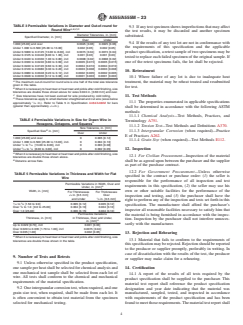
TABLE 3 Permissible Variations in Diameter and Out-of-round for
9.3 If any test specimen shows imperfections that may affect
A,B,C,D
Round Wire
the test r
...
This document is not an ASTM standard and is intended only to provide the user of an ASTM standard an indication of what changes have been made to the previous version. Because
it may not be technically possible to adequately depict all changes accurately, ASTM recommends that users consult prior editions as appropriate. In all cases only the current version
of the standard as published by ASTM is to be considered the official document.
Designation: A555/A555M − 22 A555/A555M − 23
Standard Specification for
General Requirements for Stainless Steel Wire and Wire
Rods
This standard is issued under the fixed designation A555/A555M; the number immediately following the designation indicates the year
of original adoption or, in the case of revision, the year of last revision. A number in parentheses indicates the year of last reapproval.
A superscript epsilon (´) indicates an editorial change since the last revision or reapproval.
This standard has been approved for use by agencies of the U.S. Department of Defense.
1. Scope*
1.1 This specification covers general requirements that shall apply to stainless wire and wire rods. Wire rods are a semifinished
product intended primarily for the manufacture of wire. Wire is intended primarily for cold forming, including coiling, stranding,
weaving, heading and machining as covered under the latest revision of each of the following ASTM specifications: A313/A313M,
A368, A478, A492, A493, A580/A580M, and A581/A581M.
1.2 In case of conflicting requirements, the individual material specification and this general requirement specification shall prevail
in the order named.
1.3 General requirements for flat products other than wire are covered in Specification A480/A480M.
1.4 General requirements for bar and billet products are covered in Specification A484/A484M.
1.5 The values stated in either SI units or inch-pound units are to be regarded separately as standard. The values stated in each
system are not necessarily exact equivalents; therefore, to ensure conformance with the standard, each system shall be used
independently of the other, and values from the two systems shall not be combined.
1.6 Unless the order specifies the applicable metric specification designation, the material shall be furnished in the inch-pound
units.
1.7 This international standard was developed in accordance with internationally recognized principles on standardization
established in the Decision on Principles for the Development of International Standards, Guides and Recommendations issued
by the World Trade Organization Technical Barriers to Trade (TBT) Committee.
2. Referenced Documents
2.1 ASTM Standards:
A262 Practices for Detecting Susceptibility to Intergranular Attack in Austenitic Stainless Steels
A313/A313M Specification for Stainless Steel Spring Wire
This specification is under the jurisdiction of ASTM Committee A01 on Steel, Stainless Steel and Related Alloys and is the direct responsibility of Subcommittee A01.17
on Flat-Rolled and Wrought Stainless Steel.
Current edition approved Sept. 1, 2022Sept. 1, 2023. Published September 2022September 2023. Originally approved in 1965. Last previous edition approved in 20212022
as A555/A555M – 21.A555/A555M – 22. DOI: 10.1520/A0555_A0555M-22.10.1520/A0555_A0555M-23.
For referenced ASTM standards, visit the ASTM website, www.astm.org, or contact ASTM Customer Service at service@astm.org. For Annual Book of ASTM Standards
volume information, refer to the standard’s Document Summary page on the ASTM website.
*A Summary of Changes section appears at the end of this standard
Copyright © ASTM International, 100 Barr Harbor Drive, PO Box C700, West Conshohocken, PA 19428-2959. United States
A555/A555M − 23
A368 Specification for Stainless Steel Wire Strand
A370 Test Methods and Definitions for Mechanical Testing of Steel Products
A478 Specification for Chromium-Nickel Stainless Steel Weaving and Knitting Wire
A480/A480M Specification for General Requirements for Flat-Rolled Stainless and Heat-Resisting Steel Plate, Sheet, and Strip
A484/A484M Specification for General Requirements for Stainless Steel Bars, Billets, and Forgings
A492 Specification for Stainless Steel Rope Wire
A493 Specification for Stainless Steel Wire and Wire Rods for Cold Heading and Cold Forging
A580/A580M Specification for Stainless Steel Wire
A581/A581M Specification for Free-Machining Stainless Steel Wire and Wire Rods
A700 Guide for Packaging, Marking, and Loading Methods for Steel Products for Shipment
A751 Test Methods and Practices for Chemical Analysis of Steel Products
A941 Terminology Relating to Steel, Stainless Steel, Related Alloys, and Ferroalloys
E112 Test Methods for Determining Average Grain Size
2.2 Federal Standard:
Fed. Std. No. 123 Marking for Shipment (Civil Agencies)
2.3 Military Standards:
MIL-STD-129 Marking for Shipment and Storage
MIL-STD-163 Preservation of Steel Products for Domestic Shipment
2.3 Other Standard:
Primary Metals Bar Code Standard
3. Terminology
3.1 Definitions:
3.1.1 For definitions of terms pertaining to this standard, not otherwise listed in 3.2, reference should be made to Terminology
A941.
3.2 Definitions of Terms Specific to This Standard:
3.2.1 bar, n—wire that has been straightened and cut (see Specification A484/A484M); however, a straightened and cut small
diameter product is often called straightened and cut wire.
3.2.2 wire, n—as covered by this specification and the specifications itemized in 1.1, is any round or shaped cold-reduced product,
in coils only, produced by cold-finishing coiled wire rod.
3.2.3 wire rods, n—semifinished product intended primarily for the manufacture of wire; are hot-rolled generally to an
approximate round cross section in continuous length coils.
4. Materials and Manufacture
4.1 The material may be furnished in one of the conditions detailed in the applicable material specification, that is, annealed, bright
annealed, cold worked, or as otherwise specified on the purchase order.
4.2 A variety of finishes, coatings, and lubricants are available. The particular type used is dependent upon the specific end use.
Unless otherwise specified, the finish, coating, and lubricant will be furnished as required by the individual material specification
or purchase order.
5. Chemical Composition
5.1 Heat or Cast Analysis—The chemical analysis of each heat shall be determined in accordance with the applicable material
specification and Test Methods, Practices, and Terminology A751.
5.1.1 The analysis of each heat shall be made from a test sample taken during the pouring of the melt, or from the in-process
product later in the manufacturing flow.
Available from U.S. Government Printing Office, Superintendent of Documents, 732 N. Capitol St., NW, Washington, DC 20401-0001, http://www.access.gpo.gov.
Available from Automotive Industry Action Group (AIAG), 26200 Lahser Rd., Suite 200, Southfield, MI 48033-7156, http://www.aiag.org.
A555/A555M − 23
5.1.2 The heat analysis shall conform to the chemical requirements for each of the specified elements for the grade ordered, as
listed in the applicable product specification.
5.1.3 All commercial metals contain small amounts of elements other than those which are specified. It is neither practical nor
necessary to specify limits for unspecified elements that can be present. The producer is permitted to analyze for unspecified
elements and is permitted to report such analyses. The presence of an unspecified element and the reporting of an analysis for that
element shall not be a basis for rejection unless the presence of that element causes the loss of a property typically expected for
that metal for the type and quality ordered.
5.1.4 The purchaser is permitted to require in the purchase order a maximum limit for an individual element not specified in the
product specification. Such a requirement for an element not listed in the product specification, when acknowledged in the order
acceptance, shall be treated as a specified element, with determination of chemical analysis and reporting of that analysis.
5.1.5 The purchaser is permitted to make the requirements for any element more stringent, that is, require higher minimums for
elements having minimum requirements or ranges with minimum requirements, or requiring lower maximums for elements having
specified maximums, or ranges with maximums. The purchaser is not permitted to make chemical requirements less stringent.
5.1.6 Analysis limits shall be established for specific elements rather than groups of elements, including but not limited to “all
others,” “rare earths,” and “balance,” unless all elements in such a group are similar in technical effect and are associated in typical
methods of chemical analysis.
5.2 Product Analysis—When required, a product analysis shall be determined in accordance with Test Methods, Practices, and
Terminology A751. The chemical composition thus determined shall conform to the tolerances shown in Table 1.
5.2.1 When the product requirement includes a ratio requirement that is the quotient of two, or more, elements, the minimum
required ratio determined from product analysis shall be at least 0.90× the minimum in the product specification.
5.3 The steel shall not contain an unspecified element for the ordered grade to the extent that the steel conforms to the requirements
of another grade in the referencing product specification, and any of the product specifications within the scope of this general
specification, for which that element has a specified minimum.
6. Permissible Variations in Dimensions
6.1 Unless otherwise specified in the purchase order, the product shall conform to the permissible variations in dimensions as
specified in Tables 2-5 of this specification.
7. Workmanship, Finish, and Appearance
7.1 The material shall be of uniform quality consistent with good manufacturing and inspection practices. Imperfections that may
be present shall be of such a nature or degree, for the type and quality ordered, that they will not adversely affect the forming,
machining, or fabrication of finished parts.
8. Lot Size
8.1 A lot for product analysis shall consist of all wire made from the same heat.
8.2 For other tests required by the product specification, a lot shall consist of all product of the same size, same heat, and produced
under the same processing conditions. All austenitic, ferritic, and free-machining stainless steels, as well as martensitic grades
when annealed to Condition A and precipitation or age hardening grades when solution treated, may be heat treated in more than
one charge in the same furnace or in several furnaces, utilizing controlled processing and equipment (see appendix). However,
when heat treating martensitic stainless steels to Condition T or H and when age hardening the precipitation hardening stainless
steels, a lot shall consist of the same size, same heat, and the same heat treat charge in a batch-type furnace or under the same
conditions in a continuous furnace.
A555/A555M − 23
TABLE 1 Product Analysis Tolerances
NOTE 1—This table specifies tolerances over the maximum limits or under the minimum limits of the chemical requirements of the applicable material
specification (see 1.1); it does not apply to heat analysis.
Tolerances over the Tolerances over the
Upper Limit or Maxi- Upper Limit or Maxi-
Maximum (Upper Limit) Maximum (Upper Limit)
Element mum of Specified Element mum of Specified
or Under the Minimum or Under the Minimum
Range, % Range, %
(Lower Limit) (Lower Limit)
Carbon to 0.010, incl 0.002 Cobalt over 0.05 to 0.50, incl 0.01
over 0.010 to 0.030, incl 0.005 over 0.50 to 2.00, incl 0.02
over 0.030 to 0.20, incl 0.01 over 2.00 to 5.00, incl 0.05
over 0.20 to 0.60, incl 0.02 over 5.00 to 10.00, incl 0.10
over 0.60 to 1.20, incl 0.03 over 10.00 to 15.00, incl 0.15
over 15.00 to 22.00, incl 0.20
Manganese to 1.00, incl 0.03 over 22.00 to 30.00, incl 0.25
over 1.00 to 3.00, incl 0.04
A
over 3.00 to 6.00, incl 0.05 Columbium + Tantalum to 1.50, incl 0.05
over 6.00 to 10.00, incl 0.06 over 1.50 to 5.00, incl 0.10
over 10.00 to 15.00, incl 0.10 over 5.00 0.15
over 15.00 to 20.00, incl 0.15
Tantalum to 0.10, incl 0.02
Phosphorus to 0.040, incl 0.005
over 0.040 to 0.20, incl 0.010 Copper to 0.50, incl 0.03
over 0.50 to 1.00, incl 0.05
Sulfur to 0.040, incl 0.005 over 1.00 to 3.00, incl 0.10
over 0.040 to 0.20, incl 0.010 over 3.00 to 5.00, incl 0.15
over 0.20 to 0.50, incl 0.020 over 5.00 to 10.00, incl 0.20
Silicon to 1.00, incl 0.05 Aluminum to 0.15, incl −0.005, +0.01
over 1.00 to 3.00, incl 0.10 over 0.15 to 0.50, incl 0.05
over 0.50 to 2.00, incl 0.10
Chromium over 4.00 to 10.00, incl 0.10 over 2.00 to 5.00, incl 0.20
over 10.00 to 15.00, incl 0.15 over 5.00 to 10.00, incl 0.35
over 15.00 to 20.00, incl 0.20
over 20.00 to 30.00, incl 0.25 Nitrogen to 0.02, incl 0.005
over 0.02 to 0.19, incl 0.01
Nickel to 1.00, incl 0.03 over 0.19 to 0.25, incl 0.02
over 1.00 to 5.00, incl 0.07 over 0.25 to 0.35, incl 0.03
over 5.00 to 10.00, incl 0.10 over 0.35 to 0.45, incl 0.04
over 10.00 to 20.00, incl 0.15
over 20.00 to 30.00, incl 0.20 Tungsten to 1.00, incl 0.03
over 30.00 to 40.00, incl 0.25 over 1.00 to 2.00, incl 0.05
over 40.00 0.30 over 2.00 to 5.00, incl 0.07
over 5.00 to 10.00, incl 0.10
Molybdenum over 0.20 to 0.60, incl 0.03 over 10.00 to 20.00, incl 0.15
over 0.60 to 2.00, incl 0.05
over 2.00 to 7.00, incl 0.10 Vanadium to 0.50, incl 0.03
over 7.00 to 15.00, incl 0.15 over 0.50 to 1.50, incl 0.05
over 15.00 to 30.00, incl 0.20
Selenium all 0.03
Titanium to 1.00, incl 0.05
over 1.00 to 3.00, incl 0.07
over 3.00 0.10
A
Columbium (Cb) and niobium (Nb) are considered interchangeable names for element 41 in the periodic table and both names are acceptable for use.
TABLE 2 Permissible Variations in Size of Hot Finished Round
Wire Rods
Permissible Variations
Out-of-
A
SpecifiedSize, in. [mm]
Specified Size, in. [mm]
Round, in.
[mm]
Over Under
Under ⁄4 [6.35] 0.008 [0.20] 0.008 [0.20] 0.011 [0.28]
1 7
⁄4 to ⁄16 [6.35 to 10] 0.006 [0.15] 0.006 [0.15] 0.009 [0.23]
7 5
Over ⁄16 to ⁄8 [10 to 16] 0.007 [0.18] 0.007 [0.18] 0.010 [0.25]
5 7
Over ⁄8 to ⁄8 [16 to 22] 0.008 [0.20] 0.008 [0.20] 0.012 [0.30]
7 1
Over ⁄8 to 1- ⁄8 [22 to 28] 0.010 [0.25] 0.010 [0.25] 0.015 [0.38]
1 3
Over 1- ⁄8 to 1- ⁄8 [28 to 34] 0.012 [0.30] 0.012 [0.30] 0.018 [0.45]
A
Out-of-round is the difference between the maximum and minimum diameters of
the wire rod measured at the same cross section.
A555/A555M − 23
TABLE 3 Permissible Variations in Diameter and Out-of-round for
A,B,C,D
Round Wire
Diameter Tolerances, in. [mm]
Specified Diameter, in. [mm]
Over Unde
...