

ASTM E69-22
(Test Method)Standard Test Method for Combustible Properties of Treated Wood by the Fire-Tube Apparatus
General Information
- Abstract
SIGNIFICANCE AND USE
4.1 The purpose of this test method is to provide a relative measurement of the combustibility of fire-retardant-treated wood specimens based on their percentage loss in weight under controlled fire exposure conditions (1).3 In addition, other possible data include rate of weight loss, time of flaming and afterglowing, increase in temperature, and maximum vertical flame progress.
4.2 This test method is not sufficiently large scale to evaluate the suitability of a given treated product for building construction, but it is a convenient method to use for purposes of development or as a quality-control test during manufacture.
4.3 This test method gives a procedure for sampling and preparation of test specimens from a lot of treated material in which complete penetration is a requirement. A procedure is also given for the sampling of charges at a treating plant for purposes of quality control of the treatment process.
4.4 This test method has proven useful for evaluating comparative fire performance effectiveness of fire-retardant chemicals and treatment formulations for wood and wood products (2-5).
4.5 In this test method, the specimens are subjected to one or more specific sets of laboratory test conditions. If different test conditions are substituted or the anticipated end-use conditions are changed, it is possible that this test method will not predict changes in the fire-test-response characteristics measured. Therefore, the results are valid only for the fire test exposure conditions described in this procedure.
SCOPE
1.1 This test method covers fire-tube test procedures for fire tests for combustible properties of wood treated to reduce flammability. This test method relates to properties of treated wood, as such, rather than to the performance of a fabrication used as an element of construction. Performance under this test method shall be as prescribed in requirements applicable to materials intended for specific uses.
1.2 This test method is a fire-test-response standard.
1.3 The SI values given in parentheses are provided for information purposes only.
1.4 This standard is used to measure and describe the response of materials, products, or assemblies to heat and flame under controlled conditions, but does not by itself incorporate all factors required for fire hazard or fire risk assessment of the materials, products, or assemblies under actual fire conditions.
1.5 This standard does not purport to address all of the safety concerns, if any, associated with its use. It is the responsibility of the user of this standard to establish appropriate safety, health, and environmental practices and determine the applicability of regulatory limitations prior to use.
1.6 Fire testing is inherently hazardous. Adequate safeguards for personnel and property shall be employed in conducting these tests.
1.7 This international standard was developed in accordance with internationally recognized principles on standardization established in the Decision on Principles for the Development of International Standards, Guides and Recommendations issued by the World Trade Organization Technical Barriers to Trade (TBT) Committee.
- Status
- Published
- Publication Date
- 31-Oct-2022
- Technical Committee
- D07 - Wood
- Drafting Committee
- D07.07 - Fire Performance of Wood
Buy Documents
ASTM E69-22 - Standard Test Method for Combustible Properties of Treated Wood by the Fire-Tube Apparatus
REDLINE ASTM E69-22 - Standard Test Method for Combustible Properties of Treated Wood by the Fire-Tube Apparatus
Overview
ASTM E69-22 - Standard Test Method for Combustible Properties of Treated Wood by the Fire-Tube Apparatus - is an internationally recognized fire-test-response standard developed by ASTM International. This standard specifically addresses the evaluation of the combustibility of fire-retardant-treated wood through controlled laboratory procedures. ASTM E69-22 outlines a relative measurement method based on weight loss of wood specimens when exposed to flame within a fire-tube apparatus. It is commonly used for comparative fire performance analysis of treated wood, quality control in manufacturing, and research and development of fire-retardant treatments.
Key Topics
Combustibility Measurement
Evaluates the relative combustibility of fire-retardant-treated wood by measuring percentage weight loss when subjected to standardized fire exposure conditions.Laboratory Testing Procedures
Describes fire-tube test procedures that expose wood specimens to controlled flame and heat, monitoring factors such as:- Overall weight loss
- Rate of weight loss over time
- Duration of flaming and afterglowing
- Maximum vertical flame progress
Sampling and Preparation
Specifies detailed methods for sampling treated wood from production lots and preparing test specimens, including requirements for moisture content, dimensions, and sample representativeness.Limitations
The fire-tube method is considered a small-scale laboratory test and is not intended to predict building-scale performance or overall fire risk in end-use applications.Quality Control and Development
Provides a convenient, repeatable methodology for manufacturers, treaters, and researchers to verify consistency and development efficacy of fire-retardant treatments.
Applications
ASTM E69-22 is widely applied in the wood products and fire safety industries for:
Quality Assurance in Manufacturing
Used at treating plants to ensure uniform application and effectiveness of fire-retardant chemicals by sampling and testing specimens from different production lots.Research and Development
Assists researchers and formulation chemists in evaluating and comparing fire performance of new or existing fire-retardant treatments for wood and wood-based products.Comparative Performance Testing
Enables laboratory-scale comparison of different fire-retardant formulations under consistent test conditions.Regulatory and Acceptance Testing
Supports compliance with procurement or specification requirements that reference standardized fire performance criteria for treated wood.Educational and Training Purposes
Provides fundamental insights for safety professionals, quality engineers, and students regarding fire behavior of treated materials under controlled scenarios.
Related Standards
The following ASTM standards are frequently used in conjunction with ASTM E69-22:
- ASTM D9 – Terminology Relating to Wood and Wood-Based Products
- ASTM E176 – Terminology of Fire Standards
Additionally, ASTM E69-22 aligns with internationally recognized standardization principles, ensuring global applicability and acceptance.
Keywords
Combustibility, fire-retardant-treated wood, fire-tube apparatus, flammability, quality control, fire performance, ASTM E69-22, laboratory fire testing, wood products.
By adhering to ASTM E69-22, manufacturers, researchers, and quality professionals can reliably assess the relative fire performance of treated wood products, enhance product safety, and maintain consistency in fire-retardant treatment processes. For best practices and regulatory compliance, always reference the latest official version of the standard.
Relations
- Effective Date
- 01-Jan-2024
- Effective Date
- 15-Dec-2018
- Effective Date
- 01-Mar-2018
- Effective Date
- 01-Aug-2015
- Effective Date
- 01-Aug-2015
- Effective Date
- 01-Feb-2015
- Effective Date
- 01-Oct-2014
- Effective Date
- 15-Aug-2014
- Effective Date
- 01-Aug-2014
- Effective Date
- 01-Jul-2014
- Effective Date
- 01-Apr-2013
- Effective Date
- 15-Dec-2012
- Effective Date
- 01-Nov-2012
- Effective Date
- 15-Oct-2012
- Effective Date
- 01-Oct-2012
Buy Documents
ASTM E69-22 - Standard Test Method for Combustible Properties of Treated Wood by the Fire-Tube Apparatus
REDLINE ASTM E69-22 - Standard Test Method for Combustible Properties of Treated Wood by the Fire-Tube Apparatus
Get Certified
Connect with accredited certification bodies for this standard

Gozdarski inštitut Slovenije
Slovenian Forestry Institute. Forest management certification support, timber testing.
Sponsored listings
Frequently Asked Questions
ASTM E69-22 is a standard published by ASTM International. Its full title is "Standard Test Method for Combustible Properties of Treated Wood by the Fire-Tube Apparatus". This standard covers: SIGNIFICANCE AND USE 4.1 The purpose of this test method is to provide a relative measurement of the combustibility of fire-retardant-treated wood specimens based on their percentage loss in weight under controlled fire exposure conditions (1).3 In addition, other possible data include rate of weight loss, time of flaming and afterglowing, increase in temperature, and maximum vertical flame progress. 4.2 This test method is not sufficiently large scale to evaluate the suitability of a given treated product for building construction, but it is a convenient method to use for purposes of development or as a quality-control test during manufacture. 4.3 This test method gives a procedure for sampling and preparation of test specimens from a lot of treated material in which complete penetration is a requirement. A procedure is also given for the sampling of charges at a treating plant for purposes of quality control of the treatment process. 4.4 This test method has proven useful for evaluating comparative fire performance effectiveness of fire-retardant chemicals and treatment formulations for wood and wood products (2-5). 4.5 In this test method, the specimens are subjected to one or more specific sets of laboratory test conditions. If different test conditions are substituted or the anticipated end-use conditions are changed, it is possible that this test method will not predict changes in the fire-test-response characteristics measured. Therefore, the results are valid only for the fire test exposure conditions described in this procedure. SCOPE 1.1 This test method covers fire-tube test procedures for fire tests for combustible properties of wood treated to reduce flammability. This test method relates to properties of treated wood, as such, rather than to the performance of a fabrication used as an element of construction. Performance under this test method shall be as prescribed in requirements applicable to materials intended for specific uses. 1.2 This test method is a fire-test-response standard. 1.3 The SI values given in parentheses are provided for information purposes only. 1.4 This standard is used to measure and describe the response of materials, products, or assemblies to heat and flame under controlled conditions, but does not by itself incorporate all factors required for fire hazard or fire risk assessment of the materials, products, or assemblies under actual fire conditions. 1.5 This standard does not purport to address all of the safety concerns, if any, associated with its use. It is the responsibility of the user of this standard to establish appropriate safety, health, and environmental practices and determine the applicability of regulatory limitations prior to use. 1.6 Fire testing is inherently hazardous. Adequate safeguards for personnel and property shall be employed in conducting these tests. 1.7 This international standard was developed in accordance with internationally recognized principles on standardization established in the Decision on Principles for the Development of International Standards, Guides and Recommendations issued by the World Trade Organization Technical Barriers to Trade (TBT) Committee.
SIGNIFICANCE AND USE 4.1 The purpose of this test method is to provide a relative measurement of the combustibility of fire-retardant-treated wood specimens based on their percentage loss in weight under controlled fire exposure conditions (1).3 In addition, other possible data include rate of weight loss, time of flaming and afterglowing, increase in temperature, and maximum vertical flame progress. 4.2 This test method is not sufficiently large scale to evaluate the suitability of a given treated product for building construction, but it is a convenient method to use for purposes of development or as a quality-control test during manufacture. 4.3 This test method gives a procedure for sampling and preparation of test specimens from a lot of treated material in which complete penetration is a requirement. A procedure is also given for the sampling of charges at a treating plant for purposes of quality control of the treatment process. 4.4 This test method has proven useful for evaluating comparative fire performance effectiveness of fire-retardant chemicals and treatment formulations for wood and wood products (2-5). 4.5 In this test method, the specimens are subjected to one or more specific sets of laboratory test conditions. If different test conditions are substituted or the anticipated end-use conditions are changed, it is possible that this test method will not predict changes in the fire-test-response characteristics measured. Therefore, the results are valid only for the fire test exposure conditions described in this procedure. SCOPE 1.1 This test method covers fire-tube test procedures for fire tests for combustible properties of wood treated to reduce flammability. This test method relates to properties of treated wood, as such, rather than to the performance of a fabrication used as an element of construction. Performance under this test method shall be as prescribed in requirements applicable to materials intended for specific uses. 1.2 This test method is a fire-test-response standard. 1.3 The SI values given in parentheses are provided for information purposes only. 1.4 This standard is used to measure and describe the response of materials, products, or assemblies to heat and flame under controlled conditions, but does not by itself incorporate all factors required for fire hazard or fire risk assessment of the materials, products, or assemblies under actual fire conditions. 1.5 This standard does not purport to address all of the safety concerns, if any, associated with its use. It is the responsibility of the user of this standard to establish appropriate safety, health, and environmental practices and determine the applicability of regulatory limitations prior to use. 1.6 Fire testing is inherently hazardous. Adequate safeguards for personnel and property shall be employed in conducting these tests. 1.7 This international standard was developed in accordance with internationally recognized principles on standardization established in the Decision on Principles for the Development of International Standards, Guides and Recommendations issued by the World Trade Organization Technical Barriers to Trade (TBT) Committee.
ASTM E69-22 is classified under the following ICS (International Classification for Standards) categories: 79.040 - Wood, sawlogs and sawn timber. The ICS classification helps identify the subject area and facilitates finding related standards.
ASTM E69-22 has the following relationships with other standards: It is inter standard links to ASTM E176-24, ASTM E176-18a, ASTM E176-18, ASTM E176-15a, ASTM E176-15ae1, ASTM E176-15, ASTM E176-14c, ASTM E176-14b, ASTM E176-14a, ASTM E176-14, ASTM E176-13, ASTM E176-12b, ASTM E176-12a, ASTM D9-12, ASTM E176-12. Understanding these relationships helps ensure you are using the most current and applicable version of the standard.
ASTM E69-22 is available in PDF format for immediate download after purchase. The document can be added to your cart and obtained through the secure checkout process. Digital delivery ensures instant access to the complete standard document.
Standards Content (Sample)
This international standard was developed in accordance with internationally recognized principles on standardization established in the Decision on Principles for the
Development of International Standards, Guides and Recommendations issued by the World Trade Organization Technical Barriers to Trade (TBT) Committee.
Designation: E69 − 22
Standard Test Method for
Combustible Properties of Treated Wood by the Fire-Tube
Apparatus
This standard is issued under the fixed designation E69; the number immediately following the designation indicates the year of original
adoption or, in the case of revision, the year of last revision.Anumber in parentheses indicates the year of last reapproval.Asuperscript
epsilon (´) indicates an editorial change since the last revision or reapproval.
1. Scope 2. Referenced Documents
2.1 ASTM Standards:
1.1 This test method covers fire-tube test procedures for fire
D9 Terminology Relating to Wood and Wood-Based Prod-
tests for combustible properties of wood treated to reduce
ucts
flammability. This test method relates to properties of treated
E176 Terminology of Fire Standards
wood, as such, rather than to the performance of a fabrication
used as an element of construction. Performance under this test
3. Terminology
method shall be as prescribed in requirements applicable to
3.1 Definitions—For definitions of terms found in this test
materials intended for specific uses.
method, refer to Terminologies D9 and E176.
1.2 This test method is a fire-test-response standard.
4. Significance and Use
1.3 The SI values given in parentheses are provided for
4.1 The purpose of this test method is to provide a relative
information purposes only.
measurement of the combustibility of fire-retardant-treated
1.4 This standard is used to measure and describe the
woodspecimensbasedontheirpercentagelossinweightunder
response of materials, products, or assemblies to heat and controlled fire exposure conditions (1). In addition, other
flame under controlled conditions, but does not by itself possible data include rate of weight loss, time of flaming and
afterglowing, increase in temperature, and maximum vertical
incorporate all factors required for fire hazard or fire risk
flame progress.
assessment of the materials, products, or assemblies under
actual fire conditions.
4.2 This test method is not sufficiently large scale to
evaluate the suitability of a given treated product for building
1.5 This standard does not purport to address all of the
construction, but it is a convenient method to use for purposes
safety concerns, if any, associated with its use. It is the
of development or as a quality-control test during manufacture.
responsibility of the user of this standard to establish appro-
4.3 This test method gives a procedure for sampling and
priate safety, health, and environmental practices and deter-
preparation of test specimens from a lot of treated material in
mine the applicability of regulatory limitations prior to use.
which complete penetration is a requirement. A procedure is
1.6 Fire testing is inherently hazardous. Adequate safe-
also given for the sampling of charges at a treating plant for
guards for personnel and property shall be employed in
purposes of quality control of the treatment process.
conducting these tests.
4.4 This test method has proven useful for evaluating
1.7 This international standard was developed in accor-
comparative fire performance effectiveness of fire-retardant
dance with internationally recognized principles on standard-
chemicals and treatment formulations for wood and wood
ization established in the Decision on Principles for the
products (2-5).
Development of International Standards, Guides and Recom-
4.5 In this test method, the specimens are subjected to one
mendations issued by the World Trade Organization Technical
or more specific sets of laboratory test conditions. If different
Barriers to Trade (TBT) Committee.
test conditions are substituted or the anticipated end-use
1 2
This test method is under the jurisdiction of ASTM Committee D07 on Wood For referenced ASTM standards, visit the ASTM website, www.astm.org, or
and is the direct responsibility of Subcommittee D07.07 on Fire Performance of contact ASTM Customer Service at service@astm.org. For Annual Book of ASTM
Wood. Standards volume information, refer to the standard’s Document Summary page on
Current edition approved Nov. 1, 2022. Published November 2022. Originally the ASTM website.
approved in 1946. Last previous edition approved in 2015 as E69 – 15. DOI: The boldface numbers in parentheses refer to the list of references at the end of
10.1520/E0069-22. this test method.
Copyright © ASTM International, 100 Barr Harbor Drive, PO Box C700, West Conshohocken, PA 19428-2959. United States
E69−22
conditions are changed, it is possible that this test method will flowmeter is desirable since they are readily available, very
not predict changes in the fire-test-response characteristics accurate, and inexpensive.
measured. Therefore, the results are valid only for the fire test 5.1.3 Temperature-Indicating Apparatus—A thermometer
exposure conditions described in this procedure. or thermocouple equipment that will indicate temperatures up
to 1000 °F (538 °C).
5. Apparatus
5.1.4 Timer—A timing device capable of being read to
minutes and seconds.
5.1 The apparatus for conducting the fire-tube test shall
5.1.5 Balance—A balance with readability of 0.1 g and
consist of the fire-tube assembly and accessory equipment as
suitable for weighing test specimens and moisture-content
follows:
samples.
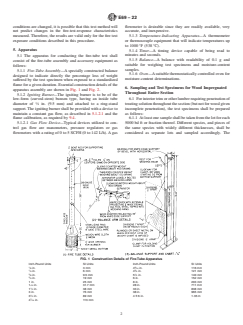
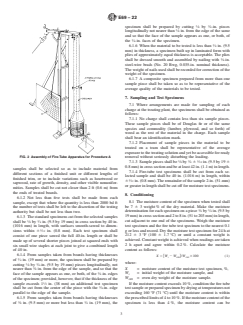
5.1.1 Fire-Tube Assembly—A specially constructed balance
5.1.6 Oven—Asuitable thermostatically controlled oven for
designed to indicate directly the percentage loss of weight
moisture-content determinations.
suffered by the test specimen when exposed to a standardized
flame for a given duration. Essential construction details of the
6. Sampling and Test Specimens for Wood Impregnated
apparatus assembly are shown in Fig. 1 and Fig. 2.
Throughout Entire Section
5.1.2 Igniting Burner—The igniting burner is to be of the
low-form (curved-stem) bunsen type, having an inside tube 6.1 Forinteriortrimorotherlumberrequiringpenetrationof
diameter of ⁄8 in. (9.5 mm) and attached to a ring-stand treatingsolutionthroughoutthesection(butnotforwoodgiven
support. The igniting burner shall be provided with a device to incomplete penetration), the test specimens shall be prepared
maintain a constant gas flow, as described in 5.1.2.1 and the as follows:
flame calibration, as required by 9.4. 6.1.1 Atleastonesampleshallbetakenfromthelotforeach
5.1.2.1 Gas Flow Device—Typical devices utilized to con- 5000 bd ft or fraction thereof. Different species, and pieces of
trol gas flow are manometers, pressure regulators or gas the same species with widely different thicknesses, shall be
flowmeters with a rating of 0 to 5 SCFH (0 to 142 L/h).Agas considered as separate lots and sampled accordingly. The
FIG. 1 Construction Details of Fire-Tube Apparatus
Inch-Pound Units SI Units Inch-Pound Units SI Units
1 9
⁄8 in. 3 mm 4 ⁄16 in. 116 mm
1 3
⁄4 in. 6 mm 4 ⁄4 in. 121 mm
3 1
⁄8 in. 9.5 mm 5 ⁄2 in. 140 mm
⁄4 in. 19 mm 6 in. 152 mm
1 in. 25 mm 8 in. 203 mm
1 ⁄4 in. 31.7 mm 28 in. 711 mm
1 ⁄2 in. 38 mm 33 in. 838 mm
3 in. 76 mm 38 in. 965 mm
3 ⁄2 in. 89 mm 4 ft 6 in. 1.35 m
4 ⁄16 in. 113 mm
E69−22
3 3
specimen shall be prepared by cutting ⁄8 by ⁄4-in. pieces
longitudinally not nearer than ⁄8 in. from the edge of the same
and so that the face of the sample appears as one, or both, of
the ⁄4-in. faces of the specimen.
6.1.6 When the material to be tested is less than ⁄8 in. (9.5
mm) in thickness, a specimen built up in laminated form with
plies of approximately equal thickness is acceptable. The plies
shall be dressed smooth and assembled by nailing with ⁄8-in.
steel-wire brads (No. 20 Bwg, 0.035-in. nominal thickness).
The weight of nails used shall be recorded for correction of the
weight of the specimen.
6.1.7 A composite specimen prepared from more than one
sample piece shall be taken so as to be representative of the
average quality of the materials to be tested.
7. Sampling and Test Specimens
7.1 Where arrangements are made for sampling of each
charge at the treating plant, the specimens shall be obtained as
follows:
7.1.1 No charge shall contain less than six sample pieces.
These sample pieces shall be of Douglas fir or of the same
species and commodity (lumber, plywood, and so forth) of
wood as the rest of the material in the charge. Each sample
shall bear an identification mark.
7.1.2 Placement of sample pieces in the material to be
treated on a tram shall be representative of the average
exposuretothetreatingsolutionandyetbeaccessibleforready
FIG. 2 Assembly of Fire-Tube Apparatus for Procedure A removal without seriously disturbing the loading.
3 3 1
7.1.3 Sample pieces shall be ⁄8 by ⁄4 6 ⁄32 in. (9.5 by 19 6
0.8mm)incrosssectionandbeatleast42in.(1.1m)inlength.
samples shall be selected so as to include material from
7.1.4 Fire-tube test specimens shall be cut from each se-
different sections of a finished unit or different lengths of
lected sample and shall be 40 in. (1.016 m) in length, within
finished trim, or to include variations such as heartwood or
6 ⁄32 in. (0.8 mm).The remainder of the sample 2-in. (51-mm)
sapwood, rate of growth, density, and other visible nonunifor-
or greater in length shall be cut off for moisture test specimens.
mities. Samples shall be cut not closer than 2 ft (0.6 m) from
the ends of treated boards.
8. Conditioning
6.1.2 Not less than five tests shall be made from each
8.1 The moisture content of the specimen when tested shall
sample, except that where the quantity is less than 2000 bd ft
be 7 6 3 weight % of the dry material. Make the moisture
the number of tests shall be left to the discretion of the testing
3 3
determination for each specimen on a piece ⁄8 by ⁄4 in. (9.5 by
authority but shall be not
...
This document is not an ASTM standard and is intended only to provide the user of an ASTM standard an indication of what changes have been made to the previous version. Because
it may not be technically possible to adequately depict all changes accurately, ASTM recommends that users consult prior editions as appropriate. In all cases only the current version
of the standard as published by ASTM is to be considered the official document.
Designation: E69 − 15 E69 − 22
Standard Test Method for
Combustible Properties of Treated Wood by the Fire-Tube
Apparatus
This standard is issued under the fixed designation E69; the number immediately following the designation indicates the year of original
adoption or, in the case of revision, the year of last revision. A number in parentheses indicates the year of last reapproval. A superscript
epsilon (´) indicates an editorial change since the last revision or reapproval.
1. Scope
1.1 This test method covers fire-tube test procedures for fire tests for combustible properties of wood treated to reduce
flammability. This test method relates to properties of treated wood, as such, rather than to the performance of a fabrication used
as an element of construction. Performance under this test method shall be as prescribed in requirements applicable to materials
intended for specific uses.
1.2 This test method is a fire-test-response standard.
1.3 The SI values given in parentheses are provided for information purposes only.
1.4 This standard is used to measure and describe the response of materials, products, or assemblies to heat and flame under
controlled conditions, but does not by itself incorporate all factors required for fire hazard or fire risk assessment of the materials,
products, or assemblies under actual fire conditions.
1.5 This standard does not purport to address all of the safety concerns, if any, associated with its use. It is the responsibility
of the user of this standard to establish appropriate safety safety, health, and healthenvironmental practices and determine the
applicability of regulatory limitations prior to use.
1.6 Fire testing is inherently hazardous. Adequate safeguards for personnel and property shall be employed in conducting these
tests.
1.7 This international standard was developed in accordance with internationally recognized principles on standardization
established in the Decision on Principles for the Development of International Standards, Guides and Recommendations issued
by the World Trade Organization Technical Barriers to Trade (TBT) Committee.
2. Referenced Documents
2.1 ASTM Standards:
D9 Terminology Relating to Wood and Wood-Based Products
E176 Terminology of Fire Standards
This test method is under the jurisdiction of ASTM Committee D07 on Wood and is the direct responsibility of Subcommittee D07.07 on Fire Performance of Wood.
Current edition approved Dec. 1, 2015Nov. 1, 2022. Published February 2016November 2022. Originally approved in 1946. Last previous edition approved in 20072015
as E69 – 02 (2007).E69 – 15. DOI: 10.1520/E0069-15.10.1520/E0069-22.
For referenced ASTM standards, visit the ASTM website, www.astm.org, or contact ASTM Customer Service at service@astm.org. For Annual Book of ASTM Standards
volume information, refer to the standard’s Document Summary page on the ASTM website.
Copyright © ASTM International, 100 Barr Harbor Drive, PO Box C700, West Conshohocken, PA 19428-2959. United States
E69 − 22
3. Terminology
3.1 Definitions—For definitions of terms found in this test method, refer to Terminologies D9 and E176.
4. Significance and Use
4.1 The purpose of this test method is to provide a relative measurement of the combustibility of fire-retardant-treated wood
specimens based on their percentage loss in weight under controlled fire exposure conditions (1). In addition, other possible data
include rate of weight loss, time of flaming and afterglowing, increase in temperature, and maximum vertical flame progress.
4.2 This test method is not sufficiently large scale to evaluate the suitability of a given treated product for building construction,
but it is a convenient method to use for purposes of development or as a quality-control test during manufacture.
4.3 This test method gives a procedure for sampling and preparation of test specimens from a lot of treated material in which
complete penetration is a requirement. A procedure is also given for the sampling of charges at a treating plant for purposes of
quality control of the treatment process.
4.4 This test method has proven useful for evaluating comparative fire performance effectiveness of fire-retardant chemicals and
treatment formulations for wood and wood products (2-5).
4.5 In this test method, the specimens are subjected to one or more specific sets of laboratory test conditions. If different test
conditions are substituted or the anticipated end-use conditions are changed, it may not be possible by or from is possible that this
test method to will not predict changes in the fire-test-response characteristics measured. Therefore, the results are valid only for
the fire test exposure conditions described in this procedure.
5. Apparatus
5.1 The apparatus for conducting the fire-tube test shall consist of the fire-tube assembly and accessory equipment as follows:
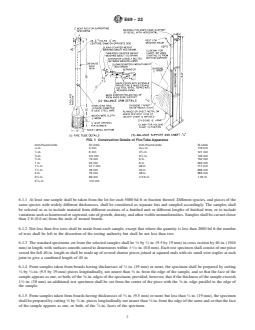
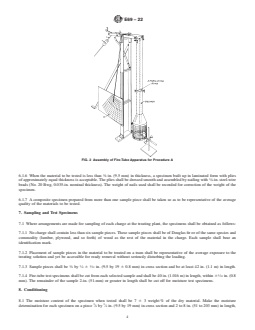
5.1.1 Fire-Tube Assembly—A specially constructed balance designed to indicate directly the percentage loss of weight suffered by
the test specimen when exposed to a standardized flame for a given duration. Essential construction details of the apparatus
assembly are shown in Fig. 1 and Fig. 2.
5.1.2 Igniting Burner—The igniting burner is to be of the low-form (curved-stem) bunsen type, having an inside tube diameter
of ⁄8 in. (9.5 mm) and attached to a ring-stand support. The igniting burner shall be provided with a device to maintain a constant
gas flow, as described in 5.1.2.1 and the flame calibration, as required by 9.4.
5.1.2.1 Gas Flow Device—Typical devices utilized to control gas flow are manometers, pressure regulators or gas flowmeters with
a rating of 0 to 5 SCFH (0 to 142 L/h). A gas flowmeter is desirable since they are readily available, very accurate, and inexpensive.
5.1.3 Temperature-Indicating Apparatus—A thermometer or thermocouple equipment that will indicate temperatures up to 1000°F
(538°C).1000 °F (538 °C).
5.1.4 Timer—A timing device capable of being read to minutes and seconds.
5.1.5 Balance—A balance with readability of 0.1 g and suitable for weighing test specimens and moisture-content samples.
5.1.6 Oven—A suitable thermostatically controlled oven for moisture-content determinations.
6. Sampling and Test Specimens for Wood Impregnated Throughout Entire Section
6.1 For interior trim or other lumber requiring penetration of treating solution throughout the section (but not for wood given
incomplete penetration), the test specimens shall be prepared as follows:
The boldface numbers in parentheses refer to the list of references at the end of this test method.
E69 − 22
FIG. 1 Construction Details of Fire-Tube Apparatus
Inch-Pound Units SI Units Inch-Pound Units SI Units
1 9
⁄8 in. 3 mm 4 ⁄16 in. 116 mm
1 3
⁄4 in. 6 mm 4 ⁄4 in. 121 mm
3 1
⁄8 in. 9.5 mm 5 ⁄2 in. 140 mm
⁄4 in. 19 mm 6 in. 152 mm
1 in. 25 mm 8 in. 203 mm
1 ⁄4 in. 31.7 mm 28 in. 711 mm
1 ⁄2 in. 38 mm 33 in. 838 mm
3 in. 76 mm 38 in. 965 mm
3 ⁄2 in. 89 mm 4 ft 6 in. 1.35 m
4 ⁄16 in. 113 mm
6.1.1 At least one sample shall be taken from the lot for each 5000 bd ft or fraction thereof. Different species, and pieces of the
same species with widely different thicknesses, shall be considered as separate lots and sampled accordingly. The samples shall
be selected so as to include material from different sections of a finished unit or different lengths of finished trim, or to include
variations such as heartwood or sapwood, rate of growth, density, and other visible nonuniformities. Samples shall be cut not closer
than 2 ft (0.6 m) from the ends of treated boards.
6.1.2 Not less than five tests shall be made from each sample, except that where the quantity is less than 2000 bd ft the number
of tests shall be left to the discretion of the testing authority but shall be not less than two.
3 3
6.1.3 The standard specimens cut from the selected samples shall be ⁄8 by ⁄4 in. (9.5 by 19 mm) in cross section by 40 in. (1016
mm) in length, with surfaces smooth-sawed to dimensions within 6 ⁄32 in. (0.8 mm). Each test specimen shall consist of one piece
sawed the full 40-in. length or shall be made up of several shorter pieces joined at squared ends with six small wire staples at each
joint to give a combined length of 40 in.
6.1.4 From samples taken from boards having thicknesses of ⁄4 in. (19 mm) or more, the specimen shall be prepared by cutting
3 3 3
⁄8 by ⁄4-in. (9.5 by 19-mm) pieces longitudinally, not nearer than ⁄8 in. from the edge of the sample, and so that the face of the
sample appears as one, or both, of the ⁄8-in. edges of the specimen; provided, however, that if the thickness of the sample exceeds
1 3
1 ⁄2 in. (38 mm) an additional test specimen shall be cut from the center of the piece with the ⁄8-in. edge parallel to the edge of
the sample.
3 3
6.1.5 From samples taken from boards having thicknesses of ⁄8 in. (9.5 mm) or more but less than ⁄4 in. (19 mm), the specimen
3 3 3
shall be prepared by cutting ⁄8 by ⁄4-in. pieces longitudinally not nearer than ⁄8 in. from the edge of the same and so that the face
of the sample appears as one, or both, of the ⁄4-in. faces of the specimen.
E69 − 22
FIG. 2 Assembly of Fire-Tube Apparatus for Procedure A
6.1.6 When the material to be tested is less than ⁄8 in. (9.5 mm) in thickness, a specimen built up in laminated form with plies
of approximately equal thickness is acceptable. The plies shall be dressed smooth and assembled by nailing with ⁄8-in. steel-wire
brads (No. 20 Bwg, 0.035-in. nominal thickness). The weight of nails used shall be recorded for correction of the weight of the
specimen.
6.1.7 A composite specimen prepared from more than one sample piece shall be taken so as to be representative of the average
quality of the materials to be tested.
7. Sampling and Test Specimens
7.1 Where arrangements are made for sampling of each ch
...