

ASTM D8205-20
(Guide)Standard Guide for Video Surveillance System
General Information
- Abstract
SIGNIFICANCE AND USE
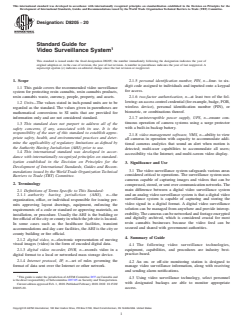
3.1 The video surveillance system safeguards various areas considered critical to operations. The surveillance system uses cameras capable of capturing images and videos that can be compressed, stored, or sent over communication networks. The main difference between a digital video surveillance system and an analog video surveillance system is that a digital video surveillance system is capable of capturing and storing the video signal in a digital format. A digital video surveillance solution can be managed from anywhere and provide interoperability. The cameras can be networked and footage encrypted and digitally archived, which is considered crucial for most resin cannabis businesses because the video feed can be secured and shared with government authorities.
SCOPE
1.1 This guide covers the recommended video surveillance system for protecting resin cannabis, resin cannabis products, resin cannabis waste, currency, people, property, and assets.
1.2 Units—The values stated in inch-pound units are to be regarded as the standard. The values given in parentheses are mathematical conversions to SI units that are provided for information only and are not considered standard.
1.3 This standard does not purport to address all of the safety concerns, if any, associated with its use. It is the responsibility of the user of this standard to establish appropriate safety, health, and environmental practices and determine the applicability of regulatory limitations as defined by the Authority Having Jurisdiction (AHJ) prior to use.
1.4 This international standard was developed in accordance with internationally recognized principles on standardization established in the Decision on Principles for the Development of International Standards, Guides and Recommendations issued by the World Trade Organization Technical Barriers to Trade (TBT) Committee.
- Status
- Published
- Publication Date
- 31-Jan-2020
- Technical Committee
- D37 - Cannabis
- Drafting Committee
- D37.05 - Security and Transportation


Overview
ASTM D8205-20: Standard Guide for Video Surveillance System is published by ASTM International to guide the selection, installation, operation, and maintenance of video surveillance systems for facilities handling resin cannabis products and related assets. This comprehensive standard addresses the essential requirements for safeguarding critical operations and assets, such as resin cannabis, currency, personnel, and property, through the deployment of robust video surveillance technologies.
The standard applies to both analog and digital video surveillance solutions, emphasizing modern digital systems for their security and ease of management, such as remote access and digital archiving. It provides guidance on system specifications, policies, maintenance, and compliance with regulatory demands set forth by recognized authorities.
Key Topics
System Types and Functionality
- Coverage includes both digital and analog video surveillance systems.
- Highlights the advantages of digital systems, including encrypted storage, real-time monitoring, and remote management.
- Recommends uninterruptible power supply (UPS) and auxiliary power to ensure uninterrupted operation.
Video Management Software (VMS)
- Centralized viewing, multi-user access, integration with analytics, and capability to accommodate additional cameras.
- Motion detection and alert notification systems for enhanced security response.
Camera Placement and Coverage
- Strategic installation of cameras (fixed, PTZ, domed, panoramic, infrared) to cover all critical areas including entrances, exits, storage, cash handling, and exterior perimeters.
- Mandates clear identification of individuals and activities under various lighting conditions.
Access Control and Data Security
- Video data storage in secure, access-controlled areas, protected by two-factor authentication (e.g., badge, PIN, biometric).
- Password protection and strict authority limitations on data access.
Data Storage and Retention
- Digital recording with synchronized date and time stamps.
- Minimum on-site retention of 60 days, with provisions for longer periods during investigations.
- Long-term retention of maintenance and inspection records.
Maintenance and Monitoring
- Monthly system inspections, regular functional checks, and documented repairs and upgrades.
- 24/7 monitoring station with immediate notification of failures or security breaches.
Applications
ASTM D8205-20 is particularly relevant for:
- Cannabis Industry: Meeting stringent regulatory requirements for security in resin cannabis and related products facilities.
- High-Value Asset Protection: Securing cash, data, and proprietary records in commercial, banking, and industrial environments.
- Compliance Operations: Providing a framework to adhere to regulations enforced by the Authority Having Jurisdiction (AHJ), law enforcement, and government agencies.
- Remote Facility Management: Enabling authorized individuals to securely manage surveillance footage from off-site locations.
By implementing this standard, organizations can enhance facility security, streamline compliance audits, and ensure uninterrupted protection of sensitive areas and assets.
Related Standards
Organizations using ASTM D8205-20 may also reference:
- ASTM D37 Series: Standards on security and transportation for cannabis operations.
- ISO/IEC 27001 - Information security management systems
- NFPA 731 - Standard for the Installation of Electronic Premises Security Systems
- UL 2802 - Performance Testing of Camera Image Quality
Utilizing ASTM D8205-20 in conjunction with these related standards ensures a comprehensive, best-practice approach to video surveillance system planning, deployment, security, and compliance in regulated industries.
Relations
- Effective Date
- 01-Feb-2020
Get Certified
Connect with accredited certification bodies for this standard

BSI Group
BSI (British Standards Institution) is the business standards company that helps organizations make excellence a habit.

TÜV Rheinland
TÜV Rheinland is a leading international provider of technical services.

TÜV SÜD
TÜV SÜD is a trusted partner of choice for safety, security and sustainability solutions.
Sponsored listings
Frequently Asked Questions
ASTM D8205-20 is a guide published by ASTM International. Its full title is "Standard Guide for Video Surveillance System". This standard covers: SIGNIFICANCE AND USE 3.1 The video surveillance system safeguards various areas considered critical to operations. The surveillance system uses cameras capable of capturing images and videos that can be compressed, stored, or sent over communication networks. The main difference between a digital video surveillance system and an analog video surveillance system is that a digital video surveillance system is capable of capturing and storing the video signal in a digital format. A digital video surveillance solution can be managed from anywhere and provide interoperability. The cameras can be networked and footage encrypted and digitally archived, which is considered crucial for most resin cannabis businesses because the video feed can be secured and shared with government authorities. SCOPE 1.1 This guide covers the recommended video surveillance system for protecting resin cannabis, resin cannabis products, resin cannabis waste, currency, people, property, and assets. 1.2 Units—The values stated in inch-pound units are to be regarded as the standard. The values given in parentheses are mathematical conversions to SI units that are provided for information only and are not considered standard. 1.3 This standard does not purport to address all of the safety concerns, if any, associated with its use. It is the responsibility of the user of this standard to establish appropriate safety, health, and environmental practices and determine the applicability of regulatory limitations as defined by the Authority Having Jurisdiction (AHJ) prior to use. 1.4 This international standard was developed in accordance with internationally recognized principles on standardization established in the Decision on Principles for the Development of International Standards, Guides and Recommendations issued by the World Trade Organization Technical Barriers to Trade (TBT) Committee.
SIGNIFICANCE AND USE 3.1 The video surveillance system safeguards various areas considered critical to operations. The surveillance system uses cameras capable of capturing images and videos that can be compressed, stored, or sent over communication networks. The main difference between a digital video surveillance system and an analog video surveillance system is that a digital video surveillance system is capable of capturing and storing the video signal in a digital format. A digital video surveillance solution can be managed from anywhere and provide interoperability. The cameras can be networked and footage encrypted and digitally archived, which is considered crucial for most resin cannabis businesses because the video feed can be secured and shared with government authorities. SCOPE 1.1 This guide covers the recommended video surveillance system for protecting resin cannabis, resin cannabis products, resin cannabis waste, currency, people, property, and assets. 1.2 Units—The values stated in inch-pound units are to be regarded as the standard. The values given in parentheses are mathematical conversions to SI units that are provided for information only and are not considered standard. 1.3 This standard does not purport to address all of the safety concerns, if any, associated with its use. It is the responsibility of the user of this standard to establish appropriate safety, health, and environmental practices and determine the applicability of regulatory limitations as defined by the Authority Having Jurisdiction (AHJ) prior to use. 1.4 This international standard was developed in accordance with internationally recognized principles on standardization established in the Decision on Principles for the Development of International Standards, Guides and Recommendations issued by the World Trade Organization Technical Barriers to Trade (TBT) Committee.
ASTM D8205-20 is classified under the following ICS (International Classification for Standards) categories: 11.120.99 - Other standards related to pharmaceutics; 13.310 - Protection against crime; 65.020.20 - Plant growing. The ICS classification helps identify the subject area and facilitates finding related standards.
ASTM D8205-20 has the following relationships with other standards: It is inter standard links to ASTM D8320-21. Understanding these relationships helps ensure you are using the most current and applicable version of the standard.
ASTM D8205-20 is available in PDF format for immediate download after purchase. The document can be added to your cart and obtained through the secure checkout process. Digital delivery ensures instant access to the complete standard document.
Standards Content (Sample)
This international standard was developed in accordance with internationally recognized principles on standardization established in the Decision on Principles for the
Development of International Standards, Guides and Recommendations issued by the World Trade Organization Technical Barriers to Trade (TBT) Committee.
Designation: D8205 − 20
Standard Guide for
Video Surveillance System
This standard is issued under the fixed designation D8205; the number immediately following the designation indicates the year of
original adoption or, in the case of revision, the year of last revision. A number in parentheses indicates the year of last reapproval. A
superscript epsilon (´) indicates an editorial change since the last revision or reapproval.
1. Scope 2.1.5 personal identification number, PIN, n—four- to six-
digit code assigned to individuals and inputted onto a keypad
1.1 This guide covers the recommended video surveillance
for access.
system for protecting resin cannabis, resin cannabis products,
resin cannabis waste, currency, people, property, and assets.
2.1.6 two-factor authentication, n—at least two of the fol-
lowing:anaccesscontrolcredential(forexample,badge,FOB,
1.2 Units—The values stated in inch-pound units are to be
wireless device), personal identification number (PIN), or
regarded as the standard. The values given in parentheses are
biometric, or combinations thereof.
mathematical conversions to SI units that are provided for
information only and are not considered standard.
2.1.7 uninterruptible power supply, UPS, n—ensure con-
tinuous operation of camera systems using a surge protector
1.3 This standard does not purport to address all of the
with a built-in backup battery.
safety concerns, if any, associated with its use. It is the
responsibility of the user of this standard to establish appro-
2.1.8 video management software, VMS, n—ability to view
priate safety, health, and environmental practices and deter-
all cameras in operation with capacity to accommodate addi-
mine the applicability of regulatory limitations as defined by
tional cameras analytics that sound an alert when motion is
the Authority Having Jurisdiction (AHJ) prior to use.
detected; multi-user capabilities to accommodate all users;
1.4 This international standard was developed in accor-
accessibility via the Internet; and multi-screen video display.
dance with internationally recognized principles on standard-
ization established in the Decision on Principles for the
3. Significance and Use
Development of International Standards, Guides and Recom-
3.1 The video surveillance system safeguards various areas
mendations issued by the World Trade Organization Technical
considered critical to operations. The surveillance system uses
Barriers to Trade (TBT) Committee.
cameras capable of capturing images and videos that can be
2. Terminology
compressed,stored,orsentovercommunicationnetworks.The
main difference between a digital video surveillance system
2.1 Definitions of Terms Specific to This Standard:
and an analog video surveillance system is that a digital video
2.1.1 authority having jurisdiction (AHJ), n—the
surveillance system is capable of capturing and storing the
organization, office, or individual responsible for issuing per-
video signal in a digital format. A digital video surveillance
mits approving layout drawings, equipment, enforcing the
solution can be managed from anywhere and provide interop-
requirements of a code or standard or approving materials, an
erability.Thecamerascanbenetworkedandfootageencrypted
installation, or procedure. Usually the AHJ is the building or
and digitally archived, which is considered crucial for most
fireofficialofthecityorcountyinwhichthejobsiteislocated.
resin cannabis businesses because the video feed can be
In some cases such as the healthcare facilities, transient
secured and shared with government authorities.
accommodations and day care facilities, theAHJ is the city or
county building or fire official.
4. Summary of Guide
2.1.2 digital video, n—electronic representation of moving
visual images (video) in the form of encoded digital data.
4.1 The following video surveillance technologies,
equipment, capabilities, and procedures are industry best-
2.1.3 digital video recorder, DVR, n—records video in a
practice-based.
digital format to a local or networked mass storage device.
2.1.4 Internet protocol, IP, n—set of rules governing the
4.2 An on- or off-site monitoring station is designed to
format of data sent over the Internet or other network. manage video surveillance information, along with receiving
and sending alarm notifications.
This guide is under the jurisdiction ofASTM Committee D37 on Cannabis and
4.3 Using video surveillance technology, select personnel
is the direct responsibility of Subcommittee D37.05 on Security andTransportation.
with designated backups are able to monitor appropriate
Current edition approved Feb. 1, 2020. Published February 2020. DOI: 10.1520/
D8205-20. access.
Copyright © ASTM International, 100 Barr Harbor Drive, PO Box C700, West Conshohocken, PA 19428-2959. United States
D8205 − 20
4.4 Avideo surveillance system should have all, or some of for responding to analytics that sound an alert when motion is
the following basic capabilities, among others: indoor; out- detected and notification protocols for alerts.
door; daytime; nighttime; fixed; and pan, tilt, and zoom (PTZ).
5.2 A complete index and guide to the hardware, software,
4.5 Withvideomanagementsoftware(VMS),allcamerasin devices, technical documentation, monitors, and controls
should be available either in hardcopy or electronic form. This
operation can be viewed with the capacity to accommodate
additionalcamerasanalyticsthatsoundanalertwhenmotionis guide should include a map of the alarm locations, direction of
coverage, device numbers, and operating instructions for the
detected. There are multi-user capabilities for all users, acces-
sibility via the Internet, and multi-screen video display. video surveillance equipment.
4.6 Acamera can be fixed to only look at one specific view
6. Maintenance Requirements
or it can be movable through the use of PTZ (that is, moving
6.1 The video surveillance system should be maintained in
left and right, up and down, and closer and far away). PTZ
good working order at all times, per the manufacturer’s
cameras are used to cover wider fields of view.
specifications.
4.7 Coverage is capable of capturing clear visual identifica-
6.2 Conduct and document monthly maintenance inspec-
tion of individuals and activities and provides an unobstructed
tions to ensure that any repairs, alterations, and upgrades are
view of all areas, unless prohibited by law, including all points
made for proper operation of the system.
ofentrancestoandexitsfromthefacility,frombothindoorand
6.3 Designated personnel oversee the functioning of the
outdoor vantage points.
system and need to report immediately any malfunctioning or
4.8 Cameras positioned in the building and around the
technical problems.
property include, but are not limited to, exterior perimeter;
6.4 The system conducts a self-test when set and identifies
parking lots; entrances and exits; loading dock; storage rooms;
attempted sabotage of the system.
vaults; offices; areas in which product is grown, processed,
manufactured, stored, handled, inventoried, sold, delivered,
6.5 All equipment is inspected, tested, and documented at
transported, or destroyed; rooms with exterior windows, roof
regular intervals, not to exceed 30 calendar days from the
hatches or skylights; and rooms that contain equipment,
previous inspection and test to ensure the systems remain
product, currency, drop boxes, safes, vaults, data, and propri-
functional.
etary records.
6.6 All maintenance records should be maintained for a
4.9 Operate under all lighting conditions of each area under
period of tim
...