

ASTM F1551-23
(Test Method)Standard Test Methods for Comprehensive Characterization of Synthetic Turf Playing Surfaces and Materials
General Information
- Abstract
SIGNIFICANCE AND USE
5.1 These test methods constitute a standard for obtaining data in research and development, quality control, acceptance and rejection under specifications, and for special purposes.
5.2 The data obtained from use of these test methods are applicable to the system and its components under conditions of the particular test procedures and are not necessarily the same as the data that might be obtained in other environments or use conditions.
5.3 The selection of test methods or tests should be limited to those appropriate to the system or material(s) being evaluated.
SCOPE
1.1 These test methods establish a recommended list from which suitable test methods shall be selected for the identification of physical property characteristics and comparison of the performance properties of synthetic turf systems or components for athletic and recreational uses, or both.
1.2 Some of the test procedures are suitable only for the laboratory characterization of either components or the complete system; others are suitable for tests on installed sports fields; and some tests may be applied in both the laboratory and the field.
1.3 The test procedures included in these test methods apply as a group to the description of synthetic turf playing surfaces.
1.4 Test methods outlined herein cover system components as well as fully assembled synthetic turf systems. Most of the methods measure material and performance properties of turf components. Component properties are not intended to represent the performance of a fully assembled turf system. Component results provide data for quality control, specification compliance, and component performance used in product design.
1.5 Reference to the methods for testing the synthetic turf playing surface and its components contained herein should state specifically the particular test or tests desired and not refer to this list of test methods as a whole.
1.6 Several new standards have been added since the last revision of this standard. Other standards, for which more appropriate standards exist, have been removed from this standard. A list of the standards that have been removed and their replacements are listed in Table X1.1 in Appendix X1.
1.7 This is a physical property characterization standard, and it shall not be construed as a safety standard.
1.8 The values stated in SI units are to be regarded as the standard. The values given in parentheses are for information only.
1.9 This standard does not purport to address all of the safety concerns, if any, associated with its use. It is the responsibility of the user of this standard to establish appropriate safety, health, and environmental practices and determine the applicability of regulatory limitations prior to use.
1.10 This international standard was developed in accordance with internationally recognized principles on standardization established in the Decision on Principles for the Development of International Standards, Guides and Recommendations issued by the World Trade Organization Technical Barriers to Trade (TBT) Committee.
- Status
- Published
- Publication Date
- 31-Aug-2023
- Technical Committee
- F08 - Sports Equipment, Playing Surfaces, and Facilities
- Drafting Committee
- F08.65 - Artificial Turf Surfaces and Systems
Buy Documents
ASTM F1551-23 - Standard Test Methods for Comprehensive Characterization of Synthetic Turf Playing Surfaces and Materials
REDLINE ASTM F1551-23 - Standard Test Methods for Comprehensive Characterization of Synthetic Turf Playing Surfaces and Materials
Overview
ASTM F1551-23 is the authoritative international standard for test methods utilized in the comprehensive characterization of synthetic turf playing surfaces and materials. Issued by ASTM International, this standard provides a recommended list of test methods to analyze both physical property characteristics and performance properties of synthetic turf systems and their components, primarily for athletic and recreational applications. The standard supports quality control, research and development, product acceptance, specification compliance, and ensures consistent evaluation of synthetic turf under controlled laboratory and field conditions.
Key Topics
- Test Method Selection: ASTM F1551-23 features a curated list of individual test methods for identifying and comparing properties of synthetic turf and its components. Users select relevant procedures based on the specific turf system or material being evaluated.
- Component and System Testing: Test methods address both individual components (fibers, infill, shock pads, backing fabrics) and fully assembled synthetic turf systems.
- Performance and Material Properties: The standard outlines procedures for measuring characteristics such as pile height, yarn thickness, tensile strength, dimensional stability, impact attenuation, water permeability, infill properties, and seam strength.
- Field and Laboratory Applications: Some test methods are suitable solely for laboratory characterization, some for measuring performance on installed fields, while others can be executed in both environments.
- Updates and Integrity: Recently added and superseded standards are clearly referenced, ensuring users apply modern, relevant test methods.
- Units and Compliance: SI units are standard throughout, with parenthetical imperial units for reference.
- Safety Notice: ASTM F1551-23 is a physical property characterization document and does not serve as a safety or hazard standard. Users are responsible for appropriate safety, health, and environmental practices.
Applications
ASTM F1551-23 is widely used across various stages of synthetic turf utilization:
- Product Development: Manufacturers and researchers apply these test methods to develop, benchmark, and improve the performance and durability of synthetic turf products.
- Quality Control: Facilities managers, QA personnel, and suppliers rely on these standardized tests for ongoing production monitoring and consistency checks.
- Specification Compliance: Architects, engineers, and procurement specialists ensure that synthetic turf installations meet required performance specifications for sports fields and recreational facilities.
- Acceptance and Rejection Testing: Project stakeholders use ASTM F1551-23 to verify that installed systems conform to contractual specifications and performance expectations.
- Comparative Analysis: The standard facilitates objective comparison between different synthetic turf systems and component materials, supporting informed decision-making in product selection.
- Field Maintenance and Evaluation: Maintenance teams use relevant field test methods to assess the ongoing condition and performance of installed surfaces.
Related Standards
ASTM F1551-23 references numerous key standards integral to the characterization of synthetic turf, including but not limited to:
- ASTM D1907 - Linear Density of Yarn (Denier)
- ASTM D2256 - Tensile Properties of Yarns
- ASTM D5848 - Mass Per Unit Area of Pile Yarn Floor Coverings
- ASTM F355 - Impact Attenuation of Playing Surface Systems
- ASTM F1936 - Impact Attenuation of Turf Playing Systems in the Field
- EN 1969 - Thickness of Synthetic Sports Surfaces
- EN 12616 - Water Infiltration Rate in Sports Areas
- EPA 1312/3050B - Environmental Hazard and Heavy Metals Testing
For a complete list of referenced standards, users should consult Appendix X1 in ASTM F1551-23, which includes updates for added or superseded standards.
Keywords: ASTM F1551-23, synthetic turf testing, synthetic turf standards, test methods, turf system performance, athletic field quality, artificial turf laboratory testing, synthetic turf materials, sports surface evaluation.
Relations
- Effective Date
- 01-Sep-2023
- Effective Date
- 01-Aug-2023
- Effective Date
- 01-Sep-2023
- Referred By
ASTM F3383-19a - Standard Test Method for Filament Bind of Single Fibers in Synthetic Turf - Effective Date
- 01-Sep-2023
- Effective Date
- 01-Sep-2023
Buy Documents
ASTM F1551-23 - Standard Test Methods for Comprehensive Characterization of Synthetic Turf Playing Surfaces and Materials
REDLINE ASTM F1551-23 - Standard Test Methods for Comprehensive Characterization of Synthetic Turf Playing Surfaces and Materials
Frequently Asked Questions
ASTM F1551-23 is a standard published by ASTM International. Its full title is "Standard Test Methods for Comprehensive Characterization of Synthetic Turf Playing Surfaces and Materials". This standard covers: SIGNIFICANCE AND USE 5.1 These test methods constitute a standard for obtaining data in research and development, quality control, acceptance and rejection under specifications, and for special purposes. 5.2 The data obtained from use of these test methods are applicable to the system and its components under conditions of the particular test procedures and are not necessarily the same as the data that might be obtained in other environments or use conditions. 5.3 The selection of test methods or tests should be limited to those appropriate to the system or material(s) being evaluated. SCOPE 1.1 These test methods establish a recommended list from which suitable test methods shall be selected for the identification of physical property characteristics and comparison of the performance properties of synthetic turf systems or components for athletic and recreational uses, or both. 1.2 Some of the test procedures are suitable only for the laboratory characterization of either components or the complete system; others are suitable for tests on installed sports fields; and some tests may be applied in both the laboratory and the field. 1.3 The test procedures included in these test methods apply as a group to the description of synthetic turf playing surfaces. 1.4 Test methods outlined herein cover system components as well as fully assembled synthetic turf systems. Most of the methods measure material and performance properties of turf components. Component properties are not intended to represent the performance of a fully assembled turf system. Component results provide data for quality control, specification compliance, and component performance used in product design. 1.5 Reference to the methods for testing the synthetic turf playing surface and its components contained herein should state specifically the particular test or tests desired and not refer to this list of test methods as a whole. 1.6 Several new standards have been added since the last revision of this standard. Other standards, for which more appropriate standards exist, have been removed from this standard. A list of the standards that have been removed and their replacements are listed in Table X1.1 in Appendix X1. 1.7 This is a physical property characterization standard, and it shall not be construed as a safety standard. 1.8 The values stated in SI units are to be regarded as the standard. The values given in parentheses are for information only. 1.9 This standard does not purport to address all of the safety concerns, if any, associated with its use. It is the responsibility of the user of this standard to establish appropriate safety, health, and environmental practices and determine the applicability of regulatory limitations prior to use. 1.10 This international standard was developed in accordance with internationally recognized principles on standardization established in the Decision on Principles for the Development of International Standards, Guides and Recommendations issued by the World Trade Organization Technical Barriers to Trade (TBT) Committee.
SIGNIFICANCE AND USE 5.1 These test methods constitute a standard for obtaining data in research and development, quality control, acceptance and rejection under specifications, and for special purposes. 5.2 The data obtained from use of these test methods are applicable to the system and its components under conditions of the particular test procedures and are not necessarily the same as the data that might be obtained in other environments or use conditions. 5.3 The selection of test methods or tests should be limited to those appropriate to the system or material(s) being evaluated. SCOPE 1.1 These test methods establish a recommended list from which suitable test methods shall be selected for the identification of physical property characteristics and comparison of the performance properties of synthetic turf systems or components for athletic and recreational uses, or both. 1.2 Some of the test procedures are suitable only for the laboratory characterization of either components or the complete system; others are suitable for tests on installed sports fields; and some tests may be applied in both the laboratory and the field. 1.3 The test procedures included in these test methods apply as a group to the description of synthetic turf playing surfaces. 1.4 Test methods outlined herein cover system components as well as fully assembled synthetic turf systems. Most of the methods measure material and performance properties of turf components. Component properties are not intended to represent the performance of a fully assembled turf system. Component results provide data for quality control, specification compliance, and component performance used in product design. 1.5 Reference to the methods for testing the synthetic turf playing surface and its components contained herein should state specifically the particular test or tests desired and not refer to this list of test methods as a whole. 1.6 Several new standards have been added since the last revision of this standard. Other standards, for which more appropriate standards exist, have been removed from this standard. A list of the standards that have been removed and their replacements are listed in Table X1.1 in Appendix X1. 1.7 This is a physical property characterization standard, and it shall not be construed as a safety standard. 1.8 The values stated in SI units are to be regarded as the standard. The values given in parentheses are for information only. 1.9 This standard does not purport to address all of the safety concerns, if any, associated with its use. It is the responsibility of the user of this standard to establish appropriate safety, health, and environmental practices and determine the applicability of regulatory limitations prior to use. 1.10 This international standard was developed in accordance with internationally recognized principles on standardization established in the Decision on Principles for the Development of International Standards, Guides and Recommendations issued by the World Trade Organization Technical Barriers to Trade (TBT) Committee.
ASTM F1551-23 is classified under the following ICS (International Classification for Standards) categories: 97.220.10 - Sports facilities. The ICS classification helps identify the subject area and facilitates finding related standards.
ASTM F1551-23 has the following relationships with other standards: It is inter standard links to ASTM F1551-09(2017), ASTM F963-23, ASTM F2898-11(2019), ASTM F3383-19a, ASTM F1936-19. Understanding these relationships helps ensure you are using the most current and applicable version of the standard.
ASTM F1551-23 is available in PDF format for immediate download after purchase. The document can be added to your cart and obtained through the secure checkout process. Digital delivery ensures instant access to the complete standard document.
Standards Content (Sample)
This international standard was developed in accordance with internationally recognized principles on standardization established in the Decision on Principles for the
Development of International Standards, Guides and Recommendations issued by the World Trade Organization Technical Barriers to Trade (TBT) Committee.
Designation: F1551 − 23 An American National Standard
Standard Test Methods for
Comprehensive Characterization of Synthetic Turf Playing
Surfaces and Materials
This standard is issued under the fixed designation F1551; the number immediately following the designation indicates the year of
original adoption or, in the case of revision, the year of last revision. A number in parentheses indicates the year of last reapproval. A
superscript epsilon (´) indicates an editorial change since the last revision or reapproval.
1. Scope 1.9 This standard does not purport to address all of the
safety concerns, if any, associated with its use. It is the
1.1 These test methods establish a recommended list from
responsibility of the user of this standard to establish appro-
which suitable test methods shall be selected for the
priate safety, health, and environmental practices and deter-
identification of physical property characteristics and compari-
mine the applicability of regulatory limitations prior to use.
son of the performance properties of synthetic turf systems or
1.10 This international standard was developed in accor-
components for athletic and recreational uses, or both.
dance with internationally recognized principles on standard-
1.2 Some of the test procedures are suitable only for the
ization established in the Decision on Principles for the
laboratory characterization of either components or the com-
Development of International Standards, Guides and Recom-
plete system; others are suitable for tests on installed sports
mendations issued by the World Trade Organization Technical
fields; and some tests may be applied in both the laboratory and
Barriers to Trade (TBT) Committee.
the field.
1.3 The test procedures included in these test methods apply
2. Referenced Documents
as a group to the description of synthetic turf playing surfaces.
2.1 ASTM Standards:
1.4 Test methods outlined herein cover system components
C136 Test Method for Sieve Analysis of Fine and Coarse
as well as fully assembled synthetic turf systems. Most of the
Aggregates
methods measure material and performance properties of turf
D412 Test Methods for Vulcanized Rubber and Thermoplas-
components. Component properties are not intended to repre-
tic Elastomers—Tension
sent the performance of a fully assembled turf system. Com-
D696 Test Method for Coefficient of Linear Thermal Expan-
ponent results provide data for quality control, specification
sion of Plastics Between −30°C and 30°C with a Vitreous
compliance, and component performance used in product
Silica Dilatometer
design.
D1335 Test Method for Tuft Bind of Pile Yarn Floor
1.5 Reference to the methods for testing the synthetic turf
Coverings
playing surface and its components contained herein should D1577 Test Methods for Linear Density of Textile Fibers
state specifically the particular test or tests desired and not refer
D1895 Test Methods for Apparent Density, Bulk Factor, and
to this list of test methods as a whole. Pourability of Plastic Materials
D1907 Test Method for Linear Density of Yarn (Yarn Num-
1.6 Several new standards have been added since the last
ber) by the Skein Method
revision of this standard. Other standards, for which more
D2256 Test Method for Tensile Properties of Yarns by the
appropriate standards exist, have been removed from this
Single-Strand Method
standard. A list of the standards that have been removed and
D2616 Test Method for Evaluation of Visual Color Differ-
their replacements are listed in Table X1.1 in Appendix X1.
ence With a Gray Scale
1.7 This is a physical property characterization standard,
D2859 Test Method for Ignition Characteristics of Finished
and it shall not be construed as a safety standard.
Textile Floor Covering Materials
1.8 The values stated in SI units are to be regarded as the
D3218 Specification for Polyolefin Monofilaments
standard. The values given in parentheses are for information
D3575 Test Methods for Flexible Cellular Materials Made
only.
from Olefin Polymers
These test methods are under the jurisdiction of ASTM Committee F08 on
Sports Equipment, Playing Surfaces, and Facilities and are the direct responsibility
of Subcommittee F08.65 on Artificial Turf Surfaces and Systems. For referenced ASTM standards, visit the ASTM website, www.astm.org, or
Current edition approved Sept. 1, 2023. Published March 2024. Originally contact ASTM Customer Service at service@astm.org. For Annual Book of ASTM
approved in 1994. Last previous edition approved in 2017 as F1551 – 09 (2017). Standards volume information, refer to the standard’s Document Summary page on
DOI: 10.1520/F1551-23. the ASTM website.
Copyright © ASTM International, 100 Barr Harbor Drive, PO Box C700, West Conshohocken, PA 19428-2959. United States
F1551 − 23
D4716 Test Method for Determining the (In-plane) Flow Water Infiltration Rate
Rate per Unit Width and Hydraulic Transmissivity of a EN 13036-7 Road and Airfield Surface Characteristics – Test
Geosynthetic Using a Constant Head Methods – Part 7: Irregularity Measurement of Pavement
D5034 Test Method for Breaking Strength and Elongation of Courses: The Straightedge Test
Textile Fabrics (Grab Test) EN 13744 Surfaces for Sports Areas – Procedure for Accel-
D5644 Test Method for Rubber Compounding Materials— erated Ageing by Immersion in Hot Water
Determination of Particle Size Distribution of Recycled EN 13746 Surface for sports areas – Determination of
Vulcanizate Particulate Rubber Dimensional Changes Due to the Effect of Varied Water,
D5793 Test Method for Binding Sites per Unit Length or Frost, and Heat Conditions
Width of Pile Yarn Floor Coverings EN 14836 Synthetic Surfaces for Outdoor Sports Areas -
D5823 Test Method for Tuft Height of Pile Floor Coverings Exposure to Artificial Weathering
D5848 Test Method for Mass Per Unit Area of Pile Yarn EN 15301 Surfaces for Sports Areas – Part 1: Determination
Floor Coverings of Rotational Resistance
D7138 Test Method to Determine Melting Temperature of EN 17326 Surfaces for Sports Areas – Determination of
Synthetic Fibers dimensional stability of shock pads used within sports
E2402 Test Method for Mass Loss, Residue, and Tempera- system
ture Measurement Validation of Thermogravimetric Ana- EN 17409 Surfaces for Sports Areas – Code of Practice for
lyzers the Sampling of Performance Infills Used Within Syn-
F355 Test Method for Impact Attenuation of Playing Surface thetic Turf Surfaces
Systems, Other Protective Sport Systems, and Materials 2.3 EPA Standards:
Used for Athletics, Recreation and Play EPA 1312 Synthetic Precipitation Leaching Procedure
F963 Consumer Safety Specification for Toy Safety EPA 3050B Acid Digestion of Sediments, Sludges, and Soils
F1015 Test Method for Relative Abrasiveness of Synthetic EPA 6010B Inductively Coupled Plasma – Atomic Emission
Turf Playing Surfaces Spectrometry
F1632 Test Method for Particle Size Analysis and Sand
3. Terminology
Shape Grading of Golf Course Putting Green and Sports
Field Rootzone Mixes 3.1 Definitions—Terms are as defined in the referenced
F1936 Specification for Impact Attenuation of Turf Playing
ASTM procedures comprising these test methods.
Systems as Measured in the Field
3.2 Definitions of Terms Specific to This Standard:
F2117 Test Method for Vertical Rebound Characteristics of
3.2.1 fabric construction—the method of assembly of pile
Sports Surface/Ball Systems; Acoustical Measurement
fiber and backing yarns that produces the fabric, usually
F2765 Specification for Total Lead Content in Synthetic Turf
tufting, knitting, or weaving.
Fibers
3.2.2 infilled turf system—field system having a long pile
F2898 Test Method for Permeability of Synthetic Turf
height and one or more substances in the face of the fabric to
Sports Field Base Stone and Surface System by Non-
provide the desired playing properties. Infill substances gener-
confined Area Flood Test Method
ally consist of synthetic or natural materials. Historically, sand
F3146 Test Method for Impact Attenuation of Turf Playing
and crumb rubber have been the primary choice of infill
Systems Designated for Rugby
materials. The use of various synthetic particles and natural
F3188 Specification for Extractable Hazardous Metals in
alternative materials have become more prevalent in the
Synthetic Turf Infill Materials
synthetic turf industry.
F3189 Test Method for Measuring Force Reduction, Vertical
3.2.3 lengthwise direction, n—in textiles, the direction in a
Deformation, and Energy Restitution of Synthetic Turf
machine-made fabric parallel to the direction of movement the
Systems Using the Advanced Artificial Athlete
fabric followed in the manufacturing machine.
F3383 Test Method for Filament Bind of Single Fibers in
Synthetic Turf
3.2.4 pile, n—for pile fiber turf surfacing, surface fibers
F3496 Specification for Polyaromatic Hydrocarbon (PAH)
composed of many individual strands or groups of strands
Content in Synthetic Turf Infill
bound to a backing fabric in a repetitive array.
2.2 EN Standards:
3.2.5 primary backing—a woven or non-woven fabric used
EN 1969 Surfaces for Sports Areas – Determination of
as the tufting substrate through which the turf yarns are tufted
Thickness of Synthetic Sports Surfaces
to form the synthetic turf greige fabric.
EN 12228 Surfaces for Sports Areas – Determination of
3.2.6 secondary backing—a material adhered to the backing
Joint Strength of Synthetic Surfaces
side of a pile turf fabric.
EN 12234 Surfaces for Sports Areas – Determination of Ball
3.2.7 synthetic turf field system—composite of synthetic
Roll Behaviour
contact surface material, any fill material used in the contact
EN 12616 Surfaces for Sports Areas – Determination of
Available from United States Environmental Protection Agency (EPA), William
Available from European Committee for Standardization (CEN), Avenue Jefferson Clinton Bldg., 1200 Pennsylvania Ave., NW, Washington, DC 20460,
Marnix 17, B-1000, Brussels, Belgium, http://www.cen.eu. http://www.epa.gov.
F1551 − 23
surface, energy absorbing material, fabric layers, seams, 6.2.1 Special conditions that should be reported for testing
adhesives, if any, and other constructed layers (as applicable to outdoor installations shall include excessively wet, frozen, or
the individual system construction). shaded areas.
3.2.8 synthetic turf system components—the separate com-
7. Sampling
ponents such as turf fabric, shock-absorbing pad, and adhesives
7.1 For laboratory tests, select representative samples of
that comprise the synthetic turf playing surface when as-
components, in accordance with specific sampling instructions
sembled; the subcomponents such as pile yarns and backing
of the test procedure, when provided.
yarns that comprise the turf fabric.
7.2 For field tests, specify locations on the synthetic turf
3.2.9 water permeability—the measure of the ability of a
playing surface where tests are conducted.
porous material to transmit fluids.
8. Application of Test Procedures
4. Summary of Test Methods
8.1 References to the test procedures stated herein are to be
4.1 The purpose of these test methods is to provide a
followed with regard to the apparatus, preparation of
comprehensive characterization of synthetic turf playing sur-
specimens, procedures, calculations, and reporting of results,
faces.
except when different conditions are noted specifically in these
4.2 Specific conditions of the referenced procedures are
test methods.
recommended to encourage uniform application of these test
8.2 Precision and bias statements are given for each test
methods.
procedure in the respective test methods.
4.3 This standard is organized by system components and
8.3 Test procedures shall be followed except when test
with the turf system.
method-specific conditions are provided.
4.4 Appropriate test procedures are summarized in sections
related to components of the turf system or the turf system as
TEST PROCEDURES
a whole.
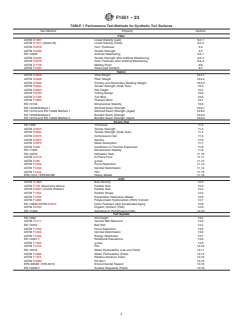
4.5 Table 1 is an index of the test methods listed herein.
9. Fiber
4.6 Table X1.1 in the appendix is an index of test methods 9.1 Fiber properties such as denier, thickness, and tensile
included in previous versions of ASTM F1551 but are no
strength are important for the performance and durability of
longer used or have been superseded by newer test methods. synthetic turf. As an outdoor product, the resistance to polymer
degradation and color loss are important yarn properties.
5. Significance and Use
Melting point and lead content assure that the correct yarn is
being used and that it meets the lead content requirement.
5.1 These test methods constitute a standard for obtaining
data in research and development, quality control, acceptance
9.2 Denier
and rejection under specifications, and for special purposes.
9.2.1 Denier — ASTM D1907, Standard Test Method for
Linear Density of Yarn (Yarn Number) by the Skein
5.2 The data obtained from use of these test methods are
Method
applicable to the system and its components under conditions
9.2.1.1 Scope:
of the particular test procedures and are not necessarily the
9.2.1.2 This test method covers the determination of the
same as the data that might be obtained in other environments
linear density (denier) of all types of yarn in (bobbin) package
or use conditions.
form.
5.3 The selection of test methods or tests should be limited
9.2.1.3 Test Method Specific Conditions:
to those appropriate to the system or material(s) being evalu-
9.2.1.4 Specified lengths of yarn are wound on reels as
ated.
skeins, and weighed.
9.2.1.5 Nine meters is recommended length weighed in
6. Conditioning of Materials
grams times 1000 for denier, grams per 9000 m.
6.1 Conduct laboratory tests under known conditions of
9.2.2 Denier — ASTM D1577, Standard Test Methods
temperature and humidity as specified in the individual test
for Linear Density of Textile Fibers (Option B)
procedures. In the absence of specified conditions, tests must
9.2.2.1 Scope:
be conducted under the standard laboratory conditions of 23 6
9.2.2.2 This test procedure describes measurement of the
2°C (73.4 6 3°F) and 65 6 5 % relative humidity. Materials
linear density (denier) of textile fibers and filaments.
must be conditioned, undeflected, and undistorted at the
9.2.2.3 The test is appropriate and applicable to the pile yarn
temperature and humidity of test for at least 24 h prior to
component of synthetic turf fabrics after the product is manu-
testing.
factured.
6.2 Conduct field tests on installed, indoor or outdoor 9.2.2.4 Test Method Specific Conditions:
synthetic turf playing surfaces at ambient temperature and 9.2.2.5 Test Method B—The direct weighing method is
humidity conditions. Measure and record the temperature of recommended.
the synthetic turf surface, shock-absorbing pad, or other 9.2.2.6 The linear density of finish-free fiber is the recom-
specific components being characterized by the particular test. mended measurement; see 12.1 of Test Method D1577.
F1551 − 23
TABLE 1 Performance Test Methods for Synthetic Turf Surfaces
Test Method Property Section
Fiber
ASTM D1907 Linear Density (Lab) 9.2.1
ASTM D1577 (Option B) Linear Density (Field) 9.2.2
ASTM D3218 Yarn Thickness 9.3
ASTM D2256 Tensile Strength 9.4
EN 14836 Artificial Weathering 9.5.1
ASTM D2256 Tensile Strength after Artificial Weathering 9.5.2
ASTM D2616 Color Fastness after Artificial Weathering 9.5.3
ASTM D7138 Melting Point 9.6
ASTM F2765 Total Lead Content 9.7
Fabric
ASTM D5848 Total Weight 10.2.1
ASTM D5848 Fiber Weight 10.2.2
ASTM D5848 Primary and Secondary Backing Weight 10.2.3
ASTM D5034 Tensile Strength (Grab Tear) 10.3
ASTM D5823 Pile Height 10.4
ASTM D5793 Tufting Gauge 10.5
ASTM D1335 Tuft Bind 10.6
ASTM F3383 Filament Bind 10.7
EN 13746 Dimensional Stability 10.8
EN 12228 Method 1 Stitched Seam Strength 10.9.1
EN 13744 and EN 12228 Method 1 Stitched Seam Strength (Aged) 10.9.2
EN 12228 Method 2 Bonded Seam Strength 10.9.3
EN 13744 and EN 12228 Method 2 Bonded Seam Strength (Aged) 10.9.4
Shock Pad
EN 1969 Thickness 11.2
ASTM D3575 Tensile Strength 11.3
ASTM D5034 Tensile Strength (Grab Tear) 11.4
ASTM D3575 Compression Set 11.5
ASTM D3575 Density 11.6
ASTM D3575 Water Absorption 11.7
ASTM D696 Coefficient of Thermal Expansion 11.8
EN 17326 Dimensional Stability 11.9
EN 12616 Infiltration Rate 11.10
ASTM D4716 In-Plane Flow 11.11
ASTM F355 g-max 11.12
ASTM F3189 Force Reduction 11.13
ASTM F3189 Vertical Deformation 11.14
ASTM F3146 HIC 11.15
EPA 1312 / EPA 6010B Heavy Metals 11.16
Infill
ASTM D1895 Bulk Density 12.2
ASTM C136 (Sand and others) Particle Size 12.3
ASTM D5644 (Crumb Rubber) Particle Size 12.4
ASTM F1632 Particle Shape 12.5
ASTM F3188 Extractable Hazardous Metals 12.6
ASTM F3496 Polyaromatic Hydrocarbon (PAH) Content 12.7
EN 14836/ ASTM D2616 Color Fastness after Accelerated Aging 12.8
ASTM E2402 Organic Content (TGA) 12.9
EN 17409 Sampling of Performance Infills 12.10
Turf System
EN 1969 Infill Depth 13.2
ASTM F2117 Vertical Ball Rebound 13.3
EN 12234 Ball Roll 13.4
ASTM F3189 Force Reduction 13.5
ASTM F3189 Vertical Deformation 13.6
ASTM F3189 Energy Restitution 13.7
EN 15301-1 Rotational Resistance 13.8
ASTM F1936 g-max 13.9
ASTM F3146 HIC 13.10
EN 12616 Water Permeability (Lab and Field) 13.11
ASTM F2898 Water Permeability (Field) 13.12
ASTM F1015 Relative Abrasive Index 13.13
ASTM D2859 Pill Burn 13.14
EPA 3050B / EPA 6010 Environmental Hazard 13.15
EN 13036-7 Surface Regularity (Field) 13.16
F1551 − 23
9.2.2.7 The turf manufacturing process may change yarn 9.5.2.4 Weathering resistance is expressed as % retention of
denier as measured. tensile strength.
9.5.3 Color Fastness after Artificial Weathering —
9.3 Yarn Thickness — ASTM D3218, Standard Specifi-
ASTM D2616, Standard Test Method for Evaluation of
cation for Polyolefin Monofilaments
Visual Color Difference With a Gray Scale
9.3.1 Scope:
9.5.3.1 Scope:
9.3.1.1 This specification covers polyolefin monofilament
9.5.3.2 A method for quantifying the resistance to weather-
yarn materials, and test methods for standard polyolefin mono-
ing is measuring the color change of the fiber.
filaments.
9.5.3.3 Color change is quantified by evaluating the differ-
9.3.1.2 This test method covers the determination of the
ence in color between the weathered and non-weathered turf
thickness of polyolefin monofilament turf yarn, by a microm-
fiber using a gray scale.
eter.
9.3.1.3 This method can also be used for slit-tape turf yarn.
9.6 Melting Point — ASTM D7138, Standard Test
9.3.2 Test Method Specific Conditions—Measure the thick-
Method to Determine Melting Temperature of Synthetic
ness of the specimen to the nearest 2.5 μm (0.1 mil) using the
Fibers
micrometer.
9.6.1 Scope:
9.6.2 These test methods describe techniques for measuring
9.4 Yarn Tensile Strength — ASTM D2256, Standard
the melting point of polyethylene, polypropylene, and poly-
Test Method for Tensile Properties of Yarns by the Single
amide fibers used in synthetic turf fabrics.
Strand Method
9.6.3 Method 1—A specimen of fiber and a reference sample
9.4.1 Scope:
are positioned into the designated heating blocks of a Differ-
9.4.1.1 This test procedure describes measurement of the
ential Scanning Calorimetry (DSC) instrument.
tensile properties strength, elongation, and (optionally) modu-
lus for textile fibers and filaments. 9.6.3.1 The DSC data is used to determine the fiber speci-
men melting temperature.
9.4.1.2 The test is appropriate and applicable to the pile
fiber component of synthetic turf fabrics before the turf product 9.6.4 Method 2—A specimen of fiber is positioned in a
is made. melting temperature device.
9.4.2 Test Method Specific Conditions: 9.6.4.1 The temperature of the device is raised until the fiber
9.4.2.1 Option A1, standard-conditioned, straight fiber or specimen reaches its melting temperature as determined by
visual observation.
filament is recommended.
9.4.2.2 Horn grip clamps are recommended.
9.7 Lead Content — ASTM F2765, Standard Specifica-
9.4.2.3 The recommended gage length is 15.2 cm (6 in.).
tion for Total Lead Content in Synthetic Turf Fibers
9.4.2.4 The recommended cross-head speed is 30.5 cm/min
9.7.1 Scope:
(12 in./min).
9.7.2 This specification applies to the maximum content of
9.4.2.5 The tangent method is recommended if the modulus
lead in fibers used in synthetic turf.
is calculated (Appendix, Test Method D2256).
9.7.3 A sample of the fiber is dissolved in a strong acid by
9.4.2.6 The measurement of strength and elongation may be
microwave digestion.
conducted on monofilaments or multifilament yarns; specify
9.7.4 The total lead content is determined using inductively
either monofilament or fiber bundle.
coupled plasma/atomic emission spectrometry.
9.5 Artificial Weathering
9.7.5 The total lead content is expressed in mg/kg (ppm).
9.5.1 Yarn Artificial Weathering — EN 14836, Synthetic
9.7.6 The total lead content shall be less than 100 ppm.
Surfaces for Outdoor Sports Areas – Exposure to Artificial
Weathering
10. Fabric
9.5.1.1 Scope:
10.1 Identification of turf fabric construction can be accom-
9.5.1.2 This test method specifies the procedure for expos-
plished with the component weights, pile height, and tufting
ing synthetic turf yarns to accelerated weathering.
gauge. Tear strength, tuft bind, filament bind, and dimensional
9.5.1.3 The UV light source is specified as fluorescent UVA
stability assure that the fabric meets performance specifica-
bulbs described in EN 4892-3.
tions. Seams need to be strong and durable to prevent hazard-
9.5.1.4 The exposure conditions and exposure times are
ous seam separations in the field.
defined.
10.2 Turf Fabric Component Weights
9.5.2 Tensile Strength after Artificial Weathering —
ASTM D2256, Standard Test Method for Tensile Properties 10.2.1 Fabric Total Weight — ASTM D5848, Standard
of Yarns by the Single Strand Method Test Method for Mass Per Unit Area of Pile Yarn Floor
Coverings
9.5.2.1 Scope:
10.2.1.1 Scope:
9.5.2.2 A method for quantifying the resistance to weather-
ing is measuring the retention of tensile strength.
10.2.1.2 Test specimens are cut from a conditioned test
9.5.2.3 Tensile strength of the yarn after weathering is sample and then measured. Each conditioned test specimen is
compared to the yarn strength before weathering. weighed and the mass per unit area is calculated.
F1551 − 23
10.2.2 Fiber Weight — ASTM D5848, Standard Test 10.5.1 Scope:
Method for Mass Per Unit Area of Pile Yarn Floor Cover- 10.5.1.1 This test method describes the measurement of the
ings
number of binding sites per unit length or width of machine-
10.2.2.1 Scope: made, woven, knitted, and tufted pile yarn floor covering.
10.2.2.2 Test specimens are cut from a conditioned sample 10.5.1.2 This test procedure describes methods appropriate
and weighed.
and applicable for characterizing synthetic turf fabric.
10.2.2.3 The fiber is sheared from the test specimens. The 10.5.2 Test Method Specific Conditions:
weight of the sheared test specimen is recorded. 10.5.3 If the binding sites are visible from the back, place
10.2.2.4 The fiber stubble is removed from the backing.
the test specimen face down on a flat surface; otherwise, place
10.2.2.5 The coating is removed from the stubble and the the test specimen back down and shear the pile close to the
weight of the cleaned stubble is recorded. backing to reveal the binding sites.
10.2.2.6 The fiber weight is the sum of the stubble weight 10.5.4 Locate the zero point at this distinguishing feature of
plus the difference between original test sample and the sheard one binding site with a marker.
test sample. 10.5.5 Count a known number of binding sites from the zero
10.2.3 Primary and Secondary Backing Weight — point and add a second marker.
ASTM D5848, Standard Test Method for Mass Per Unit 10.5.6 Measure the distance between the two markers with
Area of Pile Yarn Floor Coverings
a graduated scale or tape, reading to the nearest 1 mm (0.05
10.2.3.1 Scope: in.).
10.2.3.2 The total turf fabric weight is measured according 10.5.7 The stitch rate or tufting gauge is calculated depend-
to ASTM D5848. ing on direction.
10.2.3.3 The fiber weight for the turf fabric is also deter-
10.6 Tuft Bind — ASTM D1335, Standard Test Method
mined according to ASTM D5848.
for Tuft Bind of Pile Floor Coverings
10.2.3.4 The weight of the primary and secondary backing
10.6.1 Scope:
is calculated by subtracting the fiber weight from the total
10.6.1.1 This test provides a method for measuring the tuft
fabric weight.
bind in pile fabrics such as carpets.
10.3 Grab Tear Strength — ASTM D5034, Standard Test 10.6.1.2 The test is appropriate and applicable to the pile
Method for Breaking Strength and Elongation of Textile yarn component of synthetic turf fabrics.
Fabrics (Grab Test) 10.6.2 Test Method Specific Conditions:
10.3.1 Scope:
10.6.2.1 For the purposes of Test Method D1335, a tuft has
10.3.2 This grab test procedure is applicable to the determi-
the conventional definition of the two halves of the mono or
nation of the effective strength of a woven or non-woven multifilament loop of pile that is inserted between the adjacent
fabric.
yarns of the tufting medium (backing fabric), held in place by
10.3.3 A 100-mm (4.0-in.) wide specimen is mounted cen- a primary coating (adhesive), and not otherwise connected
trally in clamps of a tensile testing machine and a force applied mechanically to the tufting medium.
until the specimen breaks. The breaking strength and elonga-
10.6.2.2 For turf made with multi-filament fibers, one tuft
tion are reported. leg includes all filaments of the multi-filament bundle.
10.3.4 Of the various methods described in ASTM D5034,
10.6.2.3 A specimen (tuft leg or loop) is mounted in a
the grab test using a constant-rate-of-extension (CRE) tensile
special clamping fixture of a tensile testing machine and the
testing machine is recommended for synthetic turf.
test sample containing the specimen is mounted on a special
holder on the tensile testing machine. The force to pull the
10.4 Pile Height — ASTM D5823, Standard Test Method
specimen free from the test sample is measured as the tuft bind.
for Tuft Height of Pile Floor Coverings
10.4.1 Scope: 10.7 Filament Bind — ASTM F3383, Standard Test
10.4.2 This method covers the determination of tuft height Method for Filament Bind of Single Fibers in Synthetic
using a grooved specimen holder. Turf
10.4.3 Test Method Specific Conditions: 10.7.1 Scope:
10.4.3.1 Sever the leg of each selected tuft leg or loop as 10.7.1.1 This test method applies to tufted synthetic turf
close to the backing surface as possible with the angled flush produced with at least one bundle of monofilament fibers.
wire cutter and place in grooved specimen holder. 10.7.1.2 This test method is applicable to laboratory testing
10.4.3.2 Read the graduated scale at the opposite end of the (Method A), and for testing of installed turf (Method B).
tuft element and record to the nearest 0.5 mm (0.01 in.).
10.7.2 Summary of the Method—A test sample is mounted
10.4.3.3 Pile height (blade length) is also measured by in a clamping device associated with the constant rate of
inserting a small graduated ruler into the pile down to the
extension (CRE) force testing device. The force required to
backing and reading the overall height of the pile for machine pull one filament of one yarn bundle of one tuft from the
set-up or rough field work.
synthetic turf fabric sample is measured as the filament bind.
10.5 Tufting Gauge — ASTM D5793, Standard Test 10.8 Dimensional Stability — EN 13746, Surface for
Method for Binding Sites per Unit Length or Width of Pile Sports Areas – Determination of Dimensional Changes Due
Floor Coverings to the Effect of Varied Water, Frost, and Heat Conditions
F1551 − 23
10.8.1 Scope: for Sports Areas – Determination of Joint Strength of
10.8.1.1 This test method measures the percent change in Synthetic Surfaces – Method 2
the dimensions of a synthetic turf fabric subjected to changes
10.9.4.1 Scope:
in temperature and water exposure.
10.9.4.2 This method measures the strength of bonded
10.8.2 Benchmark lines were drawn on the backing in both
seams after accelerated aging.
the warp and fill directions of the specimens.
10.9.4.3 Bonded seams undergo accelerated aging by hot
10.8.3 The distance between benchmark lines is measured
water (70°C) for 14 days according to the procedure in EN
after the following exposures:
13744.
10.8.3.1 48 h at 23°C and 50 % relative humidity (initial
10.9.4.4 After conditioning for at least 16 h, the average
condition),
peel strength is measured according to EN 12228 Method 2.
10.8.3.2 24 h immersed in water containing 0.1 % sodium
laurel sulfate at 23°C,
11. Shock Pad
10.8.3.3 24 h at –18°C,
11.1 Shock pads are added to turf systems to enhance
10.8.3.4 72 h at 70°C, and
impact attenuation and possibly drainage. Test method are
10.8.3.5 48 h at 23°C and 50 % relative humidity.
provided for identification of the shock pads. Additional tests
10.8.4 Calculate the difference in the measured dimensions
verify performance characteristics and environmental compli-
at each condition and the dimension at the initial condition.
ance.
10.8.5 Express the change in dimension as % change.
11.2 Thickness — EN 1969, Surfaces for Sports Areas –
10.9 Fabric Seams
Determination of Thickness of Synthetic Sports Surfaces
10.9.1 Stitched Seam Strength — EN 12228, Surfaces for
11.2.1 Scope:
Sports Areas – Determination of Joint Strength of Syn-
11.2.2 EN 1969 describes two methods for measuring the
thetic Surfaces – Method 1 (Stitched Seams)
thickness of sports surfaces in the laboratory and “in situ”.
10.9.1.1 Scope:
11.2.3 Method A uses a thickness gauge with a pressure foot
10.9.1.2 This test method is appropriate for determining the
with a pressure of 0.8 to 1.0 N.
strength of sewn seams, overlapped bonded seams, and hot
melt seams. 11.2.4 The accuracy of Method A is 6 0.1 mm.
10.9.1.3 The two sides of the seam are clamped into a
11.2.5 Method B uses a three pronged thickness probe
tensile test machine.
having a calibrated barrel. The prongs are pushed through the
10.9.1.4 The test method applies tensile force perpendicular
shock pad. The sliding barrel is lowered until it contacts the
to the seam at 100 mm/min until the seam breaks
surface.
10.9.1.5 The maximum force is recorded as the seam
11.2.6 The accuracy of Method B is between 6 0.5 mm and
strength.
6 1.5 mm, depending upon the texture.
10.9.2 Stitched Seam Strength after Aging — EN 13744,
11.3 Tensile Strength — ASTM D3575, Standard Test
Surfaces for Sports Areas – Procedure for Accelerated
Methods for Flexible Cellular Materials Made From Olefin
Ageing by Immersion in Hot Water + EN 12228 Surfaces
Polymers – Suffix T Tensile Strength and Elongation
for Sports Areas – Determination of Joint Strength of
11.3.1 Scope:
Synthetic Surfaces – Method 1
11.3.1.1 This standard measures the tensile strength of the
10.9.2.1 Scope:
shock pad.
10.9.2.2 Sewn, overlapped, or hot melt seams undergo
11.3.1.2 This standard is applicable to foam type pads.
accelerated aging by hot water (70°C) for 14 days according to
the procedure in EN 13744. 11.3.2 Test samples are dumbbell shaped samples cut using
10.9.2.3 After conditioning for at least 16 h, the tensile the Die A, as described in ASTM Test Methods D412.
strength is measured according to EN 12228 Method 1.
11.3.3 The ends of the dumbbell shaped sample are clamped
10.9.3 Bonded Seam Strength — EN 12228, Surfaces for
into a tensile testing machine with a gauge of 50 mm (2 in.).
Sports Areas – Determination of Joint Strength of Syn-
11.3.4 Tensile force is applied at 500 mm/min (20 in./min).
thetic Surfaces – Method 2 (Bonded Seams)
11.3.5 The tensile load to rupture is recorded as the tensile
10.9.3.1 Scope:
strength.
10.9.3.2 This test method is appropriate for determining the
11.4 Tensile Strength — ASTM D5034, Standard Test
seam strength of reinforced butt seams.
Method for Breaking Strength and Elongation of Textile
10.9.3.3 The two flaps of the reinforced butt seam are
Fabrics (Grab Test)
clamped into a tensile testing machine.
11.4.1 Scope:
10.9.3.4 A peel force is applied to the joint at a rate of 100
11.4.2 The grab tear test is applicable for measuring tensile
mm/min.
strength of pads having a non-woven fabric nature.
10.9.3.5 The average force between 25 % and 75 % of the
peel length is recorded as the reported as the joint strength. 11.4.3 A 100-mm (4.0-in.) wide specimen is mounted cen-
10.9.4 Bonded Seam Strength After Aging — EN 13744, trally in clamps of a tensile testing machine and a force applied
Surfaces for Sports Areas – Procedure for Accelerated until the specimen breaks. The breaking strength and elonga-
Ageing by Immersion in Hot Water + EN 12228 Surfaces tion are reported.
F1551 − 23
11.4.4 Of the various methods described in ASTM D5034, 11.7.2 This test method covers the measurement of the
the grab test using a constant-rate-of-extension (CRE) tensile water absorbed by olefin polymer flexible cellular materials
testing machine is recommended for shock pads. during submersion under pressure.
11.7.3 Test specimens shall be 101.6 by 101.6 mm (4 by 4
11.5 Compression Set — ASTM D3575, Standard Test
in.) by the thickness of material being supplied. The specimen
Methods for Flexible Cellular Materials Made From Olefin
may or may not have natural skins on top, bottom, or both
Polymers – Suffix B Compression Set Under Constant
surfaces.
Deflection
11.7.4 Specimens are measured and weighed.
11.5.1 Scope:
11.7.5 Specimens are submerged under a 3-m (10-ft) head
11.5.1.1 This test method covers the deflection of the foam
of water (equal to 30 kPa or 4.35 psi) at room temperature (18
specimen under a compressive force and under specified
to 29°C (65 to 90°F)) for 48 h.
conditions of time and temperature, then noting the effect on
11.7.6 Report the weight of water absorbed divided by the
the thickness of the specimen after releasing the compressive
area of the specimen.
force.
11.8 Coefficient of Thermal Expansion — ASTM D696,
11.5.2 Measure the test specimen original thickness (t ).
o
Standard Test Method for Coefficient of Linear Thermal
11.5.3 Place the test specimen or specimens in the apparatus
Expansion of Plastics Between −30°C and 30°C with a
in a manner that will not allow the specimens to come into
Vitreous Silica Dilatometer
contact with each other upon being compressed and deflect the
11.8.1 Scope:
specimens to 50 % 6 1 % of their thickness.
11.8.2 This test method covers determination of the coeffi-
11.5.4 Allow the test specimen to remain deflected in the
cient of linear thermal expansion for plastic materials having
apparatus for 22 h 6 30 min.
coefficients of expansion greater than 1 μm ⁄(m.°C) by use of a
11.5.5 Remove the specimen from the test apparatus at the
vitreous silica dilatometer.
end of the 22-h period. Measure the final thickness (t ) after 24
f
11.9 Dimensional Stability — EN 17326, Surfaces for
h 6 30 min of recovery.
Sports Areas – Determination of Dimensional Stability of
11.5.6 Calculate the constant deflection compression set,
Shock Pads Used Within Sports Systems
expressed as a percentage of the original thickness.
11.9.1 Scope:
11.9.2 This test method measures the dimensional stability
11.6 Density — ASTM D3575, Standard Test Methods
(bowing and curling) of shockpads used within sports surface
for Flexible Cellular Materials Made From Olefin Polymers
systems.
– Suffix W – Density
11.9.3 A 300 × 300 mm sample is secured over a rigid base
11.6.1 Scope:
and adjustable side frame.
11.6.2 ASTM D3575 has two methods for determining
11.9.4 The frame and sample are heated at 70°C for 4 h.
density. Method A is appropriate for pads with flat surfaces.
11.9.5 The height of the pad above the frame is measured at
Method B is appropriate for pads with grooves or voids that
five locations at each stage of the test.
prevent adequate sample collection for use in Method A.
11.9.6 The maximum difference between the initial condi-
11.6.3 Test Method A covers the determination of density of
tions and any stage in the test is reported.
foam by calculation from the mass and volume of a regularly
11.9.7 Report whether the change was doming (convex) or
shaped specimen.
curling (concave).
11.6.3.1 A sample not less than 1 in. is cut from the pad.
11.10 Infiltration Rate — EN 12616, Surfaces for Sports
The volume of the sample is determined by measuring the
Areas – Determination of Water Infiltration Rate
length, width, and thickness of the sample. Mass is measured
11.10.1 Scope:
by weighing to the nearest 1 % of the sample weight.
11.10.2 Infiltration rate is measured using a double ring
11.6.3.2 Density is calculated by dividing the mass by the
infiltrometer.
volume of the sample.
11.10.3 The time for the water in the inner ring to fall 20
11.6.4 Test Method B describes the determination of density
mm (from 30 mm to 10 mm) is measured.
of closed cell foams using volume measured using a liquid
11.10.4 The infiltration rate is calculated by dividing the
displacement method.
distance of water fall (mm) by the time (h).
11.6.4.1 The mass of the sample is determined by weighing
11.11 In-Plane Flow — ASTM D4716, Standard Test
to the nearest 1 % of the sample weight.
Method for Determining the (In-plane) Flow Rate per Unit
11.6.4.2 The volume is measured by collecting the liquid
Width and Hydraulic Transmissivity of a Geosynthetic
displaced using an immersion vessel.
Using a Constant Head
11.6.4.3 The density is calculated using the weighed mass of
11.11.1 Scope:
the sample divided by the mass of the displaced liquid.
11.11.2 The flow rate through a 300 × 300 mm sample is
11.7 Water Absorption — ASTM D3575, Standard Test
measured under a constant head of water and at a constant
Methods for Flexible Cellular Materials Made from Olefin
normal load on the sample.
Polymers – Suffix L Water Absorption
11.11.3 The normal load and gradient can be varied. Typi-
11.7.1 Scope: cally three loads and three gradients are used.
F1551 − 23
11.11.4 Gradients shall include the expected gradients of 11.14.1 Scope:
synthetic turf field installations.
11.14.1.1 Vertical deformation is a measure of the distance
a test foot penetrates into the surface when a standard impact
11.12 Impact Attenuation — ASTM F355, Standard Test
force is applied.
Method for Impact Attenuation of Playing Surface
11.14.1.2 This method is used to characterize properties of
Systems, Other Protective Sport Systems, and Materials
synthetic turf systems including the turf fabric, infill material,
Used for Athletics, Recreation and Play
and shock pad.
11.12.1 Scope:
11.14.2 Vertical deformation along with force reduction and
11.12.1.1 This test method measures the impact attenuation
energy restitution are measured with the Advanced Artificial
of surface systems and materials, specifically the peak impact
Athlete (AAA).
acceleration (“impact shock”) produced under prescribed im-
11.14.3 The acceleration curve is recorded for a mass of 20
pact conditions.
kg dropped from a height of 55 mm.
11.12.2 Test Method Specific Conditions:
11.14.4 Vertical deformation is calculated by double inte-
11.12.2.1 Procedure A, 4.2.1 of Test Method F355 is rec-
gration of the acceleration curve to obtain the change in
ommended.
position of the mass during the impact with the surface.
11.12.2.2 An impact velocity of 3.43 6 0.17 m/s is required.
11.14.5 The dynamic interaction between the athlete and the
(This velocity corresponds to a theoretical drop height of 0.61
synthetic turf surface affects the comfort and the performance
m (24 in.) at sea level.)
of the athlete. Surfaces with high vertical deformation and low
11.12.2.3 The g-max is determined by measuring the maxi-
energy restitution require the athlete to exert more energy to
mum of the acceleration curve.
perform, increasing the risk for fatigue for the athlete.
11.12.2.4 The average of the second and third drops is
recorded as the average g-max.
11.15 HIC — ASTM F3146, Standard Test Method for
11.12.2.5 This is a physical property characterization Impact Attenuation of Turf Playing Systems Designated for
standard, and it shall not be construed as a safety standard.
Rugby
11.15.1 Scope:
11.13 Force Reduction — ASTM F3189, Standard Test
11.15.1.1 This standard establishes a test method to be used
Method for Measuring Force Reduction, Vertical
when testing a synthetic turf field’s impact attenuation property
Deformation, and Energy Restitution of Synthetic Turf
for assessing its suitability for rugby.
Systems Using the Advanced Artificial Athlete
11.15.1.2 This test is conducted in the lab for pads using
11.13.1 Scope:
Procedure A.
11.13.1.1 Force reduction is the ability of a synthetic turf
11.15.2 Test Method Specific Conditions:
sports surface to reduce the impact force of a mass falling onto
11.15.3 The head form used for impact test is the E Missile
that surface.
specified in ASTM F355.
11.13.1.2 This method is used to characterize properties of
11.15.4 Impact attenuation is calculated by dropping the E
synthetic turf systems including the turf fabric, infill material,
missile onto the surface from four different drop heights and
and shock pad.
the HIC value for each drop height calculated.
11.13.1.3 Force reduction along with vertical deformation
11.15.5 Regression analysis is used to define the relation-
and energy restitution are measured with the Advanced Artifi-
ship between measured drop heights and corresponding char-
cial Athlete (AAA).
acteristic HIC values.
11.13.2 The acceleration curve is recorded for a mass of 20
11.15.6 The regression equation is used to estimate the drop
kg dropped from a height of 55 mm.
height that corresponds to a representative HIC value equal to
11.13.3 The impact force is calculated by multiplying the
a specified criterion. This value is the Critical Fall Height
mass of the falling weight by the peak acceleration recorded on
(CFH).
the impact acceleration curve.
11.15.7 The measured CFH is compared to an established
11.13.4 The reduction in impact force for this test method is
specification to determine compliance.
expressed as a percentage reduction when compared to a
reference force of 6760 N. The reference force is the theoretical
11.16 Heavy Metals — EPA 1312, Synthetic Precipita-
maximum impact force that occurs when the test is performed
tion Leaching Procedure / EPA 6010B Inductively Coupled
on a rigid surface (concrete).
Plasma – Atomic Emission Spectrometry
11.13.5 The dynamic interaction between the athlete and the
11.16.1 Scope:
synthetic turf surface affects the comfort and the performance
11.16.1.1 Concentration levels of heavy metals above cer-
of the athlete. Interaction with a surface that has low shock
tain limits are hazardous to human health.
absorption allows the player to run fast and turn quickly, but
11.16.1.2 Test Method EPA 1312 is an extraction technique
has the potential to cause discomfort and damage to the lower
designed to simulate extraction of hazardous metals by rainfall.
extremity joints.
11.16.1.3 Test method EPA 6010B is used to measure the
concentration of heavy metals that are extracted from a pad
11.14 Vertical Deformation — ASTM F3189, Standard
sample.
Test Method for Measuring Force Reduction, Vertical
Deformation, and Energy Restitution of Synthetic Turf 11.16.2 A sample of the shock pad is extracted with a
Systems Using the Advanced Artificial Athlete mixture of sulfuric and nitric acids to simulate acid rain in the
F1551 − 23
appropriate section of the U.S. (pH = 4.2 east of the Mississippi 12.4.2 Test Method Specific Conditions:
River and 5.0 west of the Mississippi).
12.4.2.1 100 g of crumb rubber is combined with a fixed
11.16.3 The extract is analyzed for heavy metals using EPA
amount of flowing agent and placed on top of a series of mesh
6010B inductively coupled plasma/atomic emission spectrom-
sieves, with the coarsest sieve being on top and the finest on the
etry. The reported levels are compared to relevant state or
bottom.
federal limits.
12.4.2.2 The specimen is placed in a Ro-tap shaker for 10
min.
12. Infill
12.4.2.3 The weight of the rubber retained on the individual
12.1 Infill is added to high pile turf systems to provide sieves is then recorded and the mesh designation of the product
determined
...
This document is not an ASTM standard and is intended only to provide the user of an ASTM standard an indication of what changes have been made to the previous version. Because
it may not be technically possible to adequately depict all changes accurately, ASTM recommends that users consult prior editions as appropriate. In all cases only the current version
of the standard as published by ASTM is to be considered the official document.
Designation: F1551 − 09 (Reapproved 2017) F1551 − 23 An American National Standard
Standard Test Methods for
Comprehensive Characterization of Synthetic Turf Playing
Surfaces and Materials
This standard is issued under the fixed designation F1551; the number immediately following the designation indicates the year of
original adoption or, in the case of revision, the year of last revision. A number in parentheses indicates the year of last reapproval. A
superscript epsilon (´) indicates an editorial change since the last revision or reapproval.
1. Scope
1.1 These test methods establish a recommended list from which suitable test methods shall be selected for the
identificationidentification of physical property characteristics and comparison of the performance properties of synthetic turf
systems or components for athletic and recreational uses, or both.
1.2 Some of the test procedures are suitable only for the laboratory characterization of either components or the complete system;
others are suitable for tests on installed sports fields;fields; and some tests may be applied in both the laboratory and the field.field.
1.3 The test procedures included in these test methods apply as a group to the description of synthetic turf playing surfaces.
1.4 Some of the test procedures are specific for components of the synthetic turf system, and others apply to the complete synthetic
turf playing surface.Test methods outlined herein cover system components as well as fully assembled synthetic turf systems. Most
of the methods measure material and performance properties of turf components. Component properties are not intended to
represent the performance of a fully assembled turf system. Component results provide data for quality control, specification
compliance, and component performance used in product design.
1.5 Reference to the methods for testing the synthetic turf playing surface and its components contained herein should state
specificallyspecifically the particular test or tests desired and not necessarily refer to these this list of test methods as a whole.
1.6 Several new standards have been added since the last revision of this standard. Other standards, for which more appropriate
standards exist, have been removed from this standard. A list of the standards that have been removed and their replacements are
listed in Table X1.1 in Appendix X1.
1.7 This is a physical property characterization standard, and it shall not be construed as a safety standard.
1.8 The values stated in SI units are to be regarded as the standard. The values given in parentheses are for information only.
1.9 This standard does not purport to address all of the safety concerns, if any, associated with its use. It is the responsibility
of the user of this standard to establish appropriate safety, health, and environmental practices and determine the applicability of
regulatory limitations prior to use.
These test methods are under the jurisdiction of ASTM Committee F08 on Sports Equipment, Playing Surfaces, and Facilities and are the direct responsibility of
Subcommittee F08.65 on Artificial Turf Surfaces and Systems.
Current edition approved Dec. 1, 2017Sept. 1, 2023. Published December 2017March 2024. Originally approved in 1994. Last previous edition approved in 20092017
as F1551 – 09.F1551 – 09 (2017). DOI: 10.1520/F1551-09R17.10.1520/F1551-23.
Copyright © ASTM International, 100 Barr Harbor Drive, PO Box C700, West Conshohocken, PA 19428-2959. United States
F1551 − 23
1.10 This international standard was developed in accordance with internationally recognized principles on standardization
established in the Decision on Principles for the Development of International Standards, Guides and Recommendations issued
by the World Trade Organization Technical Barriers to Trade (TBT) Committee.
2. Referenced Documents
2.1 ASTM Standards:
C136 Test Method for Sieve Analysis of Fine and Coarse Aggregates 2.1.1 Pile Fiber:
D792D412 Test Methods for Density and Specific Gravity (Relative Density) of Plastics by DisplacementVulcanized Rubber
and Thermoplastic Elastomers—Tension
D696 Test Method for Coefficient of Linear Thermal Expansion of Plastics Between −30°C and 30°C with a Vitreous Silica
Dilatometer
D1335 Test Method for Tuft Bind of Pile Yarn Floor Coverings
D1577 Test Methods for Linear Density of Textile Fibers
D1895 Test Methods for Apparent Density, Bulk Factor, and Pourability of Plastic Materials
D1907 Test Method for Linear Density of Yarn (Yarn Number) by the Skein Method
D2256 Test Method for Tensile Properties of Yarns by the Single-Strand Method
D3218 Specification for Polyolefin Monofilaments
D7138D2616 Test Method to Determine Melting Temperature of Synthetic Fibersfor Evaluation of Visual Color Difference With
a Gray Scale
2.1.2 Fabric:
D1335 Test Method for Tuft Bind of Pile Yarn Floor Coverings
D1776 Practice for Conditioning and Testing Textiles
D2859 Test Method for Ignition Characteristics of Finished Textile Floor Covering Materials
D3218 Specification for Polyolefin Monofilaments
D4158D3575 Guide for Abrasion Resistance of Textile Fabrics (Uniform Abrasion)Test Methods for Flexible Cellular Materials
Made from Olefin Polymers
D4716 Test Method for Determining the (In-plane) Flow Rate per Unit Width and Hydraulic Transmissivity of a Geosynthetic
Using a Constant Head
D5034 Test Method for Breaking Strength and Elongation of Textile Fabrics (Grab Test)
D5251D5644 Practice for the Operation of the Tetrapod Walker Drum TesterTest Method for Rubber Compounding
Materials—Determination of Particle Size Distribution of Recycled Vulcanizate Particulate Rubber (Withdrawn 2014)
D5793 Test Method for Binding Sites per Unit Length or Width of Pile Yarn Floor Coverings
D5823 Test Method for Tuft Height of Pile Floor Coverings
D5848 Test Method for Mass Per Unit Area of Pile Yarn Floor Coverings
E648D7138 Test Method for Critical Radiant Flux of Floor-Covering Systems Using a Radiant Heat Energy Sourceto Determine
Melting Temperature of Synthetic Fibers
F1015 Test Method for Relative Abrasiveness of Synthetic Turf Playing Surfaces
2.1.3 Shock Absorbing Cushion Underlayment:
D395 Test Methods for Rubber Property—Compression Set
D412 Test Methods for Vulcanized Rubber and Thermoplastic Elastomers—Tension
D624 Test Method for Tear Strength of Conventional Vulcanized Rubber and Thermoplastic Elastomers
D1667 Specification for Flexible Cellular Materials—Poly (Vinyl Chloride) Foam (Closed-Cell)
D1876E2402 Test Method for Peel Resistance of Adhesives (T-Peel Test)Mass Loss, Residue, and Temperature Measurement
Validation of Thermogravimetric Analyzers
D2126 Test Method for Response of Rigid Cellular Plastics to Thermal and Humid Aging
D3574 Test Methods for Flexible Cellular Materials—Slab, Bonded, and Molded Urethane Foams
D3575 Test Methods for Flexible Cellular Materials Made from Olefin Polymers
D3936 Test Method for Resistance to Delamination of the Secondary Backing of Pile Yarn Floor Covering
F355 Test Method for Impact Attenuation of Playing Surface Systems, Other Protective Sport Systems, and Materials Used for
Athletics, Recreation and Play
2.1.4 Turf Systems:
D1667F963 Specification for Flexible Cellular Materials—Poly (Vinyl Chloride) Foam (Closed-Cell)Consumer Safety
Specification for Toy Safety
F355 Test Method for Impact Attenuation of Playing Surface Systems, Other Protective Sport Systems, and Materials Used for
Athletics, Recreation and Play
For referenced ASTM standards, visit the ASTM website, www.astm.org, or contact ASTM Customer Service at service@astm.org. For Annual Book of ASTM Standards
volume information, refer to the standard’s Document Summary page on the ASTM website.
F1551 − 23
F1015 Test Method for Relative Abrasiveness of Synthetic Turf Playing Surfaces
F1632 Test Method for Particle Size Analysis and Sand Shape Grading of Golf Course Putting Green and Sports Field Rootzone
Mixes
F1936 Specification for Impact Attenuation of Turf Playing Systems as Measured in the Field
F2117 Test Method for Vertical Rebound Characteristics of Sports Surface/Ball Systems; Acoustical Measurement
F2765 Specification for Total Lead Content in Synthetic Turf Fibers
F2333F2898 Test Method for Traction Characteristics of the Athletic Shoe-Sports Surface InterfacePermeability of Synthetic
Turf Sports Field Base Stone and Surface System by Non-confined Area Flood Test Method
F3146 Test Method for Impact Attenuation of Turf Playing Systems Designated for Rugby
2.1.4F3188 Infill Materials:Specification for Extractable Hazardous Metals in Synthetic Turf Infill Materials
D5644F3189 Test Method for Rubber Compounding Materials—Determination of Particle Size Distribution of Recycled
Vulcanizate Particulate RubberMeasuring Force Reduction, Vertical Deformation, and Energy Restitution of Synthetic Turf
Systems Using the Advanced Artificial Athlete
F1632F3383 Test Method for Particle Size Analysis and Sand Shape Grading of Golf Course Putting Green and Sports Field
Rootzone MixesFilament Bind of Single Fibers in Synthetic Turf
F3496 Specification for Polyaromatic Hydrocarbon (PAH) Content in Synthetic Turf Infill
2.2 OtherEN Standards:
AT-030 EN 1969 Sports Shoe TractionSurfaces for Sports Areas – Determination of Thickness of Synthetic Sports Surfaces
NOTE 1—AstroTurf® Industries internal test procedure is suitable as a basis for new ASTM test methods.
DIN 18-035EN 12228 Part 6—Water Permeability of Synthetic Turf Systems and Permeable BasesSurfaces for Sports Areas –
Determination of Joint Strength of Synthetic Surfaces
EN 12234 Surfaces for Sports Areas – Determination of Ball Roll Behaviour
EN 12616 Surfaces for Sports Areas – Determination of Water Infiltration Rate
EN 1480813036-7 Surfaces for Sports Areas- Determination of Force ReductionRoad and Airfield Surface Characteristics – Test
Methods – Part 7: Irregularity Measurement of Pavement Courses: The Straightedge Test
EN 1480913744 Surfaces for Sports Areas – Determination of Vertical DeformationProcedure for Accelerated Ageing by
Immersion in Hot Water
EN 13746 Surface for sports areas – Determination of Dimensional Changes Due to the Effect of Varied Water, Frost, and Heat
Conditions
EN 14836 Synthetic Surfaces for Outdoor Sports Areas - Exposure to Artificial Weathering
prEN 15301-1EN 15301 Surfaces for Sports Areas- Part 1.Areas – Part 1: Determination of Rotational Resistance
EN 17326 Surfaces for Sports Areas – Determination of dimensional stability of shock pads used within sports system
EN 17409 Surfaces for Sports Areas – Code of Practice for the Sampling of Performance Infills Used Within Synthetic Turf
Surfaces
2.3 EPA Standards:
EPA 1312 Synthetic Precipitation Leaching Procedure
EPA 3050B Acid Digestion of Sediments, Sludges, and Soils
EPA 6010B Inductively Coupled Plasma – Atomic Emission Spectrometry
3. Terminology
3.1 Definitions—Terms are as defined in the referenced ASTM procedures comprising these test methods.
3.1 Definitions—Terms are as defined in the referenced ASTM procedures comprising these test methods.
3.2 Definitions of Terms Specific to This Standard:
3.2.1 fabric construction—the method of assembly of pile ribbonfiber and backing yarns that produces the fabric, usually tufting,
knitting, or weaving.
The last approved version of this historical standard is referenced on www.astm.org.Available from European Committee for Standardization (CEN), Avenue Marnix 17,
B-1000, Brussels, Belgium, http://www.cen.eu.
The Tetrapod Walker can be purchased from Lawson Hemphill Sales Inc., P.O. Box 6388, Spartanburg, SC; or Machine Control B.A.A. Canada Inc., 701 Ave. Meloche,
Dorval, Quebec.
The sole source of supply of the apparatus known to the committee at this time is NAEF Press & Dies, Inc., Bolton Landing, NY 12814. If you are aware of alternative
suppliers, please provide this information to ASTM International Headquarters. Your comments will receive careful consideration at a meeting of the responsible technical
committee,Available from United States Environmental Protection Agency (EPA), William Jefferson Clinton Bldg., 1200 Pennsylvania Ave., NW, Washington, DC 20460,
http://www.epa.gov. which you may attend.
F1551 − 23
3.2.2 infilled turf system—field system having a long pile height and either one or more substances in the face of the fabric to
provide the desired playing properties. Infill substances can be either sand, rubber or other substances or a combination of
items.generally consist of synthetic or natural materials. Historically, sand and crumb rubber have been the primary choice of infill
materials. The use of various synthetic particles and natural alternative materials have become more prevalent in the synthetic turf
industry.
3.2.3 lengthwise direction, n—in textiles, the direction in a machine-made fabric parallel to the direction of movement the fabric
followed in the manufacturing machine.
3.2.4 matting—the extent of change of the apparent synthetic turf pile thickness from the original value due to permanent
compression of the pile from sports use.
3.2.4 pile, n—for pile fiber turf surfacing, surface texturefibers composed of many individual thin strands or groups of strands
bound to a backing fabric in a repetitive array.
3.2.5 pile lay—primary backing—the direction in which most of the pile fibers lean in the original, uncrushed a woven or
non-woven fabric used as the tufting substrate through which the turf yarns are tufted to form the synthetic turf greige fabric.
3.2.6 secondary backing—a material adhered to the backing side of a pile turf fabric.
3.2.8 sports shoe traction—a measure of the static or sliding coefficient of friction between a weighted sports shoe and the turf
pile surface, horizontal motion.
3.2.7 synthetic turf field system—composite of synthetic contact surface material, any fillfill material used in the contact surface,
energy absorbing material, fabric layers, seams, adhesives, if any, and other constructed layers (as applicable to the individual
system construction).
3.2.8 synthetic turf system components—the separate components such as turf fabric, shock-absorbing pad, and adhesives that
comprise the synthetic turf playing surface when assembled; the subcomponents such as pile yarns and backing yarns that comprise
the turf fabric.
3.2.11 texture—the detailed configuration of loops, cut pile ends, and individual fibers in the pile layer.
3.2.11.1 Discussion—
Texture is the detailed appearance of the pile that changes by matting, crushing, flattening, fuzzing, untwisting, etc. during
exposure to service. The texture should be distinguished from the construction, that is, the specifications of kinds of yarns, yarn
sizes, and the mode of combination.
3.2.9 water permeability—the rate at which water of a specified head flows vertically through synthetic turf or other components
of the system.measure of the ability of a porous material to transmit fluids.
4. Summary of Test Methods
4.1 The purpose of these test methods is to provide a comprehensive characterization of synthetic turf playing surfaces.
4.2 SpecificSpecific conditions of the referenced procedures are recommended to encourage uniform application of these test
methods.
4.3 This standard is organized by system components and with the turf system.
4.4 Appropriate test procedures are summarized in sections related to components of the turf system or the turf system as a whole.
4.5 Table 1 is an index of the test methods listed herein.
F1551 − 23
TABLE 1 Performance Test Methods for Synthetic Turf Surfaces
Test Method Property Section
Fiber
ASTM D1907 Linear Density (Lab) 9.2.1
ASTM D1577 (Option B) Linear Density (Field) 9.2.2
ASTM D3218 Yarn Thickness 9.3
ASTM D2256 Tensile Strength 9.4
EN 14836 Artificial Weathering 9.5.1
ASTM D2256 Tensile Strength after Artificial Weathering 9.5.2
ASTM D2616 Color Fastness after Artificial Weathering 9.5.3
ASTM D7138 Melting Point 9.6
ASTM F2765 Total Lead Content 9.7
Fabric
ASTM D5848 Total Weight 10.2.1
ASTM D5848 Fiber Weight 10.2.2
ASTM D5848 Primary and Secondary Backing Weight 10.2.3
ASTM D5034 Tensile Strength (Grab Tear) 10.3
ASTM D5823 Pile Height 10.4
ASTM D5793 Tufting Gauge 10.5
ASTM D1335 Tuft Bind 10.6
ASTM F3383 Filament Bind 10.7
EN 13746 Dimensional Stability 10.8
EN 12228 Method 1 Stitched Seam Strength 10.9.1
EN 13744 and EN 12228 Method 1 Stitched Seam Strength (Aged) 10.9.2
EN 12228 Method 2 Bonded Seam Strength 10.9.3
EN 13744 and EN 12228 Method 2 Bonded Seam Strength (Aged) 10.9.4
Shock Pad
EN 1969 Thickness 11.2
ASTM D3575 Tensile Strength 11.3
ASTM D5034 Tensile Strength (Grab Tear) 11.4
ASTM D3575 Compression Set 11.5
ASTM D3575 Density 11.6
ASTM D3575 Water Absorption 11.7
ASTM D696 Coefficient of Thermal Expansion 11.8
EN 17326 Dimensional Stability 11.9
EN 12616 Infiltration Rate 11.10
ASTM D4716 In-Plane Flow 11.11
ASTM F355 g-max 11.12
ASTM F3189 Force Reduction 11.13
ASTM F3189 Vertical Deformation 11.14
ASTM F3146 HIC 11.15
EPA 1312 / EPA 6010B Heavy Metals 11.16
Infill
ASTM D1895 Bulk Density 12.2
ASTM C136 (Sand and others) Particle Size 12.3
ASTM D5644 (Crumb Rubber) Particle Size 12.4
ASTM F1632 Particle Shape 12.5
ASTM F3188 Extractable Hazardous Metals 12.6
ASTM F3496 Polyaromatic Hydrocarbon (PAH) Content 12.7
EN 14836/ ASTM D2616 Color Fastness after Accelerated Aging 12.8
ASTM E2402 Organic Content (TGA) 12.9
EN 17409 Sampling of Performance Infills 12.10
Turf System
EN 1969 Infill Depth 13.2
ASTM F2117 Vertical Ball Rebound 13.3
EN 12234 Ball Roll 13.4
ASTM F3189 Force Reduction 13.5
ASTM F3189 Vertical Deformation 13.6
ASTM F3189 Energy Restitution 13.7
EN 15301-1 Rotational Resistance 13.8
ASTM F1936 g-max 13.9
ASTM F3146 HIC 13.10
EN 12616 Water Permeability (Lab and Field) 13.11
ASTM F2898 Water Permeability (Field) 13.12
ASTM F1015 Relative Abrasive Index 13.13
ASTM D2859 Pill Burn 13.14
EPA 3050B / EPA 6010 Environmental Hazard 13.15
EN 13036-7 Surface Regularity (Field) 13.16
F1551 − 23
4.6 Table X1.1 in the appendix is an index of test methods included in previous versions of ASTM F1551 but are no longer used
or have been superseded by newer test methods.
5. Significance and Use
5.1 These test methods constitute a standard for obtaining data in research and development, quality control, acceptance and
rejection under specifications,specifications, and for special purposes.
5.2 The data obtained from use of these test methods are applicable to the system and its components under conditions of the
particular test procedures and are not necessarily the same as the data that might be obtained in other environments or use
conditions.
5.3 The selection of test methods or tests should be limited to those appropriate to the system or material(s) being evaluated.
6. Conditioning of Materials
6.1 Conduct laboratory tests under known conditions of temperature and humidity as specifiedspecified in the individual test
procedures. In the absence of specifiedspecified conditions, tests must be conducted under the standard laboratory conditions of
23 6 2°C (73.4 6 3°F) and 65 6 5 % 5 % relative humidity. Materials must be conditioned, undeflected,undeflected, and
undistorted at the temperature and humidity of test for at least 24 h prior to testing.
6.2 Conduct fieldfield tests on installed, indoor or outdoor synthetic turf playing surfaces at ambient temperature and humidity
conditions. Measure and record the temperature of the synthetic turf surface, shock-absorbing pad, or other specificspecific
components being characterized by the particular test.
6.2.1 Special conditions that should be reported for testing outdoor installations shall include excessively wet, frozen, or shaded
areas.
7. Sampling
7.1 For laboratory tests, select representative samples of components, in accordance with specificspecific sampling instructions of
the test procedure, when provided.
7.2 For fieldfield tests, specify locations on the synthetic turf playing surface where tests are conducted.
8. Application of Test Procedures
8.1 References to the test procedures stated herein are to be followed with regard to the apparatus, preparation of specimens,
procedures, calculations, and reporting of results, except when different conditions are noted specificallyspecifically in these test
methods.
8.2 Precision and bias statements are given for each test procedure in the respective test methods.
8.3 Test procedures shall be followed except when test method-specificmethod-specific conditions are provided.
TEST PROCEDURES
9. Test Methods D792, Specific Gravity (Relative Density) and Density of Plastics by Displacement
9.1 Scope:
9.1.1 This test procedure describes measurement of the specific gravity of fibers and filaments.
F1551 − 23
9.1.2 This test is appropriate and applicable to the pile yarn component of synthetic turf fabrics before the product is made.
10. Test Methods D1577, Linear Density of Textile Fibers
10.1 Scope:
10.1.1 This test procedure describes measurement of the linear density (denier) of textile fibers and filaments.
10.1.2 The test is appropriate and applicable to the pile yarn component of synthetic turf fabrics after the product is manufactured.
10.2 Test Method Specific Conditions:
10.2.1 Test Method A—The direct weighing method is recommended.
10.2.2 The linear density of finish-free fiber is the recommended measurement; see 12.1 of Test Methods D1577.
10.2.3 Manufacturing process may change yarn denier as measured.
11. Test Method D1907, Linear Density of Yarn (Yarn Number) by the Skein Method
11.1 Scope—This test method covers the determination of the linear density (denier) of all types of yarn in (bobbin) package form.
11.2 Test Method Specific Conditions:
11.2.1 Specified lengths of yarn are wound on reels as skeins, and weighed.
11.2.2 Nine meters is recommended length weighed in grams times 1000 for denier, grams per 9000 meters.
9. Test Method FiberD2256, Tensile Properties of Yarns by the Single Strand Method
9.1 Fiber properties such as denier, thickness, and tensile strength are important for the performance and durability of synthetic
turf. As an outdoor product, the resistance to polymer degradation and color loss are important yarn properties. Melting point and
lead content assure that the correct yarn is being used and that it meets the lead content requirement.
9.2 Scope: Denier
9.2.1 This test procedureDenier — ASTM D1907describes measurement of the tensile properties , Standard Test Method
for Linear Density of Yarn (Yarn Number) by the Skein Methodstrength, elongation, and (optionally) modulus for textile fibers
and filaments.
9.2.1.1 Scope:
9.2.1.2 This test method covers the determination of the linear density (denier) of all types of yarn in (bobbin) package form.
9.2.1.3 Test Method Specific Conditions:
9.2.1.4 Specified lengths of yarn are wound on reels as skeins, and weighed.
9.2.1.5 Nine meters is recommended length weighed in grams times 1000 for denier, grams per 9000 m.
9.2.2 The test isDenier — ASTM D1577appropriate and applicable to the pile fiber component of synthetic turf fabrics
before , Standard Test Methods for Linear Density of Textile Fibers (Option B)the product is made.
9.2.2.1 Scope:
9.2.2.2 This test procedure describes measurement of the linear density (denier) of textile fibers and filaments.
F1551 − 23
9.2.2.3 The test is appropriate and applicable to the pile yarn component of synthetic turf fabrics after the product is manufactured.
9.2.2.4 Test Method Specific Conditions:
9.2.2.5 Test Method B—The direct weighing method is recommended.
9.2.2.6 The linear density of finish-free fiber is the recommended measurement; see 12.1 of Test Method D1577.
9.2.2.7 The turf manufacturing process may change yarn denier as measured.
9.3 Yarn Thickness — ASTM D3218, Standard Specification for Polyolefin Monofilaments
9.3.1 Scope:
9.3.1.1 This specification covers polyolefin monofilament yarn materials, and test methods for standard polyolefin monofilaments.
9.3.1.2 This test method covers the determination of the thickness of polyolefin monofilament turf yarn, by a micrometer.
9.3.1.3 This method can also be used for slit-tape turf yarn.
9.3.2 Test Method Specific Conditions—Measure the thickness of the specimen to the nearest 2.5 μm (0.1 mil) using the
micrometer.
9.4 Test Method Specific Conditions: Yarn Tensile Strength — ASTM D2256, Standard Test Method for Tensile Properties
of Yarns by the Single Strand Method
9.4.1 Option Scope:A1, standard-conditioned, straight fiber or filament is recommended.
9.4.1.1 This test procedure describes measurement of the tensile properties strength, elongation, and (optionally) modulus for
textile fibers and filaments.
9.4.1.2 The test is appropriate and applicable to the pile fiber component of synthetic turf fabrics before the turf product is made.
12.2.2 Horn grip clamps are recommended.
12.2.3 The recommended gage length is 15.2 cm (6 in.).
12.2.4 The recommended cross-head speed is 30.5 cm/min (12 in./min).
9.4.2 The tangent method is recommended if the modulus is calculated (Appendix, Test Method D2256).Test Method Specific
Conditions:
9.4.2.1 Option A1, standard-conditioned, straight fiber or filament is recommended.
9.4.2.2 Horn grip clamps are recommended.
9.4.2.3 The recommended gage length is 15.2 cm (6 in.).
9.4.2.4 The recommended cross-head speed is 30.5 cm/min (12 in./min).
9.4.2.5 The tangent method is recommended if the modulus is calculated (Appendix, Test Method D2256).
9.4.2.6 The measurement of strength and elongation may be conducted on monofilaments or multifilament yarns; specify either
monofilament or fiber bundle.
12.2.6 The measurement of strength and elongation may be conducted on monofilaments or multifilament yarns; specify which.
F1551 − 23
9.5 Artificial Weathering
9.5.1 Yarn Artificial Weathering — EN 14836, Synthetic Surfaces for Outdoor Sports Areas – Exposure to Artificial
Weathering
9.5.1.1 Scope:
9.5.1.2 This test method specifies the procedure for exposing synthetic turf yarns to accelerated weathering.
9.5.1.3 The UV light source is specified as fluorescent UVA bulbs described in EN 4892-3.
9.5.1.4 The exposure conditions and exposure times are defined.
9.5.2 Tensile Strength after Artificial Weathering — ASTM D2256, Standard Test Method for Tensile Properties of Yarns
by the Single Strand Method
9.5.2.1 Scope:
9.5.2.2 A method for quantifying the resistance to weathering is measuring the retention of tensile strength.
9.5.2.3 Tensile strength of the yarn after weathering is compared to the yarn strength before weathering.
9.5.2.4 Weathering resistance is expressed as % retention of tensile strength.
9.5.3 Color Fastness after Artificial Weathering — ASTM D2616, Standard Test Method for Evaluation of Visual Color
Difference With a Gray Scale
9.5.3.1 Scope:
9.5.3.2 A method for quantifying the resistance to weathering is measuring the color change of the fiber.
9.5.3.3 Color change is quantified by evaluating the difference in color between the weathered and non-weathered turf fiber using
a gray scale.
9.6 Melting Point — ASTM D7138, Standard Test Method to Determine Melting Temperature of Synthetic Fibers
9.6.1 Scope:
9.6.2 These test methods describe techniques for measuring the melting point of polyethylene, polypropylene, and polyamide
fibers used in synthetic turf fabrics.
9.6.3 Method 1—A specimen of fiber and a reference sample are positioned into the designated heating blocks of a Differential
Scanning Calorimetry (DSC) instrument.
9.6.3.1 The DSC data is used to determine the fiber specimen melting temperature.
9.6.4 Method 2—A specimen of fiber is positioned in a melting temperature device.
9.6.4.1 The temperature of the device is raised until the fiber specimen reaches its melting temperature as determined by visual
observation.
9.7 Lead Content — ASTM F2765, Standard Specification for Total Lead Content in Synthetic Turf Fibers
9.7.1 Scope:
9.7.2 This specification applies to the maximum content of lead in fibers used in synthetic turf.
F1551 − 23
9.7.3 A sample of the fiber is dissolved in a strong acid by microwave digestion.
9.7.4 The total lead content is determined using inductively coupled plasma/atomic emission spectrometry.
9.7.5 The total lead content is expressed in mg/kg (ppm).
9.7.6 The total lead content shall be less than 100 ppm.
13. Specification D3218, Polyolefin Monofilaments
13.1 Scope:
13.1.1 This specification covers polyolefin monofilament yarn materials, and test methods for standard polyolefin monofilaments.
13.1.2 This test method covers the determination of the thickness of flat polyolefin monofilaments, by a micrometer.
13.1.3 This method can also be used for slit-filament tape yarn.
13.2 Test Method Specific Conditions—Measure the thickness of the specimen to the nearest 2.5 μm (0.1 mil) using the
micrometer.
14. Test Method D7138, Determine Melting Temperature of Synthetic Fibers
14.1 Scope:
14.1.1 These test methods describe several techniques for the characterization of polyamides, polypropylene, and other fibers.
14.1.2 The applicable part of this test procedure is that describing the measurement of melting point for polyamide fibers and other
fibers used in constructing synthetic turf fabrics.
14.2 Test Method Specific Conditions:
14.2.1 A temperature rise of 2°C/min with the Fisher-Johns melting point apparatus is recommended. Follow Test Method 2 where
applicable.
14.2.2 Acceptable alternatives for the measurement of melting point is differential scanning calorimetry (DSC) instruments.
Report the temperature rise and other pertinent experimental conditions used with DSC Method 1.
15. Test Method D1335, Tuft Bind of Pile Floor Coverings
15.1 Scope:
15.1.1 This test provides a method for measuring the tuft bind in pile fabrics such as carpets.
15.1.2 The test is appropriate and applicable to the pile yarn component of synthetic turf fabrics.
15.2 Test Method Specific Conditions:
15.2.1 Test Method D1335 is written in the language of fabrics of tufted construction. However, application may be extended to
knitted and woven synthetic turf fabrics if the concept of tuft is redefined suitably.
15.2.2 Tufted Fabrics—For the purposes of Test Method D1335, a tuft has the conventional definition of the two halves of the
mono or multifilament loop of pile that is inserted between the adjacent yarns of the tufting medium (backing fabric), held in place
by a primary coating (adhesive), and not otherwise connected mechanically to the tufting medium (see Fig. 1).
F1551 − 23
15.2.3 Knitted Fabrics—For the purposes of Test Method D1335, a tuft is comprised of the adjacent legs of two loops of pile. Each
loop passes under a yarn of fabric backing, but adjacent legs are not restrained mechanically, thereby permitting pullout without
rupture of the backing yarns (see Fig. 2).
15.2.4 Woven Fabrics—For the purposes of Test Method D1335, a tuft is defined suitably as in the case of knitted fabrics (14.2.3)
to avoid rupture of the backing yarns when determining tuft pullout (see Fig. 3).
15.3 The specified cross-head speed for the measurement of tuft bind with all fabrics is 30.5 6 1.0 cm/min (12 6 0.05 in./min).
15.4 For turf made with multi-filament fibers, one tuft leg (Figure 1) includes all filaments of the multi-filament bundle.
16. Practice D1776, Conditioning and Testing Textiles
16.1 Scope:
16.1.1 This practice covers the conditioning and testing of textiles in those instances where such conditioning is specified in a test
method.
16.1.2 The conditioning prescribed in this practice is designed to obtain reproducible results on textiles and textile products.
17. Test Method D2859, Flammability of Finished Textile Floor Covering Materials
17.1 Scope:
17.1.1 This test covers determination of the flammability of finished textile floor covering materials using the methenamine tablet
method.
17.1.2 This test method should be used for measuring and describing the properties of materials or assemblies in response to heat
and flame under controlled laboratory conditions. It should not be used for describing or appraising the fire hazard or fire risk of
materials, products, or assemblies under actual fire conditions.
17.2 Test Method Specific Conditions:
17.2.1 This test method involves the exposure of conditioned and oven-dried samples to a methenamine tablet ignition source in
a draft-protected environment and measurement of the resulting char length.
17.2.2 The test method may be used for assessing the effect of a specific underlayment or cushion in combination with a floor
covering.
17.2.3 Condition the samples as directed in Practice D1776.
17.3 Sampling and Test Specimens:
17.3.1 Cut eight specimens from each lot fabricated for each playing surface or field.
17.3.2 This test is applicable for new, non-used, synthetic turf surfaces and materials.
17.4 Procedure, Results, and Report—Test Method D2859 applies as written for synthetic turf fabrics and surfaces.
18. Guide D4158, Abrasion Resistance of Textile Fabrics (Uniform Abrasion Method)
18.1 Scope:
18.1.1 This test describes the Schiefer and Krasny method for determining the resistance of fabrics to abrasion.
18.1.2 The test is useful for characterizing the abrasion resistance of non-infilled synthetic turf fabrics.
F1551 − 23
18.2 Test Method Specific Conditions:
18.2.1 The type of abradant wheel used must be specified when reporting the results.
18.2.2 The spring steel blade abradant is the recommended standard.
18.2.3 The counterweight used must be specified when reporting the results.
18.2.4 The 4.536-kg (10-lb) counterweight is the recommended standard.
18.2.5 The standard abrading wheel r/min is 260.
19. Test Method D5034, Breaking Strength and Elongation of Textile Fabrics (Grab Test)
19.1 Scope:
19.1.1 This test provides methods for determining the breaking strength and elongation of textile fabrics.
19.1.2 Of the various test methods described in Test Method D5034 for measuring the strength of textile materials, the grab test
(Section 9.2) is recommended for use with synthetic turf fabrics.
19.1.3 The modified grab test procedure is applicable only to unraveling or high-strength fabrics.
19.2 Test Method Specific Conditions:
19.2.1 The recommended instrument type for the tensile testing is a constant rate of extension (CRE) tensile testing machine.
19.2.2 The recommended sample size is 10.2 by 15.2 cm (4 by 6 in.). The sample elongation is in the longer dimension.
19.2.3 The recommended clamps (top and bottom) are 2.54 by 2.54 cm (1 by 1 in.) on one side and 2.54 by 5.08 cm (1 by 2 in.)
on the other side. The shorter side of the clamp is oriented in the direction of sample elongation.
19.2.4 The recommended gage length is 7.6 cm (3 in.).
19.2.5 The recommended cross-head speed is a uniform 30.5 cm/min (12 in./min).
19.2.6 The test method is applicable to knitted fabrics. (Warning—Higher strengths and elongation, than anticipated, could
result.)
20. Practice D5251, Operation of the Tetrapod Walker Drum Tester
20.1 Scope:
20.1.1 This practice describes the equipment and operation of the Tetrapod Walker for testing shorter pile, non-infilled synthetic
turf surfaces for resistance to matting.
20.1.2 This practice may be used upon mutual agreement between the purchaser and the supplier to set purchasing specifications.
20.1.3 The values stated in inch-pound units are to be regarded as the standard for all measurements except mass. The SI values
are provided for information only for all measurements except mass.
20.2 Summary of Practice—The specimen is secured as the lining of a rotatable drum with the pile surface exposed. A four-legged
metal casting (tetrapod) walks on the pile surface as it is tumbled in the drum, which is rotated about its longitudinal axis for a
specified number of revolutions.
20.3 Significance and Use:
F1551 − 23
20.3.1 This equipment may be used to bring about the changes in texture on the surface of pile turf surfacing caused by mechanical
action.
20.3.2 The acceptance criteria of this practice shall be set by mutual agreement between the purchaser and the supplier.
20.4 Apparatus and Reagent Tetrapod Walker Tester:
20.4.1 Driving System, which cradles a drum on rollers and keeps the axis of the drum level, rotates at 5.2 6 0.2 rad/s (50 6 2
r/min), and has a counter that can be preset to stop the drum after any number of revolutions. Drive systems that do not reverse
shall have the direction of rotation shown on the drum.
20.4.2 Drum, constructed of a rigid material and capped by a lid that is secured firmly. Each drum is equipped with two springs
to hold the test specimen in place during testing. The inner dimensions of the drum are as follows: diameter, 205 6 5 mm (8.0
6 0.2 in.); and height, 190 6 5 mm (7.6 6 0.2 in.).
20.4.3 Tetrapod—A metal casting tetrahedral in shape with four legs placed equidistant from one another. That is, the outer most
points correspond to the points on an equilateral tetrahedron, and the large angle between any two legs is 109.5°. Each leg shall
have a replaceable plastic foot at the end. The free standing height of the tetrapod with three of the four plastic feet in one plane
is 125 6 2 mm (5 6 0.1 in.). The total mass of the tetrapod, including the feet, is 1000 6 2.5 g.
20.4.4 Reagent Solvent—Ethyl or isopropyl alcohols are suitable. Do not use cellosolve, chlorinated, or ketone solvents.
20.5 Preparation of Specimen:
20.5.1 Marking the Specimen—Before cutting out the test specimen, mark the direction of the pile lay and direction of the tetrapod
walk on the secondary backing of each specimen.
20.5.2 Size of Specimen—Cut the specimen 61 by 20.5 cm (24 by 8 in.). The long dimension shall be parallel to the lengthwise
direction of the carpet. Take no specimen within 10 cm (4 in.) of the trimmed edge.
20.6 Conditioning—Bring the specimen to moisture equilibrium for testing in the standard atmosphere for testing textiles, having
a relative humidity of 65 6 2 % at 216 1°C (970 6 2°F). Condition for a minimum of 12 h.
20.7 Procedure:
20.7.1 Test the conditioned specimen in a standard atmosphere at 65 6 2 % relative humidity at 21 6 1°C (70 6 2°F).
20.7.2 Ensure that the inside of the drum and feet of the tetrapod are clean, smooth, and free from any contamination. Wipe the
tetrapod tumbler and inside of the drum with a clean, lint-free tissue and one of the recommended reagents.
20.7.3 Inspect the tetrapod feet for signs of wear or damage, and replace as necessary.
20.7.4 Place the specimen in the drum, with the lay of the pile and drum rotation in the same direction.
NOTE 2—Some testers have the capability of reversing their direction of rotation intermittently.
20.7.5 Place the specimen in the drum with the pile yarn exposed.
20.7.6 Carefully fit one spring over the specimen at the closed end of the drum and the second spring at the open end. The solid
part of the springs should bridge any carpet seams.
20.7.7 Place the tetrapod tumbler in the drum on the carpet surfaces.
20.7.8 Secure the lid to the drum, and then position the drum on the rollers of the drive mechanism and ensure that the drum is
level.
F1551 − 23
20.7.9 Set the counter for 50 000 revolutions unless otherwise specified.
20.7.10 Remove the specimen from the drum at the end of the specified revolutions.
20.8 Report:
20.8.1 State that the test was conducted as directed in Practice D5251.
20.8.2 Identify the tested specimen.
20.8.3 Report the atmospheric conditions.
20.8.4 Report whether the drum rotation reverses.
20.8.5 Report the number of revolutions.
20.8.6 Report the appearance (texture) rating versus standard matting sample Numbers 1 through 5 or provide photographs of the
matted samples versus photographs of a control matted turf sample.
21. Test Method D5793, Binding Sites per Unit Length or Width of Pile Yarn Floor Coverings
21.1 Scope:
21.1.1 This test method describes the measurement of the number of binding sites per unit length or width of machine-made,
woven, knitted, and tufted pile yarn floor covering.
21.1.2 This test procedure describes methods appropriate and applicable for characterizing synthetic turf fabric.
21.2 Test Method Specific Conditions:
21.2.1 If the binding sites are visible from the back, place the test specimen face down on a flat surface; otherwise, place the test
specimen back down and shear the pile close to the backing to reveal the binding sites.
21.2.2 Count the binding sites with a graduated scale or tape, reading to the nearest 1 mm (0.05 in.) in the direction to be counted.
10. Test Method FabricD5823, Tuft Height of Pile Floor Coverings
10.1 Identification of turf fabric construction can be accomplished with the component weights, pile height, and tufting gauge.
Tear strength, tuft bind, filament bind, and dimensional stability assure that the fabric meets performance specifications. Seams
need to be strong and durable to prevent hazardous seam separations in the field.
10.2 Turf Fabric Component Weights
10.2.1 Fabric Total Weight — ASTM D5848, Standard Test Method for Mass Per Unit Area of Pile Yarn Floor Coverings
10.2.1.1 Scope:
10.2.1.2 Test specimens are cut from a conditioned test sample and then measured. Each conditioned test specimen is weighed and
the mass per unit area is calculated.
10.2.2 Fiber Weight — ASTM D5848, Standard Test Method for Mass Per Unit Area of Pile Yarn Floor Coverings
10.2.2.1 Scope:
10.2.2.2 Test specimens are cut from a conditioned sample and weighed.
10.2.2.3 The fiber is sheared from the test specimens. The weight of the sheared test specimen is recorded.
F1551 − 23
10.2.2.4 The fiber stubble is removed from the backing.
10.2.2.5 The coating is removed from the stubble and the weight of the cleaned stubble is recorded.
10.2.2.6 The fiber weight is the sum of the stubble weight plus the difference between original test sample and the sheard test
sample.
10.2.3 Primary and Secondary Backing Weight — ASTM D5848, Standard Test Method for Mass Per Unit Area of Pile
Yarn Floor Coverings
10.2.3.1 Scope:
10.2.3.2 The total turf fabric weight is measured according to ASTM D5848.
10.2.3.3 The fiber weight for the turf fabric is also determined according to ASTM D5848.
10.2.3.4 The weight of the primary and secondary backing is calculated by subtracting the fiber weight from the total fabric
weight.
10.3 Scope—This method covers the determinationGrab Tear Strength — ASTM D5034of tuft height using a , Standard
Test Method for Breaking Strength and Elongation of Textile Fabrics (Grab Test)grooved specimen holder.
10.3.1 Scope:
10.3.2 This grab test procedure is applicable to the determination of the effective strength of a woven or non-woven fabric.
10.3.3 A 100-mm (4.0-in.) wide specimen is mounted centrally in clamps of a tensile testing machine and a force applied until
the specimen breaks. The breaking strength and elongation are reported.
10.3.4 Of the various methods described in ASTM D5034, the grab test using a constant-rate-of-extension (CRE) tensile testing
machine is recommended for synthetic turf.
10.4 Test Method Specific Conditions: Pile Height — ASTM D5823, Standard Test Method for Tuft Height of Pile Floor
Coverings
10.4.1 Sever Scope:the leg of each selected tuft leg or loop as close to the backing surface as possible with the angled flush wire
cutter and place in grooved specimen holder.
10.4.2 Read the graduated scale at the opposite end of the tuft element and record to the nearest 0.5 mm (0.01 in.).This method
covers the determination of tuft height using a grooved specimen holder.
10.4.3 Pile height (blade length) is also measured by inserting a small graduated ruler into the pile down to the backing and reading
the overall height of the pile for machine set-up or rough field work.Test Method Specific Conditions:
10.4.3.1 Sever the leg of each selected tuft leg or loop as close to the backing surface as possible with the angled flush wire
...