

ASTM C1086-20
(Specification)Standard Specification for Glass Fiber Mechanically Bonded Felt Thermal Insulation
General Information
- Abstract
ABSTRACT
This specification covers glass fiber unsupported needled felt binder-free thermal insulations. This material is used as the thermal insulation component in the fabrication of insulation systems for use on machinery and equipment, such as steam turbines, boilers, boiler feed pumps, and piping at specified elevated temperatures. Thermal insulations should adhere to the following physical requirements: apparent thermal conductivity, hot surface performance, tensile strength, non-combustibility, and dimensions (nominal thickness, mass per unit area, length, and width).
SCOPE
1.1 This specification covers glass fiber unsupported needled felt (mechanically bonded) binder-free insulation for thermal insulation. This material is used as the thermal insulation component in the fabrication of insulation systems for use on machinery and equipment, such as steam turbines, boilers, boiler feed pumps, and piping at temperatures from ambient up to 1200°F (650°C).
1.2 The values stated in inch-pound units are to be regarded as standard. The values given in parentheses are mathematical conversions to SI units that are provided for information only and are not considered standard.
1.3 This standard does not purport to address all of the safety concerns, if any, associated with its use. It is the responsibility of the user of this standard to establish appropriate safety, health, and environmental practices and determine the applicability of regulatory limitations prior to use.
1.4 This international standard was developed in accordance with internationally recognized principles on standardization established in the Decision on Principles for the Development of International Standards, Guides and Recommendations issued by the World Trade Organization Technical Barriers to Trade (TBT) Committee.
- Status
- Published
- Publication Date
- 31-Mar-2020
- Technical Committee
- C16 - Thermal Insulation
- Drafting Committee
- C16.23 - Blanket and Loose Fill Insulation
Buy Documents

ASTM C1086-20 - Standard Specification for Glass Fiber Mechanically Bonded Felt Thermal Insulation
REDLINE ASTM C1086-20 - Standard Specification for Glass Fiber Mechanically Bonded Felt Thermal Insulation
Overview
ASTM C1086-20: Standard Specification for Glass Fiber Mechanically Bonded Felt Thermal Insulation establishes requirements for the use, manufacture, and performance of glass fiber, mechanically bonded (needled) binder-free felt as thermal insulation. This material is primarily applied in the fabrication of insulation systems for high-temperature machinery and equipment, such as steam turbines, boilers, boiler feed pumps, and piping, operating from ambient temperatures up to 1200°F (650°C). The specification is widely recognized in industrial and commercial applications due to its high thermal performance, durability, and non-combustibility.
Key Topics
Material Requirements:
- 100% glass fiber, needled without binders
- Free from asbestos, ceramic fibers, organic fibers, and glass or mineral shot
- Consistency in fiber diameter and composition as referenced by ASTM D578
Physical Properties:
- Apparent thermal conductivity at multiple temperature points (up to 700°F/371°C)
- Hot surface performance: minimal shrinkage and no melting at 1200°F (650°C)
- Minimum tensile strength of 5 psi (34.5 kPa)
- Non-combustibility compliance
- Specific thickness, width, length, and mass per area tolerances
Testing and Quality Assurance:
- Sampling, qualification, and inspection protocols
- Certification requirements
- Standard test methods for thickness, density, thermal transmission, hot surface performance, tensile strength, and non-combustibility
Packaging and Marking:
- Manufacturer's standard commercial containers
- Clear labeling with product and manufacturer information
Applications
Glass fiber mechanically bonded felt thermal insulation covered by ASTM C1086-20 is extensively used for:
Industrial Equipment:
- Insulation of steam turbines, boilers, and boiler feed pumps
- Thermal protection for piping in power generation and process industries
- Engineered insulation systems requiring performance at elevated temperatures
Commercial Installations:
- HVAC systems requiring high-temperature, non-combustible insulation
- Retrofit and new installations for heat and energy efficiency
Marine and Military Uses:
- Conformance with supplementary requirements for U.S. Department of Defense and U.S. Navy use, including standards MIL-I-16411F and MIL-STD-1623
- Fire and safety performance according to maritime codes and regulations (IMO 1182:1990, 46 CFR 164.009)
This standard provides a reliable framework for specifying and verifying insulation systems that require superior thermal resistance and consistent mechanical properties without the inclusion of organic binders, enhancing performance longevity and fire safety.
Related Standards
The following internationally and nationally recognized standards are referenced within ASTM C1086-20 for complementary testing, terminology, and practice:
ASTM Standards:
- ASTM C167 - Test methods for blanket or batt insulation
- ASTM C168 - Terminology for thermal insulation
- ASTM C177, C335, C518 - Thermal transmission properties
- ASTM C411 - Hot-surface performance
- ASTM C390 - Sampling and acceptance of insulation lots
- ASTM C1045, C1058 - Calculating and reporting thermal properties
- ASTM D123 - Terminology relating to textiles
- ASTM D578 - Glass fiber strands specification
- ASTM E136 - Combustibility test method
Federal and International Standards:
- FED-STD-191 - Textile test methods
- 46 CFR 164.009 - Non-combustible materials
- IMO 1182:1990 FTP Code Annex, Part 1 - Fire test procedures for marine use
- MIL-I-16411F, MIL-STD-1623 - U.S. Military fire performance and insulation specifications
Keywords: glass fiber insulation, needled felt, binder-free insulation, thermal insulation for high temperatures, ASTM C1086-20, non-combustible insulation, steam turbine insulation, boiler insulation
By conforming to ASTM C1086-20, manufacturers, specifiers, and end-users can ensure the safe, reliable, and efficient application of glass fiber felt insulation in demanding environments.
Relations
- Effective Date
- 01-Apr-2020
- Effective Date
- 15-Apr-2024
- Effective Date
- 01-Mar-2024
- Effective Date
- 01-Mar-2024
- Effective Date
- 01-Feb-2024
- Effective Date
- 01-Sep-2019
- Effective Date
- 01-Apr-2019
- Effective Date
- 01-Mar-2019
- Effective Date
- 01-Feb-2019
- Effective Date
- 15-Apr-2018
- Effective Date
- 01-Oct-2017
- Effective Date
- 01-Jun-2017
- Effective Date
- 01-Mar-2017
- Effective Date
- 01-Nov-2016
- Effective Date
- 01-Jan-2016
Buy Documents
ASTM C1086-20 - Standard Specification for Glass Fiber Mechanically Bonded Felt Thermal Insulation
REDLINE ASTM C1086-20 - Standard Specification for Glass Fiber Mechanically Bonded Felt Thermal Insulation
Get Certified
Connect with accredited certification bodies for this standard

DIBt (Deutsches Institut für Bautechnik)
German Institute for Building Technology.
DIN CERTCO
DIN Group product certification.

Aboma Certification B.V.
Specialized in construction, metal, and transport sectors.
Sponsored listings
Frequently Asked Questions
ASTM C1086-20 is a technical specification published by ASTM International. Its full title is "Standard Specification for Glass Fiber Mechanically Bonded Felt Thermal Insulation". This standard covers: ABSTRACT This specification covers glass fiber unsupported needled felt binder-free thermal insulations. This material is used as the thermal insulation component in the fabrication of insulation systems for use on machinery and equipment, such as steam turbines, boilers, boiler feed pumps, and piping at specified elevated temperatures. Thermal insulations should adhere to the following physical requirements: apparent thermal conductivity, hot surface performance, tensile strength, non-combustibility, and dimensions (nominal thickness, mass per unit area, length, and width). SCOPE 1.1 This specification covers glass fiber unsupported needled felt (mechanically bonded) binder-free insulation for thermal insulation. This material is used as the thermal insulation component in the fabrication of insulation systems for use on machinery and equipment, such as steam turbines, boilers, boiler feed pumps, and piping at temperatures from ambient up to 1200°F (650°C). 1.2 The values stated in inch-pound units are to be regarded as standard. The values given in parentheses are mathematical conversions to SI units that are provided for information only and are not considered standard. 1.3 This standard does not purport to address all of the safety concerns, if any, associated with its use. It is the responsibility of the user of this standard to establish appropriate safety, health, and environmental practices and determine the applicability of regulatory limitations prior to use. 1.4 This international standard was developed in accordance with internationally recognized principles on standardization established in the Decision on Principles for the Development of International Standards, Guides and Recommendations issued by the World Trade Organization Technical Barriers to Trade (TBT) Committee.
ABSTRACT This specification covers glass fiber unsupported needled felt binder-free thermal insulations. This material is used as the thermal insulation component in the fabrication of insulation systems for use on machinery and equipment, such as steam turbines, boilers, boiler feed pumps, and piping at specified elevated temperatures. Thermal insulations should adhere to the following physical requirements: apparent thermal conductivity, hot surface performance, tensile strength, non-combustibility, and dimensions (nominal thickness, mass per unit area, length, and width). SCOPE 1.1 This specification covers glass fiber unsupported needled felt (mechanically bonded) binder-free insulation for thermal insulation. This material is used as the thermal insulation component in the fabrication of insulation systems for use on machinery and equipment, such as steam turbines, boilers, boiler feed pumps, and piping at temperatures from ambient up to 1200°F (650°C). 1.2 The values stated in inch-pound units are to be regarded as standard. The values given in parentheses are mathematical conversions to SI units that are provided for information only and are not considered standard. 1.3 This standard does not purport to address all of the safety concerns, if any, associated with its use. It is the responsibility of the user of this standard to establish appropriate safety, health, and environmental practices and determine the applicability of regulatory limitations prior to use. 1.4 This international standard was developed in accordance with internationally recognized principles on standardization established in the Decision on Principles for the Development of International Standards, Guides and Recommendations issued by the World Trade Organization Technical Barriers to Trade (TBT) Committee.
ASTM C1086-20 is classified under the following ICS (International Classification for Standards) categories: 91.100.60 - Thermal and sound insulating materials. The ICS classification helps identify the subject area and facilitates finding related standards.
ASTM C1086-20 has the following relationships with other standards: It is inter standard links to ASTM C1086-09(2016), ASTM C168-24, ASTM C390-08(2024), ASTM E136-24a, ASTM E136-24, ASTM C390-08(2019), ASTM C1045-19, ASTM C411-19, ASTM E136-19, ASTM C168-18, ASTM C411-17, ASTM C168-17, ASTM D123-17, ASTM E136-16a, ASTM E136-16. Understanding these relationships helps ensure you are using the most current and applicable version of the standard.
ASTM C1086-20 is available in PDF format for immediate download after purchase. The document can be added to your cart and obtained through the secure checkout process. Digital delivery ensures instant access to the complete standard document.
Standards Content (Sample)
This international standard was developed in accordance with internationally recognized principles on standardization established in the Decision on Principles for the
Development of International Standards, Guides and Recommendations issued by the World Trade Organization Technical Barriers to Trade (TBT) Committee.
Designation:C1086 −20
Standard Specification for
Glass Fiber Mechanically Bonded Felt Thermal Insulation
This standard is issued under the fixed designation C1086; the number immediately following the designation indicates the year of
original adoption or, in the case of revision, the year of last revision.Anumber in parentheses indicates the year of last reapproval.A
superscript epsilon (´) indicates an editorial change since the last revision or reapproval.
1. Scope C390Practice for Sampling and Acceptance of Thermal
Insulation Lots
1.1 This specification covers glass fiber unsupported
C411Test Method for Hot-Surface Performance of High-
needled felt (mechanically bonded) binder-free insulation for
Temperature Thermal Insulation
thermal insulation. This material is used as the thermal
C518Test Method for Steady-State Thermal Transmission
insulation component in the fabrication of insulation systems
Properties by Means of the Heat Flow Meter Apparatus
for use on machinery and equipment, such as steam turbines,
C1045Practice for Calculating Thermal Transmission Prop-
boilers, boiler feed pumps, and piping at temperatures from
erties Under Steady-State Conditions
ambient up to 1200°F (650°C).
C1058Practice for Selecting Temperatures for Evaluating
1.2 Thevaluesstatedininch-poundunitsaretoberegarded
and Reporting Thermal Properties of Thermal Insulation
as standard. The values given in parentheses are mathematical
D123Terminology Relating to Textiles
conversions to SI units that are provided for information only
D578Specification for Glass Fiber Strands
and are not considered standard.
E136TestMethodforAssessingCombustibilityofMaterials
1.3 This standard does not purport to address all of the Using a Vertical Tube Furnace at 750°C
safety concerns, if any, associated with its use. It is the
2.2 Other Standards:
responsibility of the user of this standard to establish appro-
FED-STD-191Textile Test Methods
priate safety, health, and environmental practices and deter-
46 CFR 164.009Non-Combustible Materials
mine the applicability of regulatory limitations prior to use.
IMO 1182:1990per FTP Code Annex, Part 1
1.4 This international standard was developed in accor-
dance with internationally recognized principles on standard- 3. Terminology
ization established in the Decision on Principles for the
3.1 Definitions:
Development of International Standards, Guides and Recom-
3.1.1 Terminology C168 and D123 shall be considered as
mendations issued by the World Trade Organization Technical
applying to the terms used in this specification.
Barriers to Trade (TBT) Committee.
3.1.2 Definitions in Specification D578 shall be considered
as applying to the terms used in defining glass fiber composi-
2. Referenced Documents
tion code, process, and fiber diameter.
2.1 ASTM Standards:
C167Test Methods forThickness and Density of Blanket or
4. Classification
Batt Thermal Insulations
4.1 Thermal insulation shall be glass fiber, unsupported
C168Terminology Relating to Thermal Insulation
needled felt insulation, for use on surfaces with temperatures
C177Test Method for Steady-State Heat Flux Measure-
up to 1200°F (650°C).
ments and Thermal Transmission Properties by Means of
the Guarded-Hot-Plate Apparatus
5. Ordering Information
C335Test Method for Steady-State HeatTransfer Properties
5.1 The purchase order or contract shall specify the follow-
of Pipe Insulation
ing:
5.1.1 Quantity of each thickness (10.1).
This specification is under the jurisdiction of ASTM Committee C16 on
Thermal Insulation and is the direct responsibility of Subcommittee C16.23 on
Blanket and Loose Fill Insulation.
Current edition approved April 1, 2020. Published April 2020. Originally Available from Standardization Documents Order Desk, DODSSP, Bldg. 4,
approved in 1987. Last previous edition approved in 2016 as C1086–09 (2016). Section D, 700 Robbins Ave., Philadelphia, PA 19111-5098, http://
DOI: 10.1520/C1086-20. www.dodssp.daps.mil.
2 4
For referenced ASTM standards, visit the ASTM website, www.astm.org, or Available from U.S. Government Publishing Office, 732 N. Capitol Street NW,
contact ASTM Customer Service at service@astm.org. For Annual Book of ASTM Washington, D.C. 20401, https://www.gpo.gov/.
Standards volume information, refer to the standard’s Document Summary page on Available from International Maritime Organization (IMO), 4, Albert
the ASTM website. Embankment, London SE1 7SR, United Kingdom, http://www.imo.org.
Copyright © ASTM International, 100 Barr Harbor Drive, PO Box C700, West Conshohocken, PA 19428-2959. United States
C1086−20
TABLE 2 Physical Requirements
5.1.2 Any special requirements for nonstandard sizes or
dimensions (10.2 and 10.3). Thickness, length of roll See Table 3
Mass per unit area See Table 4
5.1.3 Any requirements for certification (19.1).
A
Apparent Thermal Conductivity, Max
5.1.4 Any special requirements for supplementary testing 2
Btu in./h ft F (W/mK) at mean temp. of:
requirements (9.1). and 75°F (24°C) 0.29 (0.042)
300°F (149°C) 0.40 (0.058)
5.1.5 Any special packaging information.
500°F (260°C) 0.50 (0.072)
700°F (371°C) 0.65 (0.094)
6. Materials and Manufacture Hot Surface Performance no melting, no significant
at 1200°F (650°C) shrinkage (max 5 %)
6.1 The material shall consist of 100% glass fiber needled
Tensile strength: psi (kPa)
Minimum 5 (34.5)
into insulation felts without the use of binders. No organic
Non-Combustibility Pass
fibers and no glass or mineral shot shall be included in the
A
It is possible that the thermal transmission properties of felted glass fiber thermal
product. It is acceptable for the insulation felt to be composed
insulation will vary with temperature, temperature gradient, thickness and shape.
oflaminatesformedwithouttheuseofbinders.Theglassfibers
Note that the apparent thermal conductivity requirements specified in the table are
shall meet the designation C, Continuous Filament Yarns, in
based on samples tested under conditions specified in 16.1.3. These are com-
parative values for establishing specification compliance and it is possible that they
accordance with Specification D578 (see Note 1).
do not represent the installed performance of the insulation under use conditions
of the insulation differing substantially from the test conditions.
6.2 The fiber diameter of the glass fiber used in the final
product, when determined in accordance with the Filament
Diameter section of Specification D578 shall conform to the
10. Standard Sizes and Dimensions
requirementsofTable1.Thecertificationofthediameterofthe
fiber is to be provided in one of two ways: either by the felt 10.1 Thickness—The insulation shall be furnished in the
thicknesses shown in Table 3.
manufacturer or by certification of the glass fiber supplier and
documentation by the manufacturer as to sources of supply.
10.2 Insulation Length—Unless otherwise specified, the
insulation shall be furnished in rolls of the lengths given in
6.3 Allmaterialsusedshallbeasbestosandceramic(refrac-
tory) fiber-free. Table 3.
10.3 Insulation Width—Unless otherwise specified (5.1.2),
NOTE 1—The fibers from glass composition designated as “E” glass
(electrical glass) in the range from D through G meet the requirements of
the width of the insulation shall be 60 in. (1.52 m).
Tables 1 and 2.
10.4 Nominal Mass per Area—The insulation shall be fur-
nished in the mass per area shown in Table 4.
7. Physical Properties
7.1 When tested in accordance with Section 16, the insula- 11. Dimensional Tolerances
tion shall conform to the physical requirements listed in Table
11.1 Thickness Tolerance—The average thickness as deter-
2.
mined in accordance with 16.1.1 shall be within 60.125 in.
(3.2 mm) of the specified thickness.
8. Performance Characteristics
11.2 Mass per Area Tolerance—The average mass per area
8.1 Any of the following conditions can result in damage to
shall be within 610% of that specified in Table 4.
the needled glass fiber insulation:
11.3 Insulation Length/Tolerance—The tolerance on the
8.1.1 Direct exposure to hydrofluoric acid.
lengths, listed in Table 3, shall be−6 in. (−152 mm), with
8.1.2 Prolonged direct exposure to strong caustics.
excess permitted. It is acceptable for a roll to contain either a
8.1.3 Prolonged exposure to boiling water.
maximumofonefullthicknessspliceorconsistofamaximum
8.2 Conditions outlined in 8.1 are mentioned only to make
of two pieces.
the user aware of such applications that r
...
This document is not an ASTM standard and is intended only to provide the user of an ASTM standard an indication of what changes have been made to the previous version. Because
it may not be technically possible to adequately depict all changes accurately, ASTM recommends that users consult prior editions as appropriate. In all cases only the current version
of the standard as published by ASTM is to be considered the official document.
Designation: C1086 − 09 (Reapproved 2016) C1086 − 20
Standard Specification for
Glass Fiber Mechanically Bonded Felt Thermal Insulation
This standard is issued under the fixed designation C1086; the number immediately following the designation indicates the year of
original adoption or, in the case of revision, the year of last revision. A number in parentheses indicates the year of last reapproval. A
superscript epsilon (´) indicates an editorial change since the last revision or reapproval.
1. Scope
1.1 This specification covers glass fiber unsupported needled felt (mechanically bonded) binder-free insulation for thermal
insulation. This material is used as the thermal insulation component in the fabrication of insulation systems for use on machinery
and equipment, such as steam turbines, boilers, boiler feed pumps, and piping at temperatures from ambient up to 1200°F (650°C).
1.2 This standard does not purport to address all of the safety concerns, if any, associated with its use. It is the responsibility
of the user of this standard to establish appropriate safety and health practices and determine the applicability of regulatory
limitations prior to use.
1.2 The values stated in inch-pound units are to be regarded as standard. The values given in parentheses are mathematical
conversions to SI units that are provided for information only and are not considered standard.
1.4 See Supplementary Requirements for modifications to paragraphs in this standard when using Specification C1086 in lieu
of the United States Department of Defense, Department of Navy, Naval Sea Systems Command, in Washington, DC. Military
Specifications No.(s) MIL-I-16411F.
1.3 This standard does not purport to address all of the safety concerns, if any, associated with its use. It is the responsibility
of the user of this standard to establish appropriate safety, health, and environmental practices and determine the applicability of
regulatory limitations prior to use.
1.4 This international standard was developed in accordance with internationally recognized principles on standardization
established in the Decision on Principles for the Development of International Standards, Guides and Recommendations issued
by the World Trade Organization Technical Barriers to Trade (TBT) Committee.
2. Referenced Documents
2.1 ASTM Standards:
C167 Test Methods for Thickness and Density of Blanket or Batt Thermal Insulations
C168 Terminology Relating to Thermal Insulation
C177 Test Method for Steady-State Heat Flux Measurements and Thermal Transmission Properties by Means of the
Guarded-Hot-Plate Apparatus
C335 Test Method for Steady-State Heat Transfer Properties of Pipe Insulation
C390 Practice for Sampling and Acceptance of Thermal Insulation Lots
C411 Test Method for Hot-Surface Performance of High-Temperature Thermal Insulation
C518 Test Method for Steady-State Thermal Transmission Properties by Means of the Heat Flow Meter Apparatus
C1045 Practice for Calculating Thermal Transmission Properties Under Steady-State Conditions
C1058 Practice for Selecting Temperatures for Evaluating and Reporting Thermal Properties of Thermal Insulation
D123 Terminology Relating to Textiles
D578 Specification for Glass Fiber Strands
E136 Test Method for Assessing Combustibility of Materials Using a Vertical Tube Furnace at 750°C
This specification is under the jurisdiction of ASTM Committee C16 on Thermal Insulation and is the direct responsibility of Subcommittee C16.23 on Blanket and Loose
Fill Insulation.
Current edition approved Nov. 15, 2016April 1, 2020. Published December 2016April 2020. Originally approved in 1987. Last previous edition approved in 20092016
as C1086 – 09.C1086 – 09 (2016). DOI: 10.1520/C1086-09R16.10.1520/C1086-20.
For referenced ASTM standards, visit the ASTM website, www.astm.org, or contact ASTM Customer Service at service@astm.org. For Annual Book of ASTM Standards
volume information, refer to the standard’s Document Summary page on the ASTM website.
Copyright © ASTM International, 100 Barr Harbor Drive, PO Box C700, West Conshohocken, PA 19428-2959. United States
C1086 − 20
2.2 U.S. Federal Standard:Other Standards:
FED-STD-191 Textile Test Methods
46 CFR 164.009 Non-Combustible Materials
IMO 1182:1990 per FTP Code Annex, Part 1
2.3 U.S. Military Standards:
MIL-I-16411F Insulation Felt, Thermal, Glass Fiber
MIL-STD-1623 Fire Performance Requirements and Approved Specifications for Interior Finish Materials and Furnishings
(Naval Shipboard Use)
3. Terminology
3.1 Definitions:
3.1.1 Terminology C168 and D123 shall be considered as applying to the terms used in this specification.
3.1.2 Definitions in Specification D578 shall be considered as applying to the terms used in defining glass fiber composition
code, process, and fiber diameter.
4. Classification
4.1 Thermal insulation shall be glass fiber, unsupported needled felt insulation, for use on surfaces with temperatures up to
1200°F (650°C).
5. Ordering Information
5.1 The purchase order or contract shall specify the following:
5.1.1 Quantity of each thickness (10.1).
5.1.2 Any special requirements for nonstandard sizes or dimensions (10.2 and 10.3).
5.1.3 Any requirements for certification (19.1).
5.1.4 Any special requirements for supplementary testing requirements (9.1). and
5.1.5 Any special packaging information.
6. Materials and Manufacture
6.1 The material shall consist of 100 % glass fiber needled into insulation felts without the use of binders. No organic fibers and
no glass or mineral shot shall be included in the product. It is acceptable for the insulation felt to be composed of laminates formed
without the use of binders. The glass fibers shall meet the designation C, Continuous Filament Yarns, in accordance with
Specification D578 (see Note 1).
6.2 The fiber diameter of the glass fiber used in the final product, when determined in accordance with the Filament Diameter
section of Specification D578 shall conform to the requirements of Table 1. The certification of the diameter of the fiber is to be
provided in one of two ways: either by the felt manufacturer or by certification of the glass fiber supplier and documentation by
the manufacturer as to sources of supply.
6.3 All materials used shall be asbestos and ceramic (refractory) fiber-free.
NOTE 1—The fibers from glass composition designated as “E” glass (electrical glass) in the range from D through G meet the requirements of Tables
1 and 2.
7. Physical Properties
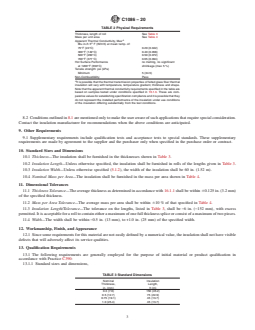
7.1 When tested in accordance with Section 16, the insulation shall conform to the physical requirements listed in Table 2.
8. Performance Characteristics
8.1 Any of the following conditions can result in damage to the needled glass fiber insulation:
8.1.1 Direct exposure to hydrofluoric acid.
8.1.2 Prolonged direct exposure to strong caustics.
8.1.3 Prolonged exposure to boiling water.
TABLE 1 Requirements for Diameter of Fiber
Diameter of Fiber Inch (Millimetre)
Average diameter shall not exceed 0.00036 (0.009)
90 % shall be less than 0.00040 (0.102)
Available from Standardization Documents Order Desk, DODSSP, Bldg. 4, Section D, 700 Robbins Ave., Philadelphia, PA 19111-5098, http://www.dodssp.daps.mil.
Available from U.S. Government Publishing Office, 732 N. Capitol Street NW, Washington, D.C. 20401, https://www.gpo.gov/.
Available from International Maritime Organization (IMO), 4, Albert Embankment, London SE1 7SR, United Kingdom, http://www.imo.org.
C1086 − 20
TABLE 2 Physical Requirements
Thickness, length of roll See Table 3
Mass per unit area See Table 4
A
Apparent Thermal Conductivity, Max
Btu in./h ft F (W/mK) at mean temp. of:
75°F (24°C) 0.29 (0.042)
300°F (149°C) 0.40 (0.058)
500°F (260°C) 0.50 (0.072)
700°F (371°C) 0.65 (0.094)
Hot Surface Performance no melting, no significant
at 1200°F (650°C) shrinkage (max 5 %)
Tensile strength: psi (kPa)
Minimum 5 (34.5)
Non-Combustibility Pass
A
It is possible that the thermal transmission properties of felted glass fiber thermal
insulation will vary with temperature, temperature gradient, thickness and shape.
Note that the apparent thermal conductivity requirements specified in the table are
based on samples tested under conditions specified in 16.1.3. These are com-
parative values for establishing specification compliance and it is possible that they
do not represent the installed performance of the insulation under use conditions
of the insulation differing substantially from the test conditions.
8.2 Conditions outlined in 8.1 are mentioned only to make the user aware of such applications that require special consideration.
Contact the insulation manufacturer for recommendations when the above conditions are anticipated.
9. Other Requirements
9.1 Supplementary requirements include qualification tests and acceptance tests to special standards. These supplementary
requirements are made by agreement to the supplier and the purchaser only when specified in the purchase order or contract.
10. Standard Sizes and Dimensions
10.1 Thickness—The insulation shall be furnished in the thicknesses shown in Table 3.
10.2 Insulation Length—Unless otherwise specified, the insulation shall be furnished in rolls of the lengths given in Table 3.
10.3 Insulation Width—Unless otherwise specified (5.1.2), the width of the insulation shall be 60 in. (1.52 m).
10.4 Nominal Mass per Area—The insulation shall be furnished in the mass per area shown in Table 4.
11. Dimensional Tolerances
11.1 Thickness Tolerance—The average thickness as determined in accordance with 16.1.1 shall be within 60.125 in. (3.2 mm)
of the specified thickness.
11.2 Mass per Area Tolerance—The average mass per area shall be within 610 % of that specified in Table 4.
11.3 Insulation Length/Tolerance—The tolerance on the lengths, listed in Table 3, shall be −6 in. (−152 mm), with excess
permitted. It is acceptable for a roll to contain either a maximum of one full thickness splice or consist of a maximum of two pieces.
11.4 Width—The width shall be within −0.5 in. (13 mm), to +1.0 in. (25 mm) of the specified width.
12. Workmanship, Finish, and Appearance
12.1 Since some requirements for this material are not easily defined by a numerical value, the insulation shall not have visible
defects that will adversely affect its service qualities.
13. Qualification Requirements
13.1 The following requirements are
...