

ASTM E260-96(2019)
(Practice)Standard Practice for Packed Column Gas Chromatography
General Information
- Abstract
SIGNIFICANCE AND USE
5.1 This practice describes a procedure for packed-column gas chromatography. It provides general comments, recommended techniques, and precautions. A recommended form for reporting GC methods is given in Section 14.
SCOPE
1.1 This practice is intended to serve as a general guide to the application of gas chromatography (GC) with packed columns for the separation and analysis of vaporizable or gaseous organic and inorganic mixtures and as a reference for the writing and reporting of GC methods.
Note 1: This practice excludes any form of gas chromatography associated with open tubular (capillary) columns.
1.2 This standard does not purport to address all the safety concerns, if any, associated with its use. It is the responsibility of the user of this standard to establish appropriate safety, health, and environmental practices and determine the applicability of regulatory limitations prior to use. Specific hazard statements are given in Section 8 and 9.1.3.
1.3 This international standard was developed in accordance with internationally recognized principles on standardization established in the Decision on Principles for the Development of International Standards, Guides and Recommendations issued by the World Trade Organization Technical Barriers to Trade (TBT) Committee.
- Status
- Published
- Publication Date
- 31-Aug-2019
- Technical Committee
- E13 - Molecular Spectroscopy and Separation Science
- Drafting Committee
- E13.19 - Separation Science
Overview
ASTM E260-96(2019), titled Standard Practice for Packed Column Gas Chromatography, is a key international standard published by ASTM International. This practice provides a comprehensive procedural guide for the application of gas chromatography (GC) using packed columns, specifically for separating and analyzing volatile organic and inorganic mixtures. The standard targets users seeking guidance on equipment selection, method reporting, and best practices in packed column GC analysis, excluding capillary (open tubular) columns.
ASTM E260-96(2019) plays a significant role in ensuring data quality, system safety, and method consistency for laboratories and industries engaged in analyzing vaporizable or gaseous compounds. It aligns with internationally recognized principles for standardization and supports regulatory compliance across diverse sectors.
Key Topics
- GC System Components: Detailed recommendations for selecting and maintaining essential packed column chromatograph parts, including carrier gas systems, columns, detectors, and temperature control devices.
- Sample Preparation and Injection: Guidance on techniques for introducing vapor-phase samples to maximize separation efficiency and reproducibility.
- Column Selection: Considerations for choosing appropriate stationary phases, supports (e.g., diatomaceous earth, halocarbon supports), column materials (glass, stainless steel), and particle sizes based on the analysis target.
- Detector Types and Usage: Overview of widely used detectors (e.g., thermal conductivity, flame ionization, electron capture) and their proper integration to optimize sensitivity, linearity, and specificity.
- Temperature Control: The importance of precise column oven and detector temperature management for reproducible retention times and reliable chromatograms.
- Carrier Gas Selection: Criteria for choosing carrier gases such as helium, nitrogen, or hydrogen, focusing on purity requirements and detector compatibility.
- Safety and Environmental Considerations: User responsibility for establishing safe practices, with specific attention to compressed gas handling and regulatory limitations.
- Reporting Standards: Recommended format for documenting packed column GC methods to ensure clarity, reproducibility, and regulatory acceptance.
Applications
ASTM E260-96(2019) serves a broad range of practical applications across analytical and industrial laboratories, including:
- Environmental Analysis: Detection and quantification of trace organic pollutants, atmospheric gases, and volatile contaminants in water or air samples.
- Industrial Quality Control: Routine monitoring of process gases, solvents, and chemical feedstocks for production consistency and compliance.
- Pharmaceutical and Chemical Research: Qualitative and quantitative separation of volatile compounds in drug development and materials science.
- Petrochemical Testing: Analysis of hydrocarbons and gas mixtures for compositional profiling and process optimization.
- Food and Beverage Testing: Detection of flavor compounds, residual solvents, and contaminants in product safety evaluations.
Laboratories follow this standard to enhance data comparability, improve analytical reproducibility, and satisfy accreditation requirements.
Related Standards
ASTM E260-96(2019) references and complements several other important ASTM and industry standards, including:
- ASTM E355: Practice for Gas Chromatography Terms and Relationships
- ASTM E516: Practice for Testing Thermal Conductivity Detectors Used in Gas Chromatography
- ASTM E594: Practice for Testing Flame Ionization Detectors Used in Gas or Supercritical Fluid Chromatography
- ASTM E697: Practice for Use of Electron-Capture Detectors in Gas Chromatography
- ASTM E840: Practice for Using Flame Photometric Detectors in Gas Chromatography
- ASTM E1140: Practice for Testing Nitrogen/Phosphorus Thermionic Ionization Detectors for Use in Gas Chromatography
- CGA Standards (Compressed Gas Association): Safe handling of compressed gases and cryogenic liquids
Adherence to ASTM E260-96(2019), along with these related standards, helps laboratories maintain high levels of safety, method validation, and analytical excellence in packed column gas chromatography.
Relations
- Effective Date
- 01-Sep-2019
- Effective Date
- 01-Oct-2017
- Refers
ASTM E697-96(2011) - Standard Practice for Use of Electron-Capture Detectors in Gas Chromatography - Effective Date
- 01-Nov-2011
- Effective Date
- 01-Nov-2011
- Effective Date
- 01-Nov-2010
- Effective Date
- 01-Mar-2007
- Refers
ASTM E697-96(2006) - Standard Practice for Use of Electron-Capture Detectors in Gas Chromatography - Effective Date
- 01-Mar-2006
- Effective Date
- 01-Mar-2006
- Effective Date
- 01-Sep-2005
- Refers
ASTM E840-95(2005) - Standard Practice for Using Flame Photometric Detectors in Gas Chromatography - Effective Date
- 01-Sep-2005
- Effective Date
- 01-Feb-2005
- Effective Date
- 01-Jan-2001
- Effective Date
- 01-Jan-2001
- Effective Date
- 01-Jan-2001
- Effective Date
- 01-Jan-2001
Get Certified
Connect with accredited certification bodies for this standard

ECOCERT
Organic and sustainability certification.

Eurofins Food Testing Global
Global leader in food, environment, and pharmaceutical product testing.

Intertek Bangladesh
Intertek certification and testing services in Bangladesh.
Sponsored listings
Frequently Asked Questions
ASTM E260-96(2019) is a standard published by ASTM International. Its full title is "Standard Practice for Packed Column Gas Chromatography". This standard covers: SIGNIFICANCE AND USE 5.1 This practice describes a procedure for packed-column gas chromatography. It provides general comments, recommended techniques, and precautions. A recommended form for reporting GC methods is given in Section 14. SCOPE 1.1 This practice is intended to serve as a general guide to the application of gas chromatography (GC) with packed columns for the separation and analysis of vaporizable or gaseous organic and inorganic mixtures and as a reference for the writing and reporting of GC methods. Note 1: This practice excludes any form of gas chromatography associated with open tubular (capillary) columns. 1.2 This standard does not purport to address all the safety concerns, if any, associated with its use. It is the responsibility of the user of this standard to establish appropriate safety, health, and environmental practices and determine the applicability of regulatory limitations prior to use. Specific hazard statements are given in Section 8 and 9.1.3. 1.3 This international standard was developed in accordance with internationally recognized principles on standardization established in the Decision on Principles for the Development of International Standards, Guides and Recommendations issued by the World Trade Organization Technical Barriers to Trade (TBT) Committee.
SIGNIFICANCE AND USE 5.1 This practice describes a procedure for packed-column gas chromatography. It provides general comments, recommended techniques, and precautions. A recommended form for reporting GC methods is given in Section 14. SCOPE 1.1 This practice is intended to serve as a general guide to the application of gas chromatography (GC) with packed columns for the separation and analysis of vaporizable or gaseous organic and inorganic mixtures and as a reference for the writing and reporting of GC methods. Note 1: This practice excludes any form of gas chromatography associated with open tubular (capillary) columns. 1.2 This standard does not purport to address all the safety concerns, if any, associated with its use. It is the responsibility of the user of this standard to establish appropriate safety, health, and environmental practices and determine the applicability of regulatory limitations prior to use. Specific hazard statements are given in Section 8 and 9.1.3. 1.3 This international standard was developed in accordance with internationally recognized principles on standardization established in the Decision on Principles for the Development of International Standards, Guides and Recommendations issued by the World Trade Organization Technical Barriers to Trade (TBT) Committee.
ASTM E260-96(2019) is classified under the following ICS (International Classification for Standards) categories: 71.040.50 - Physicochemical methods of analysis. The ICS classification helps identify the subject area and facilitates finding related standards.
ASTM E260-96(2019) has the following relationships with other standards: It is inter standard links to ASTM E260-96(2011), ASTM E1140-95(2017), ASTM E697-96(2011), ASTM E594-96(2011), ASTM E1140-95(2010)e1, ASTM E355-96(2007), ASTM E697-96(2006), ASTM E594-96(2006), ASTM E516-95a(2005), ASTM E840-95(2005), ASTM E1140-95(2005), ASTM E355-96(2001), ASTM E355-96, ASTM E594-96, ASTM E594-96(2001). Understanding these relationships helps ensure you are using the most current and applicable version of the standard.
ASTM E260-96(2019) is available in PDF format for immediate download after purchase. The document can be added to your cart and obtained through the secure checkout process. Digital delivery ensures instant access to the complete standard document.
Standards Content (Sample)
This international standard was developed in accordance with internationally recognized principles on standardization established in the Decision on Principles for the
Development of International Standards, Guides and Recommendations issued by the World Trade Organization Technical Barriers to Trade (TBT) Committee.
Designation: E260 − 96 (Reapproved 2019)
Standard Practice for
Packed Column Gas Chromatography
This standard is issued under the fixed designation E260; the number immediately following the designation indicates the year of
original adoption or, in the case of revision, the year of last revision.Anumber in parentheses indicates the year of last reapproval.A
superscript epsilon (´) indicates an editorial change since the last revision or reapproval.
1. Scope E1140PracticeforTestingNitrogen/PhosphorusThermionic
Ionization Detectors for Use In Gas Chromatography
1.1 This practice is intended to serve as a general guide to
2.2 CGA Standards:
the application of gas chromatography (GC) with packed
CGAP-1Standard for Safe Handling of Compressed Gases
columns for the separation and analysis of vaporizable or
in Containers
gaseous organic and inorganic mixtures and as a reference for
CGAG-5.4Standard for Hydrogen Piping Systems at Con-
the writing and reporting of GC methods.
sumer Locations
NOTE 1—This practice excludes any form of gas chromatography
CGAP-9The Inert Gases: Argon, Nitrogen, and Helium
associated with open tubular (capillary) columns.
CGAP-12Safe Handling of Cryogenic Liquids
1.2 This standard does not purport to address all the safety
CGAV-7Standard Method of Determining Cylinder Valve
concerns, if any, associated with its use. It is the responsibility
Outlet Connections for Industrial Gas Mixtures
of the user of this standard to establish appropriate safety,
HB-3Handbook of Compressed Gases
health, and environmental practices and determine the appli-
cability of regulatory limitations prior to use. Specific hazard
3. Terminology
statements are given in Section 8 and 9.1.3.
3.1 Terms and relations are defined in Practice E355 and
1.3 This international standard was developed in accor-
references therein.
dance with internationally recognized principles on standard-
ization established in the Decision on Principles for the
4. Summary of Practice
Development of International Standards, Guides and Recom-
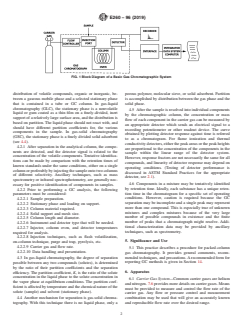
4.1 Ablock diagram of the basic apparatus needed for a gas
mendations issued by the World Trade Organization Technical
chromatographic system is as shown in Fig. 1. An inert,
Barriers to Trade (TBT) Committee.
pressure or flow-controlled carrier gas flowing at a measured
rate passes to the injection port or gas sample valve.Asample
2. Referenced Documents
isintroducedintotheinjectionport, whereit isvaporized,orif
2.1 ASTM Standards:
gaseous, into a gas sample valve, and then swept into and
E355Practice for Gas ChromatographyTerms and Relation-
through the column by the carrier gas. Passage through the
ships
column separates the sample into its components. The effluent
E516Practice for Testing Thermal Conductivity Detectors
from the column passes to a detector where the response of
Used in Gas Chromatography
sample components is measured as they emerge from the
E594Practice for Testing Flame Ionization Detectors Used
column. The detector electrical output is relative to the
in Gas or Supercritical Fluid Chromatography
concentrationofeachresolvedcomponentandistransmittedto
E697Practice for Use of Electron-Capture Detectors in Gas
a recorder, or electronic data processing system, or both, to
Chromatography
produce a record of the separation, or chromatogram, from
E840PracticeforUsingFlamePhotometricDetectorsinGas
which detailed analysis can be obtained. The detector effluent
Chromatography
must be vented to a hood if the effluent contains toxic
substances.
4.2 Gas chromatography is essentially a physical separation
This practice is under the jurisdiction ofASTM Committee E13 on Molecular
technique.Theseparationisobtainedwhenthesamplemixture
Spectroscopy and Separation Science and is the direct responsibility of Subcom-
mittee E13.19 on Separation Science. in the vapor phase passes through a column containing a
Current edition approved Sept. 1, 2019. Published September 2019. Originally
stationary phase possessing special adsorptive properties. The
approved in 1965. Last previous edition approved in 2011 as E260–96(2011). DOI:
degree of separation depends upon the differences in the
10.1520/E0260–96R19.
For referenced ASTM standards, visit the ASTM website, www.astm.org, or
contact ASTM Customer Service at service@astm.org. For Annual Book of ASTM
Standards volume information, refer to the standard’s Document Summary page on Available from Compressed Gas Association (CGA), 14501 George Carter
the ASTM website. Way, Suite 103, Chantilly, VA 20151, http://www.cganet.com.
Copyright © ASTM International, 100 Barr Harbor Drive, PO Box C700, West Conshohocken, PA 19428-2959. United States
E260 − 96 (2019)
FIG. 1 Block Diagram of a Basic Gas Chromatographic System
distribution of volatile compounds, organic or inorganic, be- porous polymer, molecular sieve, or solid adsorbent. Partition
tween a gaseous mobile phase and a selected stationary phase is accomplished by distribution between the gas phase and the
that is contained in a tube or GC column. In gas-liquid solid phase.
chromatography (GLC), the stationary phase is a nonvolatile
4.5 After the sample is resolved into individual components
liquid or gum coated as a thin film on a finely-divided, inert
by the chromatographic column, the concentration or mass
supportofarelativelylargesurfacearea,andthedistributionis
flow of each component in the carrier gas can be measured by
based on partition. The liquid phase should not react with, and
an appropriate detector which sends an electrical signal to a
should have different partition coefficients for, the various
recording potentiometer or other readout device. The curve
components in the sample. In gas-solid chromatography
obtained by plotting detector response against time is referred
(GSC), the stationary phase is a finely divided solid adsorbent
to as a chromatogram. For flame ionization and thermal
(see 4.4).
conductivitydetectors,eitherthepeakareasorthepeakheights
4.2.1 After separation in the analytical column, the compo-
are proportional to the concentration of the components in the
nents are detected, and the detector signal is related to the
sample within the linear range of the detector system.
concentration of the volatile components. Tentative identifica-
However, response fractors are not necessarily the same for all
tions can be made by comparison with the retention times of
compounds, and linearity of detector response may depend on
known standards under the same conditions, either on a single
operating conditions. (Testing of detector performance is
columnorpreferablybyinjectingthesampleontotwocolumns
discussed in ASTM Standard Practices for the appropriate
of different selectivity. Ancillary techniques, such as mass
detector, see 2.1).
spectrometry or infrared spectrophotometry, are generally nec-
4.6 Components in a mixture may be tentatively identified
essary for positive identification of components in samples.
by retention time. Ideally, each substance has a unique reten-
4.2.2 Prior to performing a GC analysis, the following
tion time in the chromatogram for a specific set of operating
parameters must be considered:
conditions. However, caution is required because the GC
4.2.2.1 Sample preparation.
separation may be incomplete and a single peak may represent
4.2.2.2 Stationary phase and loading on support.
more than one compound. This is especially true of unknown
4.2.2.3 Column material required.
mixtures and complex mixtures because of the very large
4.2.2.4 Solid support and mesh size.
number of possible compounds in existence and the finite
4.2.2.5 Column length and diameter.
number of peaks that a chromatograph might resolve. Addi-
4.2.2.6 Instrument and detector type that will be needed.
tional characterization data may be provided by ancillary
4.2.2.7 Injector, column oven, and detector temperatures
techniques, such as spectrometry.
required for analysis.
4.2.2.8 Injection techniques, such as flash volatilization,
5. Significance and Use
on-column technique, purge and trap, pyrolysis, etc.
4.2.2.9 Carrier gas and flow rate.
5.1 This practice describes a procedure for packed-column
4.2.2.10 Data handling and presentation.
gas chromatography. It provides general comments, recom-
mended techniques, and precautions.Arecommended form for
4.3 In gas-liquid chromatography, the degree of separation
reporting GC methods is given in Section 14.
possible between any two compounds (solutes), is determined
by the ratio of their partition coefficients and the separation
efficiency.The partition coefficient, K, is the ratio of the solute 6. Apparatus
concentration in the liquid phase to the solute concentration in
6.1 Carrier Gas System—Common carrier gases are helium
the vapor phase at equilibrium conditions. The partition coef-
andnitrogen.7.6providesmoredetailsoncarriergases.Means
ficientisaffectedbytemperatureandthechemicalnatureofthe
must be provided to measure and control the flow rate of the
solute (sample) and solvent (stationary phase).
carrier gas. Any flow or pressure control and measurement
4.4 Another mechanism for separation is gas-solid chroma- combination may be used that will give an accurately known
tography. With this technique there is no liquid phase, only a and reproducible flow rate over the desired range.
E260 − 96 (2019)
6.1.1 The main gas supply is regulated with a two-stage theliner,especiallyfrombiologicalsamples,canbeasourceof
regulator which must have a stainless steel diaphragm. Rubber excessive sample adsorption. If a liner is used, the debris can
orplasticdiaphragmspermitoxygenorwatertodiffuseintothe easily be removed by replacing the liner. Deactivation of the
carrier gas. In addition, instruments will have a flow controller glass liner by treatment with dimethyldichlorosilane may be
between the pressure regulator and column inlet to maintain a
necessary for some compounds.
constant flow during temperature programming. Copper or
6.3.3 With on-column injection technique, the sample is
stainless steel carrier gas lines, not plastic tubing, should be
deposited in the liquid state directly on the column packing.
used to avoid diffusion of oxygen (air) into the carrier gas.
The sample must be small enough to preclude flooding of the
Whenusingthethermalconductivitydetector,variationsinthe
column, with possible detrimental effects to peak shape and
flow will change retention and response. The carrier gas line
column life. Ideally, the on-column inlet is a part of the
pressure must be higher than that required to maintain the
column, so its temperature may be controlled as the column
column flow at the upper temperature limit for the flow
temperature is controlled. In practice, because an on-column
controller to operate properly. A pressure of 40 to 60 psi is
inlet usually has a somewhat higher thermal mass than an
usually sufficient.
equivalent sector of the rest of the column, the inlet must be
heated somewhat above the maximum analysis temperature of
6.2 Column Temperature Control—Precisecolumntempera-
the column oven. The criteria of good peak shape and
ture control is mandatory if reproducible analyses are to be
quantitation should be used to determine the maximum re-
obtained. Temperature control must be within 0.1°C if reten-
quired temperature for the inlet. One should consider the
tion times are to be compared with another instrument.
6.2.1 Air Bath—The thermostated forced-air bath is gener- temperature limit of the column packing when heating the
injection inlet and detector. With some samples, a nonheated
ally accepted as the best practical method of temperature
regulation for most applications. Temperatures can be con- injection port is adequate, especially with temperature-
programmed operation.
trolled by regulators or proportionally controlled heaters using
a thermocouple or platinum-resistance thermometer as a sens-
6.3.4 Injection Port Septum:
ing element.The advantage of a forced-air bath is the speed of
6.3.4.1 The septum is a disc, usually made of silicone
temperature equilibration.Air bath ovens are readily adaptable
rubber,whichsealsoneendoftheinjectionport.Itisimportant
to temperature programming and are capable of operating over
to change the septum frequently after two to three dozen
a range of 35 to 450°C. This range can be extended down
injections,orpreferablyattheendoftheworkingday.Thebest
to−100°C by using cryogenic equipment.
technique is to change the septum when the column is
6.2.2 Other Devices—Liquid baths, drying ovens,
relatively cool (below 50°C) to avoid contact of stationary
incubators, or vapor jacket enclosures are less stable, less
phase in a hot column with air (danger of oxidation).After the
convenient means of providing a source of heat to maintain or
septum is changed, return the inlet temperature to that which
raise the temperature of a chromatographic column. These
was originally set. The inlet temperature should be the opti-
devices are not recommended for precision chromatographic
mum for the particular analysis, as well as within the recom-
applications.
mended operating temperature of the septum. If the septum is
punctured too many times, it will leak air into the gas
6.3 The Injection Port—The purpose of the injection port is
chromatographic system, even though it is under pressure. At
to introduce the sample into the gas chromatographic column
high temperatures, above 150 to 200°C, air (oxygen) in the
by instantaneous volatilization following injection into the gas
carrier gas from a septum leak will degrade the stationary
chromatographic system. Two sample inlet types are in com-
phase.An excessive septum leak will also produce a change in
mon use in gas chromatography: the flash vaporization and the
carrier gas flow rate (a change in retention time) and loss of
on-column injection inlets.
sample (irreproducible peak heights) due to outflow from the
6.3.1 The temperature of the flash vaporization inlet should
leak. When installing the septum, do not overtighten the
be above the boiling points of the sample components and is
retaining nut. The septa will swell at high temperature and
limited by the amount of septum bleed generated and the
extrudeoutoftheinjectionport.Asnugfitatroomtemperature
temperature stability of sample components. It should be set at
is sufficient. It is important for septum life to make sure the
that temperature above which no improvement in peak shape
injection needle is sharp with no bent tip. Fine emery cloth, or
occurs but should be determined by the nature of the sample
a fine sharpening stone, can be used to sharpen the point.
andthevolumeinjected,notbythetemperatureofthecolumn.
If the inlet temperature is too low, broad peak with a slowly 6.3.4.2 Ghost peaks may be observed in temperature pro-
rising front edge will result from slow vaporization of the
grammed runs due to septum bleed. Septum bleed is due to the
sample. If the temperature is set far above what is necessary to thermal decomposition, 300°C or higher, of the septum that
produce fast vaporization, thermal decomposition of the
produces primarily lower molecular weight cyclic dimethylsi-
sample, decreased septum life, and ghost peaks due to septum loxanes. It contributes to baseline response and is frequently
bleed may be observed. Generally, a good guideline is to
observedasevenlyspacedpeaksinatemperatureprogrammed
maintain the inlet temperature 25 to 30°C higher than the runinwhichnosamplehasbeeninjected.Thissituationcanbe
highest boiling point of any sample component.
demonstratedbythedisappearanceofghostpeaksafterplacing
6.3.2 A glass liner placed inside the injection port will aluminum foil (pre-cleaned with solvents such as methylene
eliminatesamplecontactwithhotmetalinnerwallsoftheinlet, chloride or toluene) over the inner face of the septum or by
which can catalyze thermal decompositions.Any debris left in turning off the injector temperature and making several blank
E260 − 96 (2019)
runs. Septum bleed can be decreased by using either air- or 6.6.2 Detector Characteristics—Desirable detector charac-
water-cooled septum retaining nuts, by using a septum flush teristics should include the following:
head, or by using special high-temperature septa which are
6.6.2.1 Good stability (low noise level, minimum response
available from a number of gas chromatographic supply
to changes in temperature and flow rate).
houses.
6.6.2.2 Ruggedness and simplicity.
6.4 Detector Temperature Control—The detector tempera- 6.6.2.3 Sensitivity to the components for which analysis is
ture should always be above that of the maximum operating
desired. Use either a selective detector for materials of interest
analytical temperature, to prevent the possibility of condensa- or one with a similar response for all components.
tion of sample components or stationary phase bleed in the
6.6.2.4 Linearity of response versus sample concentration.
detector and connecting line. Because there is usually some
Wide linear range.
temperature gradient across a detector, the temperature should
6.6.2.5 Rapid response to changes in column effluent com-
be set at 30 to 50°C above the maximum analysis temperature
position (small internal volume or flow-through design, or
to ensure that the entire detector is hot enough to prevent
both).
condensation. Usually, it is neither necessary nor desirable to
6.6.2.6 Detectors, which are nondestructive and do not
use an excessively high temperature since this can result in
contributetobandbroadeningmaybeusedinserieswithother
reduced sensitivity, increased noise level, frequent need to
detectors.
clean the detector, and thermal decomposition of sample or
stationary phase. 6.7 Types of Detectors—The detector is located at the outlet
end of the chromatographic column and both senses and
6.5 Measurement of Temperature—The choice of sensing
measures the amount of components that have emerged from
elements used to measure temperature depends on the desired
the column. The optimum detector should have high
accuracy (control about a set point) and precision of the
sensitivity, low noise level, a wide linearity of response, a
measurements. Instrument read-outs should be verified peri-
response to all compounds of interest, and yet be insensitive to
odically. Some common temperature measurement devices are
changes in flow and temperature. Selective detectors are
as follows:
characterizedashavingselective,orgreatlyenhancedresponse
6.5.1 Standardized Mercury Thermometer:
to certain components. Linearity is decreased for all detectors
Range, °C Accuracy, °C
by column bleed. As many as forty detection systems have
0 to 100 ±0.02
been reported, yet only about a dozen are commonly used.
100 to 200 ±0.05
200 to 400 ±0.50
Table 1 shows some of the more commonly used detectors. Of
these, the thermal conductivity, the flame ionization, the
6.5.2 Calibrated Platinum Resistance Thermometer:
electron capture, the nitrogen-phosphorus, and the flame pho-
Range, °C Accuracy, °C
−140 to 500 ±0.01 tometric detectors are the most popular. Nondestructive detec-
tors should be vented to a hood to remove any toxic effluents
6.5.3 Thermocouple (iron−constantan, or other).
from the workplace. The effluent from destructive detectors
6.6 Analytical Column:
may also be toxic. Details on detectors can be found in the
6.6.1 The analytical column is a length of tubing (glass,
applicable methods in Practices E516, E594, E697, E840, and
metal, or plastic) that is filled with a packing material. It is
E1140.
discussed thoroughly in Section 7.
6.6.1.1 Column Characteristics—Specified by method. 6.8 Programmed Temperature Operation—The apparatus
6.6.1.2 Carrier Gas—Specified by method. used in programmed temperature gas chromatography differs
6.6.1.3 Sample Size—Variable within limits. in some respects from that normally used for isothermal work.
6.6.1.4 Flow Rates of Carrier Gas and Detector Gases— Basically,thecolumntemperatureisvariedwithtime(program
Variable within limits. rate) to enhance speed of separations. The advantages of using
6.6.1.5 Column Temperature—Usuallyspecifiedbymethod, programmedtemperatureoperationincludebetterresolutionof
and lower boiling components because of lower starting tempera-
6.6.1.6 Physical or Chemical Characteristic of Compound ture and greater sensitivity because of sharper peaks for the
Analyzed, or both.
higher boiling components.
TABLE 1 Applicability of Commonly Used
Gas Chromatographic Detectors
Applicability Range of Minimal Detectable
A
Detector
(Type of Compound) Amounts (grams)
−6 −7
Thermal Conductivity All 10 to 10
−12
Flame Ionization Organic 10
−12 −15
Electron Capture Halogenated and 10 to 10
Oxygenated
−11
Flame Photometric Sulfur, Phosphorus 10
−12
Alkali Flame Nitrogen, Phosphorus 10 (even lower for
phosphorus)
A
Further information can be found in Practices E516, E594, and E697.
E260 − 96 (2019)
6.8.1 Column Heater and Temperature Programmer—It is 7.1.1 The polarity of the stationary phases is currently best
of utmost importance that the column temperature program be characterized by McReynolds Constants. The higher the
reproducible, and that the difference between the set (desired) McReynolds Constant, the more polar the phase. Rohrschnei-
temperature and the true average column temperature be as der constants can also be used to measure the polarity of
small as possible. However, these requirements are difficult to stationary phases.
achieve at high heating rates and with columns of large 7.1.2 The effects of using polar and nonpolar stationary
diameter.Themassofthecolumnanditsheatershouldbekept phases are summarized as follows:
as small as possible. This will minimize thermal lag and will 7.1.2.1 Nonpolar stationary phases separate compounds pri-
give proportionately small variations around the set tempera- marily by order of relative volatility or boiling point.
ture at any time. Proportional temperature controllers supply 7.1.2.2 Polar stationary phases separate compounds by or-
almostfullpowertotheheateruntilthesetpointisveryclosely der of both relative volatility and relative polarity. With polar
approached. phases, nonpolar compounds will elute before polar com-
6.8.2 The recirculating air bath is the recommended method pounds of the same boiling point.
of heating in programmed temperature gas chromatography 7.1.2.3 Polarity alone is insufficient to describe the separa-
(PTGC). The obvious advantages are extremely rapid heating tion power of a column. One must consider the overall
selectivity of a column towards a set of analytes. This
(and cooling after an analysis is completed) with very little
temperature lag. selectivity is a summation of the effects of dispersive
interactions, acid-base interactions and the dipole interactions
6.8.3 Liquid baths may be used for very low heating rates.
They are commonly contained in taped Dewar flasks. offered by the various pendent groups in the stationary phase.
7.1.3 The stationary phases used in gas chromatographic
6.8.4 No matter what type of heating device is used,
accurate control of the temperature program is necessary. This columns have both minimum and maximum temperature
limits.Thechromatographermustbeawareofthelimitsforthe
is usually accomplished by appropriate electronic systems that
develop linear (or other) programming rates as desired. phase being used. Below the minimum temperature, the phase
will behave as either a viscous liquid or a solid. Less efficient
6.8.5 Detectors for programmed temperature gas chroma-
tography should be relatively insensitive to minor temperature separation will be observed, and the chromatographic results
willbeexhibitedasbroaderpeaksinthegaschromatogramdue
and flow fluctuations and insensitive to stationary-phase bleed.
These difficulties can be overcome by operating the detector at to poor mass transfer of components in the stationary phase.
7.1.3.1 Above the maximum temperature limit, the phase
or near the upper temperature limit for the analysis and by
using adequate flow controllers. If stationary-phase bleeding is will begin to bleed off the column at an accelerated rate, and
the observed results will include a drifting baseline or exces-
excessive during PTGC runs, a second conditioning procedure
(Section 9) might improve the situation. Alternately, a dupli- sive spiking on the baseline. Under these conditions, the liquid
cate analysis column can be used on the reference side of the phase will decompose or volatilize, and thus be removed from
detector. By equalizing substrate bleed on both sides of the the column. This situation will eventually lead to decreased
detector, the baseline drift can be substantially compensated. retention times with broader peaks resulting in poorer resolu-
tion of very close peaks. Peak tailing will also be observed as
However, this technique does not improve column life and is
detrimental to detector linearity. If at all possible, operate the the uncoated surface becomes exposed by removal of liquid
phase, thus shortening column life. Bleeding also can expose
column within its recommended temperature range.
6.8.6 When using the temperature programming technique, bare support surface that can adsorb molecules being analyzed
andreducecolumnefficiency.Inextremecases,phasebleeding
the resistance to carrier gas flow in the gas chromatographic
column increases with increasing temperature. The flow con- will result in fouling the detector and connecting lines. The
observed maximum temperature will depend upon many ex-
trollers need a positive pressure of 10 psi to operate properly.
By setting the second stage of the regulator to 40 to 60 psi, perimental variables, such as type of liquid phase column,
conditioning, phase-loading level, column temperature, sensi-
there will usually be sufficient excess pressure to maintain a
constant gas flow through the column. Higher pressures might tivity setting of the detector, and purity of the carrier gas. In
programmed temperature runs, the column can sometimes be
be required to maintain flow when using relatively long
columns of 10 ft, or longer, or packings finer than 120 mesh. operated for short periods about 25°C above maximum tem-
perature. However, column bleed should be minimized for
quantitative results since it decreases the linear range of all
7. Materials
detectors.
7.1 Stationary Phases—The stationary phases (partitioning
7.2 Active Solids:
agents) that have been successfully used for specific separa-
7.2.1 Molecular Sieves—The synthetic zeolite molecular
tions are found most quickly by a literature search. Many
sieve sorbents separate molecules by size and structural shape.
phases are listed inASTM publicationsAMD-25AandAMD-
Isomers with a more round shape, as branched versus straight
25A-51. Themostdesirablestationaryphasesdonotvolatilize
chainmolecules,diffuseinandoutofthezeolitestructuremore
(bleed) significantly from the solid supports at temperatures
easily than isomers with the long chain structures. Separations
required to elute the sample.
McReynolds, W.O., Journal of Chromatography Science, Vol 8, 1970, p. 685.
4 6
Gas Chromatographic Data Compilation, ASTM, 1981. Supina,W.R., and Rose, L.P., Journal of Chromatography,Vol 8, 1970, p. 214.
E260 − 96 (2019)
are affected by the differences in times required for molecules surface is generally more adsorptive than white supports. For
ofdifferentsizestofindtheirwayintoandoutofthesieve-like this reason, they are not recommended for use in the gas
structureoftheadsorbent.Molecularsievesaremostusefulfor chromatographic analysis of polar compounds. However, pink
separating H,O,N , CO, and CH . Carbon molecular sieves supports provide excellent efficiencies for the analysis of
2 2 2 4
are also available, and can be used to separate O,N , CO, hydrocarbons and organic compounds of low polarity.
2 2
CO,H O, and C to C hydrocarbons. 7.3.3 Chemical Treatment of Diatomaceous Earth
2 2 1 4
7.2.2 Porous Polymers: Supports—Neither the pink nor the white materials give
generally acceptable analysis of more polar compounds with-
7.2.2.1 One type of porous polymer used in gas chromatog-
out further treatment. With these compounds, severe peak
raphy is available in the form of microporous cross-linked,
tailing is often observed, especially with the dense pink
polymer beads produced by copolymerizing styrene and divi-
nylbenzeneormorepolarcopolymers,orboth.Thesematerials supports. This tailing is due to the presence of adsorptive and
catalytic centers on all diatomaceous earth supports. The
are generally used as received without coating with any liquid
phase. They provide symmetrical peaks for polar, hydrogen- adsorptive sites are attributed to metal oxides (Fe, Al) and
surface silanol groups, -SiOH, on the support surface. The
bonding compounds such as water, alcohols, free acids,
amines, ammonia, hydrogen sulfide, etc., and organic com- latter are capable of forming hydrogen bonds with polar
compounds.
pounds up to molecular weights corresponding to about 170.
7.3.3.1 Metal impurities are removed by washing with
7.2.2.2 Another porous polymer is poly(2,6-diphenyl-p-
phenylene oxide). This material is useful for the analysis of hydrochloric acid, which leaches out iron and aluminum and
renders the surface both less adsorptive and less catalytically
amines, alcohols, and hydrogen-bonding compounds. It is also
used as an adsorbent for trapping trace organic compounds in active.However,evenwithacidwashing,thepinksupportsare
still more adsorptive toward polar compounds than the white-
water and air.
type supports. Acid washing is sometimes followed by base
7.2.3 Silica Gel, Alumina, and Carbon—Among the active
washing, which seems to remove only minor amounts of metal
solid adsorbents are silica gel, alumina, and activated carbon.
impurities,butisagoodpretreatmentforsupportsthataretobe
They are useful for low-boiling hydrocarbons.
used for the analysis of basic compounds.
7.2.4 Solid adsorbents modified by low concentrations of
7.3.3.2 Neitheracidorbasewashingiseffectiveinreducing
liquid phases may retain the advantageous properties of both.
peak tailing due to hydrogen bonding with the surface silanol
Some solid adsorbents can be modified by the addition of
groups, -SiOH. These groups are most effectively masked by
surface activating compounds such as wetting agents, silver
treatment with dimethyldichlorosilane.
nitrate, and the metal salts of fatty acids.
7.3.4 Acid-washed silanized grades of white diatomaceous
7.3 Diatomaceous Earth Supports—The most popular gas
earths are recommended as supports for nonpolar and medium
chromatographic supports are those prepared from diatoma-
polarityliquidphases.Becauseofthehydrophobiccharacterof
ceous earth, also called diatomaceous silica or kieselguhr. The
a silanized diatomaceous earth, even coating of the most polar
twomaintypesarewhiteandpinkincolor.Thewhitesupports
liquid phases is difficult to achieve. Acid-washed, silanized
arerecommendedoverthepinksupportsbecauseoftheirmore
grades of white diatomaceous earths are recommended as
inert surface. The former are, however, very friable and must
supports for the polar liquid phases, such as polyesters and
behandledverycarefullywhenpreparingpackingsandloading
silicones of high cyano-group content.
into gas chromatographic columns. Before using these
7.3.5 If the column is 6 ft (2 m), or less, use particle size of
supports, check the manufacturer’s literature for comments on
100 to 120 mesh (125 to 149 µm) for highest efficiency under
their use.
isothermal conditions. If the column is longer than 6 ft, use 80
7.3.1 The white-colored supports are produced by calcina-
to 100 mesh (149 to 177 µm) particles. If temperature pro-
tion of diatomaceous earth with sodium carbonate as a flux. In
gramming is used, 80 to 100 mesh particles should be used to
this process, the diatomaceous earth fuses, due to formation of
lessen resistance to carrier gas flow.
a sodium silicate glass. The product is white in color due to
7.3.6 Further information concerning the liquid phase load-
conversion of iron oxide into a colorless complex of sodium
ing is given in 9.3.
iron silicate. These white materials are used to prepare the
more inert gas chromatographic supports. However, they are 7.4 Halocarbon Supports—The two types of halocarbon
fragile and subject to abrasion from excessive handling in the supports are those prepared from poly(tetrafluoroethylene) and
course of sieving, packing, or shipping.Abrasion will produce poly(chlorotrifluoroethylene). These supports are relatively
finer particles, or fines, which will decrease column efficiency. inert and are nonpolar.They eliminate peak tailing observed in
the analysis of organic compounds capable of hydrogen
7.3.2 The pink-colored supports are prepared by crushing
bonding, such as water, alcohols, amines, etc. They are the
diatomaceous earth firebrick that has been calcined with a clay
preferred supports in the analysis of corrosive halogen com-
binder. The metal impurities remaining form complex oxides
pounds such as HF, BCl,UF , COCl,F , and HCl.
that contribute to the pink color of the support. These pink
3 6 2 2
supports are denser than the white supports because of the 7.4.1 Poly(tetrafluoroethylene)supportsrequirespecialhan-
greater destruction of the diatomite structure during calcina- dlingprocedures.Whenusedasreceived,theyaresoftandtend
tion. They are harder and less friable than the white supports to form gums upon handling. They can also build up a static
and are capable of holding larger amounts of liquid phase (up charge and spray out of the column during the packing
to 30%) without becoming too sticky to flow freely. Their operation. These problems can be virtually eliminated by
E260 − 96 (2019)
cooling the support to 0°C before coating with liquid phase 7.6.5 Carrier Gas for Instruments with Thermal Conductiv-
and by avoiding the use of glass vessels. Rinsing poly(tetra- ity Detectors—Amajor factor in sensitivity is the difference in
fluoroethylene)withmethanolanddryingbeforeuseisanother thermal conductivity of the compound being analyzed and the
way to eliminate the static-charge problem. thermal conductivity of the carrier gas. Helium (thermal
conductivity=33.60 cal⁄cm-s-°C) is usually the carrier gas of
7.4.2 Supports prepared from poly(chlorotrifluoroethylene)
choice.
are structurally harder and are much easier to handle and to
pack into a column.
7.6.6 Carrier Gas for Instruments with Flame Ionization
Detectors—The most commonly used carrier gases are nitro-
7.5 Tubing Materials—Tubing materials should be chosen
gen or helium. A maximum impurity level of 0.05 volume %
on the basis of the following criteria:
does not generally interfere with most applications. Hydrogen
7.5.1 They should be nonreactive with the stationary phase,
is less commonly used in the U.S. but is more popular in
sample solvent, and carrier gas.
Europe because of availability and relatively low cost.
7.5.2 They should possess physical properties to withstand
NOTE 2—If hydrogen is used, special precautions must be taken due to
temperature and pressure of operating conditions, and
its explosive nature, to ensure that the system is free from leaks and that
7.5.3 They can be shaped to fit in the column oven of the
the effluent is properly vented.
chromatograph.
7.6.7 Carrier Gas for Instruments with Electron-Capture
7.5.4 Satisfactory materials include glass, nickel, stainless
Detectors—Usersshouldfollowthemanufacturers’recommen-
steel, and glass-lined stainless steel. Glass is the material of
dations for the choice of carrier gas. Some common ones are
choice,unlessconditionsprohibititsuse.Nickeltubingismore
nitrogen or 95% argon/5% methane. When using a tritium
inert than stainless steel in most applications. Less frequently
source in the detector, do not use hydrogen as the carrier gas.
used column materials are poly(tetrafluoroethylene),
Hydrogen will replace tritium in the source.
aluminum, and copper.
7.6 Carrier Gas—The use of an impure carrier gas will
8. Hazards
produce problems in gas chromatography. Trace water and
8.1 Gas Handling Safety—The safe handling of compressed
oxygen can cause decomposition of the liquid phase coated on
gases and cryogenic liquids for use in chromatography is the
the support. The common carrier gases, helium and nitrogen,
responsibility of every laboratory. The Compressed Gas
should contain less than 5 ppm water and less than 1 to 2 ppm
Association, a member group of specialty and bulk gas
oxygen by volume. An oxygen adsorption trap can be used to
suppliers, publishes the following guidlines to assist the
remove trace oxygen, while trace amounts of water and
laboratory chemist to establish a safe work environment:
hydrocarbonswithmolecularweightshigherthanmethane,can
CGAP-1, CGAG-5.4, CGAP-9, CGAV-7, CGAP-12, and
betrappedonamolecularsievetrap.Placethemolecularsieve
HB-3.
drier nearest the gas supply. Calcium sulfate has been used in
drying tubes, but cannot dry carrier gas to the same level as
9. Preparation of Packed Gas Chromatographic Columns
molecular sieve.
7.6.1 For some applications, hydrogen may be the preferred
9.1 Preparation of the Tubing Material:
carriergas.However,additionalsafetyprecautionsarerequired
9.1.1 Glasscolumnsshouldbecleanedanddeactivated,first
due to hydrogen’s explosive nature.
by rinsing with 30 mL acetone and then 30 mL toluene. Next,
7.6.2 Air (oxygen) can leak into the gas chromatographic
fill the column with 10 volume % solution of dimethyldichlo-
system through loose fittings or a septum, that has been
rosilane in toluene. Allow the solution to stand in the column
puncturedtoomanytimes,eventhoughthecarriergasisunder
for 30 min. Finally, rinse the column with anhydrous toluene
a pressure of 40 to 60 psi. Keep all fittings on the gas delivery
and then anhydrous methanol to cap unreacted DMDCS CL
lines tight, and check them at periodic intervals. Change the
groups. Dry the column by passing a stream of dry nitrogen
septum in the injection port frequently. Plastic tubing should
through it. Cap both ends of the column until such time that it
never be used for carrier gas, hydrogen fuel (for FID), or
can be packed.
make-up gas lines due to the possibility of oxygen or moisture
9.1.2 Metal columns should be cleaned thoroughly before
diffusing through the tubing wall.
packing by rinsing with methanol, acetone, and chloroform.
7.6.3 Eachcylinderofcarriergashasitsownimpuritylevel.
The column should be dried by passing nitrogen or dry air
Occasional tanks contain large amounts of impurities which
throughit.Donotblowhouseairthroughthecolumnsincethis
might overcome a low-capacity oxygen adsorption trap and
compressed air usually contains an oil aerosol from the pump.
destroy a gas chromatographic column at high temperature. A
NOTE 3—Most chromatographic supply houses provide metal tubing
new tank or a fresh oxygen adsorption unit, or both will
that has been washed with solvents and is ready for use.
improve this situation.
7.6.4 Always change the tank when the pressure is less than 9.1.3 An alternative procedure is recommended for nickel
200 psi.As the total pressure in the cylinder decreases, there is tubingandcanbeusedtocleanstainlesssteeltubing.Rinsethe
an increase in the partial pressure of the water and other nickel tubing with ethyl acetate, methanol, and distilled water.
impurities adsorbed on the inner walls of the gas cylinder. As Then fill the tube with 20 volume % nitric acid and let it stand
aresult,thelastamountsofgasdeliveredfromthegascylinder for 10 min. (Warning—Work in a hood and wear safety
contain high levels of impurities. equipment when using nitric acid.) Next, rinse the tube with
E260 − 96 (2019)
distilled water to neutrality and then rinse with methanol and support will depend upon both the viscosity of the phase
acetone.Finally,drythecolumnbyblowingnitrogenorhelium solution and the density and mesh size of the support.
through it. 9.4.1.1 Add 20 g of support to the filter flask. Reduce the
9.1.4 The column length is generally 3 to 6 ft (1 to 2 m). pressure in the filter flask for a few minutes with a water
aspirator, then release the vacuum. Repeat this procedure for
Shortercolumnscanbeusedtodecreasethetimeofanalysisor
to separate high boiling compounds. Longer columns are used several cycles in order to remove air bubbles from the pores of
the support particles. Be prepared to release the vacuum if the
to improve resolution, but have longer analysis times. (Col-
umns longer than 20 ft (6.1 m) require excessive pressures to slurry foams excessively.
9.4.1.2 Allow the slurry to stand for several minutes. Pour
maintain the proper carrier gas flow.)Acompromise is usually
made between analysis time and resolution.As a general rule, the slurry into a coarse-frit sintered-glass filter funnel, and
an increase or decrease of column length by a factor of 3 to 4 allow the solvent to drain freely until the support settles.
is necessary to see a significant change in peak separation. 9.4.1.3 Apply vacuum cautiously and stop instantly when
the solvent stops dripping. Dump the support into a flat
9.1.5 The diameter of the column can be ⁄8 in. (3.2 mm) or
1 1
⁄4 in. (6.4 mm) outside diameter. The ⁄8 in. column has less borosilicate glass dish, and allow it to dry. Do not scrape the
particles out of the funnel, since this might crush the particles.
sample capacity, but greater efficiency, and is the most com-
Do not resieve before use.
mon type. Glass columns are generally 2 mm or 4 mm inside
9.4.1.4 The actual phase loading will depend upon the
diameter. Some analysts have found that ⁄16 in. (4.8 mm
viscosityofthephasesolutionandboththedensityandparticle
outside diameter) metal columns are the ideal combination
size of the support. For example, a 2% solution of dimethyl
between the capacity of ⁄4 in. (6.4 mm outside diameter)
silicone gum liquid phase will give a 3.8 wt% loading on
columns and the efficiency of ⁄8 in. (3.2 mm) outside diameter
white-typesupports.A10wt%solutionofalessviscousliquid
columns.
phase will give a 5.5 wt% loading on white-type supports and
9.2 Choice of Diatomaceous Earth Support for Packed
7.5 wt% on pink-type supports. Loadings obtained with other
Columns—See 7.3.
phases on other supports are best determined by experimenta-
9.3 Phase Loading on Diatomaceous Supports—For pre-
tion.
parative work and analysis of substances boiling below room
9.4.1.5 The best way to determine the percent loading is to
temperature, use 15 wt% loadings for white-type supports and
extract it from the support by extraction in a Soxhlet apparatus
30wt%forpink-typesupports.Forgeneralwork,useloadings
and determine the weight loss. Alternatively, measure the
of the range of 3 to 15 wt%. For highest efficiency, shortest
volume of solution recovered and calculate the volume of
retention times, and the least amount of bleed during high-
solution held up by the support. Calculate the approximate
temperature operation, use 3 wt.% loadings. The lower phase
percent loading on the support by assuming that the concen-
loadings have lower sample capacity and elute components
tration of the solution does not change.
more rapidly and at lower temperatures. Always check the
9.4.2 Evaporative Method:
manufacturers’ literature for suggested phase loadings for a
9.4.2.1 Weighoutthedesiredamountsofsupportandphase.
particularsupport.Forsomeapplications(especiallyheadspace
Use a larger amount than that required to account for attrition,
analysis) loadings as low as 0.2 wt.% are used which result in
spills, etc. Dissolve the liquid phase in a chemically inert,
very narrow peaks and short analysis times. High phase
low-boilingsolvent containedinafiltrationflask(seeTable2).
loadings tend to produce less reactive packings.
(Most catalogs of gas chromatography equipment suppliers
contain lists of suitable solvents.)
9.4 Preparation of the Gas Chromatographic Packing—The
9.4.2.2 Graduallyaddthesupporttothesolutionwithgentle
following procedures describe the coating of a solid support
swirling or agitation but with no mechanical stirring. (Sug-
with stationary phase. The following four methods are com-
gested solvents are given in Table 2.) The amount of solution
monly used to prepare gas chromatographic packings: (a)
s
...