

ASTM D8037/D8037M-16
(Practice)Standard Practice for Direct Push Hydraulic Logging for Profiling Variations of Permeability in Soils
General Information
- Abstract
SIGNIFICANCE AND USE
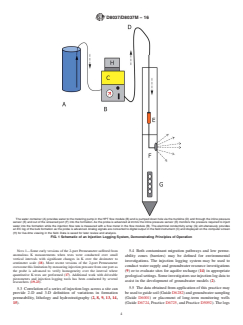
5.1 The injection logging system provides a rapid and efficient way to ascertain the pressure required to inject water into unconsolidated formations at the given flow rate in real time (Fig. 1) (1-4, 7).5 The measured injection pressure and flow rate are then used to assess variations in formation permeability versus depth and infer changes in formation lithology and understand the local hydrostratigraphy (1-4, 8-16). Log interpretation should be confirmed with targeted soil coring adjacent to selected log locations or running logs adjacent to one or more previously logged borings. Practice D3740 was developed for agencies engaged in the testing and/or inspection of soils and rock. As such, it is not totally applicable to agencies performing this practice. However, users of this practice should recognize that the framework of Practice D3740 is appropriate for evaluating the quality of an agency performing this practice. Currently there is no known qualifying national authority that inspects agencies that perform this practice.
SCOPE
1.1 This practice describes a method for rapid delineation of variations in formation permeability in the subsurface using an injection logging tool. Clean water is injected from a port on the side of the probe as it is advanced at approximately 2cm/s into virgin soils. Logging with the injection tool is typically performed with direct push equipment, however other drilling machines may be modified to run the logs by direct push methods (for example, addition of a suitable hammer and/or hydraulic ram systems). Injection logs exceeding 100 ft [30m] depth have been obtained. Direct push methods are not intended to penetrate consolidated rock and may encounter refusal in very dense formations or when cobbles or boulders are encountered in the subsurface. However, injection logging has been performed in some semi-consolidated or soft formations.
1.2 This standard practice describes how to obtain a real time vertical log of injection pressure and flow rate with depth. The data obtained is indicative of the variations of permeability in the subsurface and is typically used to infer formation lithology. The person(s) responsible for review, interpretation and application of the injection logging data should be familiar with the logging technique as well as the soils, geology and hydrogeology of the area under investigation.
1.3 The injection logging system may be operated with a built in electrical conductivity sensor to provide additional real time information on stratigraphy and is essential for targeting test zones. Other sensors, such as fluorescence detectors (Practice D6187), a membrane interface probe (Practice D7352) or a cone penetration tool (Test Method D5778) may be used in conjunction with injection logging to provide additional information. The use of the injection logging tool in concert with an electrical conductivity array or cone penetration tool is highly recommended (although not mandatory) to further define hydrostratigraphic conditions, such as migration pathways, low permeability zones (for example, aquitards) and to guide confirmation sampling. The EC log and injection pressure log may be compared in some settings to identify the presence of ionic contaminants or ionic injectates used for remediation.
1.4 The injection logging system does not provide quantitative permeability or hydraulic conductivity information. However, injection pressure and flow data may be used to provide a qualitative indication of formation permeability. Semi-quantitative values of permeability may be obtained by correlation of injection logging data with other methods (1-4).2 Also, a log of estimated hydraulic conductivity (5) may be calculated for the saturated zone using an empirical model included in some versions of the log viewing software. The data allows for estimates of hydraulic conductivity (K) at the inch-scale using the corrected injection pressure ...
- Status
- Published
- Publication Date
- 14-Nov-2016
- Technical Committee
- D18 - Soil and Rock
- Drafting Committee
- D18.21 - Groundwater and Vadose Zone Investigations
Overview
ASTM D8037/D8037M-16 is an international standard issued by ASTM International that outlines the standard practice for direct push hydraulic logging to profile variations of permeability in soils. This method provides a rapid and efficient approach for real-time delineation of subsurface permeability using an injection logging tool. The practice is designed for use primarily in unconsolidated or semi-consolidated soil formations and is widely utilized in environmental and geotechnical site characterizations.
The standard describes how clean water is injected into soils via a specialized probe advanced at a controlled rate, with injection pressure and flow rate monitored continuously with depth. This data enables practitioners to qualitatively assess formation permeability and infer changes in soil and hydrostratigraphic properties, making it a valuable tool for understanding subsurface conditions.
Key Topics
- Direct Push Hydraulic Logging: A field method involving the advancement of a steel probe through unconsolidated soils while injecting clean water and recording injection pressures and flow rates.
- Real-Time Permeability Profiling: Provides immediate insights into permeability variations and possible lithological changes as the probe is advanced.
- Qualitative Assessment: Injection pressure and flow rates offer a qualitative (and sometimes semi-quantitative) indication of permeability. Additional calibration or correlation with other tests may be required for hydraulic conductivity estimates.
- Supplementary Sensors: The system may also include electrical conductivity (EC) sensors, fluorescence detectors, membrane interface probes, or cone penetration tools to enhance stratigraphic interpretation and target specific test zones.
- Quality Assurance: Emphasizes the importance of proper system assembly, calibration, and pre-log quality assurance checks to ensure reliable data.
- Limitations: Not designed for consolidated rock or highly dense formations and may encounter refusal if cobbles or obstructions are present.
Applications
ASTM D8037/D8037M-16 is applicable in a range of environmental, geotechnical, and hydrogeological investigations where detailed knowledge of subsurface permeability and lithology is essential:
- Site Characterization: Rapid profiling of permeability in environmental site investigations, hazardous waste assessments, and brownfield redevelopment projects.
- Hydrostratigraphy: Facilitates understanding of groundwater flow paths, identification of aquifers and aquitards, and delineation of migration pathways for contaminants.
- Remediation Planning: Assists in optimizing injection or extraction well placement by mapping high and low permeability zones, critical for effective remediation of contaminated sites.
- Resource Management: Supports assessments for groundwater supply, aquifer recharge studies, and well placement.
- Sampling Guidance: Results may be used to guide soil and groundwater sampling activities, select monitoring well locations, and inform targeted confirmation measurements.
Related Standards
Practitioners frequently use ASTM D8037/D8037M-16 in conjunction with other ASTM standards and methods to ensure comprehensive subsurface assessment and regulatory compliance:
- ASTM D653 - Terminology Relating to Soil, Rock, and Contained Fluids
- ASTM D3740 - Qualification of Agencies Engaged in Testing and/or Inspection of Soils and Rock
- ASTM D6282 - Guide for Direct Push Soil Sampling for Environmental Site Characterizations
- ASTM D6001 - Guide for Direct-Push Groundwater Sampling for Environmental Site Characterization
- ASTM D6724/D6725 - Installation of Direct Push Groundwater Monitoring Wells
- ASTM D7352 - Membrane Interface Probe for Volatile Contaminants Logging
- ASTM D5778 - Cone Penetration Testing of Soils
By integrating these standards, users can perform comprehensive site investigations, validate interpretations from hydraulic logging, and ensure data quality and consistency across geotechnical and environmental projects.
Keywords: ASTM D8037, direct push hydraulic logging, permeability profiling, soil characterization, hydrostratigraphy, environmental site assessment, groundwater investigations, injection pressure, flow rate, electrical conductivity sensor.
Relations
- Effective Date
- 01-Nov-2023
- Effective Date
- 01-Jun-2020
- Effective Date
- 01-May-2020
- Effective Date
- 01-Oct-2019
- Effective Date
- 15-Jul-2018
- Effective Date
- 01-Jan-2017
- Effective Date
- 01-Aug-2016
- Effective Date
- 01-Aug-2015
- Effective Date
- 01-Jun-2015
- Effective Date
- 15-Jan-2015
- Effective Date
- 01-Aug-2014
- Effective Date
- 15-Oct-2012
- Effective Date
- 15-May-2012
- Effective Date
- 01-May-2012
- Effective Date
- 01-Mar-2012
Get Certified
Connect with accredited certification bodies for this standard

CIS Institut d.o.o.
Personal Protective Equipment (PPE) certification body. Notified Body NB-2890 for EU Regulation 2016/425 PPE.

Kiwa BDA Testing
Building and construction product certification.
Kmetijski inštitut Slovenije
Agricultural Institute of Slovenia. Soil testing, plant health, agricultural product analysis.
Sponsored listings
Frequently Asked Questions
ASTM D8037/D8037M-16 is a standard published by ASTM International. Its full title is "Standard Practice for Direct Push Hydraulic Logging for Profiling Variations of Permeability in Soils". This standard covers: SIGNIFICANCE AND USE 5.1 The injection logging system provides a rapid and efficient way to ascertain the pressure required to inject water into unconsolidated formations at the given flow rate in real time (Fig. 1) (1-4, 7).5 The measured injection pressure and flow rate are then used to assess variations in formation permeability versus depth and infer changes in formation lithology and understand the local hydrostratigraphy (1-4, 8-16). Log interpretation should be confirmed with targeted soil coring adjacent to selected log locations or running logs adjacent to one or more previously logged borings. Practice D3740 was developed for agencies engaged in the testing and/or inspection of soils and rock. As such, it is not totally applicable to agencies performing this practice. However, users of this practice should recognize that the framework of Practice D3740 is appropriate for evaluating the quality of an agency performing this practice. Currently there is no known qualifying national authority that inspects agencies that perform this practice. SCOPE 1.1 This practice describes a method for rapid delineation of variations in formation permeability in the subsurface using an injection logging tool. Clean water is injected from a port on the side of the probe as it is advanced at approximately 2cm/s into virgin soils. Logging with the injection tool is typically performed with direct push equipment, however other drilling machines may be modified to run the logs by direct push methods (for example, addition of a suitable hammer and/or hydraulic ram systems). Injection logs exceeding 100 ft [30m] depth have been obtained. Direct push methods are not intended to penetrate consolidated rock and may encounter refusal in very dense formations or when cobbles or boulders are encountered in the subsurface. However, injection logging has been performed in some semi-consolidated or soft formations. 1.2 This standard practice describes how to obtain a real time vertical log of injection pressure and flow rate with depth. The data obtained is indicative of the variations of permeability in the subsurface and is typically used to infer formation lithology. The person(s) responsible for review, interpretation and application of the injection logging data should be familiar with the logging technique as well as the soils, geology and hydrogeology of the area under investigation. 1.3 The injection logging system may be operated with a built in electrical conductivity sensor to provide additional real time information on stratigraphy and is essential for targeting test zones. Other sensors, such as fluorescence detectors (Practice D6187), a membrane interface probe (Practice D7352) or a cone penetration tool (Test Method D5778) may be used in conjunction with injection logging to provide additional information. The use of the injection logging tool in concert with an electrical conductivity array or cone penetration tool is highly recommended (although not mandatory) to further define hydrostratigraphic conditions, such as migration pathways, low permeability zones (for example, aquitards) and to guide confirmation sampling. The EC log and injection pressure log may be compared in some settings to identify the presence of ionic contaminants or ionic injectates used for remediation. 1.4 The injection logging system does not provide quantitative permeability or hydraulic conductivity information. However, injection pressure and flow data may be used to provide a qualitative indication of formation permeability. Semi-quantitative values of permeability may be obtained by correlation of injection logging data with other methods (1-4).2 Also, a log of estimated hydraulic conductivity (5) may be calculated for the saturated zone using an empirical model included in some versions of the log viewing software. The data allows for estimates of hydraulic conductivity (K) at the inch-scale using the corrected injection pressure ...
SIGNIFICANCE AND USE 5.1 The injection logging system provides a rapid and efficient way to ascertain the pressure required to inject water into unconsolidated formations at the given flow rate in real time (Fig. 1) (1-4, 7).5 The measured injection pressure and flow rate are then used to assess variations in formation permeability versus depth and infer changes in formation lithology and understand the local hydrostratigraphy (1-4, 8-16). Log interpretation should be confirmed with targeted soil coring adjacent to selected log locations or running logs adjacent to one or more previously logged borings. Practice D3740 was developed for agencies engaged in the testing and/or inspection of soils and rock. As such, it is not totally applicable to agencies performing this practice. However, users of this practice should recognize that the framework of Practice D3740 is appropriate for evaluating the quality of an agency performing this practice. Currently there is no known qualifying national authority that inspects agencies that perform this practice. SCOPE 1.1 This practice describes a method for rapid delineation of variations in formation permeability in the subsurface using an injection logging tool. Clean water is injected from a port on the side of the probe as it is advanced at approximately 2cm/s into virgin soils. Logging with the injection tool is typically performed with direct push equipment, however other drilling machines may be modified to run the logs by direct push methods (for example, addition of a suitable hammer and/or hydraulic ram systems). Injection logs exceeding 100 ft [30m] depth have been obtained. Direct push methods are not intended to penetrate consolidated rock and may encounter refusal in very dense formations or when cobbles or boulders are encountered in the subsurface. However, injection logging has been performed in some semi-consolidated or soft formations. 1.2 This standard practice describes how to obtain a real time vertical log of injection pressure and flow rate with depth. The data obtained is indicative of the variations of permeability in the subsurface and is typically used to infer formation lithology. The person(s) responsible for review, interpretation and application of the injection logging data should be familiar with the logging technique as well as the soils, geology and hydrogeology of the area under investigation. 1.3 The injection logging system may be operated with a built in electrical conductivity sensor to provide additional real time information on stratigraphy and is essential for targeting test zones. Other sensors, such as fluorescence detectors (Practice D6187), a membrane interface probe (Practice D7352) or a cone penetration tool (Test Method D5778) may be used in conjunction with injection logging to provide additional information. The use of the injection logging tool in concert with an electrical conductivity array or cone penetration tool is highly recommended (although not mandatory) to further define hydrostratigraphic conditions, such as migration pathways, low permeability zones (for example, aquitards) and to guide confirmation sampling. The EC log and injection pressure log may be compared in some settings to identify the presence of ionic contaminants or ionic injectates used for remediation. 1.4 The injection logging system does not provide quantitative permeability or hydraulic conductivity information. However, injection pressure and flow data may be used to provide a qualitative indication of formation permeability. Semi-quantitative values of permeability may be obtained by correlation of injection logging data with other methods (1-4).2 Also, a log of estimated hydraulic conductivity (5) may be calculated for the saturated zone using an empirical model included in some versions of the log viewing software. The data allows for estimates of hydraulic conductivity (K) at the inch-scale using the corrected injection pressure ...
ASTM D8037/D8037M-16 is classified under the following ICS (International Classification for Standards) categories: 13.080.40 - Hydrological properties of soils. The ICS classification helps identify the subject area and facilitates finding related standards.
ASTM D8037/D8037M-16 has the following relationships with other standards: It is inter standard links to ASTM D3740-23, ASTM D5778-20, ASTM D5088-20, ASTM D3740-19, ASTM D7352-18, ASTM D4043-17, ASTM D5084-16, ASTM D5088-15a, ASTM D5856-15, ASTM D5088-15, ASTM D653-14, ASTM D7352-07(2012), ASTM D1587-08(2012)e1, ASTM D3740-12a, ASTM D3740-12. Understanding these relationships helps ensure you are using the most current and applicable version of the standard.
ASTM D8037/D8037M-16 is available in PDF format for immediate download after purchase. The document can be added to your cart and obtained through the secure checkout process. Digital delivery ensures instant access to the complete standard document.
Standards Content (Sample)
This international standard was developed in accordance with internationally recognized principles on standardization established in the Decision on Principles for the
Development of International Standards, Guides and Recommendations issued by the World Trade Organization Technical Barriers to Trade (TBT) Committee.
Designation:D8037/D8037M −16
Standard Practice for
Direct Push Hydraulic Logging for Profiling Variations of
Permeability in Soils
This standard is issued under the fixed designation D8037/D8037M; the number immediately following the designation indicates the
year of original adoption or, in the case of revision, the year of last revision. A number in parentheses indicates the year of last
reapproval. A superscript epsilon (´) indicates an editorial change since the last revision or reapproval.
1. Scope to guide confirmation sampling. The EC log and injection
pressure log may be compared in some settings to identify the
1.1 Thispracticedescribesamethodforrapiddelineationof
presence of ionic contaminants or ionic injectates used for
variations in formation permeability in the subsurface using an
remediation.
injection logging tool. Clean water is injected from a port on
the side of the probe as it is advanced at approximately 2cm/s 1.4 The injection logging system does not provide quanti-
into virgin soils. Logging with the injection tool is typically tative permeability or hydraulic conductivity information.
performed with direct push equipment, however other drilling However, injection pressure and flow data may be used to
machines may be modified to run the logs by direct push provide a qualitative indication of formation permeability.
methods (for example, addition of a suitable hammer and/or Semi-quantitative values of permeability may be obtained by
hydraulic ram systems). Injection logs exceeding 100 ft [30m] correlation of injection logging data with other methods (1-4).
depth have been obtained. Direct push methods are not Also, a log of estimated hydraulic conductivity (5) may be
intended to penetrate consolidated rock and may encounter calculated for the saturated zone using an empirical model
refusal in very dense formations or when cobbles or boulders included in some versions of the log viewing software. The
are encountered in the subsurface. However, injection logging data allows for estimates of hydraulic conductivity (K) at the
has been performed in some semi-consolidated or soft forma- inch-scale using the corrected injection pressure and flow rate.
tions.
1.5 This tool is to be used as a logging tool for the rapid
1.2 This standard practice describes how to obtain a real delineation of variations in permeability, lithology and hy-
time vertical log of injection pressure and flow rate with depth. drostratigraphy in unconsolidated formations. Direct push soil
Thedataobtainedisindicativeofthevariationsofpermeability sampling (Guide D6282) and slug testing (Practice D7242)by
in the subsurface and is typically used to infer formation means of groundwater sampling devices (Guide D6001)or
lithology. The person(s) responsible for review, interpretation direct push monitoring wells (Guide D6724 and Practice
and application of the injection logging data should be familiar D6725) may be used to validate injection log interpretation,
with the logging technique as well as the soils, geology and permeability and hydraulic conductivity estimates. Other aqui-
hydrogeology of the area under investigation. fer tests (Guide D4043) in larger wells can also be used to
obtain additional information about permeability and hydraulic
1.3 The injection logging system may be operated with a
conductivity. However, correlation of results from long
built in electrical conductivity sensor to provide additional real
screenedwellswiththefinedetailofthehydraulicinjectionlog
time information on stratigraphy and is essential for targeting
data may be difficult at best due to the effect of scale in
test zones. Other sensors, such as fluorescence detectors
measurements of transmissivity (6).
(Practice D6187), a membrane interface probe (Practice
D7352) or a cone penetration tool (Test Method D5778) may 1.6 All observed and calculated values shall conform to the
be used in conjunction with injection logging to provide guidelines for significant digits and rounding established in
additional information. The use of the injection logging tool in Practice D6026, unless superseded by this standard.
concert with an electrical conductivity array or cone penetra-
1.7 The values stated in either inch-pound units or SI units
tion tool is highly recommended (although not mandatory) to
[presented in brackets] are to be regarded separately as
further define hydrostratigraphic conditions, such as migration
standard. The values stated in each system may not be exact
pathways, low permeability zones (for example, aquitards) and
equivalents;therefore,eachsystemshallbeusedindependently
of the other. Combining values from the two systems may
result in non-conformance with the standard.
ThistestmethodisunderthejurisdictionofASTMCommitteeD18onSoiland
Rock and is the direct responsibility of Subcommittee D18.21 on Groundwater and
Vadose Zone Investigations.
Current edition approved Nov. 15, 2016. Published December 2016. DOI: The boldface numbers in parentheses refer to a list of references at the end of
10.1520/D8037_D8037M-16 this standard.
Copyright © ASTM International, 100 Barr Harbor Drive, PO Box C700, West Conshohocken, PA 19428-2959. United States
D8037/D8037M−16
1.8 This practice offers a set of instructions for performing D6187 Practice for Cone Penetrometer Technology Charac-
one or more specific operations. This document cannot replace terization of Petroleum Contaminated Sites with Nitrogen
education or experience and should be used in conjunction Laser-Induced Fluorescence
withprofessionaljudgment.Notallaspectsofthispracticemay D6282 Guide for Direct Push Soil Sampling for Environ-
be applicable in all circumstances. This ASTM standard is not mental Site Characterizations
intended to represent or replace the standard of care by which D6724 Guide for Installation of Direct Push Groundwater
the adequacy of a given professional service must be judged, Monitoring Wells
nor should this document be applied without the consideration D6725 Practice for Direct Push Installation of Prepacked
ofaproject’smanyuniqueaspects.Theword“standard”inthe Screen Monitoring Wells in Unconsolidated Aquifers
title means that the document has been approved through the D7242 Practice for Field Pneumatic Slug (Instantaneous
ASTM consensus process. Change in Head) Tests to Determine Hydraulic Properties
of Aquifers with Direct Push Groundwater Samplers
1.9 This standard does not purport to address all of the
D7352 Practice for Direct Push Technology for Volatile
safety concerns, if any, associated with its use. It is the
Contaminant Logging with the Membrane Interface Probe
responsibility of the user of this standard to establish appro-
(MIP)
priate safety and health practices and determine the applica-
bility of regulatory limitations prior to use.
3. Terminology
3.1 Definitions:
2. Referenced Documents
3.1.1 DefinitionsareinaccordancewithTerminologyD653.
2.1 ASTM Standards:
3.2 Definitions of Terms Specific to This Standard:
D653 Terminology Relating to Soil, Rock, and Contained
3.2.1 atmospheric pressure (P ), n—relative to injection
Fluids atm
logging, the atmospheric pressure is measured with the down-
D1587 Practice for Thin-Walled Tube Sampling of Fine-
hole pressure sensor during the reference test when no water is
Grained Soils for Geotechnical Purposes
being pumped through the probe, the bottom valve is open on
D2434 Test Method for Permeability of Granular Soils
the reference tube, and the water level in the reference tube is
(Constant Head) (Withdrawn 2015)
stable.
D3740 Practice for Minimum Requirements for Agencies
Engaged in Testing and/or Inspection of Soil and Rock as 3.2.2 corrected injection pressure (P ), n—relative to injec-
c
Used in Engineering Design and Construction
tion logging, the corrected injection pressure is calculated by
D4043 Guide for Selection of Aquifer Test Method in subtracting the measured atmospheric pressure (P ) and the
atm
Determining Hydraulic Properties by Well Techniques
piezometric pressure (P ) from the total injection pressure
piezo
D5084 Test Methods for Measurement of Hydraulic Con- (P ) at a specified depth increment (i). That is:
tot
ductivity of Saturated Porous Materials Using a Flexible
P 5 P 2 P 1 P
~ !
c~i! tot~i! atm~i! piezo~i!
Wall Permeameter
3.2.3 dissipation test, v—relative to injection logging, a test
D5088 Practice for Decontamination of Field Equipment
made by halting the advancement of the probe, shutting off
Used at Waste Sites
injection flow, and recording the change (decay) in ambient
D5092 Practice for Design and Installation of Groundwater
formation pressure with time, also called a pressure dissipation
Monitoring Wells
test.
D5299 Guide for Decommissioning of Groundwater Wells,
3.2.3.1 Discussion—Whentheexcesspressureintheforma-
Vadose Zone Monitoring Devices, Boreholes, and Other
tioncausedbywaterinjectionandprobeadvancementhasfully
Devices for Environmental Activities
dissipated then the observed pressure provides a measurement
D5778 Test Method for Electronic Friction Cone and Piezo-
of the formation piezometric pressure (P ) when the probe
piezo
cone Penetration Testing of Soils
is below the water level. It is recommended to perform
D5856 Test Method for Measurement of Hydraulic Conduc-
dissipation tests in higher permeability materials (sandy) so
tivity of Porous Material Using a Rigid-Wall,
that dissipation occurs quickly to stability. Changing pressure
Compaction-Mold Permeameter
in the formation (such as caused by a nearby extraction or
D6001 Guide for Direct-Push Groundwater Sampling for
injection well) will result in changing piezometric pressure
Environmental Site Characterization
over time. These conditions will influence the piezometric
D6026 Practice for Using Significant Digits in Geotechnical
profile determined from dissipation tests.
Data
3.2.4 injection port, n—relative to injection logging, a
D6067 Practice for Using the Electronic Piezocone Pen-
etrometer Tests for Environmental Site Characterization replaceable screened orifice approximately 0.4-in. [10mm] in
diameter on the side of the HPT probe where water is injected
intotheformationastheprobeisadvancedintothesubsurface.
3.2.5 piezometric pressure (P ), n—relative to injection
For referenced ASTM standards, visit the ASTM website, www.astm.org, or
piezo
contact ASTM Customer Service at service@astm.org. For Annual Book of ASTM
logging, the piezometric pressure is the stabilized pressure
Standards volume information, refer to the standard’s Document Summary page on
measured during a dissipation test when the probe is below the
the ASTM website.
piezometric surface, the probe is not moving and no water is
The last approved version of this historical standard is referenced on
www.astm.org. being pumped through the probe.
D8037/D8037M−16
3.2.6 total injection pressure (P ), n—relative to injection 4.4 At selected depths below the water table a pressure
tot
logging, the total injection pressure is the pressure observed by dissipation test may be conducted. Insertion of the probe into
the down-hole sensor as the probe is being advanced while the formation and injection of water induces excess pore
water is injected into the formation through the injection port. pressure as the probe is advanced. To conduct a pressure
dissipation test probe advancement is halted and water flow is
3.2.7 trigger, n—relative to injection logging, mechanical
stopped. The down-hole pressure transducer is used to monitor
interface between the operator and instrumentation to initiate
decay of the excess pore pressure versus time. When the pore
or terminate data collection.
pressure stabilizes the pressure transducer is measuring the
3.3 Symbols:
potentiometric pressure at that depth in the formation. This
3.3.1 P —corrected injection pressure.
c
data may be used to calculate the local water level and
3.3.2 P —total injection pressure. piezometric profile. Often it is useful to conduct dissipation
tot
testsatseveraldepthsduringalog,especiallybetweenpossible
3.3.3 P —atmospheric pressure, as measured with the
atm
confininglayers.Thismayhelptoidentifyconfinedlayerswith
down-hole pressure sensor during a reference test.
different hydraulic head or vertical hydraulic gradients across a
3.3.4 P —piezometric pressure (same as Hydrostatic
piezo
formation.
Pressure, µ , D653)
o
4.5 Loggingiscontinuedtothedesireddepthoruntilrefusal
3.4 Acronyms:
isencountered.Atthatpointdataacquisitionisstoppedandthe
3.4.1 HPT, n—Hydraulic Profiling Tool (see 6.1)
injection probe is retracted using the hydraulic system of the
3.4.2 MIP, n—Membrane Interface Probe direct push machine.
3.4.3 CPT, v—Cone Penetration Test
5. Significance and Use
3.4.4 EC, adj—Electrical Conductivity
5.1 The injection logging system provides a rapid and
3.4.5 LIF, n—laser induced fluorescence
efficient way to ascertain the pressure required to inject water
into unconsolidated formations at the given flow rate in real
3.4.6 OIP, n—Optical Image Profiler
time (Fig. 1)(1-4, 7). The measured injection pressure and
flow rate are then used to assess variations in formation
4. Summary of Practice
permeability versus depth and infer changes in formation
4.1 This practice describes the field method for performing
lithology and understand the local hydrostratigraphy (1-4,
an injection log. A steel probe is advanced through unconsoli-
8-16). Log interpretation should be confirmed with targeted
dated soils and sediments at approximately 2cm/s while clean
soil coring adjacent to selected log locations or running logs
water is injected into the formation through a screened port on
adjacent to one or more previously logged borings.
the side of the probe.An in-line pressure transducer just above
5.2 The tooling system described below is one commer-
the port (or at the surface) measures the pressure required to
cially available injection logging system called the Hydraulic
injectwaterintotheformationwhileaflowmeteratthesurface
Profiling Tool (HPT) and this standard follows the operating
measures the rate of water injection. Drive rods are incremen-
procedure for this system (7). Other permeability profiling
tally added to the tool string as the probe is advanced to depth
tools have been and can be used for measuring the same or
using direct push methods. Injection logs exceeding 100 ft
similar parameters related to formation permeability and hy-
[30m] depth have been obtained. Total log depth is controlled
draulic conductivity (1-4, 11, 12, and 17). Most of these tools
by soil and formation conditions and equipment push capacity.
utilize one injection port on the probe and measure the
4.2 The injection probe may include an electrical conduc-
injection pressure at the surface.When the injection pressure is
tivity (EC) array. This array is used to measure the bulk
measured at the surface correction for frictional losses in the
formation electrical conductivity as the probe is advanced to
water supply tube are required. These corrections will need to
depth and provides independent, real time stratigraphy data
account for the length and diameter of the supply tube, flow
during the testing. Sometimes injection probes are run with a
rate, temperature and viscosity of the fluid, and whether the
companion cone penetration test (CPT) which provides tip
flow is laminar or turbulent in the supply tube (1). When the
resistance and sleeve friction data as the probe is advanced to
pressure measurement is made down hole at the port these
depth (D6067). While neither an EC array nor a CPT module
corrections are not required (5, 7). At least one type of
is required to run the injection log the additional independent
hydraulic profiling tool uses two down-hole ports and pressure
data can be very useful to confirm the HPT log result and to
transducers to measure pressure changes induced in the forma-
provide additional valuable information about the subsurface.
tion by injection from a separate screen at discrete intervals
(17). This system may be used to provide an injection pressure
4.3 An electronics system with portable computer and
log and conduct tests to measure hydraulic conductivity at
software acquires the injection pressure, water flow rate and
discrete intervals. At least two systems enable the operator to
bulk formation EC or CPT data as the probe is advanced. The
collect ground water samples at selected depths as the probe is
pressure, flow and EC or CPTdata are plotted on screen versus
advanced (11,14).
depth as the log is obtained for live time viewing and
interpretation. The measured injection pressure and flow rate
along with the EC or CPT data provides information about
The boldface numbers in parentheses refer to a list of references at the end of
formation permeability, lithology and hydrostratigraphy. this standard.
D8037/D8037M−16
The water container (A) provides water to the metering pump in the HPT flow module (B) and is pumped down hole via the trunkline (D) and through the inline pressure
sensor (E) and out of the screened port (F) into the formation. As the probe is advanced at 2cm/s the inline pressure sensor (E) monitors the pressure required to inject
water into the formation while the injection flow rate is measured with a flow meter in the flow module (B). The electrical conductivity array (G) simultaneously provides
an EC log of the bulk formation as the probe is advanced.Analog signals are converted to digital output in the field instrument (C) and displayed on the computer screen
(H) for live-time viewing in the field. Data is saved for later review and analysis.
FIG. 1Schematic of an Injection Logging System, Demonstrating Principles of Operation
NOTE 1—Some early versions of the 2-port Permeameter suffered from
5.4 Both contaminant migration pathways and low perme-
anomalous K measurements when tests were conducted over small
ability zones (barriers) may be defined for environmental
vertical intervals with significant changes in K over the decimeter to
investigations. The injection logging system may be used to
centimeter scale (18). More recent versions of the 2-port Permeameter
conduct water supply and groundwater resource investigations
overcome this limitation by measuring injection pressure from one port as
the probe is advanced to verify homogeneity over the interval where (9) or to evaluate sites for aquifer recharge (14) in appropriate
quantitative K tests are performed (17). Additional work with driveable
geologicalsettings.Someinvestigatorsuseinjectionlogdatato
piezometers and injection logging tools has been conducted by several
assist in the development of groundwater models (2).
researchers (19-23).
5.5 The data obtained from application of this practice may
5.3 Correlation of a series of injection logs across a site can
provide 2-D and 3-D definition of variations in formation beusedtoguidesoil(GuideD6282)andgroundwatersampling
(Guide D6001) or placement of long-term monitoring wells
permeability, lithology and hydrostratigraphy (2, 8, 9, 13, 14,
15). (Guide D6724, Practice D6725, and Practice D5092). The logs
D8037/D8037M−16
also may be used to select the location and screen intervals for consolidated sandstone) and may have difficulty penetrating
water supply wells (9, 14) or dewatering wells. very dense formations (for example, highly compacted glacial
tills) and heavily cemented soils (for example, caliche). Allu-
5.6 The data can be used to optimize site remediation by
vial and glacial deposits with abundant cobbles and boulders
knowing the depth and distribution of higher permeability
usually cannot be penetrated. Other drilling methods can be
zones and lower permeability zones. For example, the logs can
used to pre-bore through surface obstructions and set surface
guide where remediation fluids may be injected successfully or
casings.
provide guidance about the required injection pressures.
NOTE 2—The quality of the result produced by this standard is
5.7 The injection logging system may be configured with a
dependent on the competence of the personnel performing it, and the
soil electrical conductivity array (Fig. 1 and Fig. 2) for
suitability of the equipment and facilities used. Practitioners that meet the
simultaneous logging of bulk formation electrical conductivity
criteria of Practice D3740 are generally considered capable of competent
which also may be used to infer formation lithology or indicate
and objective testing/sampling/inspection/etc. Users of this standard are
cautioned that compliance with Practice D3740 does not in itself assure
changes in pore fluid ionic strength (14, 15). Alternately, the
reliable results. Reliable results depend on many factors; Practice D3740
HPT system may be paired with a CPT probe to obtain
provides a means of evaluating some of those factors.
information on soil/sediment types and strength of materials
Practice D3740 was developed for agencies engaged in the testing
for foundation design (24). The HPT probe also may be
and/or inspection of soils and rock.As such, it is not totally applicable to
coupled with a membrane interface probe for the detection of agencies performing this practice. However, users of this practice should
recognize that the framework of Practice D3740 is appropriate for
some volatile organic contaminants (Practice D7352)(8)or
evaluating the quality of an agency performing this practice. Currently
with a laser induced fluorescence (LIF) probe (D6187)or
there is no known qualifying national authority that inspects agencies that
optical image profiler (OIP) (25) or fuel fluorescence detector
perform this practice.
probe (26) that uses ultraviolet light for the detection of fuels
and related organic contaminants by fluorescence. 6. Apparatus
5.8 DP methods are not designed to penetrate consolidated 6.1 General—The following discussion provides descrip-
rock (for example, granite, basalt, gneiss, schist, limestone or tions and details for the Hydraulic Profiling Tool (HPT) and
A) injection logging probe, B) electrical conductivity array, C) screen mounted in probe, D) close up of removable screen, E) down-hole pressure sensor, F) trunkline
FIG. 2Common Components of an Injection Logging Tool
D8037/D8037M−16
system components (Fig. 1). Additional details on the HPT A shut off valve on the module permits the operator to stop
components and system described here are available in the flow to the injection screen when desired (for example, during
manufacturer’s operating procedure (7). Other injection log- a pressure dissipation test).
ging systems may have different specifications and compo-
6.9 Field Instrument (FI)—The primary function of this
nents.
electronic component (Fig. 3) is to acquire the analog signals
6.2 Hydraulic Profiling Tool—Asteel probe with a screened from the down-hole pressure sensor, flow meter, line pressure
sensor, EC array and other optional down hole sensors and
port on one side. The HPT screen allows for the injection of
water into soils and unconsolidated formations as the probe is convert the signal to digital data for output to a laptop
computer. The FI also supplies regulated voltage to the EC
advanced steadily at a rate of approximately 2cm/s to depth.A
down-hole pressure sensor monitors the total pressure required array for electrical conductivity logging.
to inject water into the formation while simultaneously an
6.10 Laptop Computer—A portable computer (Fig. 3)is
up-hole flow meter measures the rate of water injection (Fig.
used to acquire and display the digital log data on screen as the
1).
log is obtained using the data acquisition software. The data is
6.2.1 The screen is set in a removable insert. It is con-
saved for later review, plotting and reporting.
structed of stainless steel wire mesh and the orifice has a
6.11 Acquisition Software—Asoftware package designed to
diameter of approximately 0.4-in. [10mm].
receivedigitizedHPTlogdataandplotitgraphicallyonscreen
6.2.2 The down-hole pressure sensor operates in a pressure
versusdepthastheprobeisadvanced.Somesoftwarepackages
range of 10 psi to 100 psi [70kPa to 700kPa] with an accuracy
can display the injection pressure, water flow rate, electrical
rated at 61 % full scale. Sensor accuracy at lower pressures
conductivity log, depth and rate of probe advancement as the
generally exceeds manufacturer’s specifications.
log is obtained (27). The line pressure also may be displayed.
6.2.3 Plastic tubing is used to supply clean water to the
Quality assurance tests also are performed with the acquisition
screen. The tubing is usually included in the trunkline (Fig. 2).
software. Data for all of these parameters are saved in the log
6.3 Trunkline—This cable (Fig. 2) consists of electrical
file.
wires for the down hole pressure sensor, EC array and other
6.12 Viewing Software—Asoftware package that allows the
optional probes or sensors (for example, CPT, MIP, LIF, OIP).
log file to be displayed graphically on screen and printed for
The trunkline also contains the water supply line for the
reporting purposes from the saved acquisition file. Some
injection screen. This trunkline is packaged in a durable,
software packages enable the user to review pressure dissipa-
protective jacketing and is pre-strung through the steel drive
tiontestfilestodeterminethepiezometricpressureatthegiven
rods prior to logging.
depth and plot piezometric profiles (28). Some viewing soft-
6.4 Pressure Sensor—A replaceable pressure transducer as-
ware packages also may be used to create simple 2D cross
semblyinstalledjustabovetheinjectionprobeinthetoolstring
sections from multiple logs. Log data also may be exported to
to measure the pressure required to inject water into uncon-
other software programs for analysis and plotting and for
solidated materials while the probe is being advanced by direct
creation of 2D and 3D representations of log data.
push methods.
6.13 Global Positioning System—GPS connections for ac-
6.5 Reference Tube—A cylinder, closed on the bottom and
quiring latitude and longitude coordinates of log locations are
open on the top, of specified height and diameter with a valve
provided in some hardware/software systems. GPS data may
6-in.[150mm]belowthetopedgeofthecylinder.Theinjection
be saved with the log file.
probe is submerged under water in the reference tube to
6.14 Stringpot—A depth measuring potentiometer (Fig. 4).
conduct a calibration check (reference test) on the down-hole
It is mounted to the direct push machine or anchored to the
pressure sensor.
ground. The stringpot transfers voltage to the data acquisition
6.6 EC Test Jig and Test Load—Devicesusedtoperformthe
system as the length of the string changes during probe
qualityassurancetestoftheelectricalconductivityarray.Some
advancement. This allows for accurate measurement of the
arrays require only a test jig.
probe depth below ground surface and also rate of probe
movement. When location elevations are surveyed elevations
6.7 Water Container—A plastic or metal container, clean
may be input to some viewing software packages to convert
and free of any particulates or contaminants, used to hold at
depth to elevation.
least 5 gallons [20 liters] of clean water. The water is pumped
down hole to inject into the formation for injection logging.
6.15 Drive Rods—Steel rods having adequate strength to
sustain the force required to advance the probe into the
6.8 Flow Module—The flow module (Fig. 3) is used to
subsurface.Therodsaresequentiallyaddedtothetoolstringto
control and measure the rate of water flow delivered to the
advancetheprobetodepth.Thetrunklineispre-strungthrough
injection port. The water supply pump and flow meter are
all rods before the logging process is started.Typical diameters
included in the module.Abypass line is included on the pump
for percussion probing applications are 1.5, 1.75 and 2.25 in.
so when downhole pressure exceeds pump capacity flow
[38, 44 and 57mm]. When operated with a CPT system either
bypass is permitted to prevent pump damage. An inline
36mm or 44mm diameter CPT rods can be used.
pressure sensor inside the module monitors the water pressure
in the injection line (line pressure). A pressure gauge on the 6.16 Direct Push Machine—A track or vehicle mounted
flow module allows for visual verification of the line pressure. machine with hydraulic rams supplemented with vehicle
D8037/D8037M−16
(A) The flow module, contains pump, flow meter and line pressure transducer:
(1) flow shut-off valve
(2) pump on-off switch
(3) pump flow control valve
(4) line pressure gauge
(B) Field instrument: converts analog signal to digital output for computer
(C) Laptop computer with acquisition and viewing software installed
FIG. 3Common Electronic Components of an Injection Logging System
weight and/or a hydraulic hammer used to advance drive rods 7. Reagents and Materials
and tools into unconsolidated formations. Rotary drilling rigs
7.1 Injection Fluid—Clean water, free of any potential
can be modified to perform direct push advancement of tools
contaminants, is used for the injection fluid during injection
and for injection logging, often by addition of a suitable direct
logging. Distilled or de-ionized water may be used as the
push hydraulic hammer system and/or hydraulic rams. Depth
injection fluid if desired. Water is usually injected at a rate of
of penetration is dependent on local formation conditions, but
200mL/min to 300mL/min but higher or lower injection rates
depths in excess of 20 to 30 meters are routinely achieved.
may be used if desired. For a typical 60 ft [20m] depth log
Review site specific soil and geological data to determine if
about 10 to 15 gal [40 to 60L] of water is required. This
direct push logging is an appropriate method on a site-by-site
includes continued flow during retraction of the probe that is
basis.
D8037/D8037M−16
(A) Stringpot assembly.
(B) Anchoring the stringpot at ground surface and attaching the string to the sliding mast of the direct push machine to track
depth as the probe is advanced into the subsurface.
FIG. 4Stringpot Used to Track Probe Depth
required to keep the screen open and prevent damage to the water or other fluids into the subsurface. Some agencies may
down hole pressure sensor. require at least limited oversight during initial logging and
water injection to verify procedures are acceptable. Water
8. Preparation of Apparatus
injection volumes may be below minimum reporting require-
ments in many jurisdictions.
8.1 General—The injection probe and logging system must
be assembled and set up properly to obtain valid log data.
8.3 HPT System Assembly—The following subsections pro-
Quality assurance tests must be performed before and after
vide a brief overview of the HPT probe and system assembly.
each log and at the end of the working day to verify pressure
Refer to the manufacturer’s operating procedure (7) for com-
transducer and system performance. The following provides a
plete details and guidance.
brief overview of system preparation and QA test procedures
8.3.1 HPT Probe to Trunkline Assembly—The electrical
fortheHPTinjectionloggingsystem,forcompletedetailsrefer
conductivity and down-hole transducer connections are made
to the manufacturers operating procedure (7). If a different
after the trunkline is strung through the drive rods, probe drive
injection logging system is used follow the manufacturer’s
head and connection tube (Fig. 5).
specifications for that system. At this time the HPT system is
8.3.1.1 Electrical Conductivity—Thread the male and fe-
the only commercially available injection logging system.
male connectors together. Snug the connectors gently and then
8.2 Regulatory Considerations—Contact the appropriate wrap them with electrical tape as strain relief against vibration
state and local agencies to obtain drilling licenses and permits as the probe is driven to depth.
that may be required to conduct the logging operation. Local 8.3.1.2 Down-Hole Pressure Transducer—Using appropri-
and state regulations also may control injection of clean water ate tools and fittings connect the down-hole transducer to the
or any fluids into the subsurface. Contact the appropriate water supply line (Fig. 5). Next connect the tubing at the top of
agencies to evaluate permitting requirements for injection of the probe to the barb fitting on the base of the down-hole
D8037/D8037M−16
FIG. 5Assembly of an Injection Logging Probe and Attachment to the Trunkline
pressure sensor. Before assembly cut the water supply tubing 8.3.2 Attach Trunkline to Flow Module and FI—
as required to prevent kinking of the tube during probe Connections between the trunkline and up hole electronics and
assembly and logging. Attach the electrical connector for the
water supply are made following manufacturers specifications.
pressure sensor to the appropriate electrical connector at the
8.3.2.1 Down-Hole Sensor Connection—The trunkline con-
end of the trunkline. Snug the connectors gently and then wrap
nection for the down-hole pressure sensor is installed in the
them with electrical tape as strain relief against vibration as the
receptacle on the back of the flow module. Refer to the
probe is driven to depth.
manufacturer’s operating procedure for details (7).
8.3.1.3 Seal and Probe BodyAssembly—Threadtheconnec-
8.3.3 Power and Communication Connections—The power
tion tube onto the HPTprobe (Fig. 5) being sure not to twist or
cords for both the FI and Flow Module are connected to a
kink the water supply tubes or damage any electrical connec-
clean, grounded power supply. The power supplied by genera-
tions. The water seal assembly is placed over the trunkline
tors or landline must be properly grounded and free of
above the connection tube and below the drive head. Apply
excessive noise, both of which can impair signal integrity and
water to the seal to make assembling the drive head to the
quality. Connect the field instrument to the flow module using
connectiontubeeasier.Snugallthreadedconnectionswithpipe
wrenches. the serial cable between the ports on the back of each
D8037/D8037M−16
instrument. A USB cable is then used to connect the FI to a system is used follow the manufacturer’s specification for that
laptop computer in which the acquisition software has been system.BoththeECarrayandtheHPTpressuresensorcircuits
installed. must be tested before and after each log to verify the log data
8.3.4 Stringpot Setup and Connection—Anchor the string is valid. If CPT or other sensors are run in tandem with
pot to the ground (Fig. 4) or use a machine specific bracket to injection logging then pre-log QAtests should be run on those
attachthestringpottotheDPmachineprobederrick.Thestring systems.
is then attached so that the string length changes as the HPT
9.2 Electrical Conductivity QA Test—Assemble the EC test
probe and tool string are advanced into the subsurface. Be sure
load and test jig (Fig. 7) and attach the test jig to the EC array
stringmovementisfreeandunencumberedsodepthtrackingis
on the probe and perform the QA test as specified in the
accurate. The stringpot and string must be mounted so that if
manufacturer’s operating procedure. The QA test results are
the DP machine foot is lifted off the ground during tool
captured by the software and saved. If the readings are all
advancement depth is correctly tracked. The stringpot cable is
within specified limits of the target values the EC array passes
then used to attach the stringpot to the field instrument for
the QA test. If the system fails the QA test, then follow the
depth tracking.
onscreen instructions to select a dipole EC array for the probe.
8.4 System Startup—When all plumbing and electrical con- If the system indicates that no valid dipole arrays are available,
nections are completed initiate power to the flow module, field
then troubleshoot the system per the manufacturer’s instruc-
instrument and portable computer. Also start the injection tions and repeat the process until a valid EC array passes the
pump to pump water into the trunkline and purge all air from
QA test. For complete details refer to the manufacturer’s
the trunkline and probe plumbing and injection port. operating procedure (7).
8.5 Start Acquisition Software—Initiate the acquisition soft-
9.3 Entry of System Operating Parameters—Once the EC
ware and start a new log (Fig. 6). Assign filename for the log
test is completed the acquisition software opens a window for
andprovideotherrequestedinformationasprompted.Oncethe
the entry of operating parameters including the selection of the
initial operating data is entered the software will then begin the
injection probe model, desired EC array (Wenner; top, middle
quality assurance pre-log test sequence.
or bottom dipole), rod length, string pot cable length, and
down-hole sensor calibration data. Select the appropriate
9. Quality Assurance Testing
options and follow prompts in the software for adding calibra-
9.1 The following steps outline the pre-log quality assur- tion parameters for a new down-hole pressure transducer when
ancetestsrequiredforthedown-holepressuresensor,ECarray required.Ifanewdown-holepressuresensorhasbeeninstalled
and EC system. For complete details refer to the manufactur- the calibration information for that sensor must be entered in
er’s operating procedure (7). If a different injection logging the software to obtain accurate pressure data.
This is an example of one software system used for injection logging. Other similar systems may be used.
FIG. 6Initiate Acquisition Software and Start New Log File to Prepare for Logging
D8037/D8037M−16
FIG. 7Electrical Conductivity Quality Assurance Test Screen and Setup for a Typical Injection Logging System
9.4 Quality Assurance Test of the Down-hole Pressure 9.4.2 Down-hole Pressure Transducer Quality Assurance
Transducer—The following basic steps are required to test the Testing Procedure—The QA test of the down-hole pressure
down-hole pressure transducer to verify it is operating cor- transducer verifies the ability of the pressure transducer to
rectly before the log is started. Quality assurance testing is an accurately measure a known height difference in a water
integral part of ensuring the quality of pressure data obtained column (typically 6-in. [150mm]). This test also acquires the
from the injection logging system. A pressure transducer QA down-hole transducer measurement of atmospheric pressure at
test must be conducted before and after each log is run in the the time of logging. The atmospheric pressure as measured by
field. Without a pre-log QA test for each log it is not possible the down-hole pressure transducer is critical data required to
to verify the accuracy of the down-hole pressure data. obtain accurate water levels, piezometric profiles, corrected
9.4.1 Trunkline and Probe Purge—Air and air bubbles pressure logs and estimated hydraulic conductivity logs.
(which are compressible) must be purged from the water 9.4.3 Reference Tube—The injection probe is inserted in the
injection system, probe and line to obtain accurate pressure reference tube (Fig. 8) and the tube is filled with water as
logs. With the water flow line connected to the supply port on described below to perform the reference test. The reference
the back of the Flow Module open the line valve and turn on tube is fitted with a valve located 6 in. [150mm] below the top
the water pump (Fig. 3). Use the pump flow control knob to rim. When this valve is closed and the Reference tube is
adjust the injection flow to the desired rate, often 250mL/min completely filled with water, then the water level is at the
is used. It may require two to three minutes for water to begin “Top” level for the reference test. When the valve is open and
flowing from the injection screen. Sputtering and air bubbles the water level fills the tube to the level of the open valve, then
are usually observed. Once flow begins to stabilize place the the water level is at the “Bottom” level for the Reference Test.
thumb or finger over the injection screen and restrict flow to The Reference Tube must be sufficient height so that when the
increase pressure in the trunkline then release. Repeat several tube is filled to the height of the open valve (Bottom Level) the
times for 2 to 3 minutes to surge the line pressure and dislodge water level completely covers the HPT injection port of the
and remove all air bubbles from the trunkline and probe. probe. The distance from the screened injection port to the
D8037/D8037M−16
FIG. 8Injection Probe Submerged in the Reference Tube for Pressure Sensor Quality Assurance Testing (A) and the Reference Test
Window (B) in a Typical Acquisition Software System
Bottom Level of water in the reference tube must be known record the “top with flow” pressure value when flow has
and entered into the acquisition software either manually or stabilized. In general the pressures observed during the flow
automatically according to the injection probe model to allow tests will exceed atmospheric pressure (about 14.7 psi
for completion of the QA test. [101kPa]) due to the internal system friction with water
9.4.4 Flow Tests—Set the water flow at the rate to be used flowing. Also, the difference observed between the top and
duringtheloggingoperation(forexample,250mL/min).Allow bottom flow tests will often exceed 0.22 psi [1.5kPa] of
the reference tube to fill until water flows from the open valve pressure exerted by the 6-in [150mm] difference in the water
atastablerate.Capture/recordthe“bottomwithflow”pressure column height. If the pressure observed during the flow tests
valueintheQAtestwindow(Fig.8).Closethevalveandallow exceeds 20 psi [140kPa] then corrective measures should be
the reference tube to fill with water until overflowing. Capture/ taken. Occasionally the screen becomes clogged with mud
D8037/D8037M−16
during retrieval from a previous log. In this case remove the lines in the area that may require independent clearance and
screen, flush out the HPT probe and clean and replace the contact for clearance as needed.Also, remember that privately
screen. If the screen has been damaged, install a new screen. If owned, site specific subsurface structures and utilities usually
the pressure reading continues to exceed 20 psi [140kPa] other will not be covered by one-call service providers. Coordinate
correctivemeasuresarerequired,thismayincludereplacement with the property owner for appropriate site specific clearances
of the down-hole pressure transducer. For complete details (if any) before advancing tools into the subsurface. Some
refer to the manufacturer’s operating procedure (7). federal, state or local agencies may require utility clearance
9.4.5 No-Flow tests and Quality Assurance Test Result— with an air-knife or hand auger before probe advancement may
With the reference tube full turn off the water pump and close begin.
the flow valve on the front of the flow module. Allow the 10.1.2 Most operators will place a rod wiper “doughnut” on
pressure to stabilize and capture/record the “top with no-flow”
thegroundatthelogginglocation.Theprobeanddriverodsare
pressure value in the QA test window of the software. Now advanced through the rubber doughnut as logging is per-
open the valve on the reference tube and let the water drain
formed.Whenthelogiscompletedthedriverodsandprobeare
until it stops flowing. When the pressure is stable capture the retractedthroughtherubberdoughnutwhichisheldinposition
“bottom no-flow” pressure value in the QA test window. The
by a metal weldment placed under the foot of the direct push
software will subtract the “bottom no-flow” pressure value or rotary drilling machine modified for DP operation. The rod
from the “top no-flow” pressure value to determine the ∆P
wiper greatly reduces decontamination effort and also signifi-
value and check the result against the QA criteria of: cantly minimizes worker exposure to potentially contaminated
∆P=(observedpressureattopno-flow)–(observedpressure
soil.
at bottom no-flow
...