

ASTM D7352-18
(Practice)Standard Practice for Volatile Contaminant Logging Using a Membrane Interface Probe (MIP) in Unconsolidated Formations with Direct Push Methods
General Information
- Abstract
SIGNIFICANCE AND USE
5.1 The MIP system provides a timely and cost effective way for delineation of many VOC plumes (for example, gasoline, benzene, toluene, solvents, trichloroethylene, tetrachloroethylene) with depth (1, 2, 4, 8, 9). MIP detector logs provide insight into the relative contaminant concentration based upon the response magnitude of detector and a determination of compound class based upon which detectors of the series respond of the bulk VOC distribution in the subsurface but do not provide analyte specificity (1, 2, 7). DP logging tools such as the MIP are often used to perform expedited site characterizations (10, 11, D5730) and develop detailed conceptual site models (E1689). The project manager should determine if the required data quality objectives (D5792) can be achieved with a MIP investigation. MIP logging is typically one part of an overall investigation program.
5.2 MIP logs provide a detailed record of VOC distribution in the saturated and unsaturated formations and assist in evaluating the approximate limits of potential contaminants. A proportion of the halogenated and non-halogenated VOCs in the sorbed, aqueous, or gaseous phases partition through the membrane for detection up hole (1).
5.3 Many factors influence the movement of volatile compounds from the formation across the membrane and into the carrier gas stream. One study has evaluated the effects of temperature and pressure at the face of the membrane on analyte permeability (12). Formation factors such as degree of saturation, clay content, proportion of organic carbon, porosity and permeability will also influence the efficiency of analyte movement from the formation across the membrane. Of course, the volatility, concentration, molecular size and mass, and water solubility of each specific VOC will influence movement across the membrane and rate of transport through the carrier gas line to the detectors.
5.4 High analyte concentrations or the presence of Non-Aqueous Phase Liquid (NAPL) ...
SCOPE
1.1 This standard practice describes a field procedure for the rapid delineation of volatile organic compounds (VOC) in the subsurface using a membrane interface probe. Logging with the membrane interface probe is usually performed with direct push (DP) equipment. DP methods are typically used in soils and unconsolidated formations, not competent rock.
1.2 This standard practice describes how to obtain a real time vertical log of VOCs with depth. The data obtained is indicative of the total VOC level in the subsurface at depth. The MIP detector responses provide insight into the relative contaminant concentration based upon the magnitude of detector responses and a determination of compound class based upon which detectors of the series respond.
1.3 The use of a lithologic logging tool is highly recommended to define hydrostratigraphic conditions, such as migration pathways, and to guide confirmation sampling and remediation efforts. Other sensors, such as electrical conductivity, hydraulic profiling tool, fluorescence detectors, and cone penetration tools may be included to provide additional information.
1.4 Since MIP results are not quantitative, soil and water sampling (Guides D6001, D6282, D6724, and Practice D6725) methods are needed to identify specific analytes and exact concentrations. MIP detection limits are subject to the selectivity of the gas phase detector applied and characteristics of the formation being penetrated (for example: permeability, saturation, clay and organic carbon content).
1.5 The values stated in either SI units or inch-pound units [given in brackets] are to be regarded separately as standard. The values stated in each system may not be exact equivalents; therefore, each system shall be used independently of the other. Combining values from the two systems may result in non-conformance with the standard. Reporting of test results in units other than SI shall not be regarded as...
- Status
- Published
- Publication Date
- 14-Jul-2018
- Technical Committee
- D18 - Soil and Rock
- Drafting Committee
- D18.21 - Groundwater and Vadose Zone Investigations
Buy Documents
ASTM D7352-18 - Standard Practice for Volatile Contaminant Logging Using a Membrane Interface Probe (MIP) in Unconsolidated Formations with Direct Push Methods
REDLINE ASTM D7352-18 - Standard Practice for Volatile Contaminant Logging Using a Membrane Interface Probe (MIP) in Unconsolidated Formations with Direct Push Methods
Overview
ASTM D7352-18 is the internationally recognized standard practice for the field procedure of volatile organic compound (VOC) logging using a Membrane Interface Probe (MIP) in unconsolidated formations with direct push (DP) methods. Developed by ASTM International, this standard outlines a rapid and cost-effective approach for delineating VOC plumes-such as gasoline, benzene, toluene, solvents, trichloroethylene, and tetrachloroethylene-across various depths in soil and groundwater investigations.
This practice is primarily intended for environmental site characterization, enabling real-time vertical profiling of total VOCs in the subsurface. By employing a MIP system in combination with DP equipment, operators can quickly identify contaminant distribution and inform decision-making for further investigative actions, risk assessment, and remediation efforts.
Key Topics
- Rapid VOC Delineation: Provides step-by-step procedures for using MIP to obtain continuous, real-time logs of VOC presence with depth in unconsolidated soils.
- System Components: Describes essential parts of the MIP system, including the membrane probe, carrier gas supply, gas phase detectors (PID, FID, ECD), and data acquisition devices.
- Detection and Data Quality: Outlines limitations and influencing factors such as detector selectivity, formation permeability, saturation, and organic content on analyte transport and detection.
- Integration with Other Tools: Encourages the use of auxiliary sensors (electrical conductivity, hydraulic profiling, fluorescence detectors, cone penetration tools) for comprehensive site characterization.
- Complementary Sampling: Emphasizes that MIP results are qualitative; soil and water sampling must be conducted for quantitative analysis and confirmation of specific analytes.
- Health, Safety, and Reporting: Stresses the importance of adhering to proper safety, environmental, and data reporting practices throughout the VOC logging process.
Applications
The practices detailed in ASTM D7352-18 support a variety of environmental and geotechnical applications:
- Expedited Site Characterization: MIP systems are routinely used for fast, in situ assessment of VOC plumes, optimizing the number and placement of soil and groundwater samples.
- Development of Conceptual Site Models (CSMs): The high-resolution, real-time VOC data facilitates detailed mapping of contaminated zones, migration pathways, and storage areas in both saturated and unsaturated subsurface formations.
- Remediation Planning and Monitoring: MIP data can guide targeted remediation by identifying specific depth intervals for treatment and can monitor remediation progress by comparing VOC distributions over time.
- Regulatory Compliance: The methodology aligns with regulatory frameworks for environmental site assessment and risk-based remediation, providing defensible data for decision-making.
Related Standards
For a comprehensive investigation and data validation, ASTM D7352-18 references several related standards, including:
- ASTM D6001: Guide for direct-push groundwater sampling for environmental site characterization
- ASTM D6282: Guide for direct-push soil sampling for environmental site characterization
- ASTM D5092: Practice for design and installation of groundwater monitoring wells
- ASTM D6724/D6725: Guides and practices for installation of direct push groundwater monitoring wells
- ASTM D5730: Guide for site characterization for environmental purposes (withdrawn but referenced for methodology)
- ASTM E1689: Guide for developing conceptual site models for contaminated sites
Practical Value
Implementing the procedures in ASTM D7352-18 can:
- Reduce investigation time and costs by minimizing the number of required physical samples and laboratory analyses.
- Enhance safety for field personnel by lessening potential exposure to hazardous contaminants.
- Improve accuracy in delineating the extent and concentration of VOC plumes, ensuring more precise remediation and risk management.
- Support robust environmental site assessments by integrating real-time volatile contaminant data with lithologic and hydrologic information.
By following ASTM D7352-18, environmental professionals can significantly increase the efficiency and reliability of subsurface VOC investigations, resulting in better-informed site management and remediation strategies.
Relations
- Effective Date
- 15-Jul-2018
- Effective Date
- 01-Nov-2023
- Effective Date
- 01-Nov-2023
- Effective Date
- 01-Oct-2019
- Effective Date
- 01-Sep-2015
- Effective Date
- 01-Aug-2014
- Effective Date
- 01-May-2012
- Effective Date
- 01-Mar-2012
- Effective Date
- 15-Feb-2012
- Effective Date
- 01-Sep-2011
- Effective Date
- 01-Sep-2011
- Effective Date
- 01-Dec-2010
- Effective Date
- 01-Jul-2010
- Refers
ASTM D6724-04(2010) - Standard Guide for Installation of Direct Push Groundwater Monitoring Wells - Effective Date
- 01-Jul-2010
- Effective Date
- 01-May-2010
Buy Documents
ASTM D7352-18 - Standard Practice for Volatile Contaminant Logging Using a Membrane Interface Probe (MIP) in Unconsolidated Formations with Direct Push Methods
REDLINE ASTM D7352-18 - Standard Practice for Volatile Contaminant Logging Using a Membrane Interface Probe (MIP) in Unconsolidated Formations with Direct Push Methods
Get Certified
Connect with accredited certification bodies for this standard

CIS Institut d.o.o.
Personal Protective Equipment (PPE) certification body. Notified Body NB-2890 for EU Regulation 2016/425 PPE.

Kiwa BDA Testing
Building and construction product certification.
Kmetijski inštitut Slovenije
Agricultural Institute of Slovenia. Soil testing, plant health, agricultural product analysis.
Sponsored listings
Frequently Asked Questions
ASTM D7352-18 is a standard published by ASTM International. Its full title is "Standard Practice for Volatile Contaminant Logging Using a Membrane Interface Probe (MIP) in Unconsolidated Formations with Direct Push Methods". This standard covers: SIGNIFICANCE AND USE 5.1 The MIP system provides a timely and cost effective way for delineation of many VOC plumes (for example, gasoline, benzene, toluene, solvents, trichloroethylene, tetrachloroethylene) with depth (1, 2, 4, 8, 9). MIP detector logs provide insight into the relative contaminant concentration based upon the response magnitude of detector and a determination of compound class based upon which detectors of the series respond of the bulk VOC distribution in the subsurface but do not provide analyte specificity (1, 2, 7). DP logging tools such as the MIP are often used to perform expedited site characterizations (10, 11, D5730) and develop detailed conceptual site models (E1689). The project manager should determine if the required data quality objectives (D5792) can be achieved with a MIP investigation. MIP logging is typically one part of an overall investigation program. 5.2 MIP logs provide a detailed record of VOC distribution in the saturated and unsaturated formations and assist in evaluating the approximate limits of potential contaminants. A proportion of the halogenated and non-halogenated VOCs in the sorbed, aqueous, or gaseous phases partition through the membrane for detection up hole (1). 5.3 Many factors influence the movement of volatile compounds from the formation across the membrane and into the carrier gas stream. One study has evaluated the effects of temperature and pressure at the face of the membrane on analyte permeability (12). Formation factors such as degree of saturation, clay content, proportion of organic carbon, porosity and permeability will also influence the efficiency of analyte movement from the formation across the membrane. Of course, the volatility, concentration, molecular size and mass, and water solubility of each specific VOC will influence movement across the membrane and rate of transport through the carrier gas line to the detectors. 5.4 High analyte concentrations or the presence of Non-Aqueous Phase Liquid (NAPL) ... SCOPE 1.1 This standard practice describes a field procedure for the rapid delineation of volatile organic compounds (VOC) in the subsurface using a membrane interface probe. Logging with the membrane interface probe is usually performed with direct push (DP) equipment. DP methods are typically used in soils and unconsolidated formations, not competent rock. 1.2 This standard practice describes how to obtain a real time vertical log of VOCs with depth. The data obtained is indicative of the total VOC level in the subsurface at depth. The MIP detector responses provide insight into the relative contaminant concentration based upon the magnitude of detector responses and a determination of compound class based upon which detectors of the series respond. 1.3 The use of a lithologic logging tool is highly recommended to define hydrostratigraphic conditions, such as migration pathways, and to guide confirmation sampling and remediation efforts. Other sensors, such as electrical conductivity, hydraulic profiling tool, fluorescence detectors, and cone penetration tools may be included to provide additional information. 1.4 Since MIP results are not quantitative, soil and water sampling (Guides D6001, D6282, D6724, and Practice D6725) methods are needed to identify specific analytes and exact concentrations. MIP detection limits are subject to the selectivity of the gas phase detector applied and characteristics of the formation being penetrated (for example: permeability, saturation, clay and organic carbon content). 1.5 The values stated in either SI units or inch-pound units [given in brackets] are to be regarded separately as standard. The values stated in each system may not be exact equivalents; therefore, each system shall be used independently of the other. Combining values from the two systems may result in non-conformance with the standard. Reporting of test results in units other than SI shall not be regarded as...
SIGNIFICANCE AND USE 5.1 The MIP system provides a timely and cost effective way for delineation of many VOC plumes (for example, gasoline, benzene, toluene, solvents, trichloroethylene, tetrachloroethylene) with depth (1, 2, 4, 8, 9). MIP detector logs provide insight into the relative contaminant concentration based upon the response magnitude of detector and a determination of compound class based upon which detectors of the series respond of the bulk VOC distribution in the subsurface but do not provide analyte specificity (1, 2, 7). DP logging tools such as the MIP are often used to perform expedited site characterizations (10, 11, D5730) and develop detailed conceptual site models (E1689). The project manager should determine if the required data quality objectives (D5792) can be achieved with a MIP investigation. MIP logging is typically one part of an overall investigation program. 5.2 MIP logs provide a detailed record of VOC distribution in the saturated and unsaturated formations and assist in evaluating the approximate limits of potential contaminants. A proportion of the halogenated and non-halogenated VOCs in the sorbed, aqueous, or gaseous phases partition through the membrane for detection up hole (1). 5.3 Many factors influence the movement of volatile compounds from the formation across the membrane and into the carrier gas stream. One study has evaluated the effects of temperature and pressure at the face of the membrane on analyte permeability (12). Formation factors such as degree of saturation, clay content, proportion of organic carbon, porosity and permeability will also influence the efficiency of analyte movement from the formation across the membrane. Of course, the volatility, concentration, molecular size and mass, and water solubility of each specific VOC will influence movement across the membrane and rate of transport through the carrier gas line to the detectors. 5.4 High analyte concentrations or the presence of Non-Aqueous Phase Liquid (NAPL) ... SCOPE 1.1 This standard practice describes a field procedure for the rapid delineation of volatile organic compounds (VOC) in the subsurface using a membrane interface probe. Logging with the membrane interface probe is usually performed with direct push (DP) equipment. DP methods are typically used in soils and unconsolidated formations, not competent rock. 1.2 This standard practice describes how to obtain a real time vertical log of VOCs with depth. The data obtained is indicative of the total VOC level in the subsurface at depth. The MIP detector responses provide insight into the relative contaminant concentration based upon the magnitude of detector responses and a determination of compound class based upon which detectors of the series respond. 1.3 The use of a lithologic logging tool is highly recommended to define hydrostratigraphic conditions, such as migration pathways, and to guide confirmation sampling and remediation efforts. Other sensors, such as electrical conductivity, hydraulic profiling tool, fluorescence detectors, and cone penetration tools may be included to provide additional information. 1.4 Since MIP results are not quantitative, soil and water sampling (Guides D6001, D6282, D6724, and Practice D6725) methods are needed to identify specific analytes and exact concentrations. MIP detection limits are subject to the selectivity of the gas phase detector applied and characteristics of the formation being penetrated (for example: permeability, saturation, clay and organic carbon content). 1.5 The values stated in either SI units or inch-pound units [given in brackets] are to be regarded separately as standard. The values stated in each system may not be exact equivalents; therefore, each system shall be used independently of the other. Combining values from the two systems may result in non-conformance with the standard. Reporting of test results in units other than SI shall not be regarded as...
ASTM D7352-18 is classified under the following ICS (International Classification for Standards) categories: 13.080.05 - Examination of soils in general. The ICS classification helps identify the subject area and facilitates finding related standards.
ASTM D7352-18 has the following relationships with other standards: It is inter standard links to ASTM D7352-07(2012), ASTM D3740-23, ASTM D5792-10(2023), ASTM D3740-19, ASTM D5792-10(2015), ASTM D653-14, ASTM D3740-12a, ASTM D3740-12, ASTM D5299-99(2012)e1, ASTM D653-11, ASTM D3740-11, ASTM D5792-10, ASTM D6725-04(2010), ASTM D6724-04(2010), ASTM D6067-10. Understanding these relationships helps ensure you are using the most current and applicable version of the standard.
ASTM D7352-18 is available in PDF format for immediate download after purchase. The document can be added to your cart and obtained through the secure checkout process. Digital delivery ensures instant access to the complete standard document.
Standards Content (Sample)
This international standard was developed in accordance with internationally recognized principles on standardization established in the Decision on Principles for the
Development of International Standards, Guides and Recommendations issued by the World Trade Organization Technical Barriers to Trade (TBT) Committee.
Designation: D7352 − 18
Standard Practice for
Volatile Contaminant Logging Using a Membrane Interface
Probe (MIP) in Unconsolidated Formations with Direct Push
Methods
This standard is issued under the fixed designation D7352; the number immediately following the designation indicates the year of
original adoption or, in the case of revision, the year of last revision.Anumber in parentheses indicates the year of last reapproval.A
superscript epsilon (´) indicates an editorial change since the last revision or reapproval.
1. Scope* conformance with the standard. Reporting of test results in
units other than SI shall not be regarded as nonconformance
1.1 Thisstandardpracticedescribesafieldprocedureforthe
with this standard.
rapid delineation of volatile organic compounds (VOC) in the
subsurface using a membrane interface probe. Logging with
1.6 All observed and calculated values shall conform to the
the membrane interface probe is usually performed with direct
guidelines for significant digits and rounding established in
push (DP) equipment. DP methods are typically used in soils
Practice D6026, unless superseded by this standard.
and unconsolidated formations, not competent rock.
1.6.1 The procedures used to specify how data is collected/
1.2 This standard practice describes how to obtain a real
recorded and calculated in the standard are regarded as the
time vertical log of VOCs with depth. The data obtained is
industry standard. In addition, they are representative of the
indicative of the total VOC level in the subsurface at depth.
significant digits that generally should be retained. The proce-
The MIP detector responses provide insight into the relative
dures used do not consider material variation, purpose for
contaminantconcentrationbaseduponthemagnitudeofdetec-
obtaining the data, special purpose studies, or any consider-
tor responses and a determination of compound class based
ations for the user’s objectives; and it is common practice to
upon which detectors of the series respond.
increase or reduce significant digits of reported data to be
commensuratewiththeseconsiderations.Itisbeyondthescope
1.3 The use of a lithologic logging tool is highly recom-
mendedtodefinehydrostratigraphicconditions,suchasmigra- of these test methods to consider significant digits used in
analytical methods for engineering data.
tion pathways, and to guide confirmation sampling and reme-
diation efforts. Other sensors, such as electrical conductivity,
1.7 This practice offers a set of instructions for performing
hydraulic profiling tool, fluorescence detectors, and cone
one or more specific operations. This document cannot replace
penetration tools may be included to provide additional infor-
education or experience and should be used in conjunction
mation.
withprofessionaljudgment.Notallaspectsofthispracticemay
1.4 Since MIP results are not quantitative, soil and water
be applicable in all circumstances. This ASTM standard is not
sampling(GuidesD6001,D6282,D6724,andPracticeD6725)
intended to represent or replace the standard of care by which
methods are needed to identify specific analytes and exact
the adequacy of a given professional service must be judged,
concentrations. MIP detection limits are subject to the selec-
nor should this document be applied without the consideration
tivity of the gas phase detector applied and characteristics of
ofaproject’smanyuniqueaspects.Theword“standard”inthe
the formation being penetrated (for example: permeability,
title means that the document has been approved through the
saturation, clay and organic carbon content).
ASTM consensus process.
1.5 The values stated in either SI units or inch-pound units
1.8 This standard does not purport to address all of the
[given in brackets] are to be regarded separately as standard.
safety concerns, if any, associated with its use. It is the
Thevaluesstatedineachsystemmaynotbeexactequivalents;
responsibility of the user of this standard to establish appro-
therefore,eachsystemshallbeusedindependentlyoftheother.
priate safety, health, and environmental practices and deter-
Combining values from the two systems may result in non-
mine the applicability of regulatory limitations prior to use.
1.9 This international standard was developed in accor-
1 dance with internationally recognized principles on standard-
This practice is under the jurisdiction of ASTM Committee D18 on Soil and
Rock and is the direct responsibility of Subcommittee D18.21 on Groundwater and
ization established in the Decision on Principles for the
Vadose Zone Investigations.
Development of International Standards, Guides and Recom-
Current edition approved July 15, 2018. Published August 2018. Originally
mendations issued by the World Trade Organization Technical
approved in 2007. Last previous edition approved in 2012 as D7352–07(2012).
DOI: 10.1520/D7352-18. Barriers to Trade (TBT) Committee.
*A Summary of Changes section appears at the end of this standard
Copyright © ASTM International, 100 Barr Harbor Drive, PO Box C700, West Conshohocken, PA 19428-2959. United States
D7352 − 18
2. Referenced Documents log to validate the MIPsystem performance.Also used so that
2 log data from different locations across a site may be com-
2.1 ASTM Standards:
pared.
D653Terminology Relating to Soil, Rock, and Contained
3.2.3 closed couple flow—the trunkline carrier gas return
Fluids
flow with the trunkline gas lines connected together when the
D3740Practice for Minimum Requirements for Agencies
MIP probe is bypassed.
Engaged in Testing and/or Inspection of Soil and Rock as
3.2.3.1 Discussion—Used during troubleshooting to deter-
Used in Engineering Design and Construction
mine the source of a gas leak in the MIP system.
D5092Practice for Design and Installation of Groundwater
Monitoring Wells
3.2.4 gas dryer—a selectively permeable membrane tubing
D5299Guide for Decommissioning of Groundwater Wells,
is used to continuously dry the MIP carrier gas stream before
Vadose Zone Monitoring Devices, Boreholes, and Other
it enters the detectors by removing only water vapor.
Devices for Environmental Activities
3.2.4.1 Discussion—The gas dryer may need to be removed
D5730Guide for Site Characterization for Environmental
to improve detection of some analytes with high water
Purposes With Emphasis on Soil, Rock, the Vadose Zone
solubility, such as MTBE, acetone, dioxane or ethanol.
and Groundwater (Withdrawn 2013)
3.2.5 gas phase detectors—heated laboratory grade detec-
D5792Practice for Generation of Environmental Data Re-
tors used for gas chromatography (Practice E355).
lated to Waste Management Activities: Development of
3.2.5.1 Discussion—CarriergaseffluentfromtheMIPprobe
Data Quality Objectives
flows through these detectors at the surface for the analysis of
D6001Guide for Direct-Push Groundwater Sampling for
VOCs. Detectors most often used with the MIP include
Environmental Site Characterization
photoionization detector (PID), flame ionization detector
D6026Practice for Using Significant Digits in Geotechnical
(FID), and a halogen specific detector (XSD) (Fig. A2.2).
Data
Other, appropriate gas phase detectors may be used.
D6067Practice for Using the Electronic Piezocone Pen-
3.2.6 membrane interface probe (MIP)—a subsurface log-
etrometer Tests for Environmental Site Characterization
ging tool for detection of VOCs.
and Estimation of Hydraulic Conductivity
3.2.7 parts per billion (ppb)—the number of units of a
D6282Guide for Direct Push Soil Sampling for Environ-
contaminant per 1 billion units of total mass, typically mea-
mental Site Characterizations
sured as either µg/Kg or µg/L depending if a solid or liquid is
D6724Guide for Installation of Direct Push Groundwater
being measured.
Monitoring Wells
D6725Practice for Direct Push Installation of Prepacked
3.2.8 parts per million (ppm)—the number of units of a
Screen Monitoring Wells in Unconsolidated Aquifers
contaminant per 1 million units of total mass, typically
D8037Practice for Direct Push Hydraulic Logging for
measured as either mg/Kg or mg/L depending if a solid or
Profiling Variations of Permeability in Soils
liquid is being measured.
E355PracticeforGasChromatographyTermsandRelation-
3.2.9 trigger—software icon interface between the operator
ships
and the acquisition software to initiate or terminate data
E1689Guide for Developing Conceptual Site Models for
collection.
Contaminated Sites
3.2.10 trip time—the time required for an analyte to diffuse
across the semipermeable membrane and travel to the gas
3. Terminology
phase detectors at the surface through a fixed length of tubing.
3.1 For definitions of common technical terms used in this
3.2.11 trunkline—a durable, protective jacketed cord con-
standard, refer to Terminology D653.
taining electrical wires for the heaters in the probe block,
3.2 Definitions of Terms Specific to This Standard:
electrical wires for other sensors, and tubing for the transport
3.2.1 carryover—retentionofcontaminantinthemembrane
ofcarriergasandtheanalytestothesurfacedetectorswhichis
and trunkline which may result in false positive results or an
pre-strung through steel drive rods prior to logging.
increased detector baseline at subsequent depth intervals.
3.2.11.1 Discussion—The trunkline connects the MIPprobe
containing the onboard sensors with the surface instrumenta-
3.2.2 chemical response test—a test of the working MIP
tion.
system performed by exposing the MIP membrane to an
aqueous phase solution with a known contaminant of known
3.2.12 working standard—an aqueous chemical standard
concentration.
used in response testing the MIP system.
3.2.2.1 Discussion—Performed before and after each MIP
4. Summary of Practice
4.1 This practice describes the field method for delineation
2 of VOCs with depth via the MIP (1-4). The MIP is advanced
For referenced ASTM standards, visit the ASTM website, www.astm.org, or
contact ASTM Customer Service at service@astm.org. For Annual Book of ASTM through the soil or unconsolidated formations using a direct
Standards volume information, refer to the standard’s Document Summary page on
the ASTM website.
3 4
The last approved version of this historical standard is referenced on Theboldfacenumbersinparenthesesrefertothelistofreferencesattheendof
www.astm.org. this standard.
D7352 − 18
pushmachineforhighresolutionloggingofvolatileanalytesin provide insight into the relative contaminant concentration
real time. Other sensors may be run in tandem with the MIP based upon the response magnitude of detector and a determi-
(e.g. electrical conductivity (EC), hydraulic profiling tool nation of compound class based upon which detectors of the
(HPT), cone penetration testing (CPT) to provide lithologic series respond of the bulk VOC distribution in the subsurface
data simultaneously (5-7, D6067, D8037). butdonotprovideanalytespecificity (1, 2, 7).DPloggingtools
such as the MIP are often used to perform expedited site
4.2 Asemipermeable membrane on the probe is heated to a
characterizations(10, 11,D5730)anddevelopdetailedconcep-
temperature of 100 to 120°C [212 to 250°F]. Clean carrier gas
tual site models (E1689). The project manager should deter-
is circulated across the internal surface of the membrane.
mine if the required data quality objectives (D5792) can be
VOCs diffuse across the membrane under a concentration
achieved with a MIP investigation. MIP logging is typically
gradient into the carrier gas. The VOCs are transported in the
one part of an overall investigation program.
carrier gas by the return gas line to the surface for analysis by
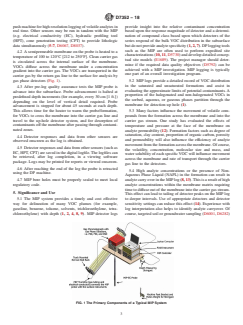
gas phase detectors (Fig. 1). 5.2 MIPlogs provide a detailed record of VOC distribution
in the saturated and unsaturated formations and assist in
4.3 After pre-log quality assurance tests the MIP probe is
evaluating the approximate limits of potential contaminants.A
advance into the subsurface. Probe advancement is halted at
proportion of the halogenated and non-halogenated VOCs in
predefined depth increments (for example, every 30 cm [1 ft.])
the sorbed, aqueous, or gaseous phases partition through the
depending on the level of vertical detail required. Probe
membrane for detection up hole (1).
advancement is stopped for about 45 seconds at each depth.
This allows time for the heater to warm the probe/formation,
5.3 Many factors influence the movement of volatile com-
for VOCs to cross the membrane into the carrier gas line and
pounds from the formation across the membrane and into the
travel to the up-hole detector system, and for desorption of
carrier gas stream. One study has evaluated the effects of
contaminantsoffthemembraneafterpassingthroughcontami-
temperature and pressure at the face of the membrane on
nated zones.
analyte permeability (12). Formation factors such as degree of
saturation, clay content, proportion of organic carbon, porosity
4.4 Detector responses and data from other sensors are
and permeability will also influence the efficiency of analyte
observed onscreen as the log is obtained.
movementfromtheformationacrossthemembrane.Ofcourse,
4.5 Detector responses and data from other sensors (such as
the volatility, concentration, molecular size and mass, and
EC,HPT,CPT)aresavedinthedigitallogfile.Thelogfilescan
watersolubilityofeachspecificVOCwillinfluencemovement
be retrieved, after log completion, in a viewing software
across the membrane and rate of transport through the carrier
package. Logs may be printed for reports or viewed onscreen.
gas line to the detectors.
4.6 After reaching the end of the log the probe is retracted
5.4 High analyte concentrations or the presence of Non-
using the DP machine.
Aqueous Phase Liquid (NAPL) in the formation can result in
4.7 MIP bore holes must be properly sealed to meet local analytecarryoverintheMIPlog (8, 13).Thisisaresultofhigh
regulatory code.
analyte concentrations within the membrane matrix requiring
timetodiffuseoutofthemembraneintothecarriergasstream.
5. Significance and Use
This effect can lead to tailing of detector peaks on the MIPlog
5.1 The MIP system provides a timely and cost effective to deeper intervals. Use of appropriate detectors and detector
way for delineation of many VOC plumes (for example, sensitivity settings can reduce this effect (14). Experience with
gasoline, benzene, toluene, solvents, trichloroethylene, tetra- log interpretation also helps to identify analyte carryover. Of
chloroethylene) with depth (1, 2, 4, 8, 9). MIP detector logs course,targetedsoilorgroundwatersampling(D6001,D6282)
FIG. 1 The Primary Components of a Typical MIP System
D7352 − 18
should be performed routinely to verify log results and assist 26). These methods typically reduce the speed of the logging
with log interpretation and site characterization (subsection process in order to provide improved quantitation and analyte
1.4).
specificity for a limited group of analytes.
5.5 Some volatile contaminants are composed of multiple
5.11 MIP data can be used to optimize site remediation by
analytes of different molecular mass, size and volatility (e.g.
knowing the vertical and horizontal distribution of VOCs as
gasoline). A detailed study was performed using a gas chro-
wellasobtaininginformationonthesoiltypeandpermeability
matograph (GC)-mass spectrometer system to assess the delay
where contaminants are held by using tandem lithologic
in movement of several components of gasoline from the
sensors such as EC, HPT, or CPT. For example, materials
membrane face, up the trunkline, to the MIP detectors (15).
injected for remediation are placed at correct depths in the
The larger, more massive analytes were found to be delayed in
formation based upon the detector responses of contaminants
reaching the detectors. This effect means that some analyte
and the proper type of injection is performed based upon the
mass will be graphed on the MIP log at a depth below where
formation permeability.
it entered the membrane.This “dispersion” effect is difficult to
5.11.1 This practice also may be used as a means of
overcome. However, knowledge of the site-specific analyte(s)
evaluating remediation performance. MIP can provide a cost-
and experience with log interpretation can help the user assess
effective way to evaluate the progress of VOC remediation.
these effects on log quality and contaminant distribution. Of
When properly performed at suitable sites, logging locations
course,targetedsoilorgroundwatersampling(D6001,D6282)
can be compared from the initial pre-remedial investigation to
should be performed routinely to verify log results and assist
logs of the VOC contaminants after remediation is initiated.
with log interpretation and site characterization (subsection
1.4).
NOTE 1—The quality of the result produced by this standard is
dependent on the competence of the personnel performing it, and the
5.6 One of the important benefits of MIPlogging is that the
suitability of the equipment and facilities used. Practitioners that meet the
number of samples and laboratory analyses required to effec-
criteria of Practice D3740 are generally considered capable of competent
tivelycharacterizeaVOCplumeandsourceareacanbegreatly
and objective testing/sampling/inspection/etc. Users of this standard are
reduced, thus reducing investigative time and costs. Reduction
cautioned that compliance with Practice D3740 does not in itself assure
of the number of samples required also reduces site worker
reliable results. Reliable results depend on many factors; Practice D3740
providesameansofevaluatingsomeofthosefactors.PracticeD3740was
exposure to hazardous contaminants. The data obtained from
developed for agencies engaged in the testing and/or inspection of soils
theMIPlogsmaybeusedtoguideandtargetsoil(D6282)and
and rock.As such, it is not totally applicable to agencies performing this
groundwatersampling(D6001)andtheplacementoflong-term
practice. However, users of this practice should recognize that the
monitoring wells (D6724, D6725, D5092) (2, 7, 8) to more
framework of Practice D3740 is appropriate for evaluating the quality of
effectively characterize and monitor site conditions.
an agency performing this practice. Currently there is no known qualify-
ing national authority that inspects agencies that perform this practice.
5.7 Typically,onlyVOCsaredetectedbytheMIPsystemin
the subsurface. Use of specialized methods and/or detector
6. Apparatus
systems may allow for detection of other gaseous or volatile
contaminants (for example, mercury). Detection limits are
6.1 General—The following discussion provides descrip-
subject to the selectivity and sensitivity of the gas phase
tions and details for the MIP and system components (Fig. 1).
detectors applied, the analytes encountered, and characteristics
NOTE 2—The American Society for Testing and Materials takes no
of the formation being penetrated (for example permeability,
position respecting the validity of any patent rights asserted in connection
saturation, sand, clay and organic carbon content).
with any item mentioned in this standard. Users of this standard are
expressly advised that determination of the validity of any such patent
5.8 Correlation of a series of MIP logs across a site can
rights, and the risk of infringement of such rights, are entirely their own
provide 2-D and 3-D definition of the of the primary VOC
responsibility.
contaminant plume (7, 8). When lithologic logs such as EC,
HPT, or CPT are obtained with the MIP data, contaminant
6.2 Membrane Interface Probe—The membrane is the in-
migrationpathways (7, 8)aswellasstorageandbackdiffusion
terfacebetweenthebulkformationandthegasphasedetectors
zones (16) may be defined.
up hole.
5.9 Some investigations (8, 17-21) have found the MIPcan
6.2.1 The membrane is set in a removable insert for easy
be effective in locating zones where dense nonaqueous phase replacementifdamagedorworn.Itisconstructedofapolymer
liquids (DNAPL) may be present. However, under some
coating impregnated into stainless steel wire mesh set in a
conditions, especially when inappropriate detectors and meth-
stainless-steel mount. (See Annex A1 for membrane removal/
ods are used (22, 23), analyte carryover (15) can mask the
replacement instructions.)
bottom of the DNAPL body (9, 13, 24). These limitations can
6.2.2 The membrane is inserted into a heater block. The
beminimizedbyuseofappropriatemethodsanddetectors (14,
elevated temperature of the heater block is used to speed the
23).
diffusion of contaminants out of the bulk formation and
through the membrane (Fig. 2). This heater block has a
5.10 While the conventional MIP system does not provide
regulated temperature typically set at 121°C [250°F]. Tempo-
quantitative data or analyte specificity some researchers have
rary cooling, especially in saturated formations, will occur as
modified the system with different sampling or detector sys-
temsinattemptstoachievequantitationandspecificity (21, 25, the probe is advanced incrementally to the next depth.
D7352 − 18
NOTE 1—The schematic of the membrane interface probe depicts the movement of VOCs in the bulk formation (A) diffusing through the
semipermeable membrane (B) into the carrier gas (C) to be swept to the surface detectors.
FIG. 2 Schematic Diagram of the Membrane Interface Probe
6.2.3 The MIP probe is typically configured with a soil clean carrier gas from the MIP controller source to the
conductivity dipole for simultaneous collection of bulk forma- membrane and PEEK (polyether ether ketone) tubing returns
tion EC data.At many sites the EC can be correlated with soil carriergasfromthemembranetothegasphasedetectorsatthe
and sediment lithology and used in real time to locate test ground surface. PEEK tubing is used as the return line due to
zones. is lower sorptive capacity for manyVOC analytes. If using the
6.2.4 The MIP probe may be configured with an HPT heated trunkline system, the gas lines are constructed from
injection port (D8037) for the simultaneous collection of soil stainless steel tubing.
permeability measurements (Appendix X1).
6.4 MIP Controller—The MIP controller is used to control
6.2.5 Alternately the MIP probe may be coupled to a CPT
the gas flow delivered to the membrane cavity and the voltage
probe at its lower end for simultaneous collection of CPT data
delivered to the heater block and EC dipole electrode. The
(Fig. X2.1).
primary features of the MIP controller include:
6.3 MIP Trunkline—Standard MIP trunklines operate at 6.4.1 Primary pressure regulator to control the pressure of
ambient temperatures to transport analytes to the surface carrier gas to the flow regulation circuit of the MIPcontroller.
detectors through gas line tubing. The heated trunkline (Ap- 6.4.2 Amassorelectronicflowcontrollerisusedtoregulate
pendix X3) option operates at an elevated temperature – the flow of carrier gas through the MIP system. The flow rate
approximately 100°C [212°F] for enhanced transport of ana- is typically set to 40 mL/min but can range from 20 to 60
lytes to the detectors. mL/min in the operation of the MIP.
6.3.1 Tubingisusedforthegaslinestosupplyacontinuous 6.4.3 Temperature controller regulates the voltage supplied
flow of carrier gas to and from the membrane. Two tubes are to the heater block to maintain an elevated temperature in the
used in the standard trunklines: a Teflon supply tube brings subsurface. The temperature controller has two outputs on a
D7352 − 18
(A) The Gas Chromatograph, contains the PID, FID and XSD detector cells. Other appropriate GCs and detectors may be
used.
(B) XSD Control Box for the detector heater circuit and signal amplification and output.
(C) Laptop computer with acquisition and viewing software installed.
(D) Field instrument: data acquisition for the computer also controls the EC output voltage and signal input.
(E) HPTController:pumpandflowcontrolfortheinjectionofwaterforthehydraulicprofilingsystem.(Onlyrequiredwithin
a MIP system when operating MiHPT.)
(F) MIP Controller: temperature control of the MIP probe and carrier gas flow regulation of MIP trunkline.
a. Mass (or electronic) flow controller to regulate MIP trunkline carrier flow rate.
b. Heater switch for MIP probe heater block.
c. Temperature display for MIP probe heater block temperature.
FIG. 3 Instruments Typically Required for MIP Operation
liquidcrystaldisplay(LCD).Thetopoutputisthetemperature 6.5.1 Circuitry for the EC system. A voltage output of
of the membrane in the heater block. The bottom output is the 0.75VAC is used to measure electrical conductance of the soil.
set temperature of the controller; the manufacturer sets this The input connections for EC are located on the rear of the
Field Instrument.
temperature at 121°C [250°F].
6.5.2 Universal serial bus (USB) output connection located
6.4.4 Analog signal input from the detector system. The
on the rear of the field instrument to communicate with the
analog outputs from the gas phase detectors are connected to
acquisition software on a laptop computer.
thecontrollerforconversiontodigitalformatstobetransferred
to the data acquisition system.
6.5.3 Global positioning system connections for acquiring
latitudeandlongitudelocationsoflogginglocationandstorage
6.5 Field Instrument—The primary purpose of this compo-
of this data directly to the log file.
nent is to acquire analog data from the MIP probe, controller
and detector system in real time. The data saved by the 6.6 Detector System—Laboratorygrade,gasphasedetectors
acquisition system are: depth; soil EC; rate of probe penetra-
are needed for the detection of VOCs in the carrier gas stream
tion into the subsurface; temperature of the probe; flow and (Annex A2). Detectors are typically mounted on a gas chro-
pressure of the carrier gas supply at the flow controller; and matograph.Figs.A2.1andA2.2showaGCconfiguredwithan
four possible gas phase detector inputs. The primary compo-
XSD, FID and PID however, other model gas chromatographs
nents of the field instrument include: and detectors can be used with the MIP system.
D7352 − 18
6.7 Stringpot—A depth measuring potentiometer (Fig. 4) 7. Reagents and Materials
mounted to the direct push machine, transfers a voltage to the
7.1 Carrier Gas—A non-reactive (inert) gas is used for the
data acquisition system for accurate depth measurement below
transportationofthevolatilecompoundsfromthemembraneto
ground surface.
the up-hole detector system. Examples of gases used for MIP
6.8 EC Dipole Tester—A small device with two different
logging include: ultra high purity (UHP) grade Nitrogen and
resistors located between two sets of electrical poles. Used to
UHPgradeHelium.Nitrogenismainlyusedforthecarriergas
test the EC array on the MIPprobe to verify the array and EC
because it is readily available, is a stable gas, and is inert to
system are operating properly.
hydrocarbons.
6.9 Drive Rods—Steel rods having adequate strength to
7.2 Methanol—CH OH, reagent grade, for use in the dilu-
sustain the force required to advance the MIP into the subsur-
tion of stock standards.
face.Therodsmustbesecuredtogethertoformarigidcolumn
7.3 Neat Volatile Organic Standards—Pure product stan-
of drive rods.
dards (99+% reagent grade) are used for the preparation of
6.10 Direct Push Machine—Amachinewithhydraulicrams
stock standards. The neat product chosen should correlate to
supplemented with vehicle weight and may include a high
the contaminant of concern at the investigation site. If specific
frequencyhydraulichammertoadvancedriverodsintouncon-
contaminants are known (for example, TCE, benzene), stan-
solidated formations.
dards of those compounds may be used. Some contaminants
6.11 Syringes—Areciprocating pump with a plunger inside
are composed of multiple compounds (e.g. gasoline) and an
of a barrel used to measure volumes of liquid.
appropriateneatstandard(e.g.benzeneinthecaseofgasoline)
should be used for preparation of standards.
6.12 Graduated Cylinder—A measuring cylinder with
marked lines on the cylinder to represent an amount of liquid
7.4 Gas Tight Syringes—Graduated syringes are a measure-
that has been measured.
ment device used for the preparation of the stock and working
standards. Recommended sizes include: 10 µL, 25 µL, 100 µL
6.13 Analytical Balance—A class of balance designed to
and 500 µL.
measure small mass in the sub-milligram range.
6.14 Volumetric Flask—A piece of laboratory glassware, 7.5 Stock Standards—Neat reagent grade standards are first
calibrated to contain a precise volume of liquid. diluted with methanol at the desired concentration. This is
FIG. 4 The Stringpot Used to Track Probe Depth—(A) Stringpot assembly. (B) Anchoring the stringpot at ground surface and attaching
the string to the sliding hammer carriage on the mast of the direct push machine to track depth as the probe is advanced into the sub-
surface.
D7352 − 18
typically prior to mobilization to the field. These standards 8.2.1.4 Handleandstorestandardsappropriately.VOCstan-
must be stored on ice or under refrigeration until used to dards should be handled with appropriate gloves in a well-
prepare working standards.
ventilated area or under a fume hood. Some standards are
carcinogens and a safety data sheet (SDS) should be consulted
7.6 Working Standards—Thesestandardsaremadefromthe
before handling. Some VOCs (for example, benzene) will
stock standard solutions by diluting them to the desired
degrade in sunlight and standards should be stored in a
concentration in tap or deionized water to use for pre-log and
refrigeratororfreezerorwithiceinacoolerinthefield.When
post log quality assurance testing. For specific standard prepa-
storing, replace damaged septa or lids on vials.
ration instructions see Annex A4.
8.2.2 Performing Chemical Response Tests—Response test-
8. Pre- and Post-Log Preparation and Conditioning of ing must be conducted before and after each log. This will
the Apparatus validate the data and the integrity of the system. Response
testing also provides for comparison of data for later MIPlogs
8.1 General—Quality assurance tests of the MIP logging
atthesamesite.Resultsoftheresponsetestmaychangedueto
systemareperformedpriortoeachlogtoverifythatthesystem
membrane wear from soil contact and abrasion. Additional
components are operating properly so that good quality data is
informationonperformingchemicalresponsetestsislocatedin
obtained during the logging process. Chemical response tests
Annex A5.
are performed to verify that the MIPmembrane, trunkline, gas
supply and detector systems are operating correctly. If litho- 8.2.2.1 Choose an appropriate compound for the chemical
logic logging sensors such as EC, HPT or CPT are run in response test which is similar to what is expected to be
tandem with the MIP probe, those sensors should be tested encountered on the field site.
before each log according to manufacturer’s requirements to
8.2.2.2 Run the response test by exposing the membrane to
verify their performance.
the prepared working standard for 45 seconds. There are two
acceptable methods exposing the membrane to the chemical
8.2 Chemical Response Testing is an integral part of ensur-
response test standard:The first method is to pour the working
ing the quality of data from the MIP system. A chemical
standardintoanominal5.08×61cm[2×24in.]PVCorsteel
response test must be performed before deploying the system
in the field as well as before and after each log. To conduct a pipe and insert the probe into the tube (Fig.A5.2).The second
response test, a stock standard is prepared. The selected stock acceptable method is performed by pouring the working
standard(s) used for a site needs to be determined based on the standard into a vial (approximately 40 mL) and invert onto the
sitecontaminantsofconcern.Preparationofthestockstandard
membrane (Fig. A5.3).
is critical to the final concentration of the response test.
8.2.2.3 From the chemical response seen on the computer
8.2.1 Preparation of Stock Standards—A 50mg/mL stock
screen determine the contaminant trip time, which is the time
standard is typically sufficient for a stock standard concentra-
ittakesthecontaminanttotravelthroughthetrunklinefromthe
tion.At this concentration, only a small amount (~25mL) in a
MIPmembrane to the detectors. The software will ask for this
40mL vial is needed in the field. Stock standards have a shelf
value and is needed to correctly plot the depth a detector
lifeof30dayswhenappropriatelyhandledandstoredoniceor
response came from.
in a refrigerator. For additional information see Annex A4.
8.2.1.1 Mass of Solute, M —This parameter is the mass, in
s
9. MIP Logging Procedure
milligrams, of solute needed to prepare the stock standard and
9.1 General Requirements:
is defined as:
9.1.1 PriortodrivingtheMIPintothesubsurface,makesure
M 5 V 3C (1)
s m final
that the proper clearance for direct push equipment has been
where:
providedtoavoidanyhazardsfromundergroundandoverhead
V = volume of solvent (methanol) in milliliters, and
m utilities.
C = final concentration of stock standard in mg/mL.
final
9.2 MIP System Start Up:
8.2.1.2 Volume of Solute in Microliters, V —This parameter
s
9.2.1 Turn on carrier gases. Typically, nitrogen or helium
is the volume of solute needed for the stock standard prepared
compressedcylindersareequippedwitha2-stagegasregulator
to equal a concentration of 50 mg/mL. By using the density
thatistypicallysettooutput75kPa[40psi]forMIPoperation.
(TableA4.2)ofthecompoundandtheresultin8.2.1,avolume
9.2.2 Power on the detector system, data acquisition system
of the solute is obtained.
and MIP controller box.
M
s
V 5 (2)
9.2.3 Set the nitrogen or helium carrier flow to approxi-
s
d
s
mately 40 mL/min trunkline flow (20-60 mL/min is accept-
where:
able).
M = definition in 8.2.1.1, and
s 9.2.4 Verify that there are no leaks in the MIP probe and
d = density, in mg/µL, of the solute.
s
trunkline circuit by measuring the return trunkline flow. This
8.2.1.3 Label the vial with the date the standard was must be within 3 mL/min of the MIP supply flow if it is more
than this there is a leak in the system, do not proceed until this
prepared, initials of the one who prepared the standard, the
concentration and the analyte contained within the standard. is resolved.
D7352 − 18
9.2.5 Measure the detector flow rates to verify proper flows The MIP log may be printed in the field or viewed onscreen
and operation of the detectors. For more information on with the viewing software for on-site decision making. Other
detector flow rates see the detector manufacturer’s operating data saved in the MIP log file includes rate of advancement,
manual. temperature of the probe, and carrier gas flow and pressure
9.2.6 Set the MIPpressure on the secondary pressure gauge (Fig. 5). This additional data may be plotted with the log to
to 69 kPa [10 psi].This may result in a trunkline flow rate <40 assist with log review and interpretations at the operator’s
mL/min perhaps 25-30 mL/min which is fine. Detector sensi- discretion.
tivity is improved at lower trunkline pressures. Make sure an
9.8 Record in the field notes any observations of bore hole
accurate trip time is measured and used in the software.
irregularities, pressure differences of the carrier gas, tempera-
9.3 Perform chemical response test (see section 8.2.2 and ture fluctuations and any detector anomalies. Also note if the
Annex A5). probewasstoppedatanydepthforanextendedperiodoftime.
9.4 Test the EC dipole according to the manufacturer’s 9.9 If the MIP log is to be advanced through a confining
specifications. If the EC array does not pass the QA test refer layer or into an area of very high contaminant concentration
(perhaps NAPL) the operator may choose to use a grout sub
to manufacturer’s guidance for trouble shooting and corrective
measures. (Appendix X5) for immediate, post-log abandonment of the
boring. The grout sub is operated with the 5.71cm [2.25in.]
9.5 The HPT reference test is performed when operating
MIP probe and tool string.
MiHPT to verify that the HPT pressure sensor is in working
9.10 An example MIP-HPT (MiHPT) log is shown in
orderandtoevaluatetheconditionoftheHPTinjectionscreen
and HPTsystem. Refer toASTM Practice D8037 for guidance Appendix X6.
on operation of the HPT probe and system.
9.11 Removal from the Subsurface:
9.6 PositiontheMIPprobeunderthedirectpushmachineat 9.11.1 BeforeremovingtheMIPfromthesubsurface,pause
at the terminal depth for a period equal to two times the
the cleared location after successful QA tests are completed.
LeveltheDPmachineasappropriatefortheloggingoperation. measured trip time. This allows data from the final probe
position to be recorded to the appropriate depth in the data
Place a slotted drive cap on the top of the probe to protect the
trunkline from damage during advancement.Attach the string- acquisition system.
9.11.2 Stop the log and use the direct push machine to
pot cable to the direct push machine (Fig. 4B) and the field
instrument. remove the MIP from the subsurface.
9.11.3 Turn off the probe heater when the log is finished
9.6.1 ZerothedepthoftheMIPprobebydrivingthetipinto
the subsurface aligning the MIP membrane with the ground before removing the probe from the soil to allow for the
cooling of the membrane and minimizes diffusion of contami-
surface.
9.6.2 Turn on the trigger located in the acquisition software nants through the membrane.
9.11.4 Retract the MIPprobe using the rod grip system or a
(a typical acquisition software example, other similar software
slotted pull cap. Trunkline management is important during
may be used). The data acquisition system is now ready to
removal so the tool string is ready for advancement at the next
acquire data. Any downward movement of the machine mast
location.
will now be recorded as log depth.
9.11.5 Uponcompleteremovaloftheprobe,washtheprobe
9.6.3 The MIP tool string is driven into the subsurface
and membrane with water and detergent, turn on the heater.
incrementally. The length of the increments depends on the
Heating will accelerate the cleanup if any contaminants have
level of vertical resolution required. Typically, 30cm [1ft]
sorbed onto the membrane during retraction. Wait until the
increments are used to obtain good resolution of the VOC
detector baselines return to near pre-log level before perform-
plume. Example: Take 15 seconds to advance the MIP 30cm
ing the post log chemical response test.
[1ft], then wait 45 seconds before advancing to the next
9.11.6 Record baseline readings and complete another
interval.
chemical response test with a fresh working standard as
9.6.4 Rodsareaddedtothetoolstringasneededtoadvance
outlined in section 8.2.2. Compare the results of the response
the probe to the desired depth or until refusal is encountered.
tests, noting any major differences in trip time or peak
9.6.5 During the logging process significant changes in
response.
analyte concentrations in the subsurface may require the
9.11.7 Properly abandon open borehole by grouting as per
operatortoadjustdetectorgainsettings.Fordetailsondetector
Guide D5299 or as required by local regulations.
gain adjustment refer to Annex A3 or the manufacturer’s
operating manual. When high level contaminant concentration
10. Report: Test Data Sheet(s) Form(s)
is an issue or low volatility compounds are being logged a
heated trunkline system may be used to minimize carryover in 10.1 The methodology used to specify how data are re-
the system see Appendix X3. When attempting to track lower corded is covered in section 1.5.
concentration contamination a low-level MIP system may be
10.2 Record as a minimum the following general informa-
used see Appendix X4.
tion (data): Additional information can be entered in a notes
9.7 MIPlogs are displayed on computer screen as the probe section of the log and saved in the file.
is advanced to depth (Fig. 5). Data points saved by the 10.2.1 Facility name, location and site contacts,
acquisition software are all in reference to depth from surface. 10.2.2 Date and Time the log is obtained,
D7352 − 18
NOTE 1—The log above shows from left to right: soil EC, PID, FID, XSD, MIPPressure and MIPtemperature. Soil EC can provide an indication of
soil types where chemical contaminants may be contained. Typically, lower EC is indicative of coarser grained formations and higher EC are indicative
of finer grained formations, however there are exceptions. The detectors show the vertical position of the contaminants and provide an indication of
contaminanttype.MIPpressureisgraphedtomonitorcarriergasfluctuationsandservesasanindicatorforleakswithinthesystem.Thetemperaturegraph
should show consistent recovery to the temperature setpoint throughout the log as the probe is incrementally advanced.
FIG. 5 MIP Log Example
10.2.3 MIP Contractor, MIP field technician and assistants, 10.3.1 Recordalldrillingandsamplingmeasurementstothe
10.2.4 File name of the MIP log and depth of final nearest 0.3m [0.1ft.] or better.
penetration,
10.3.2 Sampling—Report depth interval sampled, sample
10.2.5 Pre- and post-log chemical response test compound
recovery lengths to the nearest 0.3 m [0.1 ft.] or better and
used and concentration.
percent recovery, classification, and any other tests performed,
10.2.6 Equipment used in the investigation such as: type of
10.3.3 Data on flow rates, pressures, and chemical concen-
gasphasedetectors,carriergasflowrateandpressureandtype
trationsarerecordedbyelectronicdataacquisitionsystemsand
of carrier gas, probe type, trunkline type and length, data
can be reported to one significant digit.
acquisition unit, MIP controller, and
10.2.7 Site and location specific information relevant to the
11. Keywords
project. (for example: Petroleum UST, dry cleaning shop or
dense till with cobbles).
11.1 CPT;directpush;electricalconductivity(EC);hydrau-
lic profiling tool (HPT); membrane interface probe (MIP); soil
10.3 Record as a minimum the following sampling data as
investigations; volatile organic contaminants (VOCs)
follows:
D7352 − 18
ANNEXES
(Mandatory Information)
A1. REMOVAL AND REPLACEMENT REQUIREMENTS FOR MIP MEMBRANES
A1.1 Introduction A1.2.5 Inspect the open cavity for any foreign particles.
Clean as necessary.
A1.1.1 This annex describes procedures and requirements
A1.2.6 Donotleavethemembranecavityopenforextended
for removing and replacing the MIP membrane.
periodsoftime.Debriscanbecomelodgedinthegasopenings
A1.1.2 Amembraneisoperationaliftheresponsetestsignal
and affect the flow of the system.
(µV) of a compound is twice that of the baseline noise and if
the flow of the system has not changed more than 3 mL/min
A1.3 Installation of Membranes
from the closed couple flow of the system.
A1.3.1 Insert the new copper washer into the cavity. Verify
that the washer is setting flat on the base of the cavity.
A1.2 Removal of a Membrane
A1.3.2 Install the new membrane by threading it into the
A1.2.1 Turnofftheheaterpowerswitchandallowtheblock
socket first by hand to avoid cross threading the membrane,
to cool to 50°C [122°F] or less.
then use the membrane wrench to tighten the membrane to a
A1.2.2 Clean the heater block and probe to remove any
snug fit.
debristhatmayinterferewithremovalofthemembraneorclog
A1.3.3 After the membrane has been secured into the
small gas ports in the block.
socket, a flow meter must be attached to the up-hole tubing to
A1.2.3 Remove the membrane with the membrane wrench
measure the flow of the MIP system. A maximum carrier gas
from the MIPservice kit (Fig.A1.1). Keep the wrench parallel
flow difference of 3 mL/min between the trunkline supply and
to the probe while removing the membrane to make sure of
return is required to ensure a proper seal. If the flow is greater
proper engagement with socket head cap screw.
than 3 mL/min, then more torque may be applied to the
membrane to further seal the membrane.
A1.2.4 Remove and discard the copper washer. The copper
washer conforms to a membrane and a used washer may not A1.3.4 Run a response test as per subsection 8.2.2 and
seal if reused. Annex A5.
FIG. A1.1 Membrane Wrench Shown with Membrane Removed Exposing the Sub-Membrane Fittings
A2. MIP DETECTOR SYSTEM USED FOR ANALYTE DETECTION
A
...
This document is not an ASTM standard and is intended only to provide the user of an ASTM standard an indication of what changes have been made to the previous version. Because
it may not be technically possible to adequately depict all changes accurately, ASTM recommends that users consult prior editions as appropriate. In all cases only the current version
of the standard as published by ASTM is to be considered the official document.
Designation: D7352 − 07 (Reapproved 2012) D7352 − 18
Standard Practice for
Direct Push Technology for Volatile Contaminant Logging
1,2
with theUsing a Membrane Interface Probe (MIP) in Un-
consolidated Formations with Direct Push Methods
This standard is issued under the fixed designation D7352; the number immediately following the designation indicates the year of
original adoption or, in the case of revision, the year of last revision. A number in parentheses indicates the year of last reapproval. A
superscript epsilon (´) indicates an editorial change since the last revision or reapproval.
1. Scope Scope*
1.1 This standard practice describes a method field procedure for the rapid delineation of volatile organic contaminantscom-
pounds (VOC) in the subsurface using a membrane interface probe. Logging with the membrane interface probe is usually
performed with direct push equipment.(DP) equipment. DP methods are typically used in soils and unconsolidated formations, not
competent rock.
1.2 This standard practice describes how to obtain a real time vertical log of volatile organic contaminants VOCs with depth.
The data obtained is indicative of the total volatile organic contaminant concentration VOC level in the subsurface at depth. The
MIP detector responses provide insight into the relative contaminant concentration based upon the magnitude of detector responses
and a determination of compound class based upon which detectors of the series respond.
1.3 Other sensors, such as electrical conductivity, fluorescence detectors, and cone penetration tools may be included to provide
additional information. The use of a lithologic logging tool is highly recommended to define hydrostratigraphic conditions, such
as migration pathways, and to guide confirmation sampling.sampling and remediation efforts. Other sensors, such as electrical
conductivity, hydraulic profiling tool, fluorescence detectors, and cone penetration tools may be included to provide additional
information.
1.4 Limitations—TheSince MIP system does not provide specificity of analytes. This tool is to be used as a total volatile organic
contaminant-screening tool. Soil and/or results are not quantitative, soil and water sampling (Guides D6001, D6282, D6724, and
Practice D6725) must be performedmethods are needed to identify specific analytes and exact concentrations. Only VOCs are
detected by the MIP system in the subsurface. Detection MIP detection limits are subject to the selectivity of the gas phase detector
applied and characteristics of the formation being penetrated (for example, example: permeability, saturation, clay and organic
carbon content).
1.5 This practice offers a set of instructions for performing one or more specific operations. This document cannot replace
education or experience and should be used in conjunction with professional judgment. Not all aspects of this practice may be
applicable in all circumstances. This ASTM standard is not intended to represent or replace the standard of care by which the
adequacy of a given professional service must be judged, nor should this document be applied without the consideration of a
project’s many unique aspects. The word “standard” in the title means that the document has been approved through the ASTM
consensus process.
1.5 The values stated in either SI units or inch-pound units [given in brackets] are to be regarded separately as standard. The
values stated in each system may not be exact equivalents; therefore, each system shall be used independently of the other.
Combining values from the two systems may result in non-conformance with the standard. Reporting of test results in units other
than SI shall not be regarded as nonconformance with this standard.
1.6 All observed and calculated values shall conform to the guidelines for significant digits and rounding established in Practice
D6026, unless superseded by this standard.
This practice is under the jurisdiction of ASTM Committee D18 on Soil and Rock and is the direct responsibility of Subcommittee D18.21 on Groundwater and Vadose
Zone Investigations.
Current edition approved Oct. 15, 2012July 15, 2018. Published November 2012August 2018. Originally approved in 2007. Last previous edition approved in 20072012
as D7352D7352–07(2012).–07. DOI: 10.1520/D7352-07R12.10.1520/D7352-18.
*A Summary of Changes section appears at the end of this standard
Copyright © ASTM International, 100 Barr Harbor Drive, PO Box C700, West Conshohocken, PA 19428-2959. United States
D7352 − 18
1.6.1 The procedures used to specify how data is collected/recorded and calculated in the standard are regarded as the industry
standard. In addition, they are representative of the significant digits that generally should be retained. The procedures used do not
consider material variation, purpose for obtaining the data, special purpose studies, or any considerations for the user’s objectives;
and it is common practice to increase or reduce significant digits of reported data to be commensurate with these considerations.
It is beyond the scope of these test methods to consider significant digits used in analytical methods for engineering data.
1.7 This practice offers a set of instructions for performing one or more specific operations. This document cannot replace
education or experience and should be used in conjunction with professional judgment. Not all aspects of this practice may be
applicable in all circumstances. This ASTM standard is not intended to represent or replace the standard of care by which the
adequacy of a given professional service must be judged, nor should this document be applied without the consideration of a
project’s many unique aspects. The word “standard” in the title means that the document has been approved through the ASTM
consensus process.
1.8 This standard does not purport to address all of the safety concerns, if any, associated with its use. It is the responsibility
of the user of this standard to establish appropriate safety safety, health, and healthenvironmental practices and determine the
applicability of regulatory limitations prior to use.
1.9 This international standard was developed in accordance with internationally recognized principles on standardization
established in the Decision on Principles for the Development of International Standards, Guides and Recommendations issued
by the World Trade Organization Technical Barriers to Trade (TBT) Committee.
2. Referenced Documents
2.1 ASTM Standards:
D653 Terminology Relating to Soil, Rock, and Contained Fluids
D3740 Practice for Minimum Requirements for Agencies Engaged in Testing and/or Inspection of Soil and Rock as Used in
Engineering Design and Construction
D5092 Practice for Design and Installation of Groundwater Monitoring Wells
D5299 Guide for Decommissioning of Groundwater Wells, Vadose Zone Monitoring Devices, Boreholes, and Other Devices for
Environmental Activities
D5730 Guide for Site Characterization for Environmental Purposes With Emphasis on Soil, Rock, the Vadose Zone and
Groundwater (Withdrawn 2013)
D5792 Practice for Generation of Environmental Data Related to Waste Management Activities: Development of Data Quality
Objectives
D6001 Guide for Direct-Push Groundwater Sampling for Environmental Site Characterization
D6026 Practice for Using Significant Digits in Geotechnical Data
D6067 Practice for Using the Electronic Piezocone Penetrometer Tests for Environmental Site Characterization and Estimation
of Hydraulic Conductivity
D6282 Guide for Direct Push Soil Sampling for Environmental Site Characterizations
D6724 Guide for Installation of Direct Push Groundwater Monitoring Wells
D6725 Practice for Direct Push Installation of Prepacked Screen Monitoring Wells in Unconsolidated Aquifers
D8037 Practice for Direct Push Hydraulic Logging for Profiling Variations of Permeability in Soils
E355 Practice for Gas Chromatography Terms and Relationships
E1689 Guide for Developing Conceptual Site Models for Contaminated Sites
3. Terminology
3.1 Terminology used within this practice is in accordance with For definitions of common technical terms used in this standard,
refer to Terminology D653 with the addition of the following:.
3.2 Definitions:Definitions of Terms Specific to This Standard:
3.2.1 carry over—retention of contaminant in the membrane and trunkline which may result in false positive results or an
increased detector baseline at subsequent depth intervals.
3.2.2 chemical response test—a test of the working MIP system performed by exposing the MIP membrane to an aqueous phase
solution with a known contaminant of known concentration.
3.2.2.1 Discussion—
The Membrane Interface Probe is covered by a patent. Interested parties are invited to submit information regarding the identification of an alternative(s) to this patented
item to the ASTM Headquarters. Your comments will receive careful consideration at a meeting of the responsible technical committee, which you may attend.
For referenced ASTM standards, visit the ASTM website, www.astm.org, or contact ASTM Customer Service at service@astm.org. For Annual Book of ASTM Standards
volume information, refer to the standard’s Document Summary page on the ASTM website.
The last approved version of this historical standard is referenced on www.astm.org.
D7352 − 18
Performed before and after each MIP log to validate the MIP system performance. Also used so that log data from different
locations across a site may be compared.
3.2.3 closed couple flow—gas flow in the MIP system when a probe is detached and the gas lines are coupled together. The flow
is then measured with a gas flow meter on the return tubing before entering the gas phase detectors. Used to verify continuity of
gas flow in the MIP system.the trunkline carrier gas return flow with the trunkline gas lines connected together when the MIP probe
is bypassed.
3.2.3.1 Discussion—
Used during troubleshooting to determine the source of a gas leak in the MIP system.
3.2.4 gas dryer—a selectively permeable membrane tubing (Nafion®) is used to continuously dry the MIP carrier gas stream
before it enters the detectors by removing only water vapor.
3.2.4.1 Discussion—
The gas dryer may need to be removed to improve detection of some analytes with high water solubility, such as MTBE, acetone,
dioxane or ethanol.
3.2.5 gas phase detectors—heated laboratory grade detectors used for gas chromatography (Practice E355). Gas effluent from
the MIP flows through these detectors for the analysis of VOC compounds. Detectors most often used with the MIP include
photoionization detector (PID), flameionization detector (FID), and an electron capture detector (ECD).
3.2.5.1 Discussion—
Carrier gas effluent from the MIP probe flows through these detectors at the surface for the analysis of VOCs. Detectors most often
used with the MIP include photoionization detector (PID), flame ionization detector (FID), and a halogen specific detector (XSD)
(Fig. A2.2). Other, appropriate gas phase detectors may be used.
3.2.6 membrane interface probe (MIP)—a subsurface logging tool for detection of volatile organic compounds (VOCs).VOCs.
3.2.7 response test—parts per billion (ppb)—a test of the working MIP system performed by placing the MIP probe in an
aqueous phase solution with a known contaminant of known concentration. Performed before each MIP log is conducted and one
at the end of the working day to validate the MIP system performance. Also used to compare data from individual locations.the
number of units of a contaminant per 1 billion units of total mass, typically measured as either μg/Kg or μg/L depending if a solid
or liquid is being measured.
3.2.8 parts per million (ppm)—the number of units of a contaminant per 1 million units of total mass, typically measured as
either mg/Kg or mg/L depending if a solid or liquid is being measured.
3.2.9 trigger—mechanical software icon interface between the operator and instrumentation the acquisition software to initiate
or terminate data collection.
3.2.10 trip time—the time required for a contaminant to penetrate the semi-permeablean analyte to diffuse across the
semipermeable membrane and travel to the gas phase detectors at the surface through a fixed length of tubing.
3.2.11 trunkline—plastic or metala durable, protective jacketed cord containing electrical wires for the heaters in the probe
block, electrical wires for other sensors, and tubing for the transport of carrier gas and the contaminantanalytes to the surface and
detectors.detectors which is pre-strung through steel drive rods prior to logging.
3.2.11.1 Discussion—
The trunkline connects the MIP probe containing the onboard sensors with the surface instrumentation.
3.2.12 working standard—a an aqueous chemical standard used in response testing the MIP system. This standard is a diluted
concentration of an analyte stock standard, used for one application and then properly disposed.
4. Summary of Practice
4.1 This practice describes the field method for delineation of volatile organic contaminants VOCs with depth via the
MembraneMIP Interface(1-4). Probe (MIP). The MIP is a continuously sampling tool advanced through the soil or
unconsolidated formations using a direct push machine for the purpose of logging contaminant and lithologic data in real time high
The boldface numbers in parentheses refer to the list of references at the end of this standard.
D7352 − 18
resolution logging of volatile analytes in real time. Other sensors may be run in tandem with the MIP (e.g. electrical conductivity
(EC), hydraulic profiling tool (HPT), cone penetration testing (CPT) to provide lithologic data simultaneously ((5-71,2).D6067,
D8037).
4.2 A semipermeable membrane on the probe is heated to a temperature of 100 to 120°C. 120°C [212 to 250°F]. Clean carrier
gas is circulated across the internal surface of the membrane carrying volatile organic contaminants, which have diffusedmem-
brane. VOCs diffuse across the membrane under a concentration gradient into the carrier (gas.3) through the membrane, The VOCs
are transported in the carrier gas by the return gas line to the surface for analysis by gas phase detectors.detectors (Fig. 1).
4.3 After pre-log quality assurance tests the MIP probe is advance into the subsurface. Probe advancement is halted at
predefined depth increments (for example, every 30 cm [1 ft.]) depending on the level of vertical detail required. Probe
advancement is stopped for about 45 seconds at each depth. This allows time for the heater to warm the probe/formation, for VOCs
to cross the membrane into the carrier gas line and travel to the up-hole detector system, and for desorption of contaminants off
the membrane after passing through contaminated zones.
4.4 Detector responses and data from other sensors are observed onscreen as the log is obtained.
4.5 Detector responses and data from other sensors (such as EC, HPT, CPT) are saved in the digital logfile. The logfiles can
be retrieved, after log completion, in a viewing software package. Logs may be printed for reports or viewed onscreen.
4.6 After reaching the end of the log the probe is retracted using the DP machine.
4.7 MIP bore holes must be properly sealed to meet local regulatory code.
5. Significance and Use
5.1 The MIP system provides a timely and cost effective way (4)for delineation of volatile organic contaminantsmany VOC
plumes (for example, gasoline, benzene, toluene, solvents, trichloroethylene, tetrachloroethylene) with depth (51, 62, 4, 8, 9).
Recent investigation MIP detector logs provide insight into the relative contaminant concentration based upon the response
magnitude of detector and a determination of compound class based upon which detectors of the series respond of the bulk VOC
distribution in the subsurface but do not provide analyte specificity (1, 2), 7). has found the MIP can be effective in locating zones
where dense nonaqueousDP logging tools such as the MIP are often used to perform expedited site characterizations (10,
11phase,D5730 liquids (DNAPL) may be present. MIP provides) and develop detailed conceptual site models (E1689 real-time
measurement for optimizing selection of sample locations when using a dynamic). The project manager should determine if the
required data quality objectives (D5792 work plan. By identifying the depth at which a contaminant is located, a more
representative sample of soil or water can be collected.) can be achieved with a MIP investigation. MIP logging is typically one
part of an overall investigation program.
5.2 MIP logs provide a detailed record of VOC distribution in the saturated and unsaturated formations and assist in evaluating
the approximate limits of potential contaminants. A proportion of the halogenated and non-halogenated VOCs in the sorbed,
aqueous, or gaseous phases partition through the membrane for detection up hole (1).
5.3 Many factors influence the movement of volatile compounds from the formation across the membrane and into the carrier
gas stream. One study has evaluated the effects of temperature and pressure at the face of the membrane on analyte permeability
(12). Formation factors such as degree of saturation, clay content, proportion of organic carbon, porosity and permeability will also
influence the efficiency of analyte movement from the formation across the membrane. Of course, the volatility, concentration,
FIG. 1 The Primary Components of the Membrane Interfacea Typical MIP System
D7352 − 18
molecular size and mass, and water solubility of each specific VOC will influence movement across the membrane and rate of
transport through the carrier gas line to the detectors.
5.4 High analyte concentrations or the presence of Non-Aqueous Phase Liquid (NAPL) in the formation can result in analyte
carry over in the MIP log (8, 13). This is a result of high analyte concentrations within the membrane matrix requiring time to
diffuse out of the membrane into the carrier gas stream. This effect can lead to tailing of detector peaks on the MIP log to deeper
intervals. Use of appropriate detectors and detector sensitivity settings can reduce this effect (14). Experience with log
interpretation also helps to identify analyte carryover. Of course, targeted soil or groundwater sampling (D6001, D6282) should
be performed routinely to verify log results and assist with log interpretation and site characterization (subsection 1.4).
5.5 Some volatile contaminants are composed of multiple analytes of different molecular mass, size and volatility (e.g.
gasoline). A detailed study was performed using a gas chromatograph (GC)-mass spectrometer system to assess the delay in
movement of several components of gasoline from the membrane face, up the trunkline, to the MIP detectors (15). The larger, more
massive analytes were found to be delayed in reaching the detectors. This effect means that some analyte mass will be graphed
on the MIP log at a depth below where it entered the membrane. This “dispersion” effect is difficult to overcome. However,
knowledge of the site-specific analyte(s) and experience with log interpretation can help the user assess these effects on log quality
and contaminant distribution. Of course, targeted soil or groundwater sampling (D6001, D6282) should be performed routinely to
verify log results and assist with log interpretation and site characterization (subsection 1.4).
5.6 One of the important benefits of MIP logging is that the number of samples and laboratory analyses required to effectively
characterize a VOC plume and source area can be greatly reduced, thus reducing investigative time and costs. Reduction of the
number of samples required also reduces site worker exposure to hazardous contaminants. The data obtained from the MIP logs
may be used to guide and target soil (D6282) and groundwater sampling (D6001) and the placement of long-term monitoring wells
(D6724, D6725, D5092) (2, 7, 8) to more effectively characterize and monitor site conditions.
5.7 Typically, only VOCs are detected by the MIP system in the subsurface. Use of specialized methods and/or detector systems
may allow for detection of other gaseous or volatile contaminants (for example, mercury). Detection limits are subject to the
selectivity and sensitivity of the gas phase detectors applied, the analytes encountered, and characteristics of the formation being
penetrated (for example permeability, saturation, sand, clay and organic carbon content).
5.8 Correlation of a series of MIP logs across a site can provide 2-D and 3-D definition of the contaminant plume.of the primary
VOC contaminant plume (7, 8). When lithologic logs are obtained (EC, CPT, etc.) such as EC, HPT, or CPT are obtained with
the MIP data, contaminant migration pathways (7, 8) as well as storage and back diffusion zones (16) may be defined.
5.9 The Some investigations (8, 17-21)MIP logs provide a detailed record of contaminant distribution in the saturated and
unsaturated formations. A have found the MIP can be effective in locating zones where dense nonaqueous phase liquids (DNAPL)
may be present. However, under some conditions, especially when inappropriate detectors and methods are used proportion(22,
23), analyte carryover (15) can mask the bottom of the chlorinated andDNAPL body non-chlorinated(9, 13volatile, 24organic).
contaminants in the sorbed, aqueous, or gaseous phases partition through the membraneThese limitations can be minimized by use
of appropriate methods and detectors for(14, 23detection ).up hole.
5.10 The data obtained from application of this practice may be used to guide soil (Guide While the conventional MIP system
does not provide quantitative data or analyte specificity some researchers have modified the system with different sampling or
detector systems in attempts to achieve quantitation D6282) and groundwaterspecificity sampling(21, 25(Guide, D600126)). or
placement of long-term monitoring wells (GuideThese methods typically reduce the speed of the logging process in D6724).order
to provide improved quantitation and analyte specificity for a limited group of analytes.
5.5 MIP data can be used to optimize site remediation by knowing the depth distribution of volatile organic contaminants. For
example, materials injected for remediation are placed at correct depths in the formation.
5.11 This practice also may be used as a means of evaluating remediation performance. MIP can provide a cost-effective way
to monitor the progress of remediation. When properly performed at suitable sites, logging locations can be compared from the
initial investigation to the monitoring of the contaminant under remediation conditions.MIP data can be used to optimize site
remediation by knowing the vertical and horizontal distribution of VOCs as well as obtaining information on the soil type and
permeability where contaminants are held by using tandem lithologic sensors such as EC, HPT, or CPT. For example, materials
injected for remediation are placed at correct depths in the formation based upon the detector responses of contaminants and the
proper type of injection is performed based upon the formation permeability.
5.11.1 This practice also may be used as a means of evaluating remediation performance. MIP can provide a cost-effective way
to evaluate the progress of VOC remediation. When properly performed at suitable sites, logging locations can be compared from
the initial pre-remedial investigation to logs of the VOC contaminants after remediation is initiated.
NOTE 1—The quality of the result produced by this standard is dependent on the competence of the personnel performing it, and the suitability of the
equipment and facilities used. Practitioners that meet the criteria of Practice D3740 are generally considered capable of competent and objective
testing/sampling/inspection/etc. Users of this standard are cautioned that compliance with Practice D3740 does not in itself assure reliable results.
Reliable results depend on many factors; Practice D3740 provides a means of evaluating some of those factors. Practice D3740 was developed for
D7352 − 18
agencies engaged in the testing and/or inspection of soils and rock. As such, it is not totally applicable to agencies performing this practice. However,
users of this practice should recognize that the framework of Practice D3740 is appropriate for evaluating the quality of an agency performing this
practice. Currently there is no known qualifying national authority that inspects agencies that perform this practice.
NOTE 1—The quality of the result produced by this standard is dependent on the competence of the personnel performing it, and the suitability of the
equipment and facilities used. Practitioners that meet the criteria of Practice D3740 are generally considered capable of competent and objective
testing/sampling/inspection/etc. Users of this standard are cautioned that compliance with Practice D3740 does not in itself assure reliable results. Reliable
results depend on many factors; Practice D3740 provides a means of evaluating some of those factors. Practice D3740 was developed for agencies
engaged in the testing and/or inspection of soils and rock. As such, it is not totally applicable to agencies performing this practice. However, users of
this practice should recognize that the framework of Practice D3740 is appropriate for evaluating the quality of an agency performing this practice.
Currently there is no known qualifying national authority that inspects agencies that perform this practice.
6. Apparatus
6.1 General—The following discussion provides descriptions and details for the Membrane Interface Probe MIP and system
components (Fig. 1). Additional details on the MIP system are available in the Geoprobe MIP SOP (1).
6.1.1 The American Society for Testing and Materials takes no position respecting the validity of any patent rights asserted in
connection with any item mentioned in this standard. Users of this standard are expressly advised that determination of the validity
of any such patent rights, and the risk of infringement of such rights, are entirely their own responsibility.
NOTE 2—The American Society for Testing and Materials takes no position respecting the validity of any patent rights asserted in connection with any
item mentioned in this standard. Users of this standard are expressly advised that determination of the validity of any such patent rights, and the risk of
infringement of such rights, are entirely their own responsibility.
6.2 Membrane Interface Probe—The MIPmembrane is the interface between the bulk formation and the gas phase detectors up
hole. Volatile compounds outside the probe diffuse across the membrane and are swept up hole via an inert carrier gas (Fig. 2).
NOTE 1—The schematic of the membrane interface probe depicts the movement of VOCs in the bulk formation (A) diffusing through the
semipermeable membrane (B) into the carrier gas (C) to be swept to the surface detectors.
FIG. 2 Schematic Diagram of the Membrane Interface Probe
D7352 − 18
6.2.1 The membrane is set in a removable insert. insert for easy replacement if damaged or worn. It is constructed of a polymer
coating impregnated into stainless steel wire mesh.mesh set in a stainless-steel mount. (See Annex A1 for membrane
removal/replacement instructions.)
6.2.2 The membrane is inserted into a heater block. The elevated temperature of the heater block is used to speed the diffusion
of contaminants out of the bulk formation and through the membrane. membrane (Fig. 2). This heater block has a regulated
temperature typically set at 100 to 120°C.121°C [250°F]. Temporary cooling, especially in saturated formations, will occur as the
probe is advanced incrementally to the next depth.
6.2.3 Tubing is used to supply carrier gas to the membrane. Two tubes are used: a supply tube running from the carrier gas
source to the membrane and a return tube running from the membrane to the gas phase detectors at ground surface.
6.2.3 The MIP system may beprobe is typically configured with a soil electrical conductivity dipole for simultaneous collection
of general lithologic data.bulk formation EC data. At many sites the EC can be correlated with soil and sediment lithology and
used in real time to locate test zones.
6.2.4 The MIP probe may be configured with an HPT injection port (D8037) for the simultaneous collection of soil permeability
measurements (Appendix X1).
6.2.5 The Alternately the MIP probe may be coupled to a CPT probe at its lower end for simultaneous collection of CPT data
(Fig. 3X2.1).
6.3 MIP Trunkline—This cable consists of electrical wires for heating the MIP heater block and supplying voltage to additional
sensors. The trunkline alsoStandard MIP trunklines operate at ambient temperatures to transport analytes to the surface detectors
(A) The Gas Chromatograph, contains the PID, FID and XSD detector cells. Other appropriate GCs and detectors may be
used.
(B) XSD Control Box for the detector heater circuit and signal amplification and output.
(C) Laptop computer with acquisition and viewing software installed.
(D) Field instrument: data acquisition for the computer also controls the EC output voltage and signal input.
(E) HPT Controller: pump and flow control for the injection of water for the hydraulic profiling system. (Only required within
a MIP system when operating MiHPT.)
(F) MIP Controller: temperature control of the MIP probe and carrier gas flow regulation of MIP trunkline.
a. Mass (or electronic) flow controller to regulate MIP trunkline carrier flow rate.
b. Heater switch for MIP probe heater block.
c. Temperature display for MIP probe heater block temperature.
FIG. 3 Instruments Typically Required for MIP Operation
D7352 − 18
through gas line tubing. The heated trunkline (Appendix X3 contains gas lines for the transport of VOCs from the probe to
detectors up-hole. This trunkline is packaged in a durable, protective jacketing to be prestrung through steel drive rods prior to
logging () option operates at an elevated temperature – approximately 100°C [212°F] for enhanced transport of analytes to the
detectors.Fig. 2).
6.3.1 Tubing is used for the gas lines to supply a continuous flow of carrier gas to and from the membrane. Two tubes are used
in the standard trunklines: a Teflon supply tube brings clean carrier gas from the MIP controller source to the membrane and PEEK
(polyether ether ketone) tubing returns carrier gas from the membrane to the gas phase detectors at the ground surface. PEEK
tubing is used as the return line due to is lower sorptive capacity for many VOC analytes. If using the heated trunkline system,
the gas lines are constructed from stainless steel tubing.
6.4 MIP Controller—The MIP controller is used to control the gas flow delivered to the membrane cavity and the voltage
delivered to the heater block and electrical conductivity EC dipole electrode. The primary features of the MIP controller include:
6.4.1 Primary pressure regulator to control the pressure of carrier gas to the flow regulation circuit of the MIP controller.
6.4.2 A mass or electronic flow controller is used to regulate the flow of carrier gas through the MIP system. Typical flow rates
of The flow rate is typically set to 40 mL/min but can range from 20 to 60 mL/min are used in the operation of the membrane
interface probe.MIP.
6.4.3 Temperature controller regulates the voltage supplied to the heater block to maintain an elevated temperature in the
subsurface. The temperature controller has two outputs on an LCD. a liquid crystal display (LCD). The top output is the
temperature of the membrane in the heater block. The bottom output is the set temperature of the controller; the manufacturer sets
this temperature at 121°C.121°C [250°F].
6.4.4 Analog signal input from the detector system. The analog outputs from the gas phase detectors are connected to the
controller to for conversion to digital formats to be transferred to the data acquisition system.
6.5 Data Acquisition System—Field Instrument—The primary purpose of this systemcomponent is to save and graph data
collected acquire analog data from the MIP probe probe, controller and detector system in real time. The data saved by the
acquisition system are: depth; soil electrical conductivity; EC; rate of probe penetration into the subsurface; temperature of the
probe; flow and pressure of the carrier gas supply at the flow controller; and four possible gas phase detector inputs. The primary
components of the data acquisition system field instrument include:
6.5.1 Alpha/numeric keypad for entry of site location information,Circuitry for the EC system. A voltage output of 0.75VAC
is used to measure electrical conductance of the soil. The input connections for EC are located on the rear of the Field Instrument.
6.5.2 Internal and/or external data storage device for transfer of data from acquisition system to desktop or laptop computers,
andUniversal serial bus (USB) output connection located on the rear of the field instrument to communicate with the acquisition
software on a laptop computer.
6.5.3 Global positioning system connections for acquiring latitude and longitude locations of logging location and storage of
this data directly to the log file.
6.6 Detector System—Laboratory grade, gas phase detectors are needed for the detection of volatile organic contaminants VOCs
in the carrier gas stream. stream (Annex A2Detectors may be in a gas chromatograph or). Detectors are typically mounted on a
gas chromatograph. Figs. A2.1 and A2.2 in a stand-alone chassis. Different detectors are used for identification of species groups
of volatile compounds, not individual volatile compounds. Certain detectors may be operated in series for the detection of different
contaminant types. A brief discussion of commonly used detectors show a GC configured with an XSD, FID and PID however,
other model gas chromatographs and detectors can be used with the MIP system is provided.system.
6.6.1 Photoionization Detector (PID)—The PID uses an intense beam of ultraviolet radiation to ionize molecules in the effluent
of the MIP carrier gas stream for analyte detection. The PID is a non-destructive detector and can therefore be used in series with
other detector types. A gas dryer must be used on the carrier gas before entering the PID. The PID in the MIP system is generally
used for detection of aromatic hydrocarbons such as benzene and toluene.
6.6.2 Flameionization Detector (FID)—The FID uses a hydrogen/air flame to produce ions and electrons that can conduct
electricity through the flame. A potential is applied across the burner tip and the collector electrode. The resulting current is then
amplified and recorded. The FID is best used with a high carbon content contaminant (that is, propane, octane, heptane, and volatile
aliphatic hydrocarbons).
6.6.3 Electron Capture Detector (ECD)—The ECD operates by passing the effluent of the MIP carrier gas over a beta-emitter,
such as nickel-63, causing ionization of the carrier gas and the production of electrons. In the presence of molecules that tend to
capture electrons the current will decrease. This decrease in current is then measured and recorded. The ECD is highly sensitive
toward electronegative functional groups such as halogens, peroxides, quinines, and nitro groups. The MIP system primarily uses
the ECD for the detection of chlorinated VOCs.
6.6.4 Dry Electrolytic Conductivity Detector (DELCD)—The DELCD uses pyrolysis and oxygen to react with the effluent of
the sample stream. This device uses the elevated temperature to separate the chlorinated molecule from the compound forming
chlorine dioxide. The chlorine dioxide reacts with an electrode measuring the conductivity of the gases in the cell which generates
a current that is amplified and recorded. The DELCD is a destructive detector typically used for the selective determination of
chlorinated species.
D7352 − 18
6.7 Stringpot—A depth measuring potentiometer (Fig. 4) mounted to the direct push machine, transfers a voltage to the data
acquisition system for accurate depth measurement below ground surface.
6.8 EC Dipole Tester—A small device with two different resistors located between two sets of electrical poles. Used to test the
EC array on the MIP probe to verify the array and EC system are operating properly.
6.9 Drive Rods—Steel rods having adequate strength to sustain the force required to advance the membrane interface probe MIP
into the subsurface. The rods must be secured together to form a rigid column of drive rods.
6.10 Direct Push Machine—A machine with hydraulic rams supplemented with vehicle weight or and may include a high
frequency hydraulic hammer to advance drive rods into unconsolidated formations.
6.11 Syringes—A reciprocating pump with a plunger inside of a barrel used to measure volumes of liquid.
6.12 Graduated Cylinder—A measuring cylinder with marked lines on the cylinder to represent an amount of liquid that has
been measured.
6.13 Analytical Balance—A class of balance designed to measure small mass in the sub-milligram range.
6.14 Volumetric Flask—A piece of laboratory glassware, calibrated to contain a precise volume of liquid.
7. Reagents and Materials
7.1 Carrier Gas—A non-reactive (inert) gas is used for the transportation of the contaminant volatile compounds from the
membrane to the up hole up-hole detector system. Examples of gases used for MIP logging include: UHP grade Nitrogen, UHP
grade Helium, or a filtered AIR supply. ultra high purity (UHP) grade Nitrogen and UHP grade Helium. Nitrogen is mainly used
for the carrier gas because it is readily available, is a stable gas, and is inert to hydrocarbons.
NOTE 2—Electron capture detectors require the use of a Nitrogen carrier gas or a 5 % Argon/Methane mix auxiliary gas.
7.2 Methanol—CH OH, reagent grade, for use in the dilution of stock standards.
7.3 Neat Volatile Organic Standards—Pure product standards (99+% reagent grade) are used for the preparation of stock
standards. The neat product chosen should correlate to the contaminant of concern at the investigation site. If specific contaminants
are known (for example, TCE, benzene), standards of those compounds may be used. Some contaminants are composed of multiple
compounds (e.g. gasoline) and an appropriate neat standard (e.g. benzene in the case of gasoline) should be used for preparation
of standards.
FIG. 4 The Stringpot Used to Track Probe Depth—(A) Stringpot assembly. (B) Anchoring the stringpot at ground surface and attaching
the string to the sliding hammer carriage on the mast of the direct push machine to track depth as the probe is advanced into the sub-
surface.
D7352 − 18
7.4 Gas Tight Syringes—Graduated syringes are a measurement device used for the preparation of the stock and working
standards. Recommended sizes include: 10 μL, 25 μL, 100 μL and 500 μL.
7.5 Stock Standards—Neat reagent grade standards are first diluted with methanol at the desired concentration. This is typically
prior to mobilization to the field. These standards must be stored on ice or under refrigeration until used to prepare working
standards.
7.6 Working Standards—These standards are made from the stock standard solutions by diluting them to the desired
concentration in tap or deionized water to use for pre-log and post log quality assurance testing. For specific standard preparation
instructions see Annex A4.
8. Preparation/Conditioning Pre- and Post-Log Preparation and Conditioning of the Apparatus
8.1 General—Response testing is an integral part of ensuring the quality of data from the MIP system. A response test must be
conducted before deploying the system in the field. To conduct a response test, a stock standard is prepared. The stock standard
is determined by the contaminants of concern. Preparation of the stock standard is critical to the final outcome of the concentration
to be used in the response test.Quality assurance tests of the MIP logging system are performed prior to each log to verify that the
system components are operating properly so that good quality data is obtained during the logging process. Chemical response tests
are performed to verify that the MIP membrane, trunkline, gas supply and detector systems are operating correctly. If lithologic
logging sensors such as EC, HPT or CPT are run in tandem with the MIP probe, those sensors should be tested before each log
according to manufacturer’s requirements to verify their performance.
8.2 Preparation of Stock Standards—Chemical Response Testing A 50-mg/mL is an integral part of ensuring the quality of data
from the MIP system. A chemical response test must be performed before deploying the system in the field as well as before and
after each log. To conduct a response test, a stock standard is sufficient for a stock standard concentration. At this concentration,
only a small amount (25 mL) in a 40 mL vial is needed in the field. Stock standards have a shelf life of 30 days when appropriately
handled and stored.prepared. The selected stock standard(s) used for a site needs to be determined based on the site contaminants
of concern. Preparation of the stock standard is critical to the final concentration of the response test.
8.2.1 Mass of Solute, M —This parameter is the mass, in milligrams, of solute needed to prepare the stock standard and is
s
defined as:
M 5 V 3C (1)
s m final
where:
V = volume of solvent (methanol) in milliliters, and
m
C = final concentration of stock standard in milligrams per milliliter.
final
8.2.1 Volume of Solute in Microliters, VPreparation of Stock Standards— —This parameter is the volume of solute needed for
s
the stock standard prepared to equal a concentration of 50 mg/mL. By using the density of the compound and the result in 8.2.1,
a volume of the solute isA 50mg/mL stock standard is typically sufficient for a stock standard concentration. At this concentration,
only a small amount (~25mL) in a 40mL vial is needed in the field. Stock standards have a shelf life of 30 days when appropriately
handled and stored on ice or in a refrigerator. For additional information see Annex A4obtained.
M
s
V 5 (2)
s
d
s
8.2.1.1 Mass of Solute, M —This parameter is the mass, in milligrams, of solute needed to prepare the stock standard and is
s
defined as:
M 5 V 3C (1)
s m final
where:
V = volume of solvent (methanol) in milliliters, and
m
C = final concentration of stock standard in mg/mL.
final
where:
M = definition in 8.2.1, and
s
d = density, in milligrams per micro liter, of the solute.
s
8.2.1.2 Volume of Solute in Microliters, V —This parameter is the volume of solute needed for the stock standard prepared to
s
equal a concentration of 50 mg/mL. By using the density (Table A4.2) of the compound and the result in 8.2.1, a volume of the
solute is obtained.
M
s
V 5 (2)
s
d
s
D7352 − 18
where:
M = definition in 8.2.1.1, and
s
d = density, in mg/μL, of the solute.
s
8.2.1.3 Label the vial with the date the standard was prepared, initials of the one who prepared the standard, the concentration
and the analyte contained within the standard.
8.2.1.4 Handle and store standards appropriately. VOC standards should be handled with appropriate gloves in a well-ventilated
area or under a fume hood. Some standards are carcinogens and a safety data sheet (SDS) should be consulted before handling.
Some VOCs (for example, benzene) will degrade in sunlight and standards should be stored in a refrigerator or freezer or with ice
in a cooler in the field. When storing, replace damaged septa or lids on vials.
8.2.2 Performing Chemical Response Tests—Response testing must be conducted before and after each log. This will validate
the data and the integrity of the system. Response testing also provides for comparison of data for later MIP logs at the same site.
Results of the response test may change due to membrane wear from soil contact and abrasion. Additional in
...