

ASTM E164-19
(Practice)Standard Practice for Contact Ultrasonic Testing of Weldments
General Information
- Abstract
SIGNIFICANCE AND USE
3.1 The techniques for ultrasonic examination of welds described in this practice are intended to provide a means of weld examination for both internal and surface discontinuities within the weld and the heat-affected zone. The practice is limited to the examination of specific weld geometries in wrought or forged material.
3.2 The techniques provide a practical method of weld examination for internal and surface discontinuities and are well suited to the task of in-process quality control. The practice is especially suited to the detection of discontinuities that present planar surfaces perpendicular to the sound beam. Other nondestructive examinations may be used when porosity and slag inclusions must be critically evaluated.
3.3 When ultrasonic examination is used as a basis of acceptance of welds, there should be agreement between the manufacturer and the purchaser as to the specific reference standards and limits to be used. Examples of reference standards are given in Section 7. A detailed procedure for weld examination describing allowable discontinuity limits should be written and agreed upon.
SCOPE
1.1 This practice covers techniques for the ultrasonic A-scan examination of specific weld configurations joining wrought ferrous or aluminum alloy materials to detect weld discontinuities (see Note 1). The reflection method using pulsed waves is specified. Manual techniques are described employing contact of the search unit through a couplant film or water column.
1.2 This practice utilizes angle beams or straight beams, or both, depending upon the specific weld configurations. Practices for special geometries such as fillet welds and spot welds are not included. The practice is intended to be used on thicknesses of 0.250 to 8 in. (6.4 to 203 mm).
Note 1: This practice is based on experience with ferrous and aluminum alloys. Other metallic materials can be examined using this practice provided reference standards can be developed that demonstrate that the particular material and weld can be successfully penetrated by an ultrasonic beam.
Note 2: For additional pertinent information see Practice E317, Terminology E1316, and Practice E587.
1.3 The values stated in inch-pound units are to be regarded as standard. The values given in parentheses are mathematical conversions to SI units that are provided for information only and are not considered standard.
1.4 This standard does not purport to address all of the safety concerns, if any, associated with its use. It is the responsibility of the user of this standard to establish appropriate safety, health, and environmental practices and determine the applicability of regulatory limitations prior to use.
1.5 This international standard was developed in accordance with internationally recognized principles on standardization established in the Decision on Principles for the Development of International Standards, Guides and Recommendations issued by the World Trade Organization Technical Barriers to Trade (TBT) Committee.
- Status
- Published
- Publication Date
- 31-Jan-2019
- Technical Committee
- E07 - Nondestructive Testing
- Drafting Committee
- E07.06 - Ultrasonic Method
Overview
ASTM E164-19: Standard Practice for Contact Ultrasonic Testing of Weldments provides technical guidance for the ultrasonic A-scan examination of welds in wrought ferrous or aluminum alloy materials. This standard, issued by ASTM International, aims to detect internal and surface discontinuities within welds and heat-affected zones. The practice offers methods for both in-process quality control and acceptance examinations of welds, helping ensure structural integrity and compliance with contractual or regulatory requirements.
ASTM E164-19 is widely referenced in industries where weld integrity is critical, including the aerospace, construction, manufacturing, and energy sectors. The standard supports effective nondestructive testing (NDT) and upholds internationally recognized principles for quality and safety.
Key Topics
- Scope of Examination: The standard applies to manual ultrasonic testing (UT) using contact methods on specific weld geometries (excluding fillet and spot welds) in materials with thicknesses from 0.250 to 8 inches (6.4 to 203 mm). The methods are primarily demonstrated for ferrous and aluminum alloys but may be adapted for other metals with appropriate reference standards.
- Technique and Equipment: Testing involves the use of angle-beam or straight-beam search units, reflection methods with pulsed-wave instruments, and a suitable couplant (e.g., oil, water, or glycerin) to ensure acoustic transmission between the probe and the workpiece.
- Standardization and Reference Blocks: The practice details standardization procedures using International Institute of Welding (IIW) type blocks conforming to ISO 2400 for calibration, along with guidance on distance-amplitude correction and sensitivity checks.
- Procedural Requirements:
- Surface preparation recommendations for reliable ultrasonic contact.
- Directions for using various techniques per weld geometry.
- Suggestions for report contents and documentation of testing variables, equipment, settings, results, and personnel.
- Acceptance Criteria: Acceptance or rejection of welds based on UT results requires a defined agreement between manufacturer and purchaser, referencing specific standards and discontinuity limits.
Applications
ASTM E164-19 is essential for:
- Quality Control: Enables ongoing in-process and post-production inspection of welds to identify planar defects, cracks, lack of fusion, or inclusions without damaging the assembly.
- Safety and Reliability: Ensures weldments in safety-critical applications meet rigorous standards to prevent failures, especially in pressure vessels, pipelines, bridges, and transportation infrastructure.
- Regulatory and Contractual Compliance: Supports customers and manufacturers in demonstrating conformance to agreed standards, and is frequently mandated in specifications for government and commercial projects.
- Personnel Qualification: Addresses the need for trained and certified NDT personnel, typically according to standards such as ISO 9712, ANSI/ASNT CP-189, or NAS-410.
Related Standards
For complete implementation and enhanced understanding of ultrasonic weld inspection, ASTM E164-19 is frequently used alongside these standards:
- ASTM E317: Practice for Evaluating Performance Characteristics of Ultrasonic Pulse-Echo Testing Instruments and Systems
- ASTM E587: Practice for Ultrasonic Angle-Beam Contact Testing
- ASTM E543: Specification for Agencies Performing Nondestructive Testing
- ASTM E1316: Terminology for Nondestructive Examinations
- ISO 2400: Reference Block for Calibration of Equipment for Ultrasonic Examination
- ISO 9712: Qualification and Certification of NDT Personnel
Keywords: ultrasonic testing, weld examination, nondestructive testing, ASTM E164-19, quality control, reference block, IIW block, angle-beam testing, ultrasonic weld inspection, NDT personnel certification
By following ASTM E164-19, organizations can systematically detect flaws in weldments, improve product quality, and comply with industry best practices in contact ultrasonic testing.
Relations
- Effective Date
- 01-Feb-2024
- Effective Date
- 01-Jun-2020
- Effective Date
- 01-Dec-2019
- Effective Date
- 01-Mar-2019
- Effective Date
- 01-Jan-2018
- Effective Date
- 15-Jun-2017
- Effective Date
- 01-Feb-2017
- Effective Date
- 01-Aug-2016
- Effective Date
- 01-Feb-2016
- Effective Date
- 01-Dec-2015
- Effective Date
- 01-Sep-2015
- Effective Date
- 01-Jun-2014
- Effective Date
- 01-Jun-2014
- Effective Date
- 01-Dec-2013
- Effective Date
- 15-Jun-2013
Get Certified
Connect with accredited certification bodies for this standard

DVS-ZERT GmbH
German welding certification society.
CARES (UK Certification Authority for Reinforcing Steels)
UK certification for reinforcing steels and construction.
EWF/IIW (European/International Welding Federation)
International welding personnel certification.
Sponsored listings
Frequently Asked Questions
ASTM E164-19 is a standard published by ASTM International. Its full title is "Standard Practice for Contact Ultrasonic Testing of Weldments". This standard covers: SIGNIFICANCE AND USE 3.1 The techniques for ultrasonic examination of welds described in this practice are intended to provide a means of weld examination for both internal and surface discontinuities within the weld and the heat-affected zone. The practice is limited to the examination of specific weld geometries in wrought or forged material. 3.2 The techniques provide a practical method of weld examination for internal and surface discontinuities and are well suited to the task of in-process quality control. The practice is especially suited to the detection of discontinuities that present planar surfaces perpendicular to the sound beam. Other nondestructive examinations may be used when porosity and slag inclusions must be critically evaluated. 3.3 When ultrasonic examination is used as a basis of acceptance of welds, there should be agreement between the manufacturer and the purchaser as to the specific reference standards and limits to be used. Examples of reference standards are given in Section 7. A detailed procedure for weld examination describing allowable discontinuity limits should be written and agreed upon. SCOPE 1.1 This practice covers techniques for the ultrasonic A-scan examination of specific weld configurations joining wrought ferrous or aluminum alloy materials to detect weld discontinuities (see Note 1). The reflection method using pulsed waves is specified. Manual techniques are described employing contact of the search unit through a couplant film or water column. 1.2 This practice utilizes angle beams or straight beams, or both, depending upon the specific weld configurations. Practices for special geometries such as fillet welds and spot welds are not included. The practice is intended to be used on thicknesses of 0.250 to 8 in. (6.4 to 203 mm). Note 1: This practice is based on experience with ferrous and aluminum alloys. Other metallic materials can be examined using this practice provided reference standards can be developed that demonstrate that the particular material and weld can be successfully penetrated by an ultrasonic beam. Note 2: For additional pertinent information see Practice E317, Terminology E1316, and Practice E587. 1.3 The values stated in inch-pound units are to be regarded as standard. The values given in parentheses are mathematical conversions to SI units that are provided for information only and are not considered standard. 1.4 This standard does not purport to address all of the safety concerns, if any, associated with its use. It is the responsibility of the user of this standard to establish appropriate safety, health, and environmental practices and determine the applicability of regulatory limitations prior to use. 1.5 This international standard was developed in accordance with internationally recognized principles on standardization established in the Decision on Principles for the Development of International Standards, Guides and Recommendations issued by the World Trade Organization Technical Barriers to Trade (TBT) Committee.
SIGNIFICANCE AND USE 3.1 The techniques for ultrasonic examination of welds described in this practice are intended to provide a means of weld examination for both internal and surface discontinuities within the weld and the heat-affected zone. The practice is limited to the examination of specific weld geometries in wrought or forged material. 3.2 The techniques provide a practical method of weld examination for internal and surface discontinuities and are well suited to the task of in-process quality control. The practice is especially suited to the detection of discontinuities that present planar surfaces perpendicular to the sound beam. Other nondestructive examinations may be used when porosity and slag inclusions must be critically evaluated. 3.3 When ultrasonic examination is used as a basis of acceptance of welds, there should be agreement between the manufacturer and the purchaser as to the specific reference standards and limits to be used. Examples of reference standards are given in Section 7. A detailed procedure for weld examination describing allowable discontinuity limits should be written and agreed upon. SCOPE 1.1 This practice covers techniques for the ultrasonic A-scan examination of specific weld configurations joining wrought ferrous or aluminum alloy materials to detect weld discontinuities (see Note 1). The reflection method using pulsed waves is specified. Manual techniques are described employing contact of the search unit through a couplant film or water column. 1.2 This practice utilizes angle beams or straight beams, or both, depending upon the specific weld configurations. Practices for special geometries such as fillet welds and spot welds are not included. The practice is intended to be used on thicknesses of 0.250 to 8 in. (6.4 to 203 mm). Note 1: This practice is based on experience with ferrous and aluminum alloys. Other metallic materials can be examined using this practice provided reference standards can be developed that demonstrate that the particular material and weld can be successfully penetrated by an ultrasonic beam. Note 2: For additional pertinent information see Practice E317, Terminology E1316, and Practice E587. 1.3 The values stated in inch-pound units are to be regarded as standard. The values given in parentheses are mathematical conversions to SI units that are provided for information only and are not considered standard. 1.4 This standard does not purport to address all of the safety concerns, if any, associated with its use. It is the responsibility of the user of this standard to establish appropriate safety, health, and environmental practices and determine the applicability of regulatory limitations prior to use. 1.5 This international standard was developed in accordance with internationally recognized principles on standardization established in the Decision on Principles for the Development of International Standards, Guides and Recommendations issued by the World Trade Organization Technical Barriers to Trade (TBT) Committee.
ASTM E164-19 is classified under the following ICS (International Classification for Standards) categories: 25.160.40 - Welded joints and welds. The ICS classification helps identify the subject area and facilitates finding related standards.
ASTM E164-19 has the following relationships with other standards: It is inter standard links to ASTM E1316-24, ASTM E587-15(2020), ASTM E1316-19b, ASTM E1316-19, ASTM E1316-18, ASTM E1316-17a, ASTM E1316-17, ASTM E1316-16a, ASTM E1316-16, ASTM E1316-15a, ASTM E1316-15, ASTM E1316-14, ASTM E1316-14e1, ASTM E1316-13d, ASTM E1316-13c. Understanding these relationships helps ensure you are using the most current and applicable version of the standard.
ASTM E164-19 is available in PDF format for immediate download after purchase. The document can be added to your cart and obtained through the secure checkout process. Digital delivery ensures instant access to the complete standard document.
Standards Content (Sample)
This international standard was developed in accordance with internationally recognized principles on standardization established in the Decision on Principles for the
Development of International Standards, Guides and Recommendations issued by the World Trade Organization Technical Barriers to Trade (TBT) Committee.
Designation:E164 −19
Standard Practice for
Contact Ultrasonic Testing of Weldments
This standard is issued under the fixed designation E164; the number immediately following the designation indicates the year of
original adoption or, in the case of revision, the year of last revision.Anumber in parentheses indicates the year of last reapproval.A
superscript epsilon (´) indicates an editorial change since the last revision or reapproval.
This standard has been approved for use by agencies of the U.S. Department of Defense.
1. Scope* 2. Referenced Documents
2.1 ASTM Standards:
1.1 ThispracticecoverstechniquesfortheultrasonicA-scan
E317PracticeforEvaluatingPerformanceCharacteristicsof
examination of specific weld configurations joining wrought
Ultrasonic Pulse-Echo Testing Instruments and Systems
ferrous or aluminum alloy materials to detect weld disconti-
without the Use of Electronic Measurement Instruments
nuities(seeNote1).Thereflectionmethodusingpulsedwaves
E543Specification forAgencies Performing Nondestructive
is specified. Manual techniques are described employing con-
Testing
tactofthesearchunitthroughacouplantfilmorwatercolumn.
E587Practice for Ultrasonic Angle-Beam Contact Testing
1.2 This practice utilizes angle beams or straight beams, or
E1316Terminology for Nondestructive Examinations
both, depending upon the specific weld configurations. Prac-
2.2 ASNT Document:
tices for special geometries such as fillet welds and spot welds
Recommended PracticeSNT-TC-1APersonnel Qualifica-
are not included. The practice is intended to be used on
tion and Certification in Nondestructive Testing
thicknesses of 0.250 to 8 in. (6.4 to 203 mm).
2.3 ANSI/ASNT Standard:
NOTE 1—This practice is based on experience with ferrous and
ANSI/ASNT CP-189ASNT Standard for Qualification and
aluminum alloys. Other metallic materials can be examined using this
Certification of Nondestructive Testing Personnel
practice provided reference standards can be developed that demonstrate
that the particular material and weld can be successfully penetrated by an
2.4 ISO Standards:
ultrasonic beam.
ISO2400 ReferenceBlockfortheCalibrationofEquipment
NOTE 2—For additional pertinent information see Practice E317,
for Ultrasonic Examination
Terminology E1316, and Practice E587.
ISO 9712Qualification and Certification of NDT Personnel
1.3 Thevaluesstatedininch-poundunitsaretoberegarded
2.5 AIA Standard:
as standard. The values given in parentheses are mathematical
NAS-410Certification and Qualification of Nondestructive
conversions to SI units that are provided for information only
Testing Personnel
and are not considered standard.
1.4 This standard does not purport to address all of the 3. Significance and Use
safety concerns, if any, associated with its use. It is the
3.1 The techniques for ultrasonic examination of welds
responsibility of the user of this standard to establish appro-
described in this practice are intended to provide a means of
priate safety, health, and environmental practices and deter-
weld examination for both internal and surface discontinuities
mine the applicability of regulatory limitations prior to use.
within the weld and the heat-affected zone. The practice is
1.5 This international standard was developed in accor-
limited to the examination of specific weld geometries in
dance with internationally recognized principles on standard-
wrought or forged material.
ization established in the Decision on Principles for the
Development of International Standards, Guides and Recom-
mendations issued by the World Trade Organization Technical
For referenced ASTM standards, visit the ASTM website, www.astm.org, or
Barriers to Trade (TBT) Committee.
contact ASTM Customer Service at service@astm.org. For Annual Book of ASTM
Standards volume information, refer to the standard’s Document Summary page on
the ASTM website.
AvailablefromAmericanSocietyforNondestructiveTesting(ASNT),P.O.Box
This practice is under the jurisdiction of ASTM Committee E07 on Nonde- 28518, 1711 Arlingate Ln., Columbus, OH 43228-0518, http://www.asnt.org.
structive Testing and is the direct responsibility of Subcommittee E07.06 on Available fromAmerican National Standards Institute (ANSI), 25 W. 43rd St.,
Ultrasonic Method. 4th Floor, New York, NY 10036, http://www.ansi.org.
Current edition approved Feb. 1, 2019. Published March 2019. Originally Available fromAerospace IndustriesAssociation ofAmerica, Inc. (AIA), 1000
approved in 1960. Last previous edition approved in 2013 as E164–13. DOI: WilsonBlvd.,Suite1700,Arlington,VA22209-3928,http://www.aia-aerospace.org.
10.1520/E0164-19.
*A Summary of Changes section appears at the end of this standard
Copyright © ASTM International, 100 Barr Harbor Drive, PO Box C700, West Conshohocken, PA 19428-2959. United States
E164−19
3.2 The techniques provide a practical method of weld standard used and its applicable revision shall be identified in
examination for internal and surface discontinuities and are the contractual agreement between the using parties.
well suited to the task of in-process quality control. The
4.1.2 Qualification of NondestructiveAgencies—Ifspecified
practice is especially suited to the detection of discontinuities
in the contractual agreement, NDT agencies shall be qualified
that present planar surfaces perpendicular to the sound beam.
and evaluated as described in Specification E543. The appli-
Othernondestructiveexaminationsmaybeusedwhenporosity
cable edition of Specification E543 shall be specified in the
and slag inclusions must be critically evaluated.
contractual agreement.
3.3 When ultrasonic examination is used as a basis of
4.1.3 Procedures and Techniques—The procedures and
acceptance of welds, there should be agreement between the
techniquestobeutilizedshallbeasspecifiedinthecontractual
manufacturer and the purchaser as to the specific reference
agreement.
standards and limits to be used. Examples of reference stan-
4.1.4 Surface Preparation—The pre-examination surface
dards are given in Section 7. A detailed procedure for weld
preparation criteria shall be in accordance with 8.1.2 unless
examination describing allowable discontinuity limits should
otherwise specified.
be written and agreed upon.
4.1.5 Timing of Examination—The timing of examination
shall be after weld completion and surface preparation and
4. Basis of Application
whenthesurfacetemperaturehasreachedambienttemperature
4.1 The following items are subject to contractual agree-
unless otherwise specified.
ment between the parties using or referencing this standard.
4.1.6 Extent of Examination—The extent of examination
4.1.1 Personnel Qualification—If specified in the contrac-
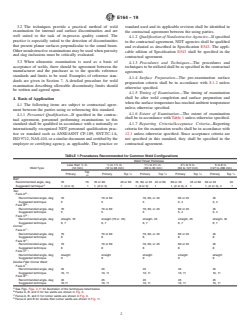
shall be in accordance with Table 1 unless otherwise specified.
tual agreement, personnel performing examinations to this
standard shall be qualified in accordance with a nationally or 4.1.7 Reporting Criteria/Acceptance Criteria—Reporting
criteria for the examination results shall be in accordance with
internationally recognized NDT personnel qualification prac-
tice or standard such as ANSI/ASNT CP-189, SNT-TC-1A, 12.1 unless otherwise specified. Since acceptance criteria are
ISO9712,NAS-410,orasimilardocumentandcertifiedbythe not specified in this standard, they shall be specified in the
employer or certifying agency, as applicable. The practice or contractual agreement.
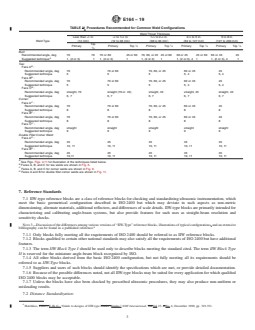
TABLE 1 Procedures Recommended for Common Weld Configurations
Weld Throat Thickness
1 1 1 1 1 1
Less than ⁄2 in. ⁄2 to 1 ⁄2 in. 1 ⁄2 to 2 ⁄2 in. 2 ⁄2to5in. 5to8in.
Weld Type (12 mm) (12to38mm) (38to63mm) (63 to 127 mm) (127 to 200 mm)
Top
1 1 1 1
Primary Primary Top ⁄4 Primary Top ⁄4 Primary Top ⁄4 Primary Top ⁄4
⁄4
Butt:
Recommended angle, deg 70 70 70 or 60 45 or 60 70, 60, or 45 45 or 60 60 or 45 45 or 60 60 or 45 45
A
Suggested technique 1, (2 or 3) 1 1, (2 or 3) 1 1, (2 or 3) 1 1, (2 or 3), 4 1 1, (2 or 3), 4 1
Tee:
B
Face A :
Recommended angle, deg 70 70 or 60 70, 60, or 45 60 or 45 45
Suggested technique 5 5 5 5, 4 5, 4
B
Face B :
Recommended angle, deg 70 70 or 60 70, 60, or 45 60 or 45 45
Suggested technique 5 5 5 5, 4 5, 4
B
Face C :
Recommended angle, deg straight, 70 straight (70 or 45) straight, 45 straight, 45 straight, 45
Suggested technique 6, 7 6, 7 6, 7 6, 7 6, 7
Corner:
C
Face A :
Recommended angle, deg 70 70 or 60 70, 60, or 45 60 or 45 45
Suggested technique 8 8 8 8 8
C
Face B :
Recommended angle, deg 70 70 or 60 70, 60, or 45 60 or 45 45
Suggested technique 8 8 8 8 8
C
Face C :
Recommended angle, deg straight straight straight straight straight
Suggested technique 9 9 9 9 9
Double Fillet Corner Weld:
D
Face A :
Recommended angle, deg 45 45 45 45 45
Suggested technique 10, 11 10, 11 10, 11 10, 11 10, 11
D
Face B :
Recommended angle, deg 45 45 45 45 45
Suggested technique 10,11 10, 11 10, 11 10, 11 10, 11
A
See Figs. Figs. 2-11 for illustration of the techniques listed below.
B
Faces A, B, and C for tee welds are shown in Fig. 6.
C
Faces A, B, and C for corner welds are shown in Fig. 9.
D
Faces A and B for double fillet corner welds are shown in Fig. 11.
E164−19
an extensive bibliography can be found in a published reference.
4.1.8 Reexamination of Repaired/Reworked Items—
Reexamination of repaired/reworked items is not addressed in
7.1.1 Only blocks fully meeting all the requirements of
this standard and if required shall be specified in the contrac-
ISO2400 should be referred to as IIW reference blocks.
tual agreement.
7.1.2 Blocks qualified to certain other national standards
may also satisfy all the requirements of ISO2400 but have
5. Search Units
additional features.
5.1 Angle-Beam requirements for angle-beam search units 7.1.3 The term IIW Block Type I should be used only to
are determined by the examination variables. The examination
describeblocksmeetingthestandardcited.Theterm IIW Block
procedure should be established by taking into consideration Type II is reserved for the miniature angle-beam block recog-
variables such as weld thickness, available surface, maximum
nized by ISO.
allowable flaw size, flaw orientation, and the acoustic proper- 7.1.4 All other blocks derived from the basic ISO2400
ties of the material. Consideration should also be given to the
configuration, but not fully meeting all its requirements should
desirability of using comparable wave lengths within the be referred to as IIW-Type blocks.
materials where both a longitudinal-wave examination and an
7.1.5 Suppliers and users of such blocks should identify the
angle-beamshear-waveexaminationareemployed.Thiscanbe specifications which are met, or provide detailed documenta-
accomplished by conducting the straight-beam (longitudinal- tion.
wave) examination at approximately two times the frequency 7.1.6 Because of the possible differences noted, not all
of the angle-beam (shear-wave) examination. IIW-type blocks may be suited for every application for which
qualified ISO2400 blocks may be acceptable.
5.2 Frequenciesof1.0to5MHzaregenerallyemployedfor
7.1.7 Unless the blocks have also been checked by pre-
angle-beam (shear-wave) and for straight-beam (longitudinal-
scribed ultrasonic procedures, they may also produce non-
wave) examination.
uniform or misleading results.
5.3 Transducer sizes recommended for weld examination
7.2 Distance Standardization:
1 1
range from a minimum of ⁄4in. (6.4mm) diameter or ⁄4in.
7.2.1 An equal-radius reflecting surface subtending an arc
squareto1in.(25.4mm)squareor1 ⁄8in.(28.6mm)diameter.
of 90° is recommended for distance standardization because it
is equally responsive to all beam angles. Other reflector
6. Standardization
configurations may be used. Equal-radius reflecting surfaces
6.1 Two methods of angle-beam standardization are in
are incorporated into IIW-Type Blocks and several other
generaluse:thepolar,andtherectangular,coordinatemethods.
reference blocks (see AnnexA1)(Note 3). Distance standard-
6.1.1 The polar coordinate method requires measurements
ization on a square-notch corner reflector with a depth of 1 to
ofthebeamcenterlineatthesearchunit/workinterfaceandthe
3% of thickness may be used. However, full beam reflections
beam angle in a reference block, and the instrument sweep is
from the square corner of the block will produce erroneous
standardized along the beam line. Examination information is
results when standardizing angle beams near 60°, due to mode
graphically converted into position and depth coordinates for
conversion. The square corner of the block should not be used
reflector location. The polar method is detailed in Annex A1.
for distance standardization.
6.1.2 The rectangular coordinate method requires measure-
mentofthepositionofthereflectorfromthefrontofthesearch NOTE 4—Small errors of beam index location are indigenous to the
standardizationprocedureusingtheanIIW-TypeBlock.Whereextremely
unit, and the instrument sweep is standardized for depth to the
accurate standardization is necessary, a procedure such as that outlined in
reflector as it is moved to different positions in the beam
7.2.2 should be used.
providing a distance-amplitude curve. Examination informa-
7.2.2 For examination of welds, a side-drilled hole may be
tion is read directly for position and depth to the reflector.The
used for distance, amplitude, position, and depth standardiza-
rectangular coordinate method is detailed in Annex A2.
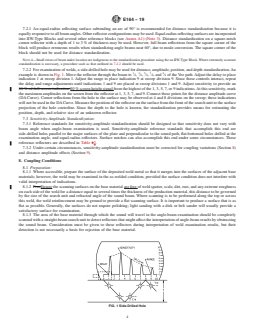
tion.AnexampleisshowninFig.1.Movethereflectorthrough
1 3 5 7 9
the beam to ⁄8, ⁄8, ⁄8, ⁄8, and ⁄8 of the Vee path. Adjust the
7. Reference Standards
delay to place indication 1 at sweep division 1. Adjust the
7.1 IIW-typereferenceblocksareaclassofreferenceblocks
range to place indication 9 at sweep division 9. Since these
for checking and standardizing ultrasonic instrumentation,
controls interact, repeat the delay and range adjustments until
which meet the basic geometrical configuration described in
indications 1 and 9 are placed at sweep divisions 1 and 9.
ISO2400butwhichmaydeviateinsuchaspectsasnon-metric
Adjustsensitivitytoprovidean80%screenheightsignalfrom
dimensioning, alternate materials, additional reflectors, and
thehighestofthe1,3,5,7,or9indications.Atthissensitivity,
differences of scale details. IIW-type blocks are primarily
markthemaximumamplitudesonthescreenfromthereflector
intended for characterizing and calibrating angle-beam
at 1, 3, 5, 7, and 9. Connect these points for the distance
systems, but also provide features for such uses as straight-
amplitude curve (DACurve). Corner reflections from the hole
beam resolution and sensitivity checks.
to the surface may be observed at 4 and 8 divisions on the
NOTE 3—Discussion of the differences among various versions of
sweep; these indications will not be used in the DA Curve.
“IIW-Type” reference blocks, illustrations of typical configurations, and
Measure the position of the reflector on the surface from the
Hotchkiss,F.H.C.,“GuidetodesignsofIIW-typeblocks,” NDT International,
Vol 23, No. 6, December 1990, pp. 319-331.
E164−19
ground to provide a flat scanning surface. It is important to
produce a surface that is as flat as possible. Generally, the
surfaces do not require polishing; light sanding with a disk or
belt sander will usually provide a satisfactory surface for
examination.
8.1.3 Theareaofthebasematerialthroughwhichthesound
will travel in the angle-beam examination should be com-
pletely scanned with a straight-beam search unit to detect
reflectors that might affect the interpretation of angle-beam
results by obstructing the sound beam. Consideration must be
given to these reflectors during interpretation of weld exami-
nation results, but their detection is not necessarily a basis for
rejection of the base material.
FIG. 1Side-Drilled Hole
8.2 Couplant:
8.2.1 Acouplant,usuallyaliquidorsemi-liquid,isrequired
front of the search unit to the surface projection of the hole
between the face of the search unit and the surface to permit
centerline. Since the depth to the hole is known, the standard-
transmission of the acoustic energy from the search unit to the
ization provides means for estimating the position, depth, and
material under examination. The couplant should wet the
relative size of an unknown reflector.
surfaces of the search unit and the piece, and eliminate any air
space between the two. Typical couplants include water, oil,
7.3 Sensitivity-Amplitude Standardization:
grease, glycerin, and cellulose gum. The couplant used should
7.3.1 Reference standards for sensitivity-amplitude stan-
not be injurious to the material to be examined, should form a
dardizationshouldbedesignedsothatsensitivitydoesnotvary
thin film, and, with the exception of water, should be used
with beam angle when angle-beam examination is used.
sparingly. When glycerin is used, a small amount of wetting
Sensitivity-amplitude reference standards that accomplish this
agent is often added to improve the coupling properties.When
end are side-drilled holes parallel to the major surfaces of the
water is used, it should be clean and de-aerated if possible.
plate and perpendicular to the sound path, flat-bottomed holes
Inhibitors or wetting agents, or both, may be used.
drilled at the examination angle, and equal-radius reflectors.
8.2.2 The coupling medium should be selected so that its
Surface notches can also accomplish this end under some
viscosity is appropriate for the surface finish of the material to
circumstances. These reference reflectors are described in
be examined. The following list is presented as a guide:
Table 2.
Roughness Average Equivalent Couplant
7.3.2 Under certain circumstances, sensitivity-amplitude
(Ra µin.) Viscosity
standardization must be corrected for coupling variations
(Section 8) and distance amplitude effects (Section 9).
5 to 100 SAE 10 wt. motor oil
50 to 200 SAE 20 wt. motor oil
8. Coupling Conditions 80 to 600 glycerin
100 to 400 SAE 30 wt. motor oil
8.1 Preparation:
8.2.3 In performing the examination, it is important that the
8.1.1 Whereaccessible,preparethesurfaceofthedeposited
samecouplant,atthesametemperature,beusedforcomparing
weld metal so that it merges into the surfaces of the adjacent
the responses between the standardization blocks and the
base materials; however, the weld may be examined in the
production material. Attenuation in couplants and wedge ma-
as-welded condition, provided the surface condition does not
terials varies with temperature so that a standardization per-
interfere with valid interpretation of indications.
formed in a comfortable room is not valid for examination of
8.1.2 Ensure the scanning surfaces on the base material are
either hotter or colder materials.
free of weld spatter, scale, dirt, rust, and any extreme rough-
ness on each side of the weld for a distance equal to several
9. Distance-Amplitude Correction
times the thickness of the production material, this distance to
be governed by the size of the search unit and refracted angle 9.1 Use standardization blocks of similar surface finish,
of the sound beam. Where scanning is to be performed along nominalthickness,andmetallurgicallysimilarintermsofalloy
the top or across this weld, the weld reinforcement may be and thermal treatment to the weldment.
TABLE 2 Reference Reflectors and Their Attributes
Reference Reflector Attributes and Limitations
Side-drilled holes Easily manufactured and reproducible. Equally reflective to different beam angles.
However, they bear negligible size relationship to most critical flaws.
Flat-bottom hole at examination angle Difficult to manufacture and requires good angular agreement of drilled hole with
examination angle.
Surface notches Square notches simulate cracks at surface. V-notch half-angle should complement beam
angle for maximum response.
E164−19
9.2 Alternative techniques of correction may be used pro-
vided the results are as reliable as those obtained by the
acceptable method. In addition, the alternative technique and
its equipment shall meet all the performance requirements of
this standard.
9.3 Reference Reflectors:
9.3.1 Straight-Beam Standardization—Correction for
straight-beam examination may be determined by means of a
1 3
side-drilled hole reflector at ⁄4 and ⁄4 of the thickness. For
1 FIG. 3Supplementary Technique 2, for Examining Butt Welds for
thickness less than 2 in. (51 mm), the ⁄4-thickness reflector
Suspected Cross-Cracking when the Weld Bead is Ground Flush
may not be resolved. If this is the case, drill another hole at ⁄2
1 3
thickness and use the ⁄2 and ⁄4-thickness reflectors for correc-
tion.
9.3.2 Angle-Beam Standardization—Correction for angle-
beamexaminationmaybedeterminedbymeansofside-drilled
1 3 1
hole reflectors at ⁄4 and ⁄4 of the thickness. The ⁄2-thickness
depthtoaside-drilledholemaybeaddedtothestandardization
or used alone at thicknesses less than 1 in. (25.4 mm).
9.4 Acceptable Techniques:
9.4.1 Distance-Amplitude Curve—This method makes use
ofstandardizationblocksrepresentingtheminimumandmaxi-
FIG. 4Supplementary Technique 3, for Examining Butt Welds for
mum thickness to be examined. Additional standardization
Suspected Cross-Cracking when the Weld Bead is not Ground
blocks of intermediate thicknesses can be used to obtain
Flush
additional data points. The ultrasonic instrument, search unit,
angle beam wedge, and couplant used for the distance-
amplitude standardization must also be used for the weld
examination.
9.4.1.1 Adjust the instrument to give an 80% screen height
signal on the A-scan display from the highest amplitude
obtained from the reference reflectors. Peak response from the
other reference reflectors with the same instrument settings,
and either record or mark on the screen the percent of screen
FIG. 5Two-Search-Unit Technique 4, for Use with Thick Weld-
height of the indication.
ments
9.4.1.2 Then use these recorded percentages to draw a
distance-amplitudecurveofpercentscreenheightversusdepth
or thickness on a chart or on the screen. During examination
FIG. 6Technique 5, for Examining the Weld Volume of T-Welds
the distance amplitude curve may be used to estimate indica-
tion amplitude in percent of the DA Curve.
9.4.2 Electronic Distance Amplitude Correction or Time-
Corrected Gain—This method can be used only if the instru-
ment is provided with electronic distance amplitude compen-
sation circuitry. Use is made of all reflectors in the
standardization range. The equipment, search unit, couplant,
etc.,tobeusedintheultrasonicexaminationaretobeusedfor
this attenuation adjustment.
9.4.2.1 Set the instrument to give a 50% screen height
signal on the A-scan display from the reference reflector that
FIG. 2Technique 1, for Examining Butt Welds with Angle Beams gives the highest amplitude.
E164−19
FIG. 9Technique 8, for Examining the Weld Volume of Double-
Vee Corner Welds
FIG. 7Technique 6, for Examining the Fusion Zone of T-Welds
8(a) Technique 7, for
Searching T-Welds for Discontinuities
FIG. 10Technique 9, for Examining the Fusion Zone of Double-
Vee Corner Welds
10.1.1 Special attention should be given to curved or
contoured surfaces to ensure consistent ultrasonic beam entry
angle and adequate coupling. Examine circumferential welds
using Techniques 12 and 13 (Fig. 12 and Fig. 13); examine
longitudinal welds using Techniques 14 and 15 (Fig. 14 and
Fig. 15). Base choice of angle both on the radius of curvature
FIG. 8(b) Alternative Technique 7, for Searching T-Welds for
andthethicknessofthematerialinordertoprovideabeamthat
Discontinuities
will travel through the material and reflect from the opposite
surface.
10.1.2 When more than one technique is given for a
9.4.2.2 Peak the response from each reference reflector at
particular weld geometry or thickness, or both, the first
otherdistanceswiththesameinstrumentsettings,adjustingthe
technique is considered primary, while the additional tech-
electronic distance amplitude correction controls to establish a
niquesaresupplementaryandmaybeaddedtotheexamination
50% screen height signal from the reference reflector at each
procedure.
successivethickness.Meansofaccomplishingtheequalization
of amplitude from equal-size reflectors over the distance range
11. Reflector Evaluation
is best described for each instrument in the operating manual
11.1 Reflector Location—When distance standardization
for that instrument.
has been achieved in accordance with 7.1, approximate reflec-
10. Examination Procedures tor location can be accomplished using the method of 7.1.2 or
a chart of the type shown in Fig. 16.
10.1 Examination procedures recommended for common
weld configurations are detailed in Table 1. 11.2 Reflector Size and Orientation:
E164−19
FIG. 11Techniques 10 and 11, for Examining Full-Penetration
NOTE 1—Search-unit shoes are machined to match the curvature of the
Double-Fillet Corner Welds
work piece when diameter is less than 20 in. (500 mm).
FIG. 13Supplementary Technique 13, for Examining Circumferen-
tial Welds, for Welds Ground Flush
NOTE 1—Search-unit shoes are machined to match the curvature of the
work piece when diameter is less than 20 in. (500 mm).
FIG. 12Technique 12, for Examining Circumferential Welds
NOTE 1—Search-unit shoes are machined to match the curvature of the
work piece when diameter is less than 20 in. (500 mm).
FIG. 14Technique 14, for Examining Longitudinal Welds
11.2.1 Geometrical Methods—Reflector length (L) ⁄4 in.
(6.4mm)minimumcanbemeasuredbydeterminingthepoints
at which half (6 dB) of the amplitude is lost at the extremities
of the reflector and measuring between them. Reflector height
based upon experience with actual flaws since artificially
⁄8 in. (3.2 mm) minimum can be measured by determining
producedreflectorsarenotalwaysdirectlyrelatabletorealflaw
∆SR(thechangeinsweepreading)atwhichhalf(6dB)ofthe
shapes or sizes. For adversely oriented planar flaws, the
amplitude is lost as the search unit (SU) is moved to and from
amplitude may not indicate flaw severity.
the reflector. The ∆SR×100 divided by tSR (through thick-
ness sweep reading) approximates the reflector height in 11.3 Reflector Type—In addition to the evaluation of loca-
percent of thickness. Only the area of the reflector that reflects tion and size of reflectors, there are several other attributes
energytothesearchunitismeasured.SeeFig.17.Thismethod which can be used to identify other types of reflectors. It must
is appropriate for reflectors with dimensions greater than the be emphasized that these methods are dependent on operator
beamdiameter.Forreflectorssmallerthanthebeam,significant skill to such a degree that acceptance of welds based upon this
errors may occur. type of information alone is not recommended.
11.2.2 Amplitude Methods—Signal amplitude can be used 11.3.1 Reflector Orientation—Reflector orientation can be
as a measure of flaw severity.Amplitude evaluation should be deduced from relative signal amplitudes obtained from the
E164−19
11.3.2 Reflector Shape—Reflector shape and roughness will
result in a characteristic degree of sharpness of the A-scan
display deflection depending upon the nature of the flaw, the
instrument, and search-unit combination used.
12. Report
12.1 The contracting parties should determine the pertinent
items to be recorded. This may include the following informa-
tion:
12.1.1 Weld types and configurations examined, including
thickness dimensions. Descriptive sketches are usually recom-
mended.
12.1.2 Automatic flaw alarm or recording equipment, or
both, if used.
12.1.3 Special search units, wedges, shoes, or saddles, if
used.
12.1.4 Rotating, revolving scanning mechanisms, if used.
12.1.5 Stage of manufacture at which examination was
NOTE 1—Search-unit shoes are machined to match the curvature of the
made.
work piece when diameter is less than 20 in. (500 mm).
12.1.6 Surface or surfaces from which the examination was
FIG. 15Supplementary Technique 15, for Examining Longitudinal
performed.
Welds, for Welds Ground Flush
12.1.7 Surface finish.
12.1.8 Couplant.
12.1.9 Method used.
12.1.10 Technique used.
12.1.11 Description of the standardization method and
method of correlating indications with flaws.
12.1.12 Scanning parameters such as raster pitch and direc-
tion of beam.
12.1.13 Mode of transmission including longitudinal or
shear, pulse-echo, tandem, or through transmission.
12.1.14 Type and size of transducer.
12.1.15 Examination frequency.
12.1.16 Instrument identification information.
12.1.17 Flaw description (depth, location, length, height,
amplitude, and character).
12.1.18 Name of operator.
FIG. 16Flaw Location Chart
12.1.19 Date of examination.
13. Keywords
reflector with the search unit placed at various locations on the 13.1 NDTofweldments;nondestructivetesting;ultrasonic
weldment. An example is shown in Fig. 18. contactexamination;ultrasonicNDTofweldments;weldments
E164−19
FIG. 17Reflector Size Evaluation
FIG. 18Determination of Reflector Orientation
ANNEXES
(Mandatory Information)
A1. INSTRUCTIONS FOR USE OF INTERNATIONAL INSTITUTE OF WELDING (IIW) TYPE REFERENCE BLOCKS AND
OTHER REFERENCE BLOCKS FOR ULTRASONIC TESTING
A1.1 Purpose A1.1.1.3 Confirm the stability and proper operation of the
equipment, or
A1.1.1 IIW Type Reference Blocks—To facilitate the adjust-
A1.1.1.4 Determine probe characteristics, such as their
ment and standardization of ultrasonic flaw-detecting equip-
sensitivity, and in the case of angle-beam search units, the
ment. The blocks can also be used to:
A1.1.1.1 Standardize the sweep length, locationofthebeamexitpoint(beamindex),thepathlengthin
A1.1.1.2 Adjust the pulse energy and amplification, the wedge, and the angle of refraction.
E164−19
A1.1.2 Supplementary Blocks—Blocks other than those de- caused by shear waves generated by the mode conversion of
rivedfromtheIIWReferenceBlock1,canbeusedfordistance the longitudinal waves and other reflections.
and sensitivity standardization. For details, see A1.5.
A1.3.2 Using an Angle-Beam Search Unit for a Sweep
Length from 4 to 10 in. (100 to 250 mm):
A1.2 Description
A1.3.2.1 Place the search unit in the position indicated in
A1.2.1 The recommended configuration for an IIW-Type
Fig.A1.5 and use the echoes obtained from the curved surface
reference block for use in this practice is shown in Fig. A1.1.
witharadiusof4in.(100mm)andthegroovewitharadiusof
Dimensions are given for a version in U.S. customary units,
1 in. (25 mm). The sweep-length setting most commonly used
and for a metric version based on IIW, ISO, and some national
is 10 in. (250 mm), whereby the screen pattern must be
standards. Material must be selected by the using parties.
standardized in such a way that the indication of the curved
Unless otherwise specified, a low carbon-steel such as UNS
surface appears at 4 in. and the pulse indication of the groove
G10180 is suggested. An optional cylindrical acrylic plastic
appears at 9 in. (225 m
...
This document is not an ASTM standard and is intended only to provide the user of an ASTM standard an indication of what changes have been made to the previous version. Because
it may not be technically possible to adequately depict all changes accurately, ASTM recommends that users consult prior editions as appropriate. In all cases only the current version
of the standard as published by ASTM is to be considered the official document.
Designation: E164 − 13 E164 − 19
Standard Practice for
Contact Ultrasonic Testing of Weldments
This standard is issued under the fixed designation E164; the number immediately following the designation indicates the year of
original adoption or, in the case of revision, the year of last revision. A number in parentheses indicates the year of last reapproval. A
superscript epsilon (´) indicates an editorial change since the last revision or reapproval.
This standard has been approved for use by agencies of the U.S. Department of Defense.
1. Scope*
1.1 This practice covers techniques for the ultrasonic A-scan examination of specific weld configurations joining wrought
ferrous or aluminum alloy materials to detect weld discontinuities (see Note 1). The reflection method using pulsed waves is
specified. Manual techniques are described employing contact of the search unit through a couplant film or water column.
1.2 This practice utilizes angle beams or straight beams, or both, depending upon the specific weld configurations. Practices for
special geometries such as fillet welds and spot welds are not included. The practice is intended to be used on thicknesses of 0.250
to 8 in. (6.4 to 203 mm).
NOTE 1—This practice is based on experience with ferrous and aluminum alloys. Other metallic materials can be examined using this practice provided
reference standards can be developed that demonstrate that the particular material and weld can be successfully penetrated by an ultrasonic beam.
NOTE 2—For additional pertinent information see Practice E317, Terminology E1316, and Practice E587.
1.3 The values stated in inch-pound units are to be regarded as standard. The values given in parentheses are mathematical
conversions to SI units that are provided for information only and are not considered standard.
1.4 This standard does not purport to address all of the safety concerns, if any, associated with its use. It is the responsibility
of the user of this standard to establish appropriate safety safety, health, and healthenvironmental practices and determine the
applicability of regulatory limitations prior to use.
1.5 This international standard was developed in accordance with internationally recognized principles on standardization
established in the Decision on Principles for the Development of International Standards, Guides and Recommendations issued
by the World Trade Organization Technical Barriers to Trade (TBT) Committee.
2. Referenced Documents
2.1 ASTM Standards:
E317 Practice for Evaluating Performance Characteristics of Ultrasonic Pulse-Echo Testing Instruments and Systems without the
Use of Electronic Measurement Instruments
E543 Specification for Agencies Performing Nondestructive Testing
E587 Practice for Ultrasonic Angle-Beam Contact Testing
E1316 Terminology for Nondestructive Examinations
2.2 ASNT Document:
Recommended Practice SNT-TC-1A Personnel Qualification and Certification in Nondestructive Testing
2.3 ANSI/ASNT Standard:
ANSI/ASNT CP-189 ASNT Standard for Qualification and Certification of Nondestructive Testing Personnel
2.4 ISO Standard:Standards:
ISO 2400 Reference Block for the Calibration of Equipment for Ultrasonic Examination
ISO 9712 Qualification and Certification of NDT Personnel
2.5 AIA Standard:
NAS-410 Certification and Qualification of Nondestructive Testing Personnel
This practice is under the jurisdiction of ASTM Committee E07 on Nondestructive Testing and is the direct responsibility of Subcommittee E07.06 on Ultrasonic Method.
Current edition approved June 1, 2013Feb. 1, 2019. Published June 2013March 2019. Originally approved in 1960. Last previous edition approved in 20082013 as
E164 - 08.E164 – 13. DOI: 10.1520/E0164-13.10.1520/E0164-19.
For referenced ASTM standards, visit the ASTM website, www.astm.org, or contact ASTM Customer Service at service@astm.org. For Annual Book of ASTM Standards
volume information, refer to the standard’s Document Summary page on the ASTM website.
Available from The American Society for Nondestructive Testing (ASNT), P.O. Box 28518, 1711 Arlingate Ln., Columbus, OH 43228-0518.43228-0518,
http://www.asnt.org.
Available from American National Standards Institute (ANSI), 25 W. 43rd St., 4th Floor, New York, NY 10036.10036, http://www.ansi.org.
Available from Aerospace Industries Association of America, Inc. (AIA), 1000 Wilson Blvd., Suite 1700, Arlington, VA 22209-3928, http://www.aia-aerospace.org.
*A Summary of Changes section appears at the end of this standard
Copyright © ASTM International, 100 Barr Harbor Drive, PO Box C700, West Conshohocken, PA 19428-2959. United States
E164 − 19
3. Significance and Use
3.1 The techniques for ultrasonic examination of welds described in this practice are intended to provide a means of weld
examination for both internal and surface discontinuities within the weld and the heat-affected zone. The practice is limited to the
examination of specific weld geometries in wrought or forged material.
3.2 The techniques provide a practical method of weld examination for internal and surface discontinuities and are well suited
to the task of in-process quality control. The practice is especially suited to the detection of discontinuities that present planar
surfaces perpendicular to the sound beam. Other nondestructive examinations may be used when porosity and slag inclusions must
be critically evaluated.
3.3 When ultrasonic examination is used as a basis of acceptance of welds, there should be agreement between the manufacturer
and the purchaser as to the specific reference standards and limits to be used. Examples of reference standards are given in Section
7. A detailed procedure for weld examination describing allowable discontinuity limits should be written and agreed upon.
4. Basis of Application
4.1 The following items are subject to contractual agreement between the parties using or referencing this standard.
4.1.1 Personnel Qualification—If specified in the contractual agreement, personnel performing examinations to this standard
shall be qualified in accordance with a nationally or internationally recognized NDT personnel qualification practice or standard
such as ANSI/ASNT CP-189, Recommended Practice SNT-TC-1A, SNT-TC-1A, ISO 9712, NAS-410, or a similar document and
certified by the employer or certifying agency, as applicable. The practice or standard used and its applicable revision shall be
identified in the contractual agreement between the using parties.
4.1.2 Qualification of Nondestructive Agencies—If specified in the contractual agreement, NDT agencies shall be qualified and
evaluated as described in Specification E543. The applicable edition of Specification E543 shall be specified in the contractual
agreement.
4.1.3 Procedures and Techniques—The procedures and techniques to be utilized shall be as specified in the contractual
agreement.
4.1.4 Surface Preparation—The pre-examination surface preparation criteria shall be in accordance with 8.1.2 unless otherwise
specified.
4.1.5 Timing of Examination—The timing of examination shall be after weld completion and surface preparation and when the
surface temperature has reached ambient temperature unless otherwise specified.
4.1.6 Extent of Examination—The extent of examination shall be in accordance with TableTable 1 2 unless otherwise specified.
4.1.7 Reporting Criteria/Acceptance Criteria—Reporting criteria for the examination results shall be in accordance with 12.1
unless otherwise specified. Since acceptance criteria are not specified in this standard, they shall be specified in the contractual
agreement.
4.1.8 Reexamination of Repaired/Reworked Items—Reexamination of repaired/reworked items is not addressed in this standard
and if required shall be specified in the contractual agreement.
5. Search Units
5.1 Angle-Beam requirements for angle-beam search units are determined by the testexamination variables. The examination
procedure should be established by taking into consideration variables such as weld thickness, available surface, maximum
allowable flaw size, flaw orientation, and the acoustic properties of the material. Consideration should also be given to the
desirability of using comparable wave lengths within the materials where both a longitudinal-wave examination and an angle-beam
shear-wave examination are employed. This can be accomplished by conducting the straight-beam (longitudinal-wave)
examination at approximately two times the frequency of the angle-beam (shear-wave) examination.
5.2 Frequencies of 1.0 to 5 MHz are generally employed for angle-beam (shear-wave) and for straight-beam (longitudinal-
wave) examination.
5.3 Transducer sizes recommended for weld examination range from a minimum of ⁄4-in. (6.4-mm) in. (6.4 mm) diameter or
1 1
⁄4-in. in. square to 1 in. (25.4 mm) square or 1 ⁄8-in. (28.6-mm) in. (28.6 mm) diameter.
6. Standardization
6.1 Two methods of angle-beam standardization are in general use: the polar, and the rectangular, coordinate methods.
6.1.1 The polar coordinate method requires measurements of the beam centerline at the search unit/work interface and the beam
angle in a reference block, and the instrument sweep is standardized along the beam line. TestExamination information is
graphically converted into position and depth coordinates for reflector location. The polar method is detailed in Annex A1.
6.1.2 The rectangular coordinate method requires measurement of the position of the reflector from the front of the search unit,
and the instrument sweep is standardized for depth to the reflector as it is moved to different positions in the beam providing a
distance-amplitude curve. TestExamination information is read directly for position and depth to the reflector. The rectangular
coordinate method is detailed in Annex A2.
E164 − 19
TABLE 21 Procedures Recommended for Common Weld Configurations
Weld Throat Thickness
1 1 1 1 1 1
Less than ⁄2 in. ⁄2 to 1 ⁄2 in. 1 ⁄2 to 2 ⁄2 in. 2 ⁄2 to 5 in. 5 to 8 in.
Weld Type (12 mm) (12 to 38 mm) (38 to 63 mm) (63 to 127 mm) (127 to 200 mm)
Top
1 1 1 1
Primary Primary Top ⁄4 Primary Top ⁄4 Primary Top ⁄4 Primary Top ⁄4
⁄4
Butt:
Recommended angle, deg 70 70 70 or 60 45 or 60 70, 60, or 45 45 or 60 60 or 45 45 or 60 60 or 45 45
A
Suggested technique 1, (2 or 3) 1 1, (2 or 3) 1 1, (2 or 3) 1 1, (2 or 3), 4 1 1, (2 or 3), 4 1
Tee:
B
Face A :
Recommended angle, deg 70 70 or 60 70, 60, or 45 60 or 45 45
Suggested technique 5 5 5 5, 4 5, 4
B
Face B :
Recommended angle, deg 70 70 or 60 70, 60, or 45 60 or 45 45
Suggested technique 5 5 5 5, 4 5, 4
B
Face C :
Recommended angle, deg straight, 70 straight (70 or 45) straight, 45 straight, 45 straight, 45
Suggested technique 6, 7 6, 7 6, 7 6, 7 6, 7
Corner:
C
Face A :
Recommended angle, deg 70 70 or 60 70, 60, or 45 60 or 45 45
Suggested technique 8 8 8 8 8
C
Face B :
Recommended angle, deg 70 70 or 60 70, 60, or 45 60 or 45 45
Suggested technique 8 8 8 8 8
C
Face C :
Recommended angle, deg straight straight straight straight straight
Suggested technique 9 9 9 9 9
Double Fillet Corner Weld:
D
Face A :
Recommended angle, deg 45 45 45 45 45
Suggested technique 10, 11 10, 11 10, 11 10, 11 10, 11
D
Face B :
Recommended angle, deg 45 45 45 45 45
Suggested technique 10,11 10, 11 10, 11 10, 11 10, 11
A
See Figs. Figs. 2-11 for illustration of the techniques listed below.
B
Faces A, B, and C for tee welds are shown in Fig. 6.
C
Faces A, B, and C for corner welds are shown in Fig. 9.
D
Faces A and B for double fillet corner welds are shown in Fig. 11.
7. Reference Standards
7.1 IIW-type reference blocks are a class of reference blocks for checking and standardizing ultrasonic instrumentation, which
meet the basic geometrical configuration described in ISO 2400 but which may deviate in such aspects as non-metric
dimensioning, alternate materials, additional reflectors, and differences of scale details. IIW-type blocks are primarily intended for
characterizing and calibrating angle-beam systems, but also provide features for such uses as straight-beam resolution and
sensitivity checks.
NOTE 3—Discussion of the differences among various versions of “IIW-Type” reference blocks, illustrations of typical configurations, and an extensive
bibliography can be found in a published reference.
7.1.1 Only blocks fully meeting all the requirements of ISO 2400 should be referred to as IIW reference blocks.
7.1.2 Blocks qualified to certain other national standards may also satisfy all the requirements of ISO 2400 but have additional
features.
7.1.3 The term IIW Block Type I should be used only to describe blocks meeting the standard cited. The term IIW Block Type
II is reserved for the miniature angle-beam block recognized by ISO.
7.1.4 All other blocks derived from the basic ISO 2400 configuration, but not fully meeting all its requirements should be
referred to as IIW-Type blocks.
7.1.5 Suppliers and users of such blocks should identify the specifications which are met, or provide detailed documentation.
7.1.6 Because of the possible differences noted, not all IIW-type blocks may be suited for every application for which qualified
ISO 2400 blocks may be acceptable.
7.1.7 Unless the blocks have also been checked by prescribed ultrasonic procedures, they may also produce non-uniform or
misleading results.
7.2 Distance Standardization:
Hotchkiss, F.H.C., F. H. C., “Guide to designs of IIW-type blocks”,blocks,” NDT International, Vol.Vol 23, n.No. 6, December 1990, pp. 319-331.
E164 − 19
7.2.1 An equal-radius reflecting surface subtending an arc of 90° is recommended for distance standardization because it is
equally responsive to all beam angles. Other reflector configurations may be used. Equal-radius reflecting surfaces are incorporated
into IIW-Type Blocks and several other reference blocks (see Annex A1) (Note 3). Distance standardization on a square-notch
corner reflector with a depth of 1 to 3 % of thickness may be used. However, full beam reflections from the square corner of the
block will produce erroneous results when standardizing angle beams near 60°, due to mode conversion. The square corner of the
block should not be used for distance standardization.
NOTE 4—Small errors of beam index location are indigenous to the standardization procedure using the an IIW-Type Block. Where extremely accurate
standardization is necessary, a procedure such as that outlined in 7.2.2 should be used.
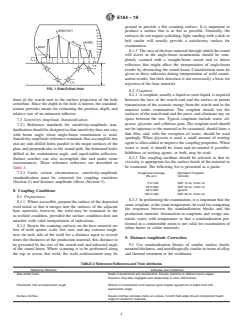
7.2.2 For examination of welds, a side-drilled hole may be used for distance, amplitude, position, and depth standardization. An
1 3 5 7 9
example is shown in Fig. 1. Move the reflector through the beam to ⁄8, ⁄8, ⁄8, ⁄8, and ⁄8 of the Vee path. Adjust the delay to place
indication 1 at sweep division 1. Adjust the range to place indication 9 at sweep division 9. Since these controls interact, repeat
the delay and range adjustments until indications 1 and 9 are placed at sweep divisions 1 and 9. Adjust sensitivity to provide an
80 %-of-full-screen indication 80 % screen height signal from the highest of the 1, 3, 5, 7, or 9 indications. At this sensitivity, mark
the maximum amplitudes on the screen from the reflector at 1, 3, 5, 7, and 9. Connect these points for the distance amplitude curve
(DA Curve). Corner reflections from the hole to the surface may be observed at 4 and 8 divisions on the sweep; these indications
will not be used in the DA Curve. Measure the position of the reflector on the surface from the front of the search unit to the surface
projection of the hole centerline. Since the depth to the hole is known, the standardization provides means for estimating the
position, depth, and relative size of an unknown reflector.
7.3 Sensitivity-Amplitude Standardization:
7.3.1 Reference standards for sensitivity-amplitude standardization should be designed so that sensitivity does not vary with
beam angle when angle-beam examination is used. Sensitivity-amplitude reference standards that accomplish this end are
side-drilled holes parallel to the major surfaces of the plate and perpendicular to the sound path, flat-bottomed holes drilled at the
examination angle, and equal-radius reflectors. Surface notches can also accomplish this end under some circumstances. These
reference reflectors are described in Table 12.
7.3.2 Under certain circumstances, sensitivity-amplitude standardization must be corrected for coupling variations (Section 8)
and distance amplitude effects (Section 9).
8. Coupling Conditions
8.1 Preparation:
8.1.1 Where accessible, prepare the surface of the deposited weld metal so that it merges into the surfaces of the adjacent base
materials; however, the weld may be examined in the as-welded condition, provided the surface condition does not interfere with
valid interpretation of indications.
8.1.2 FreeEnsure the scanning surfaces on the base material are free of weld spatter, scale, dirt, rust, and any extreme roughness
on each side of the weld for a distance equal to several times the thickness of the production material, this distance to be governed
by the size of the search unit and refracted angle of the sound beam. Where scanning is to be performed along the top or across
this weld, the weld reinforcement may be ground to provide a flat scanning surface. It is important to produce a surface that is as
flat as possible. Generally, the surfaces do not require polishing; light sanding with a disk or belt sander will usually provide a
satisfactory surface for examination.
8.1.3 The area of the base material through which the sound will travel in the angle-beam examination should be completely
scanned with a straight-beam search unit to detect reflectors that might affect the interpretation of angle-beam results by obstructing
the sound beam. Consideration must be given to these reflectors during interpretation of weld examination results, but their
detection is not necessarily a basis for rejection of the base material.
FIG. 1 Side-Drilled Hole
E164 − 19
TABLE 12 Reference Reflectors and Their Attributes
Reference Reflector Attributes and Limitations
Side-drilled holes Easily manufactured and reproducible. Equally reflective to different beam angles.
However, they bear negligible size relationship to most critical flaws.
Flat-bottom hole at examination angle Difficult to manufacture and requires good angular agreement of drilled hole with
examination
angle.
Surface notches Square notches simulate cracks at surface. V-notch half-angle should complement beam
angle for maximum response.
8.2 Couplant:
8.2.1 A couplant, usually a liquid or semi-liquid, is required between the face of the search unit and the surface to permit
transmission of the acoustic energy from the search unit to the material under examination. The couplant should wet the surfaces
of the search unit and the piece, and eliminate any air space between the two. Typical couplants include water, oil, grease, glycerin,
and cellulose gum. The couplant used should not be injurious to the material to be examined, should form a thin film, and, with
the exception of water, should be used sparingly. When glycerin is used, a small amount of wetting agent is often added to improve
the coupling properties. When water is used, it should be clean and de-aerated if possible. Inhibitors or wetting agents, or both,
may be used.
8.2.2 The coupling medium should be selected so that its viscosity is appropriate for the surface finish of the material to be
examined. The following list is presented as a guide:
Roughness Average Equivalent Couplant
(Ra μin.) Viscosity
5 to 100 SAE 10 wt. motor oil
50 to 200 SAE 20 wt. motor oil
80 to 600 glycerin
100 to 400 SAE 30 wt. motor oil
8.2.3 In performing the examination, it is important that the same couplant, at the same temperature, be used for comparing the
responses between the standardization blocks and the production material. Attenuation in couplants and wedge materials varies
with temperature so that a standardization performed in a comfortable room is not valid for examination of either hotter or colder
materials.
9. Distance-Amplitude Correction
9.1 Use standardization blocks of similar surface finish, nominal thickness, and metallurgically similar in terms of alloy and
thermal treatment to the weldment.
9.2 Alternative techniques of correction may be used provided the results are as reliable as those obtained by the acceptable
method. In addition, the alternative technique and its equipment shall meet all the performance requirements of this standard.
9.3 Reference Reflectors:
9.3.1 Straight-Beam Standardization—Correction for straight-beam examination may be determined by means of a side-drilled
1 3 1
hole reflector at ⁄4 and ⁄4 of the thickness. For thickness less than 2 in. (51 mm), the ⁄4-thickness reflector may not be resolved.
1 1 3
If this is the case, drill another hole at ⁄2 thickness and use the ⁄2 and ⁄4-thickness reflectors for correction.
9.3.2 Angle-Beam Standardization—Correction for angle-beam examination may be determined by means of side-drilled hole
1 3 1
reflectors at ⁄4 and ⁄4 of the thickness. The ⁄2-thickness depth to a side-drilled hole may be added to the standardization or used
alone at thicknesses less than 1 in. (25.4 mm).
9.4 Acceptable Techniques:
9.4.1 Distance-Amplitude Curve—This method makes use of standardization blocks representing the minimum and maximum
thickness to be examined. Additional standardization blocks of intermediate thicknesses can be used to obtain additional data
points. The ultrasonic instrument, search unit, angle beam wedge, and couplant used for the distance-amplitude standardization
must also be used for the weld examination.
9.4.1.1 SetAdjust the instrument to give an 80 % screen height signal on the A-scan display from the highest amplitude obtained
from the reference reflectors. Peak response from the other reference reflectors with the same instrument settings, and either record
or mark on the screen the percent of screen height of the indication.
9.4.1.2 Then use these recorded percentages to draw a distance-amplitude curve of percent screen height versus depth or
thickness on a chart or on the screen. During examination the distance amplitude curve may be used to estimate indication
amplitude in percent of the DA Curve.
9.4.2 Electronic Distance Amplitude Correction or Time-Corrected Gain—This method can be used only if the instrument is
provided with electronic distance amplitude compensation circuitry. Use is made of all reflectors in the standardization range. The
equipment, search unit, couplant, etc., to be used in the ultrasonic examination are to be used for this attenuation adjustment.
E164 − 19
FIG. 2 Technique 1, for Examining Butt Welds with Angle Beams
FIG. 3 Supplementary Technique 2, for Examining Butt Welds for Suspected Cross-Cracking when the Weld Bead is Ground Flush
FIG. 4 Supplementary Technique 3, for Examining Butt Welds for Suspected Cross-Cracking when the Weld Bead is not Ground Flush
FIG. 5 Two-Search-Unit Technique 4, for Use with Thick Weldments
9.4.2.1 Set the instrument to give a 50 % amplitude screen height signal on the A-scan display from the reference reflector that
gives the highest amplitude.
9.4.2.2 Peak the response from each reference reflector at other distances with the same instrument settings, adjusting the
electronic distance amplitude correction controls to establish a 50 % screen height signal from the reference reflector at each
successive thickness. Means of accomplishing the equalization of amplitude from equal-size reflectors over the distance range is
best described for each instrument in the operating manual for that instrument.
E164 − 19
FIG. 6 Technique 5, for Examining the Weld Volume of T-Welds
FIG. 7 Technique 6, for Examining the Fusion Zone of T-Welds
10. Examination Procedures
10.1 Examination procedures recommended for common weld configurations are detailed in Table 21.
10.1.1 Special attention should be given to curved or contoured surfaces to ensure consistent ultrasonic beam entry angle and
adequate coupling. Examine circumferential welds using Techniques 12 and 13 (Fig. 12 and Fig. 13); examine longitudinal welds
using Techniques 14 and 15 (Fig. 14 and Fig. 15). Base choice of angle both on the radius of curvature and the thickness of the
material in order to provide a beam that will travel through the material and reflect from the opposite surface.
10.1.2 When more than one technique is given for a particular weld geometry or thickness, or both, the first technique is
considered primary, while the additional techniques are supplementary and may be added to the examination procedure.
11. Reflector Evaluation
11.1 Reflector Location—When distance standardization has been achieved in accordance with 7.1, approximate reflector
location can be accomplished using the method of 7.1.2 or a chart of the type shown in Fig. 16.
11.2 Reflector Size and Orientation:
11.2.1 Geometrical Methods—Reflector length (L) ⁄4 in. (6.4 mm) minimum can be measured by determining the points at
which half (6 dB) of the amplitude is lost at the extremities of the reflector and measuring between them. Reflector height ⁄8 in.
(3.2 mm) minimum can be measured by determining Δ SR Δ SR (the change in sweep reading) at which half (6 dB) of the
amplitude is lost as the search unit (SU) is moved to and from the reflector. The Δ SR × 100 Δ SR × 100 divided by tSR (through
thickness sweep reading) approximates the reflector height in percent of thickness. Only the area of the reflector that reflects energy
to the search unit is measured. See Fig. 17. This method is appropriate for reflectors with dimensions greater than the beam
diameter. For reflectors smaller than the beam, significant errors may occur.
11.2.2 Amplitude Methods—Signal amplitude can be used as a measure of flaw severity. Amplitude evaluation should be based
upon experience with actual flaws since artificially produced reflectors are not always directly relatable to real flaw shapes or sizes.
For adversely oriented planar flaws, the amplitude may not indicate flaw severity.
11.3 Reflector Type—In addition to the evaluation of location and size of reflectors, there are several other attributes which can
be used to identify other types of reflectors. It must be emphasized that these methods are dependent on operator skill to such a
degree that acceptance of welds based upon this type of information alone is not recommended.
11.3.1 Reflector Orientation—Reflector orientation can be deduced from relative signal amplitudes obtained from the reflector
with the search unit placed at various locations on the weldment. An example is shown in Fig. 18.
E164 − 19
8(a) Technique 7, for
Searching T-Welds for Discontinuities
FIG. 8 (b) Alternative Technique 7, for Searching T-Welds for Discontinuities
FIG. 9 Technique 8, for Examining the Weld Volume of Double-Vee Corner Welds
11.3.2 Reflector Shape—Reflector shape and roughness will result in a characteristic degree of sharpness of the A-scan display
deflection depending upon the nature of the flaw, the instrument, and search-unit combination used.
12. Report
12.1 The contracting parties should determine the pertinent items to be recorded. This may include the following information:
12.1.1 Weld types and configurations tested,examined, including thickness dimensions. Descriptive sketches are usually
recommended.
12.1.2 Automatic flaw alarm or recording equipment, or both, if used.
12.1.3 Special search units, wedges, shoes, or saddles, if used.
12.1.4 Rotating, revolving scanning mechanisms, if used.
12.1.5 Stage of manufacture at which examination was made.
12.1.6 Surface or surfaces from which the examination was performed.
12.1.7 Surface finish.
E164 − 19
FIG. 10 Technique 9, for Examining the Fusion Zone of Double-Vee Corner Welds
FIG. 11 Techniques 10 and 11, for Examining Full-Penetration Double-Fillet Corner Welds
12.1.8 Couplant.
12.1.9 Method used.
12.1.10 Technique used.
12.1.11 Description of the standardization method and method of correlating indications with flaws.
12.1.12 Scanning parameters such as raster pitch and direction of beam.
12.1.13 Mode of transmission including longitudinal or shear, pulse-echo, tandem, or through transmission.
12.1.14 Type and size of transducer.
12.1.15 Examination frequency.
12.1.16 Instrument identification information.
12.1.17 Flaw description (depth, location, length, height, amplitude, and character).
12.1.18 Name of operator.
12.1.19 Date of examination.
13. Keywords
13.1 NDT of weldments; nondestructive testing; ultrasonic contact examination; ultrasonic NDT of weldments; weldments
E164 − 19
NOTE 1—Search-unit shoes are machined to match the curvature of the
NOTE 1—Search-unit shoes are machined to match the curvature of the
work piece when diameter is less than 20 in. (500 mm).
work piece when diameter is less than 20 in. (500 mm).
FIG. 12 Technique 12, for Examining Circumferential Welds
FIG. 14 Technique 14, for Examining Longitudinal Welds
NOTE 1—Search-unit shoes are machined to match the curvature of the
NOTE 1—Search-unit shoes are machined to match the curvature of the
work piece when diameter is less than 20 in. (500 mm).
work piece when diameter is less than 20 in. (500 mm).
FIG. 15 Supplementary Technique 15, for Examining Longitudinal
FIG. 13 Supplementary Technique 13, for Examining Circumferen-
Welds, for Welds Ground Flush
tial Welds, for Welds Ground Flush
E164 − 19
FIG. 16 Flaw Location Chart
E164 − 19
FIG. 17 Reflector Size Evaluation
FIG. 18 Determination of Reflector Orientation
ANNEXES
(Mandatory Information)
A1. INSTRUCTIONS FOR USE OF INTERNATIONAL INSTITUTE OF WELDING (IIW) TYPE REFERENCE BLOCKS AND
OTHER REFERENCE BLOCKS FOR ULTRASONIC TESTING
A1.1 Purpose
A1.1.1 IIW Type Reference Blocks—To facilitate the adjustment and standardization of ultrasonic flaw-detecting equipment. The
blocks can also be used to:
A1.1.1.1 Standardize the sweep length,
A1.1.1.2 Adjust the pulse energy and amplification,
E164 − 19
A1.1.1.3 Confirm the stability and proper operation of the equipment, or
A1.1.1.4 Determine probe characteristics, such as their sensitivity, and in the case of angle-beam search units, the location of the
beam exit point (beam index), the path length in the wedge, and the angle of refraction.
A1.1.2 Supplementary Blocks—Blocks other than those derived from the IIW Reference Block 1, can be used for distance and
sensitivity standardization. For details, see A1.5.
A1.2 Description
A1.2.1 The recommended configuration for an IIW-Type reference block for use in this practice is shown in Fig. A1.1. Dimensions
are given for a version in U.S. customary units, and for a metric version based on IIW, ISO, and some national standards. Material
must be selected by the using parties. Unless otherwise specified, a low carbon-steel such as UNS G10180 is suggested. An
optional cylindrical acrylic plastic disk may be permanently mounted in the 2 in. (50 mm) diameter hole; it is not required for this
practice.
NOTE A1.1—If the disk is provided it shall meet these requirements:
material—polymethylmethacrylate resin
thickness—0.920 6 0.005 in. (23 6 0.1 mm)
surfaces—polished, flat within 0.002 in. (0.5 mm)
one surface to be mounted flush with a block face
A1.3 Distance Standardization
A1.3.1 Straight-Beam Longitudinal Wave:
A1.3.1.1 When standardizing the horizontal distance or sweep-length scale, adjust the multiple echoes obtained from a known
length of the reference block in such a way that the leading edges of the echoes (the left-hand side) coincide with the required
divisions of the horizontal scale. In most instances, utilization of the highest possible frequency is recomme
...