

ASTM G58-85(2023)
(Practice)Standard Practice for Preparation of Stress-Corrosion Test Specimens for Weldments
General Information
- Abstract
SIGNIFICANCE AND USE
4.1 The intent of this practice is to indicate standard welded specimens and welding procedures for evaluating the SCC characteristics of weldments in corrosive environments. The practice does not recommend the specific corrosive media that may be selected by the user depending upon the intent of his investigation. Specific corrosive media are included in Practices G35, G36, G37, and G44. Other environments can be used as required.
SCOPE
1.1 This practice covers procedures for the making and utilization of test specimens for the evaluation of weldments in stress-corrosion cracking (SCC) environments.
1.2 Test specimens are described in which (a) stresses are developed by the welding process only, (b) stresses are developed by an externally applied load in addition to the stresses due to welding, and (c) stresses are developed by an externally applied load only with residual welding stresses removed by annealing.
1.3 This practice is concerned only with the welded test specimen and not with the environmental aspects of stress-corrosion testing. Specific practices for the bending and loading of test specimens, as well as the stress considerations involved in preparation of C-rings, U-bend, bent-beam, and tension specimens are discussed in other ASTM standards.
1.4 The actual stress in test specimens removed from weldments is not precisely known because it depends upon the level of residual stress from the welding operation combined with the applied stress. A method for determining the magnitude and direction of residual stress which may be applicable to weldment is described in Test Method E837. The reproducibility of test results is highly dependent on the preparation of the weldment, the type of test specimen tested, and the evaluation criteria used. Sufficient replication should be employed to determine the level of inherent variability in the specific test results that is consistent with the objectives of the test program.
1.5 This standard does not purport to address all of the safety concerns, if any, associated with its use. It is the responsibility of the user of this standard to establish appropriate safety, health, and environmental practices and determine the applicability of regulatory limitations prior to use. (For more specific safety hazards information, see Section 7.)
1.6 This international standard was developed in accordance with internationally recognized principles on standardization established in the Decision on Principles for the Development of International Standards, Guides and Recommendations issued by the World Trade Organization Technical Barriers to Trade (TBT) Committee.
- Status
- Published
- Publication Date
- 30-Nov-2023
- Technical Committee
- G01 - Corrosion of Metals
- Drafting Committee
- G01.06 - Environmentally Assisted Cracking
Overview
ASTM G58-85(2023), Standard Practice for Preparation of Stress-Corrosion Test Specimens for Weldments, defines standardized procedures for preparing and utilizing test specimens to evaluate the stress-corrosion cracking (SCC) behavior of weldments in corrosive environments. Developed by ASTM International, this standard aims to ensure consistency and reproducibility in weldment testing, enabling reliable assessment of SCC susceptibility across a wide range of materials and welding procedures.
The document focuses exclusively on the preparation and usage of welded test specimens - not on the selection of testing environments or corrosive media. Decisions regarding corrosive environments are the responsibility of users and may be guided by other specific ASTM standards. ASTM G58 is recognized internationally according to the World Trade Organization’s established standardization principles.
Key Topics
- Types of Welded Specimens: The standard covers preparation methods for various specimen forms, including flat weldments, circular beads, bead-on-bar, direct tension specimens, U-bend, bent-beam, pre-cracked cantilever beams, tuning fork, cruciform weldments, C-ring, slit tubing, and K-weld preparations.
- Stress Development: Describes test specimens with stress generated by welding alone, by a combination of welding and external loads, or by external loads with weld-induced residual stress removed through annealing.
- Weldment Preparation: Details on specimen removal methods, ensuring weldments maintain essential residual stresses for accurate evaluation. Guidelines also address appropriate surface finishing, identification of grain direction, and tolerance for weld ends or joints.
- Welding Considerations: Emphasizes the impact of welding variables - including process, heat input, shielding, composition variations, contamination, and defect introduction - on SCC susceptibility and results consistency.
- Inspection and Documentation: Outlines post-exposure inspection criteria such as crack initiation, crack location and type, microstructural examination, and thorough documentation of welding and test parameters for traceability and repeatability.
Applications
ASTM G58 is used across industries where welded structures encounter corrosive environments, such as construction, oil and gas, energy generation, shipbuilding, chemical processing, and transportation. Practical applications include:
- Material Qualification: Determining the SCC resistance of new weld procedures, consumables, or base metals to ensure serviceability in harsh chemical or marine settings.
- Failure Analysis: Investigating in-service failures related to weldment cracking by replicating field conditions under controlled laboratory stress-corrosion testing.
- Process Optimization: Comparing alternative welding methods and post-weld heat treatments to identify processes that minimize residual stresses and improve long-term durability.
- Compliance and Quality Assurance: Supporting internal quality systems and regulatory requirements with proven, reproducible SCC testing methodology.
By employing standardized test specimen forms and preparation procedures, organizations ensure consistent, comparable results that help mitigate the risk of weld-related SCC in critical infrastructure.
Related Standards
ASTM G58 references and complements a variety of other ASTM standards relevant to stress-corrosion testing:
Corrosive Media Selection:
- ASTM G35: Stainless steels and related alloys in polythionic acids
- ASTM G36: Metals and alloys in boiling magnesium chloride
- ASTM G37: Copper-zinc alloys in Mattsson’s solution
- ASTM G44: Exposure in 3.5% NaCl solution
Test Methodologies:
- ASTM E8: Tension testing of metallic materials
- ASTM E399: Linear-elastic plane-strain fracture toughness
- ASTM E837: Determining residual stresses by the hole-drilling strain-gage method
- ASTM G1, G30, G38, G39, G49: Various stress-corrosion test specimen types and preparation procedures
Keywords: ASTM G58, weldment preparation, stress-corrosion test, SCC, residual stress, weld testing, corrosive environments, welded structures, test specimen, ASTM standard, quality assurance, infrastructure durability.
Relations
- Effective Date
- 01-Dec-2023
- Referred By
ASTM G52-20 - Standard Practice for Exposing and Evaluating Metals and Alloys in Surface Seawater - Effective Date
- 01-Dec-2023
- Effective Date
- 01-Dec-2023
Get Certified
Connect with accredited certification bodies for this standard

DVS-ZERT GmbH
German welding certification society.
CARES (UK Certification Authority for Reinforcing Steels)
UK certification for reinforcing steels and construction.
EWF/IIW (European/International Welding Federation)
International welding personnel certification.
Sponsored listings
Frequently Asked Questions
ASTM G58-85(2023) is a standard published by ASTM International. Its full title is "Standard Practice for Preparation of Stress-Corrosion Test Specimens for Weldments". This standard covers: SIGNIFICANCE AND USE 4.1 The intent of this practice is to indicate standard welded specimens and welding procedures for evaluating the SCC characteristics of weldments in corrosive environments. The practice does not recommend the specific corrosive media that may be selected by the user depending upon the intent of his investigation. Specific corrosive media are included in Practices G35, G36, G37, and G44. Other environments can be used as required. SCOPE 1.1 This practice covers procedures for the making and utilization of test specimens for the evaluation of weldments in stress-corrosion cracking (SCC) environments. 1.2 Test specimens are described in which (a) stresses are developed by the welding process only, (b) stresses are developed by an externally applied load in addition to the stresses due to welding, and (c) stresses are developed by an externally applied load only with residual welding stresses removed by annealing. 1.3 This practice is concerned only with the welded test specimen and not with the environmental aspects of stress-corrosion testing. Specific practices for the bending and loading of test specimens, as well as the stress considerations involved in preparation of C-rings, U-bend, bent-beam, and tension specimens are discussed in other ASTM standards. 1.4 The actual stress in test specimens removed from weldments is not precisely known because it depends upon the level of residual stress from the welding operation combined with the applied stress. A method for determining the magnitude and direction of residual stress which may be applicable to weldment is described in Test Method E837. The reproducibility of test results is highly dependent on the preparation of the weldment, the type of test specimen tested, and the evaluation criteria used. Sufficient replication should be employed to determine the level of inherent variability in the specific test results that is consistent with the objectives of the test program. 1.5 This standard does not purport to address all of the safety concerns, if any, associated with its use. It is the responsibility of the user of this standard to establish appropriate safety, health, and environmental practices and determine the applicability of regulatory limitations prior to use. (For more specific safety hazards information, see Section 7.) 1.6 This international standard was developed in accordance with internationally recognized principles on standardization established in the Decision on Principles for the Development of International Standards, Guides and Recommendations issued by the World Trade Organization Technical Barriers to Trade (TBT) Committee.
SIGNIFICANCE AND USE 4.1 The intent of this practice is to indicate standard welded specimens and welding procedures for evaluating the SCC characteristics of weldments in corrosive environments. The practice does not recommend the specific corrosive media that may be selected by the user depending upon the intent of his investigation. Specific corrosive media are included in Practices G35, G36, G37, and G44. Other environments can be used as required. SCOPE 1.1 This practice covers procedures for the making and utilization of test specimens for the evaluation of weldments in stress-corrosion cracking (SCC) environments. 1.2 Test specimens are described in which (a) stresses are developed by the welding process only, (b) stresses are developed by an externally applied load in addition to the stresses due to welding, and (c) stresses are developed by an externally applied load only with residual welding stresses removed by annealing. 1.3 This practice is concerned only with the welded test specimen and not with the environmental aspects of stress-corrosion testing. Specific practices for the bending and loading of test specimens, as well as the stress considerations involved in preparation of C-rings, U-bend, bent-beam, and tension specimens are discussed in other ASTM standards. 1.4 The actual stress in test specimens removed from weldments is not precisely known because it depends upon the level of residual stress from the welding operation combined with the applied stress. A method for determining the magnitude and direction of residual stress which may be applicable to weldment is described in Test Method E837. The reproducibility of test results is highly dependent on the preparation of the weldment, the type of test specimen tested, and the evaluation criteria used. Sufficient replication should be employed to determine the level of inherent variability in the specific test results that is consistent with the objectives of the test program. 1.5 This standard does not purport to address all of the safety concerns, if any, associated with its use. It is the responsibility of the user of this standard to establish appropriate safety, health, and environmental practices and determine the applicability of regulatory limitations prior to use. (For more specific safety hazards information, see Section 7.) 1.6 This international standard was developed in accordance with internationally recognized principles on standardization established in the Decision on Principles for the Development of International Standards, Guides and Recommendations issued by the World Trade Organization Technical Barriers to Trade (TBT) Committee.
ASTM G58-85(2023) is classified under the following ICS (International Classification for Standards) categories: 25.160.40 - Welded joints and welds. The ICS classification helps identify the subject area and facilitates finding related standards.
ASTM G58-85(2023) has the following relationships with other standards: It is inter standard links to ASTM G58-85(2015), ASTM G52-20, ASTM G103-97(2023)e1. Understanding these relationships helps ensure you are using the most current and applicable version of the standard.
ASTM G58-85(2023) is available in PDF format for immediate download after purchase. The document can be added to your cart and obtained through the secure checkout process. Digital delivery ensures instant access to the complete standard document.
Standards Content (Sample)
This international standard was developed in accordance with internationally recognized principles on standardization established in the Decision on Principles for the
Development of International Standards, Guides and Recommendations issued by the World Trade Organization Technical Barriers to Trade (TBT) Committee.
Designation: G58 − 85 (Reapproved 2023)
Standard Practice for
Preparation of Stress-Corrosion Test Specimens for
Weldments
This standard is issued under the fixed designation G58; the number immediately following the designation indicates the year of original
adoption or, in the case of revision, the year of last revision. A number in parentheses indicates the year of last reapproval. A superscript
epsilon (´) indicates an editorial change since the last revision or reapproval.
1. Scope ization established in the Decision on Principles for the
Development of International Standards, Guides and Recom-
1.1 This practice covers procedures for the making and
mendations issued by the World Trade Organization Technical
utilization of test specimens for the evaluation of weldments in
Barriers to Trade (TBT) Committee.
stress-corrosion cracking (SCC) environments.
1.2 Test specimens are described in which (a) stresses are 2. Referenced Documents
developed by the welding process only, (b) stresses are 2
2.1 ASTM Standards:
developed by an externally applied load in addition to the
E8 Test Methods for Tension Testing of Metallic Materials
stresses due to welding, and (c) stresses are developed by an
[Metric] E0008_E0008M
externally applied load only with residual welding stresses
E399 Test Method for Linear-Elastic Plane-Strain Fracture
removed by annealing.
Toughness of Metallic Materials
1.3 This practice is concerned only with the welded test E837 Test Method for Determining Residual Stresses by the
specimen and not with the environmental aspects of stress-
Hole-Drilling Strain-Gage Method
corrosion testing. Specific practices for the bending and load- G1 Practice for Preparing, Cleaning, and Evaluating Corro-
ing of test specimens, as well as the stress considerations sion Test Specimens
involved in preparation of C-rings, U-bend, bent-beam, and G30 Practice for Making and Using U-Bend Stress-
tension specimens are discussed in other ASTM standards. Corrosion Test Specimens
G35 Practice for Determining the Susceptibility of Stainless
1.4 The actual stress in test specimens removed from
Steels and Related Nickel-Chromium-Iron Alloys to
weldments is not precisely known because it depends upon the
Stress-Corrosion Cracking in Polythionic Acids
level of residual stress from the welding operation combined
G36 Practice for Evaluating Stress-Corrosion-Cracking Re-
with the applied stress. A method for determining the magni-
sistance of Metals and Alloys in a Boiling Magnesium
tude and direction of residual stress which may be applicable to
Chloride Solution
weldment is described in Test Method E837. The reproducibil-
G37 Practice for Use of Mattsson’s Solution of pH 7.2 to
ity of test results is highly dependent on the preparation of the
Evaluate the Stress-Corrosion Cracking Susceptibility of
weldment, the type of test specimen tested, and the evaluation
Copper-Zinc Alloys
criteria used. Sufficient replication should be employed to
G38 Practice for Making and Using C-Ring Stress-
determine the level of inherent variability in the specific test
Corrosion Test Specimens
results that is consistent with the objectives of the test program.
G39 Practice for Preparation and Use of Bent-Beam Stress-
1.5 This standard does not purport to address all of the
Corrosion Test Specimens
safety concerns, if any, associated with its use. It is the
G44 Practice for Exposure of Metals and Alloys by Alternate
responsibility of the user of this standard to establish appro-
Immersion in Neutral 3.5 % Sodium Chloride Solution
priate safety, health, and environmental practices and deter-
G49 Practice for Preparation and Use of Direct Tension
mine the applicability of regulatory limitations prior to use.
Stress-Corrosion Test Specimens
(For more specific safety hazards information, see Section 7.)
1.6 This international standard was developed in accor-
3. Summary of Practice
dance with internationally recognized principles on standard-
3.1 The following summarizes the test objectives that may
be evaluated:
This practice is under the jurisdiction of ASTM Committee G01 on Corrosion
of Metals and is the direct responsibility of Subcommittee G01.06 on Environmen-
tally Assisted Cracking. For referenced ASTM standards, visit the ASTM website, www.astm.org, or
Current edition approved Dec. 1, 2023. Published January 2024. Originally contact ASTM Customer Service at service@astm.org. For Annual Book of ASTM
approved in 1985. Last previous edition approved in 2015 as G58 – 85 (2015). DOI: Standards volume information, refer to the standard’s Document Summary page on
10.1520/G0058-85R23. the ASTM website.
Copyright © ASTM International, 100 Barr Harbor Drive, PO Box C700, West Conshohocken, PA 19428-2959. United States
G58 − 85 (2023)
Procedure:
(a) Specimen size—as required.
(b) Note grain direction and weld longitudinally or across grain.
(c) For multiple-pass welds, grind between passes. Use back gouging from
opposite side to attain 100 % weld penetration.
(d) Discard weld ends.
(e) Remove test sections as required. Sections may be taken across the weld or
longitudinally with the weld.
FIG. 1 Flat Weldment
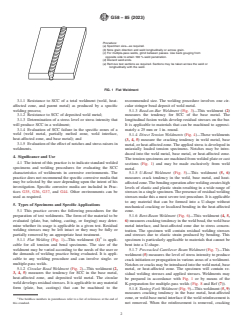
3.1.1 Resistance to SCC of a total weldment (weld, heat- recommended size. The welding procedure involves one cir-
affected zone, and parent metal) as produced by a specific cular stringer bead deposit of weld metal.
welding process; 5.1.3 Bead-on-Bar Weldment (Fig. 3)—This weldment (2)
3.1.2 Resistance to SCC of deposited weld metal; measures the tendency for SCC of the base metal. The
3.1.3 Determination of a stress level or stress intensity that longitudinal fusion welds develop residual stresses on the bar.
will produce SCC in a weldment; It is applicable to materials that can be machined to approxi-
3.1.4 Evaluation of SCC failure in the specific zones of a mately a 25 mm or 1 in. round.
weld (weld metal, partially melted zone, weld interface,
5.1.4 Direct Tension Weldments (Fig. 4)—These weldments
heat-affected zone, and base metal); and
(3, 4, 5) measure the cracking tendency in weld metal, base
3.1.5 Evaluation of the effect of notches and stress raisers in
metal, or heat-affected zone. The applied stress is developed in
weldments.
uniaxially loaded tension specimens. Notches may be intro-
duced into the weld metal, base metal, or heat-affected zone.
4. Significance and Use
The tension specimens are machined from welded plate or cast
4.1 The intent of this practice is to indicate standard welded
sections (Fig. 1) and may be made exclusively from weld
specimens and welding procedures for evaluating the SCC
metal.
characteristics of weldments in corrosive environments. The
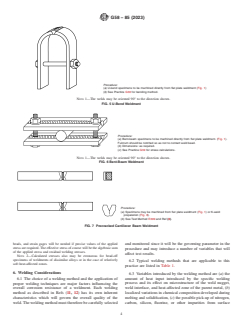
5.1.5 U-Bend Weldment (Fig. 5)—This weldment (5, 6)
practice does not recommend the specific corrosive media that
measures crack tendency in the weld, base metal, and heat-
may be selected by the user depending upon the intent of his
affected zone. The bending operation after welding creates high
investigation. Specific corrosive media are included in Prac-
levels of elastic and plastic strain resulting in a wide range of
tices G35, G36, G37, and G44. Other environments can be
stresses in a single specimen. The presence of residual welding
used as required.
stresses make this a most severe test procedure. It is applicable
to any material that can be formed into a U-shape without
5. Types of Specimens and Specific Applications
mechanical cracking or localized bending in the heat-affected
5.1 This practice covers the following procedures for the zone.
preparation of test weldments. The form of the material to be 5.1.6 Bent-Beam Weldment (Fig. 6)—This weldment (4, 5,
evaluated (plate, bar, tubing, casting, or forging) may deter- 6) measures cracking tendency in the weld bead, the weld base
mine whether its usage is applicable in a given test. Residual metal interface, and heat-affected zone due to stress concen-
welding stresses may be left intact or they may be fully or tration. The specimen will contain residual welding stresses
partially removed by an appropriate heat treatment. and stresses due to elastic strain produced by bending. This
5.1.1 Flat Welding (Fig. 1)—This weldment (1) is appli- specimen is particularly applicable to materials that cannot be
cable for all tension and bend specimens. The size of the bent into a U-shape.
weldment may be varied according to the needs of the user or
5.1.7 Precracked Cantilever Beam Weldment (Fig. 7)—This
the demands of welding practice being evaluated. It is appli-
weldment (5) measures the level of stress intensity to produce
cable to any welding procedure and can involve single- or
crack initiation or propagation in various areas of a weldment.
multiple-pass welds.
Notches or cracks may be introduced into the weld metal, base
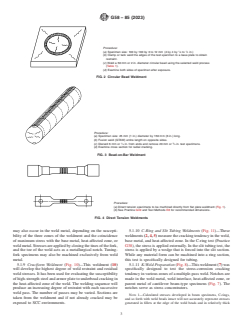
5.1.2 Circular Bead Weldment (Fig. 2)—This weldment (2,
metal, or heat-affected zone. The specimen will contain re-
3, 4, 5) measures the tendency for SCC in the base metal,
sidual welding stresses and applied stresses. Weldments may
heat-affected zone, and deposited weld metal. The circular
be prepared in accordance with Fig. 1 or by means of the
weld develops residual stresses. It is applicable to any material
K-preparation for multiple-pass welds (Fig. 8 and Ref (7)).
form (plate, bar, castings) that can be machined to the
5.1.8 Tuning Fork Weldment (Fig. 9)—This weldment (5, 9)
measures cracking tendency in the base metal, heat-affected
zone, or weld-base metal interface if the weld reinforcement is
The boldface numbers in parentheses refer to a list of references at the end of
this standard. not removed. When the reinforcement is removed, cracking
G58 − 85 (2023)
Procedure:
1 1
(a) Specimen size: 100 by 100 by 3 to 12 mm (4 by 4 by ⁄8 to ⁄2 in.)
(b) Clamp or tack weld the edges of the test specimen to a base plate to obtain
restraint.
(c) Weld a 50 mm or 2 in. diameter circular bead using the selected weld process
(Table 1).
(d) Examine both sides of specimen after exposure.
FIG. 2 Circular Bead Weldment
Procedure:
(a) Specimen size: 25 mm (1 in.) diameter by 150 mm (6 in.) long.
(b) Fusion weld (GTAW) entire length on opposite sides.
1 3
(c) Discard 6 mm or ⁄4 in. from ends and remove 20 mm or ⁄4 in. test specimens.
(d) Examine cross section for radial cracking.
FIG. 3 Bead-on-Bar Weldment
Procedure:
(a) Direct tension specimens to be machined directly from flat plate weldment (Fig. 1).
(b) See Practice G49 and Test Methods E8 for recommended dimensions.
FIG. 4 Direct Tension Weldments
may also occur in the weld metal, depending on the suscepti- 5.1.10 C-Ring and Slit Tubing Weldments (Fig. 11)—These
bility of the three zones of the weldment and the coincidence weldments (2, 4, 5) measure the cracking tendency in the weld,
of maximum stress with the base metal, heat-affected zone, or base metal, and heat-affected zone. In the C-ring test (Practice
weld metal. Stresses are applied by closing the tines of the fork, G38), the stress is applied externally. In the slit tubing test, the
and the toe of the weld acts as a metallurgical notch. Tuning- stress is applied by a wedge that is forced into the slit section.
fork specimens may also be machined exclusively from weld While any material form can be machined into a ring section,
metal. this test is specifically designed for tubing.
5.1.9 Cruciform Weldment (Fig. 10)—This weldment (10) 5.1.11 K-Weld Preparation (Fig. 8)—This weldment (7) was
will develop the highest degree of weld restraint and residual specifically designed to test the stress-corrosion cracking
weld stresses. It has been used for evaluating the susceptibility tendency in various zones of a multiple-pass weld. Notches are
of high-strength steel and armor plate to underbead cracking in made in the weld metal, weld interface, heat-affected zone, or
the heat-affected zone of the weld. The welding sequence will parent metal of cantilever beam-type specimens (Fig. 7). The
produce an increasing degree of restraint with each successive notches serve as stress concentrators.
weld pass. The number of passes may be varied. Sections are
NOTE 1—Calculated stresses developed in beam specimens, C-rings,
taken from the weldment and if not already cracked may be
and so forth with weld beads intact will not accurately represent stresses
exposed to SCC environments. generated in fillets at the edge of the weld beads and in relatively thick
G58 − 85 (2023)
Procedure:
(a) U-bend specimens to be machined directly from flat plate weldment (Fig. 1)
(b) See Practice G30 for bending method.
NOTE 1—The welds may be oriented 90° to the direction shown.
FIG. 5 U-Bend Weldment
Procedure:
(a) Bent-beam specimens to be machined directly from flat plate weldment. (Fig. 1).
Fulcrum should be notched so as not to contact weld bead.
(b) Dimensions: as required.
(c) See Practice G39 for stress calculations.
NOTE 1—The welds may be oriented 90° to the direction shown.
FIG. 6 Bent-Beam Weldment
Procedure:
(a) Specimens may be machined from flat plate weldment (Fig. 1) or K-weld
preparation (Fig. 8).
(b) See Test Method E399 and Ref (8).
FIG. 7 Precracked Cantilever Beam Weldment
beads, and strain gages will be needed if precise values of the applied
and monitored since it will be the governing parameter in the
stress are required. The effective stress of course will be the algebraic sum
procedure and may introduce a number of variables that will
of the applied stress and residual welding stresses.
affect test results.
NOTE 2—Calculated stresses also may be erroneous for bead-off
specimens of weldme
...