

ASTM C1698-19
(Test Method)Standard Test Method for Autogenous Strain of Cement Paste and Mortar
General Information
- Abstract
SIGNIFICANCE AND USE
5.1 Autogenous strain is the self-created bulk strain of cement paste, mortar, or concrete during hardening at constant temperature. In conventional concrete, autogenous shrinkage strain is generally negligible, but in concrete with low water-cementitious materials ratio (w/cm) or with silica fume it may be considerable (1).5 Restraint of the autogenous strain by aggregates or adjoining structural members may result in formation of micro and macro cracks that impair strength, durability and aesthetics. Cracks may also be a problem with regard to hygienic cleaning of surfaces.
5.2 An accurate measurement of the autogenous strain of cementitious mixtures with low w/cm is important for evaluating the risk of early-age cracking of concrete structures. Measurements of autogenous strain have been carried out using either volumetric or linear methods. Both methods may show evidence of significant artifacts (1); therefore, results of the two methods may disagree considerably if not carried out properly.
5.3 A sealed, flexible corrugated mold system (2) combines the advantages of linear and volumetric measurement of autogenous strain, while avoiding most of their disadvantages. The mold effectively prevents moisture loss and minimizes restraint to volume change during hardening. Moreover, results obtained with the corrugated mold system agree with those from the volumetric method, once some artifacts, in particular water absorption through the membrane used to contain the test specimen, have been eliminated in the latter (3,4). The corrugated mold system is easier to use and shows better repeatability than the volumetric technique (3,4). Measurements with the corrugated mold system are in good agreement with unrestrained length change measurements obtained using Test Method C157/C157M with sealed specimens (5); however, Test Method C157/C157M does not allow measurement of the shrinkage occurring before 24 h (5).
5.4 This test method can be used to evaluate the effec...
SCOPE
1.1 This test method measures the bulk strain of a sealed cement paste or mortar specimen, including those containing admixtures, various supplementary cementitious materials (SCM), and other fine materials, at constant temperature and not subjected to external forces, from the time of final setting until a specified age. This strain is known as autogenous strain. Autogenous strain is most significant in concrete with low water-cementitious materials ratio (w/cm) (See Note 1).
Note 1: A low water-cementitious materials ratio (w/cm) can be considered to be a water to cement ratio of 0.40 or lower for this test.
1.2 The values stated in SI units are to be regarded as standard. No other units of measurement are included in this standard.
1.3 The text of this standard references notes and footnotes that provide explanatory material. These notes and footnotes (excluding those in tables and figures) shall not be considered as requirements of this standard.
1.4 This standard does not purport to address all of the safety concerns, if any, associated with its use. It is the responsibility of the user of this standard to establish appropriate safety, health, and environmental practices and determine the applicability of regulatory limitations prior to use. (Warning—Fresh hydraulic cementitious mixtures are caustic and may cause chemical burns to skin and tissue upon prolonged exposure.2)
1.5 This international standard was developed in accordance with internationally recognized principles on standardization established in the Decision on Principles for the Development of International Standards, Guides and Recommendations issued by the World Trade Organization Technical Barriers to Trade (TBT) Committee.
- Status
- Published
- Publication Date
- 30-Sep-2019
- Technical Committee
- C09 - Concrete and Concrete Aggregates
- Drafting Committee
- C09.68 - Volume Change
Overview
ASTM C1698-19: Standard Test Method for Autogenous Strain of Cement Paste and Mortar provides a reliable procedure for measuring bulk strain-referred to as autogenous strain-of cement paste and mortar mixtures during hardening. This standard is particularly important for modern construction materials, especially those with a low water-cementitious materials ratio (w/cm ≤ 0.40) or containing supplementary cementitious materials such as silica fume and admixtures. The standard aims to support concrete professionals in evaluating potential early-age cracking risks, enhancing durability, and improving the quality of concrete structures.
Key Topics
- Autogenous Strain Definition: The standard defines autogenous strain as the self-induced bulk strain in cementitious materials (paste or mortar) sealed and subjected to constant temperature, from the time of final setting until a specified age. This measurement is critical for mixtures not influenced by external forces.
- Measurement Method: ASTM C1698-19 specifies the use of a sealed, flexible, corrugated mold system and a dilatometer bench equipped with a length gauge and a reference bar. The mold minimizes resistance to length change and effectively prevents moisture loss, ensuring precise autogenous shrinkage or expansion data.
- Applicability to Modern Mixtures: The procedure accommodates a wide range of cementitious materials, including those with various admixtures and supplementary materials, making it relevant for high-performance and specialty concretes.
- Precision and Artifacts: The standard highlights the importance of minimizing measurement artifacts (from environmental factors or equipment) and ensuring careful procedure to avoid errors, supporting valid and repeatable results.
Applications
ASTM C1698-19 is highly valuable in several key areas of cement-based material design and construction:
- Early-Age Cracking Risk Assessment: Accurate measurement of autogenous strain provides essential data for assessing the risk of early-age cracking in concrete structures, especially those with low w/cm and high-performance requirements.
- Durability and Aesthetics: By quantifying autogenous shrinkage, engineers and designers can optimize concrete mixes to minimize crack formation that could compromise strength, durability, or surface cleanliness.
- Mixture Optimization: The method allows for systematic evaluation of the effects of supplementary cementitious materials (e.g., fly ash, silica fume) and chemical admixtures on the autogenous movement of cement paste and mortar.
- Comparative Analysis: Because results from the corrugated mold system align closely with other standardized techniques (such as ASTM C157/C157M for sealed specimens after 24 hours), this method enables consistent comparisons and quality control across different test protocols.
Related Standards
Users of ASTM C1698-19 may also reference several related ASTM standards for terminology and complementary test methods:
- ASTM C125 - Terminology Relating to Concrete and Concrete Aggregates
- ASTM C157/C157M - Test Method for Length Change of Hardened Hydraulic-Cement Mortar and Concrete
- ASTM C191 - Test Methods for Time of Setting of Hydraulic Cement by Vicat Needle
- ASTM C192/C192M - Practice for Making and Curing Concrete Test Specimens in the Laboratory
- ASTM C219 - Terminology Relating to Hydraulic Cement
- ASTM C305 - Practice for Mechanical Mixing of Hydraulic Cement Pastes and Mortars of Plastic Consistency
- ASTM C403/C403M - Test Method for Time of Setting of Concrete Mixtures by Penetration Resistance
- ASTM C1005 - Specification for Reference Masses and Devices for Determining Mass and Volume for Use in the Physical Testing of Hydraulic Cements
Practical Value
Implementing ASTM C1698-19 ensures reliable, reproducible results in estimating the autogenous behavior of modern cementitious systems. This standard aids engineers, researchers, and quality assurance professionals in designing durable concrete structures, selecting materials wisely, and preventing common issues such as microcracking and early-age failure-leading to longer-lasting, more sustainable concrete construction.
Relations
- Effective Date
- 01-Oct-2019
- Effective Date
- 01-Apr-2024
- Effective Date
- 01-Aug-2020
- Effective Date
- 15-Jul-2020
- Effective Date
- 01-Apr-2020
- Effective Date
- 15-Dec-2019
- Effective Date
- 15-Nov-2019
- Effective Date
- 01-Jun-2019
- Effective Date
- 01-Jan-2019
- Effective Date
- 01-Oct-2018
- Effective Date
- 01-Jul-2018
- Effective Date
- 01-May-2018
- Effective Date
- 01-Jan-2018
- Effective Date
- 15-Aug-2017
- Effective Date
- 15-Mar-2017
Get Certified
Connect with accredited certification bodies for this standard

DIBt (Deutsches Institut für Bautechnik)
German Institute for Building Technology.
DIN CERTCO
DIN Group product certification.

Aboma Certification B.V.
Specialized in construction, metal, and transport sectors.
Sponsored listings
Frequently Asked Questions
ASTM C1698-19 is a standard published by ASTM International. Its full title is "Standard Test Method for Autogenous Strain of Cement Paste and Mortar". This standard covers: SIGNIFICANCE AND USE 5.1 Autogenous strain is the self-created bulk strain of cement paste, mortar, or concrete during hardening at constant temperature. In conventional concrete, autogenous shrinkage strain is generally negligible, but in concrete with low water-cementitious materials ratio (w/cm) or with silica fume it may be considerable (1).5 Restraint of the autogenous strain by aggregates or adjoining structural members may result in formation of micro and macro cracks that impair strength, durability and aesthetics. Cracks may also be a problem with regard to hygienic cleaning of surfaces. 5.2 An accurate measurement of the autogenous strain of cementitious mixtures with low w/cm is important for evaluating the risk of early-age cracking of concrete structures. Measurements of autogenous strain have been carried out using either volumetric or linear methods. Both methods may show evidence of significant artifacts (1); therefore, results of the two methods may disagree considerably if not carried out properly. 5.3 A sealed, flexible corrugated mold system (2) combines the advantages of linear and volumetric measurement of autogenous strain, while avoiding most of their disadvantages. The mold effectively prevents moisture loss and minimizes restraint to volume change during hardening. Moreover, results obtained with the corrugated mold system agree with those from the volumetric method, once some artifacts, in particular water absorption through the membrane used to contain the test specimen, have been eliminated in the latter (3,4). The corrugated mold system is easier to use and shows better repeatability than the volumetric technique (3,4). Measurements with the corrugated mold system are in good agreement with unrestrained length change measurements obtained using Test Method C157/C157M with sealed specimens (5); however, Test Method C157/C157M does not allow measurement of the shrinkage occurring before 24 h (5). 5.4 This test method can be used to evaluate the effec... SCOPE 1.1 This test method measures the bulk strain of a sealed cement paste or mortar specimen, including those containing admixtures, various supplementary cementitious materials (SCM), and other fine materials, at constant temperature and not subjected to external forces, from the time of final setting until a specified age. This strain is known as autogenous strain. Autogenous strain is most significant in concrete with low water-cementitious materials ratio (w/cm) (See Note 1). Note 1: A low water-cementitious materials ratio (w/cm) can be considered to be a water to cement ratio of 0.40 or lower for this test. 1.2 The values stated in SI units are to be regarded as standard. No other units of measurement are included in this standard. 1.3 The text of this standard references notes and footnotes that provide explanatory material. These notes and footnotes (excluding those in tables and figures) shall not be considered as requirements of this standard. 1.4 This standard does not purport to address all of the safety concerns, if any, associated with its use. It is the responsibility of the user of this standard to establish appropriate safety, health, and environmental practices and determine the applicability of regulatory limitations prior to use. (Warning—Fresh hydraulic cementitious mixtures are caustic and may cause chemical burns to skin and tissue upon prolonged exposure.2) 1.5 This international standard was developed in accordance with internationally recognized principles on standardization established in the Decision on Principles for the Development of International Standards, Guides and Recommendations issued by the World Trade Organization Technical Barriers to Trade (TBT) Committee.
SIGNIFICANCE AND USE 5.1 Autogenous strain is the self-created bulk strain of cement paste, mortar, or concrete during hardening at constant temperature. In conventional concrete, autogenous shrinkage strain is generally negligible, but in concrete with low water-cementitious materials ratio (w/cm) or with silica fume it may be considerable (1).5 Restraint of the autogenous strain by aggregates or adjoining structural members may result in formation of micro and macro cracks that impair strength, durability and aesthetics. Cracks may also be a problem with regard to hygienic cleaning of surfaces. 5.2 An accurate measurement of the autogenous strain of cementitious mixtures with low w/cm is important for evaluating the risk of early-age cracking of concrete structures. Measurements of autogenous strain have been carried out using either volumetric or linear methods. Both methods may show evidence of significant artifacts (1); therefore, results of the two methods may disagree considerably if not carried out properly. 5.3 A sealed, flexible corrugated mold system (2) combines the advantages of linear and volumetric measurement of autogenous strain, while avoiding most of their disadvantages. The mold effectively prevents moisture loss and minimizes restraint to volume change during hardening. Moreover, results obtained with the corrugated mold system agree with those from the volumetric method, once some artifacts, in particular water absorption through the membrane used to contain the test specimen, have been eliminated in the latter (3,4). The corrugated mold system is easier to use and shows better repeatability than the volumetric technique (3,4). Measurements with the corrugated mold system are in good agreement with unrestrained length change measurements obtained using Test Method C157/C157M with sealed specimens (5); however, Test Method C157/C157M does not allow measurement of the shrinkage occurring before 24 h (5). 5.4 This test method can be used to evaluate the effec... SCOPE 1.1 This test method measures the bulk strain of a sealed cement paste or mortar specimen, including those containing admixtures, various supplementary cementitious materials (SCM), and other fine materials, at constant temperature and not subjected to external forces, from the time of final setting until a specified age. This strain is known as autogenous strain. Autogenous strain is most significant in concrete with low water-cementitious materials ratio (w/cm) (See Note 1). Note 1: A low water-cementitious materials ratio (w/cm) can be considered to be a water to cement ratio of 0.40 or lower for this test. 1.2 The values stated in SI units are to be regarded as standard. No other units of measurement are included in this standard. 1.3 The text of this standard references notes and footnotes that provide explanatory material. These notes and footnotes (excluding those in tables and figures) shall not be considered as requirements of this standard. 1.4 This standard does not purport to address all of the safety concerns, if any, associated with its use. It is the responsibility of the user of this standard to establish appropriate safety, health, and environmental practices and determine the applicability of regulatory limitations prior to use. (Warning—Fresh hydraulic cementitious mixtures are caustic and may cause chemical burns to skin and tissue upon prolonged exposure.2) 1.5 This international standard was developed in accordance with internationally recognized principles on standardization established in the Decision on Principles for the Development of International Standards, Guides and Recommendations issued by the World Trade Organization Technical Barriers to Trade (TBT) Committee.
ASTM C1698-19 is classified under the following ICS (International Classification for Standards) categories: 91.100.10 - Cement. Gypsum. Lime. Mortar. The ICS classification helps identify the subject area and facilitates finding related standards.
ASTM C1698-19 has the following relationships with other standards: It is inter standard links to ASTM C1698-09(2014), ASTM C219-24, ASTM C219-20a, ASTM C305-20, ASTM C219-20, ASTM C125-19a, ASTM C219-19a, ASTM C219-19, ASTM C125-19, ASTM C125-18b, ASTM C125-18a, ASTM C1005-18, ASTM C125-18, ASTM C157/C157M-17, ASTM C1005-17. Understanding these relationships helps ensure you are using the most current and applicable version of the standard.
ASTM C1698-19 is available in PDF format for immediate download after purchase. The document can be added to your cart and obtained through the secure checkout process. Digital delivery ensures instant access to the complete standard document.
Standards Content (Sample)
This international standard was developed in accordance with internationally recognized principles on standardization established in the Decision on Principles for the
Development of International Standards, Guides and Recommendations issued by the World Trade Organization Technical Barriers to Trade (TBT) Committee.
Designation: C1698 − 19
Standard Test Method for
Autogenous Strain of Cement Paste and Mortar
This standard is issued under the fixed designation C1698; the number immediately following the designation indicates the year of
original adoption or, in the case of revision, the year of last revision. A number in parentheses indicates the year of last reapproval. A
superscript epsilon (´) indicates an editorial change since the last revision or reapproval.
1. Scope* 2. Referenced Documents
2.1 ASTM Standards:
1.1 This test method measures the bulk strain of a sealed
C125 Terminology Relating to Concrete and Concrete Ag-
cement paste or mortar specimen, including those containing
gregates
admixtures, various supplementary cementitious materials
C157/C157M Test Method for Length Change of Hardened
(SCM), and other fine materials, at constant temperature and
Hydraulic-Cement Mortar and Concrete
not subjected to external forces, from the time of final setting
C191 TestMethodsforTimeofSettingofHydraulicCement
untilaspecifiedage.Thisstrainisknownas autogenous strain.
by Vicat Needle
Autogenous strain is most significant in concrete with low
C192/C192M Practice for Making and Curing Concrete Test
water-cementitious materials ratio (w/cm) (See Note 1).
Specimens in the Laboratory
NOTE 1—A low water-cementitious materials ratio (w/cm) can be
C219 Terminology Relating to Hydraulic Cement
considered to be a water to cement ratio of 0.40 or lower for this test.
C305 Practice for Mechanical Mixing of Hydraulic Cement
Pastes and Mortars of Plastic Consistency
1.2 The values stated in SI units are to be regarded as
C403/C403M Test Method for Time of Setting of Concrete
standard. No other units of measurement are included in this
Mixtures by Penetration Resistance
standard.
C1005 Specification for Reference Masses and Devices for
1.3 The text of this standard references notes and footnotes
Determining Mass and Volume for Use in the Physical
that provide explanatory material. These notes and footnotes
Testing of Hydraulic Cements
(excluding those in tables and figures) shall not be considered
2.2 API Specification
as requirements of this standard.
RP 10B-2/ISO 10426-2 Recommended Practice for Testing
Well Cements
1.4 This standard does not purport to address all of the
safety concerns, if any, associated with its use. It is the
3. Terminology
responsibility of the user of this standard to establish appro-
3.1 Definitions:
priate safety, health, and environmental practices and deter-
3.1.1 For definitions of terms used in this test method, refer
mine the applicability of regulatory limitations prior to use.
to Terminologies C125 and C219.
(Warning—Fresh hydraulic cementitious mixtures are caustic
3.2 Definitions of Terms Specific to This Standard:
and may cause chemical burns to skin and tissue upon
3.2.1 autogenous strain, n—the bulk strain of a sealed
prolonged exposure. )
specimen of a cementitious mixture, not subjected to external
1.5 This international standard was developed in accor-
forcesandunderconstanttemperature,measuredfromthetime
dance with internationally recognized principles on standard-
offinalsettinguntilaspecifiedage;negativestraincorresponds
ization established in the Decision on Principles for the
to shrinkage and positive strain corresponds to expansion.
Development of International Standards, Guides and Recom-
mendations issued by the World Trade Organization Technical
4. Summary of Test Method
Barriers to Trade (TBT) Committee.
4.1 Aspecimen of freshly mixed paste or mortar is prepared
using a corrugated mold that offers little resistance to length
changeofthespecimen.Themoldissealedtopreventmoisture
This test method is under the jurisdiction of ASTM Committee C09 on
Concrete and ConcreteAggregates and is the direct responsibility of Subcommittee
C09.68 on Volume Change. For referenced ASTM standards, visit the ASTM website, www.astm.org, or
Current edition approved Oct. 1, 2019. Published November 2019. Originally contact ASTM Customer Service at service@astm.org. For Annual Book of ASTM
approvedin2009.Lastpreviouseditionapprovedin2014asC1698-09(2014).DOI: Standards volume information, refer to the standard’s Document Summary page on
10.1520/C1698-19. the ASTM website.
2 4
Section on Safety Precautions, Manual of Aggregate and Concrete Testing, Available from American Petroleum Institute (API), 1220 L. St., NW,
Annual Book of ASTM Standards, Vol. 04.02. Washington, DC 20005-4070, http://www.api.org.
*A Summary of Changes section appears at the end of this standard
Copyright © ASTM International, 100 Barr Harbor Drive, PO Box C700, West Conshohocken, PA 19428-2959. United States
C1698 − 19
loss and the specimen is stored at constant temperature. from the volumetric method, once some artifacts, in particular
Starting at the time of final setting, the length of the specimen waterabsorptionthroughthemembraneusedtocontainthetest
is measured using a dilatometer. The change in length is specimen, have been eliminated in the latter (3,4). The corru-
recorded at regular time intervals until the designated age. The gated mold system is easier to use and shows better repeatabil-
change in length and original length of the specimen are used ity than the volumetric technique (3,4). Measurements with the
to compute the autogenous strain. corrugated mold system are in good agreement with unre-
strained length change measurements obtained using Test
5. Significance and Use
Method C157/C157M with sealed specimens (5); however,
Test Method C157/C157M does not allow measurement of the
5.1 Autogenous strain is the self-created bulk strain of
shrinkage occurring before 24 h (5).
cement paste, mortar, or concrete during hardening at constant
temperature. In conventional concrete, autogenous shrinkage
5.4 This test method can be used to evaluate the effects of
strain is generally negligible, but in concrete with low water-
cementitious materials, admixtures, and mixture proportions
cementitious materials ratio (w/cm) or with silica fume it may
on autogenous shrinkage strain of paste or mortar specimens.
be considerable (1). Restraint of the autogenous strain by
5.5 The autogenous shrinkage strain of mortar specimens
aggregates or adjoining structural members may result in
will be less than that of paste specimens for the same w/cm.
formation of micro and macro cracks that impair strength,
The autogenous shrinkage strain of concrete will be less than
durability and aesthetics. Cracks may also be a problem with
that of mortar for the same w/cm. The nominal maximum
regard to hygienic cleaning of surfaces.
aggregate size for mortar used in this test method is 4.75 mm.
5.2 An accurate measurement of the autogenous strain of
cementitious mixtures with low w/cm is important for evalu- 6. Apparatus
ating the risk of early-age cracking of concrete structures.
6.1 The apparatus to measure autogenous strain is com-
Measurementsofautogenousstrainhavebeencarriedoutusing
posed of a corrugated mold with two end plugs, a dilatometer
either volumetric or linear methods. Both methods may show
bench, a length measuring gauge, and a reference bar (see Fig.
evidence of significant artifacts (1); therefore, results of the
1).
two methods may disagree considerably if not carried out
6.2 Molds—The molds consist of corrugated plastic tubes,
properly.
having a length of 420 6 5 mm and an outer diameter of 29 6
5.3 Asealed, flexible corrugated mold system (2) combines
0.5 mm (see Note 2). The plastic tubes are made of 0.5 6
the advantages of linear and volumetric measurement of
0.2-mm thick low-density polyethylene (PE) and have
autogenous strain, while avoiding most of their disadvantages.
triangular-shaped corrugations in order to minimize restraint in
The mold effectively prevents moisture loss and minimizes
the longitudinal direction (see Fig. 2). The distance between
restraint to volume change during hardening. Moreover, results
corrugations is 5.8 6 0.2 mm. The mold is tightly closed with
obtained with the corrugated mold system agree with those
two tapered end plugs having a length of 19 6 0.5 mm. The
diameter of the plastic end plugs tapers from 21 6 0.1 mm to
22.4 6 0.1 mm (see Fig. 3).
The boldface numbers in parentheses refer to a list of references at the end of
NOTE 2—The small diameter of the molds limits the temperature
this standard.
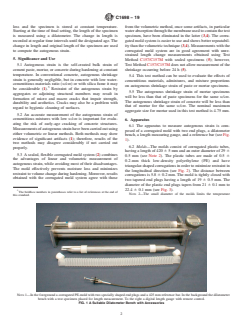
NOTE 1—In the foreground a corrugated PE-mold with two specially shaped end plugs and a 425 mm reference bar. In the background the dilatometer
bench with a test specimen placed for length measurement. To the right a digital length gauge with remote control.
FIG. 1 A Suitable Dilatometer Bench with Accessories
C1698 − 19
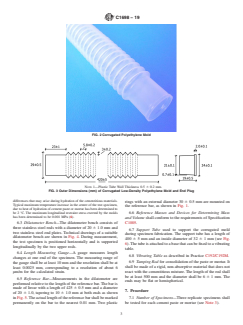
FIG. 2 Corrugated Polyethylene Mold
NOTE 1—Plastic Tube Wall Thickness 0.5 6 0.2 mm.
FIG. 3 Outer Dimensions (mm) of Corrugated Low-Density Polyethylene Mold and End Plug
differences that may arise during hydration of the cementitious materials.
rings with an external diameter 30 6 0.5 mm are mounted on
Typical maximum temperature increase in the center of the test specimen,
the reference bar, as shown in Fig. 1.
due to heat of hydration of cement paste or mortar has been determined to
be 2 °C. The maximum longitudinal restraint stress exerted by the molds 6.6 Reference Masses and Devices for Determining Mass
has been determined to be 0.001 MPa (6).
and Volume shall conform to the requirements of Specification
6.3 Dilatometer Bench—The dilatometer bench consists of C1005.
three stainless steel rods with a diameter of 20 6 1.0 mm and
6.7 Support Tube used to support the corrugated mold
two stainless steel end plates. Technical drawings of a suitable
during specimen fabrication. The support tube has a length of
dilatometer bench are shown in Fig. 4. During measurement,
400 6 5 mm and an inside diameter of 32 6 1 mm (see Fig.
the test specimen is positioned horizontally and is supported
6).Thetubeisattachedtoabasethatcanbefixedtoavibrating
longitudinally by the two upper rods.
table.
6.4 Length Measuring Gauge—A gauge measures length
6.8 Vibrating Table as described in Practice C192/C192M.
changes at one end of the specimen. The measuring range of
6.9 Tamping Rod for consolidation of the paste or mortar. It
the gauge shall be at least 10 mm and the resolution shall be at
shall be made of a rigid, non-absorptive material that does not
least 0.0025 mm, corresponding to a resolution of about 6
react with the cementitious mixture.The length of the rod shall
µm/m for the calculated strain.
be at least 500 mm and the diameter shall be 6 6 1 mm. The
6.5 Reference Bar—Measurements in the dilatometer are
ends may be flat or hemispherical.
performed relative to the length of the reference bar.The bar is
made of Invar with a length of 425 6 0.5 mm and a diameter
7. Procedure
of 20 6 1.0, tapering to 10 6 1.0 mm at both ends as shown
inFig.5.Theactuallengthofthereferencebarshallbemarked 7.1 Number of Specimens—Three replicate specimens shall
permanently on the bar to the nearest 0.01 mm. Two plastic be tested for each cement paste or mortar (see Note 3).
C1698 − 19
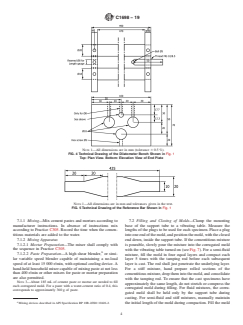
NOTE 1—All dimensions are in mm (tolerance 6 0.5 %).
FIG. 4 Technical Drawing of the Dilatometer Bench Shown in Fig. 1
Top: Plan View. Bottom: Elevation View of End Plate
NOTE 1—All dimensions are in mm and tolerances given in the text.
FIG. 5 Technical Drawing of the Reference Bar Shown in Fig. 1
7.1.1 Mixing—Mix cement pastes and mortars according to 7.2 Filling and Closing of Molds—Clamp the mounting
manufacturer instructions. In absence of instructions mix
base of the support tube to a vibrating table. Measure the
according to Practice C305. Record the time when the cemen- lengths of the plugs to be used for each specimen. Place a plug
titious materials are added to the water.
intooneendofthemold,andpositionthemold,withtheclosed
7.1.2 Mixing Apparatus
end down, inside the support tube. If the cementitious mixture
7.1.2.1 Mortar Preparation—The mixer shall comply with
is pourable, slowly pour the mixture into the corrugated mold
the sequence in Practice C305.
with the vibrating table turned on (see Fig. 7). For a semi-fluid
7.1.2.2 Paste Preparation—A high shear blender, or simi-
mixture, fill the mold in four equal layers and compact each
lar variable speed blender capable of maintaining a no-load
layer 5 times with the tamping rod before each subsequent
speed of at least 15 000 r/min, with optional cooling device.A
layer is cast. The rod shall just penetrate the underlying layer.
hand-held household mixer capable of mixing paste at not less
For a stiff mixture, hand prepare rolled sections of the
than 400 r/min or other mixers for paste or mortar preparation
cementitiousmixture,dropthemintothemold,andconsolidate
are also permitted.
with the tamping rod. To ensure that the cast specimens have
NOTE 3—About 185 mL of cement paste or mortar are needed to fill
approximately the same length, do not stretch or compress the
each corrugated mold. For a paste with a water-cement ratio of 0.4, this
corrugated mold during filling. For fluid mixtures, the corru-
corresponds to approximately 360 g of paste.
gated mold shall be held only by the support tube during
casting. For semi-fluid and stiff mixtures, manually maintain
Mixing devices described in API Specification RP 10B-2/ISO 10426-2. the initial
...
This document is not an ASTM standard and is intended only to provide the user of an ASTM standard an indication of what changes have been made to the previous version. Because
it may not be technically possible to adequately depict all changes accurately, ASTM recommends that users consult prior editions as appropriate. In all cases only the current version
of the standard as published by ASTM is to be considered the official document.
Designation: C1698 − 09 (Reapproved 2014) C1698 − 19
Standard Test Method for
Autogenous Strain of Cement Paste and Mortar
This standard is issued under the fixed designation C1698; the number immediately following the designation indicates the year of
original adoption or, in the case of revision, the year of last revision. A number in parentheses indicates the year of last reapproval. A
superscript epsilon (´) indicates an editorial change since the last revision or reapproval.
1. Scope Scope*
1.1 This test method measures the bulk strain of a sealed cement paste or mortar specimen, including those containing
admixtures, various supplementary cementitious materials (SCM), and other fine materials, at constant temperature and not
subjected to external forces, from the time of final setting until a specified age. This strain is known as autogenous strain.
Autogenous strain is most significant in concrete with low water-cementitious materials ratio (w/cm) (See Note 1).
NOTE 1—A low water-cementitious materials ratio (w/cm) can be considered to be a water to cement ratio of 0.40 or lower for this test.
1.2 The values stated in SI units are to be regarded as standard. No other units of measurement are included in this standard.
1.3 This standard does not purport to address all of the safety concerns, if any, associated with its use. It is the responsibility
of the user of this standard to establish appropriate safety and health practices and determine the applicability of regulatory
limitations prior to use.The text of this standard references notes and footnotes that provide explanatory material. These notes and
footnotes (excluding those in tables (Warning—Fresh hydraulic cementitious mixtures are caustic and may cause chemical burns
to skin and tissue upon prolonged exposure.and figures) shall not be considered as requirements of this standard.)
1.4 This standard does not purport to address all of the safety concerns, if any, associated with its use. It is the responsibility
of the user of this standard to establish appropriate safety, health, and environmental practices and determine the applicability of
regulatory limitations prior to use. (Warning—Fresh hydraulic cementitious mixtures are caustic and may cause chemical burns
to skin and tissue upon prolonged exposure. )
1.5 This international standard was developed in accordance with internationally recognized principles on standardization
established in the Decision on Principles for the Development of International Standards, Guides and Recommendations issued
by the World Trade Organization Technical Barriers to Trade (TBT) Committee.
2. Referenced Documents
2.1 ASTM Standards:
C125 Terminology Relating to Concrete and Concrete Aggregates
C157/C157M Test Method for Length Change of Hardened Hydraulic-Cement Mortar and Concrete
C191 Test Methods for Time of Setting of Hydraulic Cement by Vicat Needle
C192/C192M Practice for Making and Curing Concrete Test Specimens in the Laboratory
C219 Terminology Relating to Hydraulic Cement
C305 Practice for Mechanical Mixing of Hydraulic Cement Pastes and Mortars of Plastic Consistency
C403/C403M Test Method for Time of Setting of Concrete Mixtures by Penetration Resistance
C1005 Specification for Reference Masses and Devices for Determining Mass and Volume for Use in the Physical Testing of
Hydraulic Cements
2.2 API Specification
RP 10B-2/ISO 10426-2 Recommended Practice for Testing Well Cements
3. Terminology
3.1 Definitions:
3.1.1 For definitions of terms used in this test method, refer to Terminologies C125 and C219.
This test method is under the jurisdiction of ASTM Committee C09 on Concrete and Concrete Aggregates and is the direct responsibility of Subcommittee C09.68 on
Volume Change.
Current edition approved Oct. 1, 2014Oct. 1, 2019. Published November 2014November 2019. Originally approved in 2009. Last previous edition approved in 20092014
as C1698C1698-09(2014).-09. DOI: 10.1520/C1698-09R14.10.1520/C1698-19.
Section on Safety Precautions, Manual of Aggregate and Concrete Testing, Annual Book of ASTM Standards, Vol. 04.02.
For referenced ASTM standards, visit the ASTM website, www.astm.org, or contact ASTM Customer Service at service@astm.org. For Annual Book of ASTM Standards
volume information, refer to the standard’s Document Summary page on the ASTM website.
Available from American Petroleum Institute (API), 1220 L. St., NW, Washington, DC 20005-4070, http://www.api.org.
*A Summary of Changes section appears at the end of this standard
Copyright © ASTM International, 100 Barr Harbor Drive, PO Box C700, West Conshohocken, PA 19428-2959. United States
C1698 − 19
3.2 Definitions of Terms Specific to This Standard:
3.2.1 autogenous strain, n—the bulk strain of a sealed specimen of a cementitious mixture, not subjected to external forces and
under constant temperature, measured from the time of final setting until a specified age; negative strain corresponds to shrinkage
and positive strain corresponds to expansion.
4. Summary of Test Method
4.1 A specimen of freshly mixed paste or mortar is prepared using a corrugated mold that offers little resistance to length change
of the specimen. The mold is sealed to prevent moisture loss and the specimen is stored at constant temperature. Starting at the
time of final setting, the length of the specimen is measured using a dilatometer. The change in length is recorded at regular time
intervals until the designated age. The change in length and original length of the specimen are used to compute the autogenous
strain.
5. Significance and Use
5.1 Autogenous strain is the self-created bulk strain of cement paste, mortar, or concrete during hardening at constant
temperature. In conventional concrete, autogenous shrinkage strain is generally negligible, but in concrete with low water-
cementitious materials ratio (w/cm) or with silica fume it may be considerable (1). Restraint of the autogenous strain by aggregates
or adjoining structural members may result in formation of micro and macro cracks that impair strength, durability and aesthetics.
Cracks may also be a problem with regard to hygienic cleaning of surfaces.
5.2 An accurate measurement of the autogenous strain of cementitious mixtures with low w/cm is important for evaluating the
risk of early-age cracking of concrete structures. Measurements of autogenous strain have been carried out using either volumetric
or linear methods. Both methods may show evidence of significant artifacts (1); therefore, results of the two methods may disagree
considerably if not carried out properly.
5.3 A sealed, flexible corrugated mold system (2) combines the advantages of linear and volumetric measurement of autogenous
strain, while avoiding most of their disadvantages. The mold effectively prevents moisture loss and minimizes restraint to volume
change during hardening. Moreover, results obtained with the corrugated mold system agree with those from the volumetric
method, once some artifacts, in particular water absorption through the membrane used to contain the test specimen, have been
eliminated in the latter (3,4). The corrugated mold system is easier to use and shows better repeatability than the volumetric
technique (3,4). Measurements with the corrugated mold system are in good agreement with unrestrained length change
measurements obtained using Test Method C157/C157M with sealed specimens (5); however, Test Method C157/C157M does not
allow measurement of the shrinkage occurring before 24 h (5).
5.4 This test method can be used to evaluate the effects of cementitious materials, admixtures, and mixture proportions on
autogenous shrinkage strain of paste or mortar specimens.
5.5 The autogenous shrinkage strain of mortar specimens will be less than that of paste specimens for the same w/cm. The
autogenous shrinkage strain of concrete will be less than that of mortar for the same w/cm. The nominal maximum aggregate size
for mortar used in this test method is 4.75 mm.
6. Apparatus
6.1 The apparatus to measure autogenous strain is composed of a corrugated mold with two end plugs, a dilatometer bench, a
length measuring gauge, and a reference bar (see Fig. 1).
6.2 Molds—The molds consist of corrugated plastic tubes, having a length of 420 6 5 mm and an outer diameter of 29 6 0.5
mm (see Note 2). The plastic tubes are made of 0.5 6 0.2-mm thick low-density polyethylene (PE) and have triangular-shaped
corrugations in order to minimize restraint in the longitudinal direction (see Fig. 2). The distance between corrugations is 5.8 6
0.2 mm. The mold is tightly closed with two tapered end plugs having a length of 19 6 0.5 mm. The diameter of the plastic end
plugs tapers from 21 6 0.1 mm to 22.4 6 0.1 mm (see Fig. 3).
NOTE 2—The small diameter of the molds limits the temperature differences that may arise during hydration of the cementitious materials. Typical
maximum temperature increase in the center of the test specimen, due to heat of hydration of cement paste or mortar has been determined to be 2 °C.
The maximum longitudinal restraint stress exerted by the molds has been determined to be 0.001 MPa (6).
6.3 Dilatometer Bench—The dilatometer bench consists of three stainless steel rods with a diameter of 20 6 1.0 mm and two
stainless steel end plates. Technical drawings of a suitable dilatometer bench are shown in Fig. 4. During measurement, the test
specimen is positioned horizontally and is supported longitudinally by the two upper rods.
6.4 Length Measuring Gauge—A gauge measures length changes at one end of the specimen. The measuring range of the gauge
shall be at least 10 mm and the resolution shall be at least 0.0025 mm, corresponding to a resolution of about 6 μm/m for the
calculated strain.
The boldface numbers in parentheses refer to a list of references at the end of this standard.
C1698 − 19
NOTE 1—In the foreground a corrugated PE-mold with two specially shaped end plugs and a 425 mm reference bar. In the background the dilatometer
bench with a test specimen placed for length measurement. To the right a digital length gauge with remote control.
FIG. 1 A Suitable Dilatometer Bench with Accessories
FIG. 2 Corrugated Polyethylene Mold
6.5 Reference Bar—Measurements in the dilatometer are performed relative to the length of the reference bar. The bar is made
of Invar with a length of 425 6 0.5 mm and a diameter of 20 6 1.0, tapering to 10 6 1.0 mm at both ends as shown in Fig. 5.
The actual length of the reference bar shall be marked permanently on the bar to the nearest 0.01 mm. Two plastic rings with an
external diameter 30 6 0.5 mm are mounted on the reference bar, as shown in Fig. 1.
6.6 Reference Masses and Devices for Determining Mass and Volume shall conform to the requirements of Specification C1005.
6.7 Support Tube used to support the corrugated mold during specimen fabrication. The support tube has a length of 400 6 5
mm and an inside diameter of 32 6 1 mm (see Fig. 6). The tube is attached to a base that can be fixed to a vibrating table.
6.8 Vibrating Table as described in Practice C192/C192M.
C1698 − 19
NOTE 1—Plastic Tube Wall Thickness 0.5 6 0.2 mm.
FIG. 3 Outer Dimensions (mm) of Corrugated Low-Density Polyethylene Mold and End Plug
NOTE 1—All dimensions are in mm (tolerance 6 0.5 %).
FIG. 4 Technical Drawing of the Dilatometer Bench Shown in Fig. 1
Top: Plan View. Bottom: Elevation View of End Plate
NOTE 1—All dimensions are in mm and tolerances given in the text.
FIG. 5 Technical Drawing of the Reference Bar Shown in Fig. 1
6.9 Tamping Rod for consolidation of the paste or mortar. It shall be made of a rigid, non-absorptive material that does not react
with the cementitious mixture. The length of the rod shall be at least 500 mm and the diameter shall be 6 6 1 mm. The ends may
be flat or hemispherical.
7. Procedure
7.1 Number of Specimens—Three replicate specimens shall be tested for each cement paste or mortar (see Note 3).
C1698 − 19
NOTE 1—All dimensions are in mm. The base of the support tube allows clamping to a vibration table.
FIG. 6 Suitable Dimensions of the Support Tube That is Used During Filling of the Corrugated Molds
7.1.1 Mixing—Mix cement pastes and mortars according to manufacturer instructions. In absence of instructions mix according
to Practice C305. Record the time when the cementitious materials are added to the water.
7.1.2 Mixing Apparatus
7.1.2.1 Mortar Preparation—The mixer shall comply with the sequence in Practice C305.
7.1.2.2 Paste Preparation—A high shear blender, or similar variable speed blender capable of maintaining a no-load speed of
at least 15 000 r/min, with optional cooling device. A hand-held household mixer capable of mixing paste at not less than 400 r/min
or other mixers for paste or mortar preparation are also permitted.
NOTE 3—About 185 mL of cement paste or mortar are needed to fill each corrugated mold. For a paste with a water-cement ratio of 0.4, this corresponds
to approximately 360 g of paste.
7.2 Filling and Closing of Molds—Clamp the mounting base of the support tube to a vibrating table. Measure the lengths of
the plugs to be used for each specimen. Place a plug into one end of the mold, and position the mold, with the closed end down,
inside the support tube. If the cementitious mixture is pourable, slowly pour the mixture into the corrugated mold with the vibrating
table turned on (see Fig. 7). For a semi-fluid mixture, fill the mold in four equal layers and compact each layer 5 times with the
tamping rod before each subsequent layer is cast. The rod shall just pe
...