

ASTM C219-24
(Terminology)Standard Terminology Relating to Hydraulic and Other Inorganic Cements
General Information
- Abstract
SIGNIFICANCE AND USE
3.1 In definitions of cements, ingredients are cited only when they are inherent to the definition, for example portland-pozzolan cement. For ingredients and their quantity limits, if any, that are permitted or prohibited by a specification for a particular cement, see the applicable specification for that cement.
3.2 In definitions of materials including cements, the method of production is included only if it is inherent to the definition.
3.3 Related terms may be found in other terminology documents such as Terminology C11, Terminology C51, Terminology C125, and ACI 116R.
SCOPE
1.1 This terminology defines terms relating to hydraulic and other inorganic cements, their components, characteristics, properties, and the testing thereof. Some terms may have wider application than just to hydraulic cement.
1.2 See individual standards for terms applicable primarily therein, including meanings that may be more restrictive than those given here, and for explanations and descriptions of terms as they apply to those standards.
1.3 This standard does not purport to address all of the safety concerns, if any, associated with its use. It is the responsibility of the user of this standard to establish appropriate safety, health, and environmental practices and determine the applicability of regulatory limitations prior to use.
1.4 This international standard was developed in accordance with internationally recognized principles on standardization established in the Decision on Principles for the Development of International Standards, Guides and Recommendations issued by the World Trade Organization Technical Barriers to Trade (TBT) Committee.
- Status
- Published
- Publication Date
- 31-Mar-2024
- Technical Committee
- C01 - Cement
- Drafting Committee
- C01.91 - Terminology

Overview
ASTM C219-24: Standard Terminology Relating to Hydraulic and Other Inorganic Cements establishes unified, industry-accepted definitions for terms used in the specification, production, testing, and application of hydraulic and other inorganic cements. This terminology standard is developed by ASTM International, under Committee C01 on Cement, and serves as a foundational reference for professionals involved in cementitious materials. By defining critical terms, this standard ensures consistency, clarity, and precision across technical documents, specifications, and commercial communications in the cement industry.
Key Topics
- Hydraulic Cement and Inorganic Cements: Provides standardized definitions for cements that set and harden by reacting with water, including portland cement, blended cements, slag cement, and more.
- Additions and Ingredients: Clarifies terms related to material additions such as air-entraining agents, functional and processing additions, and blast-furnace slag.
- Testing and Measurement: Defines terms related to laboratory and field measurement, such as calibration, standardization, gauge length, and flow as determined by standardized test methods (e.g., ASTM C1437).
- Materials and Processing Terms: Includes terminology for related materials (lime, gypsum, pozzolan) and processes (blending, deionization, distillation, reverse osmosis).
- Properties and Performance: Covers terms related to cement and mortar characteristics such as early stiffening, false set, flash set, normal consistency, length change, and hydration.
Applications
ASTM C219-24 is essential in a wide range of practical contexts within the cement and construction industries:
- Specification Compliance: Assists manufacturers, engineers, auditors, and regulators by ensuring that terms used in product specifications, test reports, and quality assurance processes are clearly defined and interpreted consistently.
- Product Development and R&D: Provides a standardized vocabulary for research, development, and innovation in hydraulic and inorganic cementitious materials.
- Performance Testing and Quality Control: Supports laboratories and field technicians by describing test methods and instrumentation terms crucial for reproducible results and compliance with industry standards.
- Education and Training: Serves as a valuable resource for technical training, professional certification, and knowledge transfer within organizations and academic institutions.
- Cross-Standard Reference: Facilitates the use of multiple ASTM and related standards by providing baseline terminology applicable across documents (e.g., cement, concrete, mortar, aggregates).
Related Standards
Several other ASTM and industry standards are closely linked to ASTM C219-24 and frequently referenced for more detailed definitions or specific requirements:
- ASTM C11 - Terminology Relating to Gypsum and Related Building Materials and Systems
- ASTM C51 - Terminology Relating to Lime and Limestone (as Used by the Industry)
- ASTM C125 - Terminology Relating to Concrete and Concrete Aggregates
- ASTM C114 - Test Methods for Chemical Analysis of Hydraulic Cement
- ASTM C595/C595M - Specification for Blended Hydraulic Cements
- ASTM C1329/C1329M - Specification for Mortar Cement
- ASTM C1437 - Test Method for Flow of Hydraulic Cement Mortar
- ACI 116R - Cement and Concrete Terminology (American Concrete Institute)
Practical Value
Adopting the definitions and guidance from ASTM C219-24 ensures clear technical communication and regulatory compliance throughout the cement supply chain. Utilizing this standard helps prevent misunderstandings, supports international trade, facilitates product certification, and strengthens the reliability of engineering and construction practices involving hydraulic and other inorganic cements.
Keywords: hydraulic cement terminology, ASTM C219-24, inorganic cements, cement definitions, cement testing, industry standards, portland cement, mortar cement, blended cements.
Relations
- Effective Date
- 01-Apr-2024
- Effective Date
- 01-Apr-2024
- Effective Date
- 01-Apr-2024
- Effective Date
- 01-Apr-2024
- Effective Date
- 01-Apr-2024
- Effective Date
- 01-Apr-2024
- Effective Date
- 01-Apr-2024
- Referred By
ASTM C596-23 - Standard Test Method for Drying Shrinkage of Mortar Containing Hydraulic Cement - Effective Date
- 01-Apr-2024
- Effective Date
- 01-Apr-2024
- Effective Date
- 01-Apr-2024
- Effective Date
- 01-Apr-2024
- Effective Date
- 01-Apr-2024
- Effective Date
- 01-Apr-2024
- Effective Date
- 01-Apr-2024
- Effective Date
- 01-Apr-2024
Get Certified
Connect with accredited certification bodies for this standard

DIBt (Deutsches Institut für Bautechnik)
German Institute for Building Technology.
DIN CERTCO
DIN Group product certification.

Aboma Certification B.V.
Specialized in construction, metal, and transport sectors.
Sponsored listings
Frequently Asked Questions
ASTM C219-24 is a standard published by ASTM International. Its full title is "Standard Terminology Relating to Hydraulic and Other Inorganic Cements". This standard covers: SIGNIFICANCE AND USE 3.1 In definitions of cements, ingredients are cited only when they are inherent to the definition, for example portland-pozzolan cement. For ingredients and their quantity limits, if any, that are permitted or prohibited by a specification for a particular cement, see the applicable specification for that cement. 3.2 In definitions of materials including cements, the method of production is included only if it is inherent to the definition. 3.3 Related terms may be found in other terminology documents such as Terminology C11, Terminology C51, Terminology C125, and ACI 116R. SCOPE 1.1 This terminology defines terms relating to hydraulic and other inorganic cements, their components, characteristics, properties, and the testing thereof. Some terms may have wider application than just to hydraulic cement. 1.2 See individual standards for terms applicable primarily therein, including meanings that may be more restrictive than those given here, and for explanations and descriptions of terms as they apply to those standards. 1.3 This standard does not purport to address all of the safety concerns, if any, associated with its use. It is the responsibility of the user of this standard to establish appropriate safety, health, and environmental practices and determine the applicability of regulatory limitations prior to use. 1.4 This international standard was developed in accordance with internationally recognized principles on standardization established in the Decision on Principles for the Development of International Standards, Guides and Recommendations issued by the World Trade Organization Technical Barriers to Trade (TBT) Committee.
SIGNIFICANCE AND USE 3.1 In definitions of cements, ingredients are cited only when they are inherent to the definition, for example portland-pozzolan cement. For ingredients and their quantity limits, if any, that are permitted or prohibited by a specification for a particular cement, see the applicable specification for that cement. 3.2 In definitions of materials including cements, the method of production is included only if it is inherent to the definition. 3.3 Related terms may be found in other terminology documents such as Terminology C11, Terminology C51, Terminology C125, and ACI 116R. SCOPE 1.1 This terminology defines terms relating to hydraulic and other inorganic cements, their components, characteristics, properties, and the testing thereof. Some terms may have wider application than just to hydraulic cement. 1.2 See individual standards for terms applicable primarily therein, including meanings that may be more restrictive than those given here, and for explanations and descriptions of terms as they apply to those standards. 1.3 This standard does not purport to address all of the safety concerns, if any, associated with its use. It is the responsibility of the user of this standard to establish appropriate safety, health, and environmental practices and determine the applicability of regulatory limitations prior to use. 1.4 This international standard was developed in accordance with internationally recognized principles on standardization established in the Decision on Principles for the Development of International Standards, Guides and Recommendations issued by the World Trade Organization Technical Barriers to Trade (TBT) Committee.
ASTM C219-24 is classified under the following ICS (International Classification for Standards) categories: 91.100.10 - Cement. Gypsum. Lime. Mortar. The ICS classification helps identify the subject area and facilitates finding related standards.
ASTM C219-24 has the following relationships with other standards: It is inter standard links to ASTM C219-20a, ASTM C1891-20, ASTM C1928/C1928M-23, ASTM C349-18, ASTM C1922-23, ASTM C1365-18, ASTM C1860-23ce1, ASTM C596-23, ASTM C1240-20, ASTM C10/C10M-24, ASTM D2205-20, ASTM C490/C490M-21, ASTM C1451-18, ASTM C1778-23, ASTM C1856/C1856M-17. Understanding these relationships helps ensure you are using the most current and applicable version of the standard.
ASTM C219-24 is available in PDF format for immediate download after purchase. The document can be added to your cart and obtained through the secure checkout process. Digital delivery ensures instant access to the complete standard document.
Standards Content (Sample)
This international standard was developed in accordance with internationally recognized principles on standardization established in the Decision on Principles for the
Development of International Standards, Guides and Recommendations issued by the World Trade Organization Technical Barriers to Trade (TBT) Committee.
Designation: C219 − 24
Standard Terminology Relating to
Hydraulic and Other Inorganic Cements
This standard is issued under the fixed designation C219; the number immediately following the designation indicates the year of
original adoption or, in the case of revision, the year of last revision. A number in parentheses indicates the year of last reapproval. A
superscript epsilon (´) indicates an editorial change since the last revision or reapproval.
1. Scope* C595/C595M Specification for Blended Hydraulic Cements
C1328/C1328M Specification for Plastic (Stucco) Cement
1.1 This terminology defines terms relating to hydraulic and
C1329/C1329M Specification for Mortar Cement
other inorganic cements, their components, characteristics,
C1437 Test Method for Flow of Hydraulic Cement Mortar
properties, and the testing thereof. Some terms may have wider
2.2 ACI Document:
application than just to hydraulic cement.
ACI 116R Cement and Concrete Terminology
1.2 See individual standards for terms applicable primarily
therein, including meanings that may be more restrictive than
3. Significance and Use
those given here, and for explanations and descriptions of
3.1 In definitions of cements, ingredients are cited only
terms as they apply to those standards.
when they are inherent to the definition, for example portland-
1.3 This standard does not purport to address all of the
pozzolan cement. For ingredients and their quantity limits, if
safety concerns, if any, associated with its use. It is the
any, that are permitted or prohibited by a specification for a
responsibility of the user of this standard to establish appro-
particular cement, see the applicable specification for that
priate safety, health, and environmental practices and deter-
cement.
mine the applicability of regulatory limitations prior to use.
3.2 In definitions of materials including cements, the
1.4 This international standard was developed in accor-
method of production is included only if it is inherent to the
dance with internationally recognized principles on standard-
definition.
ization established in the Decision on Principles for the
3.3 Related terms may be found in other terminology
Development of International Standards, Guides and Recom-
documents such as Terminology C11, Terminology C51, Ter-
mendations issued by the World Trade Organization Technical
minology C125, and ACI 116R.
Barriers to Trade (TBT) Committee.
2. Referenced Documents 4. Terminology
2.1 ASTM Standards:
addition, n—a material that is interground or blended in
C11 Terminology Relating to Gypsum and Related Building
limited amounts into a hydraulic cement during manufac-
Materials and Systems
ture.
C51 Terminology Relating to Lime and Limestone (as Used
DISCUSSION—Two classes of additions are recognized as defined
by the Industry) below.
C114 Test Methods for Chemical Analysis of Hydraulic
functional addition, n—an addition introduced to modify one
Cement
or more properties of a hydraulic cement.
C230/C230M Specification for Flow Table for Use in Tests
processing addition, n—an addition introduced to aid in the
of Hydraulic Cement
manufacture or handling, or both, of a hydraulic cement.
C125 Terminology Relating to Concrete and Concrete Ag-
gregates air content, n—of freshly mixed mortar the volume of air (and
C294 Descriptive Nomenclature for Constituents of Con- other gases) in mortar, expressed as a percentage of total
crete Aggregates volume of mortar.
air-entraining addition, n—a functional addition that will
This terminology is under the jurisdiction of ASTM Committee C01 on Cement
entrain air in mortar or concrete.
and is the direct responsibility of Subcommittee C01.91 on Terminology.
Current edition approved April 1, 2024. Published April 2024. Originally
air-entraining hydraulic cement, n—a hydraulic cement
approved in 1948. Last previous edition approved in 2020 as C219 – 20a. DOI:
containing an air-entraining addition in such amount as to
10.1520/C0219-24.
For referenced ASTM standards, visit the ASTM website, www.astm.org, or
contact ASTM Customer Service at service@astm.org. For Annual Book of ASTM
Standards volume information, refer to the standard’s Document Summary page on Available from American Concrete Institute (ACI), 38800 Country Club Dr.,
the ASTM website. Farmington Hills, MI 48331-3439, http://www.concrete.org.
*A Summary of Changes section appears at the end of this standard
Copyright © ASTM International, 100 Barr Harbor Drive, PO Box C700, West Conshohocken, PA 19428-2959. United States
C219 − 24
cause air to be entrained in mortar within specified limits calibration, n—of measuring instrument, a process that, under
when measured by the prescribed method. specified conditions and following a standard procedure,
establishes metrological traceability by determining (1) the
alkali equivalent, n—deprecated term; see equivalent alka-
relationship between the quantity values provided by mea-
lies.
surement standards or certified reference materials and the
corresponding indications from a measuring instrument or
aluminous cement, n—deprecated term.
system, and (2) the estimated uncertainty of measurements
anhydrite, n—see calcium sulfate.
made subsequently with the instrument or system.
DISCUSSION—Calibration takes into account systematic error (or bias)
blast-furnace slag, n—the nonmetallic product, consisting
of the measuring instrument or system as well as random error that is
essentially of silicates and aluminosilicates of calcium and
associated with the use of the measurement instrument or system and
other bases, that is developed in a molten condition simul-
error associated with the measurement standards or certified reference
taneously with iron in a blast furnace.
materials. Calibration should not be confused with an adjustment of a
measuring instrument or with verification of a measuring instrument.
blended hydraulic cement, n—a hydraulic cement consisting
Sometimes the first step alone is mistakenly called calibration, but
of two or more inorganic constituents (at least one of which
performing only the first step is the process of standardization. In tests
is not portland cement or portland cement clinker) which
of concrete and concrete aggregates, standardization of measuring
separately or in combination contribute to the strength-
instruments or systems is often sufficient.
gaining properties of the cement (made with or without other
cement paste, n—an unhardened or hardened mixture of finely
constituents, processing additions and functional additions,
divided hydraulic cementitious material and water.
by intergrinding or other blending).
cementitious material, n—hydraulic, an inorganic material or
portland blast-furnace slag cement, n—a hydraulic cement
a mixture of inorganic materials that sets and develops
consisting of an intimate and uniform blend of portland cement
strength by chemical reaction with water by formation of
and granulated blast-furnace slag or slag cement produced by
hydrates and that is capable of doing so underwater.
intergrinding portland cement clinker and granulated blast-
furnace slag or slag cement; by blending portland cement and
deionization, n—the process of purification using the two-step
slag cement; or by a combination of intergrinding and
process of converting soluble salts into acids by passing
blending, in which the amount of the granulated blast-furnace
them through a hydrogen exchanger after which they are
slag or slag cement constituent is within specified limits.
removed by an acid absorbent or synthetic resin.
portland-limestone cement, n—a hydraulic cement consist-
distillation, n—the process of purification by the evaporation
ing of an intimate and uniform blend of portland consisting of
and vaporization of water and its subsequent condensation
an intimate and uniform blend of portland cement and lime-
and collection.
stone produced by intergrinding portland cement clinker and
limestone; by blending portland cement and finely divided
early stiffening, n—rapid loss of plasticity or rapid develop-
limestone; or by a combination of intergrinding and blending, ment of rigidity in freshly mixed hydraulic cement paste,
in which the amount of the limestone constituent is within
mortar, or concrete.
specified limits.
false set, n—with little evolution of heat, which can be
portland-pozzolan cement, n—a hydraulic cement consisting dispelled by further mixing without the addition of water.
of an intimate and uniform blend of portland cement or
flash set, n—with evolution of considerable heat, which
portland blast-furnace slag cement and fine pozzolan produced
cannot be dispelled by further mixing without the addition of
by intergrinding portland cement clinker and pozzolan; by
water.
blending portland cement or portland blast-furnace slag cement
equivalent alkalies, Na Oeq, n—in hydraulic cement, a value
and finely divided pozzolan; or by a combination of intergrind- 2
determined by reporting sodium and potassium oxides from
ing and blending, in which the amount of the pozzolan
chemical analysis using the formula:
constituent is within specified limits.
Na Oeq = % Na O + 0.658 × % K O
2 2 2
DISCUSSION—Portland blast-furnace slag cement, portland-limestone
DISCUSSION—Na Oeq is used to pro
...
This document is not an ASTM standard and is intended only to provide the user of an ASTM standard an indication of what changes have been made to the previous version. Because
it may not be technically possible to adequately depict all changes accurately, ASTM recommends that users consult prior editions as appropriate. In all cases only the current version
of the standard as published by ASTM is to be considered the official document.
Designation: C219 − 20a C219 − 24
Standard Terminology Relating to
Hydraulic and Other Inorganic Cements
This standard is issued under the fixed designation C219; the number immediately following the designation indicates the year of
original adoption or, in the case of revision, the year of last revision. A number in parentheses indicates the year of last reapproval. A
superscript epsilon (´) indicates an editorial change since the last revision or reapproval.
1. Scope*
1.1 This terminology defines terms relating to hydraulic and other inorganic cements, their components, characteristics, properties,
and the testing thereof. Some terms may have wider application than just to hydraulic cement.
1.2 See individual standards for terms applicable primarily therein, including meanings that may be more restrictive than those
given here, and for explanations and descriptions of terms as they apply to those standards.
1.3 This standard does not purport to address all of the safety concerns, if any, associated with its use. It is the responsibility
of the user of this standard to establish appropriate safety, health, and environmental practices and determine the applicability of
regulatory limitations prior to use.
1.4 This international standard was developed in accordance with internationally recognized principles on standardization
established in the Decision on Principles for the Development of International Standards, Guides and Recommendations issued
by the World Trade Organization Technical Barriers to Trade (TBT) Committee.
2. Referenced Documents
2.1 ASTM Standards:
C11 Terminology Relating to Gypsum and Related Building Materials and Systems
C51 Terminology Relating to Lime and Limestone (as Used by the Industry)
C114 Test Methods for Chemical Analysis of Hydraulic Cement
C230/C230M Specification for Flow Table for Use in Tests of Hydraulic Cement
C125 Terminology Relating to Concrete and Concrete Aggregates
C294 Descriptive Nomenclature for Constituents of Concrete Aggregates
C595/C595M Specification for Blended Hydraulic Cements
C1328/C1328M Specification for Plastic (Stucco) Cement
C1329/C1329M Specification for Mortar Cement
C1437 Test Method for Flow of Hydraulic Cement Mortar
2.2 ACI Document:
ACI 116R Cement and Concrete Terminology
3. Significance and Use
3.1 In definitions of cements, ingredients are cited only when they are inherent to the definition, for example portland-pozzolan
This terminology is under the jurisdiction of ASTM Committee C01 on Cement and is the direct responsibility of Subcommittee C01.91 on Terminology.
Current edition approved Aug. 1, 2020April 1, 2024. Published August 2020April 2024. Originally approved in 1948. Last previous edition approved in 2020 as
C219 – 20.C219 – 20a. DOI: 10.1520/C0219-20A.10.1520/C0219-24.
For referenced ASTM standards, visit the ASTM website, www.astm.org, or contact ASTM Customer Service at service@astm.org. For Annual Book of ASTM Standards
volume information, refer to the standard’s Document Summary page on the ASTM website.
Available from American Concrete Institute (ACI), 38800 Country Club Dr., Farmington Hills, MI 48331-3439, http://www.concrete.org.
*A Summary of Changes section appears at the end of this standard
Copyright © ASTM International, 100 Barr Harbor Drive, PO Box C700, West Conshohocken, PA 19428-2959. United States
C219 − 24
cement. For ingredients and their quantity limits, if any, that are permitted or prohibited by a specification for a particular cement,
see the applicable specification for that cement.
3.2 In definitions of materials including cements, the method of production is included only if it is inherent to the definition.
3.3 Related terms may be found in other terminology documents such as Terminology C11, Terminology C51, Terminology C125,
and ACI 116R.
4. Terminology
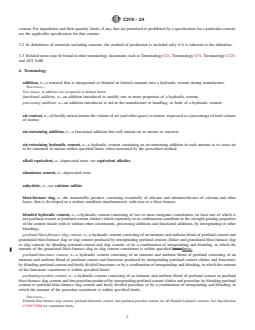
addition, n—a material that is interground or blended in limited amounts into a hydraulic cement during manufacture.
DISCUSSION—
Two classes of additions are recognized as defined below.
functional addition, n—an addition introduced to modify one or more properties of a hydraulic cement.
processing addition, n—an addition introduced to aid in the manufacture or handling, or both, of a hydraulic cement.
air content, n—of freshly mixed mortar the volume of air (and other gases) in mortar, expressed as a percentage of total volume
of mortar.
air-entraining addition, n—a functional addition that will entrain air in mortar or concrete.
air-entraining hydraulic cement, n—a hydraulic cement containing an air-entraining addition in such amount as to cause air
to be entrained in mortar within specified limits when measured by the prescribed method.
alkali equivalent, n—deprecated term; see equivalent alkalies.
aluminous cement, n—deprecated term.
anhydrite, n—see calcium sulfate.
blast-furnace slag, n—the nonmetallic product, consisting essentially of silicates and aluminosilicates of calcium and other
bases, that is developed in a molten condition simultaneously with iron in a blast furnace.
blended hydraulic cement, n—a hydraulic cement consisting of two or more inorganic constituents (at least one of which is
not portland cement or portland cement clinker) which separately or in combination contribute to the strength-gaining properties
of the cement (made with or without other constituents, processing additions and functional additions, by intergrinding or other
blending).
portland blast-furnace slag cement, n—a hydraulic cement consisting of an intimate and uniform blend of portland cement and
granulated blast-furnace slag or slag cement produced by intergrinding portland cement clinker and granulated blast-furnace slag
or slag cement; by blending portland cement and slag cement; or by a combination of intergrinding and blending, in which the
amount of the granulated blast-furnace slag or slag cement constituent is within specified limitslimits.
portland-limestone cement, n—a hydraulic cement consisting of an intimate and uniform blend of portland consisting of an
intimate and uniform blend of portland cement and limestone produced by intergrinding portland cement clinker and limestone;
by blending portland cement and finely divided limestone; or by a combination of intergrinding and blending, in which the amount
of the limestone constituent is within specified limits.
portland-pozzolan cement, n—a hydraulic cement consisting of an intimate and uniform blend of portland cement or portland
blast-furnace slag cement and fine pozzolan produced by intergrinding portland cement clinker and pozzolan; by blending portland
cement or portland blast-furnace slag cement and finely divided pozzolan; or by a combination of intergrinding and blending, in
which the amount of the pozzolan constituent is within specified limits.
DISCUSSION—
Portland blast-furnace slag cement, portland-limestone cement, and portland-pozzolan cement are all blended hydraulic cements. See Specification
C595/C595M for constituent limits.
C219 − 24
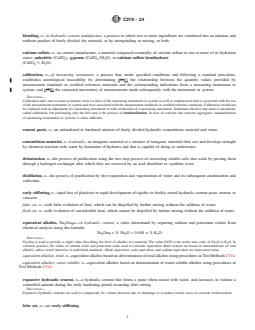
blending, n—in hydraulic cement manufacture, a process in which two or more ingredients are combined into an intimate and
uniform product of finely divided dry material, as by intergrinding or mixing, or both.
calcium sulfate, n—in cement manufacture, a material composed essentially of calcium sulfate in one or more of its hydration
states: anhydrite (CaSO ), gypsum (CaSO ·2H O), or calcium sulfate hemihydrate
4 4 2
(CaSO · ⁄2 H O).
4 2
calibration, n—of measuring instrument, a process that, under specified conditions and following a standard procedure,
establishes metrological traceability by determining ((1)1) the relationship between the quantity values provided by
measurement standards or certified reference materials and the corresponding indications from a measuring instrument or
system, and ((2)2) the estimated uncertainty of measurements made subsequently with the instrument or system.
DISCUSSION—
Calibration takes into account systematic error (or bias) of the measuring instrument or system as well as random error that is associated with the use
of the measurement instrument or system and error associated with the measurement standards or certified reference materials. Calibration should not
be confused with an adjustment of a measuring instrument or with verification of a measuring instrument. Sometimes the first step alone is mistakenly
called calibration, but performing only the first step is the process of standardization. In tests of concrete and concrete aggregates, standardization
of measuring instruments or systems is often sufficient.
cement paste, n—an unhardened or hardened mixture of finely divided hydraulic cementitious material and water.
cementitious material, n—hydraulic, an inorganic material or a mixture of inorganic materials that sets and develops strength
by chemical reaction with water by formation of hydrates and that is capable of doing so underwater.
deionization, n—the process of purification using the two-step process of converting soluble salts into acids by passing them
through a hydrogen exchanger after which they are removed by an acid absorbent or synthetic resin.
distillation, n—the process of purification by the evaporation and vaporization of water and its subsequent condensation and
collection.
early stiffening, n—rapid loss of plasticity or rapid development of rigidity in freshly mixed hydraulic cement paste, mortar, or
concrete.
false set, n—with little evolution of heat, which can be dispelled by further mixing without the addition of water.
flash set, n—with evolution of considerable heat, which cannot be dispelled by further mixing without the addition of water.
equivalent alkalies, Na
...