

ASTM D3171-22
(Test Method)Standard Test Methods for Constituent Content of Composite Materials
General Information
- Abstract
SIGNIFICANCE AND USE
5.1 A constituent content of a composite material must be known in order to analytically model the material properties (mechanical, physical, thermal, or electrical) of the composite which are affected by the reinforcement or matrix. Also, knowledge of the constituent content is required for evaluation of the quality of a fabricated material and the processes used during fabrication.
5.2 The void volume of a composite material may significantly affect some of its mechanical properties. Higher void volumes usually mean lower fatigue resistance, greater susceptibility to moisture penetration and weathering, and increased variation or scatter in strength properties. Knowledge of the void volume of a composite material is desirable as an indication of the quality of a composite.
5.3 Reinforcement content may be used to normalize mechanical properties affected by amount of reinforcement in the coupon.
SCOPE
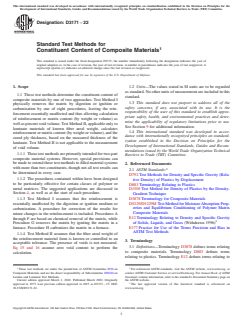
1.1 These test methods determine the constituent content of composite materials by one of two approaches. Test Method I physically removes the matrix by digestion or ignition or carbonization by one of eight procedures, leaving the reinforcement essentially unaffected and thus allowing calculation of reinforcement or matrix content (by weight or volume) as well as percent void volume. Test Method II, applicable only to laminate materials of known fiber areal weight, calculates reinforcement or matrix content (by weight or volume), and the cured ply thickness, based on the measured thickness of the laminate. Test Method II is not applicable to the measurement of void volume.
1.1.1 These test methods are primarily intended for two-part composite material systems. However, special provisions can be made to extend these test methods to filled material systems with more than two constituents, though not all test results can be determined in every case.
1.1.2 The procedures contained within have been designed to be particularly effective for certain classes of polymer or metal matrices. The suggested applications are discussed in Section 4, as well as at the start of each procedure.
1.1.3 Test Method I assumes that the reinforcement is essentially unaffected by the digestion or ignition medium or carbonization. A procedure for correction of the results for minor changes in the reinforcement is included. Procedures A through F are based on chemical removal of the matrix, while Procedure G removes the matrix by igniting the matrix in a furnace. Procedure H carbonizes the matrix in a furnace.
1.1.4 Test Method II assumes that the fiber areal weight of the reinforcement material form is known or controlled to an acceptable tolerance. The presence of voids is not measured. Eq 15 and 16 assume zero void content to perform the calculation.
1.2 Units—The values stated in SI units are to be regarded as standard. No other units of measurement are included in this standard.
1.3 This standard does not purport to address all of the safety concerns, if any, associated with its use. It is the responsibility of the user of this standard to establish appropriate safety, health, and environmental practices and determine the applicability of regulatory limitations prior to use. See Section 9 for additional information.
1.4 This international standard was developed in accordance with internationally recognized principles on standardization established in the Decision on Principles for the Development of International Standards, Guides and Recommendations issued by the World Trade Organization Technical Barriers to Trade (TBT) Committee.
- Status
- Published
- Publication Date
- 28-Feb-2022
- Technical Committee
- D30 - Composite Materials
- Drafting Committee
- D30.04 - Lamina and Laminate Test Methods
Overview
ASTM D3171-22: Standard Test Methods for Constituent Content of Composite Materials establishes widely used laboratory procedures to determine the makeup of composite materials. Composite constituents, such as matrix, reinforcement, and void content, directly affect key mechanical, physical, thermal, and electrical properties. Understanding these constituent amounts is essential for accurate material modeling, quality assurance, and evaluating fabrication processes.
This ASTM standard is primarily applicable to two-part composite systems with either polymer or metal matrices, but can be adapted with care for more complex, multi-component materials. It is recognized as a reliable, internationally aligned method by the composites industry and defense agencies for characterizing the quality and performance-relevant content of manufactured composites.
Key Topics
- Test Approaches: Two main methods are defined:
- Test Method I: Physical removal of the matrix through digestion, ignition, or carbonization, with various procedures tailored to specific matrix and reinforcement types. This method allows direct determination of reinforcement, matrix, and void content by weight and volume.
- Test Method II: For laminate composites with known fiber areal weight, constituent content is calculated using measured thickness and reference material parameters. This method does not measure void content.
- Material Coverage: Designed for polymer-matrix or metal-matrix composites, especially those with two main constituents, but adaptable in some cases to multi-filled materials.
- Void Volume Analysis: Critical for evaluating mechanical performance, as higher void content often correlates with reduced fatigue resistance, increased moisture uptake, and greater variability in strength.
- Practical Quality Control: Used to assess the quality of both material and fabrication process, including batch conformity, material uniformity, and to normalize property data for mechanical testing.
- Equipment and Safety: Specifies analytical balances, heating equipment, furnaces, and reagents, alongside necessary operator safety and environmental precautions.
Applications
ASTM D3171-22 is widely utilized in:
- Material Development: Supporting the design and research of advanced composite systems by characterizing constituent ratios and ensuring targeted material properties.
- Quality Assurance and Process Control: In manufacturing settings, constituent content evaluation ensures products meet design specifications and manufacturing consistency.
- Property Normalization: Data from these test methods help normalize mechanical testing results, as mechanical properties are affected by reinforcement content.
- Performance Assessment: Determining void content and distribution is a direct indicator of composite quality and expected performance in end-use conditions.
These methods serve industries such as aerospace, automotive, marine, and defense, where composite reliability and performance are critical.
Related Standards
For comprehensive composite materials characterization, the following standards are relevant:
- ASTM D792 - Test Methods for Density and Specific Gravity of Plastics by Displacement
- ASTM D1505 - Test Method for Density of Plastics by the Density-Gradient Technique
- ASTM D3878 - Terminology for Composite Materials
- ASTM D5229/D5229M - Test Method for Moisture Absorption Properties of Polymer Matrix Composites
- ASTM D883 - Terminology Relating to Plastics
Each standard addresses specific aspects of composite material analysis and complements ASTM D3171 in ensuring high-quality, accurately characterized materials for engineering applications.
Keywords: ASTM D3171-22, composite materials, constituent content, matrix, reinforcement, void content, quality control, material testing, polymer-matrix composites, mechanical properties, standard test methods, composite analysis.
Relations
- Effective Date
- 01-Feb-2024
- Effective Date
- 01-Nov-2023
- Effective Date
- 01-Mar-2020
- Effective Date
- 01-Jan-2020
- Effective Date
- 15-Oct-2019
- Effective Date
- 01-Aug-2019
- Effective Date
- 15-Apr-2019
- Effective Date
- 15-Apr-2019
- Effective Date
- 01-Feb-2019
- Effective Date
- 01-Dec-2018
- Effective Date
- 01-Nov-2018
- Effective Date
- 01-Apr-2018
- Effective Date
- 15-Aug-2017
- Effective Date
- 01-Aug-2016
- Effective Date
- 01-Jul-2015
Get Certified
Connect with accredited certification bodies for this standard

DIN CERTCO
DIN Group product certification.

Smithers Quality Assessments
US management systems and product certification.
Sponsored listings
Frequently Asked Questions
ASTM D3171-22 is a standard published by ASTM International. Its full title is "Standard Test Methods for Constituent Content of Composite Materials". This standard covers: SIGNIFICANCE AND USE 5.1 A constituent content of a composite material must be known in order to analytically model the material properties (mechanical, physical, thermal, or electrical) of the composite which are affected by the reinforcement or matrix. Also, knowledge of the constituent content is required for evaluation of the quality of a fabricated material and the processes used during fabrication. 5.2 The void volume of a composite material may significantly affect some of its mechanical properties. Higher void volumes usually mean lower fatigue resistance, greater susceptibility to moisture penetration and weathering, and increased variation or scatter in strength properties. Knowledge of the void volume of a composite material is desirable as an indication of the quality of a composite. 5.3 Reinforcement content may be used to normalize mechanical properties affected by amount of reinforcement in the coupon. SCOPE 1.1 These test methods determine the constituent content of composite materials by one of two approaches. Test Method I physically removes the matrix by digestion or ignition or carbonization by one of eight procedures, leaving the reinforcement essentially unaffected and thus allowing calculation of reinforcement or matrix content (by weight or volume) as well as percent void volume. Test Method II, applicable only to laminate materials of known fiber areal weight, calculates reinforcement or matrix content (by weight or volume), and the cured ply thickness, based on the measured thickness of the laminate. Test Method II is not applicable to the measurement of void volume. 1.1.1 These test methods are primarily intended for two-part composite material systems. However, special provisions can be made to extend these test methods to filled material systems with more than two constituents, though not all test results can be determined in every case. 1.1.2 The procedures contained within have been designed to be particularly effective for certain classes of polymer or metal matrices. The suggested applications are discussed in Section 4, as well as at the start of each procedure. 1.1.3 Test Method I assumes that the reinforcement is essentially unaffected by the digestion or ignition medium or carbonization. A procedure for correction of the results for minor changes in the reinforcement is included. Procedures A through F are based on chemical removal of the matrix, while Procedure G removes the matrix by igniting the matrix in a furnace. Procedure H carbonizes the matrix in a furnace. 1.1.4 Test Method II assumes that the fiber areal weight of the reinforcement material form is known or controlled to an acceptable tolerance. The presence of voids is not measured. Eq 15 and 16 assume zero void content to perform the calculation. 1.2 Units—The values stated in SI units are to be regarded as standard. No other units of measurement are included in this standard. 1.3 This standard does not purport to address all of the safety concerns, if any, associated with its use. It is the responsibility of the user of this standard to establish appropriate safety, health, and environmental practices and determine the applicability of regulatory limitations prior to use. See Section 9 for additional information. 1.4 This international standard was developed in accordance with internationally recognized principles on standardization established in the Decision on Principles for the Development of International Standards, Guides and Recommendations issued by the World Trade Organization Technical Barriers to Trade (TBT) Committee.
SIGNIFICANCE AND USE 5.1 A constituent content of a composite material must be known in order to analytically model the material properties (mechanical, physical, thermal, or electrical) of the composite which are affected by the reinforcement or matrix. Also, knowledge of the constituent content is required for evaluation of the quality of a fabricated material and the processes used during fabrication. 5.2 The void volume of a composite material may significantly affect some of its mechanical properties. Higher void volumes usually mean lower fatigue resistance, greater susceptibility to moisture penetration and weathering, and increased variation or scatter in strength properties. Knowledge of the void volume of a composite material is desirable as an indication of the quality of a composite. 5.3 Reinforcement content may be used to normalize mechanical properties affected by amount of reinforcement in the coupon. SCOPE 1.1 These test methods determine the constituent content of composite materials by one of two approaches. Test Method I physically removes the matrix by digestion or ignition or carbonization by one of eight procedures, leaving the reinforcement essentially unaffected and thus allowing calculation of reinforcement or matrix content (by weight or volume) as well as percent void volume. Test Method II, applicable only to laminate materials of known fiber areal weight, calculates reinforcement or matrix content (by weight or volume), and the cured ply thickness, based on the measured thickness of the laminate. Test Method II is not applicable to the measurement of void volume. 1.1.1 These test methods are primarily intended for two-part composite material systems. However, special provisions can be made to extend these test methods to filled material systems with more than two constituents, though not all test results can be determined in every case. 1.1.2 The procedures contained within have been designed to be particularly effective for certain classes of polymer or metal matrices. The suggested applications are discussed in Section 4, as well as at the start of each procedure. 1.1.3 Test Method I assumes that the reinforcement is essentially unaffected by the digestion or ignition medium or carbonization. A procedure for correction of the results for minor changes in the reinforcement is included. Procedures A through F are based on chemical removal of the matrix, while Procedure G removes the matrix by igniting the matrix in a furnace. Procedure H carbonizes the matrix in a furnace. 1.1.4 Test Method II assumes that the fiber areal weight of the reinforcement material form is known or controlled to an acceptable tolerance. The presence of voids is not measured. Eq 15 and 16 assume zero void content to perform the calculation. 1.2 Units—The values stated in SI units are to be regarded as standard. No other units of measurement are included in this standard. 1.3 This standard does not purport to address all of the safety concerns, if any, associated with its use. It is the responsibility of the user of this standard to establish appropriate safety, health, and environmental practices and determine the applicability of regulatory limitations prior to use. See Section 9 for additional information. 1.4 This international standard was developed in accordance with internationally recognized principles on standardization established in the Decision on Principles for the Development of International Standards, Guides and Recommendations issued by the World Trade Organization Technical Barriers to Trade (TBT) Committee.
ASTM D3171-22 is classified under the following ICS (International Classification for Standards) categories: 83.140.20 - Laminated sheets. The ICS classification helps identify the subject area and facilitates finding related standards.
ASTM D3171-22 has the following relationships with other standards: It is inter standard links to ASTM D883-24, ASTM D883-23, ASTM D5229/D5229M-20, ASTM D883-20, ASTM D3878-19a, ASTM D883-19c, ASTM D883-19a, ASTM D3878-19, ASTM D883-19, ASTM D883-18a, ASTM D883-18, ASTM D3878-18, ASTM D883-17, ASTM D3878-16, ASTM D3878-15. Understanding these relationships helps ensure you are using the most current and applicable version of the standard.
ASTM D3171-22 is available in PDF format for immediate download after purchase. The document can be added to your cart and obtained through the secure checkout process. Digital delivery ensures instant access to the complete standard document.
Standards Content (Sample)
This international standard was developed in accordance with internationally recognized principles on standardization established in the Decision on Principles for the
Development of International Standards, Guides and Recommendations issued by the World Trade Organization Technical Barriers to Trade (TBT) Committee.
Designation: D3171 − 22
Standard Test Methods for
Constituent Content of Composite Materials
This standard is issued under the fixed designation D3171; the number immediately following the designation indicates the year of
original adoption or, in the case of revision, the year of last revision. A number in parentheses indicates the year of last reapproval. A
superscript epsilon (´) indicates an editorial change since the last revision or reapproval.
This standard has been approved for use by agencies of the U.S. Department of Defense.
1. Scope 1.2 Units—The values stated in SI units are to be regarded
as standard. No other units of measurement are included in this
1.1 These test methods determine the constituent content of
standard.
composite materials by one of two approaches. Test Method I
1.3 This standard does not purport to address all of the
physically removes the matrix by digestion or ignition or
safety concerns, if any, associated with its use. It is the
carbonization by one of eight procedures, leaving the rein-
responsibility of the user of this standard to establish appro-
forcement essentially unaffected and thus allowing calculation
priate safety, health, and environmental practices and deter-
of reinforcement or matrix content (by weight or volume) as
mine the applicability of regulatory limitations prior to use.
wellaspercentvoidvolume.TestMethodII,applicableonlyto
See Section 9 for additional information.
laminate materials of known fiber areal weight, calculates
1.4 This international standard was developed in accor-
reinforcementormatrixcontent(byweightorvolume),andthe
dance with internationally recognized principles on standard-
cured ply thickness, based on the measured thickness of the
ization established in the Decision on Principles for the
laminate. Test Method II is not applicable to the measurement
Development of International Standards, Guides and Recom-
of void volume.
mendations issued by the World Trade Organization Technical
1.1.1 Thesetestmethodsareprimarilyintendedfortwo-part
Barriers to Trade (TBT) Committee.
composite material systems. However, special provisions can
be made to extend these test methods to filled material systems
2. Referenced Documents
with more than two constituents, though not all test results can 2
2.1 ASTM Standards:
be determined in every case.
D792 Test Methods for Density and Specific Gravity (Rela-
1.1.2 The procedures contained within have been designed
tive Density) of Plastics by Displacement
to be particularly effective for certain classes of polymer or
D883 Terminology Relating to Plastics
metal matrices. The suggested applications are discussed in
D1505 Test Method for Density of Plastics by the Density-
Section 4, as well as at the start of each procedure.
Gradient Technique
D3878 Terminology for Composite Materials
1.1.3 Test Method I assumes that the reinforcement is
essentially unaffected by the digestion or ignition medium or D5229/D5229M TestMethodforMoistureAbsorptionProp-
erties and Equilibrium Conditioning of Polymer Matrix
carbonization. A procedure for correction of the results for
Composite Materials
minor changes in the reinforcement is included. Procedures A
E12 Terminology Relating to Density and Specific Gravity
through F are based on chemical removal of the matrix, while
of Solids, Liquids, and Gases (Withdrawn 1996)
Procedure G removes the matrix by igniting the matrix in a
E177 Practice for Use of the Terms Precision and Bias in
furnace. Procedure H carbonizes the matrix in a furnace.
ASTM Test Methods
1.1.4 Test Method II assumes that the fiber areal weight of
the reinforcement material form is known or controlled to an
3. Terminology
acceptable tolerance. The presence of voids is not measured.
3.1 Definitions—Terminology D3878 defines terms relating
Eq 15 and 16 assume zero void content to perform the
to composite materials. Terminology D883 defines terms
calculation.
relating to plastics. Terminology E12 defines terms relating to
1 2
These test methods are under the jurisdiction of ASTM Committee D30 on For referenced ASTM standards, visit the ASTM website, www.astm.org, or
Composite Materials and are the direct responsibility of Subcommittee D30.04 on contact ASTM Customer Service at service@astm.org. For Annual Book of ASTM
Lamina and Laminate Test Methods. Standards volume information, refer to the standard’s Document Summary page on
Current edition approved March 1, 2022. Published March 2022. Originally the ASTM website.
approved in 1973. Last previous edition approved in 2015 as D3171 – 15. DOI: The last approved version of this historical standard is referenced on
10.1520/D3171-22. www.astm.org.
Copyright © ASTM International, 100 Barr Harbor Drive, PO Box C700, West Conshohocken, PA 19428-2959. United States
D3171 − 22
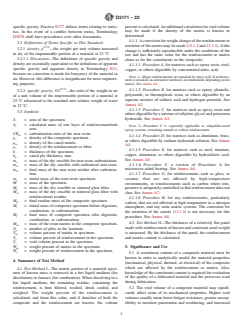
specific gravity. Practice E177 defines terms relating to statis- percentiscalculated.Anadditionalcalculationforvoidvolume
tics. In the event of a conflict between terms, Terminology may be made if the density of the matrix is known or
determined.
D3878 shall have precedence over other documents.
4.1.1 Acorrectionforweightchangeofthereinforcementor
3.2 Definitions of Terms Specific to This Standard:
retention of the matrix may be made (13.1.2 and 13.1.3), if this
23°C
3.2.1 density, ρ —the weight per unit volume measured
change is sufficiently reproducible under the conditions of the
in air, of the impermeable portion of a material at 23 °C.
test and has the same value for the reinforcement or matrix
3.2.1.1 Discussion—The definitions of specific gravity and
alone as for the constituents in the composite.
density are essentially equivalent to the definitions of apparent
4.1.1.1 Procedure A, for matrices such as epoxy resin, steel,
specific gravity and apparent density in Terminology E12,
copper, or others digestible by concentrated nitric acid.
because no correction is made for buoyancy of the material in
NOTE 1—Many reinforcements are attacked by nitric acid. If reinforce-
air. However, this difference is insignificant for most engineer-
mentisattacked,analternativemethodisrecommended,dependingonthe
ing purposes.
matrix. See Annex A1.
23°C
4.1.1.2 Procedure B, for matrices such as epoxy, phenolic,
3.2.2 specific gravity, SG —the ratio of the weight in air
polyamide, or thermoplastic resin, or others digestible by an
of a unit volume of the impermeable portion of a material at
aqueous mixture of sulfuric acid and hydrogen peroxide. See
23 °C referenced to the standard unit volume weight of water
Annex A2.
at 23 °C.
4.1.1.3 Procedure C, for matrices such as epoxy resin and
3.3 Symbols:
othersdigestiblebyamixtureofethyleneglycolandpotassium
hydroxide. See Annex A3.
A = area of the specimen.
A = calculated mass of one layer of reinforcement/unit
r
NOTE 2—Procedure C is especially applicable to anhydride-cured
area.
epoxy systems containing aramid or carbon reinforcement.
CR = carbonization ratio of the neat resin.
m
4.1.1.4 Procedure D, for matrices such as aluminum, brass,
ρ = density of the composite specimen.
c
or others digestible by sodium hydroxide solution. See Annex
ρ = density of the cured matrix.
m
A4.
ρ = density of the reinforcement or fiber.
r
4.1.1.5 Procedure E, for matrices such as steel, titanium,
h = thickness of the specimen.
copper, aluminum, or others digestible by hydrochloric acid.
h = cured ply thickness, mm.
p
See Annex A5.
m = mass of the dry crucible for neat resin carbonization.
c
4.1.1.6 Procedure F, a version of Procedure A for
m = mass of the dry crucible with carbonized neat resin.
cr
microwave-aided heating. See Annex A6.
m = final mass of the neat resin residue after carboniza-
d
tion. 4.1.1.7 Procedure G, for reinforcements such as glass, or
m = initial mass of the neat resin specimen. ceramic that are not affected by high-temperature
i
M = mass of the specimen.
environments, or reinforcements such as carbon where tem-
M = mass of the dry crucible or sintered glass filter.
peratureisadequatelycontrolledsothatreinforcementdoesnot
c
M = mass of the dry crucible or sintered glass filter with
char. See Annex A7.
cr
reinforcement residue.
4.1.1.8 Procedure H, for any reinforcements, particularly
M = final residue mass of the composite specimen.
d carbon, that are not affected at high temperature in a nitrogen
M = initial mass of composite specimen before digestion,
i
atmosphere, and any resin matrix systems. The correction for
combustion, or carbonization.
the retention of the matrix (13.1.3) is not necessary for this
M = final mass of composite specimen after digestion,
f
procedure. See Annex A8.
combustion, or carbonization.
4.2 Test Method II—The thickness of a relatively flat panel
M = mass of the resin matrix in the composite specimen.
m
made with reinforcement of known and consistent areal weight
N = number of plies in the laminate.
p
is measured. By the thickness of the panel, the reinforcement
V = volume percent of matrix in specimen.
m
V = volume percent of reinforcement in the specimen. and matrix content is calculated.
r
V = void volume percent in the specimen.
v
W = weight percent of matrix in the specimen.
5. Significance and Use
m
W = weight percent of reinforcement in the specimen.
r
5.1 A constituent content of a composite material must be
known in order to analytically model the material properties
4. Summary of Test Method
(mechanical, physical, thermal, or electrical) of the composite
which are affected by the reinforcement or matrix. Also,
4.1 Test Method I—The matrix portion of a material speci-
knowledge of the constituent content is required for evaluation
men of known mass is removed in a hot liquid medium (for
of the quality of a fabricated material and the processes used
dissolution) or furnace (for combustion). When dissolving in a
during fabrication.
hot liquid medium, the remaining residue, containing the
reinforcement, is then filtered, washed, dried, cooled, and
5.2 The void volume of a composite material may signifi-
weighed. The weight percent of the reinforcement is cantly affect some of its mechanical properties. Higher void
calculated, and from this value, and if densities of both the
volumes usually mean lower fatigue resistance, greater suscep-
composite and the reinforcement are known, the volume tibility to moisture penetration and weathering, and increased
D3171 − 22
variation or scatter in strength properties. Knowledge of the 6.5 Residual Matrix Retained—Matrix may be retained by
void volume of a composite material is desirable as an any of the techniques of Test Method I. This may be investi-
indication of the quality of a composite. gated quantitatively by subjecting the matrix to the test
conditions of the composite. Qualitatively, matrix appears as
5.3 Reinforcement content may be used to normalize me-
hardened pieces in the sample at the end of the test. Once the
chanical properties affected by amount of reinforcement in the
technique is established for a material, no significant changes
coupon.
are expected between samples unless the product or test
conditions vary significantly.
6. Interferences
6.6 Micrometer Interface—The thickness of the laminate
6.1 Density of Constituents—Calculationofthevoidvolume
assumes that reinforcement density and matrix density ob- continuously changes, particularly for surfaces with a release
clothorirregularsurface.TestMethodIImeasuresthelaminate
tainedonalotormaterialbasisareheldinthelaminatesample.
There is a normal variation in reinforcement and matrix at certain areas. The micrometer gives an indication of the
thickness of the material at a point. The micrometer thickness
densities that is dependent on the constituent material. This
assumption used by the void calculation equations is typically measure is dependent on (1) variation in thickness of the panel,
(2)typeanddiameterofthicknessmeasuringdevice,(3)ability
minor, changing the void calculation by less than 0.2 %. One
indication of this variation is the possibility of obtaining a to hold panel perpendicular to the measurement device, and (4)
sensitivity of the measurement device.
negative void volume in low-void volume composites. If
procedural errors can be ruled out, it is reasonable to believe 6.6.1 Ball micrometer geometry tends to give a thickness
measure for Test Method II that more closely approximates
that constituent density variation is responsible. Negative void
content is a physical impossibility, but a possibility in these fiber volume if there is a rough surface texture than a flat-faced
micrometer that tends to overstate laminate thickness. For
calculations. It is useful to report negative void contents to
assess if constituent density values are incorrect or within a some material forms, such as open weaves, the ball geometry
is not practical, so that a flat face micrometer is recommended.
typical range of material variation. The negative void value
then sets an upper bound on error of this test method for any
material. 7. Apparatus
6.2 Coupon Size—Ability to estimate void content is also
7.1 General Requirements:
determined by coupon size and limitations of measuring 7.1.1 Thermal Shock—Laboratory equipment, which is sub-
apparatus. For example, with just limitations of the analytical
jected to nonambient temperatures (hot or cold), shall be of
balance (accurate to 0.2 mg), a coupon of 0.2 g with a void tempered glass or polytetrafluoroethylene (PTFE) materials.
volume of 1.0 % would have an uncertainty of 10 % (reported
7.1.2 Post-Test Elemental Analysis—If a post-test elemental
void volume in the range of 0.9 to 1.1 %) on the void volume
analysis of the reinforcement residue is to be performed,
calculation as a result of possible balance error. A 1 g sample
laboratory equipment contacting the specimen shall be con-
would have an uncertainty of 2 % in the void volume calcula-
structed of PTFE, and specimen cutting performed only by
tion (reported void volume in the range of 0.98 to 1.02 %)
diamond-tipped tools.
because of possible balance error for the same 1.0 % void
7.2 General Usage:
volume.
7.2.1 Analytical Balance—The analytical balance shall be
4,5
6.3 Error in Previous Measures —Ability to estimate void
capable of reading to within 60.1 mg.
content is also determined by the accuracy of previous mea-
7.2.2 Laboratory Desiccator.
sures. Density measures of constituents and laminate have
7.3 Test Method I:
some limitations. Good measures of these properties should
7.3.1 Heating Equipment:
have an uncertainty of less than 0.0005 g/cm . For a typical
7.3.1.1 Constant Heat Source—Heatingmantle,hotplate,or
carbon/epoxylaminate,uncertaintyinthevoidvolumebecause
controlled temperature bath, capable of heating material to the
of the limitation of the constituent density measurement would
required temperature for the particular digestion medium and
be approximately 1 %.
shall be capable of maintaining the temperature to 610 °C.
6.4 Mass Change of Reinforcement—Fibers may lose mass
7.3.1.2 Microwave,capableofmaintainingaconstantpower
by any of the techniques in Test Method I. This may be
output. The microwave setup shall include an overpressure
investigated by subjecting the reinforcement without matrix to
fail-safe device. Used exclusively for Procedure F (see Annex
the test conditions of the composite. Once the technique is
A6).
established for a material, no significant changes are expected
7.3.1.3 Drying Oven, air circulating, capable of maintaining
between samples unless the product or test conditions vary
a temperature of 100 6 3 °C or other target temperature within
significantly.
63 °C.
7.3.1.4 Muffle Furnace, capable of maintaining a tempera-
ture where the polymer matrix is removed, but the reinforce-
The interface region in glass fiber-reinforced epoxy resin composites: 1.
Sample Preparation, Void Content and Interfacial Strength,Composites , 26, 1995,
ment is unaffected. This is typically 600 6 30 °C minimum.
pp. 467–475.
Used exclusively for Procedure G (see Annex A7).
“A Comparison of Void Measurement Methods for Carbon/Epoxy
7.3.1.5 Nitrogen-Purging Furnace,capableofmaintaininga
Composites,” U.S. Army Materials Technology Laboratory (US Army Research
Laboratory) MTL TR91–13. temperature where the polymer matrix is carbonized under
D3171 − 22
nitrogenenvironment,butthereinforcementisunaffected.This listed in Section 9 before selecting an extraction reagent.
is typically 560 6 40 °C minimum. Used exclusively for Extraction reagents that have been found effective for many
Procedure H (see Annex A8). matrices include:
7.3.2 Miscellaneous Equipment: 8.2.1 Procedures A and F:
7.3.2.1 Sample Container, beaker, sealed vessel, or flask of 8.2.1.1 Nitric Acid, HNO , 70 % aqueous.
borosilicate glass or PTFE, minimum size 50 mL. 8.2.2 Procedure B:
7.3.2.2 Vacuum Source, capable of 50 kPa (375 mm Hg) 8.2.2.1 Hydrogen Peroxide, H O , 30 to 50 % aqueous.
2 2
pressure. (Warning—Asoftheapprovaldateofthisstandard,H O was
2 2
7.3.2.3 Static Control Device, capable of eliminating static classified by the international agency for Research on Cancer
charge from beaker walls. as “unknown” (meaning the possibility of this material causing
7.3.2.4 Filtering Apparatus, this may consist of a filtering cancer in humans is unknown). There is limited evidence of a
flaskwithcrucibleholderandsinteredglassfilterorsomeother cancer risk associated with laboratory animals.)
apparatus. 8.2.2.2 Sulfuric Acid, H SO , 96 to 98 % aqueous.
2 4
8.2.3 Procedure C:
NOTE 3—Filter porosity should be sized to filter the smallest expected
8.2.3.1 Dimethylformamide (DMF), (CH ) NCHO.
3 2
reinforcement size. This is particularly important for discontinuous
(Warning—Asoftheapprovaldateofthisstandard,DMFwas
reinforcements or for materials which have been ground before digestion
(Note 4). If any doubt exists about the filter size selection, successively
listed by the international agency for Research on Cancer in
finer filters shall be evaluated with the material being tested until
Group 2B as a “possible human carcinogen” and is considered
confidence is established in the filter size selected. Resin fillers or other
a reproductive toxin by the National Toxicology Program. See
constituent materials not destroyed by digestion may be retained both
a recent DMF material safety data sheet for more information.)
within the reinforcement and due to filter size. An estimation of this
“trapped” matrix may be needed to adjust fiber content. Used in 8.2.3.2 Ethylene Glycol, HOCH CH OH.
2 2
Procedures A-F (see Annex A1 – Annex A7).
8.2.3.3 Solid Potassium Hydroxide, KOH.
8.2.4 Procedure D:
7.3.2.5 Reflux Condenser, capable of preventing loss of
8.2.4.1 Sodium Hydroxide, NaOH 40 to 80 % aqueous.
digestionmediumbyallowingvolatilizedvaporstorecondense
8.2.5 Procedure E:
into the container. Used in ProceduresAand C (see AnnexA1
8.2.5.1 Hydrochloric Acid, HCl 5 to 10 % aqueous.
and Annex A3).
7.3.2.6 Other Common Equipment—Other generally avail-
8.3 Washing Reagents—A suitable washing reagent(s) shall
ablelaboratorytermsmaybeneededforthevariousprocedures
be selected that is compatible with the material system under
such as beakers, pipettes, watchglasses, and lint-free wipes.
test and the apparatus. Read and understand the precautions
listed in Section 9 before selecting a washing reagent.Washing
7.4 Items for Test Method II:
reagents that have been found effective include:
7.4.1 Thickness Measuring Device—Micrometer or digital
8.3.1 Acetone, CH COCH .
indicator (with 6 mm diameter ball/ball measuring ends). 3 3
8.3.2 Water, distilled or demineralized.
Device is capable of reaching the center of the laminate test
specimen surface. Capable of reading to 0.001 mm.
9. Hazards
7.4.2 Calipers, capable of reading length or width of the
specimen to 0.1 % accuracy. Caliper reading length may vary 9.1 This test method should be used only by laboratory
depending on specimen size from 75 to over 1500 mm. Optical workers with general training in the safe handling of chemi-
devices may be used for larger specimens. cals.Asource of useful information is Prudent Practices in the
Laboratory: Handling and Disposal of Chemicals, National
8. Reagents
Academy Press, 1995, 449 pp., ISBN 0-309-05229-7.
(Warning—In addition to other precautions, consult the ap-
8.1 Purity of Reagents—Reagent grade chemicals shall be
propriate material safety data sheet for each material used,
used in all tests. Unless otherwise indicated, it is intended that
including caustics, oxidizers, and composite materials for
all reagents conform to the specifications of the Committee on
specific recommendations on safety and handling.)
Analytical Reagents of the American Chemical Society where
(Warning—In addition to other precautions, the digestion or
such specifications are available. Other grades may be used,
combustion process should be performed under a suitably
provided it is first ascertained that the reagent is of sufficiently
vented fume hood. Chemical processes and combustion pro-
high purity to permit its use without lessening the accuracy of
cesses shall not be performed in the same fume hood.)
the determination.
9.2 Carry out all oxidations behind a safety shield or hood
8.2 Digestion Reagents—A suitable digestion reagent shall
sash while using a ventilation hood.
be selected that is compatible with the material system, test
method, and apparatus. Read and understand the precautions
9.3 Usestandardproceduresforhandlingacidsandcaustics.
9.4 Store materials by type.Acids especially need to have a
containment area by acid type.
Reagent Chemicals, American Chemical Society Specifications, American
Chemical Society, Washington, DC. For suggestions on the testing of reagents not
9.5 Store 30 to 50 % hydrogen peroxide in a freezer, or in a
listed by the American Chemical Society, see Analar Standards for Laboratory
cool safety hood, in the original container with a vented cap.
Chemicals, BDH Ltd., Poole, Dorset, U.K., and the United States Pharmacopeia
Do not allow contact with any organic material. Flush spills
and National Formulary, U.S. Pharmacopeial Convention, Inc. (USPC), Rockville,
MD. with copious amounts of water.
D3171 − 22
9.6 If incidental skin contact is made with any reagent 10.2.3 Specimen Cutting—The specimen shall be free from
(except water), wash with copious amounts of water. oil, grease, or other foreign matter.
10.2.4 Specimen Conditioning—After cutting, the sample
9.7 No attempt should ever be made to purify hydrogen
shall be conditioned in accordance with Section 12.
peroxide by distillation. Explosive decomposition is said to
occur with boiling solution containing 65 % hydrogen perox-
11. Calibration and Standardization
ide.
11.1 The accuracy of all measuring equipment shall have
9.8 Ensure that all digestion medium is removed before
certified calibrations that are current at the time of use of the
placing the sample in the oven.
equipment.
9.9 Use of mixed digestion reagents, apparatus, or condi-
12. Conditioning
tions not covered by these test methods may increase hazards
as a result of splashing, toxic fumes, overpressurization, or
12.1 Dry the test specimens to an equilibrium condition in
explosion. If conditions from these test methods are altered,
accordance with Procedure D ofTest Method D5229/D5229M.
follow good laboratory practice for new test method develop-
If it may be shown that specimens are dry to within 1 % error,
ment.
withinashorterperiodoftime,thereduceddryingtimemaybe
used.
9.10 The combination of nitric acid and acetone is specifi-
cally cautioned against in the use of these test methods
12.2 Unless otherwise specified, conduct the tests at 23 6
(ProceduresAand F) since it may form an explosive media. It
5 °C and less than 65 % RH. Test specimens for density within
is good practice to rinse thoroughly so that reactive constitu-
10 min of removal from desiccator.
ents are not combined. Also reactive constituents shall not be
13. Procedure
placed in the same (waste) container.
9.11 Additional nonchemical hazards such as high heat and 13.1 Test Method I:
13.1.1 General Procedures
possibility of glass implosion under vacuum or other glass
breakage exist in these test methods. Follow good laboratory 13.1.1.1 Procedure A—Perform Procedure A in accordance
with Annex A1.
practice to minimize risks.
13.1.1.2 Procedure B—Perform Procedure B in accordance
with Annex A2.
10. Test Specimen
13.1.1.3 Procedure C—Perform Procedure C in accordance
10.1 Test Method I:
with Annex A3.
10.1.1 Sampling of Test Specimens—The minimum number
13.1.1.4 Procedure D—Perform Procedure D in accordance
of recommended test specimens is three. Use the same speci-
with Annex A4.
men sized and cut in accordance with 10.1.2 and 10.1.3 for
13.1.1.5 Procedure E—Perform Procedure E in accordance
density (as determined by Test Methods D792 or D1505) and
with Annex A5.
reinforcement volume/void content, except in Procedure G, in
13.1.1.6 Procedure F—Perform Procedure F in accordance
which the specimen may need additional dicing to maximize
with Annex A6.
surface area for combustion.
13.1.1.7 Procedure G—Perform Procedure G in accordance
10.1.2 Test Specimen Geometry—The specimen shall have a
with Annex A7.
minimum mass of 0.5 g for constituent volume only, and 1.0 g
13.1.1.8 Procedure H—Perform Procedure H in accordance
if void content is to be obtained, and any shape not restricted
with Annex A8.
by the apparatus.The specimen should contain a representative
13.1.2 Correction for Fiber Weight Change During Test:
volume of the material being evaluated. The same specimen
13.1.2.1 Weigh one blank consisting only of reinforcement.
may be used for density and reinforcement volume determina-
The blank mass shall roughly equal the mass of reinforcement
tion.
in the test specimens to the nearest 0.0001 g.
10.1.3 Specimen Cutting—The specimen shall be free from
13.1.2.2 Perform the full test procedure on blank.
oil, grease, or other foreign matter. If volume percent is to be
13.1.2.3 The mass difference between the original blank
calculated by measuring the density of the specimen, that
massandthemassafterdigestionorc
...
This document is not an ASTM standard and is intended only to provide the user of an ASTM standard an indication of what changes have been made to the previous version. Because
it may not be technically possible to adequately depict all changes accurately, ASTM recommends that users consult prior editions as appropriate. In all cases only the current version
of the standard as published by ASTM is to be considered the official document.
Designation: D3171 − 15 D3171 − 22
Standard Test Methods for
Constituent Content of Composite Materials
This standard is issued under the fixed designation D3171; the number immediately following the designation indicates the year of
original adoption or, in the case of revision, the year of last revision. A number in parentheses indicates the year of last reapproval. A
superscript epsilon (´) indicates an editorial change since the last revision or reapproval.
This standard has been approved for use by agencies of the U.S. Department of Defense.
1. Scope
1.1 These test methods determine the constituent content of composite materials by one of two approaches. Test Method I
physically removes the matrix by digestion or ignition or carbonization by one of eight procedures, leaving the reinforcement
essentially unaffected and thus allowing calculation of reinforcement or matrix content (by weight or volume) as well as percent
void volume. Test Method II, applicable only to laminate materials of known fiber areal weight, calculates reinforcement or matrix
content (by weight or volume), and the cured ply thickness, based on the measured thickness of the laminate. Test Method II is
not applicable to the measurement of void volume.
1.1.1 These test methods are primarily intended for two-part composite material systems. However, special provisions can be
made to extend these test methods to filled material systems with more than two constituents, though not all test results can be
determined in every case.
1.1.2 The procedures contained within have been designed to be particularly effective for certain classes of polymer or metal
matrices. The suggested applications are discussed in Section 4, as well as at the start of each procedure.
1.1.3 Test Method I assumes that the reinforcement is essentially unaffected by the digestion or ignition medium or carbonization.
A procedure for correction of the results for minor changes in the reinforcement is included. Procedures A through F are based on
chemical removal of the matrix, while Procedure G removes the matrix by igniting the matrix in a furnace. Procedure H carbonizes
the matrix in a furnace.
1.1.4 Test Method II assumes that the fiber areal weight of the reinforcement material form is known or controlled to an acceptable
tolerance. The presence of voids is not measured. Eq 15 and 16 assume zero void content to perform the calculation.
1.2 Units—The values stated in SI units are to be regarded as standard. No other units of measurement are included in this
standard.
1.3 This standard does not purport to address all of the safety concerns, if any, associated with its use. It is the responsibility
of the user of this standard to establish appropriate safety safety, health, and healthenvironmental practices and determine the
applicability of regulatory limitations prior to use. See Section 9 for additional information.
1.4 This international standard was developed in accordance with internationally recognized principles on standardization
established in the Decision on Principles for the Development of International Standards, Guides and Recommendations issued
by the World Trade Organization Technical Barriers to Trade (TBT) Committee.
These test methods are under the jurisdiction of ASTM Committee D30 on Composite Materials and are the direct responsibility of Subcommittee D30.04 on Lamina
and Laminate Test Methods.
Current edition approved April 1, 2015March 1, 2022. Published May 2015March 2022. Originally approved in 1973. Last previous edition approved in 20112015 as
D3171 – 11.D3171 – 15. DOI: 10.1520/D3171-15.10.1520/D3171-22.
Copyright © ASTM International, 100 Barr Harbor Drive, PO Box C700, West Conshohocken, PA 19428-2959. United States
D3171 − 22
2. Referenced Documents
2.1 ASTM Standards:
D792 Test Methods for Density and Specific Gravity (Relative Density) of Plastics by Displacement
D883 Terminology Relating to Plastics
D1505 Test Method for Density of Plastics by the Density-Gradient Technique
D3878 Terminology for Composite Materials
D5229/D5229M Test Method for Moisture Absorption Properties and Equilibrium Conditioning of Polymer Matrix Composite
Materials
E12 Terminology Relating to Density and Specific Gravity of Solids, Liquids, and Gases (Withdrawn 1996)
E177 Practice for Use of the Terms Precision and Bias in ASTM Test Methods
E1309 Guide for Identification of Fiber-Reinforced Polymer-Matrix Composite Materials in Databases (Withdrawn 2015)
3. Terminology
3.1 Definitions—Terminology D3878 defines terms relating to composite materials. Terminology D883 defines terms relating
to plastics. Terminology E12 defines terms relating to specific gravity. Practice E177 defines terms relating to statistics. In the event
of a conflict between terms, Terminology D3878 shall have precedence over other documents.
3.1.1 fiber content, n—the amount of fiber present in a composite or prepreg expressed either as percent by weight or percent by
volume. This is sometimes stated as a fraction. If no fillers exist, this is equivalent to reinforcement content. D3878
3.1.2 matrix content, n—the amount of matrix present in a composite or prepreg expressed either as percent by weight or percent
by volume. For polymer matrix composites this is resin content. D3878
3.1.3 reinforcement content, n—the amount of nonmatrix material (fiber and filler) in a composite or prepreg expressed either as
percent by weight or percent by volume. D3878
3.1.4 resin content, n—See matrix content. D3878
3.1.5 void volume, n—the volume in the specimen without mass, that is identified as neither matrix nor reinforcement. D3878
3.1 Definitions—Terminology D3878 defines terms relating to composite materials. Terminology D883 defines terms relating to
plastics. Terminology E12 defines terms relating to specific gravity. Practice E177 defines terms relating to statistics. In the event
of a conflict between terms, Terminology D3878 shall have precedence over other documents.
3.2 Definitions of Terms Specific to This Standard:
23°C
3.2.1 density, ρ —the weight per unit volume measured in air, of the impermeable portion of a material at 23°C.23 °C.
3.2.1.1 Discussion—
The definitiondefinitions of specific gravity and density are essentially equivalent to the definitions of apparent specific gravity and
apparent density in Terminology E12, because no correction is made for buoyancy of the material in air. However, this difference
is insignificant for most engineering purposes.
23°C
3.2.2 specific gravity, SG —the ratio of the weight in air of a unit volume of the impermeable portion of a material at 23°C23 °C
referenced to the standard unit volume weight of water at 23°C.23 °C.
3.3 Symbols:
A = area of the specimen.
A = calculated mass of one layer of reinforcement/unit area.
r
CR = carbonization ratio of the neat resin
CR = carbonization ratio of the neat resin.
m
ρ = density of the composite specimen.
c
For referenced ASTM standards, visit the ASTM website, www.astm.org, or contact ASTM Customer Service at service@astm.org. For Annual Book of ASTM Standards
volume information, refer to the standard’s Document Summary page on the ASTM website.
The last approved version of this historical standard is referenced on www.astm.org.
D3171 − 22
ρ = density of the cured matrix.
m
ρ = density of the reinforcement or fiber.
r
h = thickness of the specimen.
h = cured ply thickness, mm.
p
m = mass of the dry crucible for neat resin carbonization
c
m = mass of the dry crucible for neat resin carbonization.
c
m = mass of the dry crucible with carbonized neat resin
cr
m = mass of the dry crucible with carbonized neat resin.
cr
m = final mass of the neat resin residue after carbonization
d
m = final mass of the neat resin residue after carbonization.
d
m = initial mass of the neat resin specimen
i
m = initial mass of the neat resin specimen.
i
M = mass of the specimen.
M = mass of the dry crucible or sintered glass filter.
c
M = mass of the dry crucible or sintered glass filter with reinforcement residue.
cr
M = final residue mass of the composite specimen
d
M = final residue mass of the composite specimen.
d
M = initial mass of specimen before digestion or combustion.
i
M = initial mass of composite specimen before digestion, combustion, or carbonization.
i
M = final mass of specimen after digestion or combustion.
f
M = final mass of composite specimen after digestion, combustion, or carbonization.
f
M = mass of the resin matrix in the composite specimen
m
M = mass of the resin matrix in the composite specimen.
m
N = number of plies in the laminate.
p
V = volume percent of matrix in specimen.
m
V = volume percent of reinforcement in the specimen.
r
V = void volume percent in the specimen.
v
W = weight percent of matrix in the specimen.
m
W = weight percent of reinforcement in the specimen.
r
4. Summary of Test Method
4.1 Test Method I—The matrix portion of a material specimen of known mass is removed in a hot liquid medium (for dissolution)
or furnace (for combustion). When dissolving in a hot liquid medium, the remaining residue, containing the reinforcement, is then
filtered, washed, dried, cooled, and weighed. The weight percent of the reinforcement is calculated, and from this value, and if
densities of both the composite and the reinforcement are known, the volume percent is calculated. An additional calculation for
void volume may be made if the density of the matrix is known or determined.
4.1.1 A correction for weight change of the reinforcement or retention of the matrix may be made (13.1.2 and 13.1.3), if this
change is sufficiently reproducible under the conditions of the test and has the same value for the reinforcement or matrix alone
as for the constituents in the composite.
4.1.1.1 Procedure A, for matrices such as epoxy resin, steel, copper, or others digestible by concentrated nitric acid.
NOTE 1—Many reinforcements are attacked by nitric acid. If reinforcement is attacked, an alternative method is recommended, depending on the matrix.
See Annex A1.
4.1.1.2 Procedure B, for matrices such as epoxy, phenolic, polyamide, or thermoplastic resin, or others digestible by an aqueous
mixture of sulfuric acid and hydrogen peroxide. See Annex A2.
4.1.1.3 Procedure C, for matrices such as epoxy resin and others digestible by a mixture of ethylene glycol and potassium
hydroxide. See Annex A3.
NOTE 2—Procedure C is especially applicable to anhydride-cured epoxy systems containing aramid or carbon reinforcement.
4.1.1.4 Procedure D, for matrices such as aluminum, brass, or others digestible by sodium hydroxide solution. See Annex A4.
4.1.1.5 Procedure E, for matrices such as steel, titanium, copper, aluminum, or others digestible by hydrochloric acid. See Annex
A5.
D3171 − 22
4.1.1.6 Procedure F, a version of Procedure A for microwave-aided heating. See Annex A6.
4.1.1.7 Procedure G, for reinforcements such as glass, or ceramic that are not affected by high-temperature environments, or
reinforcements such as carbon where temperature is adequately controlled so that reinforcement does not char. See Annex A7.
4.1.1.8 Procedure H, for any reinforcements, particularly carbon, that are not affected at high temperature in a nitrogen
atmosphere, and any resin matrix systems. The correction for the retention of the matrix (13.1.3) is not necessary for this procedure.
See Annex A8.
4.2 Test Method II—The thickness of a relatively flat panel made with reinforcement of known and consistent areal weight is
measured. By the thickness of the panel, the reinforcement and matrix content is calculated.
5. Significance and Use
5.1 A constituent content of a composite material must be known in order to analytically model the material properties
(mechanical, physical, thermal, or electrical) of the composite which are affected by the reinforcement or matrix. Also, knowledge
of the constituent content is required for evaluation of the quality of a fabricated material and the processes used during fabrication.
5.2 The void volume of a composite material may significantly affect some of its mechanical properties. Higher void volumes
usually mean lower fatigue resistance, greater susceptibility to moisture penetration and weathering, and increased variation or
scatter in strength properties. Knowledge of the void volume of a composite material is desirable as an indication of the quality
of a composite.
5.3 Reinforcement content may be used to normalize mechanical properties affected by amount of reinforcement in the coupon.
6. Interferences
6.1 Density of Constituents—Calculation of the void volume assumes that reinforcement density and matrix density obtained on
a lot or material basis are held in the laminate sample. There is a normal variation in reinforcement and matrix densities that is
dependent on the constituent material. This assumption used by the void calculation equations is typically minor, changing the void
calculation by less than 0.2 %. One indication of this variation is the possibility of obtaining a negative void volume in low-void
volume composites. If procedural errors can be ruled out, it is reasonable to believe that constituent density variation is responsible.
Negative void content is a physical impossibility, but a possibility in these calculations. It is useful to report negative void contents
to assess if constituent density values are incorrect or within a typical range of material variation. The negative void value then
sets an upper bound on error of this test method for any material.
6.2 Coupon Size—Ability to estimate void content is also determined by coupon size and limitations of measuring apparatus. For
example, with just limitations of the analytical balance (accurate to 0.2 mg), a coupon of 0.2 g with a void volume of 1.0 % would
have an uncertainty of 10 % (reported void volume in the range of 0.9 to 1.1 %) on the void volume calculation as a result of
possible balance error. A 1-g1 g sample would have an uncertainty of 2 % in the void volume calculation (reported void volume
in the range of 0.98 to 1.02 %) because of possible balance error for the same 1.0 % void volume.
4,5
6.3 Error in Previous Measures —Ability to estimate void content is also determined by the accuracy of previous measures.
Density measures of constituents and laminate have some limitations. Good measures of these properties should have an
uncertainty of less than 0.0005 g/cm . For a typical carbon/epoxy laminate, uncertainty in the void volume because of the limitation
of the constituent density measurement would be approximately 1 %.
6.4 Mass Change of Reinforcement—Fibers may lose mass by any of the techniques in Test Method I. This may be investigated
by subjecting the reinforcement without matrix to the test conditions of the composite. Once the technique is established for a
material, no significant changes are expected between samples unless the product or test conditions vary significantly.
6.5 Residual Matrix Retained—Matrix may be retained by any of the techniques of Test Method I. This may be investigated
The interface region in glass fiber-reinforced epoxy resin composites: 1. Sample Preparation, Void Content and Interfacial Strength,Composites , 26, 1995, pp. 467–475.
“A Comparison of Void Measurement Methods for Carbon/Epoxy Composites,” U.S. Army Materials Technology Laboratory (US Army Research Laboratory) MTL
TR91–13.
D3171 − 22
quantitatively by subjecting the matrix to the test conditions of the composite. Qualitatively, matrix appears as hardened pieces in
the sample at the end of the test. Once the technique is established for a material, no significant changes are expected between
samples unless the product or test conditions vary significantly.
6.6 Micrometer Interface—The thickness of the laminate continuously changes, particularly for surfaces with a release cloth or
irregular surface. Test Method II measures the laminate at certain areas. The micrometer gives an indication of the thickness of
the material at a point. The micrometer thickness measure is dependent on (1) variation in thickness of the panel, (2) type and
diameter of thickness measuring device, (3) ability to hold panel perpendicular to the measurement device, and (4) sensitivity of
the measurement device.
6.6.1 Ball micrometer geometry tends to give a thickness measure for Test Method II that more closely approximates fiber volume
if there is a rough surface texture than a flat-faced micrometer that tends to overstate laminate thickness. For some material forms,
such as open weaves, the ball geometry is not practical, so that a flat face micrometer is recommended.
7. Apparatus
7.1 General Requirements:
7.1.1 Thermal Shock—Laboratory equipment, which is subjected to nonambient temperatures (hot or cold), shall be of tempered
glass or polytetrafluoroethylene (PTFE) materials.
7.1.2 Post-Test Elemental Analysis—If a post-test elemental analysis of the reinforcement residue is to be performed, laboratory
equipment contacting the specimen shall be constructed of PTFE, and specimen cutting performed only by diamond-tipped tools.
7.2 General Usage:
7.2.1 Analytical Balance—The analytical balance shall be capable of reading to within 60.1 mg.
7.2.2 Laboratory Desiccator.
7.3 Test Method I:
7.3.1 Heating Equipment:
7.3.1.1 Constant Heat Source—Heating mantle, hot plate, or controlled temperature bath, capable of heating material to the
required temperature for the particular digestion medium and shall be capable of maintaining the temperature to 610°C.610 °C.
7.3.1.2 Microwave, capable of maintaining a constant power output. The microwave setup shall include an overpressure fail-safe
device. Used exclusively for Procedure F (see Annex A6).
7.3.1.3 Drying Oven, air circulating, capable of maintaining a temperature of 100 6 3°C3 °C or other target temperature within
63°C.63 °C.
7.3.1.4 Muffle Furnace, capable of maintaining a temperature where the polymer matrix is removed, but the reinforcement is
unaffected. This is typically 600 6 30°C30 °C minimum. Used exclusively for Procedure G (see Annex A7).
7.3.1.5 Nitrogen-Purging Furnace, capable of maintaining a temperature where the polymer matrix is carbonized under nitrogen
environment, but the reinforcement is unaffected. This is typically 560 6 40°C40 °C minimum. Used exclusively for Procedure
H (see Annex A8).
7.3.2 Miscellaneous Equipment:
7.3.2.1 Sample Container, beaker, sealed vessel, or flask of borosilicate glass or PTFE, minimum size 50 mL.
7.3.2.2 Vacuum Source, capable of 50-kPa (375-mm50 kPa (375 mm Hg) pressure.
7.3.2.3 Static Control Device, capable of eliminating static charge from beaker walls.
D3171 − 22
7.3.2.4 Filtering Apparatus, this may consist of a filtering flask with crucible holder and sintered glass filter or some other
apparatus.
NOTE 3—Filter porosity should be sized to filter the smallest expected reinforcement size. This is particularly important for discontinuous reinforcements
or for materials which have been ground before digestion (Note 4). If any doubt exists about the filter size selection, successively finer filters shall be
evaluated with the material being tested until confidence is established in the filter size selected. Resin fillers or other constituent materials not destroyed
by digestion may be retained both within the reinforcement and due to filter size. An estimation of this “trapped” matrix may be needed to adjust fiber
content. Used in Procedures A-F (see Annex A1 – Annex A7).
7.3.2.5 Reflux Condenser, capable of preventing loss of digestion medium by allowing volatilized vapors to recondense into the
container. Used in Procedures A and C (see Annex A1 and Annex A3).
7.3.2.6 Other Common Equipment—Other generally available laboratory terms may be needed for the various procedures such as
beakers, pipettes, watchglasses, and lint-free wipes.
7.4 Items for Test Method II:
7.4.1 Thickness Measuring Device—Micrometer or digital indicator (with 6-mm6 mm diameter ball/ball measuring ends). Device
is capable of reaching the center of the laminate test specimen surface. Capable of reading to 0.001 mm.
7.4.2 Calipers, capable of reading length or width of the specimen to 0.1 % accuracy. Caliper reading length may vary depending
on specimen size from 75 to over 1500 mm. Optical devices may be used for larger specimens.
8. Reagents
8.1 Purity of Reagents—Reagent grade chemicals shall be used in all tests. Unless otherwise indicated, it is intended that all
reagents conform to the specifications of the Committee on Analytical Reagents of the American Chemical Society where such
specifications are available. Other grades may be used, provided it is first ascertained that the reagent is of sufficiently high purity
to permit its use without lessening the accuracy of the determination.
8.2 Digestion Reagents—A suitable digestion reagent shall be selected that is compatible with the material system, test method,
and apparatus. Read and understand the precautions listed in Section 9 before selecting an extraction reagent. Extraction reagents
that have been found effective for many matrices include:
8.2.1 Procedures A and F:
8.2.1.1 Nitric Acid, HNO , 70 % aqueous.
8.2.2 Procedure B:
8.2.2.1 Hydrogen Peroxide, H O , 30 to 50 % aqueous. (Warning—As of the approval date of this standard, H O was classified
2 2 2 2
by the international agency for Research on Cancer as “unknown” (meaning the possibility of this material causing cancer in
humans is unknown). There is limited evidence of a cancer risk associated with laboratory animals.)
8.2.2.2 Sulfuric Acid, H SO , 96 to 98 % aqueous.
2 4
8.2.3 Procedure C:
8.2.3.1 Dimethylformamide (DMF),(CH ) NCHO. (Warning—As of the approval date of this standard, DMF was listed by the
3 2
international agency for Research on Cancer in Group 2B as a “possible human carcinogen” and is considered a reproductive toxin
by the National Toxicology Program. See a recent DMF material safety data sheet for more information.)
8.2.3.2 Ethylene Glycol, HOCH CH OH.
2 2
Reagent Chemicals, American Chemical Society Specifications, American Chemical Society, Washington, DC. For suggestions on the testing of reagents not listed by
the American Chemical Society, see Analar Standards for Laboratory Chemicals, BDH Ltd., Poole, Dorset, U.K., and the United States Pharmacopeia and National
Formulary, U.S. Pharmacopeial Convention, Inc. (USPC), Rockville, MD.
D3171 − 22
8.2.3.3 Solid Potassium Hydroxide, KOH.
8.2.4 Procedure D:
8.2.4.1 Sodium Hydroxide, NaOH 40 to 80 % aqueous.
8.2.5 Procedure E:
8.2.5.1 Hydrochloric Acid, HCl 5-10 % 5 to 10 % aqueous.
8.3 Washing Reagents—A suitable washing reagent(s) shall be selected that is compatible with the material system under test and
the apparatus. Read and understand the precautions listed in Section 9 before selecting a washing reagent. Washing reagents that
have been found effective include:
8.3.1 Acetone, CH COCH .
3 3
8.3.2 Water, distilled or demineralized.
9. Hazards
9.1 This test method should be used only by laboratory workers with general training in the safe handling of chemicals. A source
of useful information is Prudent Practices in the Laboratory: Handling and Disposal of Chemicals, National Academy Press, 1995,
449 pp., ISBN 0-309-05229-7. (Warning—In addition to other precautions, consult the appropriate material safety data sheet for
each material used, including caustics, oxidizers, and composite materials for specific recommendations on safety and handling.)
(Warning—In addition to other precautions, the digestion or combustion process should be performed under a suitably vented
fume hood. Chemical processes and combustion processes shall not be performed in the same fume hood.)
9.2 Carry out all oxidations behind a safety shield or hood sash while using a ventilation hood.
9.3 Use standard procedures for handling acids and caustics.
9.4 Store materials by type. Acids especially need to have a containment area by acid type.
9.5 Store 30 to 50 % hydrogen peroxide in a freezer, or in a cool safety hood, in the original container with a vented cap. Do not
allow contact with any organic material. Flush spills with copious amounts of water.
9.6 If incidental skin contact is made with any reagent (except water), wash with copious amounts of water.
9.7 No attempt should ever be made to purify hydrogen peroxide by distillation. Explosive decomposition is said to occur with
boiling solution containing 65 % hydrogen peroxide.
9.8 Ensure that all digestion medium is removed before placing the sample in the oven.
9.9 Use of mixed digestion reagents, apparatus, or conditions not covered by these test methods may increase hazards as a result
of splashing, toxic fumes, overpressurization, or explosion. If conditions from these test methods are altered, follow good
laboratory practice for new test method development.
9.10 The combination of nitric acid and acetone is specifically cautioned against in the use of these test methods (Procedures A
and F) since it may form an explosive media. It is good practice to rinse thoroughly so that reactive constituents are not combined.
Also reactive constituents shall not be placed in the same (waste) container.
9.11 Additional nonchemical hazards such as high heat and possibility of glass implosion under vacuum or other glass breakage
exist in these test methods. Follow good laboratory practice to minimize risks.
D3171 − 22
10. Test Specimen
10.1 Test Method I:
10.1.1 Sampling of Test Specimens—The minimum number of recommended test specimens is three. Use the same specimen sized
and cut in accordance with 10.1.2 and 10.1.3 for density (as determined by Test Methods D792 or D1505) and reinforcement
volume/void content, except in Procedure G, in which the specimen may need additional dicing to maximize surface area for
combustion.
10.1.2 Test Specimen Geometry—The specimen shall have a minimum mass of 0.5 g for constituent volume only, and 1.0 g if void
content is to be obtained, and any shape not restricted by the apparatus. The specimen should contain a representative volume of
the material being evaluated. The same specimen may be used for density and reinforcement volume determination.
10.1.3 Specimen Cutting—The specimen shall be free from oil, grease, or other foreign matter. If volume percent is to be
calculated by measuring the density of the specimen, that cutting must not cause the specimen to fray or delaminate. An improperly
cut specimen may trap air during submersion, giving a false density.
10.1.4 Specimen Conditioning—After cutting, the sample shall be conditioned in accordance with Section 12.
10.2 Test Method II:
10.2.1 Sampling of Test Specimens—The minimum number of recommended test specimens is one.
10.2.2 Test Specimen Geometry—The specimen may be the dimensions of the laminate panel. Minimum specimen surface area
is 625 mm625 mm on one laminate face. The specimen shall be roughly cylindrical or cuboid in shape.
10.2.3 Specimen Cutting—The specimen shall be free from oil, grease, or other foreign matter.
10.2.4 Specimen Conditioning—After cutting, the sample shall be conditioned in accordance with Section 12.
11. Calibration and Standardization
11.1 The accuracy of all measuring equipment shall have certified calibrations that are current at the time of use of the equipment.
12. Conditioning
12.1 Dry the test specimens to an equilibrium condition in accordance with Procedure D of Test Method D5229/D5229M. If it
may be shown that specimens are dry to within 1 % error, within a shorter period of time, the reduced drying time may be used.
12.2 Unless otherwise specified, conduct the tests at 23 6 5°C5 °C and less than 65 % RH. Test specimens for density within 10
min 10 min of removal from desiccator.
13. Procedure
13.1 Test Method I
...