

ASTM C1646/C1646M-16
(Practice)Standard Practice for Making and Curing Test Specimens for Evaluating Resistance of Coarse Aggregate to Freezing and Thawing in Air-Entrained Concrete
General Information
- Abstract
SIGNIFICANCE AND USE
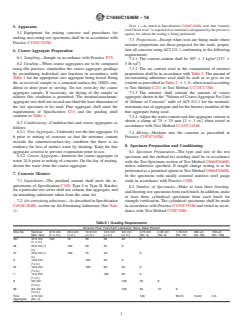
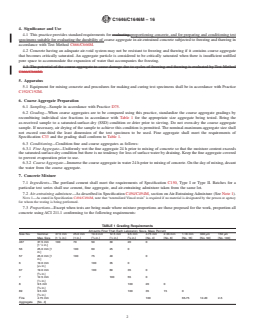
4.1 This practice provides standard requirements for proportioning concrete, and for preparing and conditioning test specimens suitable for evaluating the durability of coarse aggregate in air-entrained concrete subjected to freezing and thawing in accordance with Test Method C666/C666M.
4.2 Concrete having an adequate air-void system may not be resistant to freezing and thawing if it contains coarse aggregate that becomes critically saturated. An aggregate particle is considered to be critically saturated when there is insufficient unfilled pore space to accommodate the expansion of water that accompanies the freezing.
SCOPE
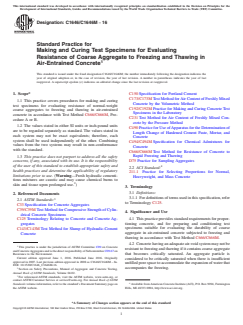
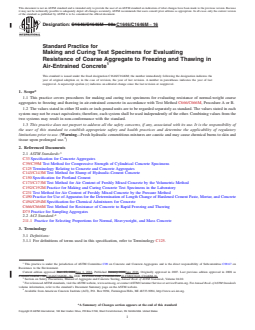
1.1 This practice covers procedures for making and curing test specimens for evaluating resistance of normal-weight coarse aggregates to freezing and thawing in air-entrained concrete in accordance with Test Method C666/C666M, Procedure A or B.
1.2 The values stated in either SI units or inch-pound units are to be regarded separately as standard. The values stated in each system may not be exact equivalents; therefore, each system shall be used independently of the other. Combining values from the two systems may result in non-conformance with the standard.
1.3 This practice does not purport to address all the safety concerns, if any, associated with its use. It is the responsibility of the user of this standard to establish appropriate safety and health practices and determine the applicability of regulatory limitations prior to use. (Warning—Fresh hydraulic cementitious mixtures are caustic and may cause chemical burns to skin and tissue upon prolonged use.2)
- Status
- Published
- Publication Date
- 31-May-2016
- Technical Committee
- C09 - Concrete and Concrete Aggregates
- Drafting Committee
- C09.67 - Resistance to the Environment
Buy Documents


ASTM C1646/C1646M-16 - Standard Practice for Making and Curing Test Specimens for Evaluating Resistance of Coarse Aggregate to Freezing and Thawing in Air-Entrained Concrete

REDLINE ASTM C1646/C1646M-16 - Standard Practice for Making and Curing Test Specimens for Evaluating Resistance of Coarse Aggregate to Freezing and Thawing in Air-Entrained Concrete
Overview
ASTM C1646/C1646M-16 is a vital standard developed by ASTM International that outlines procedures for making and curing test specimens to assess the resistance of coarse aggregates in air-entrained concrete to cycles of freezing and thawing. The practice ensures uniformity in test conditions, enabling reliable evaluation of aggregate durability in concrete exposed to freeze-thaw environments. This standard specifically references ASTM C666/C666M for testing and is critical for concrete applications exposed to harsh climatic conditions where freeze-thaw cycles are prevalent.
Key Topics
- Purpose and Importance:
The standard defines methods to proportion and prepare concrete specimens to evaluate coarse aggregate durability in air-entrained concrete exposed to freeze-thaw exposures. - Aggregate Conditioning:
Procedures for sampling, grading, and preparing coarse and fine aggregates are specified to ensure test consistency. - Concrete Mix Proportioning:
Requirements for cement type, aggregate types, air content, and mixing procedures are standardized to minimize variability in test results. - Test Specimen Preparation:
Provides specifications for molding, size, number, and curing of concrete test specimens prior to and during freeze-thaw testing. - Curing Methods:
Details instructions for initial storage, removal from molds, and subsequent storage in saturated limewater to achieve optimal specimen conditions. - Freeze-Thaw Resistance Evaluation:
Stipulates that specimens should be tested according to ASTM C666/C666M, either Procedure A or B, for accurate assessment of aggregate behavior under cyclic freezing and thawing.
Applications
ASTM C1646/C1646M-16 is essential for:
- Ready-mix concrete producers:
Assuring the durability and performance of coarse aggregates in concrete structures subjected to freezing and thawing. - Construction and infrastructure projects:
Designing concrete mixes for pavements, bridges, retaining walls, and other structures in regions prone to freeze-thaw cycles. - Material and quality control laboratories:
Validating the suitability and durability of different coarse aggregates before use in concrete production. - Specification writing and compliance:
Creating accurate project requirements and ensuring compliance with industry standards for concrete durability.
Utilizing this standard supports sustainable construction by preventing premature concrete deterioration related to inadequate freeze-thaw resistance, thereby reducing maintenance and repair costs over a structure’s lifecycle.
Related Standards
Several related standards are referenced to ensure comprehensive and consistent procedures:
- ASTM C33: Specification for Concrete Aggregates
- ASTM C39/C39M: Test Method for Compressive Strength of Cylindrical Concrete Specimens
- ASTM C125: Terminology Relating to Concrete and Concrete Aggregates
- ASTM C143/C143M: Test Method for Slump of Hydraulic-Cement Concrete
- ASTM C150: Specification for Portland Cement
- ASTM C173/C173M and C231: Air Content of Freshly Mixed Concrete (Volumetric and Pressure Methods)
- ASTM C192/C192M: Making and Curing Concrete Test Specimens in the Laboratory
- ASTM C494/C494M: Specification for Chemical Admixtures for Concrete
- ASTM C666/C666M: Test Method for Resistance of Concrete to Rapid Freezing and Thawing
- ASTM D75: Practice for Sampling Aggregates
- ACI 211.1: Practice for Selecting Proportions for Normal, Heavyweight, and Mass Concrete
Practical Value
Adoption of ASTM C1646/C1646M-16 supports the production of high-durability concrete, guards against freeze-thaw related failures, and enhances confidence in aggregate selection. By standardizing preparation, curing, and testing, it enables quality assurance for concrete materials-an essential consideration where durability, safety, and long-term performance are priorities.
Keywords: ASTM C1646, coarse aggregate, freeze-thaw resistance, air-entrained concrete, concrete durability, aggregate testing, specimen preparation, concrete standards.
Relations
- Effective Date
- 01-Jun-2016
- Effective Date
- 01-Jan-2024
- Refers
ASTM C39/C39M-23 - Standard Test Method for Compressive Strength of Cylindrical Concrete Specimens - Effective Date
- 01-Dec-2023
- Effective Date
- 01-Sep-2023
- Effective Date
- 15-Dec-2019
- Effective Date
- 01-Jan-2019
- Effective Date
- 01-Oct-2018
- Effective Date
- 01-Jul-2018
- Effective Date
- 01-Jan-2018
- Refers
ASTM C39/C39M-17b - Standard Test Method for Compressive Strength of Cylindrical Concrete Specimens - Effective Date
- 01-Aug-2017
- Effective Date
- 15-Dec-2016
- Refers
ASTM C39/C39M-16b - Standard Test Method for Compressive Strength of Cylindrical Concrete Specimens - Effective Date
- 01-Aug-2016
- Refers
ASTM C39/C39M-16a - Standard Test Method for Compressive Strength of Cylindrical Concrete Specimens - Effective Date
- 01-Jul-2016
- Effective Date
- 01-Jul-2016
- Effective Date
- 01-Feb-2016
Buy Documents
ASTM C1646/C1646M-16 - Standard Practice for Making and Curing Test Specimens for Evaluating Resistance of Coarse Aggregate to Freezing and Thawing in Air-Entrained Concrete
REDLINE ASTM C1646/C1646M-16 - Standard Practice for Making and Curing Test Specimens for Evaluating Resistance of Coarse Aggregate to Freezing and Thawing in Air-Entrained Concrete
Get Certified
Connect with accredited certification bodies for this standard

DIBt (Deutsches Institut für Bautechnik)
German Institute for Building Technology.
DIN CERTCO
DIN Group product certification.

Aboma Certification B.V.
Specialized in construction, metal, and transport sectors.
Sponsored listings
Frequently Asked Questions
ASTM C1646/C1646M-16 is a standard published by ASTM International. Its full title is "Standard Practice for Making and Curing Test Specimens for Evaluating Resistance of Coarse Aggregate to Freezing and Thawing in Air-Entrained Concrete". This standard covers: SIGNIFICANCE AND USE 4.1 This practice provides standard requirements for proportioning concrete, and for preparing and conditioning test specimens suitable for evaluating the durability of coarse aggregate in air-entrained concrete subjected to freezing and thawing in accordance with Test Method C666/C666M. 4.2 Concrete having an adequate air-void system may not be resistant to freezing and thawing if it contains coarse aggregate that becomes critically saturated. An aggregate particle is considered to be critically saturated when there is insufficient unfilled pore space to accommodate the expansion of water that accompanies the freezing. SCOPE 1.1 This practice covers procedures for making and curing test specimens for evaluating resistance of normal-weight coarse aggregates to freezing and thawing in air-entrained concrete in accordance with Test Method C666/C666M, Procedure A or B. 1.2 The values stated in either SI units or inch-pound units are to be regarded separately as standard. The values stated in each system may not be exact equivalents; therefore, each system shall be used independently of the other. Combining values from the two systems may result in non-conformance with the standard. 1.3 This practice does not purport to address all the safety concerns, if any, associated with its use. It is the responsibility of the user of this standard to establish appropriate safety and health practices and determine the applicability of regulatory limitations prior to use. (Warning—Fresh hydraulic cementitious mixtures are caustic and may cause chemical burns to skin and tissue upon prolonged use.2)
SIGNIFICANCE AND USE 4.1 This practice provides standard requirements for proportioning concrete, and for preparing and conditioning test specimens suitable for evaluating the durability of coarse aggregate in air-entrained concrete subjected to freezing and thawing in accordance with Test Method C666/C666M. 4.2 Concrete having an adequate air-void system may not be resistant to freezing and thawing if it contains coarse aggregate that becomes critically saturated. An aggregate particle is considered to be critically saturated when there is insufficient unfilled pore space to accommodate the expansion of water that accompanies the freezing. SCOPE 1.1 This practice covers procedures for making and curing test specimens for evaluating resistance of normal-weight coarse aggregates to freezing and thawing in air-entrained concrete in accordance with Test Method C666/C666M, Procedure A or B. 1.2 The values stated in either SI units or inch-pound units are to be regarded separately as standard. The values stated in each system may not be exact equivalents; therefore, each system shall be used independently of the other. Combining values from the two systems may result in non-conformance with the standard. 1.3 This practice does not purport to address all the safety concerns, if any, associated with its use. It is the responsibility of the user of this standard to establish appropriate safety and health practices and determine the applicability of regulatory limitations prior to use. (Warning—Fresh hydraulic cementitious mixtures are caustic and may cause chemical burns to skin and tissue upon prolonged use.2)
ASTM C1646/C1646M-16 is classified under the following ICS (International Classification for Standards) categories: 91.100.30 - Concrete and concrete products. The ICS classification helps identify the subject area and facilitates finding related standards.
ASTM C1646/C1646M-16 has the following relationships with other standards: It is inter standard links to ASTM C1646/C1646M-08a, ASTM C173/C173M-24, ASTM C39/C39M-23, ASTM C173/C173M-23, ASTM C125-19a, ASTM C125-19, ASTM C125-18b, ASTM C125-18a, ASTM C125-18, ASTM C39/C39M-17b, ASTM C125-16, ASTM C39/C39M-16b, ASTM C39/C39M-16a, ASTM C494/C494M-16, ASTM C192/C192M-16. Understanding these relationships helps ensure you are using the most current and applicable version of the standard.
ASTM C1646/C1646M-16 is available in PDF format for immediate download after purchase. The document can be added to your cart and obtained through the secure checkout process. Digital delivery ensures instant access to the complete standard document.
Standards Content (Sample)
This international standard was developed in accordance with internationally recognized principles on standardization established in the Decision on Principles for the
Development of International Standards, Guides and Recommendations issued by the World Trade Organization Technical Barriers to Trade (TBT) Committee.
Designation: C1646/C1646M − 16
Standard Practice for
Making and Curing Test Specimens for Evaluating
Resistance of Coarse Aggregate to Freezing and Thawing in
Air-Entrained Concrete
This standard is issued under the fixed designation C1646/C1646M; the number immediately following the designation indicates the
year of original adoption or, in the case of revision, the year of last revision. A number in parentheses indicates the year of last
reapproval. A superscript epsilon (´) indicates an editorial change since the last revision or reapproval.
1. Scope* C150 Specification for Portland Cement
C173/C173M Test Method forAir Content of Freshly Mixed
1.1 This practice covers procedures for making and curing
Concrete by the Volumetric Method
test specimens for evaluating resistance of normal-weight
C192/C192M Practice for Making and Curing Concrete Test
coarse aggregates to freezing and thawing in air-entrained
Specimens in the Laboratory
concrete in accordance with Test Method C666/C666M, Pro-
C231 Test Method for Air Content of Freshly Mixed Con-
cedure A or B.
crete by the Pressure Method
1.2 The values stated in either SI units or inch-pound units
C490 Practice for Use ofApparatus for the Determination of
are to be regarded separately as standard. The values stated in
Length Change of Hardened Cement Paste, Mortar, and
each system may not be exact equivalents; therefore, each
Concrete
system shall be used independently of the other. Combining
C494/C494M Specification for Chemical Admixtures for
values from the two systems may result in non-conformance
Concrete
with the standard.
C666/C666M Test Method for Resistance of Concrete to
Rapid Freezing and Thawing
1.3 This practice does not purport to address all the safety
concerns, if any, associated with its use. It is the responsibility D75 Practice for Sampling Aggregates
of the user of this standard to establish appropriate safety and
2.2 ACI Standard:
health practices and determine the applicability of regulatory
211.1 Practice for Selecting Proportions for Normal,
limitations prior to use. (Warning—Fresh hydraulic cementi-
Heavyweight, and Mass Concrete
tious mixtures are caustic and may cause chemical burns to
skin and tissue upon prolonged use. )
3. Terminology
3.1 Definitions:
2. Referenced Documents
3.1.1 Fordefinitionsoftermsusedinthisspecification,refer
2.1 ASTM Standards:
to Terminology C125.
C33 Specification for Concrete Aggregates
C39/C39M Test Method for Compressive Strength of Cylin-
4. Significance and Use
drical Concrete Specimens
4.1 Thispracticeprovidesstandardrequirementsforpropor-
C125 Terminology Relating to Concrete and Concrete Ag-
tioning concrete, and for preparing and conditioning test
gregates
specimens suitable for evaluating the durability of coarse
C143/C143M Test Method for Slump of Hydraulic-Cement
aggregate in air-entrained concrete subjected to freezing and
Concrete
thawing in accordance with Test Method C666/C666M.
4.2 Concretehavinganadequateair-voidsystemmaynotbe
This practice is under the jurisdiction of ASTM Committee C09 on Concrete
resistant to freezing and thawing if it contains coarse aggregate
andConcreteAggregatesandisthedirectresponsibilityofSubcommitteeC09.67on
that becomes critically saturated. An aggregate particle is
Resistance to the Environment.
Current edition approved June 1, 2016. Published June 2016. Originally
considered to be critically saturated when there is insufficient
approved in 2007. Last previous edition approved in 2008 as C1646/C1646M – 8a.
unfilledporespacetoaccommodatetheexpansionofwaterthat
DOI: 10.1520/C1646_C1646M-16.
2 accompanies the freezing.
Section on Safety Precautions, Manual of Aggregate and Concrete Testing,
Annual Book of ASTM Standards, Volume 04.02.
For referenced ASTM standards, visit the ASTM website, www.astm.org, or
contact ASTM Customer Service at service@astm.org. For Annual Book of ASTM
Standards volume information, refer to the standard’s Document Summary page on Available fromAmerican Concrete Institute (ACI), P.O. Box 9094, Farmington
the ASTM website. Hills, MI 48333-9094, http://www.aci-int.org.
*A Summary of Changes section appears at the end of this standard
Copyright © ASTM International, 100 Barr Harbor Drive, PO Box C700, West Conshohocken, PA 19428-2959. United States
C1646/C1646M − 16
NOTE 1—As stated in Specification C494/C494M, note that “neutral-
5. Apparatus
ized Vinsol resin” is required if no material is designated by the person or
5.1 Equipment for mixing concrete and procedures for
agency for whom the testing is being performed.
making and curing test specimens shall be in accordance with
7.3 Proportions—Except when tests are being made where
Practice C192/C192M.
mixture proportions are those proposed for the work, propor-
tion all concrete using ACI 211.1 conforming to the following
6. Coarse Aggregate Preparation
requirements:
6.1 Sampling—Sample in accordance with Practice D75. 3
7.3.1 The cement content shall be 307 6 3 kg/m [517 6
6.2 Grading—When coarse aggregates are to be compared 5lb⁄yd ]
using this practice, standardize the coarse aggregate gradings
7.3.2 The air content used in the computation of mixture
by recombining individual size fractions in accordance with proportions shall be in accordance with Table 2.The amount of
Table 1 for the appropriate size aggregate being tested. Bring
air-entraining admixture used shall be such as
...
This document is not an ASTM standard and is intended only to provide the user of an ASTM standard an indication of what changes have been made to the previous version. Because
it may not be technically possible to adequately depict all changes accurately, ASTM recommends that users consult prior editions as appropriate. In all cases only the current version
of the standard as published by ASTM is to be considered the official document.
Designation: C1646/C1646M − 08a C1646/C1646M − 16
Standard Practice for
Making and Curing Test Specimens for Evaluating
Resistance of Coarse Aggregate to Freezing and Thawing in
Air-Entrained Concrete
This standard is issued under the fixed designation C1646/C1646M; the number immediately following the designation indicates the
year of original adoption or, in the case of revision, the year of last revision. A number in parentheses indicates the year of last
reapproval. A superscript epsilon (´) indicates an editorial change since the last revision or reapproval.
1. Scope*
1.1 This practice covers procedures for making and curing test specimens for evaluating resistance of normal-weight coarse
aggregates to freezing and thawing in air-entrained concrete in accordance with Test Method C666/C666M, Procedure A or B.
1.2 The values stated in either SI units or inch-pound units are to be regarded separately as standard. The values stated in each
system may not be exact equivalents; therefore, each system shall be used independently of the other. Combining values from the
two systems may result in non-conformance with the standard.
1.3 This practice does not purport to address all the safety concerns, if any, associated with its use. It is the responsibility of
the user of this standard to establish appropriate safety and health practices and determine the applicability of regulatory
limitations prior to use. (Warning—Fresh hydraulic cementitious mixtures are caustic and may cause chemical burns to skin and
tissue upon prolonged use. )
2. Referenced Documents
2.1 ASTM Standards:
C33 Specification for Concrete Aggregates
C39/C39M Test Method for Compressive Strength of Cylindrical Concrete Specimens
C125 Terminology Relating to Concrete and Concrete Aggregates
C143/C143M Test Method for Slump of Hydraulic-Cement Concrete
C150 Specification for Portland Cement
C173/C173M Test Method for Air Content of Freshly Mixed Concrete by the Volumetric Method
C192/C192M Practice for Making and Curing Concrete Test Specimens in the Laboratory
C231 Test Method for Air Content of Freshly Mixed Concrete by the Pressure Method
C490 Practice for Use of Apparatus for the Determination of Length Change of Hardened Cement Paste, Mortar, and Concrete
C494/C494M Specification for Chemical Admixtures for Concrete
C666/C666M Test Method for Resistance of Concrete to Rapid Freezing and Thawing
D75 Practice for Sampling Aggregates
2.2 ACI Standard:
211.1 Practice for Selecting Proportions for Normal, Heavyweight, and Mass Concrete
3. Terminology
3.1 Definitions:
3.1.1 For definitions of terms used in this specification, refer to Terminology C125.
This practice is under the jurisdiction of ASTM Committee C09 on Concrete and Concrete Aggregates and is the direct responsibility of Subcommittee C09.67 on
Resistance to the Environment.
Current edition approved Dec. 15, 2008June 1, 2016. Published January 2009June 2016. Originally approved in 2007. Last previous edition approved in 2008 as
C1646/C1646M – 08.C1646/C1646M – 8a. DOI: 10.1520/C1646_C1646M-08A.10.1520/C1646_C1646M-16.
Section on Safety Precautions, Manual of Aggregate and Concrete Testing, Annual Book of ASTM Standards, Volume 04.02.
For referenced ASTM standards, visit the ASTM website, www.astm.org, or contact ASTM Customer Service at service@astm.org. For Annual Book of ASTM Standards
volume information, refer to the standard’s Document Summary page on the ASTM website.
Available from American Concrete Institute (ACI), P.O. Box 9094, Farmington Hills, MI 48333-9094, http://www.aci-int.org.
*A Summary of Changes section appears at the end of this standard
Copyright © ASTM International, 100 Barr Harbor Drive, PO Box C700, West Conshohocken, PA 19428-2959. United States
C1646/C1646M − 16
4. Significance and Use
4.1 This practice provides standard requirements for evaluating proportioning concrete, and for preparing and conditioning test
specimens suitable for evaluating the durability of coarse aggregate in air-entrained concrete subjected to freezing and thawing in
accordance with Test Method C666/C666M.
4.2 Concrete having an adequate air-void system may not be resistant to freezing and thawing if it contains coarse aggregate
that becomes critically saturated. An aggregate particle is considered to be critically saturated when there is insufficient unfilled
pore space to accommodate the expansion of water that accompanies the freezing.
4.3 The potential of the coarse aggregate to cause damage due to cycles of freezing and thawing is evaluated by Test Method
C666/C666M.
5. Apparatus
5.1 Equipment for mixing concrete and procedures for making and curing test specimens shall be in accordance with Practice
C192/C192M.
6. Coarse Aggregate Preparation
6.1 Sampling—Sample in accordance with Practice D75.
6.2 Grading—When coarse aggregates are to be compared using this practice, standardize the coarse aggregate gradings by
recombining individual size fractions in accordance with Table 1 for the appropriate size aggregate being tested. Bring the
as-received sample to a saturated-surface-dry (SSD) condition or drier prior to sieving. Do not oven-dry the coarse aggregate
sample. If necessary, air drying of the sample to achieve this condition is permitted. The nominal-maximum-aggregate size shall
not exceed one-third the least dimension of the test specimen to be used. Fine aggregate shall meet the requirements of
Specification C33 and the grading shall conform to Table 1.
6.3 Conditioning—Condition fine and coarse aggregates as follows:
6.3.1 Fine Aggregate—Uniformly wet the fine aggregate 24 h prior to mixing of concrete so that the moisture content exceeds
the saturated-surface-dry condition but there is no tendency for loss of surface water by draining. Keep the fine aggregate cover
...