

ASTM D2783-21
(Test Method)Standard Test Method for Measurement of Extreme-Pressure Properties of Lubricating Fluids (Four-Ball Method)
General Information
- Abstract
SIGNIFICANCE AND USE
5.1 This test method, used for specification purposes, differentiates between lubricating fluids having low, medium, and high level of extreme-pressure properties. The user of this method should determine to his own satisfaction whether results of this test procedure correlate with field performance or other bench test machines.
SCOPE
1.1 This test method covers the determination of the load-carrying properties of lubricating fluids. The following two determinations are made:
1.1.1 Load-wear index (formerly Mean-Hertz load).
1.1.2 Weld point by means of the four-ball extreme-pressure (EP) tester.
1.2 For the determination of the load-carrying properties of lubricating greases, see Test Method D2596.
1.3 The values stated in SI units are to be regarded as standard. The values given in parentheses after SI units are provided for information only and are not considered standard.
1.4 This standard does not purport to address all of the safety concerns, if any, associated with its use. It is the responsibility of the user of this standard to establish appropriate safety, health, and environmental practices and determine the applicability of regulatory limitations prior to use.
1.5 This international standard was developed in accordance with internationally recognized principles on standardization established in the Decision on Principles for the Development of International Standards, Guides and Recommendations issued by the World Trade Organization Technical Barriers to Trade (TBT) Committee.
- Status
- Published
- Publication Date
- 31-Oct-2021
- Technical Committee
- D02 - Petroleum Products, Liquid Fuels, and Lubricants
- Drafting Committee
- D02.L0.11 - Tribological Properties of Industrial Fluids and Lubricates
Buy Documents
ASTM D2783-21 - Standard Test Method for Measurement of Extreme-Pressure Properties of Lubricating Fluids (Four-Ball Method)
REDLINE ASTM D2783-21 - Standard Test Method for Measurement of Extreme-Pressure Properties of Lubricating Fluids (Four-Ball Method)
Overview
ASTM D2783-21 is the internationally recognized standard test method for measuring the extreme-pressure (EP) properties of lubricating fluids using the Four-Ball Method. Developed by ASTM International, this test method establishes a procedure to determine the load-carrying capabilities of lubricating oils under extreme pressure conditions. It specifically measures two key parameters: the load-wear index (formerly Mean-Hertz load) and the weld point of lubricating fluids. These results help to distinguish between lubricants with low, medium, and high EP performance and are critical for industries where severe lubrication conditions exist.
Key Topics
- Extreme-Pressure Properties Assessment: The standard outlines how to assess the performance of lubricants under high load situations to prevent gear, bearing, and machinery failure.
- Load-Wear Index (LWI): This index evaluates the lubricant’s capacity to minimize wear at increasing loads and is calculated as the average of the corrected loads immediately below the weld point.
- Weld Point Determination: The weld point is the minimum load at which the lubricant can no longer prevent metal-to-metal contact, leading to the welding of the test balls.
- Four-Ball Tester Usage: A unique tester where one rotating steel ball is pressed against three stationary balls submerged in the test lubricant, simulating high-pressure contacts in real-world applications.
- Safety and Environmental Practices: The method highlights the need for proper safety, health, and environmental protocols, including the use of appropriate solvents and safe handling practices.
Applications
ASTM D2783-21 is widely used across multiple industries to ensure reliable lubricant performance in extreme environments:
- Industrial Equipment: Validates lubricating fluids for gearboxes, bearings, and heavy-duty machinery exposed to high pressures and sliding contacts.
- Automotive Sector: Assesses gear oils and transmission fluids used in vehicles to ensure they meet necessary EP performance standards.
- Quality Assurance: Used by lubricant manufacturers for product development, quality control, and certification to industry specifications.
- Comparative Analysis: Allows for benchmarking and specification compliance, facilitating the selection of fluids suitable for demanding operational requirements.
- Research & Development: Provides a standardized method for the tribological evaluation of new formulations, including those with advanced EP additives.
Related Standards
To ensure comprehensive assessment of lubricating products, ASTM D2783-21 references and works in conjunction with several other international standards:
- ASTM D2596: Standard Test Method for Measurement of EP Properties of Lubricating Grease (Four-Ball Method) - specific to greases.
- ASTM G40: Terminology Relating to Wear and Erosion - provides essential definitions.
- ANSI/ABMA/ISO B 3.123290-1-2014: Specifications for steel balls used in the test.
Practical Value
Implementing ASTM D2783-21 assures end users and manufacturers that lubricating fluids meet rigorous requirements for extreme-pressure properties, supporting reliable machinery function and reducing equipment downtime. The standard delivers consistent, reproducible benchmark values crucial for product selection, field service correlation, and regulatory compliance. Through the Four-Ball Method, it offers a practical, widely-accepted approach to comparing lubricant performance in severe operational scenarios, contributing to improved safety, productivity, and operational cost management.
Keywords: ASTM D2783-21, Extreme-Pressure Properties, Four-Ball Method, Lubricating Fluids, Load-Wear Index, Weld Point, EP Lubricants, Industrial Lubrication Standards
Relations
- Effective Date
- 01-May-2020
- Effective Date
- 01-Nov-2015
- Effective Date
- 01-Jul-2015
- Effective Date
- 01-Oct-2014
- Effective Date
- 01-Jun-2013
- Effective Date
- 01-May-2012
- Effective Date
- 01-Dec-2010
- Effective Date
- 01-Jul-2010
- Effective Date
- 01-May-2010
- Effective Date
- 01-May-2010
- Effective Date
- 01-Jan-2010
- Effective Date
- 15-Nov-2009
- Effective Date
- 01-May-2008
- Effective Date
- 01-May-2005
- Effective Date
- 01-Dec-2004
Buy Documents
ASTM D2783-21 - Standard Test Method for Measurement of Extreme-Pressure Properties of Lubricating Fluids (Four-Ball Method)
REDLINE ASTM D2783-21 - Standard Test Method for Measurement of Extreme-Pressure Properties of Lubricating Fluids (Four-Ball Method)
Get Certified
Connect with accredited certification bodies for this standard

Element Materials Technology
Materials testing and product certification.

ABS Group Brazil
ABS Group certification services in Brazil.

ABS Quality Evaluations Inc.
American Bureau of Shipping quality certification.
Sponsored listings
Frequently Asked Questions
ASTM D2783-21 is a standard published by ASTM International. Its full title is "Standard Test Method for Measurement of Extreme-Pressure Properties of Lubricating Fluids (Four-Ball Method)". This standard covers: SIGNIFICANCE AND USE 5.1 This test method, used for specification purposes, differentiates between lubricating fluids having low, medium, and high level of extreme-pressure properties. The user of this method should determine to his own satisfaction whether results of this test procedure correlate with field performance or other bench test machines. SCOPE 1.1 This test method covers the determination of the load-carrying properties of lubricating fluids. The following two determinations are made: 1.1.1 Load-wear index (formerly Mean-Hertz load). 1.1.2 Weld point by means of the four-ball extreme-pressure (EP) tester. 1.2 For the determination of the load-carrying properties of lubricating greases, see Test Method D2596. 1.3 The values stated in SI units are to be regarded as standard. The values given in parentheses after SI units are provided for information only and are not considered standard. 1.4 This standard does not purport to address all of the safety concerns, if any, associated with its use. It is the responsibility of the user of this standard to establish appropriate safety, health, and environmental practices and determine the applicability of regulatory limitations prior to use. 1.5 This international standard was developed in accordance with internationally recognized principles on standardization established in the Decision on Principles for the Development of International Standards, Guides and Recommendations issued by the World Trade Organization Technical Barriers to Trade (TBT) Committee.
SIGNIFICANCE AND USE 5.1 This test method, used for specification purposes, differentiates between lubricating fluids having low, medium, and high level of extreme-pressure properties. The user of this method should determine to his own satisfaction whether results of this test procedure correlate with field performance or other bench test machines. SCOPE 1.1 This test method covers the determination of the load-carrying properties of lubricating fluids. The following two determinations are made: 1.1.1 Load-wear index (formerly Mean-Hertz load). 1.1.2 Weld point by means of the four-ball extreme-pressure (EP) tester. 1.2 For the determination of the load-carrying properties of lubricating greases, see Test Method D2596. 1.3 The values stated in SI units are to be regarded as standard. The values given in parentheses after SI units are provided for information only and are not considered standard. 1.4 This standard does not purport to address all of the safety concerns, if any, associated with its use. It is the responsibility of the user of this standard to establish appropriate safety, health, and environmental practices and determine the applicability of regulatory limitations prior to use. 1.5 This international standard was developed in accordance with internationally recognized principles on standardization established in the Decision on Principles for the Development of International Standards, Guides and Recommendations issued by the World Trade Organization Technical Barriers to Trade (TBT) Committee.
ASTM D2783-21 is classified under the following ICS (International Classification for Standards) categories: 75.100 - Lubricants, industrial oils and related products. The ICS classification helps identify the subject area and facilitates finding related standards.
ASTM D2783-21 has the following relationships with other standards: It is inter standard links to ASTM D2596-20, ASTM G40-15, ASTM D2596-15, ASTM D2596-14, ASTM G40-13, ASTM G40-12, ASTM G40-10b, ASTM G40-10a, ASTM D2596-10e1, ASTM D2596-10, ASTM G40-10, ASTM G40-09, ASTM D2596-97(2008), ASTM G40-05, ASTM G40-04. Understanding these relationships helps ensure you are using the most current and applicable version of the standard.
ASTM D2783-21 is available in PDF format for immediate download after purchase. The document can be added to your cart and obtained through the secure checkout process. Digital delivery ensures instant access to the complete standard document.
Standards Content (Sample)
This international standard was developed in accordance with internationally recognized principles on standardization established in the Decision on Principles for the
Development of International Standards, Guides and Recommendations issued by the World Trade Organization Technical Barriers to Trade (TBT) Committee.
Designation: D2783 − 21
Standard Test Method for
Measurement of Extreme-Pressure Properties of Lubricating
Fluids (Four-Ball Method)
This standard is issued under the fixed designation D2783; the number immediately following the designation indicates the year of
original adoption or, in the case of revision, the year of last revision. A number in parentheses indicates the year of last reapproval. A
superscript epsilon (´) indicates an editorial change since the last revision or reapproval.
1. Scope* 2.2 ANSI/ABMA/ISO Standard:
3290-1-2014 Rolling Bearings – Balls – Part 1: Steel Balls
1.1 This test method covers the determination of the load-
carrying properties of lubricating fluids. The following two
3. Terminology
determinations are made:
1.1.1 Load-wear index (formerly Mean-Hertz load). 3.1 Definitions:
1.1.2 Weldpointbymeansofthefour-ballextreme-pressure
3.1.1 compensation line, n—a line of plot on logarithmic
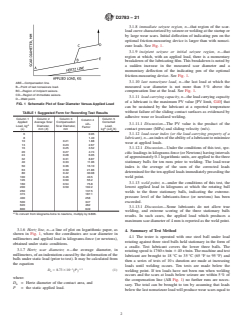
(EP) tester. paper, as shown in Fig. 1, where the coordinates are scar
diameter in millimetres and applied load in kilograms-force (or
1.2 For the determination of the load-carrying properties of
newtons), obtained under dynamic conditions.
lubricating greases, see Test Method D2596.
3.1.1.1 Discussion—Coordinates for the compensation line
1.3 The values stated in SI units are to be regarded as
are found in Table 1, Columns 1 and 3.
standard. The values given in parentheses after SI units are
3.1.1.2 Discussion—Some lubricants give coordinates
provided for information only and are not considered standard.
which are above the compensation line. Known examples of
1.4 This standard does not purport to address all of the
such fluids are methyl phenyl silicone, chlorinated methyl
safety concerns, if any, associated with its use. It is the
phenyl silicone, silphenylene, phenyl ether, and some mixtures
responsibility of the user of this standard to establish appro-
of petroleum oil and chlorinated paraffins.
priate safety, health, and environmental practices and deter-
3.1.2 compensation scar diameter, n—the average diameter,
mine the applicability of regulatory limitations prior to use.
in millimetres, of the wear scar on the stationary balls caused
1.5 This international standard was developed in accor-
by the rotating ball under an applied load in the presence of a
dance with internationally recognized principles on standard-
lubricant, but without causing either seizure or welding.
ization established in the Decision on Principles for the
3.1.2.1 Discussion—The wear scar obtained shall be within
Development of International Standards, Guides and Recom-
5 % of the values noted in Table 1, Column 3.
mendations issued by the World Trade Organization Technical
3.1.3 corrected load, n—the load in kilograms-force (or
Barriers to Trade (TBT) Committee.
newtons) for each run obtained by multiplying the applied load
by the ratio of the Hertz scar diameter to the measured scar
2. Referenced Documents
diameter at that load.
2.1 ASTM Standards:
3.1.4 extreme pressure (EP) additives, n—tribologically re-
D2596 Test Method for Measurement of Extreme-Pressure
active species that prevent mating metallic surfaces from
Properties of Lubricating Grease (Four-Ball Method)
adhering to each other under concentrated contact conditions
G40 Terminology Relating to Wear and Erosion
with high PV values [PV product, G40].
3.1.4.1 Discussion—The PV value is the product of the
This test method is under the jurisdiction of ASTM Committee D02 on
contact pressure (MPa) and sliding velocity (m/s).
Petroleum Products, Liquid Fuels, and Lubricants and is the direct responsibility of
3.1.5 extreme pressure (EP) lubricants, n—formulations
Subcommittee D02.L0.11 on Tribological Properties of Industrial Fluids and
whose effects may become observable at different operating
Lubricates.
Current edition approved Nov. 1, 2021. Published January 2022. Originally
conditions, preventing adhesive wear under mixed or boundary
approved in 1969. Last previous edition approved in 2019 as D2783 – 19. DOI:
lubrication regimes and are characterized by an increased load
10.1520/D2783-21.
carrying capacity or increased tribolfilm strength.
This method was prepared under the joint sponsorship of the American Society
of Lubrication Engineers. Accepted by ASLE January 1969.
For referenced ASTM standards, visit the ASTM website, www.astm.org, or
contact ASTM Customer Service at service@astm.org. For Annual Book of ASTM
Standards volume information, refer to the standard’s Document Summary page on Available from American National Standards Institute (ANSI), 25 W. 43rd St.,
the ASTM website. 4th Floor, New York, NY 10036, http://www.ansi.org.
*A Summary of Changes section appears at the end of this standard
Copyright © ASTM International, 100 Barr Harbor Drive, PO Box C700, West Conshohocken, PA 19428-2959. United States
D2783 − 21
3.1.8 immediate seizure region, n—that region of the scar-
load curve characterized by seizure or welding at the startup or
by large wear scars. Initial deflection of indicating pen on the
optional friction-measuring device is larger than with nonsei-
zure loads. See Fig. 1.
3.1.9 incipient seizure or initial seizure region, n—that
region at which, with an applied load, there is a momentary
breakdown of the lubricating film. This breakdown is noted by
a sudden increase in the measured scar diameter and a
momentary deflection of the indicating pen of the optional
friction-measuring device. See Fig. 1.
3.1.10 last nonseizure load, n—the last load at which the
ABE—Compensation line.
measured scar diameter is not more than 5 % above the
B—Point of last nonseizure load.
BC—Region of incipient seizure.
compensation line at the load. See Fig. 1.
CD—Region of immediate seizure.
3.1.11 load carrying capacity, n—the load carrying capacity
D—Weld point.
of a lubricant is the maximum PV value [PV limit, G40] that
FIG. 1 Schematic Plot of Scar Diameter Versus Applied Load
can be sustained by the lubricant at a reported temperature
without failure of the sliding contact surfaces as evidenced by
TABLE 1 Suggested Form for Recording Test Results
adhesive wear or localized welding.
Column 2 Column 3 Column 5
Column 1
Column 4
Applied Average Scar Compensation Corrected
LD 3.1.11.1 Discussion—The PV value is the product of the
h
A
Diameter, Scar Diameter, Load,
Load, kg
Factor
A
contact pressure (MPa) and sliding velocity (m/s).
(L)
mm (X) mm kg (LD /X)
h
3.1.12 load-wear index (or the load-carrying property of a
6 0.95
8 1.40
lubricant), n—an index of the ability of a lubricant to minimize
10 0.21 1.88
wear at applied loads.
13 0.23 2.67
16 0.25 3.52 3.1.12.1 Discussion—Under the conditions of this test, spe-
20 0.27 4.74
cific loadings in kilograms-force (or Newtons) having intervals
24 0.28 6.05
of approximately 0.1 logarithmic units, are applied to the three
32 0.31 8.87
stationary balls for ten runs prior to welding. The load-wear
40 0.33 11.96
50 0.36 16.10
index is the average of the sum of the corrected loads
63 0.39 21.86
determinedforthetenappliedloadsimmediatelyprecedingthe
80 0.42 30.08
100 0.46 40.5 weld point.
126 0.50 55.2
3.1.13 weld point, n—under the conditions of this test, the
160 0.54 75.8
200 0.59 102.2 lowest applied load in kilograms at which the rotating ball
250 137.5
welds to the three stationary balls, indicating the extreme-
315 187.1
pressure level of the lubricants-force (or newtons) has been
400 258
500 347 exceeded.
620 462
3.1.13.1 Discussion—Some lubricants do not allow true
800 649
welding, and extreme scoring of the three stationary balls
A
To convert from kilograms-force to newtons, multiply by 9.806.
results. In such cases, the applied load which produces a
maximum scar diameter of 4 mm is reported as the weld point.
3.1.6 Hertz line, n—a line of plot on logarithmic paper, as
4. Summary of Test Method
shown in Fig. 1, where the coordinates are scar diameter in
4.1 The tester is operated with one steel ball under load
millimetres and applied load in kilograms-force (or newtons),
rotating against three steel balls held stationary in the form of
obtained under static conditions.
a cradle. Test lubricant covers the lower three balls. The
3.1.7 Hertz scar diameter, n—the average diameter, in
rotating speed is 1760 r⁄min 6 40 r⁄min. The machine and test
millimetres, of an indentation caused by the deformation of the
lubricant are brought to 18 °C to 35 °C (65 °F to 95 °F) and
balls under static load (prior to test). It may be calculated from
then a series of tests of 10 s duration are made at increasing
the equation
loads until welding occurs. Ten tests are made below the
22 1/3
D 5 8.73 310 P (1)
~ ! welding point. If ten loads have not been run when welding
h
occurs and the scars at loads below seizure are within 5 % of
where:
the compensation line (AB Fig. 1) no further runs are neces-
D = Hertz diameter of the contact area, and
h
sary. The total can be brought to ten by assuming that loads
P = the static applied load.
below the last nonseizure load will produce wear scars equal to
D2783 − 21
machine parts. Reagent Grade Stoddard solvent is an example of a solvent
the “compensation scar diameter.” Values of these “assumed”
that has been found suitable.
scars are given in Table 1. For clarification of “last nonseizure
load” and “weld point” see Fig. 1. 7.2 Rinse Solvent, same as in 7.1, but with higher volatility.
ASTM n-Heptane is an example of one such rinse solvent that
5. Significance and Use
has been found suitable. (Warning—Flammable. Harmful if
inhaled. See A1.2.)
5.1 This test method, used for specification purposes, dif-
ferentiates between lubricating fluids having low, medium, and
7.3 Test Balls —Test balls shall be chrome alloy steel, made
high level of extreme-pressure properties. The user of this
from AISI standard steel No. E-52100, with diameter of
method should determine to his own satisfaction whether
12.7 mm (0.5 in.), Grade 25 EP (Extra Polish). Such balls are
resultsofthistestprocedurecorrelatewithfieldperformanceor
described in B3.12, for Metal Balls. The Extra-Polish finish is
other bench test machines.
not described in that specification. The Rockwell C hardness
shall be 64 to 66, a closer limit than is found in the ANSI
6. Apparatus
requirement.
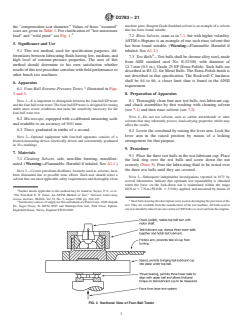
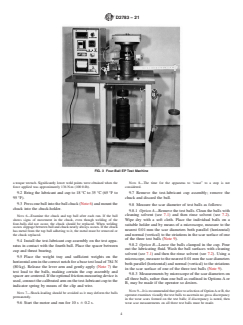
6.1 Four-Ball Extreme-Pressure Tester, illustrated in Figs.
2 and 3. 8. Preparation of Apparatus
8.1 Thoroughly clean four new test balls, test-lubricant cup,
NOTE 1—It is important to distinguish between the four-ball EP tester
andthefour-ballweartester.Thefour-ballEPtesterisdesignedfortesting
and chuck assemblies by first washing with cleaning solvent
under more severe conditions and lacks the sensitivity necessary for the
(see 7.1) and then rinse solvent (see 7.2).
four-ball wear test.
NOTE 4—Do not use solvents such as carbon tetrachloride or other
6.2 Microscope, equipped with a calibrated measuring scale
solvents that may inherently possess load-carrying properties which may
and readable to an accuracy of 0.01 mm.
affect the results.
6.3 Timer, graduated in tenths of a second.
8.2 Lower the crosshead by raising the lever arm. Lock the
lever arm in the raised position by means of a locking
NOTE 2—Optional equipment with four-ball apparatus consists of a
arrangement for that purpose.
friction-measuring device electrically driven and conveniently graduated
in 10 s markings.
9. Procedure
7. Materials
9.1 Place the three test balls in the test-lubricant cup. Place
7.1 Cleaning Solvent, safe, non-film forming, nonchlori-
the lock ring over the test balls and screw down the nut
nated. (Warning—Flammable. Harmful if inhaled. See A1.1.)
securely (Note 5). Pour the lubricating fluid to be tested over
the three test balls until they are covered.
NOTE 3—Certain petroleum distillates, formerly used as solvents, have
been eliminated due to possible toxic effects. Each user should select a
NOTE 5—Subsequent independent investigations reported in 1971 by
solvent that can meet applicable safety requirements and thoroughly clean
several laboratories indicate that optimum test repeatability is obtained
when the force on the lock-down nut is maintained within the range
68 N·m 6 7 N·m (50 ft·lb 6 5 ft·lb), applied, and measured by means of
Further details applicable to this method may be found in: Sayles, F. S., et al.,
“The Four-Ball E. P. Tester, An ASTM Method of Test,” National Lubricating
Grease Institute, NLGIA, Vol 32, No. 5, August 1968, pp. 162–167.
5 Steelballsmeetingthisdescriptionwereusedindevelopingtheprecisionofthe
SatisfactorysourcesofsupplyforthisinstrumentareFalexCorp.,1020Airpark
test. They are available from the manufacturer of the test machine.All balls used in
Dr., Sugar Grove, IL 60554–9585 and Stanhope-Seta Ltd., Park Close, Egham,
onetestshouldbetakenfromonecarton(of500balls)asreceivedfromthesupplier.
Englefield Green, Surrey, England TW20 OXD.
FIG. 2 Sectional View of Four-Ball Tester
D2783 − 21
FIG. 3 Four-Ball EP Test Machine
a torque wrench. Significantly lower weld points were obtained when the NOTE 8—The time for the apparatus to “coast” to a stop is not
force applied was approximately 136 N·m (100 ft·lb). considered.
9.2 Bring the lubricant and cup to 18 °C to 35 °C (65 °F to
9.7 Remove the test-lubricant cup assembly; remove the
95 °F).
chuck and discard the ball.
9.3 Pressoneballintotheballchuck(Note6)andmountthe
9.8 Measure the scar diameter of test balls as follows:
chuck into the chuck-holder.
9.8.1 Option A—Remove the test balls. Clean the balls with
cleaning solvent (see 7.1) and then rinse solvent (see 7.2).
NOTE 6—Examine the chuck and top ball after each run. If the ball
shows signs of movement in the chuck, even though welding of the
Wipe dry with a soft cloth. Place the individual balls on a
four-balls did not occur, the chuck should be replaced. When welding
suitable holder and by means of a microscope, measure to the
occurs slippage between ball and chuck nearly always occurs. If the chuck
nearest 0.01 mm the scar diameters both parallel (horizontal)
has metal from the top ball adhering to it, the metal must be removed or
and normal (vertical) to the striations in the scar surface of one
the chuck replaced.
of the three test balls (Note 9).
9.4 Install the test-lubricant cup assembly on the test appa-
9.8.2 Option B—Leave the balls clamped in the cup. Pour
ratus in contact with the fourth ball. Place the spacer between
out the lubricating fluid. Wash the ball surfaces with cleaning
cup and thrust bearing.
solvent (see 7.1) and then the rinse solvent (see 7.2). Using a
9.5 Place the weight tray and sufficient weights on the
microscope, measure to the nearest 0.01 mm the scar diameters
horizontalarminthecorrectnotchforabasetestloadof784 N
both parallel (horizontal) and normal (vertical) to the striations
(80 kg
...
This document is not an ASTM standard and is intended only to provide the user of an ASTM standard an indication of what changes have been made to the previous version. Because
it may not be technically possible to adequately depict all changes accurately, ASTM recommends that users consult prior editions as appropriate. In all cases only the current version
of the standard as published by ASTM is to be considered the official document.
Designation: D2783 − 19 D2783 − 21
Standard Test Method for
Measurement of Extreme-Pressure Properties of Lubricating
Fluids (Four-Ball Method)
This standard is issued under the fixed designation D2783; the number immediately following the designation indicates the year of
original adoption or, in the case of revision, the year of last revision. A number in parentheses indicates the year of last reapproval. A
superscript epsilon (´) indicates an editorial change since the last revision or reapproval.
1. Scope*
1.1 This test method covers the determination of the load-carrying properties of lubricating fluids. The following two
determinations are made:
1.1.1 Load-wear index (formerly Mean-Hertz load).
1.1.2 Weld point by means of the four-ball extreme-pressure (EP) tester.
1.2 For the determination of the load-carrying properties of lubricating greases, see Test Method D2596.
1.3 The values stated in SI units are to be regarded as standard. The values given in parentheses after SI units are provided for
information only and are not considered standard.
1.4 This standard does not purport to address all of the safety concerns, if any, associated with its use. It is the responsibility
of the user of this standard to establish appropriate safety, health, and environmental practices and determine the applicability of
regulatory limitations prior to use.
1.5 This international standard was developed in accordance with internationally recognized principles on standardization
established in the Decision on Principles for the Development of International Standards, Guides and Recommendations issued
by the World Trade Organization Technical Barriers to Trade (TBT) Committee.
2. Referenced Documents
2.1 ASTM Standards:
D2596 Test Method for Measurement of Extreme-Pressure Properties of Lubricating Grease (Four-Ball Method)
G40 Terminology Relating to Wear and Erosion
2.2 ANSIANSI/ABMA/ISO Standard:
B 3.123290-1-2014 Metal Rolling Bearings – Balls – Part 1: Steel Balls
3. Terminology
3.1 Definitions:
This test method is under the jurisdiction of ASTM Committee D02 on Petroleum Products, Liquid Fuels, and Lubricants and is the direct responsibility of Subcommittee
D02.L0.11 on Tribological Properties of Industrial Fluids and Lubricates.
Current edition approved May 1, 2019Nov. 1, 2021. Published September 2019January 2022. Originally approved in 1969. Last previous edition approved in 20142019
as D2783 – 03 (2014). 19. DOI: 10.1520/D2783-19.10.1520/D2783-21.
This method was prepared under the joint sponsorship of the American Society of Lubrication Engineers. Accepted by ASLE January 1969.
For referenced ASTM standards, visit the ASTM website, www.astm.org, or contact ASTM Customer Service at service@astm.org. For Annual Book of ASTM Standards
volume information, refer to the standard’s Document Summary page on the ASTM website.
Available from American National Standards Institute (ANSI), 25 W. 43rd St., 4th Floor, New York, NY 10036, http://www.ansi.org.
*A Summary of Changes section appears at the end of this standard
Copyright © ASTM International, 100 Barr Harbor Drive, PO Box C700, West Conshohocken, PA 19428-2959. United States
D2783 − 21
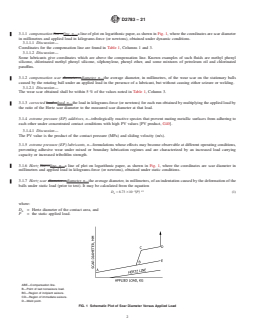
3.1.1 compensation line—line, n—a line of plot on logarithmic paper, as shown in Fig. 1, where the coordinates are scar diameter
in millimetres and applied load in kilograms-force (or newtons), obtained under dynamic conditions.
3.1.1.1 Discussion—
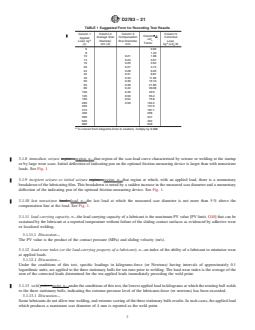
Coordinates for the compensation line are found in Table 1, Columns 1 and 3.
3.1.1.2 Discussion—
Some lubricants give coordinates which are above the compensation line. Known examples of such fluids are methyl phenyl
silicone, chlorinated methyl phenyl silicone, silphenylene, phenyl ether, and some mixtures of petroleum oil and chlorinated
paraffins.
3.1.2 compensation scar diameter—diameter, n—the average diameter, in millimetres, of the wear scar on the stationary balls
caused by the rotating ball under an applied load in the presence of a lubricant, but without causing either seizure or welding.
3.1.2.1 Discussion—
The wear scar obtained shall be within 5 % of the values noted in Table 1, Column 3.
3.1.3 corrected load—load, n—the load in kilograms-force (or newtons) for each run obtained by multiplying the applied load by
the ratio of the Hertz scar diameter to the measured scar diameter at that load.
3.1.4 extreme pressure (EP) additives, n—tribologically reactive species that prevent mating metallic surfaces from adhering to
each other under concentrated contact conditions with high PV values [PV product, G40].
3.1.4.1 Discussion—
The PV value is the product of the contact pressure (MPa) and sliding velocity (m/s).
3.1.5 extreme pressure (EP) lubricants, n—formulations whose effects may become observable at different operating conditions,
preventing adhesive wear under mixed or boundary lubrication regimes and are characterized by an increased load carrying
capacity or increased tribolfilm strength.
3.1.6 Hertz line—line, n—a line of plot on logarithmic paper, as shown in Fig. 1, where the coordinates are scar diameter in
millimetres and applied load in kilograms-force (or newtons), obtained under static conditions.
3.1.7 Hertz scar diameter—diameter, n—the average diameter, in millimetres, of an indentation caused by the deformation of the
balls under static load (prior to test). It may be calculated from the equation
22 1/3
D 5 8.73 310 P (1)
~ !
h
where:
D = Hertz diameter of the contact area, and
h
P = the static applied load.
ABE—Compensation line.
B—Point of last nonseizure load.
BC—Region of incipient seizure.
CD—Region of immediate seizure.
D—Weld point.
FIG. 1 Schematic Plot of Scar Diameter Versus Applied Load
D2783 − 21
TABLE 1 Suggested Form for Recording Test Results
Column 2 Column 3 Column 5
Column 1
Column4 4
Average Scar Compensation Corrected
Applied
LD
h
A
Diameter, Scar Diameter, Load,
Load, kg
Factor
A
(L) mm (X) mm kg (LD /X)
h
6 0.95
8 1.40
10 0.21 1.88
13 0.23 2.67
16 0.25 3.52
20 0.27 4.74
24 0.28 6.05
32 0.31 8.87
40 0.33 11.96
50 0.36 16.10
63 0.39 21.86
80 0.42 30.08
100 0.46 40.5
126 0.50 55.2
160 0.54 75.8
200 0.59 102.2
250 137.5
315 187.1
400 258
500 347
620 462
800 649
A
To convert from kilograms-force to newtons, multiply by 9.806.
3.1.8 immediate seizure region—region, n—that region of the scar-load curve characterized by seizure or welding at the startup
or by large wear scars. Initial deflection of indicating pen on the optional friction-measuring device is larger than with nonseizure
loads. See Fig. 1.
3.1.9 incipient seizure or initial seizure region—region, n—that region at which, with an applied load, there is a momentary
breakdown of the lubricating film. This breakdown is noted by a sudden increase in the measured scar diameter and a momentary
deflection of the indicating pen of the optional friction-measuring device. See Fig. 1.
3.1.10 last nonseizure load—load, n—the last load at which the measured scar diameter is not more than 5 % above the
compensation line at the load. See Fig. 1.
3.1.11 load carrying capacity, n—the load carrying capacity of a lubricant is the maximum PV value [PV limit, G40] that can be
sustained by the lubricant at a reported temperature without failure of the sliding contact surfaces as evidenced by adhesive wear
or localized welding.
3.1.11.1 Discussion—
The PV value is the product of the contact pressure (MPa) and sliding velocity (m/s).
3.1.12 load-wear index (or the load-carrying property of a lubricant), n—an index of the ability of a lubricant to minimize wear
at applied loads.
3.1.12.1 Discussion—
Under the conditions of this test, specific loadings in kilograms-force (or Newtons) having intervals of approximately 0.1
logarithmic units, are applied to the three stationary balls for ten runs prior to welding. The load-wear index is the average of the
sum of the corrected loads determined for the ten applied loads immediately preceding the weld point.
3.1.13 weld point—point, n—under the conditions of this test, the lowest applied load in kilograms at which the rotating ball welds
to the three stationary balls, indicating the extreme-pressure level of the lubricants-force (or newtons) has been exceeded.
3.1.13.1 Discussion—
Some lubricants do not allow true welding, and extreme scoring of the three stationary balls results. In such cases, the applied load
which produces a maximum scar diameter of 4 mm is reported as the weld point.
D2783 − 21
4. Summary of Test Method
4.1 The tester is operated with one steel ball under load rotating against three steel balls held stationary in the form of a cradle.
Test lubricant covers the lower three balls. The rotating speed is 1760 r ⁄min 6 40 r ⁄min. The machine and test lubricant are brought
to 18 °C to 35 °C (65 °F to 95 °F) and then a series of tests of 10 s duration are made at increasing loads until welding occurs.
Ten tests are made below the welding point. If ten loads have not been run when welding occurs and the scars at loads below
seizure are within 5 % of the compensation line (AB Fig. 1) no further runs are necessary. The total can be brought to ten by
assuming that loads below the last nonseizure load will produce wear scars equal to the “compensation scar diameter.” Values of
these “assumed” scars are given in Table 1. For clarification of “last nonseizure load” and “weld point” see Fig. 1.
5. Significance and Use
5.1 This test method, used for specification purposes, differentiates between lubricating fluids having low, medium, and high level
of extreme-pressure properties. The user of this method should determine to his own satisfaction whether results of this test
procedure correlate with field performance or other bench test machines.
6. Apparatus
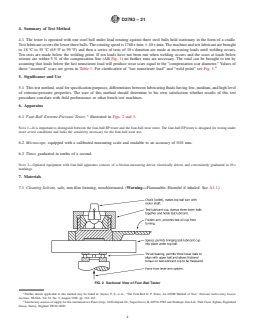
6.1 Four-Ball Extreme-Pressure Tester, illustrated in Figs. 2 and 3.
NOTE 1—It is important to distinguish between the four-ball EP tester and the four-ball wear tester. The four-ball EP tester is designed for testing under
more severe conditions and lacks the sensitivity necessary for the four-ball wear test.
6.2 Microscope, equipped with a calibrated measuring scale and readable to an accuracy of 0.01 mm.
6.3 Timer, graduated in tenths of a second.
NOTE 2—Optional equipment with four-ball apparatus consists of a friction-measuring device electrically driven and conveniently graduated in 10 s
markings.
7. Materials
7.1 Cleaning Solvent, safe, non-film forming, nonchlorinated. (Warning—Flammable. Harmful if inhaled. See A1.1.)
FIG. 2 Sectional View of Four-Ball Tester
Further details applicable to this method may be found in: Sayles, F. S., et al., “The Four-Ball E. P. Tester, An ASTM Method of Test,” National Lubricating Grease
Institute, NLGIA, Vol 32, No. 5, August 1968, pp. 162–167.
Satisfactory sources of supply for this instrument are Falex Corp., 1020 Airpark Dr., Sugar Grove, IL 60554–9585 and Stanhope-Seta Ltd., Park Close, Egham, Englefield
Green, Surrey, England TW20 OXD.
D2783 − 21
FIG. 3 Four-Ball EP Test Machine
NOTE 3—Certain petroleum distillates, formerly used as solvents, have been eliminated due to possible toxic effects. Each user should select a solvent
that can meet applicable safety requirements and thoroughly clean machine parts. Reagent Grade Stoddard solvent is an example of a solvent that has
been found suitable.
7.2 Rinse Solvent, same as in 7.1, but with higher volatility. ASTM n-Heptane is an example of one such rinse solvent that has
been found suitable. (Warning—Flammable. Harmful if inhaled. See A1.2.)
7.3 Test Balls —Test balls shall be chrome alloy steel, made from AISI standard steel No. E-52100, with diameter of 12.7 mm
12.7 mm (0.5 in.), Grade 25 EP (Extra Polish). Such balls are described in B3.12, for Metal Balls. The Extra-Polish finish is not
described in that specification. The Rockwell C hardness shall be 64 to 66, a closer limit than is found in the ANSI requirement.
8. Preparation of Apparatus
8.1 Thoroughly clean four new test balls, test-lubricant cup, and chuck assemblies by first washing with cleaning solvent (see 7.1)
and then rinse solvent (see 7.2).
NOTE 4—Do not use solvents such as carbon tetrachloride or other solvents that may inherently possess load-carrying properties which may affect the
results.
8.2 Lower the crosshead by raising the lever arm. Lock the lever arm in the raised position by means of a locking arrangement
for that purpose.
Steel balls meeting this description were used in developing the precision of the test. They are available from the manufacturer of the test machine. All balls used in
one test should be taken from one carton (of 500 balls) as received from the supplier.
D2783 − 21
9. Procedure
9.1 Place the three test balls in the test-lubricant cup. Place the lock ring over the test balls and screw down the nut securely (Note
5). Pour the lubricating fluid to be tested over the three test balls until they are covered.
NOTE 5—Subsequent independent investigations reported in 1971 by several laboratories indicate that optimum test repeatability is obtained when the
force on the lock-down nut is maintained within the range 68 η· m 6 7 η· m 68 N·m 6 7 N·m (50 ft·lb 6 5 ft·lb), applied, and measured by means of
a torque wrench. Significantly lower weld points were obtained when the force applied was approximately 136 N·m (100 ft·lb).
9.2 Bring the lubricant and cup to 18 °C to 35 °C (65 °F to 95 °F).
9.3 Press one ball into the ball chuck (Note 6) and mount the chuck into the chuck-holder.
NOTE 6—Examine the chuck and top ball after each run. If the ball shows signs of movement in the chuck, even though welding of the four-balls did
not occur, the chuck should be replaced. When welding occurs slippage between ball and chuck nearly always occurs. If the chuck has metal from the
top ball adhering to it, the metal must be removed or the chuck replaced.
9.4 Install the test-lubricant cup assembly on the test apparatus in contact with the fourth ball. Place the spacer between cup and
thrust bearing.
9.5 Place the weight tray and sufficient weights on the horizontal arm in the correct notch for a base test load of 784 N (80 kg).
Release the lever arm and gently apply (Note 7) the test load to the balls, making certain the cup assembly and spacer are centered.
If the optional friction-measuring device is used, connect the calibrated arm on the test-lubricant cup to the indicator spring by
means of the clip and wire.
NOTE 7—Shock-loading should be avoided as it may deform the balls permanently.
9.6 Start the motor and run for 10 s 6 0.2 s.
NOTE 8—The time for the apparatus to “coast” to a stop is not considered.
9.7 Remove the test-lubricant cup assembly; remove the chuck and discard the ball.
9.8 Measure the scar diameter of test balls as follows:
9.8.1 Option A—Remove the test balls. Clean the balls with cleaning solvent (see 7.1) and then rinse solvent (see 7.2). Wipe dry
with a soft cloth. Place the indi
...