


ASTM D4329-21
(Practice)Standard Practice for Fluorescent Ultraviolet (UV) Lamp Apparatus Exposure of Plastics
Standard Practice for Fluorescent Ultraviolet (UV) Lamp Apparatus Exposure of Plastics
SIGNIFICANCE AND USE
4.1 The ability of a plastic material to resist deterioration caused by exposure to light, heat, and water is a property of significance in many applications. This practice is intended to induce property changes associated with end-use conditions, including the effects of ultraviolet solar irradiance, moisture, and heat. The exposure used in this practice is not intended to simulate the deterioration caused by localized weather phenomena, such as, atmospheric pollution, biological attack, and saltwater exposure. (Warning—Variation in operating conditions within the accepted limits of this practice will not necessarily provide the same results. Therefore, no reference to the use of this practice shall be made unless accompanied by a report prepared in accordance with Section 8 that describes the specific operating conditions used. Refer to Practice G151 for detailed information on the caveats applicable to use of results obtained in accordance with this practice.)
Note 2: Additional information on sources of variability and on strategies for addressing variability in the design, execution, and data analysis of laboratory-accelerated exposure tests is found in Guide G141.
4.2 Reproducibility of test results between laboratories has been shown to be good when the stability of materials is evaluated in terms of performance ranking compared to other materials or to a control.5,6 Therefore, exposure of a similar material of known performance (a control) at the same time as the test materials is strongly recommended. It is recommended that at least three replicates of each material be exposed to allow for statistical evaluation of results.
4.3 Test results will depend upon the care that is taken to operate the equipment in accordance with Practice G154. Significant factors include regulation of line voltage, temperature of the room in which the device operates, temperature control, and condition and age of the lamp.
SCOPE
1.1 This practice covers specific procedures and test conditions that are applicable for using a fluorescent UV lamp and water apparatus exposure of plastics conducted in accordance with Practices G151 and G154. This practice also covers the preparation of test specimens, the test conditions best suited for plastics, and the evaluation of test results.
1.2 The values stated in SI units are to be regarded as standard. The values given in parentheses are for information only.
1.3 This standard does not purport to address all of the safety concerns, if any, associated with its use. It is the responsibility of the user of this standard to establish appropriate safety, health, and environmental practices and determine the applicability of regulatory limitations prior to use.
Note 1: This standard and ISO 4892-3 address the same subject matter, but differ in technical contact.
1.4 This international standard was developed in accordance with internationally recognized principles on standardization established in the Decision on Principles for the Development of International Standards, Guides and Recommendations issued by the World Trade Organization Technical Barriers to Trade (TBT) Committee.
General Information
- Status
- Published
- Publication Date
- 30-Jun-2021
- Technical Committee
- D20 - Plastics
- Drafting Committee
- D20.50 - Durability of Plastics
Relations
- Effective Date
- 01-Feb-2024
- Effective Date
- 01-Nov-2023
- Effective Date
- 01-Apr-2022
- Effective Date
- 01-Jan-2020
- Effective Date
- 01-Aug-2019
- Effective Date
- 15-Apr-2019
- Effective Date
- 01-Feb-2019
- Effective Date
- 01-Dec-2018
- Effective Date
- 01-Nov-2018
- Effective Date
- 01-Oct-2017
- Effective Date
- 01-Oct-2017
- Effective Date
- 15-Aug-2017
- Effective Date
- 01-Jun-2017
- Effective Date
- 01-Mar-2014
- Effective Date
- 15-Nov-2013
Overview
ASTM D4329-21, “Standard Practice for Fluorescent Ultraviolet (UV) Lamp Apparatus Exposure of Plastics,” establishes procedures for exposing plastic materials to fluorescent UV lamps and water, simulating the effects of weathering such as ultraviolet solar irradiance, moisture, and heat. This standard provides detailed guidelines on specimen preparation, exposure conditions, and evaluation methods to assess the durability and weather resistance of plastics for various end-use applications.
Designed by ASTM International, this standard is widely referenced by manufacturers, testing laboratories, and quality control professionals to evaluate how plastics withstand accelerated weathering in laboratory environments. ASTM D4329-21 aligns with internationally recognized testing principles, including those outlined by the World Trade Organization’s Technical Barriers to Trade (TBT) Committee.
Key Topics
- Accelerated Weathering of Plastics: Defines procedures using fluorescent UV lamps and water to mimic long-term sun and moisture exposure.
- Exposure Cycle Parameters: Provides specific cycles (e.g., UV radiation periods and condensation intervals) tailored for different applications, such as general use, automotive, or building products.
- Control and Test Specimens: Strongly recommends exposing at least three replicates of test and known-performance control materials simultaneously to ensure reliable, statistical evaluation of durability.
- Equipment Setup: Specifies apparatus location, ambient temperature ranges, ventilation needs, and lamp requirements based on ASTM Practices G151 and G154.
- Specimen Preparation: Details on proper sizing, mounting, and backing for specimens, as well as guidance for insulating materials and maintaining water vapor integrity.
- Specimen Handling and Repositioning: Emphasizes repositioning of specimens during exposure to ensure uniform exposure conditions.
- Water Quality Requirements: Highlights the importance of using purified water (typically deionized) for condensation and spray steps.
- Reporting and Evaluation: Outlines standardized reporting requirements, including apparatus details, exposure conditions, test results, and statistical considerations.
Applications
ASTM D4329-21 is essential for:
- Automotive Industry: Testing exterior plastic parts for UV and moisture resistance ensures longevity and colorfastness.
- Building Products: Evaluating window profiles, siding, or roofing materials for weather-induced degradation.
- Consumer Goods: Assessing plastic components in electronics, appliances, or outdoor furniture for their ability to withstand sunlight, heat, and humidity.
- Material R&D and Quality Assurance: Comparing new plastic formulations, additives, or coatings with known standards before product launch.
- Regulatory Compliance & Specifications: Demonstrating material durability in accordance with procurement or regulatory requirements.
By following ASTM D4329-21, organizations can reliably simulate sunlight and moisture effects in a controlled, repeatable laboratory setting, optimizing product performance and reducing outdoor exposure testing times.
Related Standards
- ASTM G151: Practice for Exposing Nonmetallic Materials in Accelerated Test Devices that Use Laboratory Light Sources
- ASTM G154: Practice for Operating Fluorescent Ultraviolet (UV) Lamp Apparatus for Exposure of Nonmetallic Materials
- ISO 4892-3: Plastics-Methods of Exposure to Laboratory Light Sources-Part 3: Fluorescent UV lamps (closely related but with some technical differences)
- SAE J2020: Accelerated Exposure of Automotive Exterior Materials Using a Fluorescent UV and Condensation Apparatus
- ASTM D883: Terminology Relating to Plastics
- ASTM G141: Guide for Addressing Variability in Exposure Testing of Nonmetallic Materials
Keywords: ASTM D4329-21, UV lamp exposure of plastics, fluorescent ultraviolet weathering, accelerated weathering test, plastics durability, UV resistance, ASTM weathering standards, laboratory sunlight simulation, polymer degradation, plastics testing.
Buy Documents
ASTM D4329-21 - Standard Practice for Fluorescent Ultraviolet (UV) Lamp Apparatus Exposure of Plastics
REDLINE ASTM D4329-21 - Standard Practice for Fluorescent Ultraviolet (UV) Lamp Apparatus Exposure of Plastics
Get Certified
Connect with accredited certification bodies for this standard

Smithers Quality Assessments
US management systems and product certification.

DIN CERTCO
DIN Group product certification.
Sponsored listings
Frequently Asked Questions
ASTM D4329-21 is a standard published by ASTM International. Its full title is "Standard Practice for Fluorescent Ultraviolet (UV) Lamp Apparatus Exposure of Plastics". This standard covers: SIGNIFICANCE AND USE 4.1 The ability of a plastic material to resist deterioration caused by exposure to light, heat, and water is a property of significance in many applications. This practice is intended to induce property changes associated with end-use conditions, including the effects of ultraviolet solar irradiance, moisture, and heat. The exposure used in this practice is not intended to simulate the deterioration caused by localized weather phenomena, such as, atmospheric pollution, biological attack, and saltwater exposure. (Warning—Variation in operating conditions within the accepted limits of this practice will not necessarily provide the same results. Therefore, no reference to the use of this practice shall be made unless accompanied by a report prepared in accordance with Section 8 that describes the specific operating conditions used. Refer to Practice G151 for detailed information on the caveats applicable to use of results obtained in accordance with this practice.) Note 2: Additional information on sources of variability and on strategies for addressing variability in the design, execution, and data analysis of laboratory-accelerated exposure tests is found in Guide G141. 4.2 Reproducibility of test results between laboratories has been shown to be good when the stability of materials is evaluated in terms of performance ranking compared to other materials or to a control.5,6 Therefore, exposure of a similar material of known performance (a control) at the same time as the test materials is strongly recommended. It is recommended that at least three replicates of each material be exposed to allow for statistical evaluation of results. 4.3 Test results will depend upon the care that is taken to operate the equipment in accordance with Practice G154. Significant factors include regulation of line voltage, temperature of the room in which the device operates, temperature control, and condition and age of the lamp. SCOPE 1.1 This practice covers specific procedures and test conditions that are applicable for using a fluorescent UV lamp and water apparatus exposure of plastics conducted in accordance with Practices G151 and G154. This practice also covers the preparation of test specimens, the test conditions best suited for plastics, and the evaluation of test results. 1.2 The values stated in SI units are to be regarded as standard. The values given in parentheses are for information only. 1.3 This standard does not purport to address all of the safety concerns, if any, associated with its use. It is the responsibility of the user of this standard to establish appropriate safety, health, and environmental practices and determine the applicability of regulatory limitations prior to use. Note 1: This standard and ISO 4892-3 address the same subject matter, but differ in technical contact. 1.4 This international standard was developed in accordance with internationally recognized principles on standardization established in the Decision on Principles for the Development of International Standards, Guides and Recommendations issued by the World Trade Organization Technical Barriers to Trade (TBT) Committee.
SIGNIFICANCE AND USE 4.1 The ability of a plastic material to resist deterioration caused by exposure to light, heat, and water is a property of significance in many applications. This practice is intended to induce property changes associated with end-use conditions, including the effects of ultraviolet solar irradiance, moisture, and heat. The exposure used in this practice is not intended to simulate the deterioration caused by localized weather phenomena, such as, atmospheric pollution, biological attack, and saltwater exposure. (Warning—Variation in operating conditions within the accepted limits of this practice will not necessarily provide the same results. Therefore, no reference to the use of this practice shall be made unless accompanied by a report prepared in accordance with Section 8 that describes the specific operating conditions used. Refer to Practice G151 for detailed information on the caveats applicable to use of results obtained in accordance with this practice.) Note 2: Additional information on sources of variability and on strategies for addressing variability in the design, execution, and data analysis of laboratory-accelerated exposure tests is found in Guide G141. 4.2 Reproducibility of test results between laboratories has been shown to be good when the stability of materials is evaluated in terms of performance ranking compared to other materials or to a control.5,6 Therefore, exposure of a similar material of known performance (a control) at the same time as the test materials is strongly recommended. It is recommended that at least three replicates of each material be exposed to allow for statistical evaluation of results. 4.3 Test results will depend upon the care that is taken to operate the equipment in accordance with Practice G154. Significant factors include regulation of line voltage, temperature of the room in which the device operates, temperature control, and condition and age of the lamp. SCOPE 1.1 This practice covers specific procedures and test conditions that are applicable for using a fluorescent UV lamp and water apparatus exposure of plastics conducted in accordance with Practices G151 and G154. This practice also covers the preparation of test specimens, the test conditions best suited for plastics, and the evaluation of test results. 1.2 The values stated in SI units are to be regarded as standard. The values given in parentheses are for information only. 1.3 This standard does not purport to address all of the safety concerns, if any, associated with its use. It is the responsibility of the user of this standard to establish appropriate safety, health, and environmental practices and determine the applicability of regulatory limitations prior to use. Note 1: This standard and ISO 4892-3 address the same subject matter, but differ in technical contact. 1.4 This international standard was developed in accordance with internationally recognized principles on standardization established in the Decision on Principles for the Development of International Standards, Guides and Recommendations issued by the World Trade Organization Technical Barriers to Trade (TBT) Committee.
ASTM D4329-21 is classified under the following ICS (International Classification for Standards) categories: 83.080.01 - Plastics in general. The ICS classification helps identify the subject area and facilitates finding related standards.
ASTM D4329-21 has the following relationships with other standards: It is inter standard links to ASTM D883-24, ASTM D883-23, ASTM E456-13a(2022)e1, ASTM D883-20, ASTM D883-19c, ASTM D883-19a, ASTM D883-19, ASTM D883-18a, ASTM D883-18, ASTM E456-13A(2017)e1, ASTM E456-13A(2017)e3, ASTM D883-17, ASTM G147-17, ASTM G113-14, ASTM E456-13ae1. Understanding these relationships helps ensure you are using the most current and applicable version of the standard.
ASTM D4329-21 is available in PDF format for immediate download after purchase. The document can be added to your cart and obtained through the secure checkout process. Digital delivery ensures instant access to the complete standard document.
Standards Content (Sample)
This international standard was developed in accordance with internationally recognized principles on standardization established in the Decision on Principles for the
Development of International Standards, Guides and Recommendations issued by the World Trade Organization Technical Barriers to Trade (TBT) Committee.
Designation: D4329 − 21
Standard Practice for
Fluorescent Ultraviolet (UV) Lamp Apparatus Exposure of
Plastics
This standard is issued under the fixed designation D4329; the number immediately following the designation indicates the year of
original adoption or, in the case of revision, the year of last revision. A number in parentheses indicates the year of last reapproval. A
superscript epsilon (´) indicates an editorial change since the last revision or reapproval.
1. Scope* G113 Terminology Relating to Natural andArtificial Weath-
ering Tests of Nonmetallic Materials
1.1 This practice covers specific procedures and test condi-
G141 Guide for Addressing Variability in Exposure Testing
tions that are applicable for using a fluorescent UV lamp and
of Nonmetallic Materials
water apparatus exposure of plastics conducted in accordance
G147 Practice for Conditioning and Handling of Nonmetal-
with Practices G151 and G154. This practice also covers the
lic Materials for Natural and Artificial Weathering Tests
preparationoftestspecimens,thetestconditionsbestsuitedfor
G151 Practice for Exposing Nonmetallic Materials inAccel-
plastics, and the evaluation of test results.
erated Test Devices that Use Laboratory Light Sources
1.2 The values stated in SI units are to be regarded as
G154 Practice for Operating Fluorescent Ultraviolet (UV)
standard. The values given in parentheses are for information
Lamp Apparatus for Exposure of Nonmetallic Materials
only.
G169 Guide for Application of Basic Statistical Methods to
1.3 This standard does not purport to address all of the Weathering Tests
safety concerns, if any, associated with its use. It is the
G177 Tables for Reference Solar Ultraviolet Spectral Distri-
responsibility of the user of this standard to establish appro- butions: Hemispherical on 37° Tilted Surface
priate safety, health, and environmental practices and deter-
2.2 ISO Standard:
mine the applicability of regulatory limitations prior to use.
ISO 4892-3 Plastics—Methods of Exposure to Laboratory
Light Sources—Part 3, Fluorescent UV Lamps
NOTE 1—This standard and ISO 4892-3 address the same subject
2.3 SAE Standard:
matter, but differ in technical contact.
SAE J2020 Accelerated Exposure of Automotive Exterior
1.4 This international standard was developed in accor-
Materials Using a Fluorescent UV and Condensation
dance with internationally recognized principles on standard-
Apparatus
ization established in the Decision on Principles for the
Development of International Standards, Guides and Recom-
3. Terminology
mendations issued by the World Trade Organization Technical
3.1 For definitions of terms relating to plastics used in this
Barriers to Trade (TBT) Committee.
practice, refer to Terminology D883.
2. Referenced Documents
3.2 For definitions of terms relating to precision and bias
andassociatedusedinthispractice,refertoTerminologyE456.
2.1 ASTM Standards:
D883 Terminology Relating to Plastics
3.3 For definitions of terms relating to weathering used in
D5870 Practice for Calculating Property Retention Index of
this practice, refer to Terminology G113.
Plastics
E456 Terminology Relating to Quality and Statistics 4. Significance and Use
E691 Practice for Conducting an Interlaboratory Study to
4.1 The ability of a plastic material to resist deterioration
Determine the Precision of a Test Method
caused by exposure to light, heat, and water is a property of
significance in many applications. This practice is intended to
induce property changes associated with end-use conditions,
ThispracticeisunderthejurisdictionofASTMCommitteeD20onPlasticsand
including the effects of ultraviolet solar irradiance, moisture,
is the direct responsibility of Subcommittee D20.50 on Durability of Plastics.
and heat. The exposure used in this practice is not intended to
Current edition approved July 1, 2021. Published July 2021. Originally approved
in 1984. Last previous edition approved in 2013 as D4329 - 13. DOI: 10.1520/
D4329-21.
2 3
For referenced ASTM standards, visit the ASTM website, www.astm.org, or Available fromAmerican National Standards Institute (ANSI), 25 W. 43rd St.,
contact ASTM Customer Service at service@astm.org. For Annual Book of ASTM 4th Floor, New York, NY 10036, http://www.ansi.org.
Standards volume information, refer to the standard’s Document Summary page on Available from SAE International (SAE), 400 Commonwealth Dr.,Warrendale,
the ASTM website. PA 15096, http://www.sae.org.
*A Summary of Changes section appears at the end of this standard
Copyright © ASTM International, 100 Barr Harbor Drive, PO Box C700, West Conshohocken, PA 19428-2959. United States
D4329 − 21
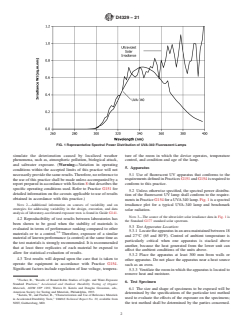
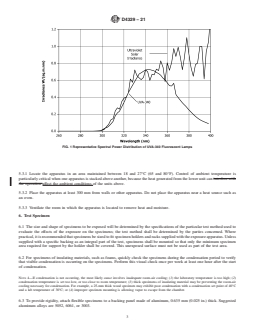
FIG. 1 Representative Spectral Power Distribution of UVA-340 Fluorescent Lamps
simulate the deterioration caused by localized weather ture of the room in which the device operates, temperature
phenomena, such as, atmospheric pollution, biological attack, control, and condition and age of the lamp.
and saltwater exposure. (Warning—Variation in operating
5. Apparatus
conditions within the accepted limits of this practice will not
necessarilyprovidethesameresults.Therefore,noreferenceto 5.1 Use of fluorescent UV apparatus that conforms to the
the use of this practice shall be made unless accompanied by a requirementsdefinedinPracticesG151andG154isrequiredto
report prepared in accordance with Section 8 that describes the conform to this practice.
specific operating conditions used. Refer to Practice G151 for
5.2 Unless otherwise specified, the spectral power distribu-
detailed information on the caveats applicable to use of results
tion of the fluorescent UV lamp shall conform to the require-
obtained in accordance with this practice.)
mentsinPracticeG154foraUVA340lamp.Fig.1isaspectral
irradiance plot for a typical UVA-340 lamp and benchmark
NOTE 2—Additional information on sources of variability and on
strategies for addressing variability in the design, execution, and data solar radiation.
analysis of laboratory-accelerated exposure tests is found in Guide G141.
NOTE 3—The source of the ultraviolet solar irradiance data in Fig. 1 is
4.2 Reproducibility of test results between laboratories has
the Standard G177 standard solar spectrum.
been shown to be good when the stability of materials is
5.3 Test Apparatus Location:
evaluated in terms of performance ranking compared to other
5.3.1 Locatetheapparatusinanareamaintainedbetween18
5,6
materials or to a control. Therefore, exposure of a similar
and 27°C (65 and 80°F). Control of ambient temperature is
material of known performance (a control) at the same time as
particularly critical when one apparatus is stacked above
the test materials is strongly recommended. It is recommended
another, because the heat generated from the lower unit can
that at least three replicates of each material be exposed to
affect the ambient conditions of the units above.
allow for statistical evaluation of results.
5.3.2 Place the apparatus at least 300 mm from walls or
4.3 Test results will depend upon the care that is taken to
other apparatus. Do not place the apparatus near a heat source
operate the equipment in accordance with Practice G154.
such as an oven.
Significant factors include regulation of line voltage, tempera-
5.3.3 Ventilate the room in which the apparatus is located to
remove heat and moisture.
Fischer, R., “Results of Round Robin Studies of Light- and Water-Exposure
6. Test Specimen
Standard Practices,” Accelerated and Outdoor Durability Testing of Organic
Materials, ASTM STP 1202, Warren D. Ketola and Douglas Grossman, eds.,
6.1 The size and shape of specimens to be exposed will be
American Society for Testing and Materials, Philadelphia, 1993.
determined by the specifications of the particular test method
Ketola, W., and Fischer, R., “Characterization and Use of Reference Materials
used to evaluate the effects of the exposure on the specimens;
in Accelerated Durability Tests,” VAMAS Technical Report No. 30, available from
NIST, Gaithersburg, MD. the test method shall be determined by the parties concerned.
D4329 − 21
Where practical, it is recommended that specimens be sized to apparatus for 24 h or more and then returned for additional
fit specimen holders and racks supplied with the exposure exposure, report the elapsed time as noted in accordance with
apparatus. Unless supplied with a specific backing as an Section 9.
integral part of the test, specimens shall be mounted so that
NOTE 6—Since the stability of the file specimen may also be time-
only the minimum specimen area required for support by the
dependent, users are cautioned that over prolonged exposure periods, or
holder shall be covered. This unexposed surface must not be
where small differences in the order of acceptable limits are anticipated,
comparisonofexposedspecimenswiththefilespecimenmaynotbevalid.
used as part of the test area.
Instrumental measurements are recommended whenever possible.
6.2 For specimens of insulating materials, such as foams,
quickly check the specimens during the condensation period to
7. Procedure
verify that visible condensation is occurring on the specimens.
7.1 When the test and control specimens do not completely
Perform this visual check once per week at least one hour after
fill the specimen racks, fill all empty spaces with blank panels
the start of condensation.
to maintain the test conditions within the chamber.
NOTE 7—Specimens in the extreme left and right side of the tester
NOTE 4—If condensation is not occurring, the most likely cause
(position 1 and 13 in Fig. 2) experience a lower irradiance than other
involves inadequate room-air cooling; (1) the laboratory temperature is
specimens. While these positions do meet the irradiance requirements in
too high; (2) condensation temperature is set too low, or too close to room
G151 when repositioning is used, it is recommended that these positions
temperature; (3) thick specimens of insulating material may be preventing
are excluded when test and control specimens do not completely fill the
the room-air cooling necessary for condensation. For example, a 25-mm
specimen racks.
thick wood specimen may exhibit poor condensation with a condensation
setpointof40°Candalabtemperatureof30°C;or(4)improperspecimen
7.2 Unlessotherwisespecified,programthedevicetooneof
mounting is allowing vapor to escape from the chamber.
the following test cycles. Operate the device continuously.
6.3 To provide rigidity, attach flexible specimens to a
7.2.1 Cycle A:
backing panel made of aluminum, 0.635 mm (0.025 in.) thick.
Typical Irradiance at 340 nm is 0.89 W/(m · nm)
Suggested aluminum alloys are 5052, 6061, or 3003.
8 h UV with uninsulated black panel temperature controlled at 60°C
4 h condensation with uninsulated black panel temperature
6.4 Seal any holes in specimens larger than 2 mm and any
controlled at 50°C
(Used for most general applications)
openings larger than 1 mm around irregularly shaped speci-
mens to prevent loss of water vapor. Attach porous specimens
7.2.2 Cycle B:
to a solid backing such as aluminum that will act as a vapor
Typical Irradiance at 340 nm is 0.77 W/(m · nm)
barrier. 8 h UV with uninsulated black panel temperature controlled at 70°C
4 h condensation with uninsulated black panel temperature
6.5 Unless otherwise specified, expose at least three repli-
controlled at 50°C
(Typically used for automotive applications) Note: Cycle B is
cate specimens of each test and control material.
equivalent to the exposure test cycle specified in SAE J2020.
6.6 Follow the procedures described in Practice G147 for
7.2.3 Cycle C:
identification, conditioning, and handling of specimens of test,
Typical Irradiance at 340 nm is 0.83 W/(m · nm)
control, and reference materials prior to, during, and after
8 h UV with uninsulated black panel temperature controlled at 50°C
exposure.
4 h condensation with uninsulated black panel temperature
controlled at 50°C
6.7 Do not mask the face of a specimen for the purpose of
(Typically used for some plastic building products)
showing on one panel the effects of various exposure times. It
NOTE 8—Unless otherwise specified, operate the apparatus to maintain
is possible that misleading results will be obtained by this
the operational fluctuations specified in Table 1 for the parameters in
method, since the masked portion of the specimen is still
Cycles A, B, and C. If the actual operating conditions do not agree with
exposed to temperature and hum
...
This document is not an ASTM standard and is intended only to provide the user of an ASTM standard an indication of what changes have been made to the previous version. Because
it may not be technically possible to adequately depict all changes accurately, ASTM recommends that users consult prior editions as appropriate. In all cases only the current version
of the standard as published by ASTM is to be considered the official document.
Designation: D4329 − 13 D4329 − 21
Standard Practice for
Fluorescent Ultraviolet (UV) Lamp Apparatus Exposure of
Plastics
This standard is issued under the fixed designation D4329; the number immediately following the designation indicates the year of
original adoption or, in the case of revision, the year of last revision. A number in parentheses indicates the year of last reapproval. A
superscript epsilon (´) indicates an editorial change since the last revision or reapproval.
1. Scope*
1.1 This practice covers specific procedures and test conditions that are applicable for using a fluorescent UV lamp and water
apparatus exposure of plastics conducted in accordance with Practices G151 and G154. This practice also covers the preparation
of test specimens, the test conditions best suited for plastics, and the evaluation of test results.
1.2 The values stated in SI units are to be regarded as standard. The values given in parentheses are for information only.
1.3 This standard does not purport to address all of the safety concerns, if any, associated with its use. It is the responsibility
of the user of this standard to establish appropriate safety safety, health, and healthenvironmental practices and determine the
applicability of regulatory limitations prior to use.
NOTE 1—This practice is technically similar to ISO 4892-3.
NOTE 1—This standard and ISO 4892-3 address the same subject matter, but differ in technical contact.
1.4 This international standard was developed in accordance with internationally recognized principles on standardization
established in the Decision on Principles for the Development of International Standards, Guides and Recommendations issued
by the World Trade Organization Technical Barriers to Trade (TBT) Committee.
2. Referenced Documents
2.1 ASTM Standards:
D883 Terminology Relating to Plastics
D5870 Practice for Calculating Property Retention Index of Plastics
E456 Terminology Relating to Quality and Statistics
E691 Practice for Conducting an Interlaboratory Study to Determine the Precision of a Test Method
G113 Terminology Relating to Natural and Artificial Weathering Tests of Nonmetallic Materials
G141 Guide for Addressing Variability in Exposure Testing of Nonmetallic Materials
G147 Practice for Conditioning and Handling of Nonmetallic Materials for Natural and Artificial Weathering Tests
G151 Practice for Exposing Nonmetallic Materials in Accelerated Test Devices that Use Laboratory Light Sources
G154 Practice for Operating Fluorescent Ultraviolet (UV) Lamp Apparatus for Exposure of Nonmetallic Materials
G169 Guide for Application of Basic Statistical Methods to Weathering Tests
G177 Tables for Reference Solar Ultraviolet Spectral Distributions: Hemispherical on 37° Tilted Surface
This practice is under the jurisdiction of ASTM Committee D20 on Plastics and is the direct responsibility of Subcommittee D20.50 on Durability of Plastics.
Current edition approved July 15, 2013July 1, 2021. Published August 2013July 2021. Originally approved in 1984. Last previous edition approved in 20052013 as
D4329 - 05.D4329 - 13. DOI: 10.1520/D4329-13.10.1520/D4329-21.
For referenced ASTM standards, visit the ASTM website, www.astm.org, or contact ASTM Customer Service at service@astm.org. For Annual Book of ASTM Standards
volume information, refer to the standard’s Document Summary page on the ASTM website.
*A Summary of Changes section appears at the end of this standard
Copyright © ASTM International, 100 Barr Harbor Drive, PO Box C700, West Conshohocken, PA 19428-2959. United States
D4329 − 21
2.2 ISO Standard:
ISO 4892-3 Plastics—Methods of Exposure to Laboratory Light Sources—Part 3, Fluorescent UV Lamps
2.3 SAE Standard:
SAE J2020 Accelerated Exposure of Automotive Exterior Materials Using a Fluorescent UV and Condensation Apparatus
3. Terminology
3.1 The definitions in TerminologyFor definitions of terms relating to plastics used in this G113 are applicable topractice, refer
to Terminology D883this practice.
3.2 For definitions of terms relating to precision and bias and associated used in this practice, refer to Terminology E456.
3.3 For definitions of terms relating to weathering used in this practice, refer to Terminology G113.
4. Significance and Use
4.1 The ability of a plastic material to resist deterioration of its electrical, mechanical, and optical properties caused by exposure
to light, heat, and water can be very significant for is a property of significance in many applications. This practice is intended to
induce property changes associated with end-use conditions, including the effects of ultraviolet solar irradiance, moisture, and heat.
The exposure used in this practice is not intended to simulate the deterioration caused by localized weather phenomena, such as,
atmospheric pollution, biological attack, and saltwater exposure. (Warning—Variation in results may be expected when operating
conditions are varied within the accepted limits of this practice. practice will not necessarily provide the same results. Therefore,
no reference to the use of this practice shouldshall be made unless accompanied by a report prepared in accordance with Section
8 that describes the specific operating conditions used. Refer to Practice G151 for detailed information on the caveats applicable
to use of results obtained in accordance with this practice.)
NOTE 2—Additional information on sources of variability and on strategies for addressing variability in the design, execution, and data analysis of
laboratory-accelerated exposure tests is found in Guide G141.
4.2 Reproducibility of test results between laboratories has been shown to be good when the stability of materials is evaluated in
5,6
terms of performance ranking compared to other materials or to a control. Therefore, exposure of a similar material of known
performance (a control) at the same time as the test materials is strongly recommended. It is recommended that at least three
replicates of each material be exposed to allow for statistical evaluation of results.
4.3 Test results will depend upon the care that is taken to operate the equipment in accordance with Practice G154. Significant
factors include regulation of line voltage, temperature of the room in which the device operates, temperature control, and condition
and age of the lamp.
5. Apparatus
5.1 Use of fluorescent UV apparatus that conforms to the requirements defined in Practices G151 and G154 is required to conform
to this practice.
5.2 Unless otherwise specified, the spectral power distribution of the fluorescent UV lamp shall conform to the requirements in
Practice G154 for a UVA 340 lamp. Fig. 1 is a spectral irradiance plot for a typical UVA-340 lamp and benchmark solar radiation.
NOTE 3—The source of the ultraviolet solar irradiance data in Fig. 1 is the Standard G177 standard solar spectrum.
5.3 Test Apparatus Location:
Available from American National Standards Institute (ANSI), 25 W. 43rd St., 4th Floor, New York, NY 10036, http://www.ansi.org.
Available from SAE International (SAE), 400 Commonwealth Dr., Warrendale, PA 15096-0001,15096, http://www.sae.org.
Fischer, R., “Results of Round Robin Studies of Light- and Water-Exposure Standard Practices,” Accelerated and Outdoor Durability Testing of Organic Materials, ASTM
STP 1202, Warren D. Ketola and Douglas Grossman, eds., American Society for Testing and Materials, Philadelphia, 1993.
Ketola, W., and Fischer, R., “Characterization and Use of Reference Materials in Accelerated Durability Tests,” VAMAS Technical Report No. 30, available from NIST,
Gaithersburg, MD.
D4329 − 21
FIG. 1 Representative Spectral Power Distribution of UVA-340 Fluorescent Lamps
5.3.1 Locate the apparatus in an area maintained between 18 and 27°C (65 and 80°F). Control of ambient temperature is
particularly critical when one apparatus is stacked above another, because the heat generated from the lower unit can interfere with
the operation affect the ambient conditions of the units above.
5.3.2 Place the apparatus at least 300 mm from walls or other apparatus. Do not place the apparatus near a heat source such as
an oven.
5.3.3 Ventilate the room in which the apparatus is located to remove heat and moisture.
6. Test Specimen
6.1 The size and shape of specimens to be exposed will be determined by the specifications of the particular test method used to
evaluate the effects of the exposure on the specimens; the test method shall be determined by the parties concerned. Where
practical, it is recommended that specimens be sized to fit specimen holders and racks supplied with the exposure apparatus. Unless
supplied with a specific backing as an integral part of the test, specimens shall be mounted so that only the minimum specimen
area required for support by the holder shall be covered. This unexposed surface must not be used as part of the test area.
6.2 For specimens of insulating materials, such as foams, quickly check the specimens during the condensation period to verify
that visible condensation is occurring on the specimens. Perform this visual check once per week at least one hour after the start
of condensation.
NOTE 4—If condensation is not occurring, the most likely cause involves inadequate room-air cooling; (1) the laboratory temperature is too high; (2)
condensation temperature is set too low, or too close to room temperature; (3) thick specimens of insulating material may be preventing the room-air
cooling necessary for condensation. For example, a 25-mm thick wood specimen may exhibit poor condensation with a condensation set point of 40°C
and a lab temperature of 30°C; or (4) improper specimen mounting is allowing vapor to escape from the chamber.
6.3 To provide rigidity, attach flexible specimens to a backing panel made of aluminum, 0.635 mm (0.025 in.) thick. Suggested
aluminum alloys are 5052, 6061, or 3003.
D4329 − 21
6.4 Seal any holes in specimens larger than 2 mm and any openings larger than 1 mm around irregularly shaped specimens to
prevent loss of water vapor. Attach porous specimens to a solid backing such as aluminum that canwill act as a vapor barrier.
6.5 Unless otherwise specified, expose at least three replicate specimens of each test and control material.
6.6 Follow the procedures described in Practice G147 for identification, conditioning, and handling of specimens of test, control,
and reference materials prior to, during, and after exposure.
6.7 Do not mask the face of a specimen for the purpose of showing on one panel the effects of various exposure times. Misleading
results mayIt is possible that misleading results will be obtained by this method, since the masked portion of the specimen is still
exposed to temperature and humidity cycles that in many cases will affect results.
6.8 Since it is possible the thickness of a specimen maywill markedly affect the results, thickness of test and control specimens
shall be within 610 % of the nominal dimensions.
NOTE 5—This is especially important when mechanical properties are being investigated.
6.9 Retain a supply of unexposed file specimens of all materials evaluated.
6.9.1 When destructive tests are run, ensure that sufficient file specimens are retained so that in order to determine the property
of interest can be determined on unexposed file specimens each time exposed materials are evaluated.
6.10 Specimens should It is recommended that specimens not be removed from the exposure apparatus for more than 24 h and
then returned for additional tests, since this does not produce the same results on all materials as tests run without this type of
interruption. When specimens are removed from the exposure apparatus for 24 h or more and then returned for additional exposure,
report the elapsed time as noted in accordance with Section 9.
NOTE 6—Since the stability of the file specimen may also be time-dependent, users are cautioned that over prolonged exposure periods, or where small
differences in the order of acceptable limits are anticipated, comparison of exposed specimens with the file specimen may not be valid. Instrumental
measurements are recommended whenever possible.
7. Procedure
7.1 When the test and control specimens do not completely fill the specimen racks, fill all empty spaces with blank panels to
maintain the test conditions within the chamber.
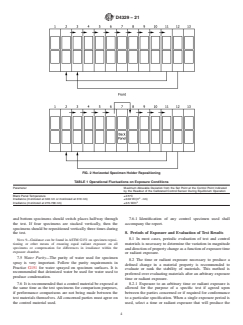
NOTE 7—Specimens in the extreme left and right side of the tester (position 1 and 13 in Fig. 2) experience a lower irradiance than other specimens. While
these positions do meet the irradiance requirements in G151 when repositioning is used, it is recommended that these positions are excluded when test
and control specimens do not completely fill the specimen racks.
7.2 Unless otherwise specified, program the device to one of the following test cycles. Operate the device continuously.
7.2.1 Cycle A:
Typical Irradiance at 340 nm is 0.89 W/(m · nm)
8 h UV with uninsulated black panel temperature controlled at 60°C
4 h condensation with uninsulated black panel temperature
controlled at 50°C
(Used for most general applications)
7.2.2 Cycle B:
D4329 − 21
FIG. 2 Horizontal Specimen Holder Repositioning
Typical Irradiance at 340 nm is 0.77 W/(m · nm)
8 h UV with uninsulated black panel temperature co
...
Questions, Comments and Discussion
Ask us and Technical Secretary will try to provide an answer. You can facilitate discussion about the standard in here.
Loading comments...