

ASTM E1118/E1118M-16(2020)
(Practice)Standard Practice for Acoustic Emission Examination of Reinforced Thermosetting Resin Pipe (RTRP)
General Information
- Abstract
SIGNIFICANCE AND USE
5.1 The AE examination method detects damage in RTRP. The damage mechanisms detected in RTRP are as follows: resin cracking, fiber debonding, fiber pullout, fiber breakage, delamination, and bond or thread failure in assembled joints. Flaws in unstressed areas and flaws which are structurally insignificant will not generate AE.
5.2 This practice is convenient for on-line use under operating conditions to determine structural integrity of in-service RTRP usually with minimal process disruption.
5.3 Flaws located with AE should be examined by other techniques; for example, visual, ultrasound, and dye penetrant, and may be repaired and retested as appropriate. Repair procedure recommendations are outside the scope of this practice.
SCOPE
1.1 This practice covers acoustic emission (AE) examination or monitoring of reinforced thermosetting resin pipe (RTRP) to determine structural integrity. It is applicable to lined or unlined pipe, fittings, joints, and piping systems.
1.2 This practice is applicable to pipe that is fabricated with fiberglass and carbon fiber reinforcements with reinforcing contents greater than 15 % by weight. The suitability of these procedures must be demonstrated before they are used for piping that is constructed with other reinforcing materials.
1.3 This practice is applicable to tests below pressures of 35 MPa absolute [5000 psia].
1.4 This practice is limited to pipe up to and including 0.6 m [24 in.] in diameter. Larger diameter pipe can be examined with AE, however, the procedure is outside the scope of this practice.
1.5 This practice applies to examinations of new or in-service RTRP.
1.6 The values stated in either SI units or inch-pound units are to be regarded separately as standard. The values stated in each system may not be exact equivalents; therefore, each system shall be used independently of the other. Combining values from the two systems may result in non-conformance with the standard.
1.7 This standard does not purport to address all of the safety concerns, if any, associated with its use. It is the responsibility of the user of this standard to establish appropriate safety, health, and environmental practices and to determine the applicability of regulatory limitations prior to use. For more specific safety precautionary information, see 8.1.
1.8 This international standard was developed in accordance with internationally recognized principles on standardization established in the Decision on Principles for the Development of International Standards, Guides and Recommendations issued by the World Trade Organization Technical Barriers to Trade (TBT) Committee.
- Status
- Published
- Publication Date
- 31-May-2020
- Technical Committee
- E07 - Nondestructive Testing
- Drafting Committee
- E07.04 - Acoustic Emission Method
Overview
ASTM E1118/E1118M-16(2020) is the international standard practice for conducting Acoustic Emission (AE) examination of Reinforced Thermosetting Resin Pipe (RTRP). Developed by ASTM International, this standard guides users in assessing the structural integrity of both new and in-service RTRP systems using acoustic emission techniques. The method is applicable to lined and unlined pipes, fittings, joints, and piping systems constructed primarily with fiberglass or carbon fiber reinforcements above 15% by weight.
The AE examination method provides a convenient and effective non-destructive evaluation (NDE) approach to detecting damage such as resin cracking, fiber debonding, fiber pullout, fiber breakage, delamination, and bond or thread failure in assembled joints. Inspections can often be performed under actual operating conditions, minimizing system downtime and disruption.
Key Topics
- Applicability: Covers AE examination for RTRP with a diameter up to 0.6 m (24 in.) and test pressures below 35 MPa (5000 psia).
- Damage Detection: Identifies AE signals associated with specific failure mechanisms, including resin cracking, delamination, fiber breakage, and joint failures.
- Testing Conditions: Suitable for both new installations and in-service pipelines, enhancing ongoing maintenance and asset management strategies.
- Examination Methodology: Involves cyclic or increasing pressure tests while monitoring for AE signals using strategically placed sensors along critical areas such as joints and fittings.
- Data Interpretation: Guidelines for recording AE events, determining severity, and identifying active zones for further evaluation.
- Follow-up and Confirmation: Recommends supplementary inspections like visual, ultrasonic, or dye penetrant testing to verify and characterize located flaws.
Applications
ASTM E1118/E1118M-16(2020) delivers tangible value across industries reliant on RTRP, such as chemical processing, oil and gas, power generation, and water treatment. The AE method is particularly useful for:
- In-Service Monitoring: Non-intrusive assessment of piping systems to identify structural compromise without requiring complete system shutdown.
- Quality Assurance Testing: Verifying structural integrity and performance of RTRP components during manufacturing, installation, or after repairs.
- Routine Maintenance Planning: Enabling proactive identification of potential failure sites, supporting more efficient maintenance scheduling.
- Regulatory Compliance: Assisting operators in meeting safety and reliability standards through documented non-destructive test results.
The standard emphasizes the importance of using qualified personnel and agencies for conducting AE examinations, referencing established practices and certifications (such as ANSI/ASNT or ISO 9712 for NDT qualification).
Related Standards
For a robust acoustic emission testing program and comprehensive piping system integrity assurance, the following related standards are recommended for consultation:
- ASTM E543: Specification for Agencies Performing Nondestructive Testing.
- ASTM E650: Guide for Mounting Piezoelectric Acoustic Emission Sensors.
- ASTM E750: Practice for Characterizing Acoustic Emission Instrumentation.
- ASTM E976: Guide for Determining the Reproducibility of Acoustic Emission Sensor Response.
- ANSI/ASNT CP-189 & ASNT SNT-TC-1A: Standards for Personnel Qualification and Certification in Nondestructive Testing.
- ISO 9712: Non-destructive Testing - Qualification and Certification of NDT Personnel.
By aligning AE practices for RTRP with ASTM E1118/E1118M-16(2020), organizations benefit from reliable, standardized, and internationally recognized assessment protocols that support safety, performance, and asset longevity.
Keywords: acoustic emission, RTRP, reinforced thermosetting resin pipe, non-destructive examination, pipe integrity, ASTM E1118, AE testing, structural evaluation, damage detection, fiberglass pipe inspection
Relations
- Effective Date
- 01-Jun-2020
- Effective Date
- 01-Feb-2024
- Effective Date
- 01-Feb-2024
- Effective Date
- 01-Nov-2023
- Effective Date
- 01-Jun-2020
- Effective Date
- 01-Jan-2020
- Effective Date
- 01-Dec-2019
- Effective Date
- 01-Aug-2019
- Effective Date
- 15-Apr-2019
- Effective Date
- 01-Mar-2019
- Effective Date
- 01-Feb-2019
- Effective Date
- 01-Dec-2018
- Effective Date
- 01-Nov-2018
- Effective Date
- 01-Jan-2018
- Effective Date
- 15-Aug-2017
Get Certified
Connect with accredited certification bodies for this standard

Institut za varilstvo d.o.o. (Welding Institute)
Slovenia's leading welding institute since 1952. ISO 3834, EN 1090, pressure equipment certification, NDT personnel, welder qualification. Only IIW Au
Sponsored listings
Frequently Asked Questions
ASTM E1118/E1118M-16(2020) is a standard published by ASTM International. Its full title is "Standard Practice for Acoustic Emission Examination of Reinforced Thermosetting Resin Pipe (RTRP)". This standard covers: SIGNIFICANCE AND USE 5.1 The AE examination method detects damage in RTRP. The damage mechanisms detected in RTRP are as follows: resin cracking, fiber debonding, fiber pullout, fiber breakage, delamination, and bond or thread failure in assembled joints. Flaws in unstressed areas and flaws which are structurally insignificant will not generate AE. 5.2 This practice is convenient for on-line use under operating conditions to determine structural integrity of in-service RTRP usually with minimal process disruption. 5.3 Flaws located with AE should be examined by other techniques; for example, visual, ultrasound, and dye penetrant, and may be repaired and retested as appropriate. Repair procedure recommendations are outside the scope of this practice. SCOPE 1.1 This practice covers acoustic emission (AE) examination or monitoring of reinforced thermosetting resin pipe (RTRP) to determine structural integrity. It is applicable to lined or unlined pipe, fittings, joints, and piping systems. 1.2 This practice is applicable to pipe that is fabricated with fiberglass and carbon fiber reinforcements with reinforcing contents greater than 15 % by weight. The suitability of these procedures must be demonstrated before they are used for piping that is constructed with other reinforcing materials. 1.3 This practice is applicable to tests below pressures of 35 MPa absolute [5000 psia]. 1.4 This practice is limited to pipe up to and including 0.6 m [24 in.] in diameter. Larger diameter pipe can be examined with AE, however, the procedure is outside the scope of this practice. 1.5 This practice applies to examinations of new or in-service RTRP. 1.6 The values stated in either SI units or inch-pound units are to be regarded separately as standard. The values stated in each system may not be exact equivalents; therefore, each system shall be used independently of the other. Combining values from the two systems may result in non-conformance with the standard. 1.7 This standard does not purport to address all of the safety concerns, if any, associated with its use. It is the responsibility of the user of this standard to establish appropriate safety, health, and environmental practices and to determine the applicability of regulatory limitations prior to use. For more specific safety precautionary information, see 8.1. 1.8 This international standard was developed in accordance with internationally recognized principles on standardization established in the Decision on Principles for the Development of International Standards, Guides and Recommendations issued by the World Trade Organization Technical Barriers to Trade (TBT) Committee.
SIGNIFICANCE AND USE 5.1 The AE examination method detects damage in RTRP. The damage mechanisms detected in RTRP are as follows: resin cracking, fiber debonding, fiber pullout, fiber breakage, delamination, and bond or thread failure in assembled joints. Flaws in unstressed areas and flaws which are structurally insignificant will not generate AE. 5.2 This practice is convenient for on-line use under operating conditions to determine structural integrity of in-service RTRP usually with minimal process disruption. 5.3 Flaws located with AE should be examined by other techniques; for example, visual, ultrasound, and dye penetrant, and may be repaired and retested as appropriate. Repair procedure recommendations are outside the scope of this practice. SCOPE 1.1 This practice covers acoustic emission (AE) examination or monitoring of reinforced thermosetting resin pipe (RTRP) to determine structural integrity. It is applicable to lined or unlined pipe, fittings, joints, and piping systems. 1.2 This practice is applicable to pipe that is fabricated with fiberglass and carbon fiber reinforcements with reinforcing contents greater than 15 % by weight. The suitability of these procedures must be demonstrated before they are used for piping that is constructed with other reinforcing materials. 1.3 This practice is applicable to tests below pressures of 35 MPa absolute [5000 psia]. 1.4 This practice is limited to pipe up to and including 0.6 m [24 in.] in diameter. Larger diameter pipe can be examined with AE, however, the procedure is outside the scope of this practice. 1.5 This practice applies to examinations of new or in-service RTRP. 1.6 The values stated in either SI units or inch-pound units are to be regarded separately as standard. The values stated in each system may not be exact equivalents; therefore, each system shall be used independently of the other. Combining values from the two systems may result in non-conformance with the standard. 1.7 This standard does not purport to address all of the safety concerns, if any, associated with its use. It is the responsibility of the user of this standard to establish appropriate safety, health, and environmental practices and to determine the applicability of regulatory limitations prior to use. For more specific safety precautionary information, see 8.1. 1.8 This international standard was developed in accordance with internationally recognized principles on standardization established in the Decision on Principles for the Development of International Standards, Guides and Recommendations issued by the World Trade Organization Technical Barriers to Trade (TBT) Committee.
ASTM E1118/E1118M-16(2020) is classified under the following ICS (International Classification for Standards) categories: 23.040.20 - Plastics pipes. The ICS classification helps identify the subject area and facilitates finding related standards.
ASTM E1118/E1118M-16(2020) has the following relationships with other standards: It is inter standard links to ASTM E1118/E1118M-16, ASTM D883-24, ASTM E1316-24, ASTM D883-23, ASTM E750-15(2020), ASTM D883-20, ASTM E1316-19b, ASTM D883-19c, ASTM D883-19a, ASTM E1316-19, ASTM D883-19, ASTM D883-18a, ASTM D883-18, ASTM E1316-18, ASTM D883-17. Understanding these relationships helps ensure you are using the most current and applicable version of the standard.
ASTM E1118/E1118M-16(2020) is available in PDF format for immediate download after purchase. The document can be added to your cart and obtained through the secure checkout process. Digital delivery ensures instant access to the complete standard document.
Standards Content (Sample)
This international standard was developed in accordance with internationally recognized principles on standardization established in the Decision on Principles for the
Development of International Standards, Guides and Recommendations issued by the World Trade Organization Technical Barriers to Trade (TBT) Committee.
Designation: E1118/E1118M − 16 (Reapproved 2020)
Standard Practice for
Acoustic Emission Examination of Reinforced
Thermosetting Resin Pipe (RTRP)
ThisstandardisissuedunderthefixeddesignationE1118/E1118M;thenumberimmediatelyfollowingthedesignationindicatestheyear
of original adoption or, in the case of revision, the year of last revision.Anumber in parentheses indicates the year of last reapproval.
A superscript epsilon (´) indicates an editorial change since the last revision or reapproval.
1. Scope* Development of International Standards, Guides and Recom-
mendations issued by the World Trade Organization Technical
1.1 This practice covers acoustic emission (AE) examina-
Barriers to Trade (TBT) Committee.
tion or monitoring of reinforced thermosetting resin pipe
(RTRP) to determine structural integrity. It is applicable to
2. Referenced Documents
lined or unlined pipe, fittings, joints, and piping systems.
2.1 ASTM Standards:
1.2 Thispracticeisapplicabletopipethatisfabricatedwith
D883Terminology Relating to Plastics
fiberglass and carbon fiber reinforcements with reinforcing
E543Specification forAgencies Performing Nondestructive
contents greater than 15% by weight. The suitability of these
Testing
procedures must be demonstrated before they are used for
E650Guide for Mounting Piezoelectric Acoustic Emission
piping that is constructed with other reinforcing materials.
Sensors
E750Practice for Characterizing Acoustic Emission Instru-
1.3 This practice is applicable to tests below pressures of
mentation
35MPa absolute [5000 psia].
E976GuideforDeterminingtheReproducibilityofAcoustic
1.4 Thispracticeislimitedtopipeuptoandincluding0.6m
Emission Sensor Response
[24in.] in diameter. Larger diameter pipe can be examined
E1106Test Method for Primary Calibration of Acoustic
with AE, however, the procedure is outside the scope of this
Emission Sensors
practice.
E1316Terminology for Nondestructive Examinations
1.5 This practice applies to examinations of new or in-
E1781Practice for Secondary Calibration ofAcoustic Emis-
service RTRP.
sion Sensors
E2075Practice for Verifying the Consistency of AE-Sensor
1.6 The values stated in either SI units or inch-pound units
Response Using an Acrylic Rod
are to be regarded separately as standard. The values stated in
2.2 ASNT Standards:
each system may not be exact equivalents; therefore, each
ANSI/ASNT CP-189Personnel Qualification and Certifica-
system shall be used independently of the other. Combining
tion in Nondestructive Testing
values from the two systems may result in non-conformance
ASNT SNT-TC-1APersonnel Qualification and Certifica-
with the standard.
tion in Nondestructive Testing
1.7 This standard does not purport to address all of the
2.3 AIA Standard:
safety concerns, if any, associated with its use. It is the
NAS-410Certification and Qualification of Nondestructive
responsibility of the user of this standard to establish appro-
Test Personnel
priate safety, health, and environmental practices and to
2.4 ISO Documents
determine the applicability of regulatory limitations prior to
ISO 9712Non-destructive Testing—Qualification and Cer-
use. For more specific safety precautionary information, see
tification of NDT Personnel
8.1.
1.8 This international standard was developed in accor-
For referenced ASTM standards, visit the ASTM website, www.astm.org, or
dance with internationally recognized principles on standard-
contact ASTM Customer Service at service@astm.org. For Annual Book of ASTM
ization established in the Decision on Principles for the
Standards volume information, refer to the standard’s Document Summary page on
the ASTM website.
AvailablefromTheAmericanSocietyforNondestructiveTesting(ASNT),P.O.
This practice is under the jurisdiction of ASTM Committee E07 on Nonde- Box 28518, 1711 Arlingate Ln., Columbus, OH 43228-0518.
structive Testing and is the direct responsibility of Subcommittee E07.04 on Available fromAerospace IndustriesAssociation ofAmerica, Inc. (AIA), 1250
Acoustic Emission Method. Eye St., NW, Washington, DC 20005.
CurrenteditionapprovedJune1,2020.PublishedJuly2020.Originallyapproved Available from International Organization for Standardization (ISO), ISO
in 1986. Last previous edition approved in 2016 as E1118/E1118M–16. DOI: Central Secretariat, BIBC II, Chemin de Blandonnet 8, CP 401, 1214 Vernier,
10.1520/E1118_E1118M-16R20. Geneva, Switzerland, http://www.iso.org.
*A Summary of Changes section appears at the end of this standard
Copyright © ASTM International, 100 Barr Harbor Drive, PO Box C700, West Conshohocken, PA 19428-2959. United States
E1118/E1118M − 16 (2020)
3. Terminology example, thermal, bending, tensile, etc. The instrumentation
and techniques for sensing and analyzing AE data are de-
3.1 Complete glossaries of terms related to plastics and
scribed.
acoustic emission will be found in Terminologies D883 and
E1316.
4.2 This practice provides guidelines to determine the loca-
tion and severity of structural flaws in RTRP.
3.2 Definitions of Terms Specific to This Standard:
3.2.1 component and assembly proof testing—a program of 4.3 ThispracticeprovidesguidelinesforAEexaminationof
tests on RTRP components designed to assess product quality
RTRP within the pressure range stated in 1.3. Maximum test
inamanufacturer’splant,attheinstallationsite,orwhentaken pressure for RTRP will be determined upon agreement among
out of service for retesting.An assembly is a shippable unit of
user, manufacturer, or test agency, or combination thereof.The
factory-assembled components. test pressure will normally be 1.1 multiplied by the maximum
operating pressure.
3.2.2 count value N —an evaluation criterion based on the
c
total number of AE counts. (See A2.6.)
5. Significance and Use
D 1D
o i
3.2.3 diameter to thickness ratio (d/t)—equal to
2t
5.1 The AE examination method detects damage in RTRP.
where (D ) is the outside pipe diameter, (D) is the inside pipe
o i
The damage mechanisms detected in RTRP are as follows:
diameter,and(t)isthewallthickness,asmeasuredinasection
resin cracking, fiber debonding, fiber pullout, fiber breakage,
of straight pipe.
delamination, and bond or thread failure in assembled joints.
3.2.4 high-amplitude threshold—a threshold for large am- Flaws in unstressed areas and flaws which are structurally
plitude events. (See A2.3.) insignificant will not generate AE.
3.2.5 in-service systems testing—aprogramofperiodictests
5.2 This practice is convenient for on-line use under oper-
during the lifetime of an RTRP system designed to assess its
ating conditions to determine structural integrity of in-service
structural integrity.
RTRP usually with minimal process disruption.
3.2.6 low-amplitude threshold—the threshold above which
5.3 Flaws located with AE should be examined by other
AE counts (N) are measured. (See A2.2.)
techniques; for example, visual, ultrasound, and dye penetrant,
and may be repaired and retested as appropriate. Repair
3.2.7 manufacturers qualification testing—a comprehensive
procedure recommendations are outside the scope of this
program of tests to confirm product design, performance
practice.
acceptability, and fabricator capability.
3.2.8 operating pressure—pressure at which the RTRP nor-
6. Basis of Application
mally operates. It should not exceed design pressure.
6.1 The following items are subject to contractual agree-
3.2.9 qualification test pressure—atestpressurewhichisset
ment between the parties using or referencing this practice.
byagreementbetweentheuser,manufacturer,ortestagency,or
combination thereof.
6.2 Personnel Qualification:
3.2.10 rated pressure—a nonstandard term used by RTRP 6.2.1 If specified in the contractual agreement, personnel
pipe manufacturers as an indication of the maximum operating performing examinations to this standard shall be qualified in
pressure. accordance with a nationally or internationally recognized
NDT personnel qualification practice or standard such as
3.2.11 RTRP—Reinforced Thermosetting Resin Pipe, a tu-
ANSI/ASNT-CP-189, ASNT SNT-TC-1A, NAS-410, ISO
bular product containing reinforcement embedded in or sur-
9712, or a similar document and certified by the employer or
rounded by cured thermosetting resin.
certifying agency, as applicable. The practice or standard used
3.2.12 RTRP system—a pipe structure assembled from vari-
and its applicable revision shall be identified in the contractual
ous components that are bonded, threaded, layed-up, etc., into
agreement between the using parties.
a functional unit.
6.3 Qualification of Nondestructive Agencies—If specified
3.2.13 signal value M—a measure of the AE signal power
in the contractual agreement, NDT agencies shall be qualified
(energy/unit time) which is used to indicate adhesive bond
and evaluated as described in Practice E543. The applicable
failure in RTRP cemented joints. (See A2.5.)
edition of Practice E543 shall be specified in the contractual
3.2.14 system proof testing—a program of tests on an
agreement.
assembled RTRP system designed to assess its structural
6.4 Timing of Examination—The timing of examination
integrity prior to in-service use.
shall be in accordance with Section 11 unless otherwise
specified.
4. Summary of Practice
6.5 Extent of Examination—Theextentofexaminationshall
4.1 This practice consists of subjecting RTRP to increasing
be in accordance with 9.4 unless otherwise specified.
or cyclic pressure while monitoring with sensors that are
sensitive to acoustic emission (transient stress waves) caused 6.6 Reporting Criteria/Acceptance Criteria—Reporting cri-
by growing flaws. Where appropriate, other types of loading teria for the examination results shall be in accordance with
may be superposed or may replace the pressure load, for Section12unlessotherwisespecified.Sinceacceptancecriteria
E1118/E1118M − 16 (2020)
are not specified in this standard, they shall be specified in the 8.2.2 If the pipe has been previously loaded, one of two
contractual agreement. methods shall be used. For both methods, the maximum
operating pressure-load in the pipe since the previous exami-
6.7 Reexamination of Repaired/Reworked Items—
nationmustbeknown.Ifmorethanoneyearhaselapsedsince
Reexamination of repaired/reworked items is not addressed in
the last examination, the maximum operating pressure-load
this standard and if required shall be specified in the contrac-
during the past year can be used. (See 11.2.3.)
tual agreement.
8.2.2.1 OptionIrequiresthatthetestshallberunfrom90up
to 110% of the maximum operating pressure-load. In this case
7. Instrumentation
no conditioning is required. (See Fig. 7.) If it is not possible to
7.1 The AE instrumentation consists of sensors, signal
achieve over 100% of the maximum operating pressure-load,
processors, and recording equipment. Additional information
Option II may be used.
on AE instrumentation can be found in Practice E750.
8.2.2.2 Option II requires that the operating pressure-load
7.2 InstrumentationshallbecapableofrecordingAEcounts be reduced prior to testing in accordance with the schedule
andAE events above the low-amplitude threshold. It shall also
shown in Table 1. In this case, the maximum pressure-load
record events above the high-amplitude threshold as well as need be only 100% of the operating pressure (see Fig. 8).
signal value M within specific frequency ranges, and have
8.3 RTRP Pressurizing-Loading—Arrangements should be
sufficient channels to localize AE sources in real time. It may
made to pressurize the RTRP to the appropriate pressure-load.
incorporate (as an option) peak amplitude detection. An AE
Liquidisthepreferredpressurizingmedium.Holdingpressure-
event amplitude measurement is recommended for sensitivity
loadlevelsisakeyaspectofanacousticemissionexamination.
verification (see Annex A2). Amplitude distributions are rec-
Accordingly, provision shall be made for holding the pressure-
ommendedforflawcharacterization.ItispreferredthattheAE
load at designated check points.
instrumentation acquire and record count, event, amplitude,
8.4 RTRP Support—The RTRP system shall be properly
andsignalvalue Minformationonaperchannelbasis.TheAE
supported.
instrumentation is further described in Annex A1.
8.5 Environmental—The normal minimum acceptable
7.3 Capability for measuring parameters such as time and
RTRP wall temperature is 4°C [40°F].
pressure shall be provided.The pressure-load shall be continu-
ously monitored to an accuracy of 62% of the maximum test 8.6 Noise Reduction—Noise sources in the examination
value.
frequency and amplitude range, such as malfunctioning pumps
or valves, movement of pipe on supports, or rain, must be
8. Test Preparations
minimized since they mask theAE signals emanating from the
pipe.
8.1 Safety Precautions—All plant safety requirements
unique to the test location shall be met.
8.7 Power Supply—Astable grounded power supply, meet-
8.1.1 Protective clothing and equipment that is normally
ing the specification of the instrumentation, is required at the
required in the area in which the test is being conducted shall
test site.
be worn.
8.8 Instrumentation Settings—Settings will be determined
8.1.2 A fire permit may be needed to use the electronic
in accordance with Annex A2.
instrumentation.
8.1.3 Precautionsshallbetakenagainsttheconsequencesof 9. Sensors
catastrophic failure when testing, for example, flying debris
9.1 Sensor Mounting—Refer to Guide E650 for additional
and impact of escaping liquid.
information on sensor mounting. Location and spacing of the
8.1.4 Pneumatictestingisextremelydangerousandshallbe
sensors are discussed in 9.4. Sensors shall be placed in the
avoided if at all possible.
designated locations with a couplant interface between sensor
8.2 RTRP Conditioning: and test article. One recommended couplant is silicone-
8.2.1 If the pipe has not been previously loaded, no condi- stopcock grease. Care must be exercised to ensure that ad-
tioning is required. equate couplant is applied. Sensors shall be held in place
NOTE 1—A maximum of three sensors can be connected into one channel.
FIG. 1 Typical Sensor Positioning for Zone Location
E1118/E1118M − 16 (2020)
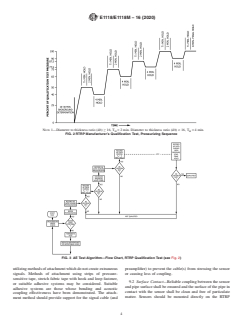
NOTE 1—Diameter to thickness ratio (d/t) ≥ 16, T =2 min. Diameter to thickness ratio (d/t) < 16, T =4 min.
H H
FIG. 2 RTRP Manufacturer’s Qualification Test, Pressurizing Sequence
FIG. 3 AE Test Algorithm—Flow Chart, RTRP Qualification Test (see Fig. 2)
utilizingmethodsofattachmentwhichdonotcreateextraneous preamplifier) to prevent the cable(s) from stressing the sensor
signals. Methods of attachment using strips of pressure-
or causing loss of coupling.
sensitive tape, stretch fabric tape with hook and loop fastener,
9.2 Surface Contact—Reliable coupling between the sensor
or suitable adhesive systems may be considered. Suitable
andpipesurfaceshallbeensuredandthesurfaceofthepipein
adhesive systems are those whose bonding and acoustic
contact with the sensor shall be clean and free of particulate
coupling effectiveness have been demonstrated. The attach-
matter. Sensors should be mounted directly on the RTRP
ment method should provide support for the signal cable (and
E1118/E1118M − 16 (2020)
NOTE 1—Diameter to thickness ratio (d/t) ≥ 16, T =2 min. Diameter to thickness ratio (d/t) < 16, T =4 min.
H H
FIG. 4 RTRP Component and Assembly Proof Test, Pressurizing Sequence
FIG. 5 RTRP Systems Proof Test, Pressurizing Sequence
surface unless integral waveguides shown by test to be number of sensors and their location is based on whether full
satisfactoryareused.Preparationofthecontactsurfaceshallbe
coverage or random sampling of the system is desired. For full
compatible with both sensor and structure modification re- coverageoftheRTRP,excludingjoints,sensorspacingsof3m
quirements. Possible causes of signal loss are coatings such as
[10 ft] are usually suitable.
paint and encapsulants, inadequate sensor contact on curved
9.4.1 Attenuation Characterization—Signal propagation
surfaces,off-centersensorpositioningandsurfaceroughnessat
losses shall be determined in accordance with the following
the contact area.
procedure. This procedure provides a relative measure of the
9.3 Zone Location—Several high-frequency sensors [100 to attenuation, but may not be representative of a genuine event.
250 kHz] are used for zone location of emission sources. It should be noted that the peak amplitude from a mechanical
Attenuation is greater at higher frequencies requiring closer
pencil lead break may vary with surface hardness, resin
spacing of sensors. Zones may be refined if events hit more
condition, cure, and test fluid. For pressure tests, the attenua-
than one sensor. (See Fig. 1 and Annex A3.)
tion characterization shall be carried out with the pipe full of
the test fluid.
9.4 Locations and Spacings—Sensor locations on the RTRP
are determined by the need to detect structural flaws at critical 9.4.1.1 Select a representative region of the RTRP. Mount
anAE sensor and locate points at distances of 150 mm [6 in.]
sections, for example, joints, high-stress areas, geometric
discontinuities, repaired regions, and visible defects. The and 300 mm [12 in.] from the center of the sensor along a line
E1118/E1118M − 16 (2020)
NOTE 1—Diameter to thickness ratio (d/t) ≥ 16, T =2 min. Diameter to thickness ratio (d/t) < 16, T =4 min.
H H
FIG. 6 RTRP Systems Proof Test, Alternate Pressurizing Sequence
NOTE 1—Diameter to thickness ratio (d/t) ≥ 16, T =2 min. Diameter to thickness ratio (d/t) < 16, T =4 min.
H H
FIG. 7 RTRP System In-Service Test, Option I, Pressurizing Sequence
TABLE 1 Option II Requirements for Reduced Operating
leads andrecordpeakamplitude.Allleadbreaksshallbedone
Pressure-Load Immediately Prior to Testing
at an angle of approximately 30° to the test surface with a
Percent of Operat- Time at Reduced
2.5-mm [0.1-in.] lead extension (see Guide E976). The data
ing Pressure or Pressure or Load,
shall be retained as part of the original experimental record.
Load, or Both or Both
10 or less 12 h
9.4.2 Sensor Location—Severe attenuation losses occur at
20 18 h
unreinforced adhesive joint lines and across threaded joints.
30 30 h
40 2 days
Accordingly, sensors should be located on either side of such
50 4 days
interfaces.Thesensorspacingonstraightsectionsofpipeshall
60 7 days
be not greater than 3×the distance at which the recorded
amplitude from the attenuation characterization equals the
low-amplitude threshold. The spacing distance shall be mea-
sured along the surface of the pipe.
parallel to the axis of the pipe. Select two additional points on
the surface of the pipe at 150 mm [6 in.] and 300 mm [12 in.]
along a helix line inclined 45° to the direction of the original 6
Pentel 0.3 (2H) lead or its equivalent has been found satisfactory for this
points.Ateachofthefourpoints,break0.3mm[0.012in.]2H purpose.
E1118/E1118M − 16 (2020)
NOTE 1—Diameter to thickness ratio (d/t) ≥ 16, T =2 min. Diameter to thickness ratio (d/t) < 16, T =4 min.
H H
FIG. 8 RTRP System In-Service Test, Option II, Pressurizing Sequence
9.4.3 Sensor zone location guidelines for the following 11. Testing Procedure
RTRP configurations are given in AnnexA3. Other configura-
11.1 General Guidelines—The RTRP is subjected to pro-
tions require an agreement among the user, manufacturer, or
grammed increasing pressure-load levels to a predetermined
test agency, or combination thereof.
maximum while being monitored by sensors that detect acous-
9.4.3.1 Case I: Coupled—Cemented or threaded joint pipe
ticemission(stresswaves)causedbygrowingstructuralflaws.
system. (The sensor on the coupling is normally required
11.1.1 Load will normally be applied by internal pressur-
because the adhesive is highly attenuative.)
ization of the pipe and this is the basis for the examination
9.4.3.2 Case II: Bell and Spigot—Cemented or threaded
procedure outlined in this and following sections. Service
joint pipe system.
conditions always include other kinds of significant loads.
9.4.3.3 Case III: Hand Lay-up—Fieldfabricatedsecondary
Suchloadsshallbeincludedorsimulatedinthetestand,where
bond mat joint pipe system.
possible, should be applied in increments similar to the
9.4.3.4 Case IV: Flanged Joint Pipe System.
pressure.
11.1.2 With the exception of proof testing, pressurization
10. Instrumentation System Performance Check
ratesofassembledpipesystemsshallbecontrolledsoasnotto
10.1 Sensor Coupling and Circuit Continuity Verification—
exceed a rate of 5% (of operating pressure) per minute.
Verificationshallbeperforme
...