

ASTM E582-21
(Test Method)Standard Test Method for Minimum Ignition Energy and Quenching Distance in Gaseous Mixtures
General Information
- Abstract
SIGNIFICANCE AND USE
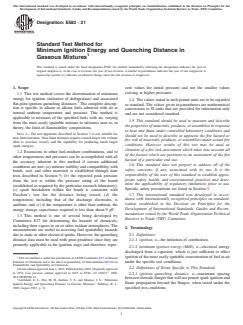
3.1 The minimum energies provide a basis for comparing the ease of ignition of gases. The flatplate ignition quenching distances provide an important verification of existing minimum ignition energy data and give approximate values of the propagation quenching distances of the various mixtures. It is emphasized that maximum safe experimental gaps, as from “flame-proof” or “explosion-proof” studies, are less than the flat-plate ignition quenching distances.
SCOPE
1.1 This test method covers the determination of minimum energy for ignition (initiation of deflagration) and associated flat-plate ignition quenching distances.2 The complete description is specific to alkane or alkene fuels admixed with air at normal ambient temperature and pressure. This method is applicable to mixtures of the specified fuels with air, varying from the most easily ignitable mixture to mixtures near to, in theory, the limit-of-flammability compositions.
Note 1: The test apparatus described in Section 4 is not suitable for near limit mixtures. Near limit mixtures require a much larger test volume (that is, reaction vessel), and the capability for producing much larger spark energies.
1.2 Extensions to other fuel-oxidizer combinations, and to other temperatures and pressures can be accomplished with all the accuracy inherent in this method if certain additional conditions are met: (a) mixture stability and compatibility with bomb, seal, and other materials is established through time tests described in Section 9; (b) the expected peak pressure from the test is within the pressure rating of the bomb (established as required by the particular research laboratory); (c) spark breakdown within the bomb is consistent with Paschen’s law for the distance being tested; (d) the temperature, including that of the discharge electrodes, is uniform; and (e) if the temperature is other than ambient, the energy storage capacitance required is less than about 9 pF.
1.3 This method is one of several being developed by Committee E27 for determining the hazards of chemicals, including their vapors in air or other oxidant atmospheres. The measurements are useful in assessing fuel ignitability hazards due to static or other electrical sparks. However, the quenching distance data must be used with great prudence since they are primarily applicable to the ignition stage and therefore, represent values for initial pressure and not the smaller values existing at higher pressures.
1.4 The values stated in inch-pound units are to be regarded as standard. The values given in parentheses are mathematical conversions to SI units that are provided for information only and are not considered standard.
1.5 This standard should be used to measure and describe the properties of materials, products, or assemblies in response to heat and flame under controlled laboratory conditions and should not be used to describe or appraise the fire hazard or fire risk of materials, products, or assemblies under actual fire conditions. However, results of this test may be used as elements of a fire risk assessment which takes into account all of the factors which are pertinent to an assessment of the fire hazard of a particular end use.
1.6 This standard does not purport to address all of the safety concerns, if any, associated with its use. It is the responsibility of the user of this standard to establish appropriate safety, health, and environmental practices and determine the applicability of regulatory limitations prior to use. Specific safety precautions are listed in Section 5.
1.7 This international standard was developed in accordance with internationally recognized principles on standardization established in the Decision on Principles for the Development of International Standards, Guides and Recommendations issued by the World Trade Organization Technical Barriers to Trade (TBT) Committee.
- Status
- Published
- Publication Date
- 31-May-2021
- Technical Committee
- E27 - Hazard Potential of Chemicals
- Drafting Committee
- E27.04 - Flammability and Ignitability of Chemicals
Buy Documents
ASTM E582-21 - Standard Test Method for Minimum Ignition Energy and Quenching Distance in Gaseous Mixtures
REDLINE ASTM E582-21 - Standard Test Method for Minimum Ignition Energy and Quenching Distance in Gaseous Mixtures
Overview
ASTM E582-21: Standard Test Method for Minimum Ignition Energy and Quenching Distance in Gaseous Mixtures provides a systematic procedure to measure the minimum ignition energy (MIE) and flat-plate ignition quenching distance of gaseous fuel-air mixtures. Developed by ASTM International Committee E27, this standard is an essential resource for comparing the ease of ignition among gases and verifying the safety margins in handling combustible gaseous mixtures.
This test method is specifically designed for alkane or alkene fuels combined with air at normal ambient temperature and pressure, but its principles can be extended to other fuel-oxidizer systems if specified conditions are met. The method supports researchers and safety professionals in evaluating fuel ignitability-critical in fire and explosion prevention.
Key Topics
Minimum Ignition Energy (MIE):
Defines the lowest electrical energy required to ignite the most easily ignitable composition of a specified fuel-air mixture. MIE is a key criterion for assessing the ease or difficulty of igniting gases due to electrical, static, or mechanical sources.Ignition Quenching Distance:
The maximum electrode gap spacing that prevents ignition and flame propagation under specified laboratory conditions. This provides a supplementary measure to MIE, supporting validation of ignition hazard assessments.Scope of Application:
- Primarily for alkane and alkene fuels mixed with air.
- Applicable for fuel-air mixtures of various compositions, from those easily ignitable to those at the theoretical flammability limits.
- With additional checks, the method applies to other gases and broader temperature/pressure ranges.
Safety Considerations:
Ensures all test procedures account for operator safety, proper pressure vessel operation, and handling of combustible gases. Users must implement suitable safety, health, and environmental protocols per Section 5 of the standard.Reproducibility and Accuracy:
The test achieves ±10% reproducibility in minimum ignition energy and ±2% for ignition quenching distance, provided the concentration of the test mixture remains stable.
Applications
Fire & Explosion Hazard Assessment:
MIE and quenching distance measurements are foundational in evaluating the risk of accidental ignition in industrial, laboratory, or storage settings where gases or vapors are present.Process Safety & Equipment Design:
Data from ASTM E582-21 supports the specification and design of explosion-proof or flame-proof electrical and mechanical equipment, particularly for processes involving flammable gases.Comparative Analysis:
By providing a standardized means to compare the ease of ignition in different gaseous mixtures, industries can make informed decisions regarding fuel selection, system design, and hazard mitigation.Regulatory Compliance:
Results from this method can inform elements of a fire risk assessment but should not be solely used to appraise fire hazard under actual fire conditions. The test is conducted under controlled laboratory settings.
Related Standards
- ASTM E681 - Standard Test Method for Concentration Limits of Flammability of Chemicals (Vapors and Gases)
- ASTM E918 - Standard Practice for Determining Limits of Flammability of Chemicals at Elevated Temperature and Pressure
- NFPA 68 - Standard on Explosion Protection by Deflagration Venting
- ISO 6184-1 - Explosion protection systems - Determination of explosion indices of dust clouds
Keywords
Minimum ignition energy, quenching distance, gaseous mixtures, fuel-air mixtures, ignition hazard, fire safety, explosion proof, ASTM E582-21, combustible gases, flammability testing, process safety.
By adhering to ASTM E582-21, laboratories and safety professionals gain reliable and comparable data essential for understanding and controlling ignition hazards in gaseous environments.
Buy Documents
ASTM E582-21 - Standard Test Method for Minimum Ignition Energy and Quenching Distance in Gaseous Mixtures
REDLINE ASTM E582-21 - Standard Test Method for Minimum Ignition Energy and Quenching Distance in Gaseous Mixtures
Get Certified
Connect with accredited certification bodies for this standard

ECOCERT
Organic and sustainability certification.

Eurofins Food Testing Global
Global leader in food, environment, and pharmaceutical product testing.

Intertek Bangladesh
Intertek certification and testing services in Bangladesh.
Sponsored listings
Frequently Asked Questions
ASTM E582-21 is a standard published by ASTM International. Its full title is "Standard Test Method for Minimum Ignition Energy and Quenching Distance in Gaseous Mixtures". This standard covers: SIGNIFICANCE AND USE 3.1 The minimum energies provide a basis for comparing the ease of ignition of gases. The flatplate ignition quenching distances provide an important verification of existing minimum ignition energy data and give approximate values of the propagation quenching distances of the various mixtures. It is emphasized that maximum safe experimental gaps, as from “flame-proof” or “explosion-proof” studies, are less than the flat-plate ignition quenching distances. SCOPE 1.1 This test method covers the determination of minimum energy for ignition (initiation of deflagration) and associated flat-plate ignition quenching distances.2 The complete description is specific to alkane or alkene fuels admixed with air at normal ambient temperature and pressure. This method is applicable to mixtures of the specified fuels with air, varying from the most easily ignitable mixture to mixtures near to, in theory, the limit-of-flammability compositions. Note 1: The test apparatus described in Section 4 is not suitable for near limit mixtures. Near limit mixtures require a much larger test volume (that is, reaction vessel), and the capability for producing much larger spark energies. 1.2 Extensions to other fuel-oxidizer combinations, and to other temperatures and pressures can be accomplished with all the accuracy inherent in this method if certain additional conditions are met: (a) mixture stability and compatibility with bomb, seal, and other materials is established through time tests described in Section 9; (b) the expected peak pressure from the test is within the pressure rating of the bomb (established as required by the particular research laboratory); (c) spark breakdown within the bomb is consistent with Paschen’s law for the distance being tested; (d) the temperature, including that of the discharge electrodes, is uniform; and (e) if the temperature is other than ambient, the energy storage capacitance required is less than about 9 pF. 1.3 This method is one of several being developed by Committee E27 for determining the hazards of chemicals, including their vapors in air or other oxidant atmospheres. The measurements are useful in assessing fuel ignitability hazards due to static or other electrical sparks. However, the quenching distance data must be used with great prudence since they are primarily applicable to the ignition stage and therefore, represent values for initial pressure and not the smaller values existing at higher pressures. 1.4 The values stated in inch-pound units are to be regarded as standard. The values given in parentheses are mathematical conversions to SI units that are provided for information only and are not considered standard. 1.5 This standard should be used to measure and describe the properties of materials, products, or assemblies in response to heat and flame under controlled laboratory conditions and should not be used to describe or appraise the fire hazard or fire risk of materials, products, or assemblies under actual fire conditions. However, results of this test may be used as elements of a fire risk assessment which takes into account all of the factors which are pertinent to an assessment of the fire hazard of a particular end use. 1.6 This standard does not purport to address all of the safety concerns, if any, associated with its use. It is the responsibility of the user of this standard to establish appropriate safety, health, and environmental practices and determine the applicability of regulatory limitations prior to use. Specific safety precautions are listed in Section 5. 1.7 This international standard was developed in accordance with internationally recognized principles on standardization established in the Decision on Principles for the Development of International Standards, Guides and Recommendations issued by the World Trade Organization Technical Barriers to Trade (TBT) Committee.
SIGNIFICANCE AND USE 3.1 The minimum energies provide a basis for comparing the ease of ignition of gases. The flatplate ignition quenching distances provide an important verification of existing minimum ignition energy data and give approximate values of the propagation quenching distances of the various mixtures. It is emphasized that maximum safe experimental gaps, as from “flame-proof” or “explosion-proof” studies, are less than the flat-plate ignition quenching distances. SCOPE 1.1 This test method covers the determination of minimum energy for ignition (initiation of deflagration) and associated flat-plate ignition quenching distances.2 The complete description is specific to alkane or alkene fuels admixed with air at normal ambient temperature and pressure. This method is applicable to mixtures of the specified fuels with air, varying from the most easily ignitable mixture to mixtures near to, in theory, the limit-of-flammability compositions. Note 1: The test apparatus described in Section 4 is not suitable for near limit mixtures. Near limit mixtures require a much larger test volume (that is, reaction vessel), and the capability for producing much larger spark energies. 1.2 Extensions to other fuel-oxidizer combinations, and to other temperatures and pressures can be accomplished with all the accuracy inherent in this method if certain additional conditions are met: (a) mixture stability and compatibility with bomb, seal, and other materials is established through time tests described in Section 9; (b) the expected peak pressure from the test is within the pressure rating of the bomb (established as required by the particular research laboratory); (c) spark breakdown within the bomb is consistent with Paschen’s law for the distance being tested; (d) the temperature, including that of the discharge electrodes, is uniform; and (e) if the temperature is other than ambient, the energy storage capacitance required is less than about 9 pF. 1.3 This method is one of several being developed by Committee E27 for determining the hazards of chemicals, including their vapors in air or other oxidant atmospheres. The measurements are useful in assessing fuel ignitability hazards due to static or other electrical sparks. However, the quenching distance data must be used with great prudence since they are primarily applicable to the ignition stage and therefore, represent values for initial pressure and not the smaller values existing at higher pressures. 1.4 The values stated in inch-pound units are to be regarded as standard. The values given in parentheses are mathematical conversions to SI units that are provided for information only and are not considered standard. 1.5 This standard should be used to measure and describe the properties of materials, products, or assemblies in response to heat and flame under controlled laboratory conditions and should not be used to describe or appraise the fire hazard or fire risk of materials, products, or assemblies under actual fire conditions. However, results of this test may be used as elements of a fire risk assessment which takes into account all of the factors which are pertinent to an assessment of the fire hazard of a particular end use. 1.6 This standard does not purport to address all of the safety concerns, if any, associated with its use. It is the responsibility of the user of this standard to establish appropriate safety, health, and environmental practices and determine the applicability of regulatory limitations prior to use. Specific safety precautions are listed in Section 5. 1.7 This international standard was developed in accordance with internationally recognized principles on standardization established in the Decision on Principles for the Development of International Standards, Guides and Recommendations issued by the World Trade Organization Technical Barriers to Trade (TBT) Committee.
ASTM E582-21 is classified under the following ICS (International Classification for Standards) categories: 71.100.20 - Gases for industrial application. The ICS classification helps identify the subject area and facilitates finding related standards.
ASTM E582-21 is available in PDF format for immediate download after purchase. The document can be added to your cart and obtained through the secure checkout process. Digital delivery ensures instant access to the complete standard document.
Standards Content (Sample)
This international standard was developed in accordance with internationally recognized principles on standardization established in the Decision on Principles for the
Development of International Standards, Guides and Recommendations issued by the World Trade Organization Technical Barriers to Trade (TBT) Committee.
Designation: E582 − 21
Standard Test Method for
Minimum Ignition Energy and Quenching Distance in
Gaseous Mixtures
This standard is issued under the fixed designation E582; the number immediately following the designation indicates the year of
original adoption or, in the case of revision, the year of last revision. A number in parentheses indicates the year of last reapproval. A
superscript epsilon (´) indicates an editorial change since the last revision or reapproval.
1. Scope sent values for initial pressure and not the smaller values
existing at higher pressures.
1.1 This test method covers the determination of minimum
energy for ignition (initiation of deflagration) and associated
1.4 The values stated in inch-pound units are to be regarded
flat-plate ignition quenching distances. The complete descrip-
as standard. The values given in parentheses are mathematical
tion is specific to alkane or alkene fuels admixed with air at
conversions to SI units that are provided for information only
normal ambient temperature and pressure. This method is
and are not considered standard.
applicable to mixtures of the specified fuels with air, varying
1.5 This standard should be used to measure and describe
from the most easily ignitable mixture to mixtures near to, in
the properties of materials, products, or assemblies in response
theory, the limit-of-flammability compositions.
to heat and flame under controlled laboratory conditions and
NOTE 1—The test apparatus described in Section 4 is not suitable for
should not be used to describe or appraise the fire hazard or
near limit mixtures. Near limit mixtures require a much larger test volume
fire risk of materials, products, or assemblies under actual fire
(that is, reaction vessel), and the capability for producing much larger
conditions. However, results of this test may be used as
spark energies.
elements of a fire risk assessment which takes into account all
1.2 Extensions to other fuel-oxidizer combinations, and to
of the factors which are pertinent to an assessment of the fire
other temperatures and pressures can be accomplished with all
hazard of a particular end use.
the accuracy inherent in this method if certain additional
1.6 This standard does not purport to address all of the
conditions are met: (a) mixture stability and compatibility with
safety concerns, if any, associated with its use. It is the
bomb, seal, and other materials is established through time
responsibility of the user of this standard to establish appro-
tests described in Section 9;(b) the expected peak pressure
priate safety, health, and environmental practices and deter-
from the test is within the pressure rating of the bomb
mine the applicability of regulatory limitations prior to use.
(established as required by the particular research laboratory);
Specific safety precautions are listed in Section 5.
(c) spark breakdown within the bomb is consistent with
1.7 This international standard was developed in accor-
Paschen’s law for the distance being tested; (d) the
dance with internationally recognized principles on standard-
temperature, including that of the discharge electrodes, is
ization established in the Decision on Principles for the
uniform; and (e) if the temperature is other than ambient, the
Development of International Standards, Guides and Recom-
energy storage capacitance required is less than about 9 pF.
mendations issued by the World Trade Organization Technical
1.3 This method is one of several being developed by
Barriers to Trade (TBT) Committee.
Committee E27 for determining the hazards of chemicals,
including their vapors in air or other oxidant atmospheres. The
2. Terminology
measurements are useful in assessing fuel ignitability hazards
2.1 Definitions:
due to static or other electrical sparks. However, the quenching
distance data must be used with great prudence since they are
2.1.1 ignition, n—the initiation of combustion.
primarily applicable to the ignition stage and therefore, repre-
2.1.2 minimum ignition energy (MIE), n—electrical energy
discharged from a capacitor, which is just sufficient to effect
ignition of the most easily ignitable concentration of fuel in air
This test method is under the jurisdiction ofASTM Committee E27 on Hazard
Potential of Chemicals and is the direct responsibility of Subcommittee E27.04 on under the specific test conditions.
Flammability and Ignitability of Chemicals.
2.2 Definitions of Terms Specific to This Standard:
CurrenteditionapprovedJune1,2021.PublishedJuly2021.Originallyapproved
ɛ1
in 1976. Last previous edition approved in 2013 as E582 – 07 (2013) . DOI:
2.2.1 ignition quenching distance, n—maximum spacing
10.1520/E0582-21.
between eletrode flanges that will not permit spark ignition and
Litchfield, E. L., Hay, M. H., Kubala, T. S., and Monroe, J. S., “Minimum
flame propagation beyond the flanges, when tested under the
Ignition Energy and Quenching Distance in Gaseous Mixtures,” BuMines,R.L.
7009, August 1967, p. 11. specified test conditions.
Copyright © ASTM International, 100 Barr Harbor Drive, PO Box C700, West Conshohocken, PA 19428-2959. United States
E582 − 21
3. Significance and Use 4. Apparatus
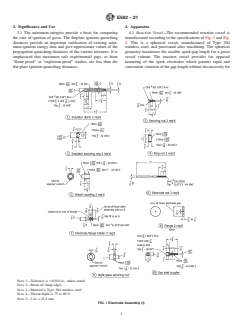
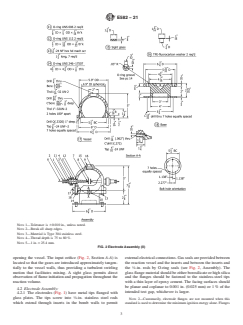
3.1 The minimum energies provide a basis for comparing 4.1 Reaction Vessel—The recommended reaction vessel is
the ease of ignition of gases. The flatplate ignition quenching manufactured according to the specifications of Fig. 1 and Fig.
distances provide an important verification of existing mini- 2. This is a spherical vessel, manufactured of Type 304
mum ignition energy data and give approximate values of the stainless steel, and passivated after machining. The spherical
propagation quenching distances of the various mixtures. It is geometry maximizes the useable spark-gap length for a given
emphasized that maximum safe experimental gaps, as from vessel volume. The reaction vessel provides for opposed
“flame-proof” or “explosion-proof” studies, are less than the mounting of the spark electrodes which permits rapid and
flat-plate ignition quenching distances. convenient variation of the gap length without the necessity for
NOTE 1—Tolerance is 60.010 in., unless noted.
NOTE 2—Break all sharp edges.
NOTE 3—Material is Type 304 stainless steel.
NOTE 4—Thread depth is 75 to 80 %.
NOTE 5—1 in. = 25.4 mm.
FIG. 1 Electrode Assembly (I)
E582 − 21
NOTE 1—Tolerance is 60.010 in., unless noted.
NOTE 2—Break all sharp edges.
NOTE 3—Material is Type 304 stainless steel.
NOTE 4—Thread depth is 75 to 80 %.
NOTE 5—1 in. = 25.4 mm.
FIG. 2 Electrode Assembly (II)
opening the vessel. The input orifice (Fig. 2, Section A-A)is external electrical connections. Gas seals are provided between
located so that the gases are introduced approximately tangen- the reaction vessel and the inserts and between the inserts and
tially to the vessel walls, thus providing a turbulent swirling the ⁄8-in. rods by O-ring seals (see Fig. 2, Assembly). The
motion that facilitates mixing. A sight glass permits direct glass flange material should be either borosilicate or high silica
observation of flame initiation and propagation throughout the and the flanges should be fastened to the stainless-steel tips
reaction volume. with a thin layer of epoxy cement. The facing surfaces should
be planar and coplanar to 0.001 in. (0.025 mm) or 1 % of the
4.2 Electrode Assembly:
intended test gap, whichever is larger.
4.2.1 The electrodes (Fig. 1) have metal tips flanged with
glass plates. The tips screw into ⁄8-in. stainless steel rods
NOTE 2—Customarily, electrode flanges are not mounted when this
which extend through inserts in the bomb walls to permit standard is used to determine the minimum ignition energy alone. Flanges
E582 − 21
are essential only for flat-plate ignition quenching distance determination.
such a power supply, the probability of lethal shock to the
operator from the high-voltage circuits becomes negligible.
4.2.2 Two inserts are required to carry the ⁄8-in. rods
However, all usual and normal hazards to personnel will exist
through the walls of the reaction vessel. At least one of these
on the 60-Hz supply, main-side of the power supply.)
inserts must be made of high-electrical resistivity insulating
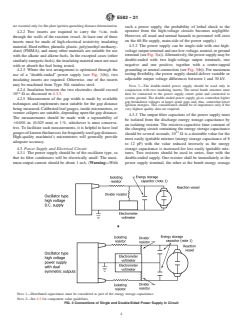
4.3.2 The power supply can be single-side with one high-
material. Hard rubber, phenolic plastic, poly(methyl methacry-
voltageoutputterminalandonelow-voltage,neutral,orground
alate) (PMMA), and many other materials are suitable for use
terminal(seeFig.3(a)).Alternatively,thepowersupplymaybe
with the alkane and alkene fuels. In the excepted cases (other
double-ended with two high-voltage output terminals, one
similarlyenergeticfuels),theinsulatingmaterialmustnotreact
negative and one positive, together with a center-tapped
with or absorb the fuel being tested.
grounding or neutral connection (see Fig. 3(b)). For maximum
4.2.3 Where the test arrangement is optimized through the
testing flexibility, the power supply should deliver variable or
use of a “double-ended” power supply (see Fig. 3(b)), two
adjustable output voltage differences between 1 and 30 kV.
insulating inserts are required. Otherwise, one of the inserts
may be machined from Type 304 stainless steel.
NOTE 3—The double-ended power supply should be used only in
4.2.4 Insulation between the two electrodes should exceed conjunction with two insulating inserts. The metal bomb structure must
then be connected to the power supply center point and connected to
10 Ω as discussed in 4.3.3.
system ground. The double-ended power supply gives somewhat higher
4.2.5 Measurement of the gap width is made by available
gap breakdown voltages at larger spark gaps and, thus, somewhat lower
techniques and implements most suitable for the gap distance
ignition energies. This consideration should be of importance only if the
being measured. Calibrated leaf gauges, inside micrometres, or
very highest quality data are required.
vernier calipers are suitable, depending upon the gap distance.
4.3.3 The output filter capacitors of the power supply must
The measurements should be made with a repeatability of
be isolated from the discharge energy storage capacitance by
60.001 in. (0.025 mm) or 1 %, whichever is most conserva-
an isolating resistor. The resistive-capacitive time constant of
tive. To facilitate such measurements, it is helpful to have leaf
the charging circuit containing the energy storage capacitance
gaugesofknownthicknessesforfrequentlyusedgapdistances. 12
should be several seconds; 10 Ω is a desirable value for the
High-quality machinist’s micrometres will generally provide
most easily ignitable mixture (energy storage capacitance of 8
adequate accuracy.
to 12 pF) with the value reduced inversely as the energy
4.3 Power Supply and Electrical Circuit: storage capacitance is increased for less easily ignitable mix-
4.3.1 The power supply should be of the oscillator type, so tures. Two resistors should be used in series, fou
...
This document is not an ASTM standard and is intended only to provide the user of an ASTM standard an indication of what changes have been made to the previous version. Because
it may not be technically possible to adequately depict all changes accurately, ASTM recommends that users consult prior editions as appropriate. In all cases only the current version
of the standard as published by ASTM is to be considered the official document.
´1
Designation: E582 − 07 (Reapproved 2013) E582 − 21
Standard Test Method for
Minimum Ignition Energy and Quenching Distance in
Gaseous Mixtures
This standard is issued under the fixed designation E582; the number immediately following the designation indicates the year of
original adoption or, in the case of revision, the year of last revision. A number in parentheses indicates the year of last reapproval. A
superscript epsilon (´) indicates an editorial change since the last revision or reapproval.
ε NOTE—Warning notes were editorially updated throughout in October 2013.
1. Scope
1.1 This test method covers the determination of minimum energy for ignition (initiation of deflagration) and associated flat-plate
ignition quenching distances. The complete description is specific to alkane or alkene fuels admixed with air at normal ambient
temperature and pressure. This method is applicable to mixtures of the specified fuels with air, varying from the most easily
ignitable mixture to mixtures near to to, in theory, the limit-of-flammability compositions.
NOTE 1—The test apparatus described in Section 4 is not suitable for near limit mixtures. Near limit mixtures require a much larger test volume (that is,
reaction vessel), and the capability for producing much larger spark energies.
1.2 Extensions to other fuel-oxidizer combinations, and to other temperatures and pressures can be accomplished with all the
accuracy inherent in this method if certain additional conditions are met: (a) mixture stability and compatibility with bomb, seal,
and other materials is established through time tests described in Section 9; (b) the expected peak pressure from the test is within
the pressure rating of the bomb (established as required by the particular research laboratory); (c) spark breakdown within the
bomb is consistent with Paschen’sPaschen’s law for the distance being tested; (d) the temperature, including that of the discharge
electrodes, is uniform; and (e) if the temperature is other than ambient, the energy storage capacitance required is less than about
9 pF.
1.3 This method is one of several being developed by Committee E27 for determining the hazards of chemicals, including their
vapors in air or other oxidant atmospheres. The measurements are useful in assessing fuel ignitability hazards due to static or other
electrical sparks. However, the quenching distance data must be used with great prudence since they are primarily applicable to
the ignition stage and therefore, represent values for initial pressure and not the smaller values existing at higher pressures.
1.4 The values stated in inch-pound units are to be regarded as standard. The values given in parentheses are mathematical
conversions to SI units that are provided for information only and are not considered standard.
1.5 This standard should be used to measure and describe the properties of materials, products, or assemblies in response to
heat and flame under controlled laboratory conditions and should not be used to describe or appraise the fire hazard or fire risk
of materials, products, or assemblies under actual fire conditions. However, results of this test may be used as elements of a fire
risk assessment which takes into account all of the factors which are pertinent to an assessment of the fire hazard of a particular
end use.
This test method is under the jurisdiction of ASTM Committee E27 on Hazard Potential of Chemicals and is the direct responsibility of Subcommittee E27.04 on
Flammability and Ignitability of Chemicals.
Current edition approved Oct. 1, 2013June 1, 2021. Published November 2013July 2021. Originally approved in 1976. Last previous edition approved in 20072013 as
ɛ1
E582 – 07.E582 – 07 (2013) . DOI: 10.1520/E0582-07R13E01.10.1520/E0582-21.
Litchfield, E. L., Hay, M. H., Kubala, T. S., and Monroe, J. S., “Minimum Ignition Energy and Quenching Distance in Gaseous Mixtures,” BuMines, R. L. 7009, August
1967, p. 11.
Copyright © ASTM International, 100 Barr Harbor Drive, PO Box C700, West Conshohocken, PA 19428-2959. United States
E582 − 21
1.6 This standard does not purport to address all of the safety concerns, if any, associated with its use. It is the responsibility
of the user of this standard to establish appropriate safety safety, health, and healthenvironmental practices and determine the
applicability of regulatory limitations prior to use. Specific safety precautions are listed in Section 5.
1.7 This international standard was developed in accordance with internationally recognized principles on standardization
established in the Decision on Principles for the Development of International Standards, Guides and Recommendations issued
by the World Trade Organization Technical Barriers to Trade (TBT) Committee.
2. Terminology
2.1 Definitions:
2.1.1 ignition, n—the initiation of combustion.
2.1.2 minimum ignition energy (MIE), n—electrical energy discharged from a capacitor, which is just sufficient to effect ignition
of the most easily ignitable concentration of fuel in air under the specific test conditions.
2.2 Definitions of Terms Specific to This Standard:
2.2.1 ignition quenching distance, n—maximum spacing between eletrode flanges that will not permit spark ignition and flame
propagation beyond the flanges, when tested under the specified test conditions.
3. Significance and Use
3.1 The minimum energies provide a basis for comparing the ease of ignition of gases. The flatplate ignition quenching distances
provide an important verification of existing minimum ignition energy data and give approximate values of the propagation
quenching distances of the various mixtures. It is emphasized that maximum safe experimental gaps, as from “flame-proof” or
“explosion-proof” studies, are less than the flat-plate ignition quenching distances.
4. Apparatus
4.1 Reaction Vessel—The recommended reaction vessel is manufactured according to the specifications of Fig. 1 and Fig. 2. This
is a spherical vessel, manufactured of Type 304 stainless steel, and passivated after machining. The spherical geometry maximizes
the useable spark-gap length for a given vessel volume. The reaction vessel provides for opposed mounting of the spark electrodes
which permits rapid and convenient variation of the gap length without the necessity for opening the vessel. The input orifice (Fig.
2, Section A-A) is located so that the gases are introduced approximately tangentially to the vessel walls, thus providing a turbulent
swirling motion that facilitates mixing. A sight glass permits direct observation of flame initiation and propagation throughout the
reaction volume.
4.2 Electrode Assembly:
4.2.1 The electrodes (Fig. 1) have metal tips flanged with glass plates. The tips screw into ⁄8-in. stainless steel rods which extend
through inserts in the bomb walls to permit external electrical connections. Gas seals are provided between the reaction vessel and
the inserts and between the inserts and the ⁄8-in. rods by O-ring seals (see Fig. 2, Assembly). The glass flange material should be
either borosilicate or high silica and the flanges should be fastened to the stainless steel stainless-steel tips with a thin layer of
epoxy cement. The facing surfaces should be planar and coplanar to 0.001 in. (0.025 mm) or 1 % of the intended test gap,
whichever is larger.
NOTE 2—Customarily, electrode flanges are not mounted when this standard is used to determine the minimum ignition energy alone. Flanges are essential
only for flat-plate ignition quenching distance determination.
4.2.2 Two inserts are required to carry the ⁄8-in. rods through the walls of the reaction vessel. At least one of these inserts must
be made of high-electrical resistivity insulating material. Hard rubber, phenolic plastic, poly(methyl methacryalate) (PMMA), and
many other materials are suitable for use with the alkane and alkene fuels. In the excepted cases (other similarly energetic fuels),
the insulating material must not react with or absorb the fuel being tested.
4.2.3 Where the test arrangement is optimized through the use of a “double-ended’’“double-ended” power supply,supply (see Fig.
3(b))(b)), two insulating inserts are required. Otherwise, one of the inserts may be machined from Type 304 stainless steel.
4.2.4 Insulation between the two electrodes should exceed 10 Ω as discussed in 4.3.3.
E582 − 21
NOTE 1—Tolerance is 60.010 in., unless noted.
NOTE 2—Break all sharp edges.
NOTE 3—Material is Type 304 stainless steel.
NOTE 4—Thread depth is 75 to 80 %.
NOTE 5—1 in. = 25.4 mm.
FIG. 1 Electrode Assembly (I)
4.2.5 Measurement of the gap width is made by available techniques and implements most suitable for the gap distance being
measured. Calibrated leaf gages,gauges, inside micrometers,micrometres, or vernier calipers are suitable, depending upon the gap
distance. The measurements should be made with a repeatability of 60.001 in. (0.025 mm) or 1 %, whichever is most conservative.
To facilitate such measurements, it is helpful to have leaf gagesgauges of known thicknesses for frequently used gap distances.
High-quality machinist’s micrometersmachinist’s micrometres will generally provide adequate accuracy.
4.3 Power Supply and Electrical Circuit:
4.3.1 The power supply should be of the oscillator type, so that its filter condensers will be electrically small. The maximum output
E582 − 21
NOTE 1—Tolerance is 60.010 in., unless noted.
NOTE 2—Break all sharp edges.
NOTE 3—Material is Type 304 stainless steel.
NOTE 4—Thread depth is 75 to 80 %.
NOTE 5—1 in. = 25.4 mm.
FIG. 2 Electrode Assembly (II).(II)
current should be about 1 mA. (Warning—With such a power supply, the probability of lethal shock to the operator from the
high-voltage circuits becomes negligible. However, all usual and normal hazards to personnel will exist on the 60-Hz supply,
main-side of the power supply.)
4.3.2 The power supply can be single-side with one high-voltage output terminal and one low-voltage, neutral, or ground terminal
(see Fig. 3(a)). Alternatively, the power supply may be double-ended with two high-voltage output terminals, one negative and one
positive, together with a center-tapped grounding or neutral connection (see Fig. 3(b)). For maximum testing flexibility, the power
supply should deliver variable or adjustable output voltage differences between 1 and 30 kV.
NOTE 3—The double-ended power supply should be used only in conjunction with two insulating inserts. The metal bomb structure must then be
E582 − 21
NOTE 1—Distributed capacitance must be considered as part of the energy storage capacitance.
NOTE 2—See 4.3 for component value guidelines.
FIG. 3 Connections of Single and Double-Sided Power Supply in Circuit.Circuit
connected to the power supply center point and connected to system ground. The double-ended power supply gives somewhat higher gap breakdown
voltages at larger spark gaps and, thus, somewhat lower ignition energies. This consideration should be of importance only if the very highest quality
data are required.
4.3.3 The output filter
...