

ASTM F1307-20
(Test Method)Standard Test Method for Oxygen Transmission Rate Through Dry Packages Using a Coulometric Sensor
General Information
- Abstract
SIGNIFICANCE AND USE
5.1 Oxygen gas transmission rate is an important determinant of the protection afforded by barrier materials. It is not, however, the sole determinant, and additional tests, based on experience, must be used to correlate package performance with O2GTR. This test method is suitable as a referee method of testing, provided that the user and source have agreed on sampling procedures, standardization procedures, test conditions, and acceptance criteria.
SCOPE
1.1 This test method covers a procedure for the determination of the steady-state rate of transmission of oxygen gas into packages. More specifically, the method is applicable to packages that in normal use will enclose a dry environment.
1.2 The values stated in SI units are to be regarded as the standard.
1.3 This standard does not purport to address all of the safety concerns, if any, associated with its use. It is the responsibility of the user of this standard to establish appropriate safety, health, and environmental practices and determine the applicability of regulatory limitations prior to use.
1.4 This international standard was developed in accordance with internationally recognized principles on standardization established in the Decision on Principles for the Development of International Standards, Guides and Recommendations issued by the World Trade Organization Technical Barriers to Trade (TBT) Committee.
- Status
- Published
- Publication Date
- 31-May-2020
- Technical Committee
- F02 - Primary Barrier Packaging
- Drafting Committee
- F02.10 - Permeation
Buy Documents
ASTM F1307-20 - Standard Test Method for Oxygen Transmission Rate Through Dry Packages Using a Coulometric Sensor
REDLINE ASTM F1307-20 - Standard Test Method for Oxygen Transmission Rate Through Dry Packages Using a Coulometric Sensor
Overview
ASTM F1307-20 is the internationally recognized standard test method for measuring the oxygen transmission rate (OTR) through dry packages using a coulometric sensor. Developed by ASTM International, this method provides a reliable procedure to determine the steady-state rate at which oxygen permeates into packaging that maintains a dry internal environment in its typical use.
Oxygen transmission is a significant factor in assessing the barrier performance of packaging materials, particularly in industries where the ingress of oxygen can compromise product integrity, shelf life, or safety. This standard is widely utilized for quality control, research and development, and materials comparison in the packaging sector.
Key Topics
- Oxygen Gas Transmission Rate (O2 GTR): Defines the quantity of oxygen passing through a package per unit of time. This is a crucial parameter for evaluating the protective qualities of barrier materials.
- Coulometric Sensor Utilization: The test employs a coulometric oxygen sensor, which detects and quantitatively measures the oxygen that has permeated the sample package.
- Sample Preparation and Testing: Packages must be representative of normal usage and free of non-typical defects (unless those are characteristics of the intended package). The method details how packages are mounted, purged with nitrogen, and exposed to controlled oxygen concentrations.
- Calibration and Accuracy: Periodic calibration is necessary using reference materials of known oxygen transmission rates, ensuring the measurement system remains precise and reliable.
- Test Conditions: The importance of controlling variables such as temperature, humidity, and carrier gas purity during testing to ensure data accuracy.
- Reporting Requirements: The method mandates comprehensive reporting of all test parameters, including package description, environmental conditions, calibration details, and final measured values.
Applications
ASTM F1307-20 is especially relevant for packaging developers, manufacturers, and quality assurance professionals. Typical applications include:
- Food and Beverage Packaging: Ensuring bottles, trays, cups, and pouches provide adequate protection from oxygen ingress, preserving freshness and quality of contents.
- Pharmaceutical Packaging: Validating barrier performance for blister packs, vials, and other containers that protect oxygen-sensitive pharmaceuticals.
- Medical Device Packaging: Assessing packaging integrity for medical devices where oxygen exposure could impact sterility or device functionality.
- Industrial Packaging: Evaluating high-performance materials designed to prevent oxygen penetration for chemicals, electronics, or sensitive raw materials.
By enabling precise measurement of oxygen permeation through entire packaging systems (not just films), ASTM F1307-20 helps manufacturers optimize material selection, packaging design, and process controls to meet regulatory requirements and product protection goals.
Related Standards
ASTM F1307-20 references and complements several other key packaging and permeation standards, including:
- ASTM D1434: Test Method for Determining Gas Permeability Characteristics of Plastic Film and Sheeting.
- ASTM D3985: Test Method for Oxygen Gas Transmission Rate Through Plastic Film and Sheeting Using a Coulometric Sensor.
- ASTM E691: Practice for Conducting an Interlaboratory Study to Determine the Precision of a Test Method.
These related standards provide additional methodologies for testing oxygen and other gas permeation properties in packaging materials, supporting comprehensive package evaluation programs.
Practical Value
Implementing ASTM F1307-20 facilitates:
- Confident selection and validation of packaging materials based on their oxygen barrier properties.
- Establishment of comparative benchmarks in competitive product development.
- Assurance of compliance with industry and regulatory requirements for oxygen-sensitive products.
- Identification of weaknesses in packaging systems, enabling targeted improvements for greater shelf life and product quality.
Keywords: oxygen transmission rate, OTR, coulometric sensor, package permeability, packaging barrier performance, ASTM F1307, oxygen permeation, dry packages, packaging test method, packaging quality assurance.
Relations
- Effective Date
- 01-Jun-2020
- Effective Date
- 01-May-2013
- Effective Date
- 01-Nov-2011
- Effective Date
- 01-Oct-2010
- Effective Date
- 01-Oct-2008
- Effective Date
- 01-Nov-2005
- Effective Date
- 01-Jun-2005
- Effective Date
- 10-May-2002
- Effective Date
- 10-May-2001
- Effective Date
- 10-May-1999
- Effective Date
- 10-Nov-1998
- Effective Date
- 30-Jul-1982
- Effective Date
- 01-Jun-2020
Buy Documents
ASTM F1307-20 - Standard Test Method for Oxygen Transmission Rate Through Dry Packages Using a Coulometric Sensor
REDLINE ASTM F1307-20 - Standard Test Method for Oxygen Transmission Rate Through Dry Packages Using a Coulometric Sensor
Get Certified
Connect with accredited certification bodies for this standard

ECOCERT
Organic and sustainability certification.

BRCGS (Brand Reputation Compliance Global Standards)
Global food safety and quality standards owner.

Eurofins Food Testing Global
Global leader in food, environment, and pharmaceutical product testing.
Sponsored listings
Frequently Asked Questions
ASTM F1307-20 is a standard published by ASTM International. Its full title is "Standard Test Method for Oxygen Transmission Rate Through Dry Packages Using a Coulometric Sensor". This standard covers: SIGNIFICANCE AND USE 5.1 Oxygen gas transmission rate is an important determinant of the protection afforded by barrier materials. It is not, however, the sole determinant, and additional tests, based on experience, must be used to correlate package performance with O2GTR. This test method is suitable as a referee method of testing, provided that the user and source have agreed on sampling procedures, standardization procedures, test conditions, and acceptance criteria. SCOPE 1.1 This test method covers a procedure for the determination of the steady-state rate of transmission of oxygen gas into packages. More specifically, the method is applicable to packages that in normal use will enclose a dry environment. 1.2 The values stated in SI units are to be regarded as the standard. 1.3 This standard does not purport to address all of the safety concerns, if any, associated with its use. It is the responsibility of the user of this standard to establish appropriate safety, health, and environmental practices and determine the applicability of regulatory limitations prior to use. 1.4 This international standard was developed in accordance with internationally recognized principles on standardization established in the Decision on Principles for the Development of International Standards, Guides and Recommendations issued by the World Trade Organization Technical Barriers to Trade (TBT) Committee.
SIGNIFICANCE AND USE 5.1 Oxygen gas transmission rate is an important determinant of the protection afforded by barrier materials. It is not, however, the sole determinant, and additional tests, based on experience, must be used to correlate package performance with O2GTR. This test method is suitable as a referee method of testing, provided that the user and source have agreed on sampling procedures, standardization procedures, test conditions, and acceptance criteria. SCOPE 1.1 This test method covers a procedure for the determination of the steady-state rate of transmission of oxygen gas into packages. More specifically, the method is applicable to packages that in normal use will enclose a dry environment. 1.2 The values stated in SI units are to be regarded as the standard. 1.3 This standard does not purport to address all of the safety concerns, if any, associated with its use. It is the responsibility of the user of this standard to establish appropriate safety, health, and environmental practices and determine the applicability of regulatory limitations prior to use. 1.4 This international standard was developed in accordance with internationally recognized principles on standardization established in the Decision on Principles for the Development of International Standards, Guides and Recommendations issued by the World Trade Organization Technical Barriers to Trade (TBT) Committee.
ASTM F1307-20 is classified under the following ICS (International Classification for Standards) categories: 55.020 - Packaging and distribution of goods in general; 71.100.20 - Gases for industrial application. The ICS classification helps identify the subject area and facilitates finding related standards.
ASTM F1307-20 has the following relationships with other standards: It is inter standard links to ASTM F1307-14, ASTM E691-13, ASTM E691-11, ASTM D3985-05(2010)e1, ASTM E691-08, ASTM E691-05, ASTM D3985-05, ASTM D3985-02e1, ASTM D3985-02, ASTM E691-99, ASTM D1434-82(1998), ASTM D1434-82(2003), ASTM F2097-20. Understanding these relationships helps ensure you are using the most current and applicable version of the standard.
ASTM F1307-20 is available in PDF format for immediate download after purchase. The document can be added to your cart and obtained through the secure checkout process. Digital delivery ensures instant access to the complete standard document.
Standards Content (Sample)
This international standard was developed in accordance with internationally recognized principles on standardization established in the Decision on Principles for the
Development of International Standards, Guides and Recommendations issued by the World Trade Organization Technical Barriers to Trade (TBT) Committee.
Designation: F1307 − 20
Standard Test Method for
Oxygen Transmission Rate Through Dry Packages Using a
Coulometric Sensor
This standard is issued under the fixed designation F1307; the number immediately following the designation indicates the year of
original adoption or, in the case of revision, the year of last revision.Anumber in parentheses indicates the year of last reapproval.A
superscript epsilon (´) indicates an editorial change since the last revision or reapproval.
1. Scope 3.1.1 oxygen gas transmission rate (O GTR)—as applied to
a package, is the quantity of oxygen gas passing through the
1.1 This test method covers a procedure for the determina-
surface of the package (PKG) per unit of time.
tion of the steady-state rate of transmission of oxygen gas into
3.1.1.1 Discussion—The SI unit of transmission rate is the
packages. More specifically, the method is applicable to
mol/s. The test conditions, including temperature, oxygen
packages that in normal use will enclose a dry environment.
partial pressure and humidity on both sides of the package,
1.2 The values stated in SI units are to be regarded as the
must be stated. A commonly used unit of O GTR is the
3 3
standard.
cm (STP)/(PKG·d), where 1 cm at Standard Temperature and
5 −6
1.3 This standard does not purport to address all of the
Pressure (STP= 273.15K; 1.013 × 10 Pa) is 44.62×10 mol
safety concerns, if any, associated with its use. It is the and one day is 86400 s. Note: The term package (PKG) is
responsibility of the user of this standard to establish appro-
utilized within the transmission rate unit to distinguish it from
priate safety, health, and environmental practices and deter- traditional film OTR results. Unlike film testing, where the test
mine the applicability of regulatory limitations prior to use.
area is always known, a package oxygen transmission rate
1.4 This international standard was developed in accor- measurement often involves complex systems with seals and
dance with internationally recognized principles on standard-
closures (for example, a bottle with cap, a tray with lidding or
ization established in the Decision on Principles for the a heat-sealed foil pouch with permeation through the edges),
Development of International Standards, Guides and Recom-
whereoxygentransmissionisoccurring.ApackageOTRtestis
mendations issued by the World Trade Organization Technical often a packaging “system” test versus a simple component
Barriers to Trade (TBT) Committee.
test.
’
3.1.2 oxygen permeability coeffıcient (P O )—theproductof
2. Referenced Documents
the permeance and thickness of the barrier.
2.1 ASTM Standards: 3.1.2.1 Discussion—The permeability is meaningful only
for homogenous materials, in which case it is a property
D1434TestMethodforDeterminingGasPermeabilityChar-
acteristics of Plastic Film and Sheeting characteristic of the bulk material. This quantity should not be
used unless the relationship between thickness and permeance
D3985Test Method for Oxygen Gas Transmission Rate
Through Plastic Film and Sheeting Using a Coulometric has been verified in tests using several thicknesses of the
material. The SI unit of permeability is the mol/(m·s·Pa). The
Sensor
E691Practice for Conducting an Interlaboratory Study to test conditions must be stated.
Determine the Precision of a Test Method
3.1.3 oxygen permeance (PO )—the ratio of the O GTR to
2 2
the difference between the partial pressure of O on the two
3. Terminology
sides of the package wall.
3.1.3.1 Discussion—The SI unit of permeance is the mol/
3.1 Definitions of Terms Specific to This Standard:
(s·Pa). The test conditions (see 4.2) must be stated.
4. Summary of Test Method
ThistestmethodisunderthejurisdictionofASTMCommitteeF02onPrimary
4.1 This test method employs a coulometric oxygen sensor
Barrier Packaging and is the direct responsibility of Subcommittee F02.10 on
Permeation.
and associated equipment in an arrangement similar to that
CurrenteditionapprovedJune1,2020.PublishedJuly2020.Originallyapproved
describedinTestMethodD3985.Oxygengastransmissionrate
in 1990. Last previous edition approved in 2014 as F1307–14. DOI: 10.1520/
(O GTR)isdeterminedafterthepackagehasbeenmountedon
F1307-20. 2
For referenced ASTM standards, visit the ASTM website, www.astm.org, or a test fixture and has equilibrated in the test environment.
contact ASTM Customer Service at service@astm.org. For Annual Book of ASTM
4.2 Thepackageismountedinsuchawayastoprovidethat
Standards volume information, refer to the standard’s Document Summary page on
the ASTM website. the inside of the package is slowly purged by a stream of
Copyright © ASTM International, 100 Barr Harbor Drive, PO Box C700, West Conshohocken, PA 19428-2959. United States
F1307 − 20
7.1.1.1 Experience has shown that arrangements using mul-
tiple package test stations are a practical way to increase the
number of measurements that can be obtained from a coulo-
metric sensor.Avalving manifold connects the carrier gas side
of each individual test station to the sensor in a predetermined
pattern. Carrier gas is continually purging the carrier gas sides
of those packages that are not connected to the sensor. Either
test gas (100% oxygen) or normal room air (20.8% oxygen),
whichever is appropriate, contacts the outside of the package.
7.1.2 Diffusion Cell, consisting of two metal halves which,
when closed upon the film used for system calibration, will
accurately define a circular area of that film. Typical diffusion
2 2
cell areas are 100 cm and 30 cm .The volumes inside the cell
above and below the enclosed film are not critical; they should
be small enough to allow for rapid gas exchange, but not so
small that an unsupported film which happens to sag or bulge
will contact the top or bottom of the cell. Means shall be
provided for the measurement of cell temperature.
7.1.2.1 O-Ring—An appropriately sized groove, machined
into the oxygen (or test gas) side of the diffusion cell, retains a
neoprene O-ring. The test area is considered to be the area
established by the inside contact diameter of the compressed
FIG. 1 Arrangement of Components when Reference Film is
O-ring when the diffusion cell is clamped shut against the test
Used to Calibrate System for Package Testing
specimen.Thearea, A,canbeobtainedbymeasuringtheinside
diameteroftheimprintleftbytheO-ringonthespecimenafter
it has been removed from the diffusion cell.
nitrogen while the outside of the package is exposed to a
7.1.2.2 Thenitrogen(orcarriergas)sideofthediffusioncell
known concentration of oxygen. The package may be exposed
shallhaveaflatraisedrim.Sincethisrimisthesealingsurface
in ambient room air which contains 20.8% oxygen, or im-
against which the test specimen is pressed, it must be smooth
mersed in an atmosphere of 100% oxygen.As oxygen perme-
and flat, without scratches which may promote leakage.
ates through the package walls into the nitrogen carrier gas, it
7.1.2.3 Diffusion Cell Pneumatic Fittings—Each half of the
is transported to the coulometric detector where it produces an
diffusion cell shall incorporate suitable fittings for the intro-
electricalcurrent,themagnitudeofwhichisproportionaltothe
duction and exhaust of gas without significant loss or leakage.
amount of oxygen flowing into the detector per unit of time.
7.1.2.4 It is desirable to thermostatically control the diffu-
5. Significance and Use
sion cell. A simple resistive heater, attached to the carrier gas
side of the cell in such a manner as to ensure good thermal
5.1 Oxygen gas transmission rate is an important determi-
contact, is adequate for this purpose. A thermistor sensor and
nant of the protection afforded by barrier materials. It is not,
an appropriate control circuit will serve to regulate the cell
however, the sole determinant, and additional tests, based on
temperature unless measurements are being made close to
experience, must be used to correlate package performance
ambient temperature. In this case, it is desirable to provide
with O GTR. This test method is suitable as a referee method
cooling coils to remove some of the heat.
of testing, provided that the user and source have agreed on
sampling procedures, standardization procedures, test 7.1.3 Catalyst Bed, a small metal tube with fittings for
attachment to the inlet of the nitrogen gas pneumatic fitting
conditions, and acceptance criteria.
containing 3 to5gof0.5% platinum or palladium catalyst on
6. Interferences
aluminatoprovideanessentiallyoxygen-freecarriergastothe
diffusion cell and to each package test station.
6.1 The presence of certain interfering substances in the
7.1.4 Flowmeter, a flowmeter having an operating range of
carrier gas stream may give rise to unwanted electrical outputs
5 to 100 mL/min is required to monitor the flow rate of
and error factors. Interfering substances include free chlorine
nitrogen carrier gas through each test station.
and some strong oxidizing agents. Exposure to carbon dioxide
7.1.5 Flow Switching Valves—Two or more valves for the
should also be minimized to avoid damage to the sensor
through reaction with the potassium hydroxide electrolyte. switching of the nitrogen and test gas flow streams.
7.1.6 Oxygen-Sensitive Coulometric Sensor, operating at an
7. Apparatus
essentially constant efficiency is employed to monitor the
quantity of oxygen transmitted.
7.1 Oxygen Gas Transmission Apparatus,asdiagrammedin
Fig. 1 with the following: 7.1.7 Load Resistor—The current generated by the coulo-
7.1.1 Package Test Stations, providing a means for the metric cell shall pass through a resistive load across which the
introduction and exhaust of the nitrogen carrier gas stream outputvoltageismeasured.Typicalvaluesforloadresistorsare
without significant loss or leakage. suchthatthevaluesyieldaconvenientrelationshipbetweenthe
F1307 − 20
outputvoltageandtheoxygentransmissionrateasexpressedin 11. Test Specimens
terms of cm (STP)/(PKG·d).
11.1 Test packages shall be representative of the population
7.1.8 Voltage Recorder—The voltage across the load resis-
andshallbefreeofnon-typicaldefects,unlessthesedefectsare
tor is measured and recorded using a strip-chart potentiometer,
a characteristic of the package being analyzed (for example,
data-logger or other suitable device. The instrument or system
wrinkled pouch, dented bottle.etc.)
should be able to measure a full-scale voltage of 50 mV. It
should be able to measure voltages as low as 0.10 mV with a
12. Calibration
resolution of at least 10 µV.An input impedance of 5000 ohm
or higher is acceptable. 12.1 General Approach—The oxygen sensor used in this
method is a coulometric device that yields a linear output as
8. Reagents and Materials
predictedbyFaraday’sLaw.Sincethissensorhasanefficiency
8.1 Nitrogen Carrier Gas, consisting of a nitrogen and of 95 to 98% it is almost an absolute “yardstick” that does not
hydrogen mixture in which the percentage of hydrogen shall
requirecalibration.Experiencehasshown,however,thatunder
fall between 0.5 and 3.0 volume percent. The carrier gas shall some circumstances the sensor may become depleted or
be dry and contain not more than 100 ppm of oxygen. A
damaged to the extent that efficiency and response are im-
commercially available mixture known as “forming gas” is paired. For this reason, the method incorporates means for
suitable.
periodic system calibration. This calibration is derived from
measurements of a known-value “Reference Package.”
8.2 Sealing Grease—A high-viscosity silicone stopcock
grease or a high-vacuum grease is required for sealing the
12.2 Thereferencepackageisessentiallythelower-halfofa
calibration film in the diffusion cell.
diffusion cell (Fig. 1) in which a sheet of reference film of
known O GTR has been sealed and clamped. This creates a
8.3 Oxygen Test Gas—The test gas shall be dry and contain 2
“package” into which oxygen will diffuse at a known rate.
not less than 99.5% oxygen (except as provided for in 14.8).
12.3 Assembling the Reference Package—Ensure the sensor
9. Technical Precautions
isbypassedtoavoidswampingitwithair,thatis,noflowtothe
9.1 Extendeduseofthetestunitwithnomoistureinthegas
sensor. Unclamp the diffusion cell and open it. Apply a thin
stream may result in a noticeable decrease in output and
layer of sealing grease (see 8.2) around the raised rim of the
response time from the sensor (equivalent to an increase in the
lower half of the diffusion cell. Insert the reference film in the
calibrationfactor, Q).Thisconditionisduetodryingoutofthe
diffusioncellandplaceituponthegreasedsurface,takingcare
sensor.
to avoid wrinkles or creases. Lower the upper half of the
9.2 Temperature is a critical parameter affecting the mea-
diffusioncellintoplaceandclampbothhalvestightlytogether.
surement of O GTR. Careful temperature control can help to
12.4 Purging the System—Startthenitrogencarriergasflow
minimize variations due to temperature fluctuations. During
andpurgeairfromtheupperandlowerdiffusioncellchambers
testing,monitorandrecordthetemperature,periodically,tothe
using a flow rate of 50 to 60 cm /min (as indicated by the
nearest0.5°C.Reporttheaveragetemperatureandtherangeof
flowmeter).After3or4min,reducetheflowratetothedesired
temperatures found during a test.
value between 5 and 15 cm /min. Maintain this configuration
9.3 Thesensorwillrequirearelativelylongtimetostabilize
for 30 min.
atalowreadingcharacteristicofagoodbarrierafterithasbeen
12.5 Establishing Zero Level of Reference Film—After the
usedtotestabarriersuchaslow-densitypolyethylene.Forthis
system has been flushed with nitrogen for 30 min, with the
reason, materials of comparable gas transmission qualities
sensor bypassed, divert the nitrogen carrier gas flow to the
should be tested together.
sensor. At this time the sensor output, as displayed on the
9.4 Back diffusion of air into the unit is undesirable. Take
voltage recorder, will usually increase abruptly, indicating that
care, therefore, to ensure that there is a flow of nitrogen
oxygen is entering the sensor with the carrier gas. The most
through the system at all times.This flow can be low when the
likely sources of this oxygen are (1) outgassing of the sample,
instrument is not being used.
(2)leaksinthesystem,or(3)acombinationof(1)and(2).The
9.5 The gas-permeability characteristics of some barrier operatorshallobservetherecordertraceuntilthesensoroutput
current stabilizes at a constant low value with no significant
materials are altered by exposure to water vapor. If a package
is to be exposed and tested in normal laboratory air (20.8% trend in either direction. Note the observed deflection of the
strip chart recorder at this time and label it E .
O ), the ambient relative humidity should be monitored to the
2 0
nearest 3%. This may be accomplished using a sling psy-
12.6 Oncethezerolevel(E )hasbeenestablished,switchto
chrometer or other method of comparable accuracy. Report the
a flow of oxygen on the test gas side of the diffusion cell.
average and range of relative humidities measured during the
Nitrogen will continue to flow on the downstream side of the
test.
cell.
10. Sampling
12.7 Establishing a Steady-State O GTR—The sensor
10.1 The sampling units used for the determination of output,asdisplayedbythestrip-chartrecorder,shouldincrease
...
This document is not an ASTM standard and is intended only to provide the user of an ASTM standard an indication of what changes have been made to the previous version. Because
it may not be technically possible to adequately depict all changes accurately, ASTM recommends that users consult prior editions as appropriate. In all cases only the current version
of the standard as published by ASTM is to be considered the official document.
Designation: F1307 − 14 F1307 − 20
Standard Test Method for
Oxygen Transmission Rate Through Dry Packages Using a
Coulometric Sensor
This standard is issued under the fixed designation F1307; the number immediately following the designation indicates the year of
original adoption or, in the case of revision, the year of last revision. A number in parentheses indicates the year of last reapproval. A
superscript epsilon (´) indicates an editorial change since the last revision or reapproval.
1. Scope
1.1 This test method covers a procedure for the determination of the steady-state rate of transmission of oxygen gas into
packages. More specifically, the method is applicable to packages that in normal use will enclose a dry environment.
1.2 The values stated in SI units are to be regarded as the standard.
1.3 This standard does not purport to address all of the safety concerns, if any, associated with its use. It is the responsibility
of the user of this standard to establish appropriate safety safety, health, and healthenvironmental practices and determine the
applicability of regulatory limitations prior to use.
1.4 This international standard was developed in accordance with internationally recognized principles on standardization
established in the Decision on Principles for the Development of International Standards, Guides and Recommendations issued
by the World Trade Organization Technical Barriers to Trade (TBT) Committee.
2. Referenced Documents
2.1 ASTM Standards:
D1434 Test Method for Determining Gas Permeability Characteristics of Plastic Film and Sheeting
D1898 Practice for Sampling of Plastics (Withdrawn 1998)
D3985 Test Method for Oxygen Gas Transmission Rate Through Plastic Film and Sheeting Using a Coulometric Sensor
E691 Practice for Conducting an Interlaboratory Study to Determine the Precision of a Test Method
3. Terminology
3.1 Definitions of Terms Specific to This Standard:
3.1.1 oxygen gas transmission rate (O GTR)—as applied to a package, is the quantity of oxygen gas passing through the surface
of the package (PKG) per unit of time.
This test method is under the jurisdiction of ASTM Committee F02 on FlexiblePrimary Barrier Packaging and is the direct responsibility of Subcommittee F02.10 on
Permeation.
Current edition approved April 1, 2014June 1, 2020. Published June 2014July 2020. Originally approved in 1990. Last previous edition approved in 20072014 as
F1307 – 02 (2007).F1307 – 14. DOI: 10.1520/F1307-14.10.1520/F1307-20.
For referenced ASTM standards, visit the ASTM website, www.astm.org, or contact ASTM Customer Service at service@astm.org. For Annual Book of ASTM Standards
volume information, refer to the standard’s Document Summary page on the ASTM website.
3.1.1.1 Discussion—
The SI unit of transmission rate is the mol/s. The test conditions, including temperature, oxygen partial pressure and humidity on
3 3
both sides of the package, must be stated. A commonly used unit of O GTR is the cm (STP)/(PKG·d), where 1 cm at Standard
5 −6
Temperature and Pressure (STP = 273.15K; 1.013 × 10 Pa) is 44.62 × 10 mol and one day is 86 400 s.86 400 s. Note: The term
package (PKG) is utilized within the transmission rate unit to distinguish it from traditional film OTR results. Unlike film testing,
where the test area is always known, a package oxygen transmission rate measurement often involves complex systems with seals
and closures (for example, a bottle with cap, a tray with lidding or a heat-sealed foil pouch with permeation through the edges),
where oxygen transmission is occurring. A package OTR test is often a packaging “system” test versus a simple component test.
’
3.1.2 oxygen permeability coeffıcient (P O )—the product of the permeance and thickness of the barrier.
3.1.2.1 Discussion—
Copyright © ASTM International, 100 Barr Harbor Drive, PO Box C700, West Conshohocken, PA 19428-2959. United States
F1307 − 20
The permeability is meaningful only for homogenous materials, in which case it is a property characteristic of the bulk material.
This quantity should not be used unless the relationship between thickness and permeance has been verified in tests using several
thicknesses of the material. The SI unit of permeability is the mol/(m·s·Pa). The test conditions must be stated.
3.1.3 oxygen permeance (PO )—the ratio of the O GTR to the difference between the partial pressure of O on the two sides
2 2 2
of the package wall.
3.1.3.1 Discussion—
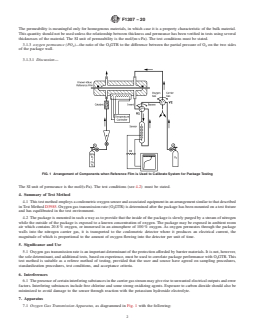
FIG. 1 Arrangement of Components when Reference Film is Used to Calibrate System for Package Testing
The SI unit of permeance is the mol/(s·Pa). The test conditions (see 4.2) must be stated.
4. Summary of Test Method
4.1 This test method employs a coulometric oxygen sensor and associated equipment in an arrangement similar to that described
in Test Method D3985. Oxygen gas transmission rate (O GTR) is determined after the package has been mounted on a test fixture
and has equilibrated in the test environment.
4.2 The package is mounted in such a way as to provide that the inside of the package is slowly purged by a stream of nitrogen
while the outside of the package is exposed to a known concentration of oxygen. The package may be exposed in ambient room
air which contains 20.8 % oxygen, or immersed in an atmosphere of 100 % oxygen. As oxygen permeates through the package
walls into the nitrogen carrier gas, it is transported to the coulometric detector where it produces an electrical current, the
magnitude of which is proportional to the amount of oxygen flowing into the detector per unit of time.
5. Significance and Use
5.1 Oxygen gas transmission rate is an important determinant of the protection afforded by barrier materials. It is not, however,
the sole determinant, and additional tests, based on experience, must be used to correlate package performance with O GTR. This
test method is suitable as a referee method of testing, provided that the user and source have agreed on sampling procedures,
standardization procedures, test conditions, and acceptance criteria.
6. Interferences
6.1 The presence of certain interfering substances in the carrier gas stream may give rise to unwanted electrical outputs and error
factors. Interfering substances include free chlorine and some strong oxidizing agents. Exposure to carbon dioxide should also be
minimized to avoid damage to the sensor through reaction with the potassium hydroxide electrolyte.
7. Apparatus
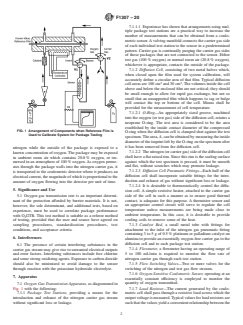
7.1 Oxygen Gas Transmission Apparatus, as diagrammed in Fig. 1 with the following:
F1307 − 20
7.1.1 Package Test Stations, providing a means for the introduction and exhaust of the nitrogen carrier gas stream without
significant loss or leakage.
7.1.1.1 Experience has shown that arrangements using multiple package test stations are a practical way to increase the number
of measurements that can be obtained from a coulometric sensor. A valving manifold connects the carrier gas side of each
individual test station to the sensor in a predetermined pattern. Carrier gas is continually purging the carrier gas sides of those
packages that are not connected to the sensor. Either test gas (100 % oxygen) or normal room air (20.8 % oxygen), whichever is
appropriate, contacts the outside of the package.
7.1.2 Diffusion Cell, consisting of two metal halves which, when closed upon the film used for system calibration, will
2 2
accurately define a circular area of that film. Typical diffusion cell areas are 100 cm and 30 cm . The volumes inside the cell above
and below the enclosed film are not critical; they should be small enough to allow for rapid gas exchange, but not so small that
an unsupported film which happens to sag or bulge will contact the top or bottom of the cell. Means shall be provided for the
measurement of cell temperature.
7.1.2.1 O-Ring—An appropriately sized groove, machined into the oxygen (or test gas) side of the diffusion cell, retains a
neoprene O-ring. The test area is considered to be the area established by the inside contact diameter of the compressed O-ring
when the diffusion cell is clamped shut against the test specimen. The area, A, can be obtained by measuring the inside diameter
of the imprint left by the O-ring on the specimen after it has been removed from the diffusion cell.
7.1.2.2 The nitrogen (or carrier gas) side of the diffusion cell shall have a flat raised rim. Since this rim is the sealing surface
against which the test specimen is pressed, it must be smooth and flat, without scratches which may promote leakage.
7.1.2.3 Diffusion Cell Pneumatic Fittings—Each half of the diffusion cell shall incorporate suitable fittings for the introduction
and exhaust of gas without significant loss or leakage.
7.1.2.4 It is desirable to thermostatically control the diffusion cell. A simple resistive heater, attached to the carrier gas side of
the cell in such a manner as to ensure good thermal contact, is adequate for this purpose. A thermistor sensor and an appropriate
control circuit will serve to regulate the cell temperature unless measurements are being made close to ambient temperature. In
this case, it is desirable to provide cooling coils to remove some of the heat.
7.1.3 Catalyst Bed, a small metal tube with fittings for attachment to the inlet of the nitrogen gas pneumatic fitting containing
3 to 5 g of 0.5 % platinum or palladium catalyst on alumina to provide an essentially oxygen-free carrier gas to the diffusion cell
and to each package test station.
7.1.4 Flowmeter, a flowmeter having an operating range of 5 to 100 mL/min is required to monitor the flow rate of nitrogen
carrier gas through each test station.
7.1.5 Flow Switching Valves—Two or more valves for the switching of the nitrogen and test gas flow streams.
7.1.6 Oxygen-Sensitive Coulometric Sensor, operating at an essentially constant efficiency is employed to monitor the quantity
of oxygen transmitted.
7.1.7 Load Resistor—The current generated by the coulometric cell shall pass through a resistive load across which the output
voltage is measured. Typical values for load resistors are such that the values yield a convenient relationship between the output
voltage and the oxygen transmission rate as expressed in terms of cm (STP)/PKG·d.(STP)/(PKG·d).
7.1.8 Voltage Recorder—The voltage across the load resistor is measured and recorded using a strip-chart potentiometer,
data-logger or other suitable device. The instrument or system should be able to measure a full-scale voltage of 50 mV. It should
be able to measure voltages as low as 0.10 mV with a resolution of at least 10 μV. An input impedance of 5000 ohm or higher
is acceptable.
8. Reagents and Materials
8.1 Nitrogen Carrier Gas, consisting of a nitrogen and hydrogen mixture in which the percentage of hydrogen shall fall between
0.5 and 3.0 volume percent. The carrier gas shall be dry and contain not more than 100 ppm of oxygen. A commercially available
mixture known as “forming gas” is suitable.
8.2 Sealing Grease—A high-viscosity silicone stopcock grease or a high-vacuum grease is required for sealing the calibration
film in the diffusion cell.
8.3 Oxygen Test Gas—The test gas shall be dry and contain not less than 99.5 % oxygen (except as provided for in 14.8).
9. Technical Precautions
9.1 Extended use of the test unit with no moisture in the gas stream may result in a noticeable decrease in output and response
time from the sensor (equivalent to an increase in the calibration factor, Q). This condition is due to drying out of the sensor.
9.2 Temperature is a critical parameter affecting the measurement of O GTR. Careful temperature control can help to minimize
variations due to temperature fluctuations. During testing, monitor and record the temperature, periodically, to the nearest 0.5°C.
Report the average temperature and the range of temperatures found during a test.
9.3 The sensor will require a relatively long time to stabilize at a low reading characteristic of a good barrier after it has been
used to test a barrier such as low-density polyethylene. For this reason, materials of comparable gas transmission qualities should
be tested together.
F1307 − 20
9.4 Back diffusion of air into the unit is undesirable. Take care, therefore, to ensure that there is a flow of nitrogen through the
system at all times. This flow can be low when the instrument is not being used.
9.5 The gas-permeability characteristics of some barrier materials are altered by exposure to water vapor. If a package is to be
exposed and tested in normal laboratory air (20.8 % O ), the ambient relative humidity should be monitored to the nearest 3 %.
This may be accomplished using a sling psychrometer or other method of comparable accuracy. Report the average and range of
relative humidities measured during the test.
10. Sampling
10.1 The sampling units used for the determination of O GTR shall be representative of the quantity of product for which the
data are required, in accordance with Practice required.D1898.
11. Test Specimens
11.1 Test packages shall be representative of the population and shall be free of non-typical defects.defects, unless these defects
are a characteristic of the package being analyzed (for example, wrinkled pouch, dented bottle.etc.)
12. Calibration
12.1 General Approach—The oxygen sensor used in this method is a coulometric device that yields a linear output as predicted
by Faraday’s Law. Since this sensor has an efficiency of 95 to 98 % it is almost an absolute “yardstick” that does not require
calibration. Experience has shown, however, that under some circumstances the sensor may become depleted or damaged to the
extent that efficiency and response are impaired. For this reason, the method incorporates means for periodic system calibration.
This calibration is derived from measurements of a known-value “Reference Package.”
12.2 The reference package is essentially the lower-half of a diffusion cell (Fig. 1) in which a sheet of reference film of known
O GTR has been sealed and clamped. This creates a “package” into which oxygen will diffuse at a known rate.
12.3 Assembling the Reference Package—Ensure the sensor is bypassed to avoid swamping it with air, that is, no flow to the
sensor. Unclamp the diffusion cell and open it. Apply a thin layer of sealing grease (see 8.2) around the raised rim of the lower
half of the diffusion cell. Insert the reference film in the diffusion cell and place it upon the greased surface, taking care to avoid
wrinkles or creases. Lower the upper half of the diffusion cell into place and clamp both halves tightly together.
12.4 Purging the System—Start the nitrogen carrier gas flow and purge air from the upper and lower diffusion cell chambers
using a flow rate of 50 to 60 cm /min (as indicated by the flowmeter). After 3 or 4 min, reduce the flow rate to the desired value
between 5 and 15 cm /min. Maintain this configuration for 30 min.
12.5 Establishing Zero Level of Reference Film—After the system has been flushed with nitrogen for 30 min, with the sensor
bypassed, divert the nitrogen carrier gas flow to the sensor. At this time the sensor output, as displayed on the voltage recorder,
will usually increase abruptly, indicating that oxygen is entering the sensor with the carrier gas. The most likely sources of this
oxygen are (1) outgassing of the sample, (2) leaks in the system, or (3) a combination of (1) and (2). The operator shall observe
the recorder trace until the sensor output current stabilizes at a constant low value with no significant trend in either direction. Note
the observed deflection of the strip chart recorder at this time and label it E .
12.6 Once the zero level (E ) has been established, swit
...