

ASTM B827-05(2020)
(Practice)Standard Practice for Conducting Mixed Flowing Gas (MFG) Environmental Tests
General Information
- Abstract
SIGNIFICANCE AND USE
4.1 Mixed flowing gas (MFG) tests are used to simulate or amplify exposure to environmental conditions which electrical contacts or connectors can be expected to experience in various application environments (1, 2).4
4.2 Test samples which have been exposed to MFG tests have ranged from bare metal surfaces, to electrical connectors, and to complete assemblies.
4.3 The specific test conditions are usually chosen so as to simulate, in the test laboratory, the effects of certain representative field environments or environmental severity levels on standard metallic surfaces, such as copper and silver coupons or porous gold platings (1, 2).
4.4 Because MFG tests are simulations, both the test conditions and the degradation reactions (chemical reaction rate, composition of reaction products, etc.) may not always resemble those found in the service environment of the product being tested in the MFG test. A guide to the selection of simulation conditions suitable for a variety of environments is found in Guide B845.
4.5 The MFG exposures are generally used in conjunction with procedures which evaluate contact or connector electrical performance such as measurement of electrical contact resistance before and after MFG exposure.
4.6 The MFG tests are useful for connector systems whose contact surfaces are plated or clad with gold or other precious metal finishes. For such surfaces, environmentally produced failures are often due to high resistance or intermittences caused by the formation of insulating contamination in the contact region. This contamination, in the form of films and hard particles, is generally the result of pore corrosion and corrosion product migration or tarnish creepage from pores in the precious metal coating and from unplated base metal boundaries, if present.
4.7 The MFG exposures can be used to evaluate novel electrical contact metallization for susceptibility to degradation due to environmental exposure to the test corrosive gases...
SCOPE
1.1 This practice provides procedures for conducting environmental tests involving exposures to controlled quantities of corrosive gas mixtures.
1.2 This practice provides for the required equipment and methods for gas, temperature, and humidity control which enable tests to be conducted in a reproducible manner. Reproducibility is measured through the use of control coupons whose corrosion films are evaluated by mass gain, coulometry, or by various electron and X-ray beam analysis techniques. Reproducibility can also be measured by in situ corrosion rate monitors using electrical resistance or mass/frequency change methods.
1.3 The values stated in SI units are to be regarded as standard. No other units of measurement are included in this standard.
1.4 This standard does not purport to address all of the safety concerns, if any, associated with its use. It is the responsibility of the user of this standard to become familiar with all hazards including those identified in the appropriate Material Safety Data Sheet (MSDS) for this product/material as provided by the manufacturer, to establish appropriate safety, health, and environmental practices, and determine the applicability of regulatory limitations prior to use. See 5.1.2.4.
1.5 This international standard was developed in accordance with internationally recognized principles on standardization established in the Decision on Principles for the Development of International Standards, Guides and Recommendations issued by the World Trade Organization Technical Barriers to Trade (TBT) Committee.
- Status
- Published
- Publication Date
- 31-Mar-2020
- Technical Committee
- B02 - Nonferrous Metals and Alloys
Overview
ASTM B827-05(2020): Standard Practice for Conducting Mixed Flowing Gas (MFG) Environmental Tests is an internationally recognized standard developed by ASTM. This standard outlines reproducible laboratory practices for exposing materials-particularly electrical contacts, connectors, and assemblies-to controlled quantities of corrosive gas mixtures. The primary goal of this practice is to simulate or amplify the effects of real-world environmental conditions on materials, enabling better prediction of their durability and performance across diverse operating environments.
Testing under standardized mixed flowing gas conditions is crucial for manufacturers and users of components such as connectors with gold, silver, copper, and other metallic finishes. These tests deliver essential data on how products withstand atmospheric pollutants and humidity, providing critical insights that drive product reliability and quality control.
Key Topics
- Simulation of Environmental Exposure: MFG testing mimics the exposure of electrical contacts and assemblies to atmospheric pollutants like sulfur dioxide, hydrogen sulfide, chlorine, and nitrogen oxides found in field environments.
- Test Reproducibility: Procedures for gas, temperature, and humidity control ensure consistent and repeatable test results, verified through control coupons that undergo rigorous analytical evaluations such as mass gain or coulometry.
- Assessment of Corrosion Effects: The practice details methods to measure corrosion, such as evaluating electrical contact resistance before and after exposure. It is particularly valuable for coatings on precious metals prone to pore corrosion or tarnish.
- Chamber and Equipment Requirements: Specifications for corrosion test chambers, gas supply, humidity control, and continuous monitoring are provided to maintain precise test conditions.
- Health, Safety, and Environmental Considerations: Users must address all safety concerns, conforming to current regulations and safety best practices as part of the test process.
Applications
- Connector and Contact Reliability Testing: Electrical connectors with metallic coatings, including gold or other precious metals, are commonly tested to understand failure mechanisms such as increased resistance or intermittent operation due to corrosion byproducts.
- Qualification of New Materials: The standard guides the evaluation of novel electrical contact materials and finishes for environmental durability, helping manufacturers validate performance claims.
- Comparative Analysis of Platings: By using standardized MFG exposure, companies can compare the performance and longevity of different metallic platings and surface treatments under accelerated aging conditions.
- Assessment of Protective Housings and Insulating Materials: The MFG test can be used to evaluate the ability of connector housings (including plastics) to shield sensitive components from corrosive gases.
- Quality Assurance and Product Development: Early-stage testing using this practice supports product development, ongoing quality assurance programs, and process optimization in manufacturing environments affected by humidity and atmospheric pollutants.
Related Standards
ASTM B827-05(2020) references and complements a number of other standards relevant to corrosion testing, environmental simulation, and analytical assessment:
- ASTM B542: Terminology relating to electrical contacts
- ASTM B765: Guide for porosity testing of electrodeposits and metallic coatings
- ASTM B808: Test method for monitoring atmospheric corrosion chambers
- ASTM B810: Test method for calibration of atmospheric corrosion test chambers
- ASTM B825/B826: Methods for analyzing surface films and monitoring by resistance probes
- ASTM B845: Guide for selecting MFG test conditions for electrical contacts
- ASTM D1193: Specification for reagent water used in humidity generation
- ASTM D2912, D2914, D3449, D3464, D3824, D4230: Methods for atmospheric gas analysis and monitoring test conditions
By following ASTM B827-05(2020) and its referenced standards, manufacturers and testing laboratories can assure that corrosion testing is carefully controlled, scientifically valid, and globally recognized as meeting the best available practices for environmental simulation.
Keywords: Mixed Flowing Gas (MFG), environmental testing, corrosion, electrical connectors, precious metal coatings, laboratory simulation, ASTM B827, atmospheric pollutants, gold plating reliability, test reproducibility, connector performance.
Relations
- Effective Date
- 01-Apr-2024
- Effective Date
- 01-Nov-2023
- Effective Date
- 01-Mar-2020
- Effective Date
- 01-Nov-2019
- Effective Date
- 01-Aug-2018
- Effective Date
- 01-May-2018
- Effective Date
- 01-Dec-2013
- Effective Date
- 01-Aug-2013
- Effective Date
- 01-Aug-2013
- Effective Date
- 01-Aug-2013
- Refers
ASTM B845-97(2013)e2 - Standard Guide for Mixed Flowing Gas (MFG) Tests for Electrical Contacts - Effective Date
- 01-Aug-2013
- Effective Date
- 01-Feb-2013
- Effective Date
- 01-Apr-2012
- Effective Date
- 01-Nov-2011
- Effective Date
- 01-Oct-2011
Get Certified
Connect with accredited certification bodies for this standard

ECOCERT
Organic and sustainability certification.

Eurofins Food Testing Global
Global leader in food, environment, and pharmaceutical product testing.

Intertek Bangladesh
Intertek certification and testing services in Bangladesh.
Sponsored listings
Frequently Asked Questions
ASTM B827-05(2020) is a standard published by ASTM International. Its full title is "Standard Practice for Conducting Mixed Flowing Gas (MFG) Environmental Tests". This standard covers: SIGNIFICANCE AND USE 4.1 Mixed flowing gas (MFG) tests are used to simulate or amplify exposure to environmental conditions which electrical contacts or connectors can be expected to experience in various application environments (1, 2).4 4.2 Test samples which have been exposed to MFG tests have ranged from bare metal surfaces, to electrical connectors, and to complete assemblies. 4.3 The specific test conditions are usually chosen so as to simulate, in the test laboratory, the effects of certain representative field environments or environmental severity levels on standard metallic surfaces, such as copper and silver coupons or porous gold platings (1, 2). 4.4 Because MFG tests are simulations, both the test conditions and the degradation reactions (chemical reaction rate, composition of reaction products, etc.) may not always resemble those found in the service environment of the product being tested in the MFG test. A guide to the selection of simulation conditions suitable for a variety of environments is found in Guide B845. 4.5 The MFG exposures are generally used in conjunction with procedures which evaluate contact or connector electrical performance such as measurement of electrical contact resistance before and after MFG exposure. 4.6 The MFG tests are useful for connector systems whose contact surfaces are plated or clad with gold or other precious metal finishes. For such surfaces, environmentally produced failures are often due to high resistance or intermittences caused by the formation of insulating contamination in the contact region. This contamination, in the form of films and hard particles, is generally the result of pore corrosion and corrosion product migration or tarnish creepage from pores in the precious metal coating and from unplated base metal boundaries, if present. 4.7 The MFG exposures can be used to evaluate novel electrical contact metallization for susceptibility to degradation due to environmental exposure to the test corrosive gases... SCOPE 1.1 This practice provides procedures for conducting environmental tests involving exposures to controlled quantities of corrosive gas mixtures. 1.2 This practice provides for the required equipment and methods for gas, temperature, and humidity control which enable tests to be conducted in a reproducible manner. Reproducibility is measured through the use of control coupons whose corrosion films are evaluated by mass gain, coulometry, or by various electron and X-ray beam analysis techniques. Reproducibility can also be measured by in situ corrosion rate monitors using electrical resistance or mass/frequency change methods. 1.3 The values stated in SI units are to be regarded as standard. No other units of measurement are included in this standard. 1.4 This standard does not purport to address all of the safety concerns, if any, associated with its use. It is the responsibility of the user of this standard to become familiar with all hazards including those identified in the appropriate Material Safety Data Sheet (MSDS) for this product/material as provided by the manufacturer, to establish appropriate safety, health, and environmental practices, and determine the applicability of regulatory limitations prior to use. See 5.1.2.4. 1.5 This international standard was developed in accordance with internationally recognized principles on standardization established in the Decision on Principles for the Development of International Standards, Guides and Recommendations issued by the World Trade Organization Technical Barriers to Trade (TBT) Committee.
SIGNIFICANCE AND USE 4.1 Mixed flowing gas (MFG) tests are used to simulate or amplify exposure to environmental conditions which electrical contacts or connectors can be expected to experience in various application environments (1, 2).4 4.2 Test samples which have been exposed to MFG tests have ranged from bare metal surfaces, to electrical connectors, and to complete assemblies. 4.3 The specific test conditions are usually chosen so as to simulate, in the test laboratory, the effects of certain representative field environments or environmental severity levels on standard metallic surfaces, such as copper and silver coupons or porous gold platings (1, 2). 4.4 Because MFG tests are simulations, both the test conditions and the degradation reactions (chemical reaction rate, composition of reaction products, etc.) may not always resemble those found in the service environment of the product being tested in the MFG test. A guide to the selection of simulation conditions suitable for a variety of environments is found in Guide B845. 4.5 The MFG exposures are generally used in conjunction with procedures which evaluate contact or connector electrical performance such as measurement of electrical contact resistance before and after MFG exposure. 4.6 The MFG tests are useful for connector systems whose contact surfaces are plated or clad with gold or other precious metal finishes. For such surfaces, environmentally produced failures are often due to high resistance or intermittences caused by the formation of insulating contamination in the contact region. This contamination, in the form of films and hard particles, is generally the result of pore corrosion and corrosion product migration or tarnish creepage from pores in the precious metal coating and from unplated base metal boundaries, if present. 4.7 The MFG exposures can be used to evaluate novel electrical contact metallization for susceptibility to degradation due to environmental exposure to the test corrosive gases... SCOPE 1.1 This practice provides procedures for conducting environmental tests involving exposures to controlled quantities of corrosive gas mixtures. 1.2 This practice provides for the required equipment and methods for gas, temperature, and humidity control which enable tests to be conducted in a reproducible manner. Reproducibility is measured through the use of control coupons whose corrosion films are evaluated by mass gain, coulometry, or by various electron and X-ray beam analysis techniques. Reproducibility can also be measured by in situ corrosion rate monitors using electrical resistance or mass/frequency change methods. 1.3 The values stated in SI units are to be regarded as standard. No other units of measurement are included in this standard. 1.4 This standard does not purport to address all of the safety concerns, if any, associated with its use. It is the responsibility of the user of this standard to become familiar with all hazards including those identified in the appropriate Material Safety Data Sheet (MSDS) for this product/material as provided by the manufacturer, to establish appropriate safety, health, and environmental practices, and determine the applicability of regulatory limitations prior to use. See 5.1.2.4. 1.5 This international standard was developed in accordance with internationally recognized principles on standardization established in the Decision on Principles for the Development of International Standards, Guides and Recommendations issued by the World Trade Organization Technical Barriers to Trade (TBT) Committee.
ASTM B827-05(2020) is classified under the following ICS (International Classification for Standards) categories: 71.100.20 - Gases for industrial application. The ICS classification helps identify the subject area and facilitates finding related standards.
ASTM B827-05(2020) has the following relationships with other standards: It is inter standard links to ASTM B845-97(2024), ASTM B765-03(2023), ASTM D4230-20, ASTM B542-13(2019), ASTM B765-03(2018), ASTM G91-11(2018), ASTM B765-03(2013), ASTM B845-97(2013)e1, ASTM B825-13, ASTM B845-97(2013), ASTM B845-97(2013)e2, ASTM B542-13, ASTM D4230-02(2012), ASTM G91-11, ASTM B810-01a(2011). Understanding these relationships helps ensure you are using the most current and applicable version of the standard.
ASTM B827-05(2020) is available in PDF format for immediate download after purchase. The document can be added to your cart and obtained through the secure checkout process. Digital delivery ensures instant access to the complete standard document.
Standards Content (Sample)
This international standard was developed in accordance with internationally recognized principles on standardization established in the Decision on Principles for the
Development of International Standards, Guides and Recommendations issued by the World Trade Organization Technical Barriers to Trade (TBT) Committee.
Designation: B827 − 05 (Reapproved 2020)
Standard Practice for
Conducting Mixed Flowing Gas (MFG) Environmental Tests
This standard is issued under the fixed designation B827; the number immediately following the designation indicates the year of
original adoption or, in the case of revision, the year of last revision. A number in parentheses indicates the year of last reapproval. A
superscript epsilon (´) indicates an editorial change since the last revision or reapproval.
1. Scope B542 Terminology Relating to Electrical Contacts and Their
Use
1.1 This practice provides procedures for conducting envi-
B765 Guide for Selection of Porosity and Gross Defect Tests
ronmental tests involving exposures to controlled quantities of
for Electrodeposits and Related Metallic Coatings
corrosive gas mixtures.
B808 Test Method for Monitoring of Atmospheric Corrosion
1.2 This practice provides for the required equipment and
Chambers by Quartz Crystal Microbalances
methods for gas, temperature, and humidity control which
B810 Test Method for Calibration of Atmospheric Corrosion
enable tests to be conducted in a reproducible manner. Repro-
Test Chambers by Change in Mass of Copper Coupons
ducibility is measured through the use of control coupons
B825 Test Method for Coulometric Reduction of Surface
whose corrosion films are evaluated by mass gain, coulometry,
Films on Metallic Test Samples
or by various electron and X-ray beam analysis techniques.
B826 Test Method for Monitoring Atmospheric Corrosion
Reproducibility can also be measured by in situ corrosion rate
Tests by Electrical Resistance Probes
monitors using electrical resistance or mass/frequency change
B845 Guide for Mixed Flowing Gas (MFG) Tests for Elec-
methods.
trical Contacts
1.3 The values stated in SI units are to be regarded as
D1193 Specification for Reagent Water
standard. No other units of measurement are included in this
D2912 Test Method for Oxidant Content of the Atmosphere
standard.
(Neutral Ki) (Withdrawn 1990)
1.4 This standard does not purport to address all of the
D2914 Test Methods for Sulfur Dioxide Content of the
safety concerns, if any, associated with its use. It is the
Atmosphere (West-Gaeke Method)
responsibility of the user of this standard to become familiar
D3449 Test Method for Sulfur Dioxide in Workplace Atmo-
with all hazards including those identified in the appropriate
spheres (Barium Perchlorate Method) (Withdrawn 1989)
Material Safety Data Sheet (MSDS) for this product/material
D3464 Test Method for Average Velocity in a Duct Using a
as provided by the manufacturer, to establish appropriate
Thermal Anemometer
safety, health, and environmental practices, and determine the
D3609 Practice for Calibration Techniques Using Perme-
applicability of regulatory limitations prior to use. See 5.1.2.4.
ation Tubes
1.5 This international standard was developed in accor-
D3824 Test Methods for Continuous Measurement of Ox-
dance with internationally recognized principles on standard-
ides of Nitrogen in the Ambient or Workplace Atmosphere
ization established in the Decision on Principles for the
by Chemiluminescence
Development of International Standards, Guides and Recom-
mendations issued by the World Trade Organization Technical D4230 Test Method for Measuring Humidity with Cooled-
Barriers to Trade (TBT) Committee. Surface Condensation (Dew-Point) Hygrometer
E902 Practice for Checking the Operating Characteristics of
2. Referenced Documents
X-Ray Photoelectron Spectrometers (Withdrawn 2011)
2.1 ASTM Standards: G91 Practice for Monitoring Atmospheric SO Deposition
Rate for Atmospheric Corrosivity Evaluation
This practice is under the jurisdiction of ASTM Committee B02 on Nonferrous
3. Terminology
Metals and Alloys and is the direct responsibility of Subcommittee B02.05 on
Precious Metals and Electrical Contact Materials and Test Methods.
3.1 Definitions relating to electrical contacts are in accor-
Current edition approved April 1, 2020. Published April 2020. Originally
dance with Terminology B542.
approved in 1992. Last previous edition approved in 2014 as B827 – 05 (2014).
DOI: 10.1520/B0827-05R20.
For referenced ASTM standards, visit the ASTM website, www.astm.org, or
contact ASTM Customer Service at service@astm.org. For Annual Book of ASTM
Standards volume information, refer to the standard’s Document Summary page on The last approved version of this historical standard is referenced on
the ASTM website. www.astm.org.
Copyright © ASTM International, 100 Barr Harbor Drive, PO Box C700, West Conshohocken, PA 19428-2959. United States
B827 − 05 (2020)
4. Significance and Use 5. Apparatus
4.1 Mixed flowing gas (MFG) tests are used to simulate or 5.1 Apparatus required to conduct MFG tests are divided
into four major categories, corrosion test chamber, gas supply
amplify exposure to environmental conditions which electrical
system, chamber monitoring system, and chamber operating
contacts or connectors can be expected to experience in various
system.
application environments (1, 2).
5.1.1 Corrosion Test Chamber:
4.2 Test samples which have been exposed to MFG tests
5.1.1.1 The chamber shall consist of an enclosure made of
have ranged from bare metal surfaces, to electrical connectors,
nonreactive, low-absorbing, nonmetallic materials contained
and to complete assemblies.
within a cabinet or oven capable of maintaining the tempera-
4.3 The specific test conditions are usually chosen so as to
ture to a maximum tolerance of 61°C with a preferred
simulate, in the test laboratory, the effects of certain represen-
tolerance held to 60.5°C within the usable chamber working
tative field environments or environmental severity levels on space accordance with 7.3, with a means to introduce and
standard metallic surfaces, such as copper and silver coupons exhaust gases from the chamber.
or porous gold platings (1, 2).
5.1.1.2 The chamber isolates the reactive gases from the
external environment. Chamber materials that are not low-
4.4 Because MFG tests are simulations, both the test con-
absorbing can affect test conditions by absorbing or emitting
ditions and the degradation reactions (chemical reaction rate,
reactive gases, leading to control and reproducibility problems.
composition of reaction products, etc.) may not always re-
The chamber construction shall be such that the leak rate is less
semble those found in the service environment of the product
than 3 % of the volume exchange rate.
being tested in the MFG test. A guide to the selection of
5.1.1.3 The chamber shall have provision for maintaining
simulation conditions suitable for a variety of environments is
uniformity of the average gas flow velocity within 620 % of a
found in Guide B845.
specified value or of the chamber average when the chamber is
4.5 The MFG exposures are generally used in conjunction
empty. For chambers with a dimension of more than 0.5 m,
with procedures which evaluate contact or connector electrical
measurement points shall be in accordance with Test Method
performance such as measurement of electrical contact resis- B810. For chambers with all dimensions of less than 0.5 m, a
tance before and after MFG exposure.
minimum of five points shall be measured at locations in the
plane of sample exposure (perpendicular to the expected flow
4.6 The MFG tests are useful for connector systems whose
direction) that are equidistant from each other and the walls of
contact surfaces are plated or clad with gold or other precious
the chamber. After all five or more data values are recorded, all
metal finishes. For such surfaces, environmentally produced
measurements shall be repeated a second time. After the two
failures are often due to high resistance or intermittences
sets of measurements are recorded, a third complete set shall be
caused by the formation of insulating contamination in the
recorded. The arithmetic average of the 15 or more measure-
contact region. This contamination, in the form of films and
ments shall be the chamber average. See 7.5 and 7.6.8. If a hot
hard particles, is generally the result of pore corrosion and
wire anemometer is used for gas velocity measurements, it
corrosion product migration or tarnish creepage from pores in
shall be made in accordance with Test Method D3464, with the
the precious metal coating and from unplated base metal
exception that sample sites shall be in accordance with Test
boundaries, if present.
Method B810.
5.1.1.4 A sample access port is desirable. This should be
4.7 The MFG exposures can be used to evaluate novel
electrical contact metallization for susceptibility to degradation designed such that control coupons can be removed or replaced
without interrupting the flow of gases. Corrosion test chamber
due to environmental exposure to the test corrosive gases.
corrosion rates have been shown to be a function of the
4.8 The MFG exposures can be used to evaluate the
presence or absence of light (3, 4). Provision for controlling the
shielding capability of connector housings which may act as a
test illumination level in accordance with a test specification
barrier to the ingress of corrosive gases.
shall be made.
5.1.1.5 Examples of test chamber systems are diagrammed
4.9 The MFG exposures can be used to evaluate the
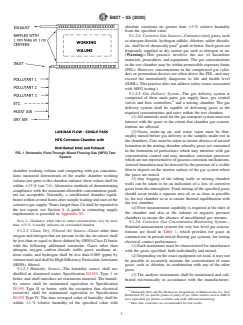
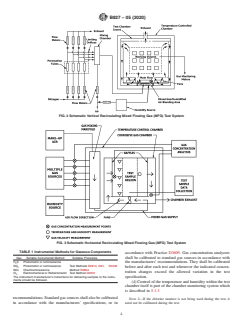
susceptibility of other connector materials such as plastic in Figs. 1-3. They are not to be considered exclusive examples.
housings to degradation from the test corrosive gases.
5.1.2 Gas Supply System:
5.1.2.1 Description and Requirements—The gas supply sys-
4.10 The MFG tests are not normally used as porosity tests.
tem consists of five main parts: a source of clean, dry, filtered
For a guide to porosity testing, see Guide B765.
air; a humidity source; corrosive gas source(s); gas delivery
4.11 The MFG tests are generally not applicable where the
system; and corrosive gas concentration monitoring system(s).
failure mechanism is other than pollutant gas corrosion such as
Total supply capacity must be such as to meet requirements for
in tin-coated separable contacts.
control of gas concentrations. The minimum number of volume
changes is determined by the requirement that the concentra-
tion of corrosive gases be maintained within 615 % between
gas inlet and outlet. This is verified by measurement of the gas
The boldface numbers in parentheses refer to the list of references at the end of
this standard. concentrations near the gas inlet upstream of the usable
B827 − 05 (2020)
absolute variations no greater than 63 % relative humidity
from the specified value.
5.1.2.4 Corrosive Gas Sources—Corrosive (test) gases, such
as nitrogen dioxide, hydrogen sulfide, chlorine, sulfur dioxide,
etc. shall be of chemically pure grade or better. Such gases are
frequently supplied in dry carrier gas such as nitrogen or air.
(Warning—This practice involves the use of hazardous
materials, procedures, and equipment. The gas concentrations
in the test chamber may be within permissible exposure limits
(PEL). However, concentrations in the compressed gas cylin-
ders or permeation devices are often above the PEL, and may
exceed the immediately dangerous to life and health level
(IDHL). This practice does not address safety issues associated
with MFG testing.)
5.1.2.5 Gas Delivery System—The gas delivery system is
comprised of three main parts: gas supply lines, gas control
valves and flow controllers, and a mixing chamber. The gas
delivery system shall be capable of delivering gases at the
required concentrations and rates within the test chamber.
(1) All materials used for the gas transport system must not
interact with the gases to the extent that chamber gas concen-
trations are affected.
(2) Gases, make-up air, and water vapor must be thor-
oughly mixed before gas delivery to the samples under test in
the chambers. Care must be taken to ensure absence of aerosol
formation in the mixing chamber whereby gases are consumed
in the formation of particulates which may interfere with gas
FIG. 1 Schematic Flow-Through Mixed Flowing Gas (MFG) Test
concentration control and may introduce corrosion processes
System
which are not representative of gaseous corrosion mechanisms.
Aerosol formation may be detected by the presence of a visible
film or deposit on the interior surface of the gas system where
chamber working volume and comparing with gas concentra-
the gases are mixed.
tions measured downstream of the usable chamber working
(3) Any fogging of the tubing walls or mixing chamber
volume just prior to the chamber exhaust; these values shall be
walls can be taken to be an indication of a loss of corrosive
within 615 % (see 7.6). Alternative methods of demonstrating
gases from the atmosphere. Final mixing of the specified gases
compliance with the maximum allowable concentration gradi-
should occur inside a separate area of, or as close as possible
ent are acceptable. Normally, a conditioned chamber equili-
to, the test chamber so as to ensure thermal equilibration with
brates within several hours after sample loading and start of the
the test chamber.
corrosive gas supply. Times longer than 2 h shall be reported in
(4) Flow measurement capability is required at the inlet of
the test report; see Section 8. A guide to estimating supply
the chamber and also at the exhaust of negative pressure
requirements is provided in Appendix X1.
chambers to ensure the absence of uncalibrated gas streams.
NOTE 1—Guidance: when inlet to outlet concentrations vary by more
5.1.2.6 Corrosive Gas Concentration Monitoring System—
than 615 %, it usually indicates an overloaded chamber.
Standard measurement systems for very low level gas concen-
5.1.2.2 Clean, Dry, Filtered Air Source—Gases other than
trations are listed in Table 1, which provides for gases in
oxygen and nitrogen that are present in the dry air source shall
common use in present mixed flowing gas systems, for testing
be less than or equal to those defined by OHSA Class D limits
electrical contact performance.
with the following additional constraint. Gases other than
(1) Each instrument must be characterized for interference
nitrogen, oxygen, carbon dioxide, noble gases, methane, ni-
with the gases specified, both individually and mixed.
trous oxide, and hydrogen shall be less than 0.005 (ppm) by
(2) Depending on the exact equipment set used, it may not
volume total and shall be High Efficiency Particulate Arrestants
be possible to accurately measure the concentration of some
(HEPA) filtered.
gases, such as chlorine, in combination with any of the other
5.1.2.3 Humidity Source—The humidity source shall use
gases.
distilled or deionized water, Specification D1193, Type 1 or
(3) The analytic instruments shall be maintained and cali-
better, and shall introduce no extraneous material. The humid-
brated electronically in accordance with the manufacturers’
ity source shall be maintained equivalent to Specification
D1193 Type II or better, with the exception that electrical
Chemically Pure and Pre-Purified are designations of Matheson Gas Co., East
resistivity shall be maintained equivalent to Specification
Rutherford, NJ, for specific grades of purity of gas. Other vendors such as AIRCO
D1193 Type IV. The time averaged value of humidity shall be
have equivalent gas purities available sold under different terminology.
within 61 % relative humidity of the specified value with Mass flow controllers are recommended for best results.
B827 − 05 (2020)
FIG. 2 Schematic Vertical Recirculating Mixed Flowing Gas (MFG) Test System
FIG. 3 Schematic Horizontal Recirculating Mixed Flowing Gas (MFG) Test System
TABLE 1 Instrumental Methods for Gaseous Components
accordance with Practice D3609. Gas concentration analyzers
Gas Suitable Instrumental Method Suitable Procedure shall be calibrated to standard gas sources in accordance with
H S Photometric or luminescence the manufacturers’ recommendations. They shall be calibrated
SO Photometric or luminescence Test Methods D2914, G91, D3449
before and after each test and whenever the indicated concen-
NO Chemiluminescence Method D3824
tration changes exceed the allowed variation in the test
Cl Electrochemical or Reflectometric Test Method D2912
The instrument manufacturer’s instructions for delivering samples to the instru-
specification.
ments should be followed.
(4) Control of the temperature and humidity within the test
chamber itself is part of the chamber monitoring system which
is described in 5.1.3
recommendations. Standard gas sources shall also be calibrated
NOTE 2—If the chlorine monitor is not being used during the test, it
in accordance with the manufacturers’ specifications, or in need not be calibrated during the test.
B827 − 05 (2020)
5.1.3 Chamber Monitoring System—Chamber monitoring amount of more than 5 % of any specified corrosive test
systems are required to ensure test reproducibility from one test atmosphere constituent.
run to the next. Calibration of monitoring instruments is
6.1.3 Clean Filtered Air—Clean filtered air as required for
required periodically because the corrosive effects of mixed
makeup to support the necessary exchange rate, in accordance
gas environments can affect instrument sensitivity and accu-
with 7.6.7.1 (2) is specified in 5.1.2.2.
racy. The chamber monitoring system must address four test
6.1.4 Corrosive Gases—Corrosive gases shall be chemically
parameters: temperature, humidity, gas concentrations, and
pure grade or equivalent.
corrosivity.
6.1.5 Corrosivity Monitor Materials (CMM)—CMM are
5.1.3.1 Temperature Monitoring—Temperature monitoring
comprised of the coupons that are exposed to the test atmo-
is usually a simple thermocouple or other temperature mea-
sphere for mass gain or coulometric reduction in accordance
surement device capable of the required resolution of 0.2°C
with Test Methods B810 and B825, respectively, the coated
and accuracy of 60.5°C within the temperature range required
quartz crystals used for microbalance measurements in accor-
by the test specification. For test temperatures above 40°C, see
dance with Test Method B808, resistance monitor materials in
7.6.5.
accordance with Test Method B826, or other coupons for
5.1.3.2 Humidity Monitoring—Humidity must be deter-
analytical techniques described in Appendix X2.3.
mined by an apparatus with a resolution of 0.5 % relative
humidity and an accuracy of 61 % relative humidity. Test
7. Procedure
Method D4230 describes a dew point method which meets this
requirement. For test temperatures above 40°C, see 7.6.5.
7.1 The following procedure is comprised of requirements
5.1.3.3 Corrosive Gas Monitoring—Chamber corrosive gas
and other comments provided as a general guide to achieving
concentration monitoring must be accomplished by provision
reproducible results with MFG testing. This procedure is
of sampling lines from the test chamber to the gas concentra-
compatible with most test facilities; however, differences in
tion analyzers. These sampling lines must be maintained above
apparatus, test conditions, or local safety requirements may
the chamber dew point temperature. The interior of the gas
necessitate alternative procedures. Any deviations shall be
concentration analyzers shall also be maintained above the
reported with all test results (see Section 8).
chamber dew point temperature. For test temperatures above
40°C, see 7.6.5.
7.2 The procedure is comprised of the following major
5.1.3.4 Chamber Corrosivity Monitoring—Chamber corro- activities: test chamber calibration, sample preparation, test
sivity monitoring can be accomplished by a number of comple-
chamber set-up, test chamber start-up, test chamber operation
mentary techniques, none of which provide both a comprehen- during test duration, test chamber shut-down, and reporting
sive analysis of the corrosion process and an instantaneous
requirements.
indication of the corrosion rate. Five acceptable techniques are
7.3 Test Chamber Calibration—The spatial uniformity of
as follows: metal coupon corrosion mass gain, corrosion film
the corrosivity of test chambers larger than 0.5 m on a side
analysis by coulometric reduction, corrosion film analysis by
shall be measured in accordance with Test Method B810,
electron or X-ray beam analysis, quartz crystal microbalance
which describes the required placement scheme for calibration
mass gain, and electrical resistance measurement of corroding
samples which are used to determine corrosion rate uniformity
metal conductors. The first three provide information subse-
over the entire chamber volume. For chambers smaller than 0.5
quent to the test whereas the last two can be used in situ in the
m on a side or chambers of unusual geometry, use sufficient
test chamber to provide information during the test itself. See
samples for corrosivity characterization so as to clearly delin-
Appendix X2 for a discussion of these methods. It is recom-
eate the usable chamber working volume as defined in this
mended that the test requester specify chamber corrosivity
paragraph. This profiling shall be done when the chamber is
monitoring methods to be used.
initially built and after any structural change to the chamber
5.1.4 Chamber Operating System—The chamber operating
that may affect the flow of test gas over the test samples. Test
system is comprised of equipment and software necessary to
Method B810 describes a procedure using mass gain. Alterna-
adequately control all of the variables of the test. This will
tive means to characterize corrosion rates such as Test Method
include data logging and alert procedures for operation outside
of desired bounds. Some form of computer control is highly B825, Coulometric Reduction, or Test Method B808, Quartz
Crystal Microbalance, in accordance with 5.1.3.4 are also
recommended to assure satisfactory operation during unat-
tended periods and for data tracking for failure analysis in case acceptable. A minimum of three corrosivity monitors of a given
the test is disrupted. type must be used, if possible, in each chamber location. The
average corrosivity for that location must be within 15 % of the
6. Reagents and Materials average for the entire chamber. When a single monitor has to
be used at a location, due to chamber size limitations or
6.1 Materials required to conduct flowing mixed gas tests
monitor geometry, the average corrosivity for that location
are as follows:
must be based upon three consecutive calibration runs. These
6.1.1 Purity of Water—Water for humidity generation shall
requirements define the usable chamber working space.
be equivalent to Type 1 or better of Specification D1193.
6.1.2 Carrier Gas—Carrier gas such as nitrogen shall not
NOTE 3—Profiling does not remove
...