


ASTM D790-17
(Test Method)Standard Test Methods for Flexural Properties of Unreinforced and Reinforced Plastics and Electrical Insulating Materials
Standard Test Methods for Flexural Properties of Unreinforced and Reinforced Plastics and Electrical Insulating Materials
SIGNIFICANCE AND USE
5.1 Flexural properties as determined by this test method are especially useful for quality control and specification purposes. They include:
5.1.1 Flexural Stress (σf)—When a homogeneous elastic material is tested in flexure as a simple beam supported at two points and loaded at the midpoint, the maximum stress in the outer surface of the test specimen occurs at the midpoint. Flexural stress is calculated for any point on the load-deflection curve using equation (Eq 3) in Section 12 (see Notes 5 and 6).
Note 5: Eq 3 applies strictly to materials for which stress is linearly proportional to strain up to the point of rupture and for which the strains are small. Since this is not always the case, a slight error will be introduced if Eq 3 is used to calculate stress for materials that are not true Hookean materials. The equation is valid for obtaining comparison data and for specification purposes, but only up to a maximum fiber strain of 5 % in the outer surface of the test specimen for specimens tested by the procedures described herein.
Note 6: When testing highly orthotropic laminates, the maximum stress may not always occur in the outer surface of the test specimen.4 Laminated beam theory must be applied to determine the maximum tensile stress at failure. If Eq 3 is used to calculate stress, it will yield an apparent strength based on homogeneous beam theory. This apparent strength is highly dependent on the ply-stacking sequence of highly orthotropic laminates.
5.1.2 Flexural Stress for Beams Tested at Large Support Spans (σf)—If support span-to-depth ratios greater than 16 to 1 are used such that deflections in excess of 10 % of the support span occur, the stress in the outer surface of the specimen for a simple beam is reasonably approximated using equation (Eq 4) in 12.3 (see Note 7).
Note 7: When large support span-to-depth ratios are used, significant end forces are developed at the support noses which will affect the moment in a simple supported...
SCOPE
1.1 These test methods are used to determine the flexural properties of unreinforced and reinforced plastics, including high modulus composites and electrical insulating materials utilizing a three-point loading system to apply a load to a simply supported beam (specimen). The method is generally applicable to both rigid and semi-rigid materials, but flexural strength cannot be determined for those materials that do not break or yield in the outer surface of the test specimen within the 5.0 % strain limit.
1.2 Test specimens of rectangular cross section are injection molded or, cut from molded or extruded sheets or plates, or cut from molded or extruded shapes. Specimens must be solid and uniformly rectangular. The specimen rests on two supports and is loaded by means of a loading nose midway between the supports.
1.3 Measure deflection in one of two ways; using crosshead position or a deflectometer. Please note that studies have shown that deflection data obtained with a deflectometer will differ from data obtained using crosshead position. The method of deflection measurement shall be reported.
Note 1: Requirements for quality control in production environments are usually met by measuring deflection using crosshead position. However, more accurate measurement may be obtained by using an deflection indicator such as a deflectometer.
Note 2: Materials that do not rupture by the maximum strain allowed under this test method may be more suited to a 4-point bend test. The basic difference between the two test methods is in the location of the maximum bending moment and maximum axial fiber stresses. The maximum axial fiber stresses occur on a line under the loading nose in 3-point bending and over the area between the loading noses in 4-point bending. A four-point loading system method can be found in Test Method D6272.
1.4 The values stated in SI units are to be regarded as the standard. The values provided i...
General Information
- Status
- Published
- Publication Date
- 30-Jun-2017
- Technical Committee
- D20 - Plastics
- Drafting Committee
- D20.10 - Mechanical Properties
Relations
- Effective Date
- 01-Jul-2017
- Effective Date
- 01-Feb-2024
- Effective Date
- 01-Feb-2024
- Effective Date
- 01-Nov-2023
- Effective Date
- 01-Jan-2020
- Effective Date
- 01-Aug-2019
- Effective Date
- 15-Apr-2019
- Effective Date
- 01-Feb-2019
- Effective Date
- 01-Dec-2018
- Effective Date
- 01-Nov-2018
- Effective Date
- 15-Aug-2017
- Effective Date
- 01-Mar-2017
- Effective Date
- 01-Mar-2017
- Effective Date
- 01-Jun-2014
- Effective Date
- 01-Mar-2014
Overview
ASTM D790-17 - Standard Test Methods for Flexural Properties of Unreinforced and Reinforced Plastics and Electrical Insulating Materials establishes widely adopted procedures for measuring the flexural strength, modulus, and related mechanical properties of plastics and electrical insulating materials. Developed by ASTM International, this standard describes two main three-point bending methods suitable for both rigid and semi-rigid materials, including high modulus composites. It is a primary reference for quality control, product specification, and comparative analysis of unreinforced and reinforced plastics in a diverse range of industries.
Key Topics
Three-point Bending Test: The core of ASTM D790-17, this method applies a force at the midpoint of a plastic or composite specimen supported at two points, generating a load-deflection curve to capture mechanical behavior in flexure.
Flexural Stress and Strength: Determines the maximum stress and failure point in the outer fibers of the test specimen, which is crucial for understanding the material's ability to withstand bending forces.
Flexural Modulus: Assesses the stiffness of materials by measuring the ratio of stress to strain in flexure, a key parameter for applications requiring predictable elastic response.
Specimen Preparation: Specifies that samples should be rectangular, solid, and prepared via molding or by cutting from extruded or molded sheets, ensuring repeatability and comparability.
Measurement Techniques: Allows deflection measurement using either crosshead position (suitable for quality control) or a more precise deflectometer, with reporting requirements clearly outlined.
Strain Limitations: Flexural strength is only determined for materials that yield or break within the 5% maximum fiber strain; materials not meeting this criterion may require alternate testing such as four-point bending.
Applicability: Covers unreinforced plastics, reinforced plastics, high modulus composites, and various electrical insulating materials, underlining the versatility of the method.
Applications
ASTM D790-17 is extensively used in industries where plastics and composites are critical for structural and functional components. Key applications include:
- Quality Assurance: Routine use in manufacturing to verify material consistency, lot-to-lot variability, and to ensure products meet customer or regulatory specifications.
- Material Comparison and Development: Enables the benchmarking of new formulations, additives, or reinforcements by providing standardized flexural property data.
- Design Verification: Supports engineers in selecting materials with suitable stiffness and strength for components under bending loads, such as housings, brackets, insulators, and more.
- Electrical Insulation: Assesses the mechanical suitability of plastics and composite materials used in electrical applications, ensuring long-term reliability.
- Research & Development: Facilitates advances in polymer blends and composite structures by providing reproducible mechanical evaluation methods.
Related Standards
ASTM D790-17 references and is complemented by several other international standards:
- ASTM D6272: Standard Test Method for Flexural Properties by Four-Point Bending, suitable for materials that do not yield in three-point testing.
- ASTM D618: Practice for Conditioning Plastics for Testing, ensuring consistent test environments.
- ASTM D638: Test Method for Tensile Properties of Plastics, often used together with flexural results for a comprehensive mechanical profile.
- ASTM D5947: Test Methods for Physical Dimensions of Solid Plastics Specimens, critical for specimen preparation.
- ISO 178: Plastics - Determination of Flexural Properties, similar in scope but with technical differences from ASTM D790.
- ASTM D883: Terminology relating to plastics, useful for interpreting material descriptions and test results.
Practical Value
By providing standardized procedures, ASTM D790-17 ensures measurable, repeatable, and comparable results for flexural properties across laboratories and industries. This consistency supports product development, regulatory compliance, and performance validation in sectors such as automotive, electrical, construction, and consumer goods manufacturing. Applying ASTM D790-17 helps optimize material selection, predict product performance, and minimize risk in the use of unreinforced and reinforced plastics.
Buy Documents
ASTM D790-17 - Standard Test Methods for Flexural Properties of Unreinforced and Reinforced Plastics and Electrical Insulating Materials
REDLINE ASTM D790-17 - Standard Test Methods for Flexural Properties of Unreinforced and Reinforced Plastics and Electrical Insulating Materials
Get Certified
Connect with accredited certification bodies for this standard

Intertek Testing Services NA Inc.
Intertek certification services in North America.

UL Solutions
Global safety science company with testing, inspection and certification.

ANCE
Mexican certification and testing association.
Sponsored listings
Frequently Asked Questions
ASTM D790-17 is a standard published by ASTM International. Its full title is "Standard Test Methods for Flexural Properties of Unreinforced and Reinforced Plastics and Electrical Insulating Materials". This standard covers: SIGNIFICANCE AND USE 5.1 Flexural properties as determined by this test method are especially useful for quality control and specification purposes. They include: 5.1.1 Flexural Stress (σf)—When a homogeneous elastic material is tested in flexure as a simple beam supported at two points and loaded at the midpoint, the maximum stress in the outer surface of the test specimen occurs at the midpoint. Flexural stress is calculated for any point on the load-deflection curve using equation (Eq 3) in Section 12 (see Notes 5 and 6). Note 5: Eq 3 applies strictly to materials for which stress is linearly proportional to strain up to the point of rupture and for which the strains are small. Since this is not always the case, a slight error will be introduced if Eq 3 is used to calculate stress for materials that are not true Hookean materials. The equation is valid for obtaining comparison data and for specification purposes, but only up to a maximum fiber strain of 5 % in the outer surface of the test specimen for specimens tested by the procedures described herein. Note 6: When testing highly orthotropic laminates, the maximum stress may not always occur in the outer surface of the test specimen.4 Laminated beam theory must be applied to determine the maximum tensile stress at failure. If Eq 3 is used to calculate stress, it will yield an apparent strength based on homogeneous beam theory. This apparent strength is highly dependent on the ply-stacking sequence of highly orthotropic laminates. 5.1.2 Flexural Stress for Beams Tested at Large Support Spans (σf)—If support span-to-depth ratios greater than 16 to 1 are used such that deflections in excess of 10 % of the support span occur, the stress in the outer surface of the specimen for a simple beam is reasonably approximated using equation (Eq 4) in 12.3 (see Note 7). Note 7: When large support span-to-depth ratios are used, significant end forces are developed at the support noses which will affect the moment in a simple supported... SCOPE 1.1 These test methods are used to determine the flexural properties of unreinforced and reinforced plastics, including high modulus composites and electrical insulating materials utilizing a three-point loading system to apply a load to a simply supported beam (specimen). The method is generally applicable to both rigid and semi-rigid materials, but flexural strength cannot be determined for those materials that do not break or yield in the outer surface of the test specimen within the 5.0 % strain limit. 1.2 Test specimens of rectangular cross section are injection molded or, cut from molded or extruded sheets or plates, or cut from molded or extruded shapes. Specimens must be solid and uniformly rectangular. The specimen rests on two supports and is loaded by means of a loading nose midway between the supports. 1.3 Measure deflection in one of two ways; using crosshead position or a deflectometer. Please note that studies have shown that deflection data obtained with a deflectometer will differ from data obtained using crosshead position. The method of deflection measurement shall be reported. Note 1: Requirements for quality control in production environments are usually met by measuring deflection using crosshead position. However, more accurate measurement may be obtained by using an deflection indicator such as a deflectometer. Note 2: Materials that do not rupture by the maximum strain allowed under this test method may be more suited to a 4-point bend test. The basic difference between the two test methods is in the location of the maximum bending moment and maximum axial fiber stresses. The maximum axial fiber stresses occur on a line under the loading nose in 3-point bending and over the area between the loading noses in 4-point bending. A four-point loading system method can be found in Test Method D6272. 1.4 The values stated in SI units are to be regarded as the standard. The values provided i...
SIGNIFICANCE AND USE 5.1 Flexural properties as determined by this test method are especially useful for quality control and specification purposes. They include: 5.1.1 Flexural Stress (σf)—When a homogeneous elastic material is tested in flexure as a simple beam supported at two points and loaded at the midpoint, the maximum stress in the outer surface of the test specimen occurs at the midpoint. Flexural stress is calculated for any point on the load-deflection curve using equation (Eq 3) in Section 12 (see Notes 5 and 6). Note 5: Eq 3 applies strictly to materials for which stress is linearly proportional to strain up to the point of rupture and for which the strains are small. Since this is not always the case, a slight error will be introduced if Eq 3 is used to calculate stress for materials that are not true Hookean materials. The equation is valid for obtaining comparison data and for specification purposes, but only up to a maximum fiber strain of 5 % in the outer surface of the test specimen for specimens tested by the procedures described herein. Note 6: When testing highly orthotropic laminates, the maximum stress may not always occur in the outer surface of the test specimen.4 Laminated beam theory must be applied to determine the maximum tensile stress at failure. If Eq 3 is used to calculate stress, it will yield an apparent strength based on homogeneous beam theory. This apparent strength is highly dependent on the ply-stacking sequence of highly orthotropic laminates. 5.1.2 Flexural Stress for Beams Tested at Large Support Spans (σf)—If support span-to-depth ratios greater than 16 to 1 are used such that deflections in excess of 10 % of the support span occur, the stress in the outer surface of the specimen for a simple beam is reasonably approximated using equation (Eq 4) in 12.3 (see Note 7). Note 7: When large support span-to-depth ratios are used, significant end forces are developed at the support noses which will affect the moment in a simple supported... SCOPE 1.1 These test methods are used to determine the flexural properties of unreinforced and reinforced plastics, including high modulus composites and electrical insulating materials utilizing a three-point loading system to apply a load to a simply supported beam (specimen). The method is generally applicable to both rigid and semi-rigid materials, but flexural strength cannot be determined for those materials that do not break or yield in the outer surface of the test specimen within the 5.0 % strain limit. 1.2 Test specimens of rectangular cross section are injection molded or, cut from molded or extruded sheets or plates, or cut from molded or extruded shapes. Specimens must be solid and uniformly rectangular. The specimen rests on two supports and is loaded by means of a loading nose midway between the supports. 1.3 Measure deflection in one of two ways; using crosshead position or a deflectometer. Please note that studies have shown that deflection data obtained with a deflectometer will differ from data obtained using crosshead position. The method of deflection measurement shall be reported. Note 1: Requirements for quality control in production environments are usually met by measuring deflection using crosshead position. However, more accurate measurement may be obtained by using an deflection indicator such as a deflectometer. Note 2: Materials that do not rupture by the maximum strain allowed under this test method may be more suited to a 4-point bend test. The basic difference between the two test methods is in the location of the maximum bending moment and maximum axial fiber stresses. The maximum axial fiber stresses occur on a line under the loading nose in 3-point bending and over the area between the loading noses in 4-point bending. A four-point loading system method can be found in Test Method D6272. 1.4 The values stated in SI units are to be regarded as the standard. The values provided i...
ASTM D790-17 is classified under the following ICS (International Classification for Standards) categories: 29.035.20 - Plastics and rubber insulating materials. The ICS classification helps identify the subject area and facilitates finding related standards.
ASTM D790-17 has the following relationships with other standards: It is inter standard links to ASTM D790-15e2, ASTM D883-24, ASTM D4101-24, ASTM D883-23, ASTM D883-20, ASTM D883-19c, ASTM D883-19a, ASTM D883-19, ASTM D883-18a, ASTM D883-18, ASTM D883-17, ASTM D6272-17e1, ASTM D6272-17, ASTM E4-14, ASTM D4101-14e1. Understanding these relationships helps ensure you are using the most current and applicable version of the standard.
ASTM D790-17 is available in PDF format for immediate download after purchase. The document can be added to your cart and obtained through the secure checkout process. Digital delivery ensures instant access to the complete standard document.
Standards Content (Sample)
This international standard was developed in accordance with internationally recognized principles on standardization established in the Decision on Principles for the
Development of International Standards, Guides and Recommendations issued by the World Trade Organization Technical Barriers to Trade (TBT) Committee.
Designation: D790 − 17
Standard Test Methods for
Flexural Properties of Unreinforced and Reinforced Plastics
and Electrical Insulating Materials
This standard is issued under the fixed designation D790; the number immediately following the designation indicates the year of
original adoption or, in the case of revision, the year of last revision. A number in parentheses indicates the year of last reapproval. A
superscript epsilon (´) indicates an editorial change since the last revision or reapproval.
This standard has been approved for use by agencies of the U.S. Department of Defense.
1. Scope* 1.5 The text of this standard references notes and footnotes
that provide explanatory material. These notes and footnotes
1.1 These test methods are used to determine the flexural
(excluding those in tables and figures) shall not be considered
properties of unreinforced and reinforced plastics, including
as requirements of the standard.
high modulus composites and electrical insulating materials
1.6 This standard does not purport to address all of the
utilizing a three-point loading system to apply a load to a
safety concerns, if any, associated with its use. It is the
simply supported beam (specimen). The method is generally
responsibility of the user of this standard to establish appro-
applicable to both rigid and semi-rigid materials, but flexural
priate safety and health practices and determine the applica-
strength cannot be determined for those materials that do not
bility of regulatory limitations prior to use.
break or yield in the outer surface of the test specimen within
the 5.0 % strain limit.
NOTE 3—This standard and ISO 178 address the same subject matter,
but differ in technical content.
1.2 Test specimens of rectangular cross section are injection
molded or, cut from molded or extruded sheets or plates, or cut 1.7 This international standard was developed in accor-
from molded or extruded shapes. Specimens must be solid and dance with internationally recognized principles on standard-
uniformly rectangular.The specimen rests on two supports and ization established in the Decision on Principles for the
is loaded by means of a loading nose midway between the Development of International Standards, Guides and Recom-
supports. mendations issued by the World Trade Organization Technical
Barriers to Trade (TBT) Committee.
1.3 Measure deflection in one of two ways; using crosshead
positionoradeflectometer.Pleasenotethatstudieshaveshown
2. Referenced Documents
that deflection data obtained with a deflectometer will differ
from data obtained using crosshead position. The method of 2.1 ASTM Standards:
deflection measurement shall be reported. D618 Practice for Conditioning Plastics for Testing
D638 Test Method for Tensile Properties of Plastics
NOTE 1—Requirements for quality control in production environments
D883 Terminology Relating to Plastics
are usually met by measuring deflection using crosshead position.
D4000 Classification System for Specifying Plastic Materi-
However, more accurate measurement may be obtained by using an
deflection indicator such as a deflectometer.
als
NOTE 2—Materials that do not rupture by the maximum strain allowed
D4101 Specification for Polypropylene Injection and Extru-
underthistestmethodmaybemoresuitedtoa4-pointbendtest.Thebasic
sion Materials
differencebetweenthetwotestmethodsisinthelocationofthemaximum
D5947 Test Methods for Physical Dimensions of Solid
bending moment and maximum axial fiber stresses. The maximum axial
Plastics Specimens
fiberstressesoccuronalineundertheloadingnosein3-pointbendingand
over the area between the loading noses in 4-point bending. A four-point
D6272 Test Method for Flexural Properties of Unreinforced
loading system method can be found in Test Method D6272.
and Reinforced Plastics and Electrical Insulating Materi-
1.4 The values stated in SI units are to be regarded as the
als by Four-Point Bending
standard. The values provided in parentheses are for informa- E4 Practices for Force Verification of Testing Machines
tion only.
E83 Practice for Verification and Classification of Exten-
someter Systems
These test methods are under the jurisdiction of ASTM Committee D20 on
Plastics and are the direct responsibility of Subcommittee D20.10 on Mechanical
Properties. For referenced ASTM standards, visit the ASTM website, www.astm.org, or
Current edition approved July 1, 2017. Published July 2017. Originally approved contact ASTM Customer Service at service@astm.org. For Annual Book of ASTM
ɛ2
in 1970. Last previous edition approved in 2015 as D790 – 15 . DOI: 10.1520/ Standards volume information, refer to the standard’s Document Summary page on
D0790-17. the ASTM website.
*A Summary of Changes section appears at the end of this standard
Copyright © ASTM International, 100 Barr Harbor Drive, PO Box C700, West Conshohocken, PA 19428-2959. United States
D790 − 17
proportional to strain up to the point of rupture and for which the strains
E691 Practice for Conducting an Interlaboratory Study to
are small. Since this is not always the case, a slight error will be
Determine the Precision of a Test Method
introduced if Eq 3 is used to calculate stress for materials that are not true
E2309 Practices for Verification of Displacement Measuring
Hookean materials. The equation is valid for obtaining comparison data
Systems and Devices Used in Material Testing Machines
and for specification purposes, but only up to a maximum fiber strain of
2.2 ISO Standard: 5 % in the outer surface of the test specimen for specimens tested by the
procedures described herein.
ISO 178 Plastics—Determination of Flexural Properties
NOTE 6—When testing highly orthotropic laminates, the maximum
stress may not always occur in the outer surface of the test specimen.
3. Terminology
Laminated beam theory must be applied to determine the maximum
3.1 Definitions—Definitions of terms applying to these test
tensile stress at failure. If Eq 3 is used to calculate stress, it will yield an
methods appear in Terminology D883 and Annex A2 of Test apparent strength based on homogeneous beam theory. This apparent
strength is highly dependent on the ply-stacking sequence of highly
Method D638.
orthotropic laminates.
4. Summary of Test Method
5.1.2 Flexural Stress for Beams Tested at Large Support
Spans (σ)—If support span-to-depth ratios greater than 16 to 1
4.1 Atestspecimenofrectangularcrosssectionrestsontwo
f
supports in a flat-wise position and is loaded by means of a are used such that deflections in excess of 10 % of the support
span occur, the stress in the outer surface of the specimen for
loading nose located midway between the supports. Unless
testing certain laminated materials (see 7 for guidance), a a simple beam is reasonably approximated using equation (Eq
4)in 12.3 (see Note 7).
support span-to-depth (of specimen) ratio 16:1 shall be used.
The specimen is deflected until rupture occurs in the outer
NOTE 7—When large support span-to-depth ratios are used, significant
surface of the test specimen or until a maximum strain (see
end forces are developed at the support noses which will affect the
5.1.6) of 5.0 % is reached, whichever occurs first.
moment in a simple supported beam. Eq 4 includes additional terms that
are an approximate correction factor for the influence of these end forces
4.2 Procedure A is designed principally for materials that
in large support span-to-depth ratio beams where relatively large deflec-
breakatcomparativelysmalldeflectionsanditshallbeusedfor
tions exist.
measurement of flexural properties, particularly flexural
5.1.3 Flexural Strength (σ )—Maximum flexural stress
fM
modulus, unless the material specification states otherwise.
sustained by the test specimen (see Note 6) during a bending
Procedure A employs a strain rate of 0.01 mm/mm/min (0.01
test. It is calculated according to Eq 3 or Eq 4. Some materials
in./in./min) and is the preferred procedure for this test method.
that do not break at strains of up to 5 % give a load deflection
4.3 Procedure B is designed principally for those materials
curve that shows a point at which the load does not increase
that do not break or yield in the outer surface of the test
with an increase in strain, that is, a yield point (Fig. 1, Curve
specimen within the 5.0 % strain limit when Procedure A
b), Y. The flexural strength is calculated for these materials by
conditions are used. Procedure B employs a strain rate of 0.10
letting P (in Eq 3 or Eq 4) equal this point, Y.
mm/mm/min (0.10 in./in./min).
5.1.4 Flexural Offset Yield Strength—Offset yield strength is
4.4 Type I tests utilize crosshead position for deflection
the stress at which the stress-strain curve deviates by a given
measurement.
strain(offset)fromthetangenttotheinitialstraightlineportion
of the stress-strain curve. The value of the offset must be given
4.5 Type II tests utilize an instrument (deflectometer) for
whenever this property is calculated.
deflection measurement.
4.6 The procedure used and test type shall be reported NOTE 8—Flexural Offset Yield Strength may differ from flexural
strength defined in 5.1.3. Both methods of calculation are described in the
NOTE 4—Comparative tests may be run in accordance with either
annex to Test Method D638.
procedure, provided that the procedure is found satisfactory for the
material being tested. Tangent modulus data obtained by Procedure A
5.1.5 Flexural Stress at Break (σ )—Flexuralstressatbreak
fB
tends to exhibit lower standard deviations than comparable results
of the test specimen during a bending test. It is calculated
obtained by means of Procedure B.
according to Eq 3 or Eq 4. Some materials give a load
5. Significance and Use
deflection curve that shows a break point, B, without a yield
point(Fig.1,Curvea)inwhichcase σ = σ .Othermaterials
5.1 Flexuralpropertiesasdeterminedbythistestmethodare
fB fM
give a yield deflection curve with both a yield and a break
especially useful for quality control and specification purposes.
point, B (Fig. 1, Curve b). The flexural stress at break is
They include:
calculated for these materials by letting P (in Eq 3 or Eq 4)
5.1.1 Flexural Stress (σ)—When a homogeneous elastic
f
equal this point, B.
material is tested in flexure as a simple beam supported at two
5.1.6 Stress at a Given Strain—The stress in the outer
points and loaded at the midpoint, the maximum stress in the
outer surface of the test specimen occurs at the midpoint. surface of a test specimen at a given strain is calculated in
accordance with Eq 3 or Eq 4 by letting P equal the load read
Flexuralstressiscalculatedforanypointontheload-deflection
curve using equation (Eq 3) in Section 12 (see Notes 5 and 6).
NOTE 5—Eq 3 applies strictly to materials for which stress is linearly
For a discussion of these effects, see Zweben, C., Smith, W. S., and Wardle, M.
W., “Test Methods for Fiber Tensile Strength, Composite Flexural Modulus and
Available fromAmerican National Standards Institute (ANSI), 25 W. 43rd St., Properties of Fabric-Reinforced Laminates,” Composite Materials: Testing and
4th Floor, New York, NY 10036, http://www.ansi.org. Design (Fifth Conference), ASTM STP 674, 1979, pp. 228–262.
D790 − 17
or by customer contract. It is calculated in accordance with Eq
6 by letting m equal the slope of the secant to the load-
deflection curve. The chosen stress or strain point used for the
determination of the secant shall be reported.
5.1.8.3 Chord Modulus (E)—The chord modulus is calcu-
f
latedfromtwodiscretepointsontheloaddeflectioncurve.The
selected points are to be chosen at two pre-specified stress or
strain points in accordance with the appropriate material
specification or by customer contract. The chosen stress or
strain points used for the determination of the chord modulus
shall be reported. Calculate the chord modulus, E using Eq 7
f
in 12.5.2.
5.2 Experience has shown that flexural properties vary with
specimen depth, temperature, atmospheric conditions, and
strain rate as specified in Procedures A and B.
5.3 Before proceeding with these test methods, refer to the
ASTM specification of the material being tested. Any test
specimen preparation, conditioning, dimensions, or testing
parameters, or combination thereof, covered in the ASTM
material specification shall take precedence over those men-
tioned in these test methods. Table 1 in Classification System
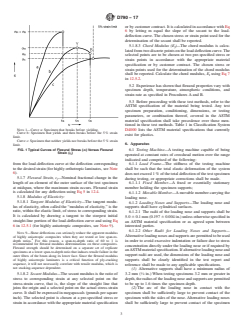
NOTE 1—Curve a: Specimen that breaks before yielding.
D4000 lists the ASTM material specifications that currently
Curve b: Specimen that yields and then breaks before the 5 % strain
exist for plastics.
limit.
Curve c: Specimen that neither yields nor breaks before the 5 % strain
6. Apparatus
limit.
FIG. 1 Typical Curves of Flexural Stress (σ ) Versus Flexural
f 6.1 Testing Machine—A testing machine capable of being
Strain (ε )
f
operated at constant rates of crosshead motion over the range
indicated and comprised of the following:
from the load-deflection curve at the deflection corresponding
6.1.1 Load Frame—The stiffness of the testing machine
to the desired strain (for highly orthotropic laminates, see Note
shall be such that the total elastic deformation of the system
6).
does not exceed 1 % of the total deflection of the test specimen
5.1.7 Flexural Strain, ɛ—Nominal fractional change in the
f during testing, or appropriate corrections shall be made.
length of an element of the outer surface of the test specimen
6.1.1.1 Fixed Member—A fixed or essentially stationary
at midspan, where the maximum strain occurs. Flexural strain
member holding the specimen supports;
is calculated for any deflection using Eq 5 in 12.4.
6.1.1.2 Movable Member—Amovable member carrying the
5.1.8 Modulus of Elasticity:
loading nose.
5.1.8.1 Tangent Modulus of Elasticity—The tangent modu-
6.1.2 Loading Noses and Supports—The loading nose and
lus of elasticity, often called the “modulus of elasticity,” is the
supports shall have cylindrical surfaces.
ratio, within the elastic limit, of stress to corresponding strain.
6.1.2.1 The radii of the loading nose and supports shall be
It is calculated by drawing a tangent to the steepest initial
5.0 60.1mm(0.197 60.004in.)unlessotherwisespecifiedin
straight-line portion of the load-deflection curve and using Eq
an ASTM material specification or as agreed upon between
6 in 12.5.1 (for highly anisotropic composites, see Note 9).
interested parties.
6.1.2.2 Other Radii for Loading Noses and Supports—
NOTE 9—Shear deflections can seriously reduce the apparent modulus
Alternativeloadingnosesandsupportsarepermittedtobeused
of highly anisotropic composites when they are tested at low span-to-
depth ratios. For this reason, a span-to-depth ratio of 60 to 1 is
in order to avoid excessive indentation or failure due to stress
recommended for flexural modulus determinations on these composites.
concentration directly under the loading nose or if required by
Flexural strength should be determined on a separate set of replicate
anASTMmaterialspecification.Ifalternativeloadingnoseand
specimens at a lower span-to-depth ratio that induces tensile failure in the
support radii are used, the dimensions of the loading nose and
outer fibers of the beam along its lower face. Since the flexural modulus
supports shall be clearly identified in the test report and
of highly anisotropic laminates is a critical function of ply-stacking
sequence, it will not necessarily correlate with tensile modulus, which is
reference shall be made to any applicable specifications.
not stacking-sequence dependent.
(1) Alternative supports shall have a minimum radius of
5.1.8.2 Secant Modulus—The secant modulus is the ratio of 3.2 mm ( ⁄8 in.) When testing specimens 3.2 mm or greater in
stress to corresponding strain at any selected point on the depth,theradiusoftheloadingnoseandsupportsarepermitted
stress-strain curve, that is, the slope of the straight line that to be up to 1.6 times the specimen depth.
joins the origin and a selected point on the actual stress-strain (2) The arc of the loading nose in contact with the
curve. It shall be expressed in megapascals (pounds per square specimen shall be sufficiently large to prevent contact of the
inch). The selected point is chosen at a pre-specified stress or specimen with the sides of the nose.Alternative loading noses
strain in accordance with the appropriate material specification shall be sufficiently large to prevent contact of the specimen
D790 − 17
with the sides of the nose. The maximum radius of the loading opposite sides flat and parallel (60.2 mm) and adjacent sides
nose shall be no more than four times the specimen depth. perpendicular along the full length of the specimen.
6.1.3 Drive Mechanism—A drive mechanism for imparting
7.2 Whenever possible, the original surface of the sheet
to the movable member a uniform, controlled velocity with
shall be unaltered. However, where testing machine limitations
respect to the stationary member, with this velocity to be
make it impossible to follow the above criterion on the
regulated as specified in Procedure A or B.
unaltered sheet, one or both surfaces shall be machined to
6.1.4 Load Indicator—A suitable load-indicating mecha-
provide the desired dimensions, and the location of the
nism capable of showing the total load applied to specimen
specimens with reference to the total depth shall be noted.
when in position on the flex fixture. This mechanism shall be
Consequently, any specifications for flexural properties on
essentially free of inertia lag at the specified rate of testing and
thicker sheets must state whether the original surfaces are to be
shall indicate the load with an accuracy of 61%ofthe
retained or not. When only one surface was machined, it must
indicated value, or better. The accuracy of the testing machine
be stated whether the machined surface was on the tension or
shall be verified in accordance with Practices E4.
compression side of the beam. Any necessary polishing of
6.1.5 Deflection Measuring Device—Thedeflectionmeasur-
specimens shall be done only in the lengthwise direction of the
ing device used shall be selected from the following two
specimen.
choices:
NOTE 13—The value obtained on specimens with machined surfaces
6.1.5.1 Type I—Crosshead Position Indicating System—A
may differ from those obtained on specimens with original surfaces.
suitable deflection indicating mechanism capable of showing
theamountofchangeincrossheadmovement.Thismechanism 7.3 Sheet Materials (Except Laminated Thermosetting Ma-
shall be essentially free of inertial lag at the specified rate of terials and Certain Materials Used for Electrical Insulation,
testing and shall indicate the crosshead movement. The cross- Including Vulcanized Fiber and Glass Bonded Mica):
head position indicating system shall be verified in accordance 7.3.1 Materials 1.6 mm ( ⁄16 in.) or Greater in Thickness—
with Practice E2309 and minimally meet the requirements of a
Specimenwidthshallnotexceedonefourthofthesupportspan
Class B system for use in determining strain. for specimens greater than 3.2 mm ( ⁄8 in.) in depth. Specimens
3.2 mm or less in depth shall be 12.7 mm ( ⁄2 in.) in width.The
NOTE10—Machinecompliancecorrectionmaybeappliedtocorrectfor
specimen shall be long enough to allow for overhanging on
lostmotionanddeflectionintheloadframe,drivemechanism,loadsensor
and other elements in order to give a more precise measurement of the each end of at least 10 % of the support span, but in no case
deflection of the test specimen. Many manufacturer’s machines and/or
less than 6.4 mm ( ⁄4 in.) on each end. Overhang shall be
softwarepackagesperformthismachinecompliancecorrection.Appendix
sufficient to prevent the specimen from slipping through the
X1 also provides a means of determining the compliance correction.
supports. A support span of 16 6 1 times the depth of the
6.1.5.2 Type II—Deflection Indicator (Deflectometer)—A
specimen is used for these specimens.
suitable instrument for more accurately determining the deflec-
7.3.2 Materials Less than 1.6 mm ( ⁄16 in.) in Thickness—
tion of the specimen at its midpoint (beneath the loading nose). 1
Thespecimenshallbe50.8mm(2in.)longby12.7mm( ⁄2in.)
This instrument shall be essentially free of inertia at the
wide, tested flatwise on a 25.4-mm (1-in.) support span.
specified speed of testing.The deflection indicator system shall
NOTE 14—Use of the formulas for simple beams cited in these test
be verified in accordance with Practice E83 and minimally
methods for calculating results presumes that beam width is small in
meet the requirements of a Class B-2 instrument for modulus
comparison with the support span. Therefore, the formulas do not apply
and a Class C instrument for other strain measurements.
rigorously to these dimensions.
NOTE 15—Where machine sensitivity is such that specimens of these
NOTE 11—It is desirable, but not essential, that this instrument
dimensions cannot be measured, wider specimens or shorter support
automatically record this distance, or any change in it, as a function of the
spans, or both, may be used, provided the support span-to-depth ratio is at
load on the test specimen or of the elapsed time from the start of the test,
least 14 to 1. All dimensions must be stated in the report (see also Note
or both. If only the latter is obtained, it has been found useful to also
14).
record load-time data.
NOTE 12—Practice E83 is intended for extensometers. As such it
7.4 Laminated Thermosetting Materials and Sheet and
references gauge length which is not applicable to deflectometers. To
Plate Materials Used for Electrical Insulation, Including
satisfy the “fixed value” and “fixed error” requirements in Table 1 of
VulcanizedFiberandGlass-BondedMica—Forpaper-baseand
Practice E83, an effective gauge length of 50 mm can be assumed.
fabric-base grades over 25.4 mm (1 in.) in nominal thickness,
6.2 Micrometers—Apparatus for measuring the width and
the specimens shall be machined on both surfaces to a depth of
thickness of the test specimen shall comply with the require-
25.4 mm. For glass-base and nylon-base grades, specimens
ments of Test Method D5947.
over 12.7 mm (0.5 in.) in nominal depth shall be machined on
bothsurfacestoadepthof12.7mm.Thesupportspan-to-depth
7. Test Specimens
ratio shall be chosen such that failures occur in the outer fibers
7.1 Test specimens that are cut from sheets, plates, or of the specimens, due only to the bending moment. As a
molded or extruded shapes, or molded to the desired finished general rule, support span-to-specimen depth ratios of 16:1 are
dimensionsareacceptable.Theactualdimensionsusedshallbe satisfactory when the ratio of the tensile strength to shear
measured in accordance with Test Methods D5947. The depth strength is less than 8 to 1, but the support span-to-depth ratio
of the specimen shall be defined as the thickness of the must be increased for composite laminates having relatively
material. The depth shall not exceed the width (see Note 13). low shear strength in the plane of the laminate and relatively
The crosssection of the specimens shall be rectangular with high tensile strength parallel to the support span (32:1 or 40:1
D790 − 17
are recommended). When laminated materials exhibit low 10. Procedure
compressive strength perpendicular to the laminations, they
10.1 Procedure A:
shall be loaded with a large radius loading nose (up to four
10.1.1 Use an untested specimen for each measurement.
times the specimen depth to prevent premature damage to the
Measure the width and depth of the specimen to the nearest
outer fibers.
0.03 mm (0.001 in.) at the center of the support span. For
7.5 Molding Materials (Thermoplastics and Thermosets)—
specimens less than 2.54 mm (0.100 in.) in depth, measure the
The preferred specimen dimensions for molding materials is depth to the nearest 0.003 mm (0.0005 in.). These measure-
12.7 mm (0.5 in.) wide, 3.2 mm (0.125 in.) thick, and 127 mm
ments shall be made in accordance with Test Methods D5947.
(5.0 in.) long. They are tested flatwise on the support span, 10.1.2 Determinethesupportspantobeusedasdescribedin
resulting in a support span-to-depth ratio of 16:1 (tolerance
Section 7 and set the support span to within 1 % of the
61). Thicker specimens are to be avoided if they exhibit determined value.
significant sink marks or bubbles when molded.
10.1.3 For flexural fixtures that have continuously adjust-
able spans, measure the span accurately to the nearest 0.1 mm
7.6 High-Strength Reinforced Composites, Including Highly
(0.004in.)forspanslessthan63mm(2.5in.)andtothenearest
Orthotropic Laminates—The span-to-depth ratio shall be cho-
0.3 mm (0.012 in.) for spans greater than or equal to 63 mm
sen such that failure occurs in the outer fibers of the specimens
(2.5 in.). Use the actual measured span for all calculations. For
and is due only to the bending moment. As a general rule,
flexuralfixturesthathavefixedmachinedspanpositions,verify
support span-to-depth ratios of 16:1 are satisfactory when the
the span distance the same as for adjustable spans at each
ratio of the tensile strength to shear strength is less than 8 to 1,
machined position. This distance becomes the span for that
but the support span-to-depth ratio must be increased for
position and is used for calculations applicable to all subse-
composite laminates having relatively low shear strength in the
quent tests conducted at that position. See Annex A2 for
plane of the laminate and relatively high tensile strength
information on the determination of and setting of the span.
parallel to the support span (32:1 or 40:1 are recommended).
10.1.4 Calculatetherateofcrossheadmotionasfollowsand
Forsomehighlyanisotropiccomposites,sheardeformationcan
set the machine for the rate of crosshead motion as calculated
significantly influence modulus measurements, even a
...
This document is not an ASTM standard and is intended only to provide the user of an ASTM standard an indication of what changes have been made to the previous version. Because
it may not be technically possible to adequately depict all changes accurately, ASTM recommends that users consult prior editions as appropriate. In all cases only the current version
of the standard as published by ASTM is to be considered the official document.
´2
Designation: D790 − 15 D790 − 17
Standard Test Methods for
Flexural Properties of Unreinforced and Reinforced Plastics
and Electrical Insulating Materials
This standard is issued under the fixed designation D790; the number immediately following the designation indicates the year of
original adoption or, in the case of revision, the year of last revision. A number in parentheses indicates the year of last reapproval. A
superscript epsilon (´) indicates an editorial change since the last revision or reapproval.
This standard has been approved for use by agencies of the U.S. Department of Defense.
ε NOTE—Editorially corrected 4.3 in January 2016.
ε NOTE—Editorial corrections were made in February 2016.
1. Scope*
1.1 These test methods are used to determine the flexural properties of unreinforced and reinforced plastics, including high
modulus composites and electrical insulating materials utilizing a three-point loading system to apply a load to a simply supported
beam (specimen). The method is generally applicable to both rigid and semi-rigid materials, but flexural strength cannot be
determined for those materials that do not break or yield in the outer surface of the test specimen within the 5.0 % strain limit.
1.2 Test specimens of rectangular cross section are injection molded or, cut from molded or extruded sheets or plates, or cut
from molded or extruded shapes. Specimens must be solid and uniformly rectangular. The specimen rests on two supports and is
loaded by means of a loading nose midway between the supports.
1.3 Measure deflection in one of two ways; using crosshead position or a deflectometer. Please note that studies have shown
that deflection data obtained with a deflectometer will differ from data obtained using crosshead position. The method of deflection
measurement shall be reported.
NOTE 1—Requirements for quality control in production environments are usually met by measuring deflection using crosshead position. However,
more accurate measurement may be obtained by using an deflection indicator such as a deflectometer.
NOTE 2—Materials that do not rupture by the maximum strain allowed under this test method may be more suited to a 4-point bend test. The basic
difference between the two test methods is in the location of the maximum bending moment and maximum axial fiber stresses. The maximum axial fiber
stresses occur on a line under the loading nose in 3-point bending and over the area between the loading noses in 4-point bending. A four-point loading
system method can be found in Test Method D6272.
1.4 The values stated in SI units are to be regarded as the standard. The values provided in parentheses are for information only.
1.5 The text of this standard references notes and footnotes that provide explanatory material. These notes and footnotes
(excluding those in tables and figures) shall not be considered as requirements of the standard.
1.6 This standard does not purport to address all of the safety concerns, if any, associated with its use. It is the responsibility
of the user of this standard to establish appropriate safety and health practices and determine the applicability of regulatory
limitations prior to use.
NOTE 3—This standard and ISO 178 address the same subject matter, but differ in technical content.
1.7 This international standard was developed in accordance with internationally recognized principles on standardization
established in the Decision on Principles for the Development of International Standards, Guides and Recommendations issued
by the World Trade Organization Technical Barriers to Trade (TBT) Committee.
2. Referenced Documents
2.1 ASTM Standards:
D618 Practice for Conditioning Plastics for Testing
D638 Test Method for Tensile Properties of Plastics
These test methods are under the jurisdiction of ASTM Committee D20 on Plastics and are the direct responsibility of Subcommittee D20.10 on Mechanical Properties.
Current edition approved Dec. 1, 2015July 1, 2017. Published January 2016July 2017. Originally approved in 1970. Last previous edition approved in 20102015 as
ɛ2
D790 – 10.D790 – 15 . DOI: 10.1520/D0790-15E02.10.1520/D0790-17.
For referenced ASTM standards, visit the ASTM website, www.astm.org, or contact ASTM Customer Service at service@astm.org. For Annual Book of ASTM Standards
volume information, refer to the standard’s Document Summary page on the ASTM website.
*A Summary of Changes section appears at the end of this standard
Copyright © ASTM International, 100 Barr Harbor Drive, PO Box C700, West Conshohocken, PA 19428-2959. United States
D790 − 17
D883 Terminology Relating to Plastics
D4000 Classification System for Specifying Plastic Materials
D4101 Specification for Polypropylene Injection and Extrusion Materials
D5947 Test Methods for Physical Dimensions of Solid Plastics Specimens
D6272 Test Method for Flexural Properties of Unreinforced and Reinforced Plastics and Electrical Insulating Materials by
Four-Point Bending
E4 Practices for Force Verification of Testing Machines
E83 Practice for Verification and Classification of Extensometer Systems
E691 Practice for Conducting an Interlaboratory Study to Determine the Precision of a Test Method
E2309 Practices for Verification of Displacement Measuring Systems and Devices Used in Material Testing Machines
2.2 ISO Standard:
ISO 178 Plastics—Determination of Flexural Properties
3. Terminology
3.1 Definitions—Definitions of terms applying to these test methods appear in Terminology D883 and Annex A2 of Test Method
D638.
4. Summary of Test Method
4.1 A test specimen of rectangular cross section rests on two supports in a flat-wise position and is loaded by means of a loading
nose located midway between the supports. Unless testing certain laminated materials (see 7 for guidance), a support span-to-depth
(of specimen) ratio 16:1 shall be used. The specimen is deflected until rupture occurs in the outer surface of the test specimen or
until a maximum strain (see 5.1.6) of 5.0 % is reached, whichever occurs first.
4.2 Procedure A is designed principally for materials that break at comparatively small deflections and it shall be used for
measurement of flexural properties, particularly flexural modulus, unless the material specification states otherwise. Procedure A
employs a strain rate of 0.01 mm/mm/min (0.01 in./in./min) and is the preferred procedure for this test method.
4.3 Procedure B is designed principally for those materials that do not break or yield in the outer surface of the test specimen
within the 5.0 % strain limit when Procedure A conditions are used. Procedure B employs a strain rate of 0.10 mm/mm/min (0.10
in./in./min).
4.4 Type I tests utilize crosshead position for deflection measurement.
4.5 Type II tests utilize an instrument (deflectometer) for deflection measurement.
4.6 The procedure used and test type shall be reported
NOTE 4—Comparative tests may be run in accordance with either procedure, provided that the procedure is found satisfactory for the material being
tested. Tangent modulus data obtained by Procedure A tends to exhibit lower standard deviations than comparable results obtained by means of Procedure
B.
5. Significance and Use
5.1 Flexural properties as determined by this test method are especially useful for quality control and specification purposes.
They include:
5.1.1 Flexural Stress (σ )—When a homogeneous elastic material is tested in flexure as a simple beam supported at two points
f
and loaded at the midpoint, the maximum stress in the outer surface of the test specimen occurs at the midpoint. Flexural stress
is calculated for any point on the load-deflection curve using equation (Eq 3) in Section 12 (see Notes 5 and 6).
NOTE 5—Eq 3 applies strictly to materials for which stress is linearly proportional to strain up to the point of rupture and for which the strains are small.
Since this is not always the case, a slight error will be introduced if Eq 3 is used to calculate stress for materials that are not true Hookean materials.
The equation is valid for obtaining comparison data and for specification purposes, but only up to a maximum fiber strain of 5 % in the outer surface
of the test specimen for specimens tested by the procedures described herein.
NOTE 6—When testing highly orthotropic laminates, the maximum stress may not always occur in the outer surface of the test specimen. Laminated
beam theory must be applied to determine the maximum tensile stress at failure. If Eq 3 is used to calculate stress, it will yield an apparent strength based
on homogeneous beam theory. This apparent strength is highly dependent on the ply-stacking sequence of highly orthotropic laminates.
5.1.2 Flexural Stress for Beams Tested at Large Support Spans (σ )—If support span-to-depth ratios greater than 16 to 1 are used
f
such that deflections in excess of 10 % of the support span occur, the stress in the outer surface of the specimen for a simple beam
is reasonably approximated using equation (Eq 4) in 12.3 (see Note 7).
NOTE 7—When large support span-to-depth ratios are used, significant end forces are developed at the support noses which will affect the moment in
a simple supported beam. Eq 4 includes additional terms that are an approximate correction factor for the influence of these end forces in large support
Available from American National Standards Institute (ANSI), 25 W. 43rd St., 4th Floor, New York, NY 10036, http://www.ansi.org.
For a discussion of these effects, see Zweben, C., Smith, W. S., and Wardle, M. W., “Test Methods for Fiber Tensile Strength, Composite Flexural Modulus and Properties
of Fabric-Reinforced Laminates,” Composite Materials: Testing and Design (Fifth Conference), ASTM STP 674, 1979, pp. 228–262.
D790 − 17
span-to-depth ratio beams where relatively large deflections exist.
5.1.3 Flexural Strength (σ )—Maximum flexural stress sustained by the test specimen (see Note 6) during a bending test. It
fM
is calculated according to Eq 3 or Eq 4. Some materials that do not break at strains of up to 5 % give a load deflection curve that
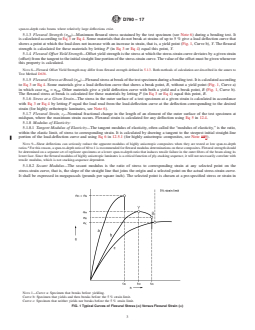
shows a point at which the load does not increase with an increase in strain, that is, a yield point (Fig. 1, Curve b), Y. The flexural
strength is calculated for these materials by letting P (in Eq 3 or Eq 4) equal this point, Y.
5.1.4 Flexural Offset Yield Strength—Offset yield strength is the stress at which the stress-strain curve deviates by a given strain
(offset) from the tangent to the initial straight line portion of the stress-strain curve. The value of the offset must be given whenever
this property is calculated.
NOTE 8—Flexural Offset Yield Strength may differ from flexural strength defined in 5.1.3. Both methods of calculation are described in the annex to
Test Method D638.
5.1.5 Flexural Stress at Break (σ )—Flexural stress at break of the test specimen during a bending test. It is calculated according
fB
to Eq 3 or Eq 4. Some materials give a load deflection curve that shows a break point, B, without a yield point (Fig. 1, Curve a)
in which case σ = σ . Other materials give a yield deflection curve with both a yield and a break point, B (Fig. 1, Curve b).
fB fM
The flexural stress at break is calculated for these materials by letting P (in Eq 3 or Eq 4) equal this point, B.
5.1.6 Stress at a Given Strain—The stress in the outer surface of a test specimen at a given strain is calculated in accordance
with Eq 3 or Eq 4 by letting P equal the load read from the load-deflection curve at the deflection corresponding to the desired
strain (for highly orthotropic laminates, see Note 6).
5.1.7 Flexural Strain, ɛ —Nominal fractional change in the length of an element of the outer surface of the test specimen at
f
midspan, where the maximum strain occurs. Flexural strain is calculated for any deflection using Eq 5 in 12.4.
5.1.8 Modulus of Elasticity:
5.1.8.1 Tangent Modulus of Elasticity—The tangent modulus of elasticity, often called the “modulus of elasticity,” is the ratio,
within the elastic limit, of stress to corresponding strain. It is calculated by drawing a tangent to the steepest initial straight-line
portion of the load-deflection curve and using Eq 6 in 12.5.1 (for highly anisotropic composites, see Note 159).
NOTE 9—Shear deflections can seriously reduce the apparent modulus of highly anisotropic composites when they are tested at low span-to-depth
ratios. For this reason, a span-to-depth ratio of 60 to 1 is recommended for flexural modulus determinations on these composites. Flexural strength should
be determined on a separate set of replicate specimens at a lower span-to-depth ratio that induces tensile failure in the outer fibers of the beam along its
lower face. Since the flexural modulus of highly anisotropic laminates is a critical function of ply-stacking sequence, it will not necessarily correlate with
tensile modulus, which is not stacking-sequence dependent.
5.1.8.2 Secant Modulus—The secant modulus is the ratio of stress to corresponding strain at any selected point on the
stress-strain curve, that is, the slope of the straight line that joins the origin and a selected point on the actual stress-strain curve.
It shall be expressed in megapascals (pounds per square inch). The selected point is chosen at a pre-specified stress or strain in
NOTE 1—Curve a: Specimen that breaks before yielding.
Curve b: Specimen that yields and then breaks before the 5 % strain limit.
Curve c: Specimen that neither yields nor breaks before the 5 % strain limit.
FIG. 1 Typical Curves of Flexural Stress (σ ) Versus Flexural Strain (ε )
f f
D790 − 17
accordance with the appropriate material specification or by customer contract. It is calculated in accordance with Eq 6 by letting
m equal the slope of the secant to the load-deflection curve. The chosen stress or strain point used for the determination of the
secant shall be reported.
5.1.8.3 Chord Modulus (E )—The chord modulus is calculated from two discrete points on the load deflection curve. The
f
selected points are to be chosen at two pre-specified stress or strain points in accordance with the appropriate material specification
or by customer contract. The chosen stress or strain points used for the determination of the chord modulus shall be reported.
Calculate the chord modulus, E using Eq 7 in 12.5.2.
f
5.2 Experience has shown that flexural properties vary with specimen depth, temperature, atmospheric conditions, and strain
rate as specified in Procedures A and B.
5.3 Before proceeding with these test methods, refer to the ASTM specification of the material being tested. Any test specimen
preparation, conditioning, dimensions, or testing parameters, or combination thereof, covered in the ASTM material specification
shall take precedence over those mentioned in these test methods. Table 1 in Classification System D4000 lists the ASTM material
specifications that currently exist for plastics.
6. Apparatus
6.1 Testing Machine—A testing machine capable of being operated at constant rates of crosshead motion over the range
indicated and comprised of the following:
6.1.1 Load Frame—The stiffness of the testing machine shall be such that the total elastic deformation of the system does not
exceed 1 % of the total deflection of the test specimen during testing, or appropriate corrections shall be made.
6.1.1.1 Fixed Member—A fixed or essentially stationary member holding the specimen supports;
6.1.1.2 Movable Member—A movable member carrying the loading nose.
6.1.2 Loading Noses and Supports—The loading nose and supports shall have cylindrical surfaces.
6.1.2.1 The radii of the loading nose and supports shall be 5.0 6 0.1 mm (0.197 6 0.004 in.) unless otherwise specified in an
ASTM material specification or as agreed upon between interested parties.
6.1.2.2 Other Radii for Loading Noses and Supports—Alternative loading noses and supports are permitted to be used in order
to avoid excessive indentation or failure due to stress concentration directly under the loading nose or if required by an ASTM
material specification. If alternative loading nose and support radii are used, the dimensions of the loading nose and supports shall
be clearly identified in the test report and reference shall be made to any applicable specifications.
(1) Alternative supports shall have a minimum radius of 3.2 mm ( ⁄8 in.) When testing specimens 3.2 mm or greater in depth,
the radius of the loading nose and supports are permitted to be up to 1.6 times the specimen depth.
(2) The arc of the loading nose in contact with the specimen shall be sufficiently large to prevent contact of the specimen with
the sides of the nose. Alternative loading noses shall be sufficiently large to prevent contact of the specimen with the sides of the
nose. The maximum radius of the loading nose shall be no more than four times the specimen depth.
6.1.3 Drive Mechanism—A drive mechanism for imparting to the movable member a uniform, controlled velocity with respect
to the stationary member, with this velocity to be regulated as specified in Procedure A or B.
6.1.4 Load Indicator—A suitable load-indicating mechanism capable of showing the total load applied to specimen when in
position on the flex fixture. This mechanism shall be essentially free of inertia lag at the specified rate of testing and shall indicate
the load with an accuracy of 61 % of the indicated value, or better. The accuracy of the testing machine shall be verified in
accordance with Practices E4.
6.1.5 Deflection Measuring Device—The deflection measuring device used shall be selected from the following two choices:
6.1.5.1 Type I—Crosshead Position Indicating System—A suitable deflection indicating mechanism capable of showing the
amount of change in crosshead movement. This mechanism shall be essentially free of inertial lag at the specified rate of testing
and shall indicate the crosshead movement. The crosshead position indicating system shall be verified in accordance with Practice
E2309 and minimally meetsmeet the requirements of a Class D system. B system for use in determining strain.
NOTE 10—Machine compliance correction may be applied to correct for lost motion and deflection in the load frame, drive mechanism, load sensor
and other elements in order to give a more precise measurement of the deflection of the test specimen. Many manufacturer’s machines and/or software
packages perform this machine compliance correction. Appendix X1 also provides a means of determining the compliance correction.
6.1.5.2 Type II—Deflection Indicator (Deflectometer)—A suitable instrument for more accurately determining the deflection of
the specimen distance between two designated points. at its midpoint (beneath the loading nose). This instrument shall be
essentially free of inertia at the specified speed of testing. The deflection indicator system shall be verified in accordance with
Practice E2309E83 and minimally meetsmeet the requirements of a Class B system.B-2 instrument for modulus and a Class C
instrument for other strain measurements.
NOTE 11—It is desirable, but not essential, that this instrument automatically record this distance, or any change in it, as a function of the load on the
test specimen or of the elapsed time from the start of the test, or both. If only the latter is obtained, it has been found useful to also record load-time data.
NOTE 12—Practice E83 is intended for extensometers. As such it references gauge length which is not applicable to deflectometers. To satisfy the “fixed
value” and “fixed error” requirements in Table 1 of Practice E83, an effective gauge length of 50 mm can be assumed.
D790 − 17
6.2 Micrometers—Apparatus for measuring the width and thickness of the test specimen shall comply with the requirements of
Test Method D5947.
7. Test Specimens
7.1 Test specimens that are cut from sheets, plates, or molded or extruded shapes, or molded to the desired finished dimensions
are acceptable. The actual dimensions used shall be measured in accordance with Test Methods D5947. The depth of the specimen
shall be defined as the thickness of the material. The depth shall not exceed the width (see Note 1113). The crosssection of the
specimens shall be rectangular with opposite sides flat and parallel (60.2 mm) and adjacent sides perpendicular along the full
length of the specimen.
7.2 Whenever possible, the original surface of the sheet shall be unaltered. However, where testing machine limitations make
it impossible to follow the above criterion on the unaltered sheet, one or both surfaces shall be machined to provide the desired
dimensions, and the location of the specimens with reference to the total depth shall be noted. Consequently, any specifications
for flexural properties on thicker sheets must state whether the original surfaces are to be retained or not. When only one surface
was machined, it must be stated whether the machined surface was on the tension or compression side of the beam. Any necessary
polishing of specimens shall be done only in the lengthwise direction of the specimen.
NOTE 13—The value obtained on specimens with machined surfaces may differ from those obtained on specimens with original surfaces.
7.3 Sheet Materials (Except Laminated Thermosetting Materials and Certain Materials Used for Electrical Insulation,
Including Vulcanized Fiber and Glass Bonded Mica):
7.3.1 Materials 1.6 mm ( ⁄16 in.) or Greater in Thickness—Specimen width shall not exceed one fourth of the support span for
1 1
specimens greater than 3.2 mm ( ⁄8 in.) in depth. Specimens 3.2 mm or less in depth shall be 12.7 mm ( ⁄2 in.) in width. The
specimen shall be long enough to allow for overhanging on each end of at least 10 % of the support span, but in no case less than
6.4 mm ( ⁄4 in.) on each end. Overhang shall be sufficient to prevent the specimen from slipping through the supports. A support
span of 16 6 1 times the depth of the specimen is used for these specimens.
1 1
7.3.2 Materials Less than 1.6 mm ( ⁄16 in.) in Thickness—The specimen shall be 50.8 mm (2 in.) long by 12.7 mm ( ⁄2 in.) wide,
tested flatwise on a 25.4-mm (1-in.) support span.
NOTE 14—Use of the formulas for simple beams cited in these test methods for calculating results presumes that beam width is small in comparison
with the support span. Therefore, the formulas do not apply rigorously to these dimensions.
NOTE 15—Where machine sensitivity is such that specimens of these dimensions cannot be measured, wider specimens or shorter support spans, or
both, may be used, provided the support span-to-depth ratio is at least 14 to 1. All dimensions must be stated in the report (see also Note 1214).
7.4 Laminated Thermosetting Materials and Sheet and Plate Materials Used for Electrical Insulation, Including Vulcanized
Fiber and Glass-Bonded Mica—For paper-base and fabric-base grades over 25.4 mm (1 in.) in nominal thickness, the specimens
shall be machined on both surfaces to a depth of 25.4 mm. For glass-base and nylon-base grades, specimens over 12.7 mm (0.5
in.) in nominal depth shall be machined on both surfaces to a depth of 12.7 mm. The support span-to-depth ratio shall be chosen
such that failures occur in the outer fibers of the specimens, due only to the bending moment. As a general rule, support
span-to-specimen depth ratios of 16:1 are satisfactory when the ratio of the tensile strength to shear strength is less than 8 to 1,
but the support span-to-depth ratio must be increased for composite laminates having relatively low shear strength in the plane of
the laminate and relatively high tensile strength parallel to the support span (32:1 or 40:1 are recommended). When laminated
materials exhibit low compressive strength perpendicular to the laminations, they shall be loaded with a large radius loading nose
(up to four times the specimen depth to prevent premature damage to the outer fibers.
7.5 Molding Materials (Thermoplastics and Thermosets)—The preferred specimen dimensions for molding materials is 12.7
mm (0.5 in.) wide, 3.2 mm (0.125 in.) thick, and 127 mm (5.0 in.) long. They are tested flatwise on the support span, resulting
in a support span-to-depth ratio of 16:1 (tolerance 61). Thicker specimens are to be avoided if they exhibit significant sink marks
or bubbles when molded.
7.6 High-Strength Reinforced Composites, Including Highly Orthotropic Laminates—The span-to-depth ratio shall be chosen
such that failure occurs in the outer fibers of the specimens and is due only to the bending moment. As a general rule, support
span-to-depth ratios of 16:1 are satisfactory when the ratio of the tensile strength to shear strength is less than 8 to 1, but the support
span-to-depth ratio must be increased for composite laminates having relatively low shear strength in the plane of the laminate and
relatively high tensile strength parallel to the support span (32:1 or 40:1 are recommended). For some highly anisotropic
composites, shear deformation can significantly influence modulus measurements, even at span-to-depth ratios as high as 40:1.
Hence, for these materials, an increase in the span-to-depth ratio to 60:1 is recommended to eliminate shear effects when modulus
data are required, it should also be noted that the flexural modulus of highly anisotropic laminates is a strong function of
ply-stacking sequence and will not necessarily correlate with tensile modulus, which is not stacking-sequence dependent.
8. Number of Test Specimens
8.1 Test at least five specimens for each sample in the case of isotropic materials or molded specimens.
D790 − 17
8.2 For each sample of anisotropic material in sheet form, test at least five specimens cut in the desired direction. For the
purposes of this test, “lengthwise” designates the principal axis of anisotropy and shall be interpreted to mean the direction of the
sheet known to be stronger in flexure. “Crosswise” indicates the sheet direction known to be the weaker in flexure and shall be
at 90° to the lengthwise direction. The direction of test, whether it be lengthwise, crosswise, or some angle relative to these shall
be noted in the report.
9. Conditioning
9.1 Conditioning—Condition the test specimens in accordance with Procedure A of Practice D618 unless otherwise specified
by contract
...
Questions, Comments and Discussion
Ask us and Technical Secretary will try to provide an answer. You can facilitate discussion about the standard in here.
Loading comments...