

ASTM D4272/D4272M-23
(Test Method)Standard Test Method for Total Energy Impact of Plastic Films by Dart Drop
General Information
- Abstract
SIGNIFICANCE AND USE
5.1 Evaluation of the impact toughness of film is important in predicting the performance of a material in applications such as packaging, construction, and other uses. The test simulates the action encountered in applications where moderate-velocity blunt impacts occur in relatively small areas of film.
5.2 The values obtained by this test method are highly dependent on the method and conditions of film fabrication as well as the type and grade of resin.
5.3 Test methods employing different missile velocities, impinging surface diameters, or effective specimen diameters will most likely produce different results. Data obtained by this test method cannot necessarily be compared directly with those obtained by other test methods.
5.4 The impact resistance of a film, while partly dependent on thickness, does not have a simple correlation with sample thickness. Hence, impact values expressed in joules [ft·lbf] normalized over a range of thickness will not necessarily be linear with thickness. Data from this test method are comparable only for specimens that vary by no more than ±15 % from the nominal or average thickness of the specimens tested.
5.5 The test results obtained by this test method are greatly influenced by the quality of film under test. The influence of variability of data obtained by this procedure will, therefore, depend strongly on the sample quality, uniformity of film thickness, the presence of die marks, contaminants, etc.
5.6 Several impact test methods are used for film. It is sometimes desirable to know the relationships among test results derived by different test methods. A study was conducted in which four films made from two resins (polypropylene and linear low-density polyethylene), with two film thicknesses for each resin, were impacted using Test Methods D1709 (Test Method A), Test Method D3420 (Procedures A and B), and Test Method D4272. The test results are shown in Appendix X2. Differences in results between Test Methods...
SCOPE
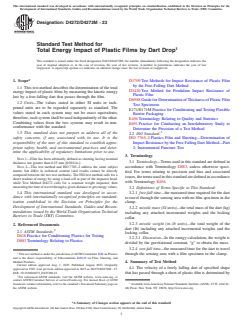
1.1 This test method describes the determination of the total energy impact of plastic films by measuring the kinetic energy lost by a free-falling dart that passes through the film.
1.2 Units—The values stated in either SI units or inch-pound units are to be regarded separately as standard. The values stated in each system may not be exact equivalents; therefore, each system shall be used independently of the other. Combining values from the two systems may result in non-conformance with the standard
1.3 This standard does not purport to address all of the safety concerns, if any, associated with its use. It is the responsibility of the user of this standard to establish appropriate safety, health, and environmental practices and determine the applicability of regulatory limitations prior to use.
Note 1: Film has been arbitrarily defined as sheeting having nominal thickness not greater than 0.25 mm [0.010 in.].
Note 2: This test method and ISO 7765–2 address the same subject matter, but differ in technical content (and results cannot be directly compared between the two test methods). The ISO test method calls for a direct readout of energy by using a load cell as part of the impactor head, while Test Method D4272 calls for a constant weight impactor, then measuring the time of travel through a given distance to get energy values.
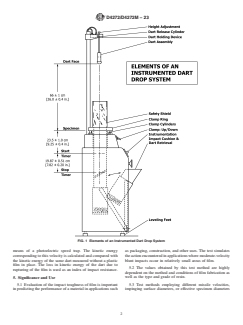
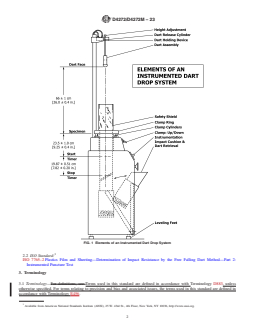
FIG. 1 Elements of an Instrumented Dart Drop System
1.4 This international standard was developed in accordance with internationally recognized principles on standardization established in the Decision on Principles for the Development of International Standards, Guides and Recommendations issued by the World Trade Organization Technical Barriers to Trade (TBT) Committee.
- Status
- Published
- Publication Date
- 31-Jul-2023
- Technical Committee
- D20 - Plastics
- Drafting Committee
- D20.19 - Film, Sheeting, and Molded Products
Buy Documents
ASTM D4272/D4272M-23 - Standard Test Method for Total Energy Impact of Plastic Films by Dart Drop
REDLINE ASTM D4272/D4272M-23 - Standard Test Method for Total Energy Impact of Plastic Films by Dart Drop
Overview
ASTM D4272/D4272M-23 is a widely recognized standard that details the test method for determining the total energy impact of plastic films using a dart drop approach. Developed by ASTM International, this method measures the kinetic energy lost by a free-falling dart as it punctures and passes through a film sample. This test is critical in analyzing the impact toughness and durability of plastic films, providing manufacturers, material specifiers, and end-users with valuable insights for quality assurance and material selection, particularly in packaging and construction applications.
Key Topics
- Purpose of the Test: The dart drop impact test simulates moderate-velocity blunt impacts on small areas of plastic film, helping predict real-world performance.
- Testing Apparatus: The method uses a specific apparatus featuring a rigid base, specimen clamping device, instrumented light-sensitive speed trap, and a precisely controlled dart and weights.
- Impact Energy Measurement: Impact resistance is determined by comparing the dart’s kinetic energy before and after passing through the film, using standardized equations in both SI and inch-pound units.
- Sample Considerations: Test results depend heavily on film fabrication, thickness, resin type and grade, and sample quality. Results from different test methods or with distinct dart velocities, impinging surface diameters, or specimen sizes may not be directly comparable.
- Precision and Reliability: Repeatability and reproducibility are addressed through rigorous procedures and reference to interlaboratory studies, ensuring valid data when specimens are prepared and conditioned consistently.
Applications
ASTM D4272/D4272M-23 is essential for industries where the mechanical integrity of plastic films under impact is critical. Typical applications include:
- Packaging Industry: Used to assess the resistance of films used in flexible packaging, ensuring product protection during shipping, handling, and storage.
- Construction Materials: Evaluates protective films or membranes subjected to mechanical impacts during installation or service life.
- Quality Control: Facilitates benchmarking for new materials or batches, supporting conformance to performance standards and customer requirements.
- Research and Development: Enables comparison of material formulations, production methods, and the effect of additives on impact properties.
Related Standards
Several standards complement or relate to ASTM D4272/D4272M-23, providing a broader context for film testing:
- ASTM D1709 - Test Methods for Impact Resistance of Plastic Film by the Free-Falling Dart Method
- ASTM D3420 - Test Method for Pendulum Impact Resistance of Plastic Film
- ASTM D6988 - Guide for Determination of Thickness of Plastic Film Test Specimens
- ISO 7765-2 - Plastics Film and Sheeting - Determination of Impact Resistance by the Free Falling Dart Method - Part 2: Instrumented Puncture Test
- ASTM D883 - Terminology Relating to Plastics
- ASTM D618 - Practice for Conditioning Plastics for Testing
Practical Value
Implementing ASTM D4272/D4272M-23 provides crucial benefits for businesses relying on plastic films:
- Ensures product reliability and safety by quantifying impact resistance
- Supports regulatory compliance by adhering to recognized international test protocols
- Enhances marketplace competitiveness through documented quality assurance
- Facilitates material optimization to reduce costs and improve performance
Overall, ASTM D4272/D4272M-23 offers a robust framework for evaluating and comparing the impact properties of plastic films, making it an indispensable part of materials testing and certification.
Relations
- Effective Date
- 01-Feb-2024
- Effective Date
- 01-Nov-2023
- Effective Date
- 01-Apr-2022
- Refers
ASTM E171/E171M-11(2020) - Standard Practice for Conditioning and Testing Flexible Barrier Packaging - Effective Date
- 01-May-2020
- Effective Date
- 01-Jan-2020
- Effective Date
- 01-Aug-2019
- Effective Date
- 15-Apr-2019
- Effective Date
- 01-Feb-2019
- Effective Date
- 01-Dec-2018
- Effective Date
- 01-Nov-2018
- Effective Date
- 01-Oct-2017
- Effective Date
- 01-Oct-2017
- Effective Date
- 15-Aug-2017
- Effective Date
- 01-May-2016
- Effective Date
- 15-Apr-2016
Buy Documents
ASTM D4272/D4272M-23 - Standard Test Method for Total Energy Impact of Plastic Films by Dart Drop
REDLINE ASTM D4272/D4272M-23 - Standard Test Method for Total Energy Impact of Plastic Films by Dart Drop
Get Certified
Connect with accredited certification bodies for this standard

DIN CERTCO
DIN Group product certification.

Smithers Quality Assessments
US management systems and product certification.
Sponsored listings
Frequently Asked Questions
ASTM D4272/D4272M-23 is a standard published by ASTM International. Its full title is "Standard Test Method for Total Energy Impact of Plastic Films by Dart Drop". This standard covers: SIGNIFICANCE AND USE 5.1 Evaluation of the impact toughness of film is important in predicting the performance of a material in applications such as packaging, construction, and other uses. The test simulates the action encountered in applications where moderate-velocity blunt impacts occur in relatively small areas of film. 5.2 The values obtained by this test method are highly dependent on the method and conditions of film fabrication as well as the type and grade of resin. 5.3 Test methods employing different missile velocities, impinging surface diameters, or effective specimen diameters will most likely produce different results. Data obtained by this test method cannot necessarily be compared directly with those obtained by other test methods. 5.4 The impact resistance of a film, while partly dependent on thickness, does not have a simple correlation with sample thickness. Hence, impact values expressed in joules [ft·lbf] normalized over a range of thickness will not necessarily be linear with thickness. Data from this test method are comparable only for specimens that vary by no more than ±15 % from the nominal or average thickness of the specimens tested. 5.5 The test results obtained by this test method are greatly influenced by the quality of film under test. The influence of variability of data obtained by this procedure will, therefore, depend strongly on the sample quality, uniformity of film thickness, the presence of die marks, contaminants, etc. 5.6 Several impact test methods are used for film. It is sometimes desirable to know the relationships among test results derived by different test methods. A study was conducted in which four films made from two resins (polypropylene and linear low-density polyethylene), with two film thicknesses for each resin, were impacted using Test Methods D1709 (Test Method A), Test Method D3420 (Procedures A and B), and Test Method D4272. The test results are shown in Appendix X2. Differences in results between Test Methods... SCOPE 1.1 This test method describes the determination of the total energy impact of plastic films by measuring the kinetic energy lost by a free-falling dart that passes through the film. 1.2 Units—The values stated in either SI units or inch-pound units are to be regarded separately as standard. The values stated in each system may not be exact equivalents; therefore, each system shall be used independently of the other. Combining values from the two systems may result in non-conformance with the standard 1.3 This standard does not purport to address all of the safety concerns, if any, associated with its use. It is the responsibility of the user of this standard to establish appropriate safety, health, and environmental practices and determine the applicability of regulatory limitations prior to use. Note 1: Film has been arbitrarily defined as sheeting having nominal thickness not greater than 0.25 mm [0.010 in.]. Note 2: This test method and ISO 7765–2 address the same subject matter, but differ in technical content (and results cannot be directly compared between the two test methods). The ISO test method calls for a direct readout of energy by using a load cell as part of the impactor head, while Test Method D4272 calls for a constant weight impactor, then measuring the time of travel through a given distance to get energy values. FIG. 1 Elements of an Instrumented Dart Drop System 1.4 This international standard was developed in accordance with internationally recognized principles on standardization established in the Decision on Principles for the Development of International Standards, Guides and Recommendations issued by the World Trade Organization Technical Barriers to Trade (TBT) Committee.
SIGNIFICANCE AND USE 5.1 Evaluation of the impact toughness of film is important in predicting the performance of a material in applications such as packaging, construction, and other uses. The test simulates the action encountered in applications where moderate-velocity blunt impacts occur in relatively small areas of film. 5.2 The values obtained by this test method are highly dependent on the method and conditions of film fabrication as well as the type and grade of resin. 5.3 Test methods employing different missile velocities, impinging surface diameters, or effective specimen diameters will most likely produce different results. Data obtained by this test method cannot necessarily be compared directly with those obtained by other test methods. 5.4 The impact resistance of a film, while partly dependent on thickness, does not have a simple correlation with sample thickness. Hence, impact values expressed in joules [ft·lbf] normalized over a range of thickness will not necessarily be linear with thickness. Data from this test method are comparable only for specimens that vary by no more than ±15 % from the nominal or average thickness of the specimens tested. 5.5 The test results obtained by this test method are greatly influenced by the quality of film under test. The influence of variability of data obtained by this procedure will, therefore, depend strongly on the sample quality, uniformity of film thickness, the presence of die marks, contaminants, etc. 5.6 Several impact test methods are used for film. It is sometimes desirable to know the relationships among test results derived by different test methods. A study was conducted in which four films made from two resins (polypropylene and linear low-density polyethylene), with two film thicknesses for each resin, were impacted using Test Methods D1709 (Test Method A), Test Method D3420 (Procedures A and B), and Test Method D4272. The test results are shown in Appendix X2. Differences in results between Test Methods... SCOPE 1.1 This test method describes the determination of the total energy impact of plastic films by measuring the kinetic energy lost by a free-falling dart that passes through the film. 1.2 Units—The values stated in either SI units or inch-pound units are to be regarded separately as standard. The values stated in each system may not be exact equivalents; therefore, each system shall be used independently of the other. Combining values from the two systems may result in non-conformance with the standard 1.3 This standard does not purport to address all of the safety concerns, if any, associated with its use. It is the responsibility of the user of this standard to establish appropriate safety, health, and environmental practices and determine the applicability of regulatory limitations prior to use. Note 1: Film has been arbitrarily defined as sheeting having nominal thickness not greater than 0.25 mm [0.010 in.]. Note 2: This test method and ISO 7765–2 address the same subject matter, but differ in technical content (and results cannot be directly compared between the two test methods). The ISO test method calls for a direct readout of energy by using a load cell as part of the impactor head, while Test Method D4272 calls for a constant weight impactor, then measuring the time of travel through a given distance to get energy values. FIG. 1 Elements of an Instrumented Dart Drop System 1.4 This international standard was developed in accordance with internationally recognized principles on standardization established in the Decision on Principles for the Development of International Standards, Guides and Recommendations issued by the World Trade Organization Technical Barriers to Trade (TBT) Committee.
ASTM D4272/D4272M-23 is classified under the following ICS (International Classification for Standards) categories: 83.140.10 - Films and sheets. The ICS classification helps identify the subject area and facilitates finding related standards.
ASTM D4272/D4272M-23 has the following relationships with other standards: It is inter standard links to ASTM D883-24, ASTM D883-23, ASTM E456-13a(2022)e1, ASTM E171/E171M-11(2020), ASTM D883-20, ASTM D883-19c, ASTM D883-19a, ASTM D883-19, ASTM D883-18a, ASTM D883-18, ASTM E456-13A(2017)e3, ASTM E456-13A(2017)e1, ASTM D883-17, ASTM D1709-16a, ASTM D1709-16. Understanding these relationships helps ensure you are using the most current and applicable version of the standard.
ASTM D4272/D4272M-23 is available in PDF format for immediate download after purchase. The document can be added to your cart and obtained through the secure checkout process. Digital delivery ensures instant access to the complete standard document.
Standards Content (Sample)
This international standard was developed in accordance with internationally recognized principles on standardization established in the Decision on Principles for the
Development of International Standards, Guides and Recommendations issued by the World Trade Organization Technical Barriers to Trade (TBT) Committee.
Designation: D4272/D4272M − 23
Standard Test Method for
Total Energy Impact of Plastic Films by Dart Drop
This standard is issued under the fixed designation D4272/D4272M; the number immediately following the designation indicates the
year of original adoption or, in the case of revision, the year of last revision. A number in parentheses indicates the year of last
reapproval. A superscript epsilon (´) indicates an editorial change since the last revision or reapproval.
1. Scope* D1709 Test Methods for Impact Resistance of Plastic Film
by the Free-Falling Dart Method
1.1 This test method describes the determination of the total
D3420 Test Method for Pendulum Impact Resistance of
energy impact of plastic films by measuring the kinetic energy
Plastic Film
lost by a free-falling dart that passes through the film.
D6988 Guide for Determination of Thickness of Plastic Film
1.2 Units—The values stated in either SI units or inch-
Test Specimens
pound units are to be regarded separately as standard. The
E171/E171M Practice for Conditioning and Testing Flexible
values stated in each system may not be exact equivalents;
Barrier Packaging
therefore, each system shall be used independently of the other.
E456 Terminology Relating to Quality and Statistics
Combining values from the two systems may result in non-
E691 Practice for Conducting an Interlaboratory Study to
conformance with the standard
Determine the Precision of a Test Method
1.3 This standard does not purport to address all of the 2.2 ISO Standard:
safety concerns, if any, associated with its use. It is the
ISO 7765–2 Plastics Film and Sheeting—Determination of
responsibility of the user of this standard to establish appro- Impact Resistance by the Free Falling Dart Method—Part
priate safety, health, and environmental practices and deter-
2: Instrumented Puncture Test
mine the applicability of regulatory limitations prior to use.
3. Terminology
NOTE 1—Film has been arbitrarily defined as sheeting having nominal
3.1 Terminology—Terms used in this standard are defined in
thickness not greater than 0.25 mm [0.010 in.].
NOTE 2—This test method and ISO 7765–2 address the same subject accordance with Terminology D883, unless otherwise speci-
matter, but differ in technical content (and results cannot be directly
fied. For terms relating to precision and bias and associated
compared between the two test methods). The ISO test method calls for a
issues, the terms used in this standard are defined in accordance
direct readout of energy by using a load cell as part of the impactor head,
with Terminology E456.
while Test Method D4272 calls for a constant weight impactor, then
measuring the time of travel through a given distance to get energy values.
3.2 Definitions of Terms Specific to This Standard:
1.4 This international standard was developed in accor- 3.2.1 free-fall time—the measured time required for the dart
dance with internationally recognized principles on standard-
to travel through the sensing area with no film specimen in the
ization established in the Decision on Principles for the clamp.
Development of International Standards, Guides and Recom-
3.2.2 missile mass (SI units)—the total mass of the dart (kg)
mendations issued by the World Trade Organization Technical
including any attached incremental weights and the locking
Barriers to Trade (TBT) Committee.
collar.
3.2.3 missile weight (in.-lb units)—the total weight of the
2. Referenced Documents
dart (lb) including any attached incremental weights and the
2.1 ASTM Standards:
locking collar.
D618 Practice for Conditioning Plastics for Testing
3.2.3.1 Discussion—In the energy calculation, the weight is
D883 Terminology Relating to Plastics
divided by the gravitational constant, “g” to obtain the mass.
3.2.4 test-fall time—the measured time for the dart to travel
through the sensing area with a film specimen in the clamp.
This test method is under the jurisdiction of ASTM Committee D20 on Plastics
and is the direct responsibility of Subcommittee D20.19 on Film, Sheeting, and
Molded Products.
4. Summary of Test Method
Current edition approved Aug. 1, 2023. Published August 2023. Originally
4.1 The velocity of a freely falling dart of specified shape
approved in 1983. Last previous edition approved in 2015 as D4272/D4272M - 15.
DOI: 10.1520/D4272_D4272M-23.
that has passed through a sheet of plastic film is determined by
For referenced ASTM standards, visit the ASTM website, www.astm.org, or
contact ASTM Customer Service at service@astm.org. For Annual Book of ASTM
Standards volume information, refer to the standard’s Document Summary page on Available from American National Standards Institute (ANSI), 25 W. 43rd St.,
the ASTM website. 4th Floor, New York, NY 10036, http://www.ansi.org.
*A Summary of Changes section appears at the end of this standard
Copyright © ASTM International, 100 Barr Harbor Drive, PO Box C700, West Conshohocken, PA 19428-2959. United States
D4272/D4272M − 23
FIG. 1 Elements of an Instrumented Dart Drop System
means of a photoelectric speed trap. The kinetic energy as packaging, construction, and other uses. The test simulates
corresponding to this velocity is calculated and compared with the action encountered in applications where moderate-velocity
the kinetic energy of the same dart measured without a plastic blunt impacts occur in relatively small areas of film.
film in place. The loss in kinetic energy of the dart due to
5.2 The values obtained by this test method are highly
rupturing of the film is used as an index of impact resistance.
dependent on the method and conditions of film fabrication as
well as the type and grade of resin.
5. Significance and Use
5.1 Evaluation of the impact toughness of film is important 5.3 Test methods employing different missile velocities,
in predicting the performance of a material in applications such impinging surface diameters, or effective specimen diameters
D4272/D4272M − 23
will most likely produce different results. Data obtained by this devices to prevent slippage of the specimen during impact. The
test method cannot necessarily be compared directly with those clamp shall hold the specimen so that the impact surface is
obtained by other test methods. exactly perpendicular to the trajectory of the dart and at the
correct distance from the tip of the dart. During impact, the
5.4 The impact resistance of a film, while partly dependent
specimen shall be held with enough force to prevent slippage
on thickness, does not have a simple correlation with sample
but not great enough to distort, fracture, or otherwise damage
thickness. Hence, impact values expressed in joules [ft·lbf]
the specimen in such a way as to affect the impact strength of
normalized over a range of thickness will not necessarily be
the film.
linear with thickness. Data from this test method are compa-
6.2.3 Light-Sensitive Speed Trap—A system comprised of
rable only for specimens that vary by no more than 615 %
photocells, lasers, or other non-mechanical devices connected
from the nominal or average thickness of the specimens tested.
to the timing device to measure the time-of-flight of the dart.
5.5 The test results obtained by this test method are greatly
The distance from the bottom surface of the specimen to the
influenced by the quality of film under test. The influence of
upper (starting) sensor shall be 23.5 6 1.0 cm [9.25 6 0.40
variability of data obtained by this procedure will, therefore,
in.]. The length of the speed trap, that is, the distance between
depend strongly on the sample quality, uniformity of film
the starting and stopping sensors shall be 19.87 6 0.51 cm
thickness, the presence of die marks, contaminants, etc.
[7.82 6 0.20 in.].
5.6 Several impact test methods are used for film. It is
6.2.4 Timing Device—An electronic timer capable of mea-
-5
sometimes desirable to know the relationships among test
suring to the nearest 10 s.
results derived by different test methods. A study was con-
6.2.5 Dart Well—The bottom of the dart well shall contain
ducted in which four films made from two resins (polypropyl-
adequate cushioning material to prevent damage to the dart
ene and linear low-density polyethylene), with two film thick-
head. If the impact machine utilizes an enclosed dart well, it
nesses for each resin, were impacted using Test Methods
must contain a single unobstructed vent with a minimum area
2 2
D1709 (Test Method A), Test Method D3420 (Procedures A
of 645 mm [~1in. ] to provide adequate venting.
and B), and Test Method D4272. The test results are shown in
NOTE 3—Some dart impact machine designs utilize enclosed dart wells
Appendix X2. Differences in results between Test Methods
that do not permit adequate venting to the atmosphere during impact. Data
D1709 and D3420 are expected since Test Methods D1709
have shown that this has a significant effect on the observed impact value,
represents failure-initiated energy, while Test Method D4272 is
especially with films that exhibit high elongation during testing, resulting
in atypically high impact values.
initiation plus completion energy. It is possible some films
NOTE 4—The use of smaller, multiple vents is permitted if it can be
show consistency when the initiation energy is the same as the
demonstrated that the venting efficiency is comparable and has no
total energy. This statement and the test data also appear in the
statistically significant effect on the values obtained.
significance and appendixes sections of Test Methods D1709
6.2.6 Dart Holding Fixture—An electromagnetic,
and D3420.
pneumatic, or mechanical system to suspend the dart in
position above the test specimen. It shall be adjustable verti-
6. Apparatus
cally and horizontally relative to the impact surface to insure
6.1 The test apparatus shall be constructed essentially as
that the dart falls from the correct height and directly onto the
shown in Fig. 1 and include the following:
center of the clamped specimen. In some equipment designs,
6.1.1 A rigid base containing a specimen clamping device, a
this fixture is an integral part of the base. When the dart is in
light sensitive speed trap, and a dart well or chamber for
position to drop, the distance between the lower tip of the dart
catching and retrieving the dart after impact.
and the upper surface of the specimen shall be 66 6 1 cm [26.0
6.1.2 A rigid fixture for holding the dart at the proper height
6 0.4 in.]. A plumb bob shall be used to precisely center the
above the film surface. In some equipment designs the dart
fixture over the specimen clamp to insure that the dart strikes
holding fixture is an integral part of the base unit.
the center of the specimen. The fixture shall release the dart
6.1.3 The dimensions of the impact apparatus shall conform
without imparting any vertical or horizontal force that might
to those shown in Fig. 1 and those listed below.
affect the trajectory of the dart.
6.2 Specific Requirements for Individual Components:
6.2.7 Dart—The impact dart shall have a single 38.10 6
6.2.1 Base—The base shall be rigid enough to prevent
0.13 mm [1.500 6 0.005 in.] diameter hemispherical stainless
movement between the specimen clamp and components of the
steel head. It shall have a mass of 227 6 5 g [0.50 6 0.01 lb]
timing system during impact. It shall be located on a flat
and a shaft of sufficient length and diameter to accommodate
surface that provides adequate support to prevent downward
any additional weights used to increase the mass of the dart.
movement of the unit during impact. It shall be leveled to
The shaft shall be attached to the center of the flat surface of
insure that the impact surface of the specimen is exactly
the dart head with its longitudinal axis perpendicular to the
perpendicular to the trajectory of the dart.
surface. The impact surface of the dart head shall be free of
6.2.2 Specimen Clamp—The apparatus shall be equipped
nicks, scratches, or other irregularities.
with a circular clamp to hold the specimen. The clamp shall be
NOTE 5—A stem diameter of 9.52 mm [0.37 in.] has been found to be
mechanically, pneumatically, or hydraulically actuated. The
satisfactory to resist bending.
diameter of the clamped area shall be 127 6 2 mm [5.0 6 0.1
NOTE 6—Data have shown a sensitivity of impact results related to the
in.]. In some equipment designs the clamping surface is
condition and finish of the dart head used. The differences have been
equipped with rubber O-rings, round gaskets or other circular especially significant when testing films exhibiting high impact, or high
D4272/D4272M − 23
elongation characteristics, or both. This issue, together with related
system, the position of the sensing
...
This document is not an ASTM standard and is intended only to provide the user of an ASTM standard an indication of what changes have been made to the previous version. Because
it may not be technically possible to adequately depict all changes accurately, ASTM recommends that users consult prior editions as appropriate. In all cases only the current version
of the standard as published by ASTM is to be considered the official document.
Designation: D4272/D4272M − 15 D4272/D4272M − 23
Standard Test Method for
Total Energy Impact of Plastic Films by Dart Drop
This standard is issued under the fixed designation D4272/D4272M; the number immediately following the designation indicates the
year of original adoption or, in the case of revision, the year of last revision. A number in parentheses indicates the year of last
reapproval. A superscript epsilon (´) indicates an editorial change since the last revision or reapproval.
1. Scope*
1.1 This test method describes the determination of the total energy impact of plastic films by measuring the kinetic energy lost
by a free-falling dart that passes through the film.
1.2 Units—The values stated in either SI units or inch-pound units are to be regarded separately as standard. The values stated in
each system may not be exact equivalents; therefore, each system shall be used independently of the other. Combining values from
the two systems may result in non-conformance with the standard
1.3 This standard does not purport to address all of the safety concerns, if any, associated with its use. It is the responsibility
of the user of this standard to establish appropriate safety and healthsafety, health, and environmental practices and determine
the applicability of regulatory limitations prior to use.
NOTE 1—Film has been arbitrarily defined as sheeting having nominal thickness not greater than 0.25 mm [0.010 in.].
NOTE 2—This test method and ISO 7765–2 address the same subject matter, but differ in technical content (and results cannot be directly compared
between the two test methods). The ISO test method calls for a direct readout of energy by using a load cell as part of the impactor head, while Test
Method D4272 calls for a constant weight impactor, then measuring the time of travel through a given distance to get energy values.
1.4 This international standard was developed in accordance with internationally recognized principles on standardization
established in the Decision on Principles for the Development of International Standards, Guides and Recommendations issued
by the World Trade Organization Technical Barriers to Trade (TBT) Committee.
2. Referenced Documents
2.1 ASTM Standards:
D618 Practice for Conditioning Plastics for Testing
D883 Terminology Relating to Plastics
D1709 Test Methods for Impact Resistance of Plastic Film by the Free-Falling Dart Method
D3420 Test Method for Pendulum Impact Resistance of Plastic Film
D6988 Guide for Determination of Thickness of Plastic Film Test Specimens
E171E171/E171M Practice for Conditioning and Testing Flexible Barrier Packaging
E456 Terminology Relating to Quality and Statistics
E691 Practice for Conducting an Interlaboratory Study to Determine the Precision of a Test Method
This test method is under the jurisdiction of ASTM Committee D20 on Plastics and is the direct responsibility of Subcommittee D20.19 on Film, Sheeting, and Molded
Products.
Current edition approved Oct. 1, 2015Aug. 1, 2023. Published October 2015August 2023. Originally approved in 1983. Last previous edition approved in 20142015 as
D4272 - 14.D4272/D4272M - 15. DOI: 10.1520/D4272_D4272M-15.10.1520/D4272_D4272M-23.
For referenced ASTM standards, visit the ASTM website, www.astm.org, or contact ASTM Customer Service at service@astm.org. For Annual Book of ASTM Standards
volume information, refer to the standard’s Document Summary page on the ASTM website.
*A Summary of Changes section appears at the end of this standard
Copyright © ASTM International, 100 Barr Harbor Drive, PO Box C700, West Conshohocken, PA 19428-2959. United States
D4272/D4272M − 23
FIG. 1 Elements of an Instrumented Dart Drop System
2.2 ISO Standard:
ISO 7765–2 Plastics Film and Sheeting—Determination of Impact Resistance by the Free Falling Dart Method—Part 2:
Instrumented Puncture Test
3. Terminology
3.1 Terminology—For definitions, see Terms used in this standard are defined in accordance with Terminology D883, unless
otherwise specified. For terms relating to precision and bias and associated issues, the terms used in this standard are defined in
accordance with Terminology E456.
Available from American National Standards Institute (ANSI), 25 W. 43rd St., 4th Floor, New York, NY 10036, http://www.ansi.org.
D4272/D4272M − 23
3.2 Definitions of Terms Specific to This Standard:
3.2.1 free-fall time—the measured time required for the dart to travel through the sensing area with no film specimen in the clamp.
3.2.2 missile mass (SI units)—the total mass of the dart (kg) including any attached incremental weights and the locking collar.
3.2.3 missile weight (in.-lb units)—the total weight of the dart (lb) including any attached incremental weights and the locking
collar.
3.2.3.1 Discussion—
In the energy calculation, the weight is divided by the gravitational constant, “g” to obtain the mass.
3.2.4 test-fall time—the measured time for the dart to travel through the sensing area with a film specimen in the clamp.
4. Summary of Test Method
4.1 The velocity of a freely falling dart of specified shape that has passed through a sheet of plastic film is determined by means
of a photoelectric speed trap. The kinetic energy corresponding to this velocity is calculated and compared with the kinetic energy
of the same dart measured without a plastic film in place. The loss in kinetic energy of the dart due to rupturing of the film is used
as an index of impact resistance.
5. Significance and Use
5.1 Evaluation of the impact toughness of film is important in predicting the performance of a material in applications such as
packaging, construction, and other uses. The test simulates the action encountered in applications where moderate-velocity blunt
impacts occur in relatively small areas of film.
5.2 The values obtained by this test method are highly dependent on the method and conditions of film fabrication as well as the
type and grade of resin.
5.3 Test methods employing different missile velocities, impinging surface diameters, or effective specimen diameters will most
likely produce different results. Data obtained by this test method cannot necessarily be compared directly with those obtained by
other test methods.
5.4 The impact resistance of a film, while partly dependent on thickness, does not have a simple correlation with sample thickness.
Hence, impact values expressed in joules [ft·lbf] normalized over a range of thickness will not necessarily be linear with thickness.
Data from this test method are comparable only for specimens that vary by no more than 615 % from the nominal or average
thickness of the specimens tested.
5.5 The test results obtained by this test method are greatly influenced by the quality of film under test. The influence of variability
of data obtained by this procedure will, therefore, depend strongly on the sample quality, uniformity of film thickness, the presence
of die marks, contaminants, etc.
5.6 Several impact test methods are used for film. It is sometimes desirable to know the relationships among test results derived
by different test methods. A study was conducted in which four films made from two resins (polypropylene and linear low-density
polyethylene), with two film thicknesses for each resin, were impacted using Test Methods D1709 (Test Method A), Test Method
D3420 (Procedures A and B), and Test Method D4272. The test results are shown in Appendix X2. Differences in results between
Test Methods D1709 and D3420 are expected since Test Methods D1709 represents failure-initiated energy, while Test Method
D4272 is initiation plus completion energy. Some films may It is possible some films show consistency when the initiation energy
is the same as the total energy. This statement and the test data also appear in the significance and appendixes sections of Test
Methods D1709 and D3420.
6. Apparatus
6.1 The test apparatus shall be constructed essentially as shown in Fig. 1 and include the following:
D4272/D4272M − 23
6.1.1 A rigid base containing a specimen clamping device, a light sensitive speed trap, and a dart well or chamber for catching
and retrieving the dart after impact.
6.1.2 A rigid fixture for holding the dart at the proper height above the film surface. In some equipment designs the dart holding
fixture is an integral part of the base unit.
6.1.3 The dimensions of the impact apparatus shall conform to those shown in Fig. 1 and those listed below.
6.2 Specific Requirements for Individual Components:
6.2.1 Base—The base shall be rigid enough to prevent movement between the specimen clamp and components of the timing
system during impact. It shall be located on a flat surface that provides adequate support to prevent downward movement of the
unit during impact. It shall be leveled to insure that the impact surface of the specimen is exactly perpendicular to the trajectory
of the dart.
6.2.2 Specimen Clamp—The apparatus shall be equipped with a circular clamp to hold the specimen. The clamp shall be
mechanically, pneumatically, or hydraulically actuated. The diameter of the clamped area shall be 127 6 2 mm [5.0 6 0.1 in.].
In some equipment designs the clamping surface is equipped with rubber O-rings, round gaskets or other circular devices to prevent
slippage of the specimen during impact. The clamp shall hold the specimen so that the impact surface is exactly perpendicular to
the trajectory of the dart and at the correct distance from the tip of the dart. During impact, the specimen shall be held with enough
force to prevent slippage but not great enough to distort, fracture, or otherwise damage the specimen in such a way as to affect
the impact strength of the film.
6.2.3 Light-Sensitive Speed Trap—A system comprised of photocells, lasers, or other non-mechanical devices connected to the
timing device to measure the time-of-flight of the dart. The distance from the bottom surface of the specimen to the upper (starting)
sensor shall be 23.5 6 1.0 cm [9.25 6 0.40 in.]. The length of the speed trap, that is, the distance between the starting and stopping
sensors shall be 19.87 6 0.51 cm [7.82 6 0.20 in.].
-5
6.2.4 Timing Device—An electronic timer capable of measuring to the nearest 10 s.
6.2.5 Dart Well—The bottom of the dart well shall contain adequate cushioning material to prevent damage to the dart head. If
the impact machine utilizes an enclosed dart well, it must contain a single unobstructed vent with a minimum area of 645 mm
[~1in. ] to provide adequate venting.
NOTE 3—Some dart impact machine designs utilize enclosed dart wells that do not permit adequate venting to the atmosphere during impact. Data have
shown that this has a significant effect on the observed impact value, especially with films that exhibit high elongation during testing, resulting in
atypically high impact values.
NOTE 4—The use of smaller, multiple vents is permitted if it can be demonstrated that the venting efficiency is comparable and has no statistically
significant effect on the values obtained.
6.2.6 Dart Holding Fixture—An electromagnetic, pneumatic, or mechanical system to suspend the dart in position above the test
specimen. It shall be adjustable vertically and horizontally relative to the impact surface to insure that the dart falls from the correct
height and directly onto the center of the clamped specimen. In some equipment designs, this fixture is an integral part of the base.
When the dart is in position to drop, the distance between the lower tip of the dart and the upper surface of the specimen shall
be 66 6 1 cm [26.0 6 0.4 in.]. A plumb bob shall be used to precisely center the fixture over the specimen clamp to insure that
the dart strikes the center of the specimen. The fixture shall release the dart without imparting any vertical or horizontal force that
might affect the trajectory of the dart.
6.2.7 Dart—The impact dart shall have a single 38.10 6 0.13 mm [1.500 6 0.005 in.] diameter hemispherical stainless steel head.
It shall have a mass of 227 6 5 g [0.50 6 0.01 lb] and a shaft of sufficient length and diameter to accommodate any additional
weights used to increase the mass of the dart. The shaft shall be attached to the center of the flat surface of the dart head with its
longitudinal axis perpendicular to the surface. The impact surface of the dart head shall be free of nicks, scratches, or other
irregularities.
NOTE 5—A stem diameter of 9.52 mm [0.37 in.] has been found to be satisfactory to resist bending.
D4272/D4272M − 23
NOTE 6—Data have shown a sensitivity of impact results related to the condition and finish of the dart head used. The differences have been especially
significant when testing films exhibiting high impact, or high elongation characteristics, or both. This issue, together with related concerns, is currently
under study in Subcommittee D20.19.
6.2.8 Dart Weights—Weights to increase the mass of the dart in 227 6 5 g [0.50 6 0.01 lb] increments to a total of 1135 6 25
g [2.50 6 0.05 lb]. The diameter of the weights shall be 31.8 mm [1.25 in.] or less and they shall attach securely to the dart stem.
Weights shall be of rigid, metallic construction, that is, not filled with lead shot or other loose material. In adjusting the mass of
the dart, incremental weights are added individually or as a single weight equivalent to the appropriate mass. If single weights are
used, their masses shall vary in 227 g [0.5 lb] increments.
6.3 Other Required Equipment:
6.3.1 Micrometer (or other suitable thickness gauge)—For measuring specimen thickness in accordance with Guide D6988.
6.3.2 Plumb B
...