

ASTM D1494-22
(Test Method)Standard Test Method for Diffuse Light Transmission Factor of Reinforced Plastics Panels
General Information
- Abstract
SIGNIFICANCE AND USE
4.1 The purpose of this test method is to obtain the diffuse light transmittance factor of both flat and corrugated translucent building panels by the use of simple apparatus and by employing as a light source a combination of fluorescent tubes whose energy distribution closely approximates CIE Source C.
SCOPE
1.1 This test method covers the determination of the diffuse light transmission factor of translucent reinforced plastics building panels.
1.2 The values stated in SI units are to be regarded as the standard. The values given in the parentheses are for information only.
1.3 The text of this standard references notes and footnotes which provide explanatory material. These notes and footnotes (excluding those in Tables and Figures) shall not be considered as requirements of this standard.
1.4 This standard does not purport to address all of the safety concerns, if any, associated with its use. It is the responsibility of the user of this standard to establish appropriate safety, health, and environmental practices and determine the applicability of regulatory limitations prior to use.
Note 1: There is no known ISO equivalent to this standard.
1.5 This international standard was developed in accordance with internationally recognized principles on standardization established in the Decision on Principles for the Development of International Standards, Guides and Recommendations issued by the World Trade Organization Technical Barriers to Trade (TBT) Committee.
- Status
- Published
- Publication Date
- 31-Oct-2022
- Technical Committee
- D20 - Plastics
- Drafting Committee
- D20.24 - Plastic Building Products
Buy Documents

ASTM D1494-22 - Standard Test Method for Diffuse Light Transmission Factor of Reinforced Plastics Panels
REDLINE ASTM D1494-22 - Standard Test Method for Diffuse Light Transmission Factor of Reinforced Plastics Panels
Overview
ASTM D1494-22 is the Standard Test Method for Diffuse Light Transmission Factor of Reinforced Plastics Panels. Published by ASTM International, this standard provides a uniform method to determine the diffuse light transmittance factor of both flat and corrugated translucent reinforced plastics building panels. The standard ensures that manufacturers, researchers, and quality control specialists have a consistent method for evaluating the light-diffusing properties of plastic panels used in construction and architectural applications.
The method utilizes SI units as the standard and details safety, health, and environmental considerations that users need to address. Its significance lies in providing accurate, reproducible measurements of light transmission, which is crucial for materials used in daylighting systems or any application where controlled light diffusion through plastics is required.
Key Topics
- Diffuse Light Transmission Factor: The method focuses on quantifying how much incident light passes through translucent reinforced plastic panels in a diffuse manner, rather than solely as direct transmission.
- Applicable Materials: Suitable for both flat and corrugated panels made from reinforced plastics, commonly used in building and architectural panels.
- Test Apparatus: Involves a transmissometer equipped with a specific arrangement of fluorescent light sources, photocell, galvanometer, and test cabinet, designed to create standardized lighting conditions that approximate CIE Source C illumination.
- Sample Conditioning and Testing Environment:
- Specimens are conditioned at specified temperature and humidity ranges to ensure result consistency.
- Tests are conducted under controlled laboratory atmosphere for accuracy and repeatability.
- Precision and Reproducibility: The standard addresses within-laboratory repeatability and between-laboratory reproducibility, making it reliable for quality control and interlaboratory comparisons.
Applications
- Building and Construction: Vital for manufacturers of translucent roofing, wall panels, skylights, and daylighting systems where light diffusion needs to be quantified for energy efficiency, comfort, and aesthetics.
- Material Development and Quality Control: Essential for product development and batch consistency assurance in reinforced plastics used for architectural glazing and industrial daylighting.
- Specification Compliance: Provides a standardized basis for purchasers and specifiers to request and compare light transmission properties from different suppliers or across product lines.
- Research and Development: Supports comparative studies and innovation in the formulation of plastics with enhanced or modified light-diffusing characteristics.
Related Standards
ASTM D1494-22 references several related ASTM standards, including:
- ASTM D618 - Practice for Conditioning Plastics for Testing
- ASTM D883 - Terminology Relating to Plastics
- ASTM D1600 - Terminology for Abbreviated Terms Relating to Plastics
- ASTM E456 - Terminology Relating to Quality and Statistics
- ASTM E691 - Practice for Conducting an Interlaboratory Study to Determine the Precision of a Test Method
- ASTM E2935 - Practice for Evaluating Equivalence of Two Testing Processes
Notably, there is no known ISO equivalent to ASTM D1494-22, making this document uniquely important for international users needing a globally recognized methodology for diffuse light transmission testing of reinforced plastics panels.
Keywords: ASTM D1494-22, diffuse light transmission factor, reinforced plastics panels, building panels, light diffusion, plastic testing standard, construction materials testing, daylighting systems, quality assurance, ASTM standards.
Relations
- Effective Date
- 01-Feb-2024
- Effective Date
- 01-Nov-2023
- Effective Date
- 01-Apr-2022
- Effective Date
- 01-Jan-2020
- Effective Date
- 01-Aug-2019
- Effective Date
- 15-Apr-2019
- Effective Date
- 01-Feb-2019
- Effective Date
- 01-Dec-2018
- Effective Date
- 01-Nov-2018
- Refers
ASTM D1600-18 - Standard Terminology for Abbreviated Terms Relating to Plastics (Withdrawn 2024) - Effective Date
- 01-Jan-2018
- Effective Date
- 01-Oct-2017
- Effective Date
- 01-Oct-2017
- Refers
ASTM E2935-17 - Standard Practice for Conducting Equivalence Testing in Laboratory Applications - Effective Date
- 01-Oct-2017
- Effective Date
- 15-Aug-2017
- Refers
ASTM E2935-16 - Standard Practice for Conducting Equivalence Testing in Laboratory Applications - Effective Date
- 15-Nov-2016
Buy Documents
ASTM D1494-22 - Standard Test Method for Diffuse Light Transmission Factor of Reinforced Plastics Panels
REDLINE ASTM D1494-22 - Standard Test Method for Diffuse Light Transmission Factor of Reinforced Plastics Panels
Get Certified
Connect with accredited certification bodies for this standard

DIN CERTCO
DIN Group product certification.

Smithers Quality Assessments
US management systems and product certification.
Sponsored listings
Frequently Asked Questions
ASTM D1494-22 is a standard published by ASTM International. Its full title is "Standard Test Method for Diffuse Light Transmission Factor of Reinforced Plastics Panels". This standard covers: SIGNIFICANCE AND USE 4.1 The purpose of this test method is to obtain the diffuse light transmittance factor of both flat and corrugated translucent building panels by the use of simple apparatus and by employing as a light source a combination of fluorescent tubes whose energy distribution closely approximates CIE Source C. SCOPE 1.1 This test method covers the determination of the diffuse light transmission factor of translucent reinforced plastics building panels. 1.2 The values stated in SI units are to be regarded as the standard. The values given in the parentheses are for information only. 1.3 The text of this standard references notes and footnotes which provide explanatory material. These notes and footnotes (excluding those in Tables and Figures) shall not be considered as requirements of this standard. 1.4 This standard does not purport to address all of the safety concerns, if any, associated with its use. It is the responsibility of the user of this standard to establish appropriate safety, health, and environmental practices and determine the applicability of regulatory limitations prior to use. Note 1: There is no known ISO equivalent to this standard. 1.5 This international standard was developed in accordance with internationally recognized principles on standardization established in the Decision on Principles for the Development of International Standards, Guides and Recommendations issued by the World Trade Organization Technical Barriers to Trade (TBT) Committee.
SIGNIFICANCE AND USE 4.1 The purpose of this test method is to obtain the diffuse light transmittance factor of both flat and corrugated translucent building panels by the use of simple apparatus and by employing as a light source a combination of fluorescent tubes whose energy distribution closely approximates CIE Source C. SCOPE 1.1 This test method covers the determination of the diffuse light transmission factor of translucent reinforced plastics building panels. 1.2 The values stated in SI units are to be regarded as the standard. The values given in the parentheses are for information only. 1.3 The text of this standard references notes and footnotes which provide explanatory material. These notes and footnotes (excluding those in Tables and Figures) shall not be considered as requirements of this standard. 1.4 This standard does not purport to address all of the safety concerns, if any, associated with its use. It is the responsibility of the user of this standard to establish appropriate safety, health, and environmental practices and determine the applicability of regulatory limitations prior to use. Note 1: There is no known ISO equivalent to this standard. 1.5 This international standard was developed in accordance with internationally recognized principles on standardization established in the Decision on Principles for the Development of International Standards, Guides and Recommendations issued by the World Trade Organization Technical Barriers to Trade (TBT) Committee.
ASTM D1494-22 is classified under the following ICS (International Classification for Standards) categories: 83.120 - Reinforced plastics; 83.140.10 - Films and sheets. The ICS classification helps identify the subject area and facilitates finding related standards.
ASTM D1494-22 has the following relationships with other standards: It is inter standard links to ASTM D883-24, ASTM D883-23, ASTM E456-13a(2022)e1, ASTM D883-20, ASTM D883-19c, ASTM D883-19a, ASTM D883-19, ASTM D883-18a, ASTM D883-18, ASTM D1600-18, ASTM E456-13A(2017)e1, ASTM E456-13A(2017)e3, ASTM E2935-17, ASTM D883-17, ASTM E2935-16. Understanding these relationships helps ensure you are using the most current and applicable version of the standard.
ASTM D1494-22 is available in PDF format for immediate download after purchase. The document can be added to your cart and obtained through the secure checkout process. Digital delivery ensures instant access to the complete standard document.
Standards Content (Sample)
This international standard was developed in accordance with internationally recognized principles on standardization established in the Decision on Principles for the
Development of International Standards, Guides and Recommendations issued by the World Trade Organization Technical Barriers to Trade (TBT) Committee.
Designation: D1494 − 22 An American National Standard
Standard Test Method for
Diffuse Light Transmission Factor of Reinforced Plastics
Panels
This standard is issued under the fixed designation D1494; the number immediately following the designation indicates the year of
original adoption or, in the case of revision, the year of last revision. A number in parentheses indicates the year of last reapproval. A
superscript epsilon (´) indicates an editorial change since the last revision or reapproval.
This standard has been approved for use by agencies of the U.S. Department of Defense.
1. Scope* E456 Terminology Relating to Quality and Statistics
E691 Practice for Conducting an Interlaboratory Study to
1.1 This test method covers the determination of the diffuse
Determine the Precision of a Test Method
light transmission factor of translucent reinforced plastics
E2935 Practice for Evaluating Equivalence of Two Testing
building panels.
Processes
1.2 The values stated in SI units are to be regarded as the
2.2 ASTM Adjuncts:
standard. The values given in the parentheses are for informa-
Test Cabinet for Diffuse Light Transmission Factor of
tion only. 3
Reinforced Panels
1.3 The text of this standard references notes and footnotes
3. Terminology
which provide explanatory material. These notes and footnotes
(excluding those inTables and Figures) shall not be considered
3.1 General—For definitions of terms that appear in this
as requirements of this standard.
specification relating to plastics, refer to Terminology D883.
For abbreviations that appear in this specification, refer to
1.4 This standard does not purport to address all of the
Terminology D1600.
safety concerns, if any, associated with its use. It is the
responsibility of the user of this standard to establish appro-
3.2 For definitions of terms that appear in this practice
priate safety, health, and environmental practices and deter-
relating to quality and statistics, refer to Terminology E456.
mine the applicability of regulatory limitations prior to use.
4. Significance and Use
NOTE 1—There is no known ISO equivalent to this standard.
4.1 The purpose of this test method is to obtain the diffuse
1.5 This international standard was developed in accor-
light transmittance factor of both flat and corrugated translu-
dance with internationally recognized principles on standard-
cent building panels by the use of simple apparatus and by
ization established in the Decision on Principles for the
employing as a light source a combination of fluorescent tubes
Development of International Standards, Guides and Recom-
whose energy distribution closely approximates CIE Source C.
mendations issued by the World Trade Organization Technical
Barriers to Trade (TBT) Committee.
5. Apparatus
5.1 The apparatus for this test method shall consist of a
2. Referenced Documents
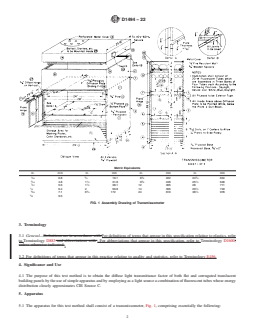
2 transmissometer, Fig. 1, comprising essentially the following:
2.1 ASTM Standards:
5.1.1 LightSource—The illumination shall consist of twelve
D618 Practice for Conditioning Plastics for Testing
20-W fluorescent tubes which are assembled in three banks of
D883 Terminology Relating to Plastics
four tubes each, according to the following schedule: daylight,
D1600 Terminology forAbbreviatedTerms Relating to Plas-
deluxe cool white, blue, and daylight.
tics
5.1.2 Photometer—The photometer shall consist of a pho-
tocell and of a galvanometer. The photocell shall be of the
This test method is under the jurisdiction ofASTM Committee D20 on Plastics barrier-layer type and shall contain a visual correction filter.
and is the direct responsibility of Subcommittee D20.24 on Plastic Building
The assembly preferably should be hermetically sealed into
Products.
plastic as a protection against moisture. The indicating galva-
Current edition approved Nov. 1, 2022. Published November 2022. Originally
nometer should contain one scale graduated from 0 to 100, and
approved in 1957. Last previous edition approved in 2017 as D1494 – 17. DOI:
10.1520/D1494-22.
For referenced ASTM standards, visit the ASTM website, www.astm.org, or
contact ASTM Customer Service at service@astm.org. For Annual Book of ASTM Detailed working drawings and a bill of materials for this equipment can be
Standards volume information, refer to the standard’s Document Summary page on obtained at a nominal charge fromASTM Headquarters, 100 Barr Harbor Drive, PO
the ASTM website. Box C700, West Conshohocken, PA 19428–2959. Order Adjunct: ADJD1494.
*A Summary of Changes section appears at the end of this standard
Copyright © ASTM International, 100 Barr Harbor Drive, PO Box C700, West Conshohocken, PA 19428-2959. United States
D1494 − 22
Metric Equivalents
in. mm in. mm in. mm in. mm
1 3 3 3
⁄32 0.8 ⁄4 19.1 8 ⁄4 222 24 ⁄4 634
3 1 3 1
⁄16 4.8 1 ⁄4 31.8 9 ⁄4 248 25 ⁄2 648
7 1
⁄37 5.6 1 ⁄2 38.1 12 305 28 711
1 1
⁄4 6.4 2 50.8 14 356 29 ⁄2 749
9 3 1
⁄32 7.1 6 ⁄4 172 24 610 38 ⁄2 978
⁄8 9.5
FIG. 1 Assembly Drawing of Transmissometer
a circuit with sufficient variable resistance so that the sensitiv- 5.1.3.4 The photocell shall be positioned below the center
ity of the photometer can be adjusted over the range of 50 to axis of the test specimen so that the distance from the bottom
100 footcandles. of the specimen to the top of the cell is 283.0 6 0.8 mm
1 1
5.1.3 Test Cabinet, constructed in accordance with the (11 ⁄8 6 ⁄32 in.).
following dimensions. 5.1.3.5 A masking plate containing a 31.8-mm (1 ⁄4-in.)
5.1.3.1 The transmitted area of the test specimen shall be diameter hole in its center shall be placed between the test
610.0 6 1.6 mm by 610.0 6 1.6 mm (24 6 ⁄16 in. by 24 6 specimen and the photocell so that the distance from the
⁄16 in.). bottom of the test specimen to the bottom of the masking plate
3 1
5.1.3.2 The distance from the bottom of the fluorescent shall be 233.0 6 0.8 mm (9 ⁄4 6 ⁄32 in.).
tubes to the bottom of the test specimen shall be 203.0 6 0.8
6. Standardization of Transmiss
...
This document is not an ASTM standard and is intended only to provide the user of an ASTM standard an indication of what changes have been made to the previous version. Because
it may not be technically possible to adequately depict all changes accurately, ASTM recommends that users consult prior editions as appropriate. In all cases only the current version
of the standard as published by ASTM is to be considered the official document.
Designation: D1494 − 17 D1494 − 22 An American National Standard
Standard Test Method for
Diffuse Light Transmission Factor of Reinforced Plastics
Panels
This standard is issued under the fixed designation D1494; the number immediately following the designation indicates the year of
original adoption or, in the case of revision, the year of last revision. A number in parentheses indicates the year of last reapproval. A
superscript epsilon (´) indicates an editorial change since the last revision or reapproval.
This standard has been approved for use by agencies of the U.S. Department of Defense.
1. Scope*
1.1 This test method covers the determination of the diffuse light transmission factor of translucent reinforced plastics building
panels.
1.2 The values stated in SI units are to be regarded as the standard. The values given in the parentheses are for information only.
1.3 The text of this standard references notes and footnotes which provide explanatory material. These notes and footnotes
(excluding those in Tables and Figures) shall not be considered as requirements of this standard.
1.4 This standard does not purport to address all of the safety concerns, if any, associated with its use. It is the responsibility
of the user of this standard to establish appropriate safety, health, and environmental practices and determine the applicability of
regulatory limitations prior to use.
NOTE 1—There is no known ISO equivalent to this standard.
1.5 This international standard was developed in accordance with internationally recognized principles on standardization
established in the Decision on Principles for the Development of International Standards, Guides and Recommendations issued
by the World Trade Organization Technical Barriers to Trade (TBT) Committee.
2. Referenced Documents
2.1 ASTM Standards:
D618 Practice for Conditioning Plastics for Testing
D883 Terminology Relating to Plastics
D1600 Terminology for Abbreviated Terms Relating to Plastics
E2935E456 Practice for Evaluating Equivalence of Two Testing ProcessesTerminology Relating to Quality and Statistics
E691 Practice for Conducting an Interlaboratory Study to Determine the Precision of a Test Method
E2935 Practice for Evaluating Equivalence of Two Testing Processes
2.2 ASTM Adjuncts:
Test Cabinet for Diffuse Light Transmission Factor of Reinforced Panels
This test method is under the jurisdiction of ASTM Committee D20 on Plastics and is the direct responsibility of Subcommittee D20.24 on Plastic Building Products.
Current edition approved Dec. 1, 2017Nov. 1, 2022. Published January 2018November 2022. Originally approved in 1957. Last previous edition approved in 20122017
as D1494 – 12.D1494 – 17. DOI: 10.1520/D1494-17.10.1520/D1494-22.
For referenced ASTM standards, visit the ASTM website, www.astm.org, or contact ASTM Customer Service at service@astm.org. For Annual Book of ASTM Standards
volume information, refer to the standard’s Document Summary page on the ASTM website.
Detailed working drawings and a bill of materials for this equipment can be obtained at a nominal charge from ASTM Headquarters, 100 Barr Harbor Drive, PO Box
C700, West Conshohocken, PA 19428–2959. Order Adjunct: ADJD1494.
*A Summary of Changes section appears at the end of this standard
Copyright © ASTM International, 100 Barr Harbor Drive, PO Box C700, West Conshohocken, PA 19428-2959. United States
D1494 − 22
Metric Equivalents
in. mm in. mm in. mm in. mm
1 3 3 3
⁄32 0.8 ⁄4 19.1 8 ⁄4 222 24 ⁄4 634
3 1 3 1
⁄16 4.8 1 ⁄4 31.8 9 ⁄4 248 25 ⁄2 648
7 1
⁄37 5.6 1 ⁄2 38.1 12 305 28 711
1 1
⁄4 6.4 2 50.8 14 356 29 ⁄2 749
9 3 1
⁄32 7.1 6 ⁄4 172 24 610 38 ⁄2 978
⁄8 9.5
FIG. 1 Assembly Drawing of Transmissometer
3. Terminology
3.1 General—Definitions are in accordance with For definitions of terms that appear in this specification relating to plastics, refer
to Terminology D883 and abbreviations with . For abbreviations that appear in this specification, refer to Terminology D1600,
unless otherwise indicated.
3.2 For definitions of terms that appear in this practice relating to quality and statistics, refer to Terminology E456.
4. Significance and Use
4.1 The purpose of this test method is to obtain the diffuse light transmittance factor of both flat and corrugated translucent
building panels by the use of simple apparatus and by employing as a light source a combination of fluorescent tubes whose energy
distribution closely approximates CIE Source C.
5. Apparatus
5.1 The apparatus for this test method shall consist of a transmissometer, Fig. 1, comprising essentially the following:
D1494 − 22
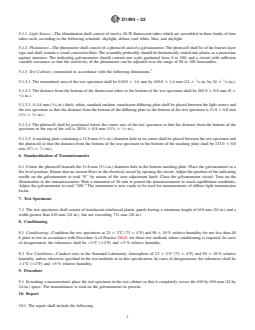
5.1.1 Light Source—The illumination shall consist of twelve 20-W fluorescent tubes which are assembled in three banks of four
tubes each, according to the following schedule: daylight, deluxe cool white, blue, and daylight.
5.1.2 Photometer—The photometer shall consist of a photocell and of a galvanometer. The photocell shall be of the barrier-layer
type and shall contain a visual correction filter. The assembly preferably should be hermetically sealed into plastic as a protection
against moisture. The indicating galvanometer should contain one scale graduated from 0 to 100, and a circuit with sufficient
variable resistance so that the sensitivity of the photometer can be adjusted over the range of 50 to 100 footcandles.
5.1.3 Test Cabinet, constructed in accordance with the following dimensions.
1 1
5.1.3.1 The transmitted area of the test specimen shall be 610.0 6 1.6 mm by 610.0 6 1.6 mm (24 6 ⁄16 in. by 24 6 ⁄16 in.).
5.1.3.2 The distance from the bottom of the fluorescent tubes to the bottom of the test specimen shall be 203.0 6 0.8 mm (8 6
⁄32 in.).
5.1.3.3 A 4.8-mm ( ⁄16-in.) thick, white, standard outdoor, translucent diffusing plate shall be placed between the light source and
the test specimen so that the distance from the bottom of the diffusing plate to the bottom of the test specimen is 31.8 6 0.8 mm
1 1
(1 ⁄4 6 ⁄32 in.).
5.1.3.4 The photocell shall be positioned below the center axis of the test specimen so that the distance from the bottom of the
1 1
specimen to the top of the cell is 283.0 6 0.8 mm (11 ⁄8 6 ⁄32 in.).
5.1.3.5 A masking plate containing a 31.8-mm (1 ⁄4-in.) diameter hole in its center shall be placed between the test specimen and
the photocell so that the distance from the bottom of the test specimen to the bottom of the masking plate shall be 233.0 6 0.8
3 1
mm (9 ⁄4 6 ⁄32 in.).
6. Standardization of Transmissometer
6.1 Center the photocell beneath the 31.8-mm (1 ⁄4-in.) diameter hole in the bottom masking pl
...