


ASTM E1547-09(2017)
(Terminology)Standard Terminology Relating to Industrial and Specialty Chemicals
Standard Terminology Relating to Industrial and Specialty Chemicals
SCOPE
1.1 This standard covers terminology relating to industrial and specialty chemicals. It is intended to provide an understanding of terms commonly used in test methods, practices, and specifications throughout the industry.
Note 1: The boldface numbers following each definition refer to E15 standards in which the definition appears. Lightface numbers refer to the E15 subcommittee having jurisdiction.
General Information
Buy Standard
Standards Content (Sample)
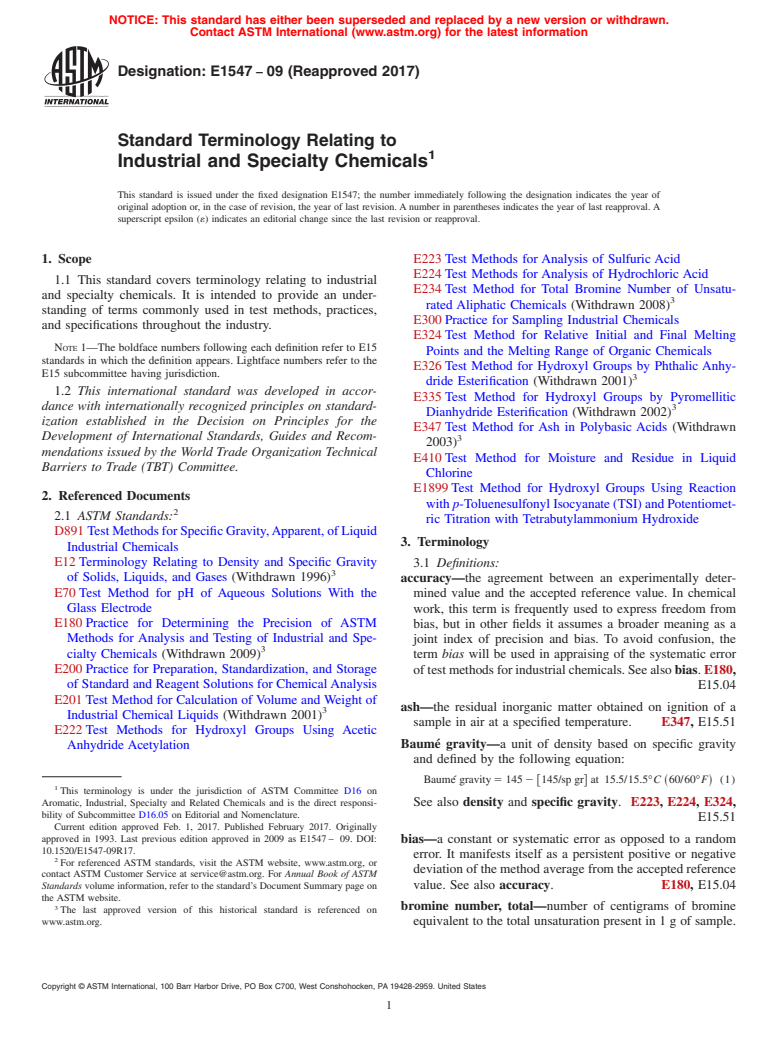
NOTICE: This standard has either been superseded and replaced by a new version or withdrawn.
Contact ASTM International (www.astm.org) for the latest information
Designation: E1547 − 09 (Reapproved 2017)
Standard Terminology Relating to
Industrial and Specialty Chemicals
This standard is issued under the fixed designation E1547; the number immediately following the designation indicates the year of
original adoption or, in the case of revision, the year of last revision. A number in parentheses indicates the year of last reapproval. A
superscript epsilon (´) indicates an editorial change since the last revision or reapproval.
1. Scope E223 Test Methods for Analysis of Sulfuric Acid
E224 Test Methods for Analysis of Hydrochloric Acid
1.1 This standard covers terminology relating to industrial
E234 Test Method for Total Bromine Number of Unsatu-
and specialty chemicals. It is intended to provide an under-
rated Aliphatic Chemicals (Withdrawn 2008)
standing of terms commonly used in test methods, practices,
E300 Practice for Sampling Industrial Chemicals
and specifications throughout the industry.
E324 Test Method for Relative Initial and Final Melting
NOTE 1—The boldface numbers following each definition refer to E15
Points and the Melting Range of Organic Chemicals
standards in which the definition appears. Lightface numbers refer to the
E326 Test Method for Hydroxyl Groups by Phthalic Anhy-
E15 subcommittee having jurisdiction.
dride Esterification (Withdrawn 2001)
1.2 This international standard was developed in accor-
E335 Test Method for Hydroxyl Groups by Pyromellitic
dance with internationally recognized principles on standard- 3
Dianhydride Esterification (Withdrawn 2002)
ization established in the Decision on Principles for the
E347 Test Method for Ash in Polybasic Acids (Withdrawn
Development of International Standards, Guides and Recom- 3
2003)
mendations issued by the World Trade Organization Technical
E410 Test Method for Moisture and Residue in Liquid
Barriers to Trade (TBT) Committee.
Chlorine
E1899 Test Method for Hydroxyl Groups Using Reaction
2. Referenced Documents
with p-Toluenesulfonyl Isocyanate (TSI) and Potentiomet-
2.1 ASTM Standards:
ric Titration with Tetrabutylammonium Hydroxide
D891 Test Methods for Specific Gravity, Apparent, of Liquid
3. Terminology
Industrial Chemicals
E12 Terminology Relating to Density and Specific Gravity
3.1 Definitions:
of Solids, Liquids, and Gases (Withdrawn 1996) accuracy—the agreement between an experimentally deter-
E70 Test Method for pH of Aqueous Solutions With the mined value and the accepted reference value. In chemical
Glass Electrode
work, this term is frequently used to express freedom from
E180 Practice for Determining the Precision of ASTM bias, but in other fields it assumes a broader meaning as a
Methods for Analysis and Testing of Industrial and Spe-
joint index of precision and bias. To avoid confusion, the
cialty Chemicals (Withdrawn 2009) term bias will be used in appraising of the systematic error
E200 Practice for Preparation, Standardization, and Storage
of test methods for industrial chemicals. See also bias. E180,
of Standard and Reagent Solutions for Chemical Analysis E15.04
E201 Test Method for Calculation of Volume and Weight of
ash—the residual inorganic matter obtained on ignition of a
Industrial Chemical Liquids (Withdrawn 2001)
sample in air at a specified temperature. E347, E15.51
E222 Test Methods for Hydroxyl Groups Using Acetic
Baumé gravity—a unit of density based on specific gravity
Anhydride Acetylation
and defined by the following equation:
Baume´ gravity5 1452 145/sp gr at 15.5/15.5°C 60/60°F (1)
@ # ~ !
This terminology is under the jurisdiction of ASTM Committee D16 on
Aromatic, Industrial, Specialty and Related Chemicals and is the direct responsi- See also density and specific gravity. E223, E224, E324,
bility of Subcommittee D16.05 on Editorial and Nomenclature.
E15.51
Current edition approved Feb. 1, 2017. Published February 2017. Originally
approved in 1993. Last previous edition approved in 2009 as E1547 – 09. DOI:
bias—a constant or systematic error as opposed to a random
10.1520/E1547-09R17.
error. It manifests itself as a persistent positive or negative
For referenced ASTM standards, visit the ASTM website, www.astm.org, or
deviation of the method average from the accepted reference
contact ASTM Customer Service at service@astm.org. For Annual Book of ASTM
value. See also accuracy. E180, E15.04
Standards volume information, refer to the standard’s Document Summary page on
the ASTM website.
3 bromine number, total—number of centigrams of bromine
The last approved version of this historical standard is referenced on
www.astm.org. equivalent to the total unsaturation present in 1 g of sample.
Copyright © ASTM International, 100 Barr Harbor Drive, PO Box C700, West Conshohocken, PA 19428-2959. United States
E1547 − 09 (2017)
It is a measure of the total ethylenic unsaturation present in lot (solid sample)—a discrete quantity of material. It may
the designated aliphatic compound. E234, E15.22 contain a single batch or several batches or be the product of
continuous process broken into units on the basis of time or
coefficient of variation—a measure of relative precision
shipment. It is very desirable that individual batches in a lot
calculated as the standard deviation of a series of values
be specifically identified so that they may become individual
divided by their average. It is often multiplied by 100 and
or stratified units for inspection. E300, E15.05
expressed as a percentage. E180, E15.04
melting point, final—the temperature at which the last crystal
density—the mass of a unit volume of a material at a specified
disappears into the melt. E324, E15.23
temperature. The units shall be stated, such as grams per
millilitre, grams per cubic centimetre, pounds per cubic foot,
melting point, initial—the temperature at which positive
or other. The form of the expression shall be the following:
evidence of liquefaction is observed. E324, E15.23
Density at x . . .
moisture—the volatile substances evolved during volatiliza-
tion and purging of the sample-residue flask and absorbed on
where x = temperature of the material, in , for
the desiccant contained in the absorption tubes under the
example, °C. See also Baumé
conditions of the test. E410, E15.57
gravity and specific gravity. E201, E15.23
95 % limit (difference between two results)—the maximum
density (of gases)—the mass of a unit volume of a gas at a
absolute difference expected for approximately 95 % of all
stated temperature and pressure. The units shall be stated.
pairs of results from laboratories similar to those in the
The form of expression shall be the following:
interlaboratory study. E180, E15.04
Density at x, y
pH—defined formally as the negative logarithm to the base 10
where:
of the conventional hydrogen ion activity. The pH of an
x = temperature of the gas units, for example, °C, and
aqueous solution is derived from E, the electromotive force
y = pressure of the gas (units, for example, kPa). E12,
(emf) of the cell:
E15.23
reference ? ? solution ? glass electrode
density, apparent—the weight in air of a unit volume of a
material at a specified temperature. The units shall be stated. (where the double vertical line represents a liquid
junction)
The form of expression shall be the following:
when the electrodes are immersed in the solution, and E ,
s
Apparent density at x
the electromotive force obtained when the electrodes are
where x = temperature of the material, in , for
immersed in a standard solution (whose assigned pH is des-
example, °C. E201, E15.23
ignated pH(S)), by the following equation:
duplicates—two independent determinations performed by
~E 2 E !F
s
pH5 pH S 1 (3)
~ !
one analyst in a short period of time, for example, one day. RTln10
~ !
E180, E15.04
where:
−1
error—in a statistical sense, any deviation of an observed
F = faraday, 96 487 C·mol ,
−1 −1
value from the true, but generally unknown, value. When R = gas constant, 8.314 33 J·K ·mol , and
expressed as a fraction or percentage of the value measured,
T = absolute temperature, (t °C + 273.15). E70, E15.23
it is called a relative error. All statements of precision or bias
precision—the degree of agreement of repeated measurements
should indicate clearly whether they are expressed in abso-
of the same property. Precision statements in ASTM meth-
lute or relative sense. E180, E15.04
ods for industrial chemicals will be derived from the
error, random—the chance variation encountered in all ex-
estimated standard deviation or coefficient of variation of a
perimental work despite the closest possible control of
series of measurements and will be expressed in terms of the
variables. It is characterized by the random occurrence of
repeatability, the within-laboratory, between days variability,
both positive and negative deviations from the mean value
and the reproducibility of the method. E180, E15.04
for the method, the algebraic average of which will approach
range—the absolute value of the algebraic difference between
zero in a long series of measurements. E180, E15.04
the highest and the lowest values in a set of data. E180,
hydroxyl number—the milligrams of potassium hydroxide
E15.04
equivalent to the hydroxyl content of 1 g of sample. In the
repeatability—the precision of a method expressed as the
case of a pure compound, the hydroxyl number is inversely
agreement attainable between independent determinations
proportional to the hydroxyl equivalent weight:
performed at essentially the same time (duplicates) by one
equivalent weight g/equivalent 5 56100/hydroxyl number (2)
~ !
analyst using the same apparatus and techniques. E180,
E222, E326, E335, E1899, E15.22
E15.04
increments (solid sample)—portions of material selected
from various parts of a lot, which may be tested individually
or composited and tested as a unit. E300, E15.05 This term or definition is specific to the standard under the test conditions.
E1547 − 09 (2017)
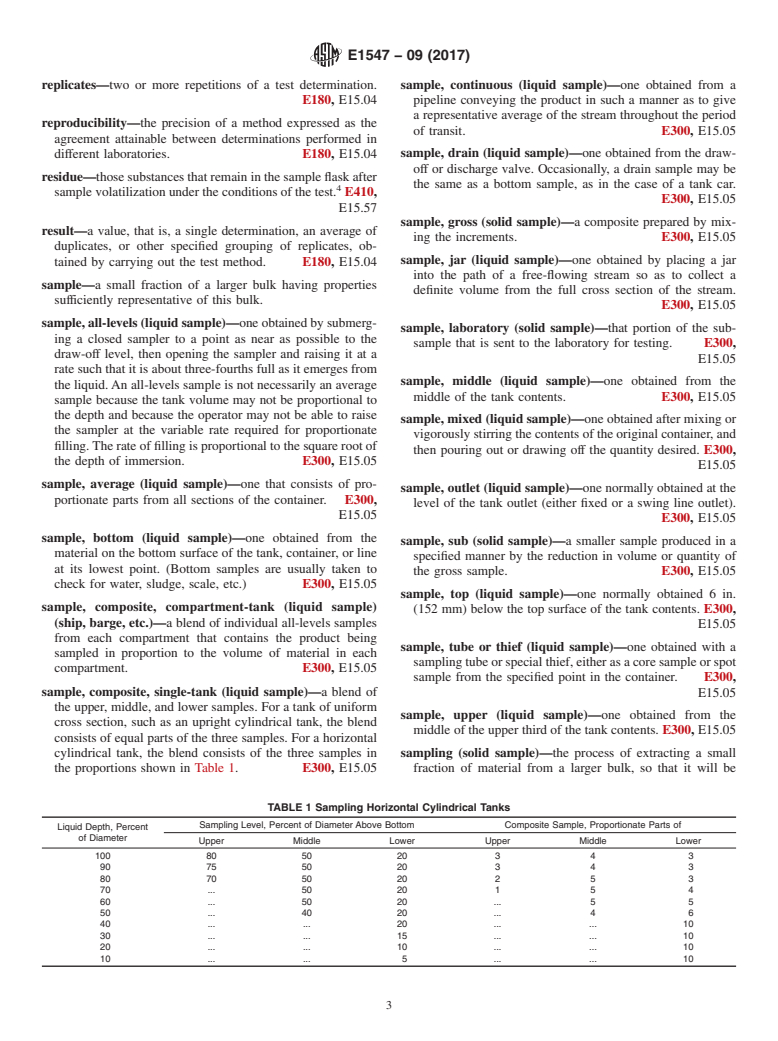
replicates—two or more repetitions of a test d
...
This document is not an ASTM standard and is intended only to provide the user of an ASTM standard an indication of what changes have been made to the previous version. Because
it may not be technically possible to adequately depict all changes accurately, ASTM recommends that users consult prior editions as appropriate. In all cases only the current version
of the standard as published by ASTM is to be considered the official document.
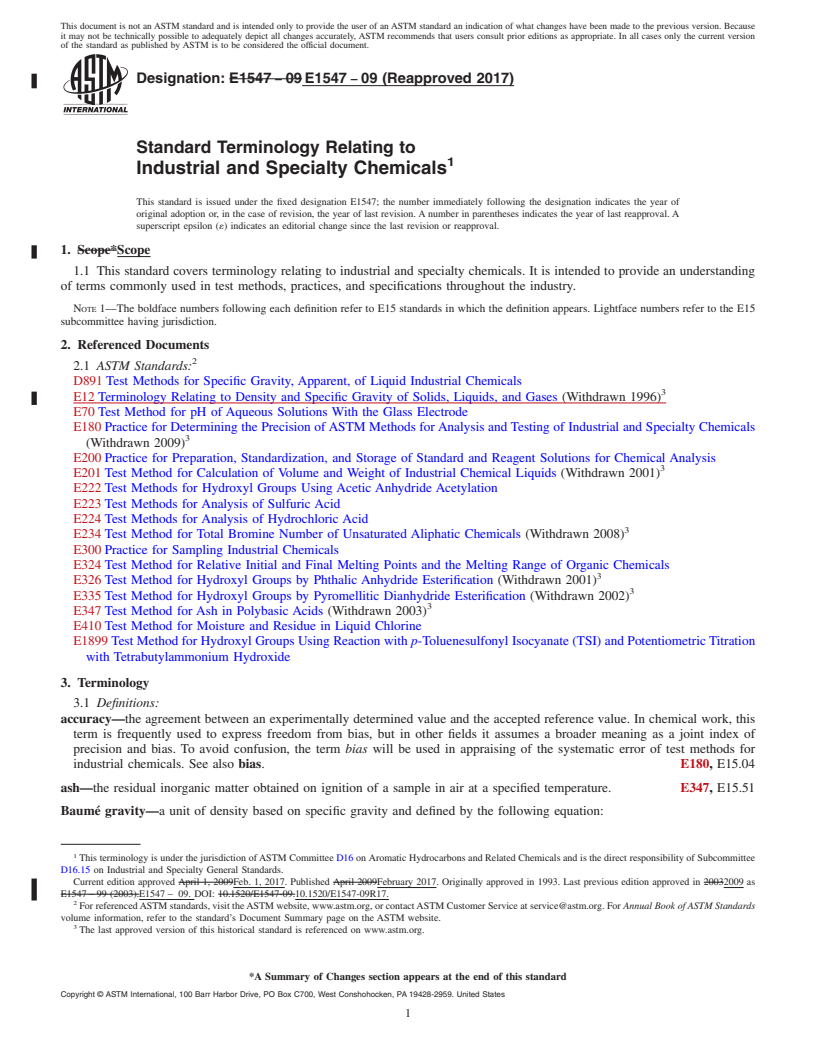
Designation: E1547 − 09 E1547 − 09 (Reapproved 2017)
Standard Terminology Relating to
Industrial and Specialty Chemicals
This standard is issued under the fixed designation E1547; the number immediately following the designation indicates the year of
original adoption or, in the case of revision, the year of last revision. A number in parentheses indicates the year of last reapproval. A
superscript epsilon (´) indicates an editorial change since the last revision or reapproval.
1. Scope*Scope
1.1 This standard covers terminology relating to industrial and specialty chemicals. It is intended to provide an understanding
of terms commonly used in test methods, practices, and specifications throughout the industry.
NOTE 1—The boldface numbers following each definition refer to E15 standards in which the definition appears. Lightface numbers refer to the E15
subcommittee having jurisdiction.
2. Referenced Documents
2.1 ASTM Standards:
D891 Test Methods for Specific Gravity, Apparent, of Liquid Industrial Chemicals
E12 Terminology Relating to Density and Specific Gravity of Solids, Liquids, and Gases (Withdrawn 1996)
E70 Test Method for pH of Aqueous Solutions With the Glass Electrode
E180 Practice for Determining the Precision of ASTM Methods for Analysis and Testing of Industrial and Specialty Chemicals
(Withdrawn 2009)
E200 Practice for Preparation, Standardization, and Storage of Standard and Reagent Solutions for Chemical Analysis
E201 Test Method for Calculation of Volume and Weight of Industrial Chemical Liquids (Withdrawn 2001)
E222 Test Methods for Hydroxyl Groups Using Acetic Anhydride Acetylation
E223 Test Methods for Analysis of Sulfuric Acid
E224 Test Methods for Analysis of Hydrochloric Acid
E234 Test Method for Total Bromine Number of Unsaturated Aliphatic Chemicals (Withdrawn 2008)
E300 Practice for Sampling Industrial Chemicals
E324 Test Method for Relative Initial and Final Melting Points and the Melting Range of Organic Chemicals
E326 Test Method for Hydroxyl Groups by Phthalic Anhydride Esterification (Withdrawn 2001)
E335 Test Method for Hydroxyl Groups by Pyromellitic Dianhydride Esterification (Withdrawn 2002)
E347 Test Method for Ash in Polybasic Acids (Withdrawn 2003)
E410 Test Method for Moisture and Residue in Liquid Chlorine
E1899 Test Method for Hydroxyl Groups Using Reaction with p-Toluenesulfonyl Isocyanate (TSI) and Potentiometric Titration
with Tetrabutylammonium Hydroxide
3. Terminology
3.1 Definitions:
accuracy—the agreement between an experimentally determined value and the accepted reference value. In chemical work, this
term is frequently used to express freedom from bias, but in other fields it assumes a broader meaning as a joint index of
precision and bias. To avoid confusion, the term bias will be used in appraising of the systematic error of test methods for
industrial chemicals. See also bias. E180, E15.04
ash—the residual inorganic matter obtained on ignition of a sample in air at a specified temperature. E347, E15.51
Baumé gravity—a unit of density based on specific gravity and defined by the following equation:
This terminology is under the jurisdiction of ASTM Committee D16 on Aromatic Hydrocarbons and Related Chemicals and is the direct responsibility of Subcommittee
D16.15 on Industrial and Specialty General Standards.
Current edition approved April 1, 2009Feb. 1, 2017. Published April 2009February 2017. Originally approved in 1993. Last previous edition approved in 20032009 as
E1547 – 99 (2003).E1547 – 09. DOI: 10.1520/E1547-09.10.1520/E1547-09R17.
For referenced ASTM standards, visit the ASTM website, www.astm.org, or contact ASTM Customer Service at service@astm.org. For Annual Book of ASTM Standards
volume information, refer to the standard’s Document Summary page on the ASTM website.
The last approved version of this historical standard is referenced on www.astm.org.
*A Summary of Changes section appears at the end of this standard
Copyright © ASTM International, 100 Barr Harbor Drive, PO Box C700, West Conshohocken, PA 19428-2959. United States
E1547 − 09 (2017)
Baume´ gravity 5 145 2 145/sp gr at 15.5/15.5°C 60/60°F (1)
@ # ~ !
See also density and specific gravity. E223, E224, E324, E15.51
bias—a constant or systematic error as opposed to a random error. It manifests itself as a persistent positive or negative deviation
of the method average from the accepted reference value. See also accuracy. E180, E15.04
bromine number, total—number of centigrams of bromine equivalent to the total unsaturation present in 1 g of sample. It is a
measure of the total ethylenic unsaturation present in the designated aliphatic compound. E234, E15.22
coefficient of variation—a measure of relative precision calculated as the standard deviation of a series of values divided by their
average. It is often multiplied by 100 and expressed as a percentage. E180, E15.04
density—the mass of a unit volume of a material at a specified temperature. The units shall be stated, such as grams per millilitre,
grams per cubic centimetre, pounds per cubic foot, or other. The form of the expression shall be the following:
Density at x . . .
where x = temperature of the material, in , for example, °C. See also Baumé
gravity and specific gravity. E201, E15.23
density (of gases)—the mass of a unit volume of a gas at a stated temperature and pressure. The units shall be stated. The form
of expression shall be the following:
Density at x,y
where:
x = temperature of the gas units, for example, °C, and
y = pressure of the gas (units, for example, kPa). E12, E15.23
density, apparent—the weight in air of a unit volume of a material at a specified temperature. The units shall be stated. The form
of expression shall be the following:
Apparent density at x
where x = temperature of the material, in , for example, °C. E201, E15.23
duplicates—two independent determinations performed by one analyst in a short period of time, for example, one day. E180,
E15.04
error—in a statistical sense, any deviation of an observed value from the true, but generally unknown, value. When expressed
as a fraction or percentage of the value measured, it is called a relative error. All statements of precision or bias should indicate
clearly whether they are expressed in absolute or relative sense. E180, E15.04
error, random—the chance variation encountered in all experimental work despite the closest possible control of variables. It is
characterized by the random occurrence of both positive and negative deviations from the mean value for the method, the
algebraic average of which will approach zero in a long series of measurements. E180, E15.04
hydroxyl number—the milligrams of potassium hydroxide equivalent to the hydroxyl content of 1 g of sample. In the case of a
pure compound, the hydroxyl number is inversely proportional to the hydroxyl equivalent weight:
equivalent weight ~g/equivalent!5 56100/hydroxyl number (2)
E222, E326, E335, E1889E1899, E15.22
increments (solid sample)—portions of material selected from various parts of a lot, which may be tested individually or
composited and tested as a unit. E300, E15.05
lot (solid sample)—a discrete quantity of material. It may contain a single batch or several batches or be the product of continuous
process broken into units on the basis of time or shipment. It is very desirable that individual batches in a lot be specifically
identified so that they may become individual or stratified units for inspection. E300, E15.05
melting point, final—the temperature at which the last crystal disappears into the melt. E324, E15.23
melting point, initial—the temperature at which positive evidence of liquefaction is observed. E324, E15.23
moisture—the volatile substances evolved during volatilization and purging of the sample-residue flask and absorbed on the
desiccant contained in the absorption tubes under the conditions of the test. E410, E15.57
This term or definition is specific to the standard under the test conditions.
E1547 − 09 (2017)
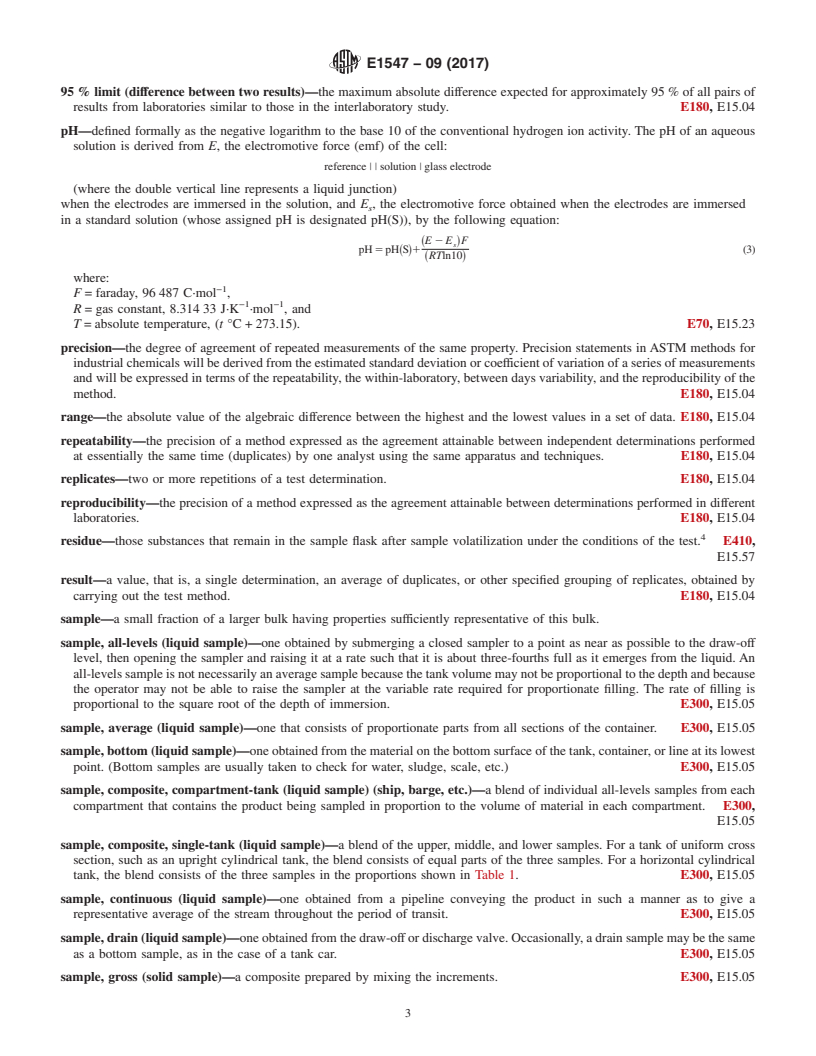
95 % limit (difference between two results)—the maximum absolute difference expected for approximately 95 % of all pairs of
results from laboratories similar to those in the interlaboratory study. E180, E15.04
pH—defined formally as the negative logarithm to the base 10 of the conventional hydrogen ion activity. The pH of an aqueous
solution is derived from E, the electromotive force (emf) of the cell:
reference ? ? solution ? glass electrode
(where the double vertical line represents a liquid junction)
when the electrodes are immersed in the solution, and E , the electromotive force obtained when the electrodes are immersed
s
in a standard solution (whose assigned pH is designated pH(S)), by the following equation:
~E 2 E !F
s
pH 5 pH S 1 (3)
~ !
RTln10
~ !
where:
−1
F = faraday, 96 487 C·mol ,
−1 −1
R = gas constant, 8.314 33 J·K ·mol , and
T = absolute temperature, (t °C + 273.15). E70, E15.23
precision—the degree of agreement of repeated measurements of the same property. Precision statements in ASTM methods for
industrial chemicals will be derived from the estimated standard deviation or coefficient of variation of a series of measurements
and will be expressed in terms of the repeatability, the within-laboratory, between days variability, and the reproducibility of the
method. E180, E15.04
range—the absolute value of the algebraic difference between the highest and the lowest values in a set of data. E180, E15.04
repeatability—the precision of a method expressed as the agreement attainable between independent determinations performed
at essentially the same time (duplicates) by one analyst using the same apparatus and techniques. E180, E15.04
replicates—two or more repetitions of a test determination. E180, E15.04
reproducibility—the precision of a method expressed as the agreement attainable between determinations performed in different
laboratories. E180, E15.04
residue—those substances that remain in the sample flask
...
Questions, Comments and Discussion
Ask us and Technical Secretary will try to provide an answer. You can facilitate discussion about the standard in here.