

ASTM D4520-18
(Practice)Standard Practice for Determining Water Injectivity Through the Use of On-Site Floods
General Information
- Abstract
SIGNIFICANCE AND USE
5.1 The injectivity of a water is best determined by measurements as near to the well as possible to minimize changes in water properties due to air contact and time. This practice describes how core flow tests are carried out near the well.
5.2 This practice permits the differentiation of permeability losses from the effects of chemical interaction of water and rock and from the effects of plugging by suspended solids. The procedure can be utilized to estimate the chemical and filtration requirements for the full-scale injection project.
5.3 Application of the test results to injection wells requires consideration of test core selection and geometry effects.
5.4 This practice as described assumes that the water does not contain free oil or other immiscible hydrocarbons. The presence of free oil would require the method to be modified to account for the effect of oil saturation in the test cores on the water permeability.
SCOPE
1.1 This practice covers a procedure for conducting on-site core flood tests to determine the filtration and chemical treatment requirements for subsurface injection of water.2, 3
1.2 This practice applies to water disposal, secondary recovery, and enhanced oil recovery projects and is applicable to injection waters with all ranges of total dissolved solids contents.
1.3 The values stated in SI units are to be regarded as standard. The values given in parentheses are mathematical conversions to inch-pound units that are provided for information only and are not considered standard.
1.4 This standard does not purport to address all of the safety concerns, if any, associated with its use. It is the responsibility of the user of this standard to establish appropriate safety, health, and environmental practices and determine the applicability of regulatory limitations prior to use.
1.5 This international standard was developed in accordance with internationally recognized principles on standardization established in the Decision on Principles for the Development of International Standards, Guides and Recommendations issued by the World Trade Organization Technical Barriers to Trade (TBT) Committee.
- Status
- Published
- Publication Date
- 30-Apr-2018
- Technical Committee
- D19 - Water
- Drafting Committee
- D19.05 - Inorganic Constituents in Water
Buy Documents
ASTM D4520-18 - Standard Practice for Determining Water Injectivity Through the Use of On-Site Floods
REDLINE ASTM D4520-18 - Standard Practice for Determining Water Injectivity Through the Use of On-Site Floods
Overview
ASTM D4520-18: Standard Practice for Determining Water Injectivity Through the Use of On-Site Floods provides a comprehensive procedure for evaluating the capacity of injection wells to accept water, focusing on subsurface injection projects such as secondary and enhanced oil recovery, and water disposal. This standard outlines the methodology for conducting on-site core flood tests to determine the filtration and chemical treatment requirements of water prior to injection. Proper application of ASTM D4520-18 helps optimize injectivity, prevent formation plugging, and reduce operational risks associated with water injection operations.
Key Topics
- On-site Core Flood Tests: Detailed procedures for preparing, selecting, and utilizing representative core samples from target formations to assess water injectivity accurately.
- Filtration and Chemical Treatment Requirements: The standard describes the process for determining appropriate filtration levels and the need for chemical treatment to minimize permeability loss and formation plugging.
- Assessment of Rock-Water Interactions: Evaluates the effects of chemical reactions, plugging by suspended solids, and permeability changes due to interaction between injection water and rock.
- Test Data Analysis: Outlines methods to calculate permeability, permeability ratio, and pore volume, and interpret results to inform operational decisions.
- Test Apparatus and Procedure: Specifies required equipment, such as filtration units and core holders, and details step-by-step procedures for sample preparation, saturation, permeability measurement, and filtration tests.
- Flow Reversal Techniques: Simulates backflow scenarios to evaluate potential recovery of permeability through reverse flow, providing insights into maintenance strategies for injection wells.
Applications
ASTM D4520-18 is widely applied within the oil and gas industry and by environmental engineers for water injection projects, including:
- Enhanced Oil Recovery (EOR): Used to assess and optimize water injection in EOR projects, ensuring proper injectivity and minimizing reservoir damage.
- Secondary Recovery Operations: Guides operators in determining need for water treatment to maintain sustained injection rates and avoid operational downtime.
- Water Disposal Wells: Provides criteria for evaluating the suitability of water disposal into subsurface formations, preventing plugging and formation damage.
- Field Development and Well Maintenance: Offers practical guidance for selecting core samples, conducting injectivity tests near the well, and adapting injection strategies based on test results.
- Filtration System Design: Informs the design and selection of filtration systems to remove particulates and prevent wellbore and formation plugging.
- Assessment of Chemical Additives: Helps estimate required chemical dosages for water treatment prior to injection by analyzing test outcomes.
Adhering to ASTM D4520-18 ensures accurate assessment of water injectivity, supporting regulatory compliance, maintaining well productivity, and reducing operational risks.
Related Standards
- ASTM D420: Guide for Site Characterization for Engineering Design and Construction Purposes.
- ASTM D653: Terminology Relating to Soil, Rock, and Contained Fluids.
- ASTM D1129: Terminology Relating to Water.
- ASTM D4404: Test Method for Determination of Pore Volume and Pore Volume Distribution of Soil and Rock by Mercury Intrusion Porosimetry.
- API RP27: Recommended Practice for Determining Permeability of Porous Media.
- API RP40: Recommended Practice for Core-Analysis Procedure.
These related standards support the comprehensive evaluation of water injectivity, rock properties, and test terminologies used in implementing ASTM D4520-18 for injection well operations.
Keywords: water injectivity, core flood test, permeability, filtration requirement, enhanced oil recovery, water disposal, secondary recovery, ASTM D4520-18, injection well.
Relations
- Effective Date
- 01-May-2018
- Effective Date
- 01-May-2020
- Effective Date
- 01-Feb-2018
- Effective Date
- 01-Aug-2014
- Effective Date
- 01-Sep-2011
- Effective Date
- 01-May-2010
- Effective Date
- 01-Mar-2010
- Effective Date
- 01-Jan-2009
- Effective Date
- 01-Dec-2008
- Effective Date
- 01-Nov-2008
- Effective Date
- 15-Dec-2007
- Effective Date
- 01-Nov-2007
- Effective Date
- 01-Aug-2007
- Effective Date
- 01-Jul-2007
- Effective Date
- 01-May-2007
Buy Documents
ASTM D4520-18 - Standard Practice for Determining Water Injectivity Through the Use of On-Site Floods
REDLINE ASTM D4520-18 - Standard Practice for Determining Water Injectivity Through the Use of On-Site Floods
Get Certified
Connect with accredited certification bodies for this standard

CIS Institut d.o.o.
Personal Protective Equipment (PPE) certification body. Notified Body NB-2890 for EU Regulation 2016/425 PPE.

Kiwa BDA Testing
Building and construction product certification.
Kmetijski inštitut Slovenije
Agricultural Institute of Slovenia. Soil testing, plant health, agricultural product analysis.
Sponsored listings
Frequently Asked Questions
ASTM D4520-18 is a standard published by ASTM International. Its full title is "Standard Practice for Determining Water Injectivity Through the Use of On-Site Floods". This standard covers: SIGNIFICANCE AND USE 5.1 The injectivity of a water is best determined by measurements as near to the well as possible to minimize changes in water properties due to air contact and time. This practice describes how core flow tests are carried out near the well. 5.2 This practice permits the differentiation of permeability losses from the effects of chemical interaction of water and rock and from the effects of plugging by suspended solids. The procedure can be utilized to estimate the chemical and filtration requirements for the full-scale injection project. 5.3 Application of the test results to injection wells requires consideration of test core selection and geometry effects. 5.4 This practice as described assumes that the water does not contain free oil or other immiscible hydrocarbons. The presence of free oil would require the method to be modified to account for the effect of oil saturation in the test cores on the water permeability. SCOPE 1.1 This practice covers a procedure for conducting on-site core flood tests to determine the filtration and chemical treatment requirements for subsurface injection of water.2, 3 1.2 This practice applies to water disposal, secondary recovery, and enhanced oil recovery projects and is applicable to injection waters with all ranges of total dissolved solids contents. 1.3 The values stated in SI units are to be regarded as standard. The values given in parentheses are mathematical conversions to inch-pound units that are provided for information only and are not considered standard. 1.4 This standard does not purport to address all of the safety concerns, if any, associated with its use. It is the responsibility of the user of this standard to establish appropriate safety, health, and environmental practices and determine the applicability of regulatory limitations prior to use. 1.5 This international standard was developed in accordance with internationally recognized principles on standardization established in the Decision on Principles for the Development of International Standards, Guides and Recommendations issued by the World Trade Organization Technical Barriers to Trade (TBT) Committee.
SIGNIFICANCE AND USE 5.1 The injectivity of a water is best determined by measurements as near to the well as possible to minimize changes in water properties due to air contact and time. This practice describes how core flow tests are carried out near the well. 5.2 This practice permits the differentiation of permeability losses from the effects of chemical interaction of water and rock and from the effects of plugging by suspended solids. The procedure can be utilized to estimate the chemical and filtration requirements for the full-scale injection project. 5.3 Application of the test results to injection wells requires consideration of test core selection and geometry effects. 5.4 This practice as described assumes that the water does not contain free oil or other immiscible hydrocarbons. The presence of free oil would require the method to be modified to account for the effect of oil saturation in the test cores on the water permeability. SCOPE 1.1 This practice covers a procedure for conducting on-site core flood tests to determine the filtration and chemical treatment requirements for subsurface injection of water.2, 3 1.2 This practice applies to water disposal, secondary recovery, and enhanced oil recovery projects and is applicable to injection waters with all ranges of total dissolved solids contents. 1.3 The values stated in SI units are to be regarded as standard. The values given in parentheses are mathematical conversions to inch-pound units that are provided for information only and are not considered standard. 1.4 This standard does not purport to address all of the safety concerns, if any, associated with its use. It is the responsibility of the user of this standard to establish appropriate safety, health, and environmental practices and determine the applicability of regulatory limitations prior to use. 1.5 This international standard was developed in accordance with internationally recognized principles on standardization established in the Decision on Principles for the Development of International Standards, Guides and Recommendations issued by the World Trade Organization Technical Barriers to Trade (TBT) Committee.
ASTM D4520-18 is classified under the following ICS (International Classification for Standards) categories: 13.080.40 - Hydrological properties of soils. The ICS classification helps identify the subject area and facilitates finding related standards.
ASTM D4520-18 has the following relationships with other standards: It is inter standard links to ASTM D4520-13, ASTM D1129-13(2020)e2, ASTM D4404-18, ASTM D653-14, ASTM D653-11, ASTM D4404-10, ASTM D1129-10, ASTM D653-09, ASTM D653-08a, ASTM D653-08, ASTM D653-07f, ASTM D653-07e, ASTM D653-07d, ASTM D653-07c, ASTM D653-07b. Understanding these relationships helps ensure you are using the most current and applicable version of the standard.
ASTM D4520-18 is available in PDF format for immediate download after purchase. The document can be added to your cart and obtained through the secure checkout process. Digital delivery ensures instant access to the complete standard document.
Standards Content (Sample)
This international standard was developed in accordance with internationally recognized principles on standardization established in the Decision on Principles for the
Development of International Standards, Guides and Recommendations issued by the World Trade Organization Technical Barriers to Trade (TBT) Committee.
Designation: D4520 − 18
Standard Practice for
Determining Water Injectivity Through the Use of On-Site
Floods
This standard is issued under the fixed designation D4520; the number immediately following the designation indicates the year of
original adoption or, in the case of revision, the year of last revision. A number in parentheses indicates the year of last reapproval. A
superscript epsilon (´) indicates an editorial change since the last revision or reapproval.
1. Scope* D2434 Test Method for Permeability of Granular Soils
(Constant Head) (Withdrawn 2015)
1.1 This practice covers a procedure for conducting on-site
D4404 Test Method for Determination of Pore Volume and
core flood tests to determine the filtration and chemical
2, 3 Pore Volume Distribution of Soil and Rock by Mercury
treatment requirements for subsurface injection of water.
Intrusion Porosimetry
1.2 This practice applies to water disposal, secondary 6
2.2 API Standards:
recovery, and enhanced oil recovery projects and is applicable
API RP27 Recommended Practice for Determining Perme-
to injection waters with all ranges of total dissolved solids
ability of Porous Media
contents.
API RP40 Recommended Practice for Core-Analysis Pro-
1.3 The values stated in SI units are to be regarded as cedure
standard. The values given in parentheses are mathematical
3. Terminology
conversions to inch-pound units that are provided for informa-
tion only and are not considered standard.
3.1 Definitions:
3.1.1 For definitions of terms relating to water and water
1.4 This standard does not purport to address all of the
safety concerns, if any, associated with its use. It is the chemistry, refer to Terminology D1129. For definitions of
terms relating to soil and rock, refer to Terminology D653.
responsibility of the user of this standard to establish appro-
priate safety, health, and environmental practices and deter-
3.2 Definitions of Terms Specific to This Standard:
mine the applicability of regulatory limitations prior to use.
3.2.1 filtration requirement, n—the maximum suspended
1.5 This international standard was developed in accor-
solids size (in micrometres) allowed in an injection water to
dance with internationally recognized principles on standard-
minimize formation plugging.
ization established in the Decision on Principles for the
3.2.2 test core, n—a sample cut from a full-core that has
Development of International Standards, Guides and Recom-
been recovered from the formation into which water is in-
mendations issued by the World Trade Organization Technical
jected.
Barriers to Trade (TBT) Committee.
3.2.3 permeability, n—the capacity of a rock (or other
2. Referenced Documents
porous medium) to conduct liquid or gas; permaeability is
measured as the proportionality constant between flow velocity
2.1 ASTM Standards:
and hydraulic gradient.
D653 Terminology Relating to Soil, Rock, and Contained
Fluids
3.2.4 pore volume, n—the porous medium’s void-volume
D1129 Terminology Relating to Water that can be saturated with the transmitted fluid.
3.2.5 porosity, n—the ratio (usually expressed as a percent-
age) of the volume of voids of a given soil, rock mass, or other
This practice is under the jurisdiction of ASTM Committee D19 on Water and
is the direct responsibility of Subcommittee D19.05 on Inorganic Constituents in
porous medium to the total volume of the soil, rock mass, or
Water.
other porous medium.
Current edition approved May 1, 2018. Published June 2018. Originally
approved in 1986. Last previous edition approved in 2013 as D4520 – 13. DOI:
3.2.6 rock-water interaction, n—a reaction between a po-
10.1520/D4520-18.
rous rock and the injected water causing precipitation or
Farley, J. T., and Redline, D. G., “Evaluation of Flood Water Quality in the
swelling or release of fines (clays) within the rock.
West Montalvo Field,” Journal Petroleum Technology, July 1968, pp. 683–687.
McCune, C. C., “On-Site Testing to Define Injection Water Quality
Requirements,” Journal Petroleum Technology, January 1977, pp. 17–24.
4 5
For referenced ASTM standards, visit the ASTM website, www.astm.org, or The last approved version of this historical standard is referenced on
contact ASTM Customer Service at service@astm.org. For Annual Book of ASTM www.astm.org.
Standards volume information, refer to the standard’s Document Summary page on Available from American Petroleum Institute (API), 1220 L. St., NW,
the ASTM website. Washington, DC 20005-4070, http://www.api.org.
*A Summary of Changes section appears at the end of this standard
Copyright © ASTM International, 100 Barr Harbor Drive, PO Box C700, West Conshohocken, PA 19428-2959. United States
D4520 − 18
4. Summary of Practice presence of free oil would require the method to be modified to
account for the effect of oil saturation in the test cores on the
4.1 This practice assumes that the injection water has been
water permeability.
characterized in terms of dissolved and suspended solids
contents (including hydrocarbons and other organics as appli-
6. Sources of Rock-Water Interactions
cable) by established standard practices and methods.
6.1 Water injected into a porous rock may interact with the
4.2 Test core material is selected by consultation between
rock to reduce the permeability as a result of the formation of
geologists and engineers and prepared for the tests by standard
precipitates, clay swelling, clay dispersion, or the migration of
practices.
other fine solids.
4.3 In the on-site core flood the permeability of the test core
is monitored to detect interactions between the formation rock
6.2 Rock-water interactions are more common in sand-
and the injection water.The water is filtered at various levels to
stones than in carbonate rocks. However, within carbonate
determine the filtration required (in micrometres) to minimize
rocks dissolved iron in the injection water may precipitate
permeability loss (damage) from suspended solids. Backflow-
especially in the presence of dissolved oxygen. Alkaline
ing injection wells are simulated by reversing the flow direc-
precipitates(CaCO andMg(OH) )mayalsoformincarbonate
3 2
tion through the cores.
rocks.
6.2.1 Dissolved hydrogen sulfide in the presence of dis-
5. Significance and Use
solved iron and oxygen can also be a problem in waters
5.1 The injectivity of a water is best determined by mea- injected into carbonate and sandstones resulting in precipita-
surements as near to the well as possible to minimize changes tion of sulfides and hydroxides of iron.
in water properties due to air contact and time. This practice
6.3 The iron and alkaline precipitates described in 6.2 can
describes how core flow tests are carried out near the well.
also form from waters injected into sandstones. Swelling type
5.2 This practice permits the differentiation of permeability
clays (montmorillonite and mixed layer clays) and dispersible
losses from the effects of chemical interaction of water and
clays (kaolinite and chlorite) are potential sources of perme-
rock and from the effects of plugging by suspended solids. The
ability losses due to changes in salinity or ionic content of the
procedurecanbeutilizedtoestimatethechemicalandfiltration
injected water compared to the natural waters in the formation.
requirements for the full-scale injection project.
In some sandstones fine mica particles have been caused to
migrate by the injection of a potassium ion deficient water.
5.3 Application of the test results to injection wells requires
consideration of test core selection and geometry effects.
6.4 In some instances in both sandstones and carbonates
5.4 This practice as described assumes that the water does some fine particles are released to migrate as a result of water
not contain free oil or other immiscible hydrocarbons. The saturating the cleaned and dried test cores.
FIG. 1 Schematic of Test Equipment
D4520 − 18
7. Apparatus 7.6 As shown in Fig. 1, facilities may also be provided for
the addition of chemicals to the water being tested.Achemical
7.1 A schematic diagram of the test apparatus is shown in
supply tank and an injection pump with pressure and flow
Fig. 1. The component parts are assembled from commercially
ratings corresponding to specific needs would be required.
available laboratory apparatus with the exception of the core
holders (Fig. 2). While four cores are shown in Fig. 1 the
7.7 The apparatus is attached to a line carrying the water
number used in a test is optional. The apparatus essentially being tested. Usually, the line pressure of the water source
consists of a filtration section and a core flood section. The
(regulated as required) satisfies the pressure requirement for
various components are connected with plastic or stainless flowing the water through the filters and test cores. If the
steel flow lines with required valves and gauges as illustrated.
supply pressure is insufficient, a small pump capable of
delivering about 1 L/min at 700 kPa is used.
7.2 The filtration section is assembled from four cartridge
filter holders mounted two each in series. Valves are installed
7.8 Other required apparatus are the following:
to permit flow through either filter pair or to bypass the filters.
7.8.1 Mechanical (non-aspirator type) vacuum pump,
Pressure gauges are included for monitoring the inlet and
7.8.2 Assorted beakers (250 to 1000 mL),
discharge pressure of the filters. Commercial filters are avail-
7.8.3 Assorted graduated cylinders (10 to 100 mL),
ablewithratingsrangingaslowas0.2µm.Theratedsizesused
7.8.4 Stopwatch,
in the on-site core flood tests generally range from 0.45 to 10
7.8.5 Vacuum tubing, and
µm.The filter holders should be provided with vents to saturate
7.8.6 Assorted tools for assembling and disassembling the
the filters and purge air from the system.
equipment as required.
7.3 The core flood section of the apparatus consists of a
laboratory constant temperature bath rated for up to 150°C
8. Procedure
(302°F) and of adequate capacity to hold up to four core
8.1 Core Selection:
holders (Fig. 2). Necessary valves and gauges are provided.As
8.1.1 Choose proper core samples to yield the most mean-
shown in Fig. 1, two of the core holders (No. 1 and No. 2) are
ingful test results through close coordination with geologists,
plumbed to allow the flow through the cores to be reversed
chemists, and engineers responsible for the water injection
without removing the core holders. The pressure to the core
project.
flood section is controlled with a regulator, and a test gauge is
8.1.2 To assist in that choice include well logs, mineralogy,
used to accurately monitor the test core inlet pressure. The test
porosity, pore size distribution, permeability, and other core
core discharge pressure is atmospheric when the apparatus is
descriptive data.
assembled as shown in Fig. 1.
8.1.3 Choose test cores to represent the zones that will
7.3.1 Another option is to control the discharge at a pressure
receive the injected water. The best samples are from whole
above atmospheric by the addition of a regulator on each core
cores cut from those zones. Prepare sufficient samples to
sample discharge line. This option is recommended if the
represent the ranges of permeability, porosity, and mineralogy
evolution of dissolved gas is anticipated from the water as it
of the injected zones. Consider the presence of natural frac-
flows through the test core.
tures.
7.4 An alternative to the core holders (Fig. 2) is a Hassler-
8.1.4 Select the number and properties of the cores for a
type permeability cell (API RP40) which uses a rubber or
particular test according to one of the following options:
plastic sleeve to form the seal around the core sample. A
8.1.4.1 Use cores having similar properties (porosity,
high-pressure air (nitrogen) or liquid supply to maintain the
permeability, mineralogy, etc.). Average the results.
seal would be required.
8.1.4.2 Use a set of cores with one of these properties
7.5 The operating gauge pressure of the test apparatus is different in each core to test the effect of this property on the
usually 700 kPa (100 psig) or less. test results.
FIG. 2 Schematic Diagram of Sample Holder
D4520 − 18
8.1.5 If cores from the flooded zone are not available, 8.3.6 After at least 1 h, close the valves from the effluent
choose another zone with similar properties as the next best ends of core holders and shut off and disconnect the vacuum
alternative sample source. As a third choice use synthetic core pump and tubing.
material (alumina, silica, porous glass, etc.).
8.3.7 Open the valve-to-waste downstream of the regulator
to check water flow and then close the valve. Open the valves
8.2 Core Sample Preparation:
to the inlet ends of core holders one at a time to begin
8.2.1 Follow the recommended procedures for core
saturation of the evacuated core samples. Pressure on the test
handling, preservation, cutting, and cleaning described in API
gauge should read at least the pressure that will be used during
RP40. (This extensive document describes various procedures
the test. Adjust the regulator as required. Leave the system
and options that the investigator may choose depending on the
shut-in with pressure on the test cores for at least 30 min.
type and condition of the cores being tested.) Related ASTM
8.3.8 Close the valves to the core holders to await next step.
standards are Test Method D2434 and Test Method D4404.
8.3.9 This procedure assumes sample cores are to be
8.2.2 The preferred sample dimensions for the core flood
vacuum saturated with the same water used in the core flood
test are 19 mm (0.75 in.) to 38 mm (1.5 in.) outside diameter
test. If a special water or brine is to be used as the saturating
with a minimum length to diameter ratio of 1:0.
fluid, the procedure is the same, except a valving arrangement
8.2.3 Carry out the following procedure for each core
is needed near the water supply valve to allow for flow of the
sample in the set to be tested:
requiredfluids.Inallcasesfilterthesaturatingfluidto0.45µm.
8.2.3.1 Cut the core sample parallel to the formation bed-
ding plane and then clean by solvent-extraction to remove
8.4 Initial Permeability Measurement:
residual hydrocarbons and water from the pore space. Dry the
8.4.1 The initial permeability of the test core with 0.45-µm
sample and determine the porosity according to the recom-
filtered water is the base value to which permeability changes
mended procedures in API RP40.
are compared.
8.2.3.2 Use the air permeability of the core sample as a
8.4.2 Follow the procedures in 8.1 – 8.3 so that the cores
guide for choosing representative samples of the formation
have been mounted, vacuum saturated, and under pressure and
being tested. The procedure for measuring air permeabilities is
0.45-µm filtered water is available upstream of the test cores.
described in API RP27.
Set and allow the constant temperature bath to become
8.2.3.3 Seal the core sample with an epoxy resin or other
stabilized at the test temperature. (Use water in the bath if the
suitable
...
This document is not an ASTM standard and is intended only to provide the user of an ASTM standard an indication of what changes have been made to the previous version. Because
it may not be technically possible to adequately depict all changes accurately, ASTM recommends that users consult prior editions as appropriate. In all cases only the current version
of the standard as published by ASTM is to be considered the official document.
Designation: D4520 − 13 D4520 − 18
Standard Practice for
Determining Water Injectivity Through the Use of On-Site
Floods
This standard is issued under the fixed designation D4520; the number immediately following the designation indicates the year of
original adoption or, in the case of revision, the year of last revision. A number in parentheses indicates the year of last reapproval. A
superscript epsilon (´) indicates an editorial change since the last revision or reapproval.
1. Scope*
1.1 This practice covers a procedure for conducting on-site core flood tests to determine the filtration and chemical treatment
2, 3
requirements for subsurface injection of water.
1.2 This practice applies to water disposal, secondary recovery, and enhanced oil recovery projects and is applicable to injection
waters with all ranges of total dissolved solids contents.
1.3 The values stated in SI units are to be regarded separately as standard. The values statedgiven in each system parentheses
are mathematical conversions and may not be exact equivalents; therefore, each system shall be used independently of the other.to
inch-pound units that are provided for information only and are not considered standard.
1.4 This standard does not purport to address all of the safety concerns, if any, associated with its use. It is the responsibility
of the user of this standard to establish appropriate safety safety, health, and healthenvironmental practices and determine the
applicability of regulatory limitations prior to use.
1.5 This international standard was developed in accordance with internationally recognized principles on standardization
established in the Decision on Principles for the Development of International Standards, Guides and Recommendations issued
by the World Trade Organization Technical Barriers to Trade (TBT) Committee.
2. Referenced Documents
2.1 ASTM Standards:
D420 Guide for Site Characterization for Engineering Design and Construction Purposes
D653 Terminology Relating to Soil, Rock, and Contained Fluids
D1129 Terminology Relating to Water
D2434 Test Method for Permeability of Granular Soils (Constant Head) (Withdrawn 2015)
D4404 Test Method for Determination of Pore Volume and Pore Volume Distribution of Soil and Rock by Mercury Intrusion
Porosimetry
2.2 American Petroleum Institute API Standards:
API RP27 Recommended Practice for Determining Permeability of Porous Media
API RP40 Recommended Practice for Core-Analysis Procedure
3. Terminology
3.1 Definitions:
3.1.1 For definitions of terms relating to water and water chemistry, refer to Terminology D1129. Refer to Terminology D653
for definitions relating to soil and rock
3.1 Definitions:
This practice is under the jurisdiction of ASTM Committee D19 on Water and is the direct responsibility of Subcommittee D19.05 on Inorganic Constituents in Water.
Current edition approved Jan. 1, 2013May 1, 2018. Published February 2013June 2018. Originally approved in 1986. Last previous edition approved in 20082013 as
D4520 – 03 (2008).D4520 – 13. DOI: 10.1520/D4520-13.10.1520/D4520-18.
Farley, J. T., and Redline, D. G., “Evaluation of Flood Water Quality in the West Montalvo Field,” Journal Petroleum Technology, July 1968, pp. 683–687.
McCune, C. C., “On-Site Testing to Define Injection Water Quality Requirements,” Journal Petroleum Technology, January 1977, pp. 17–24. McCune, C. C., “On-Site
Testing to Define Injection Water Quality Requirements,” Journal Petroleum Technology, January 1977, pp. 17–24.
For referenced ASTM standards, visit the ASTM website, www.astm.org, or contact ASTM Customer Service at service@astm.org. For Annual Book of ASTM Standards
volume information, refer to the standard’s Document Summary page on the ASTM website.
The last approved version of this historical standard is referenced on www.astm.org.
Available from American Petroleum Institute (API), 1220 L. St., NW, Washington, DC 20005-4070, http://www.api.org.
*A Summary of Changes section appears at the end of this standard
Copyright © ASTM International, 100 Barr Harbor Drive, PO Box C700, West Conshohocken, PA 19428-2959. United States
D4520 − 18
3.1.1 For definitions of terms relating to water and water chemistry, refer to Terminology D1129. For definitions of terms
relating to soil and rock, refer to Terminology D653.
3.2 Definitions of Terms Specific to This Standard:
3.2.1 filtration requirement, n—the maximum suspended solids size (in micrometres) allowed in an injection water to minimize
formation plugging.
3.2.2 test core, n—a sample cut from a full-core that has been recovered from the formation into which water is injected.
3.2.3 permeability, n—the capacity of a rock (or other porous medium) to conduct liquid or gas; permaeability is measured as
the proportionality constant between flow velocity and hydraulic gradient.
3.2.4 pore volume, n—the porous medium’s void-volume that can be saturated with the transmitted fluid.
3.2.5 porosity, n—the ratio (usually expressed as a percentage) of the volume of voids of a given soil, rock mass, or other porous
medium to the total volume of the soil, rock mass, or other porous medium.
3.2.6 rock-water interaction, n—a reaction between a porous rock and the injected water causing precipitation or swelling or
release of fines (clays) within the rock.
4. Summary of Practice
4.1 This practice assumes that the injection water has been characterized in terms of dissolved and suspended solids contents
(including hydrocarbons and other organics as applicable) by established standard practices and methods.
4.2 Test core material is selected by consultation between geologists and engineers and prepared for the tests by standard
practices.
4.3 In the on-site core flood the permeability of the test core is monitored to detect interactions between the formation rock and
the injection water. The water is filtered at various levels to determine the filtration required (in micrometres) to minimize
permeability loss (damage) from suspended solids. Backflowing injection wells are simulated by reversing the flow direction
through the cores.
5. Significance and Use
5.1 The injectivity of a water is best determined by measurements as near to the well as possible to minimize changes in water
properties due to air contact and time. This practice describes how core flow tests are carried out near the well.
5.2 This practice permits the differentiation of permeability losses from the effects of chemical interaction of water and rock
and from the effects of plugging by suspended solids. The procedure can be utilized to estimate the chemical and filtration
requirements for the full-scale injection project.
5.3 Application of the test results to injection wells requires consideration of test core selection and geometry effects.
5.4 This practice as described assumes that the water does not contain free oil or other immiscible hydrocarbons. The presence
of free oil would require the method to be modified to account for the effect of oil saturation in the test cores on the water
permeability.
6. Sources of Rock-Water Interactions
6.1 Water injected into a porous rock may interact with the rock to reduce the permeability as a result of the formation of
precipitates, clay swelling, clay dispersion, or the migration of other fine solids.
6.2 Rock-water interactions are more common in sandstones than in carbonate rocks. However, within carbonate rocks
dissolved iron in the injection water may precipitate especially in the presence of dissolved oxygen. Alkaline precipitates (CaCO
and Mg(OH) ) may also form in carbonate rocks.
6.2.1 Dissolved hydrogen sulfide in the presence of dissolved iron and oxygen can also be a problem in waters injected into
carbonate and sandstones resulting in precipitation of sulfides and hydroxides of iron.
6.3 The iron and alkaline precipitates described in 6.2 can also form from waters injected into sandstones. Swelling type clays
(montmorillonite and mixed layer clays) and dispersible clays (kaolinite and chlorite) are potential sources of permeability losses
due to changes in salinity or ionic content of the injected water compared to the natural waters in the formation. In some sandstones
fine mica particles have been caused to migrate by the injection of a potassium ion deficient water.
6.4 In some instances in both sandstones and carbonates some fine particles are released to migrate as a result of water saturating
the cleaned and dried test cores.
7. Apparatus
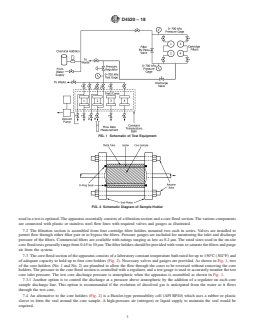
7.1 A schematic diagram of the test apparatus is shown in Fig. 1. The component parts are assembled from commercially
available laboratory apparatus with the exception of the core holders (Fig. 2). While four cores are shown in Fig. 1 the number
D4520 − 18
FIG. 1 Schematic of Test Equipment
FIG. 2 Schematic Diagram of Sample Holder
used in a test is optional. The apparatus essentially consists of a filtration section and a core flood section. The various components
are connected with plastic or stainless steel flow lines with required valves and gauges as illustrated.
7.2 The filtration section is assembled from four cartridge filter holders mounted two each in series. Valves are installed to
permit flow through either filter pair or to bypass the filters. Pressure gauges are included for monitoring the inlet and discharge
pressure of the filters. Commercial filters are available with ratings ranging as low as 0.2 μm. The rated sizes used in the on-site
core flood tests generally range from 0.45 to 10 μm. The filter holders should be provided with vents to saturate the filters and purge
air from the system.
7.3 The core flood section of the apparatus consists of a laboratory constant temperature bath rated for up to 150°C (302°F) and
of adequate capacity to hold up to four core holders (Fig. 2). Necessary valves and gauges are provided. As shown in Fig. 1, two
of the core holders (No. 1 and No. 2) are plumbed to allow the flow through the cores to be reversed without removing the core
holders. The pressure to the core flood section is controlled with a regulator, and a test gauge is used to accurately monitor the test
core inlet pressure. The test core discharge pressure is atmospheric when the apparatus is assembled as shown in Fig. 1.
7.3.1 Another option is to control the discharge at a pressure above atmospheric by the addition of a regulator on each core
sample discharge line. This option is recommended if the evolution of dissolved gas is anticipated from the water as it flows
through the test core.
7.4 An alternative to the core holders (Fig. 2) is a Hassler-type permeability cell (API RP40) which uses a rubber or plastic
sleeve to form the seal around the core sample. A high-pressure air (nitrogen) or liquid supply to maintain the seal would be
required.
D4520 − 18
7.5 The operating gauge pressure of the test apparatus is usually 700 kPa (100 psig) or less.
7.6 As shown in Fig. 1, facilities may also be provided for the addition of chemicals to the water being tested. A chemical supply
tank and an injection pump with pressure and flow ratings corresponding to specific needs would be required.
7.7 The apparatus is attached to a line carrying the water being tested. Usually, the line pressure of the water source (regulated
as required) satisfies the pressure requirement for flowing the water through the filters and test cores. If the supply pressure is
insufficient, a small pump capable of delivering about 1 L/min at 700 kPa is used.
7.8 Other required apparatus are the following:
7.8.1 Mechanical (non-aspirator type) vacuum pump,
7.8.2 Assorted beakers (250 to 1000 mL),
7.8.3 Assorted graduated cylinders (10 to 100 mL),
7.8.4 Stopwatch,
7.8.5 Vacuum tubing, and
7.8.6 Assorted tools for assembling and disassembling the equipment as required.
8. Procedure
8.1 Core Selection:
8.1.1 Choose proper core samples to yield the most meaningful test results through close coordination with geologists, chemists,
and engineers responsible for the water injection project.
8.1.2 To assist in that choice include well logs, mineralogy, porosity, pore size distribution, permeability, and other core
descriptive data.
8.1.3 Choose test cores to represent the zones that will receive the injected water. The best samples are from whole cores cut
from those zones. Prepare sufficient samples to represent the ranges of permeability, porosity, and mineralogy of the injected zones.
Consider the presence of natural fractures.
8.1.4 Select the number and properties of the cores for a particular test according to one of the following options:
8.1.4.1 Use cores having similar properties (porosity, permeability, mineralogy, etc.). Average the results.
8.1.4.2 Use a set of cores with one of these properties different in each core to test the effect of this property on the test results.
8.1.5 If cores from the flooded zone are not available, choose another zone with similar properties as the next best alternative
sample source. As a third choice use synthetic core material (alumina, silica, porous glass, etc.).
D4520 − 18
8.2 Core Sample Preparation:
8.2.1 Follow the recommended procedures for core handling, preservation, cutting, and cleaning described in API RP40. (This
extensive document describes various procedures and options that the investigator may choose depending on the type and condition
of the cores being tested.) Related ASTM standards are Guide D420, Test Method D2434, and Test Method D4404.
8.2.2 The preferred sample dimensions for the core flood test are 19 mm (0.75 in.) to 38 mm (1.5 in.) outside diameter with
a minimum length to diameter ratio of 1:0.
8.2.3 Carry out the following procedure for each core sample in the set to be tested:
8.2.3.1 Cut the core sample parallel to the formation bedding plane and then clean by solvent-extraction to remove residual
hydrocarbons and water from the pore space. Dry the sample and determine the porosity according to the recommended procedures
in API RP40.
8.2.3.2 Use the air permeability of the core sample as a guide for choosing representative samples of the formation being tested.
The procedure for measuring air permeabilities is described in API RP27.
8.2.3.3 Seal the core sample with an epoxy resin or other suitable sealant in a metal (stainless steel, aluminum, brass) tube
having an inside diameter about 6.4 mm (0.25 in.) larger than the outside diameter of the sample.
8.2.3.4 Machine the ends of the core sample and metal tube flat and perpendicular to the tube axis. Generally a stream of
compressed air on the core ends during machining will prevent the intrusion of fines into the rock pores.
8.2.3.5 Mount the metal tube (containing the core sample) in a holder designed to allow water to be flowed through the sample.
An example of such a sample holder is shown schematically in Fig. 2.
8.3 Vacuum Saturation of Test Cores:
8.3.1 Install a 10-μm rated cartridge in filter No. 1 and a 0.45-μm cartridge in filter No. 2. Close valves to and from filters No.
3 and No. 4, the filter bypass valve, and valves to all core sample holders.
8.3.2 Open the valve-to-waste upstream and downstream of the regulator and the valves to and from filters No. 1 and No. 2.
Start water flow through the filters to waste.
8.3.3 Close the valve-to-waste upstream of the pressure regulator. Set the regulator at about 120 kPa (17 psi) more than the
pressure planned for the test. After abou
...