

ASTM E1139/E1139M-17
(Practice)Standard Practice for Continuous Monitoring of Acoustic Emission from Metal Pressure Boundaries
General Information
- Abstract
SIGNIFICANCE AND USE
5.1 Acoustic emission examination of a structure requires application of a mechanical or thermal stimulus. In this case, the system operating conditions provide the stimulation. During operation of the pressurized system, AE from active discontinuities such as cracks or from other acoustic sources such as leakage of high-pressure, high-temperature fluids can be detected by an instrumentation system using sensors mounted on the structure. The sensors are acoustically coupled to the surface of the structure by means of a couplant material or pressure on the interface between the sensing device and the structure. This facilitates the transmission of acoustic energy to the sensor. When the sensors are excited by acoustic emission energy, they transform the mechanical excitations into electrical signals. The signals from a detected AE source are electronically conditioned and processed to produce information relative to source location and other parameters needed for AE source characterization and evaluation.
5.2 AE monitoring on a continuous basis is a currently available method for continuous surveillance of a structure to assess its continued integrity. The use of AE monitoring in this context is to identify the existence and location of AE sources. Also, information is provided to facilitate estimating the significance of the detected AE source relative to continued pressure system operation.
5.3 Source location accuracy is influenced by factors that affect elastic wave propagation, by sensor coupling, and by signal processor settings.
5.4 It is possible to measure AE and identify AE source locations of indications that cannot be detected by other NDT methods, due to factors related to methodological, material, or structural characteristics.
5.5 In addition to immediate evaluation of the AE sources, a permanent record of the total data collected (AE plus pressure system parameters measured) provides an archival record which can be re-evaluated.
SCOPE
1.1 This practice provides guidelines for continuous monitoring of acoustic emission (AE) from metal pressure boundaries in industrial systems during operation. Examples are pressure vessels, piping, and other system components which serve to contain system pressure. Pressure boundaries other than metal, such as composites, are specifically not covered by this document.
1.2 The functions of AE monitoring are to detect, locate, and characterize AE sources to provide data to evaluate their significance relative to pressure boundary integrity. These sources are those activated during system operation, that is, no special stimulus is applied to produce AE. Other methods of nondestructive testing (NDT) may be used, when the pressure boundary is accessible, to further evaluate or substantiate the significance of detected AE sources.
1.3 Units—The values stated in either SI units or inch-pound units are to be regarded as standard. The values stated in each system may not be exact equivalents; therefore, each system shall be used independently of the other. Combining values from the two systems may result in non-conformance with the standards.
1.4 This standard does not purport to address all of the safety concerns, if any, associated with its use. It is the responsibility of the user of this standard to establish appropriate safety and health practices and determine the applicability of regulatory limitations prior to use. For specific precautionary statements, see Section 6.
1.5 This international standard was developed in accordance with internationally recognized principles on standardization established in the Decision on Principles for the Development of International Standards, Guides and Recommendations issued by the World Trade Organization Technical Barriers to Trade (TBT) Committee.
- Status
- Published
- Publication Date
- 31-May-2017
- Technical Committee
- E07 - Nondestructive Testing
- Drafting Committee
- E07.04 - Acoustic Emission Method
Buy Documents
ASTM E1139/E1139M-17 - Standard Practice for Continuous Monitoring of Acoustic Emission from Metal Pressure Boundaries
REDLINE ASTM E1139/E1139M-17 - Standard Practice for Continuous Monitoring of Acoustic Emission from Metal Pressure Boundaries
Overview
ASTM E1139/E1139M-17: Standard Practice for Continuous Monitoring of Acoustic Emission from Metal Pressure Boundaries provides comprehensive guidelines for the continuous surveillance of metal pressure-containing components using Acoustic Emission (AE) monitoring. This international standard is especially relevant for industrial systems such as pressure vessels, piping, and related infrastructure that serve to maintain and contain system pressure.
By leveraging the natural operating conditions of pressurized systems, AE monitoring detects sound waves produced by active discontinuities-such as crack propagation or leaks from high-pressure, high-temperature fluids-using strategically mounted sensors. This practice enables real-time, non-intrusive detection and evaluation of structural integrity, offering valuable advantages over conventional nondestructive testing (NDT) methods.
Key Topics
- Continuous AE Monitoring: Describes the use of passive acoustic sensors attached directly to metal pressure boundaries to detect events such as cracks or leaks in real time, without requiring external mechanical or thermal stimulation.
- Detection and Characterization: Outlines procedures for identifying the existence, location, and significance of AE sources related to the integrity of pressure boundaries, supporting informed operational decisions.
- System Setup and Installation: Provides recommendations for sensor coupling, system calibration, sensitivity verification, and ensuring proper sensor placement for optimal monitoring accuracy.
- Data Acquisition and Processing: Covers requirements for raw and processed data storage, real-time analysis, alert mechanisms for leak detection, and long-term data archiving for regulatory and operational review.
- Performance Validation: Specifies necessary system checks before and after installation, including sensitivity, dynamic range, noise performance, and source location accuracy.
- Personnel Qualification: Emphasizes the importance of qualified professionals in AE monitoring and references recognized certification standards for operators and agencies.
- Safety Considerations: Advises on the development and approval of detailed safety plans, especially for hazardous or regulated environments.
Applications
Continuous Acoustic Emission (AE) monitoring as defined by ASTM E1139/E1139M-17 is widely used in:
- Power Generation Facilities: Monitoring of boilers, turbines, and pressurized piping in conventional and nuclear power plants, where early detection of flaws is critical for safety and reliability.
- Petrochemical and Chemical Plants: Ongoing surveillance of large pressure vessels, reactors, and transport pipelines to identify leaks, corrosion-related defects, or crack growth before catastrophic failure.
- Industrial Manufacturing: Quality assurance for pressure vessels and piping during operational cycles, including startup and shutdown periods, where the risk of flaw growth is heightened.
- Maintenance and Life Extension: Supporting asset integrity management through long-term trend analysis and archival data, aiding decisions on repairs, re-certification, or retirement of components.
The AE monitoring approach allows detection of flaws that may not be accessible or detectable by other NDT methods due to structural, material, or access limitations. This enhances both the safety and operational uptime of critical infrastructure.
Related Standards
For effective implementation and integration, ASTM E1139/E1139M-17 references and aligns with several other international and industry standards, including:
- ASTM E543 - Specification for Agencies Performing Nondestructive Testing
- ASTM E569 - Practice for Acoustic Emission Monitoring of Structures During Controlled Stimulation
- ASTM E650 - Guide for Mounting Piezoelectric Acoustic Emission Sensors
- ASTM E750 - Practice for Characterizing Acoustic Emission Instrumentation
- ASTM E1316 - Terminology for Nondestructive Examinations
- ISO 9712 - Non-Destructive Testing: Qualification and Certification of NDT Personnel
- SNT-TC-1A and ANSI/ASNT CP-189 - Practices and Standards for NDT Personnel Certification
- NAS-410 - Certification and Qualification of Nondestructive Testing Personnel (Aerospace)
These standards offer additional technical requirements and recommendations for equipment, procedures, personnel competence, and terminology, complementing the framework established in ASTM E1139/E1139M-17 for enhanced reliability and regulatory compliance in acoustic emission monitoring.
Relations
- Effective Date
- 01-Jun-2017
- Effective Date
- 01-Feb-2024
- Effective Date
- 01-Jun-2020
- Effective Date
- 01-Dec-2019
- Effective Date
- 01-Mar-2019
- Effective Date
- 01-Jan-2018
- Effective Date
- 15-Jun-2017
- Effective Date
- 01-Feb-2017
- Effective Date
- 01-Aug-2016
- Effective Date
- 01-Feb-2016
- Effective Date
- 01-Dec-2015
- Effective Date
- 01-Dec-2015
- Effective Date
- 01-Dec-2015
- Effective Date
- 01-Sep-2015
- Effective Date
- 01-Jun-2014
Buy Documents
ASTM E1139/E1139M-17 - Standard Practice for Continuous Monitoring of Acoustic Emission from Metal Pressure Boundaries
REDLINE ASTM E1139/E1139M-17 - Standard Practice for Continuous Monitoring of Acoustic Emission from Metal Pressure Boundaries
Get Certified
Connect with accredited certification bodies for this standard

BSMI (Bureau of Standards, Metrology and Inspection)
Taiwan's standards and inspection authority.
Sponsored listings
Frequently Asked Questions
ASTM E1139/E1139M-17 is a standard published by ASTM International. Its full title is "Standard Practice for Continuous Monitoring of Acoustic Emission from Metal Pressure Boundaries". This standard covers: SIGNIFICANCE AND USE 5.1 Acoustic emission examination of a structure requires application of a mechanical or thermal stimulus. In this case, the system operating conditions provide the stimulation. During operation of the pressurized system, AE from active discontinuities such as cracks or from other acoustic sources such as leakage of high-pressure, high-temperature fluids can be detected by an instrumentation system using sensors mounted on the structure. The sensors are acoustically coupled to the surface of the structure by means of a couplant material or pressure on the interface between the sensing device and the structure. This facilitates the transmission of acoustic energy to the sensor. When the sensors are excited by acoustic emission energy, they transform the mechanical excitations into electrical signals. The signals from a detected AE source are electronically conditioned and processed to produce information relative to source location and other parameters needed for AE source characterization and evaluation. 5.2 AE monitoring on a continuous basis is a currently available method for continuous surveillance of a structure to assess its continued integrity. The use of AE monitoring in this context is to identify the existence and location of AE sources. Also, information is provided to facilitate estimating the significance of the detected AE source relative to continued pressure system operation. 5.3 Source location accuracy is influenced by factors that affect elastic wave propagation, by sensor coupling, and by signal processor settings. 5.4 It is possible to measure AE and identify AE source locations of indications that cannot be detected by other NDT methods, due to factors related to methodological, material, or structural characteristics. 5.5 In addition to immediate evaluation of the AE sources, a permanent record of the total data collected (AE plus pressure system parameters measured) provides an archival record which can be re-evaluated. SCOPE 1.1 This practice provides guidelines for continuous monitoring of acoustic emission (AE) from metal pressure boundaries in industrial systems during operation. Examples are pressure vessels, piping, and other system components which serve to contain system pressure. Pressure boundaries other than metal, such as composites, are specifically not covered by this document. 1.2 The functions of AE monitoring are to detect, locate, and characterize AE sources to provide data to evaluate their significance relative to pressure boundary integrity. These sources are those activated during system operation, that is, no special stimulus is applied to produce AE. Other methods of nondestructive testing (NDT) may be used, when the pressure boundary is accessible, to further evaluate or substantiate the significance of detected AE sources. 1.3 Units—The values stated in either SI units or inch-pound units are to be regarded as standard. The values stated in each system may not be exact equivalents; therefore, each system shall be used independently of the other. Combining values from the two systems may result in non-conformance with the standards. 1.4 This standard does not purport to address all of the safety concerns, if any, associated with its use. It is the responsibility of the user of this standard to establish appropriate safety and health practices and determine the applicability of regulatory limitations prior to use. For specific precautionary statements, see Section 6. 1.5 This international standard was developed in accordance with internationally recognized principles on standardization established in the Decision on Principles for the Development of International Standards, Guides and Recommendations issued by the World Trade Organization Technical Barriers to Trade (TBT) Committee.
SIGNIFICANCE AND USE 5.1 Acoustic emission examination of a structure requires application of a mechanical or thermal stimulus. In this case, the system operating conditions provide the stimulation. During operation of the pressurized system, AE from active discontinuities such as cracks or from other acoustic sources such as leakage of high-pressure, high-temperature fluids can be detected by an instrumentation system using sensors mounted on the structure. The sensors are acoustically coupled to the surface of the structure by means of a couplant material or pressure on the interface between the sensing device and the structure. This facilitates the transmission of acoustic energy to the sensor. When the sensors are excited by acoustic emission energy, they transform the mechanical excitations into electrical signals. The signals from a detected AE source are electronically conditioned and processed to produce information relative to source location and other parameters needed for AE source characterization and evaluation. 5.2 AE monitoring on a continuous basis is a currently available method for continuous surveillance of a structure to assess its continued integrity. The use of AE monitoring in this context is to identify the existence and location of AE sources. Also, information is provided to facilitate estimating the significance of the detected AE source relative to continued pressure system operation. 5.3 Source location accuracy is influenced by factors that affect elastic wave propagation, by sensor coupling, and by signal processor settings. 5.4 It is possible to measure AE and identify AE source locations of indications that cannot be detected by other NDT methods, due to factors related to methodological, material, or structural characteristics. 5.5 In addition to immediate evaluation of the AE sources, a permanent record of the total data collected (AE plus pressure system parameters measured) provides an archival record which can be re-evaluated. SCOPE 1.1 This practice provides guidelines for continuous monitoring of acoustic emission (AE) from metal pressure boundaries in industrial systems during operation. Examples are pressure vessels, piping, and other system components which serve to contain system pressure. Pressure boundaries other than metal, such as composites, are specifically not covered by this document. 1.2 The functions of AE monitoring are to detect, locate, and characterize AE sources to provide data to evaluate their significance relative to pressure boundary integrity. These sources are those activated during system operation, that is, no special stimulus is applied to produce AE. Other methods of nondestructive testing (NDT) may be used, when the pressure boundary is accessible, to further evaluate or substantiate the significance of detected AE sources. 1.3 Units—The values stated in either SI units or inch-pound units are to be regarded as standard. The values stated in each system may not be exact equivalents; therefore, each system shall be used independently of the other. Combining values from the two systems may result in non-conformance with the standards. 1.4 This standard does not purport to address all of the safety concerns, if any, associated with its use. It is the responsibility of the user of this standard to establish appropriate safety and health practices and determine the applicability of regulatory limitations prior to use. For specific precautionary statements, see Section 6. 1.5 This international standard was developed in accordance with internationally recognized principles on standardization established in the Decision on Principles for the Development of International Standards, Guides and Recommendations issued by the World Trade Organization Technical Barriers to Trade (TBT) Committee.
ASTM E1139/E1139M-17 is classified under the following ICS (International Classification for Standards) categories: 17.140.01 - Acoustic measurements and noise abatement in general. The ICS classification helps identify the subject area and facilitates finding related standards.
ASTM E1139/E1139M-17 has the following relationships with other standards: It is inter standard links to ASTM E1139/E1139M-12, ASTM E1316-24, ASTM E750-15(2020), ASTM E1316-19b, ASTM E1316-19, ASTM E1316-18, ASTM E1316-17a, ASTM E1316-17, ASTM E1316-16a, ASTM E1316-16, ASTM E1316-15a, ASTM E750-15, ASTM E2374-15, ASTM E1316-15, ASTM E1316-14. Understanding these relationships helps ensure you are using the most current and applicable version of the standard.
ASTM E1139/E1139M-17 is available in PDF format for immediate download after purchase. The document can be added to your cart and obtained through the secure checkout process. Digital delivery ensures instant access to the complete standard document.
Standards Content (Sample)
This international standard was developed in accordance with internationally recognized principles on standardization established in the Decision on Principles for the
Development of International Standards, Guides and Recommendations issued by the World Trade Organization Technical Barriers to Trade (TBT) Committee.
Designation: E1139/E1139M − 17
Standard Practice for
Continuous Monitoring of Acoustic Emission from Metal
Pressure Boundaries
ThisstandardisissuedunderthefixeddesignationE1139/E1139M;thenumberimmediatelyfollowingthedesignationindicatestheyear
of original adoption or, in the case of revision, the year of last revision. A number in parentheses indicates the year of last reapproval.
A superscript epsilon (´) indicates an editorial change since the last revision or reapproval.
1. Scope* 2. Referenced Documents
2.1 ASTM Standards:
1.1 This practice provides guidelines for continuous moni-
E543 Specification for Agencies Performing Nondestructive
toring of acoustic emission (AE) from metal pressure bound-
Testing
aries in industrial systems during operation. Examples are
E569 Practice for Acoustic Emission Monitoring of Struc-
pressure vessels, piping, and other system components which
tures During Controlled Stimulation
serve to contain system pressure. Pressure boundaries other
E650 Guide for Mounting Piezoelectric Acoustic Emission
than metal, such as composites, are specifically not covered by
Sensors
this document.
E750 Practice for Characterizing Acoustic Emission Instru-
1.2 The functions of AE monitoring are to detect, locate,
mentation
and characterize AE sources to provide data to evaluate their
E976 GuideforDeterminingtheReproducibilityofAcoustic
significance relative to pressure boundary integrity. These
Emission Sensor Response
sources are those activated during system operation, that is, no
E1316 Terminology for Nondestructive Examinations
special stimulus is applied to produce AE. Other methods of
E2374 Guide for Acoustic Emission System Performance
nondestructive testing (NDT) may be used, when the pressure
Verification
boundary is accessible, to further evaluate or substantiate the
2.2 Aerospace Industries Association:
significance of detected AE sources.
NAS-410 Certification and Qualification of Nondestructive
1.3 Units—The values stated in either SI units or inch-
Testing Personnel
pound units are to be regarded as standard.The values stated in
2.3 Other Documents:
each system may not be exact equivalents; therefore, each
SNT-TC-1A Recommended Practice for Nondestructive
system shall be used independently of the other. Combining
Testing Personnel Qualification and Certification
values from the two systems may result in non-conformance
ANSI/ASNT CP-189 ASNT Standard for Qualification and
with the standards.
Certification of Nondestructive Testing Personnel
1.4 This standard does not purport to address all of the
2.4 ISO Standard:
safety concerns, if any, associated with its use. It is the ISO 9712 Non-Destructive Testing: Qualification and Certi-
responsibility of the user of this standard to establish appro-
fication of NDT Personnel
priate safety and health practices and determine the applica-
3. Terminology
bility of regulatory limitations prior to use. For specific
precautionary statements, see Section 6.
3.1 Definitions:
1.5 This international standard was developed in accor-
3.1.1 For definitions of terms used in this practice, refer to
dance with internationally recognized principles on standard- Terminology E1316.
ization established in the Decision on Principles for the
Development of International Standards, Guides and Recom-
For referenced ASTM standards, visit the ASTM website, www.astm.org, or
mendations issued by the World Trade Organization Technical
contact ASTM Customer Service at service@astm.org. For Annual Book of ASTM
Barriers to Trade (TBT) Committee.
Standards volume information, refer to the standard’s Document Summary page on
the ASTM website.
Available fromAerospace IndustriesAssociation ofAmerica, Inc. (AIA), 1000
WilsonBlvd.,Suite1700,Arlington,VA22209-3928,http://www.aia-aerospace.org.
This practice is under the jurisdiction of ASTM Committee E07 on Nonde-
structive Testing and is the direct responsibility of Subcommittee E07.04 on AvailablefromAmericanSocietyforNondestructiveTesting(ASNT),P.O.Box
Acoustic Emission Method. 28518, 1711 Arlingate Ln., Columbus, OH 43228-0518, http://www.asnt.org.
Current edition approved June 1, 2017. Published June 2017. Originally Available from International Organization for Standardization (ISO), ISO
approved in 1987. Last previous edition approved in 2012 as E1193 - 12. DOI: Central Secretariat, BIBC II, Chemin de Blandonnet 8, CP 401, 1214 Vernier,
10.1520/E1139-17. Geneva, Switzerland, http://www.iso.org.
*A Summary of Changes section appears at the end of this standard
Copyright © ASTM International, 100 Barr Harbor Drive, PO Box C700, West Conshohocken, PA 19428-2959. United States
E1139/E1139M − 17
3.2 Definitions of Terms Specific to This Standard: 5.4 It is possible to measure AE and identify AE source
3.2.1 continuous monitoring—the process of monitoring a locations of indications that cannot be detected by other NDT
pressure boundary continuously to detect acoustic emission methods, due to factors related to methodological, material, or
during system operation and also during system shut-down structural characteristics.
testing such as hydrostatic testing.
5.5 In addition to immediate evaluation of the AE sources,
3.2.2 raw data—data values determined directly from mea-
apermanentrecordofthetotaldatacollected(AEpluspressure
surement of analog inputs.These could include emission count system parameters measured) provides an archival record
or emission event count, or both, relative time of signal arrival
which can be re-evaluated.
at different sensors (delta time), signal rise time, peak signal
6. Hazards
amplitude, RMS signal level, pressure system pressure and
temperature, and the like.
6.1 Warning—Application of this practice will inherently
3.2.3 processed data—data resulting from analysis of raw involve work in an operating plant. This may involve potential
exposuretohazardousmaterialsandequipmentand,inthecase
data. Included would be AE source location coordinates, AE
versus time from a given source area, AE signal amplitude of nuclear power plants, exposure to nuclear radiation. A
written safety plan shall be prepared for each monitoring
versus time, and the like.
installation which defines requirements to be observed to
protectpersonnelsafety,safetyoftheplantsystem,andtomeet
4. Summary of Practice
administrative and legal needs. This plan shall be approved by
4.1 This practice describes the use of a passive monitoring
all parties prior to start of work on the plant.
system to detect, locate, and characterize AE sources, in order
to evaluate their significance to the integrity of metal pressure
7. Basis of Application
boundaries.
7.1 The following items are subject to contractual agree-
4.2 The practice provides guidelines for selection,
ment between the parties using or referencing this practice.
qualification, verification, and installation of the AE monitor-
7.2 Personnel Qualification
ing system. Qualification of personnel is also addressed.
7.2.1 If specified in the contractual agreement, personnel
4.3 The practice provides guidelines for using the AE
performing examinations to this practice shall be qualified in
information to estimate the significance of a detected AE
accordance with a nationally or internationally recognized
source with respect to continued pressure system operation.
NDT personnel qualification practice or standard such as
ANSI/ASNT-CP-189, SNT-TC-1A, NAS-410, ISO 9712, or a
5. Significance and Use
similar document and certified by the employer or certifying
5.1 Acoustic emission examination of a structure requires agency, as applicable. The practice or standard used and its
application of a mechanical or thermal stimulus. In this case, applicable revision shall be identified in the contractual agree-
the system operating conditions provide the stimulation. Dur- ment between the using parties.
ing operation of the pressurized system, AE from active
7.3 Qualification of Nondestructive Agencies
discontinuities such as cracks or from other acoustic sources
7.3.1 If specified in the contractual agreement, NDT agen-
such as leakage of high-pressure, high-temperature fluids can
cies shall be qualified and evaluated as described in Practice
be detected by an instrumentation system using sensors
E543. The applicable edition of Practice E543 shall be speci-
mounted on the structure. The sensors are acoustically coupled
fied in the contractual agreement.
to the surface of the structure by means of a couplant material
7.4 Qualification of Nondestructive Testing Agencies—If
or pressure on the interface between the sensing device and the
specified in the contractual agreement, NDT agencies shall be
structure.This facilitates the transmission of acoustic energy to
qualified and evaluated as described in Practice E543. The
the sensor. When the sensors are excited by acoustic emission
applicable edition of E543 shall be specified in the contractual
energy, they transform the mechanical excitations into electri-
agreement.
cal signals. The signals from a detected AE source are
electronically conditioned and processed to produce informa- 7.5 Timing of Examination—The timing of examination
tion relative to source location and other parameters needed for shall be continuous, in accordance with 1.1 unless otherwise
AE source characterization and evaluation. specified.
5.2 AE monitoring on a continuous basis is a currently 7.6 Extent of Examination—The extent of examination shall
available method for continuous surveillance of a structure to be that part of the pressure boundary in the coverage range of
assess its continued integrity. The use ofAE monitoring in this the mounted acoustic emission sensors, unless otherwise speci-
context is to identify the existence and location ofAE sources. fied.
Also, information is provided to facilitate estimating the
7.7 Reporting Criteria/Acceptance Criteria—Reporting cri-
significance of the detected AE source relative to continued
teria for the examination results shall be in accordance with
pressure system operation.
Section14unlessotherwisespecified.Sinceacceptancecriteria
5.3 Source location accuracy is influenced by factors that (for example, for reference radiographs) are not specified in
affect elastic wave propagation, by sensor coupling, and by this practice, they shall be specified in the contractual agree-
signal processor settings. ment.
E1139/E1139M − 17
7.8 Reexamination of Repaired/Reworked Items— chanical vibration, and the like) for an extended period of
Reexamination of repaired/reworked items is not addressed in continuous exposure. The minimum length of this period will
this practice and if required shall be specified in the contractual be dictated by accessibility to the location to change sensors,
agreement. and by economic considerations.
8.1.3 Signal Amplification—For those AE systems that use
7.9 Routine operation of the acoustic emission system for
gain adjustments, appropriate signal amplification in the range
collection and a cursory review of the data may be performed
of 0 to 60 dB is usually required to achieve an adequate AE
by a competent plant engineer not necessarily specialized in
signal level for measurement of signal parameters in digitalAE
acoustic emission. However, acoustic emission system opera-
systems. Due to the very small magnitude of energy involved
tion and data interpretation should be verified by a qualified
inanAEsource,itisdesirabletolocatethesignalamplification
acoustic emission specialist on approximately six-month inter-
as near as possible to the output of the sensor.This is beneficial
valsorsoonerifthesystemappearstobemalfunctioningorthe
in controlling noise interference and AE signal transmission
data appear unusual.
loss. These preamplifiers must have low inherent electronic
8. Monitoring System Functional Requirements and
background noise. Resistance of the amplifier circuits to the
Qualification
environment (temperature, moisture, nuclear radiation, me-
chanical vibration, and the like) must be considered and
8.1 Functional Requirements:
appropriate steps taken to protect them.
8.1.1 The monitoring system must include the functional
capabilities shown in Fig. 1 which also shows a suggested
NOTE 1—When used herein, peak means zero to peak voltage.
sequence of monitoring system functions.
8.1.4 Monitoring Frequency Band—Thefrequencyresponse
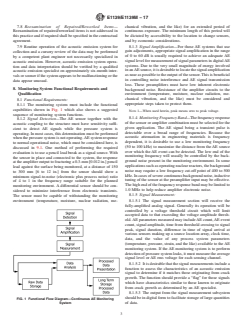
8.1.2 Signal Detection—The AE sensor together with the
of the sensor or amplifier combination must be selected for the
acoustic coupling to the structure must have sensitivity suffi-
given application. The AE signal being a transient pulse is
cient to detect AE signals while the pressure system is
detectable over a broad range of frequencies. Because the
operating. In most cases, this determination must be performed
acoustic attenuation in engineering materials is frequency
when the pressure system is not operating.AE system response
dependent, it is desirable to use a low monitoring frequency
to normal operational noise, which must be considered here, is
(50 to 100 kHz) to maximize the distance from the AE source
discussed in 9.1. One method of performing the required
over which the AE event can be detected. The low end of the
evaluation is to use a pencil lead break as a signal source.With
monitoring frequency will usually be controlled by the back-
the sensor in place and connected to the system, the response
ground noise present in the monitoring environment. In some
at the amplifier output to fracturing a 0.3-mm [0.012 in.] pencil
applicationssuchasoperatingnuclearreactors,thebackground
lead against the surface being monitored, at a distance of 150
noise may require a low frequency cut-off point of 400 to 500
to 300 mm [6 to 12 in.] from the sensor should show a
kHz.Incasesofseverecontinuousbackgroundnoise,inductive
minimum signal-to-noise (electronic plus process noise) ratio
tuning of the sensor at the preamplifier input may be effective.
of 4 to 1 in the frequency range suitable for the planned
The high end of the frequency response band may be limited to
monitoring environment. A differential sensor should be con-
1.0 MHz to help reduce amplifier electronic noise.
sidered to minimize interference from electronic transients.
8.1.5 Signal Measurement:
The sensor must be capable of withstanding the monitoring
environment (temperature, moisture, nuclear radiation, me-
8.1.5.1 The signal measurement section will receive the
fully-amplified analog signal. Generally its operation will be
controlled by a voltage threshold circuit which will limit
accepted data to that exceeding the voltage amplitude thresh-
old.AE parameters measured may includeAE count,AE event
count, signal amplitude, time from threshold crossing to signal
peak, signal duration, difference in time of signal arrival at
various sensors making up a source location array, clock time,
data, and the value of any process system parameters
(temperature, pressure, strain, and the like) available to theAE
monitoring system. If the AE monitoring system is to perform
detectionofpressuresystemleaks,itmustmeasuretheaverage
signal level or AE rms voltage for each sensing channel.
8.1.5.2 Itisdesirablethatthesignalmeasurementsincludea
function to assess the characteristics of an acoustic emission
signal to determine if it matches those originating from crack
growth. The function should provide a “flag” for those signals
which have characteristics similar to those known to originate
from crack growth as determined by an AE specialist.
8.1.5.3 The output from the signal measurement subsystem
should be in digital form to facilitate storage of large quantities
FIG. 1 Functional Flow Diagram—Continuous AE Monitoring
System of data.
E1139/E1139M − 17
8.1.6 Raw Data Storage—The AE monitoring system must system integrity. The volume of information to be stored will
include a raw digital data storage feature to facilitate retention beinherentlylarge.Digitalmassstorageplusselectedprintouts
of the output from the signal measurement subsystem. This or plots of analyzed information is a suggested approach. The
serves as a backup in the event that the data analysis process time period for storage will be influenced by two consider-
malfunctions, for example, incorrect operation of the data ations: (1) legal requirements for maintaining records, and (2)
analyzer or loss of power which might destroy data in a the need for engineering analysis data base information.
computer memory. The raw data storage device must be
8.2 General System Requirements:
compact with a high capacity and be nonvolatile. The data
8.2.1 Data processing rate of the total monitoring system is
retention period will be governed by the operating character-
a very important consideration.This will vary with the purpose
istics of the pressure system and by plant procedures. The
of the pressure system surveillance. If the objective is solely to
storage devi
...
This document is not an ASTM standard and is intended only to provide the user of an ASTM standard an indication of what changes have been made to the previous version. Because
it may not be technically possible to adequately depict all changes accurately, ASTM recommends that users consult prior editions as appropriate. In all cases only the current version
of the standard as published by ASTM is to be considered the official document.
Designation: E1139/E1139M − 12 E1139/E1139M − 17
Standard Practice for
Continuous Monitoring of Acoustic Emission from Metal
Pressure Boundaries
This standard is issued under the fixed designation E1139/E1139M; the number immediately following the designation indicates the year
of original adoption or, in the case of revision, the year of last revision. A number in parentheses indicates the year of last reapproval.
A superscript epsilon (´) indicates an editorial change since the last revision or reapproval.
1. Scope*
1.1 This practice provides guidelines for continuous monitoring of acoustic emission (AE) from metal pressure boundaries in
industrial systems during operation. Examples are pressure vessels, piping, and other system components which serve to contain
system pressure. Pressure boundaries other than metal, such as composites, are specifically not covered by this document.
1.2 The functions of AE monitoring are to detect, locate, and characterize AE sources to provide data to evaluate their
significance relative to pressure boundary integrity. These sources are those activated during system operation, that is, no special
stimulus is applied to produce AE. Other methods of nondestructive testing (NDT) may be used, when the pressure boundary is
accessible, to further evaluate or substantiate the significance of detected AE sources.
1.3 Units—The values stated in either SI units or inch-pound units are to be regarded as standard. The values stated in each
system may not be exact equivalents; therefore, each system shall be used independently of the other. Combining values from the
two systems may result in non-conformance with the standards.
1.4 This standard does not purport to address all of the safety concerns, if any, associated with its use. It is the responsibility
of the user of this standard to establish appropriate safety and health practices and determine the applicability of regulatory
limitations prior to use. For specific precautionary statements, see Section 6.
1.5 This international standard was developed in accordance with internationally recognized principles on standardization
established in the Decision on Principles for the Development of International Standards, Guides and Recommendations issued
by the World Trade Organization Technical Barriers to Trade (TBT) Committee.
2. Referenced Documents
2.1 ASTM Standards:
E543 Specification for Agencies Performing Nondestructive Testing
E569 Practice for Acoustic Emission Monitoring of Structures During Controlled Stimulation
E650 Guide for Mounting Piezoelectric Acoustic Emission Sensors
E750 Practice for Characterizing Acoustic Emission Instrumentation
E976 Guide for Determining the Reproducibility of Acoustic Emission Sensor Response
E1316 Terminology for Nondestructive Examinations
E2374 Guide for Acoustic Emission System Performance Verification
2.2 Aerospace Industries Association:
NAS-410 Certification and Qualification of Nondestructive Testing Personnel
2.3 Other Documents:
SNT-TC-1A Recommended Practice for Nondestructive Testing Personnel Qualification and Certification
ANSI/ASNT CP-189 ASNT Standard for Qualification and Certification of Nondestructive Testing Personnel
2.4 ISO Standard:
ISO 9712 Non-Destructive Testing: Qualification and Certification of NDT Personnel
This practice is under the jurisdiction of ASTM Committee E07 on Nondestructive Testing and is the direct responsibility of Subcommittee E07.04 on Acoustic Emission
Method.
Current edition approved June 15, 2012June 1, 2017. Published July 2012June 2017. Originally approved in 1987. Last previous edition approved in 20072012 as
E1193 - 07.E1193 - 12. DOI: 10.1520/E1139-12.10.1520/E1139-17.
For referenced ASTM standards, visit the ASTM website, www.astm.org, or contact ASTM Customer Service at service@astm.org. For Annual Book of ASTM Standards
volume information, refer to the standard’s Document Summary page on the ASTM website.
Available from Aerospace Industries Association of America, Inc. (AIA), 1000 Wilson Blvd., Suite 1700, Arlington, VA 22209-3928, http://www.aia-aerospace.org.
Available from American Society for Nondestructive Testing (ASNT), P.O. Box 28518, 1711 Arlingate Ln., Columbus, OH 43228-0518, http://www.asnt.org.
Available from International Organization for Standardization (ISO), ISO Central Secretariat, BIBC II, Chemin de Blandonnet 8, CP 401, 1214 Vernier, Geneva,
Switzerland, http://www.iso.org.
*A Summary of Changes section appears at the end of this standard
Copyright © ASTM International, 100 Barr Harbor Drive, PO Box C700, West Conshohocken, PA 19428-2959. United States
E1139/E1139M − 17
3. Terminology
3.1 Definitions:
3.1.1 For definitions of terms used in this practice, refer to Terminology E1316.
3.2 Definitions of Terms Specific to This Standard:
3.2.1 continuous monitoring—the process of monitoring a pressure boundary continuously to detect acoustic emission during
system operation and also during system shut-down testing such as hydrostatic testing.
3.2.2 raw data—data values determined directly from measurement of analog inputs. These could include emission count or
emission event count, or both, relative time of signal arrival at different sensors (delta time), signal rise time, peak signal amplitude,
RMS signal level, pressure system pressure and temperature, and the like.
3.2.3 processed data—data resulting from analysis of raw data. Included would be AE source location coordinates, AE versus
time from a given source area, AE signal amplitude versus time, and the like.
4. Summary of Practice
4.1 This practice describes the use of a passive monitoring system to detect, locate, and characterize AE sources, in order to
evaluate their significance to the integrity of metal pressure boundaries.
4.2 The practice provides guidelines for selection, qualification, verification, and installation of the AE monitoring system.
Qualification of personnel is also addressed.
4.3 The practice provides guidelines for using the AE information to estimate the significance of a detected AE source with
respect to continued pressure system operation.
5. Significance and Use
5.1 Acoustic emission examination of a structure requires application of a mechanical or thermal stimulus. In this case, the
system operating conditions provide the stimulation. During operation of the pressurized system, AE from active discontinuities
such as cracks or from other acoustic sources such as leakage of high-pressure, high-temperature fluids can be detected by an
instrumentation system using sensors mounted on the structure. The sensors are acoustically coupled to the surface of the structure
by means of a couplant material or pressure on the interface between the sensing device and the structure. This facilitates the
transmission of acoustic energy to the sensor. When the sensors are excited by acoustic emission energy, they transform the
mechanical excitations into electrical signals. The signals from a detected AE source are electronically conditioned and processed
to produce information relative to source location and other parameters needed for AE source characterization and evaluation.
5.2 AE monitoring on a continuous basis is a currently available method for continuous surveillance of a structure to assess its
continued integrity. The use of AE monitoring in this context is to identify the existence and location of AE sources. Also,
information is provided to facilitate estimating the significance of the detected AE source relative to continued pressure system
operation.
5.3 Source location accuracy is influenced by factors that affect elastic wave propagation, by sensor coupling, and by signal
processor settings.
5.4 It is possible to measure AE and identify AE source locations of indications that cannot be detected by other NDT methods,
due to factors related to methodological, material, or structural characteristics.
5.5 In addition to immediate evaluation of the AE sources, a permanent record of the total data collected (AE plus pressure
system parameters measured) provides an archival record which can be re-evaluated.
6. Hazards
6.1 Warning—Application of this practice will inherently involve work in an operating plant. This may involve potential
exposure to hazardous materials and equipment and, in the case of nuclear power plants, exposure to nuclear radiation. A written
safety plan shall be prepared for each monitoring installation which defines requirements to be observed to protect personnel safety,
safety of the plant system, and to meet administrative and legal needs. This plan shall be approved by all parties prior to start of
work on the plant.
7. Basis of Application
7.1 The following items are subject to contractual agreement between the parties using or referencing this practice.
7.2 Personnel Qualification
7.2.1 If specified in the contractual agreement, personnel performing examinations to this practice shall be qualified in
accordance with a nationally or internationally recognized NDT personnel qualification practice or standard such as ANSI/ASNT-
CP-189, SNT-TC-1A, NAS-410, ISO 9712, or a similar document and certified by the employer or certifying agency, as applicable.
The practice or standard used and its applicable revision shall be identified in the contractual agreement between the using parties.
E1139/E1139M − 17
7.3 Qualification of Nondestructive Agencies
7.3.1 If specified in the contractual agreement, NDT agencies shall be qualified and evaluated as described in Practice E543.
The applicable edition of Practice E543 shall be specified in the contractual agreement.
7.4 Qualification of Nondestructive Testing Agencies—If specified in the contractual agreement, NDT agencies shall be qualified
and evaluated as described in Practice E543. The applicable edition of E543 shall be specified in the contractual agreement.
7.5 Timing of Examination—The timing of examination shall be continuous, in accordance with 1.1 unless otherwise specified.
7.6 Extent of Examination—The extent of examination shall be that part of the pressure boundary in the coverage range of the
mounted acoustic emission sensors, unless otherwise specified.
7.7 Reporting Criteria/Acceptance Criteria—Reporting criteria for the examination results shall be in accordance with Section
14 unless otherwise specified. Since acceptance criteria (for example, for reference radiographs) are not specified in this practice,
they shall be specified in the contractual agreement.
7.8 Reexamination of Repaired/Reworked Items—Reexamination of repaired/reworked items is not addressed in this practice
and if required shall be specified in the contractual agreement.
7.9 Routine operation of the acoustic emission system for collection and a cursory review of the data may be performed by a
competent plant engineer not necessarily specialized in acoustic emission. However, acoustic emission system operation and data
interpretation should be verified by a qualified acoustic emission specialist on approximately six-month intervals or sooner if the
system appears to be malfunctioning or the data appear unusual.
8. Monitoring System Functional Requirements and Qualification
8.1 Functional Requirements:
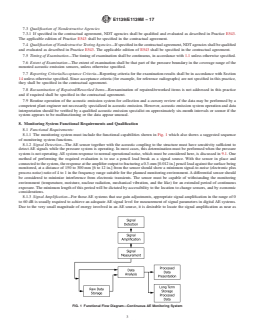
8.1.1 The monitoring system must include the functional capabilities shown in Fig. 1 which also shows a suggested sequence
of monitoring system functions.
8.1.2 Signal Detection—The AE sensor together with the acoustic coupling to the structure must have sensitivity sufficient to
detect AE signals while the pressure system is operating. In most cases, this determination must be performed when the pressure
system is not operating. AE system response to normal operational noise, which must be considered here, is discussed in 9.1. One
method of performing the required evaluation is to use a pencil lead break as a signal source. With the sensor in place and
connected to the system, the response at the amplifier output to fracturing a 0.3-mm [0.012 in.] pencil lead against the surface being
monitored, at a distance of 150 to 300 mm [6 to 12 in.] from the sensor should show a minimum signal-to-noise (electronic plus
process noise) ratio of 4 to 1 in the frequency range suitable for the planned monitoring environment. A differential sensor should
be considered to minimize interference from electronic transients. The sensor must be capable of withstanding the monitoring
environment (temperature, moisture, nuclear radiation, mechanical vibration, and the like) for an extended period of continuous
exposure. The minimum length of this period will be dictated by accessibility to the location to change sensors, and by economic
considerations.
8.1.3 Signal Amplification—For those AE systems that use gain adjustments, appropriate signal amplification in the range of 0
to 60 dB is usually required to achieve an adequate AE signal level for measurement of signal parameters in digital AE systems.
Due to the very small magnitude of energy involved in an AE source, it is desirable to locate the signal amplification as near as
FIG. 1 Functional Flow Diagram—Continuous AE Monitoring System
E1139/E1139M − 17
possible to the output of the sensor. This is beneficial in controlling noise interference and AE signal transmission loss. These
preamplifiers must have low inherent electronic background noise. Resistance of the amplifier circuits to the environment
(temperature, moisture, nuclear radiation, mechanical vibration, and the like) must be considered and appropriate steps taken to
protect them.
NOTE 1—When used herein, peak means zero to peak voltage.
8.1.4 Monitoring Frequency Band—The frequency response of the sensor or amplifier combination must be selected for the
given application. The AE signal being a transient pulse is detectable over a broad range of frequencies. Because the acoustic
attenuation in engineering materials is frequency dependent, it is desirable to use a low monitoring frequency (50 to 100 kHz) to
maximize the distance from the AE source over which the AE event can be detected. The low end of the monitoring frequency
will usually be controlled by the background noise present in the monitoring environment. In some applications such as operating
nuclear reactors, the background noise may require a low frequency cut-off point of 400 to 500 kHz. In cases of severe continuous
background noise, inductive tuning of the sensor at the preamplifier input may be effective. The high end of the frequency response
band may be limited to 1.0 MHz to help reduce amplifier electronic noise.
8.1.5 Signal Measurement:
8.1.5.1 The signal measurement section will receive the fully-amplified analog signal. Generally its operation will be controlled
by a voltage threshold circuit which will limit accepted data to that exceeding the voltage amplitude threshold. AE parameters
measured may include AE count, AE event count, signal amplitude, time from threshold crossing to signal peak, signal duration,
difference in time of signal arrival at various sensors making up a source location array, clock time, data, and the value of any
process system parameters (temperature, pressure, strain, and the like) available to the AE monitoring system. If the AE monitoring
system is to perform detection of pressure system leaks, it must measure the average signal level or AE rms voltage for each
sensing channel.
8.1.5.2 It is desirable that the signal measurements include a function to assess the characteristics of an acoustic emission signal
to determine if it matches those originating from crack growth. The function should provide a “flag” for those signals which have
characteristics similar to those known to originate from crack growth as determined by an AE specialist.
8.1.5.3 The output from the signal measurement subsystem should be in digital form to facilitate storage of large quantities of
data.
8.1.6 Raw Data Storage—The AE monitoring system must include a raw digital data storage feature to facilitate retention of
the output from the signal measurement subsystem. This serves as a backup in the event that the data analysis process malfunctions,
for example, incorrect operation of the data analyzer or loss of power which might destroy data in a computer memory. The raw
data storage device must be compact with a high capacity and be nonvolatile. The data retention period will be governed by the
operating characteristics of the pressure system and by plant procedures. The storage device should include provision to play back
the recorded information directly to the data analysis subsystem or to a peripheral computer.
8.1.7 Data Analysis:
8.1.7.1 One of the major functions of the data analysis section is to determine the source of AE signals. There are two primary
methods used to locate discrete AE signals:
(a) Calculate the source point using the difference in time of signal arrival at the sensors (Δt) in a given source location array.
(b) Utilize the Δt information to enter a “look-up” table which will define an area including the specific Δt location. Either
approach is acceptable. The “look-up” table area resolutio
...