

ASTM D7904-21
(Test Method)Standard Test Method for Determination of Water Vapor (Moisture Concentration) in Natural Gas by Tunable Diode Laser Spectroscopy (TDLAS)
General Information
- Abstract
SIGNIFICANCE AND USE
5.1 Moisture measurement in natural gas is performed to ensure sufficiently low levels for gas purchase contracts and to prevent corrosion. Moisture may also contribute to the formation of hydrates.
5.2 The significance of applying TDLAS for the measurement of moisture in natural gas is TDLAS analyzers may have a very high degree of selectivity and minimal interference in many natural gas streams. Additionally, the sensing components of the analyzer are not wetted by the natural gas, limiting the potential damage from corrosives such as hydrogen sulfide (H2S) and liquid contaminants such as ethylene glycol or compressor oils. As a result, the TDLAS analyzer is able to detect changes in concentration with relatively rapid response. It should be noted that the mirrors of a TDLAS analyzer may be fouled if large quantities of condensed liquids enter the sample cell. In most cases the mirror can be cleaned without the need for recalibration or realignment.
5.3 Primary applications covered in this method are listed in 5.3.1 – 5.3.3. Each application may have differing requirements and methods for gas sampling. Additionally, different natural gas applications may have unique spectroscopic considerations.
5.3.1 Raw natural gas is found in production, gathering sites, and inlets to gas-processing plants characterized by potentially high levels of water (H2O), carbon dioxide (CO2), hydrogen sulfide (H2S), and heavy hydrocarbons. Gas-conditioning plants and skids are normally used to remove H2O, CO2, H2S, and other contaminants. Typical moisture concentration after dehydration is roughly 20 to 200 ppmv. Protection from liquid carryover such as heavy hydrocarbons and glycols in the sample lines is necessary to prevent liquid pooling in the cell or the sample components.
5.3.2 Underground gas storage facilities are high-pressure caverns used to store large volumes of gas for use during peak demand. Underground storage caverns can reach pressures as high as 275 bar. ...
SCOPE
1.1 This test method covers online determination of vapor phase moisture concentration in natural gas using a tunable diode laser absorption spectroscopy (TDLAS) analyzer also known as a “TDL analyzer.” The particular wavelength for moisture measurement varies by manufacturer; typically between 1000 and 10 000 nm with an individual laser having a tunable range of less than 10 nm.
1.2 Process stream pressures can range from 700-mbar to 700-bar gage. TDLAS is performed at pressures near atmospheric (700- to 2000-mbar gage); therefore, pressure reduction is typically required. TDLAS can be performed in vacuum conditions with good results; however, the sample conditioning requirements are different because of higher complexity and a tendency for moisture ingress and are not covered by this test method. Generally speaking, the vent line of a TDL analyzer is tolerant to small pressure changes on the order of 50 to 200 mbar, but it is important to observe the manufacturer’s published inlet pressure and vent pressure constraints. Large spikes or steps in backpressure may affect the analyzer readings.
1.3 The typical sample temperature range is -20 to 65 °C in the analyzer cell. While sample system design is not covered by this standard, it is common practice to heat the sample transport line to around 50 °C to avoid concentration changes associated with adsorption and desorption of moisture along the walls of the sample transport line.
1.4 The moisture concentration range is 1 to 10 000 parts per million by volume (ppmv). It is unlikely that one spectrometer cell will be used to measure this entire range. For example, a TDL spectrometer may have a maximum measurement of 1 ppmv, 100 ppmv, 1000 ppmv, or 10 000 ppmv with varying degrees of accuracy and different lower detection limits.
1.5 TDL absorption spectroscopy measures molar ratios such as ppmv or mole percentage. Volumetric ratios (ppmv and %) are not pressure d...
- Status
- Published
- Publication Date
- 31-Oct-2021
- Technical Committee
- D03 - Gaseous Fuels
- Drafting Committee
- D03.12 - On-Line/At-Line Analysis of Gaseous Fuels
Buy Documents
ASTM D7904-21 - Standard Test Method for Determination of Water Vapor (Moisture Concentration) in Natural Gas by Tunable Diode Laser Spectroscopy (TDLAS)
REDLINE ASTM D7904-21 - Standard Test Method for Determination of Water Vapor (Moisture Concentration) in Natural Gas by Tunable Diode Laser Spectroscopy (TDLAS)
Overview
ASTM D7904-21, published by ASTM International, specifies the standard test method for determining water vapor (moisture concentration) in natural gas using Tunable Diode Laser Absorption Spectroscopy (TDLAS). Accurate moisture measurement is crucial for the natural gas industry to meet contract specifications, prevent corrosion in pipelines and equipment, and mitigate hydrate formation. TDLAS offers a robust, selective, and minimally invasive approach for online vapor phase moisture analysis in natural gas.
Key Topics
Moisture Measurement in Natural Gas
Monitoring moisture levels is essential in natural gas systems to prevent pipeline corrosion, maintain safety, and comply with commercial standards. Excessive water vapor can promote the formation of hydrates and corrode infrastructure.Principles of TDLAS
TDLAS is a non-contact optical method that uses a tunable diode laser to measure the absorption of light at specific wavelengths associated with water vapor. This technique delivers high specificity and sensitivity, with minimal interference from other gas components.Sampling and Sample Conditioning
Moisture measurements require precise sample extraction and conditioning to avoid adsorption or desorption and ensure representative results. It is common practice to heat sample lines, typically to around 50°C, preventing moisture loss or gain.Analyzer Performance and Selectivity
TDLAS analyzers are highly selective for water vapor, showing minimal interference from common contaminants in natural gas such as methane, CO2, and H2S. The analyzer’s sensing components remain dry, reducing vulnerability to corrosive or liquid contaminants.Operating Conditions
The method covers a moisture concentration range of 1 to 10,000 ppmv over sample temperatures from -20°C to 65°C. Process pressures from 700-mbar to 700-bar gage are typical, with TDLAS performed at near-atmospheric pressure after suitable pressure reduction.
Applications
ASTM D7904-21 is applicable across various points in the natural gas value chain, each demanding tailored sampling and conditioning:
Raw Natural Gas Production and Gathering
High-moisture and multi-contaminant environments at wellheads, gathering sites, and plant inlets require robust sample handling and careful conditioning to prevent interference from heavy hydrocarbons, CO2, and glycols.Gas Processing and Dehydration Plants
Post-dehydration, typical moisture levels range from 20 to 200 ppmv. Proper measurement assures gas meets transmission and sales quality standards.Underground Gas Storage
High-pressure storage facilities (often up to 275 bar) present unique sampling demands, necessitating multistage pressure reduction and heating to counteract rapid cooling during pressure drops.Sales Gas & Transmission
Ensuring low water vapor content in sales gas for pipelines, utilities, or power generation. Reliable TDLAS measurements help enforce contract specifications and operational safety.
Related Standards
ASTM D7904-21 references and aligns with several other important standards in the field, including:
- ASTM D1142: Test Method for Water Vapor Content of Gaseous Fuels by Measurement of Dew-Point Temperature
- ASTM D4150: Terminology Relating to Gaseous Fuels
- ASTM D5454: Test Method for Water Vapor Content Using Electronic Moisture Analyzers
- ISO 10715: Natural Gas Sampling Guidelines
- ISO 18453: Correlation Between Water Content and Water Dew Point
These related documents provide supplementary guidance for sampling, terminology, and alternative or complementary analysis methods for moisture in natural gas.
Keywords: ASTM D7904-21, moisture measurement, natural gas, TDLAS, tunable diode laser absorption spectroscopy, water vapor, gas dehydration, gas sampling, pipeline corrosion, hydrates, gas quality standards
Relations
- Effective Date
- 15-Dec-2019
- Effective Date
- 01-Jul-2016
- Effective Date
- 01-Dec-2008
- Effective Date
- 01-Dec-2008
- Effective Date
- 01-Jun-2006
- Effective Date
- 10-Aug-2003
- Effective Date
- 10-May-2003
- Effective Date
- 10-Jun-2000
- Effective Date
- 01-Jan-2000
- Effective Date
- 10-May-1999
Buy Documents
ASTM D7904-21 - Standard Test Method for Determination of Water Vapor (Moisture Concentration) in Natural Gas by Tunable Diode Laser Spectroscopy (TDLAS)
REDLINE ASTM D7904-21 - Standard Test Method for Determination of Water Vapor (Moisture Concentration) in Natural Gas by Tunable Diode Laser Spectroscopy (TDLAS)
Get Certified
Connect with accredited certification bodies for this standard

Element Materials Technology
Materials testing and product certification.

ABS Group Brazil
ABS Group certification services in Brazil.

ABS Quality Evaluations Inc.
American Bureau of Shipping quality certification.
Sponsored listings
Frequently Asked Questions
ASTM D7904-21 is a standard published by ASTM International. Its full title is "Standard Test Method for Determination of Water Vapor (Moisture Concentration) in Natural Gas by Tunable Diode Laser Spectroscopy (TDLAS)". This standard covers: SIGNIFICANCE AND USE 5.1 Moisture measurement in natural gas is performed to ensure sufficiently low levels for gas purchase contracts and to prevent corrosion. Moisture may also contribute to the formation of hydrates. 5.2 The significance of applying TDLAS for the measurement of moisture in natural gas is TDLAS analyzers may have a very high degree of selectivity and minimal interference in many natural gas streams. Additionally, the sensing components of the analyzer are not wetted by the natural gas, limiting the potential damage from corrosives such as hydrogen sulfide (H2S) and liquid contaminants such as ethylene glycol or compressor oils. As a result, the TDLAS analyzer is able to detect changes in concentration with relatively rapid response. It should be noted that the mirrors of a TDLAS analyzer may be fouled if large quantities of condensed liquids enter the sample cell. In most cases the mirror can be cleaned without the need for recalibration or realignment. 5.3 Primary applications covered in this method are listed in 5.3.1 – 5.3.3. Each application may have differing requirements and methods for gas sampling. Additionally, different natural gas applications may have unique spectroscopic considerations. 5.3.1 Raw natural gas is found in production, gathering sites, and inlets to gas-processing plants characterized by potentially high levels of water (H2O), carbon dioxide (CO2), hydrogen sulfide (H2S), and heavy hydrocarbons. Gas-conditioning plants and skids are normally used to remove H2O, CO2, H2S, and other contaminants. Typical moisture concentration after dehydration is roughly 20 to 200 ppmv. Protection from liquid carryover such as heavy hydrocarbons and glycols in the sample lines is necessary to prevent liquid pooling in the cell or the sample components. 5.3.2 Underground gas storage facilities are high-pressure caverns used to store large volumes of gas for use during peak demand. Underground storage caverns can reach pressures as high as 275 bar. ... SCOPE 1.1 This test method covers online determination of vapor phase moisture concentration in natural gas using a tunable diode laser absorption spectroscopy (TDLAS) analyzer also known as a “TDL analyzer.” The particular wavelength for moisture measurement varies by manufacturer; typically between 1000 and 10 000 nm with an individual laser having a tunable range of less than 10 nm. 1.2 Process stream pressures can range from 700-mbar to 700-bar gage. TDLAS is performed at pressures near atmospheric (700- to 2000-mbar gage); therefore, pressure reduction is typically required. TDLAS can be performed in vacuum conditions with good results; however, the sample conditioning requirements are different because of higher complexity and a tendency for moisture ingress and are not covered by this test method. Generally speaking, the vent line of a TDL analyzer is tolerant to small pressure changes on the order of 50 to 200 mbar, but it is important to observe the manufacturer’s published inlet pressure and vent pressure constraints. Large spikes or steps in backpressure may affect the analyzer readings. 1.3 The typical sample temperature range is -20 to 65 °C in the analyzer cell. While sample system design is not covered by this standard, it is common practice to heat the sample transport line to around 50 °C to avoid concentration changes associated with adsorption and desorption of moisture along the walls of the sample transport line. 1.4 The moisture concentration range is 1 to 10 000 parts per million by volume (ppmv). It is unlikely that one spectrometer cell will be used to measure this entire range. For example, a TDL spectrometer may have a maximum measurement of 1 ppmv, 100 ppmv, 1000 ppmv, or 10 000 ppmv with varying degrees of accuracy and different lower detection limits. 1.5 TDL absorption spectroscopy measures molar ratios such as ppmv or mole percentage. Volumetric ratios (ppmv and %) are not pressure d...
SIGNIFICANCE AND USE 5.1 Moisture measurement in natural gas is performed to ensure sufficiently low levels for gas purchase contracts and to prevent corrosion. Moisture may also contribute to the formation of hydrates. 5.2 The significance of applying TDLAS for the measurement of moisture in natural gas is TDLAS analyzers may have a very high degree of selectivity and minimal interference in many natural gas streams. Additionally, the sensing components of the analyzer are not wetted by the natural gas, limiting the potential damage from corrosives such as hydrogen sulfide (H2S) and liquid contaminants such as ethylene glycol or compressor oils. As a result, the TDLAS analyzer is able to detect changes in concentration with relatively rapid response. It should be noted that the mirrors of a TDLAS analyzer may be fouled if large quantities of condensed liquids enter the sample cell. In most cases the mirror can be cleaned without the need for recalibration or realignment. 5.3 Primary applications covered in this method are listed in 5.3.1 – 5.3.3. Each application may have differing requirements and methods for gas sampling. Additionally, different natural gas applications may have unique spectroscopic considerations. 5.3.1 Raw natural gas is found in production, gathering sites, and inlets to gas-processing plants characterized by potentially high levels of water (H2O), carbon dioxide (CO2), hydrogen sulfide (H2S), and heavy hydrocarbons. Gas-conditioning plants and skids are normally used to remove H2O, CO2, H2S, and other contaminants. Typical moisture concentration after dehydration is roughly 20 to 200 ppmv. Protection from liquid carryover such as heavy hydrocarbons and glycols in the sample lines is necessary to prevent liquid pooling in the cell or the sample components. 5.3.2 Underground gas storage facilities are high-pressure caverns used to store large volumes of gas for use during peak demand. Underground storage caverns can reach pressures as high as 275 bar. ... SCOPE 1.1 This test method covers online determination of vapor phase moisture concentration in natural gas using a tunable diode laser absorption spectroscopy (TDLAS) analyzer also known as a “TDL analyzer.” The particular wavelength for moisture measurement varies by manufacturer; typically between 1000 and 10 000 nm with an individual laser having a tunable range of less than 10 nm. 1.2 Process stream pressures can range from 700-mbar to 700-bar gage. TDLAS is performed at pressures near atmospheric (700- to 2000-mbar gage); therefore, pressure reduction is typically required. TDLAS can be performed in vacuum conditions with good results; however, the sample conditioning requirements are different because of higher complexity and a tendency for moisture ingress and are not covered by this test method. Generally speaking, the vent line of a TDL analyzer is tolerant to small pressure changes on the order of 50 to 200 mbar, but it is important to observe the manufacturer’s published inlet pressure and vent pressure constraints. Large spikes or steps in backpressure may affect the analyzer readings. 1.3 The typical sample temperature range is -20 to 65 °C in the analyzer cell. While sample system design is not covered by this standard, it is common practice to heat the sample transport line to around 50 °C to avoid concentration changes associated with adsorption and desorption of moisture along the walls of the sample transport line. 1.4 The moisture concentration range is 1 to 10 000 parts per million by volume (ppmv). It is unlikely that one spectrometer cell will be used to measure this entire range. For example, a TDL spectrometer may have a maximum measurement of 1 ppmv, 100 ppmv, 1000 ppmv, or 10 000 ppmv with varying degrees of accuracy and different lower detection limits. 1.5 TDL absorption spectroscopy measures molar ratios such as ppmv or mole percentage. Volumetric ratios (ppmv and %) are not pressure d...
ASTM D7904-21 is classified under the following ICS (International Classification for Standards) categories: 75.060 - Natural gas. The ICS classification helps identify the subject area and facilitates finding related standards.
ASTM D7904-21 has the following relationships with other standards: It is inter standard links to ASTM D4150-19, ASTM D4150-08(2016), ASTM D4150-08, ASTM D5503-94(2008), ASTM D1142-95(2006), ASTM D4150-03, ASTM D5503-94(2003), ASTM D4150-00, ASTM D1142-95(2000), ASTM D5503-94(1999). Understanding these relationships helps ensure you are using the most current and applicable version of the standard.
ASTM D7904-21 is available in PDF format for immediate download after purchase. The document can be added to your cart and obtained through the secure checkout process. Digital delivery ensures instant access to the complete standard document.
Standards Content (Sample)
This international standard was developed in accordance with internationally recognized principles on standardization established in the Decision on Principles for the
Development of International Standards, Guides and Recommendations issued by the World Trade Organization Technical Barriers to Trade (TBT) Committee.
Designation: D7904 − 21
Standard Test Method for
Determination of Water Vapor (Moisture Concentration) in
Natural Gas by Tunable Diode Laser Spectroscopy (TDLAS)
This standard is issued under the fixed designation D7904; the number immediately following the designation indicates the year of
original adoption or, in the case of revision, the year of last revision. A number in parentheses indicates the year of last reapproval. A
superscript epsilon (´) indicates an editorial change since the last revision or reapproval.
1. Scope 1.5 TDL absorption spectroscopy measures molar ratios
such as ppmv or mole percentage.Volumetric ratios (ppmv and
1.1 This test method covers online determination of vapor
%) are not pressure dependent. Weight-per-volume units such
phase moisture concentration in natural gas using a tunable
as milligrams of water per standard cubic metre or pounds of
diode laser absorption spectroscopy (TDLAS) analyzer also
water per standard cubic foot can be derived from ppmv at a
known as a “TDL analyzer.” The particular wavelength for
specific condition such as standard temperature and pressure
moisture measurement varies by manufacturer; typically be-
(STP). Standard conditions may be defined differently for
tween 1000 and 10 000 nm with an individual laser having a
different regions and entities. The dew point can be estimated
tunable range of less than 10 nm.
from ppmv and pressure. Refer toTest Method D1142 and ISO
1.2 Process stream pressures can range from 700-mbar to
18453.
700-bar gage. TDLAS is performed at pressures near atmo-
1.6 Units—The values stated in SI units are to be regarded
spheric (700- to 2000-mbar gage); therefore, pressure reduc-
as standard. No other units of measurement are included in this
tion is typically required.TDLAS can be performed in vacuum
standard.
conditionswithgoodresults;however,thesampleconditioning
1.7 This standard does not purport to address all of the
requirements are different because of higher complexity and a
safety concerns, if any, associated with its use. It is the
tendency for moisture ingress and are not covered by this test
responsibility of the user of this standard to establish appro-
method. Generally speaking, the vent line of aTDLanalyzer is
priate safety, health, and environmental practices and deter-
tolerant to small pressure changes on the order of 50 to
mine the applicability of regulatory limitations prior to use.
200 mbar, but it is important to observe the manufacturer’s
Some specific hazards statements are given in Section 8 on
published inlet pressure and vent pressure constraints. Large
Hazards.
spikes or steps in backpressure may affect the analyzer read-
1.8 This international standard was developed in accor-
ings.
dance with internationally recognized principles on standard-
1.3 The typical sample temperature range is -20 to 65 °C in
ization established in the Decision on Principles for the
the analyzer cell. While sample system design is not covered
Development of International Standards, Guides and Recom-
by this standard, it is common practice to heat the sample
mendations issued by the World Trade Organization Technical
transport line to around 50 °C to avoid concentration changes
Barriers to Trade (TBT) Committee.
associated with adsorption and desorption of moisture along
the walls of the sample transport line.
2. Referenced Documents
1.4 The moisture concentration range is 1 to 10 000 parts
2.1 ASTM Standards:
per million by volume (ppmv). It is unlikely that one spec-
D1142 Test Method for Water Vapor Content of Gaseous
trometer cell will be used to measure this entire range. For
Fuels by Measurement of Dew-Point Temperature
example, a TDL spectrometer may have a maximum measure-
D4150 Terminology Relating to Gaseous Fuels
ment of 1 ppmv, 100 ppmv, 1000 ppmv, or 10 000 ppmv with
D5503 Practice for Natural Gas Sample-Handling and Con-
varying degrees of accuracy and different lower detection
ditioning Systems for Pipeline Instrumentation (With-
limits.
drawn 2017)
1 2
ThistestmethodisunderthejurisdictionofASTMCommitteeD03onGaseous For referenced ASTM standards, visit the ASTM website, www.astm.org, or
Fuels and is the direct responsibility of Subcommittee D03.12 on On-Line/At-Line contact ASTM Customer Service at service@astm.org. For Annual Book of ASTM
Analysis of Gaseous Fuels. Standards volume information, refer to the standard’s Document Summary page on
Current edition approved Nov. 1, 2021. Published November 2021. Originally the ASTM website.
approved in 2015. Last previous edition approved in 2015 as D7904 – 15. DOI: The last approved version of this historical standard is referenced on
10.1520/D7904-21. www.astm.org.
Copyright © ASTM International, 100 Barr Harbor Drive, PO Box C700, West Conshohocken, PA 19428-2959. United States
D7904 − 21
2.2 ISO Standards: 4. Summary of Test Method
ISO 10715 Natural Gas Sampling Guidelines
4.1 A representative sample of the gas is extracted from a
ISO 18453 Natural Gas—Correlation Between Water Con-
process pipe or pipeline and is transferred by a sample
tent and Water Dew Point
transport line through an appropriately designed sampling
system to the inlet of a moisture analyzer. The sample must be
3. Terminology
conditioned with a minimum, preferably negligible, impact on
3.1 Definitions:FordefinitionsofgeneraltermsusedinD03
the moisture concentration. The gas flows continuously
Gaseous Fuels standards, refer to Terminology D4150.
throughtheanalyzerandisventedtoatmosphere,ortoflare,or
3.1.1 absorption spectroscopy, n—refers to spectroscopic
back to the process stream depending on application and
techniques that measure the absorption of electromagnetic
regulatory requirements.
radiation (such as light), as a function of frequency or
wavelength, because of its interaction with a sample. 4.2 The gas sample stream flows through the measurement
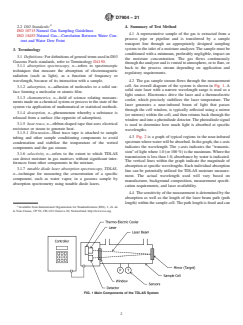
cell. An overall diagram of the system is shown in Fig. 1.A
3.1.2 adsorption, n—adhesion of molecules to a solid sur-
solid state laser with a narrow wavelength range is used as a
face forming a molecular or atomic film.
light source. Electronics drive the laser and a thermoelectric
3.1.3 chemometrics, n—field of science relating measure-
cooler, which precisely stabilizes the laser temperature. The
ments made on a chemical system or process to the state of the
laser generates a near-infrared beam of light that passes
system via application of mathematical or statistical methods.
through the cell window, is typically reflected using a mirror
3.1.4 desorption, n—phenomenon whereby a substance is
(or mirrors) within the cell, and then returns back through the
released from a surface (the opposite of adsorption).
window and into a photodiode detector. The photodiode signal
3.1.5 heat trace, n—ribbon-shaped tape that uses electrical
is used to determine how much light is absorbed at specific
resistance or steam to generate heat.
wavelengths.
3.1.5.1 Discussion—Heat trace tape is attached to sample
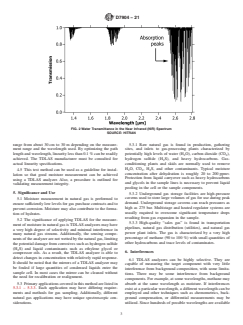
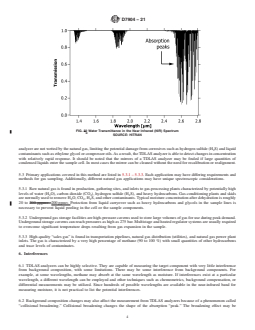
4.3 Fig. 2 is a graph of typical regions in the near-infrared
tubing and other sample conditioning components to avoid
spectrumwherewaterwillbeabsorbed.Inthegraph,the x-axis
condensation and stabilize the temperature of the wetted
indicates the wavelength. The y-axis indicates the “transmis-
components and the gas stream.
sion”oflightwhere1.0(or100 %)isthemaximum.Wherethe
3.1.6 selectivity, n—refers to the extent to which TDLAS
transmission is less than 1.0, absorbance by water is indicated.
can detect moisture in gas matrices without significant inter-
The vertical lines within the graph indicate the magnitude of
ferences from other components in the mixture.
absorption at specific wavelengths. Each individual absorption
3.1.7 tunable diode laser absorption spectroscopy, TDLAS,
line can be potentially utilized for TDLAS moisture measure-
n—technique for measuring the concentration of a specific
ment. The actual wavelength used will vary based on
component, such as water vapor, in a gaseous sample by
manufacturer, background composition, measurement specifi-
absorption spectrometry using tunable diode lasers.
cation requirements, and laser availability.
4.4 The sensitivity of the measurement is determined by the
absorption as well as the length of the laser beam path (path
length) within the sample cell. The path length is fixed and can
Available from International Organization for Standardization (ISO), 1, ch. de
la Voie-Creuse, CP 56, CH-1211 Geneva 20, Switzerland, http://www.iso.org.
FIG. 1 Main Components of the TDLAS System
D7904 − 21
FIG. 2 Water Transmittance in the Near Infrared (NIR) Spectrum
SOURCE: HITRAN
range from about 30 cm to 30 m depending on the measure- 5.3.1 Raw natural gas is found in production, gathering
ment range and the wavelength used. By optimizing the path sites, and inlets to gas-processing plants characterized by
length and wavelength, linearity less than 0.1 % can be readily potentially high levels of water (H O), carbon dioxide (CO ),
2 2
achieved. The TDLAS manufacturer must be consulted for
hydrogen sulfide (H S), and heavy hydrocarbons. Gas-
actual linearity specifications. conditioning plants and skids are normally used to remove
H O, CO,H S, and other contaminants. Typical moisture
2 2 2
4.5 This test method can be used as a guideline for instal-
concentration after dehydration is roughly 20 to 200 ppmv.
lation so that good moisture measurement can be achieved
Protection from liquid carryover such as heavy hydrocarbons
using a TDLAS analyzer. Also, a procedure is outlined for
and glycols in the sample lines is necessary to prevent liquid
validating measurement integrity.
pooling in the cell or the sample components.
5. Significance and Use
5.3.2 Underground gas storage facilities are high-pressure
caverns used to store large volumes of gas for use during peak
5.1 Moisture measurement in natural gas is performed to
demand. Underground storage caverns can reach pressures as
ensure sufficiently low levels for gas purchase contracts and to
high as 275 bar. Multistage and heated regulator systems are
prevent corrosion. Moisture may also contribute to the forma-
usually required to overcome significant temperature drops
tion of hydrates.
resulting from gas expansion in the sample.
5.2 The significance of applying TDLAS for the measure-
5.3.3 High-quality “sales gas” is found in transportation
ment of moisture in natural gas is TDLAS analyzers may have
pipelines, natural gas distribution (utilities), and natural gas
a very high degree of selectivity and minimal interference in
power plant inlets. The gas is characterized by a very high
many natural gas streams. Additionally, the sensing compo-
percentage of methane (90 to 100 %) with small quantities of
nents of the analyzer are not wetted by the natural gas, limiting
other hydrocarbons and trace levels of contaminates.
the potential damage from corrosives such as hydrogen sulfide
(H S) and liquid contaminants such as ethylene glycol or
6. Interferences
compressor oils. As a result, the TDLAS analyzer is able to
detect changes in concentration with relatively rapid response.
6.1 TDLAS analyzers can be highly selective. They are
It should be noted that the mirrors of a TDLAS analyzer may
capable of measuring the target component with very little
be fouled if large quantities of condensed liquids enter the
interference from background composition, with some limita-
sample cell. In most cases the mirror can be cleaned without
tions. There may be some interference from background
the need for recalibration or realignment.
components. For example, at some wavelengths, methane may
5.3 Primaryapplicationscoveredinthismethodarelistedin absorb at the same wavelength as moisture. If interferences
5.3.1 – 5.3.3. Each application may have differing require- exist at a particular wavelength, a different wavelength can be
ments and methods for gas sampling. Additionally, different employed and other techniques such as chemometrics, back-
natural gas applications may have unique spectroscopic con- ground compensation, or differential measurements may be
siderations. utilized. Since hundreds of possible wavelengths are available
D7904 − 21
in the near-infrared band for measuring moisture, it is not effects and to optimize speed of response in the sample
practical to list the potential interferences. transport. For a moisture concentration below 10 ppmv, the
transport line may be coated with fused silica or an equivalent
6.2 Background composition changes may also affect the
for additional resistance to adsorption and desorption effects.
measurement from TDLAS analyzers because of a phenom-
7.1.3 The sample conditioning system is typically installed
enon called “collisional broadening.” Collisional broadening
immediately before the analyzer and contains a regulat
...
This document is not an ASTM standard and is intended only to provide the user of an ASTM standard an indication of what changes have been made to the previous version. Because
it may not be technically possible to adequately depict all changes accurately, ASTM recommends that users consult prior editions as appropriate. In all cases only the current version
of the standard as published by ASTM is to be considered the official document.
Designation: D7904 − 15 D7904 − 21
Standard Test Method for
Determination of Water Vapor (Moisture Concentration) in
Natural Gas by Tunable Diode Laser Spectroscopy (TDLAS)
This standard is issued under the fixed designation D7904; the number immediately following the designation indicates the year of
original adoption or, in the case of revision, the year of last revision. A number in parentheses indicates the year of last reapproval. A
superscript epsilon (´) indicates an editorial change since the last revision or reapproval.
1. Scope
1.1 This test method covers online determination of vapor phase moisture concentration in natural gas using a tunable diode laser
absorption spectroscopy (TDLAS) analyzer also known as a “TDL analyzer.” The particular wavelength for moisture measurement
varies by manufacturer; typically between 1000 and 10 000 nm 10 000 nm with an individual laser having a tunable range of less
than 10 nm. 10 nm.
1.2 Process stream pressures can range from 700-mbar to 700-bar gage. TDLAS is performed at pressures near atmospheric (700-
to 2000-mbar gage); therefore, pressure reduction is typically required. TDLAS can be performed in vacuum conditions with good
results; however, the sample conditioning requirements are different because of higher complexity and a tendency for moisture
ingress and are not covered by this test method. Generally speaking, the vent line of a TDL analyzer is tolerant to small pressure
changes on the order of 50 to 200 mbar, but it is important to observe the manufacturer’s published inlet pressure and vent pressure
constraints. Large spikes or steps in backpressure may affect the analyzer readings.
1.3 The typical sample temperature range is -20 to 65°C65 °C in the analyzer cell. While sample system design is not covered by
this standard, it is common practice to heat the sample transport line to around 50°C50 °C to avoid concentration changes
associated with adsorption and desorption of moisture along the walls of the sample transport line.
1.4 The moisture concentration range is 1 to 10 000 10 000 parts per million by volume (ppmv). It is unlikely that one
spectrometer cell will be used to measure this entire range. For example, a TDL spectrometer may have a maximum measurement
of 1 ppmv, 100 ppmv, 1000 ppmv, or 10 000 ppmv 1 ppmv, 100 ppmv, 1000 ppmv, or 10 000 ppmv with varying degrees of
accuracy and different lower detection limits.
1.5 TDL absorption spectroscopy measures molar ratios such as ppmv or mole percentage. Volumetric ratios (ppmv and %) are
not pressure dependant.dependent. Weight-per-volume units such as milligrams of water per standard cubic metre or pounds of
water per standard cubic foot can be derived from ppmv at a specific condition such as standard temperature and pressure (STP).
Standard conditions may be defined differently for different regions and entities. The moisture dew point can be estimated from
ppmv and pressure. Refer to Test Method D1142 and ISO 18453.
1.6 Units—The values stated in SI units are to be regarded as standard. No other units of measurement are included in this
standard.
This test method is under the jurisdiction of ASTM Committee D03 on Gaseous Fuels and is the direct responsibility of Subcommittee D03.12 on On-Line/At-Line
Analysis of Gaseous Fuels.
Current edition approved Jan. 1, 2015Nov. 1, 2021. Published February 2015November 2021. Originally approved in 2015. Last previous edition approved in 2015 as
D7904 – 15. DOI: 10.1520/D7904/D7904–1510.1520/D7904-21.
Copyright © ASTM International, 100 Barr Harbor Drive, PO Box C700, West Conshohocken, PA 19428-2959. United States
D7904 − 21
1.7 This standard does not purport to address all of the safety concerns, if any, associated with its use. It is the responsibility
of the user of this standard to establish appropriate safety safety, health, and healthenvironmental practices and determine the
applicability of regulatory limitations prior to use. Some specific hazards statements are given in Section 8 on Hazards.Some
specific hazards statements are given in Section 8 on Hazards.
1.8 This international standard was developed in accordance with internationally recognized principles on standardization
established in the Decision on Principles for the Development of International Standards, Guides and Recommendations issued
by the World Trade Organization Technical Barriers to Trade (TBT) Committee.
2. Referenced Documents
2.1 ASTM Standards:
D1142 Test Method for Water Vapor Content of Gaseous Fuels by Measurement of Dew-Point Temperature
D4150 Terminology Relating to Gaseous Fuels
D5503 Practice for Natural Gas Sample-Handling and Conditioning Systems for Pipeline Instrumentation (Withdrawn 2017)
D5454 Test Method for Water Vapor Content of Gaseous Fuels Using Electronic Moisture Analyzers
2.2 ISO Standards:
ISO 10715 Natural Gas Sampling Guidelines
ISO 18453 Natural Gas—Correlation Between Water Content and Water Dew Point
3. Terminology
3.1 Definitions: Also For definitions of general terms used in D03 Gaseous Fuels standards, refer to Terminology D4150.
3.1.1 absorption spectroscopy, n—refers to spectroscopic techniques that measure the absorption of electromagnetic radiation
(such as light), as a function of frequency or wavelength, because of its interaction with a sample.
3.1.2 adsorption, n—adhesion of molecules to a solid surface forming a molecular or atomic film.
3.1.3 chemometrics, n—field of science relating measurements made on a chemical system or process to the state of the system
via application of mathematical or statistical methods.
3.1.4 desorption, n—phenomenon whereby a substance is released from a surface (the opposite of adsorption).
3.1.5 heat trace, n—ribbon-shaped tape that uses electrical resistance or steam to generate heat.
3.1.5.1 Discussion—
Heat trace tape is attached to sample tubing and other sample conditioning components to avoid condensation and stabilize the
temperature of the wetted components and the gas stream.
3.1.6 moisture dew point, n—A temperature and pressure at which water vapor begins to condense into liquid.
3.1.6.1 Discussion—
For a given concentration of water vapor, the dew point temperature is a function of pressure. A dew point curve is shown in Fig.
1 with the dew point temperature on the x-axis and pressure on the y-axis.
3.1.7 nanometre, n—unit of length;
th
1 nm = 1/1 000 000 000 of a metre.
3.1.6 selectivity, n—refers to the extent to which TDLAS can detect moisture in gas matrices without significant interferences from
other components in the mixture.
3.1.9 standard condition for temperature and pressure, STP, n—standard set of conditions established to allow the comparison of
different sets of data.
For referenced ASTM standards, visit the ASTM website, www.astm.org, or contact ASTM Customer Service at service@astm.org. For Annual Book of ASTM Standards
volume information, refer to the standard’s Document Summary page on the ASTM website.
The last approved version of this historical standard is referenced on www.astm.org.
Available from International Organization for Standardization (ISO), 1, ch. de la Voie-Creuse, CP 56, CH-1211 Geneva 20, Switzerland, http://www.iso.org.
D7904 − 21
3.1.7 tunable diode laser absorption spectroscopy, TDLAS, n—technique for measuring the concentration of a specific component,
such as water vapor, in a gaseous sample by absorption spectrometry using tunable diode lasers.
4. Summary of Test Method
4.1 A representative sample of the gas is extracted from a process pipe or pipeline and is transferred by a sample transport line
through an appropriately designed sampling system to the inlet of a moisture analyzer. The sample must be conditioned with a
minimum, preferably negligible, impact on the moisture concentration. The gas flows continuously through the analyzer and is
vented to atmosphere, or to flare, or back to the process stream depending on application and regulatory requirements.
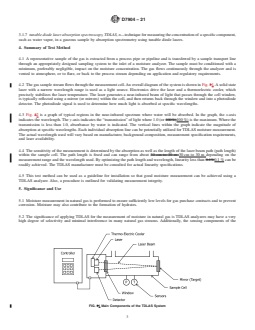
4.2 The gas sample stream flows through the measurement cell. An overall diagram of the system is shown in Fig. 21. A solid state
laser with a narrow wavelength range is used as a light source. Electronics drive the laser and a thermoelectric cooler, which
precisely stabilizes the laser temperature. The laser generates a near-infrared beam of light that passes through the cell window,
is typically reflected using a mirror (or mirrors) within the cell, and then returns back through the window and into a photodiode
detector. The photodiode signal is used to determine how much light is absorbed at specific wavelengths.
4.3 Fig. 32 is a graph of typical regions in the near-infrared spectrum where water will be absorbed. In the graph, the x-axis
indicates the wavelength. The y-axis indicates the “transmission” of light where 1.0 (or 100%)100 %) is the maximum. Where the
transmission is less than 1.0, absorbance by water is indicated. The vertical lines within the graph indicate the magnitude of
absorption at specific wavelengths. Each individual absorption line can be potentially utilized for TDLAS moisture measurement.
The actual wavelength used will vary based on manufacturer, background composition, measurement specification requirements,
and laser availability.
4.4 The sensitivity of the measurement is determined by the absorption as well as the length of the laser beam path (path length)
within the sample cell. The path length is fixed and can range from about 30 cm to 30 m 30 cm to 30 m depending on the
measurement range and the wavelength used. By optimizing the path length and wavelength, linearity less than 0.1%0.1 % can be
readily achieved. The TDLAS manufacturer must be consulted for actual linearity specifications.
4.5 This test method can be used as a guideline for installation so that good moisture measurement can be achieved using a
TDLAS analyzer. Also, a procedure is outlined for validating measurement integrity.
5. Significance and Use
5.1 Moisture measurement in natural gas is performed to ensure sufficiently low levels for gas purchase contracts and to prevent
corrosion. Moisture may also contribute to the formation of hydrates.
5.2 The significance of applying TDLAS for the measurement of moisture in natural gas is TDLAS analyzers may have a very
high degree of selectivity and minimal interference in many natural gas streams. Additionally, the sensing components of the
FIG. 21 Main Components of the TDLAS System
D7904 − 21
FIG. 32 Water Transmittance in the Near Infrared (NIR) Spectrum
SOURCE: HITRAN
analyzer are not wetted by the natural gas, limiting the potential damage from corrosives such as hydrogen sulfide (H S) and liquid
contaminants such as ethylene glycol or compressor oils. As a result, the TDLAS analyzer is able to detect changes in concentration
with relatively rapid response. It should be noted that the mirrors of a TDLAS analyzer may be fouled if large quantities of
condensed liquids enter the sample cell. In most cases the mirror can be cleaned without the need for recalibration or realignment.
5.3 Primary applications covered in this method are listed in 5.3.1 – 5.3.3. Each application may have differing requirements and
methods for gas sampling. Additionally, different natural gas applications may have unique spectroscopic considerations.
5.3.1 Raw natural gas is found in production, gathering sites, and inlets to gas-processing plants characterized by potentially high
levels of water (H O), carbon dioxide (CO ), hydrogen sulfide (H S), and heavy hydrocarbons. Gas-conditioning plants and skids
2 2 2
are normally used to remove H O, CO , H S, and other contaminants. Typical moisture concentration after dehydration is roughly
2 2 2
20 to 200 pppmv. 200 ppmv. Protection from liquid carryover such as heavy hydrocarbons and glycols in the sample lines is
necessary to prevent liquid pooling in the cell or the sample components.
5.3.2 Underground gas storage facilities are high-pressure caverns used to store large volumes of gas for use during peak demand.
Underground storage caverns can reach pressures as high as 275 bar. Multistage and heated regulator systems are usually required
to overcome significant temperature drops resulting from gas expansion in the sample.
5.3.3 High-quality “sales gas” is found in transportation pipelines, natural gas distribution (utilities), and natural gas power plant
inlets. The gas is characterized by a very high percentage of methane (90 to 100 %) with small quantities of other hydrocarbons
and trace levels of contaminates.
6. Interferences
6.1 TDLAS analyzers can be highly selective. They are capable of measuring the target component with very little interference
from background composition, with some limitations. There may be some interference from background components. For
example, at some wavelengths, methane may absorb at the same wavelength as moisture. If interferences exist at a particular
wavelength, a different wavelength can be employed and other techniques such as chemometrics, background compensation, or
differential measurements may be utilized. Since hundreds of possible wavelengths are available in the near-infrared band for
measuring moisture, it is not practical to list the potential interferences.
6.2 Background composition changes may also affect the measurement from TDLAS analyzers because of a phenomenon called
“collisional broadening.” Collisional broadening changes the shape of the absorption “peak.” The broadening effect may be
-----
...