

ASTM C1396/C1396M-17
(Specification)Standard Specification for Gypsum Board
General Information
- Abstract
ABSTRACT
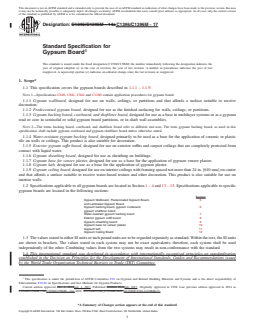
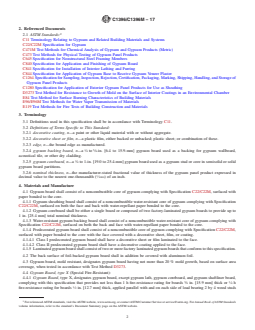
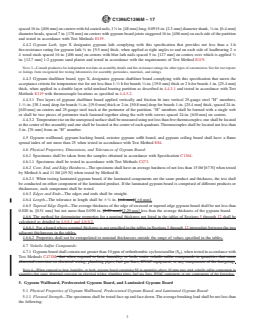
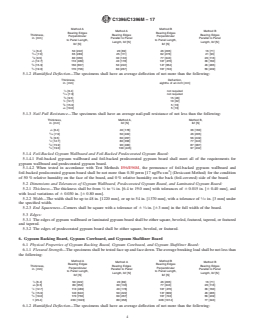
This specification covers gypsum boards which include the following: gypsum wallboard for use on walls, ceilings, or partitions and that affords a surface suitable to receive decoration; predecorated gypsum board for use as the finished surfacing for walls, ceilings, or partitions; gypsum backing board, coreboard, and shaftliner board for use as a base in multilayer systems or as a gypsum stud or core in semisolid or solid gypsum board partitions, or in shaft wall assemblies; water-resistant gypsum backing board to be used as a base for the application of ceramic or plastic tile on walls or ceilings; exterior gypsum soffit board for exterior soffits and carport ceilings that are completely protected from contact with liquid water; gypsum sheathing board for use as sheathing on buildings; gypsum base for veneer plaster; gypsum lath for use as a base for gypsum plaster application; and gypsum ceiling board for interior ceilings and walls. Gypsum board shall consist of a noncombustible core, essentially gypsum, surfaced with paper bonded to the core. The specimens shall comply with the following required physical properties: core, end, and edge hardness; straightness of the edges and ends; length; tapered edge depth; flexural strength; humidified deflection; nail pull resistance; permeance; water resistance; and surface water absorption.
SCOPE
1.1 This specification covers the gypsum boards described in 1.1.1 – 1.1.9.
Note 1: Specifications C840, C841, C844 and C1280 contain application procedures for gypsum board.
1.1.1 Gypsum wallboard, designed for use on walls, ceilings, or partitions and that affords a surface suitable to receive decoration.
1.1.2 Predecorated gypsum board, designed for use as the finished surfacing for walls, ceilings, or partitions.
1.1.3 Gypsum backing board, coreboard, and shaftliner board, designed for use as a base in multilayer systems or as a gypsum stud or core in semisolid or solid gypsum board partitions, or in shaft wall assemblies.
Note 2: The terms backing board, coreboard, and shaftliner board refer to different end uses. The term gypsum backing board, as used in this specification, shall include gypsum coreboard and gypsum shaftliner board unless otherwise stated.
1.1.4 Water-resistant gypsum backing board, designed primarily to be used as a base for the application of ceramic or plastic tile on walls or ceilings. This product is also suitable for decoration.
1.1.5 Exterior gypsum soffit board, designed for use on exterior soffits and carport ceilings that are completely protected from contact with liquid water.
1.1.6 Gypsum sheathing board, designed for use as sheathing on buildings.
1.1.7 Gypsum base for veneer plaster, designed for use as a base for the application of gypsum veneer plaster.
1.1.8 Gypsum lath, designed for use as a base for the application of gypsum plaster.
1.1.9 Gypsum ceiling board, designed for use on interior ceilings with framing spaced not more than 24 in. [610 mm] on center and that affords a surface suitable to receive water-based texture and other decoration. This product is also suitable for use on interior walls.
1.2 Specifications applicable to all gypsum boards are located in Section 1 – 4 and 13 – 15. Specifications applicable to specific gypsum boards are located in the following sections:
Section
Gypsum Wallboard, Predecorated Gypsum Board, and Laminated Gypsum Board
5
Gypsum backing board, gypsum coreboard,
gypsum shaftliner board
6
Water-resistant gypsum backing board
7
Exterior gypsum soffit board
8
Gypsum sheathing board
9
Gypsum base for veneer plaster
10
Gypsum lath
11
Gypsum Ceiling Board
12
1.3 The values stated in either SI units or inch-pound units are to be regarded separately as standard. Within the text, the SI units are shown in brackets. The values stated in each s...
- Status
- Published
- Publication Date
- 30-Jun-2017
- Technical Committee
- C11 - Gypsum and Related Building Materials and Systems
- Drafting Committee
- C11.01 - Specifications and Test Methods for Gypsum Products
Overview
ASTM C1396/C1396M-17: Standard Specification for Gypsum Board is the internationally recognized guideline for the manufacturing, testing, and application of a variety of gypsum board products. Developed by ASTM International, this specification defines the essential requirements for gypsum wallboard, predecorated board, backing, coreboard, shaftliner, water-resistant board, exterior soffit board, sheathing, veneer base, gypsum lath, and ceiling board. Gypsum boards covered by this standard are widely used in construction for interior and protected exterior applications, providing surfaces suitable for decoration or as substrates for veneer plasters, tile, or other finishes.
Key Topics
Product Coverage:
- Gypsum wallboard: Used for walls, ceilings, or partitions; suitable for receiving decoration.
- Predecorated gypsum board: Factory-finished for direct use as a finished surface.
- Gypsum backing board, coreboard, shaftliner: Used as a base in multilayer systems, studs, or cores in various partition systems.
- Water-resistant gypsum backing board: Designed as a tile or decorative base, especially in wet areas.
- Exterior gypsum soffit board: For protected exterior applications, such as soffits and carport ceilings.
- Gypsum sheathing board: Used as exterior building sheathing.
- Gypsum base for veneer plaster and gypsum lath: Substrates for veneer and traditional plasters.
- Gypsum ceiling board: Intended for interior ceilings and suitable for both ceilings and walls.
Core Properties and Requirements:
- Noncombustible gypsum core, typically surfaced with bonded paper.
- Physical property requirements, including:
- Core, end, and edge hardness
- Flexural strength
- Straightness and squareness of edges and ends
- Tapered edge depth
- Humidified deflection
- Nail pull resistance
- Water and vapor resistance
- Permeance and surface water absorption
- Special classifications for fire-resistance (Type X) and mold resistance.
Testing and Compliance:
- Full compliance with referenced ASTM test methods for chemical, physical, fire, and water-resistance properties.
- Dimensional and tolerance specifications for each board type.
- Ensures interoperability with other ASTM standards for application and installation methods.
Applications
Building and Construction:
- Residential, commercial, institutional, and industrial buildings utilize gypsum boards meeting ASTM C1396/C1396M-17 for a wide range of purposes, including:
- Fire-rated interior partitions and ceilings
- Wet-area backers for tile installations, especially in bathrooms and kitchens
- Exterior sheathing under weather-protective barriers
- Substrates for plasters in restoration or new construction
- Sound-control wall assemblies using specialized coreboards and shaftliners
Benefits for Professionals:
- Architects and specifiers: Rely on standardized performance, fire-resistance, and durability properties for code compliance and quality assurance.
- Builders and contractors: Reference clear manufacturing and installation requirements to ensure proper product performance and reduce callbacks.
- Manufacturers: Meet international market demands with well-defined benchmarks for gypsum board quality and safety.
Related Standards
Professionals referencing ASTM C1396/C1396M-17 should be aware of the following related ASTM standards, which provide installation, application, and test procedures for gypsum board products:
- ASTM C840: Application and Finishing of Gypsum Board
- ASTM C1264: Sampling, Inspection, Certification, Packaging, and Storage of Gypsum Panel Products
- ASTM C841: Installation of Interior Lathing and Furring
- ASTM C844: Application of Gypsum Base to Receive Gypsum Veneer Plaster
- ASTM C1280: Application of Exterior Gypsum Panel Products as Sheathing
- ASTM E119: Fire Tests of Building Construction and Materials
- ASTM E84: Surface Burning Characteristics of Building Materials
- ASTM C473: Physical Testing of Gypsum Panel Products
These references ensure that all aspects of gypsum board performance - from raw material quality to final installation - meet rigorous, standardized benchmarks demanded by modern construction projects.
Keywords: gypsum board, ASTM C1396, wallboard, ceiling board, gypsum sheathing, water-resistant gypsum, fire-resistant gypsum board, construction materials, building codes, ASTM standards.
Relations
- Refers
ASTM C471M-24 - Standard Test Methods for Chemical Analysis of Gypsum and Gypsum Products (Metric) - Effective Date
- 01-Apr-2024
- Effective Date
- 01-Mar-2024
- Effective Date
- 01-Dec-2023
- Effective Date
- 15-Nov-2023
- Effective Date
- 01-Oct-2023
- Effective Date
- 01-Oct-2023
- Effective Date
- 01-Sep-2023
- Effective Date
- 01-Nov-2019
- Effective Date
- 01-Oct-2019
- Effective Date
- 01-Oct-2019
- Effective Date
- 01-Oct-2019
- Effective Date
- 01-Jul-2019
- Effective Date
- 01-Jun-2019
- Effective Date
- 15-Apr-2019
- Effective Date
- 01-Mar-2019
Get Certified
Connect with accredited certification bodies for this standard

DIBt (Deutsches Institut für Bautechnik)
German Institute for Building Technology.
DIN CERTCO
DIN Group product certification.

Aboma Certification B.V.
Specialized in construction, metal, and transport sectors.
Sponsored listings
Frequently Asked Questions
ASTM C1396/C1396M-17 is a technical specification published by ASTM International. Its full title is "Standard Specification for Gypsum Board". This standard covers: ABSTRACT This specification covers gypsum boards which include the following: gypsum wallboard for use on walls, ceilings, or partitions and that affords a surface suitable to receive decoration; predecorated gypsum board for use as the finished surfacing for walls, ceilings, or partitions; gypsum backing board, coreboard, and shaftliner board for use as a base in multilayer systems or as a gypsum stud or core in semisolid or solid gypsum board partitions, or in shaft wall assemblies; water-resistant gypsum backing board to be used as a base for the application of ceramic or plastic tile on walls or ceilings; exterior gypsum soffit board for exterior soffits and carport ceilings that are completely protected from contact with liquid water; gypsum sheathing board for use as sheathing on buildings; gypsum base for veneer plaster; gypsum lath for use as a base for gypsum plaster application; and gypsum ceiling board for interior ceilings and walls. Gypsum board shall consist of a noncombustible core, essentially gypsum, surfaced with paper bonded to the core. The specimens shall comply with the following required physical properties: core, end, and edge hardness; straightness of the edges and ends; length; tapered edge depth; flexural strength; humidified deflection; nail pull resistance; permeance; water resistance; and surface water absorption. SCOPE 1.1 This specification covers the gypsum boards described in 1.1.1 – 1.1.9. Note 1: Specifications C840, C841, C844 and C1280 contain application procedures for gypsum board. 1.1.1 Gypsum wallboard, designed for use on walls, ceilings, or partitions and that affords a surface suitable to receive decoration. 1.1.2 Predecorated gypsum board, designed for use as the finished surfacing for walls, ceilings, or partitions. 1.1.3 Gypsum backing board, coreboard, and shaftliner board, designed for use as a base in multilayer systems or as a gypsum stud or core in semisolid or solid gypsum board partitions, or in shaft wall assemblies. Note 2: The terms backing board, coreboard, and shaftliner board refer to different end uses. The term gypsum backing board, as used in this specification, shall include gypsum coreboard and gypsum shaftliner board unless otherwise stated. 1.1.4 Water-resistant gypsum backing board, designed primarily to be used as a base for the application of ceramic or plastic tile on walls or ceilings. This product is also suitable for decoration. 1.1.5 Exterior gypsum soffit board, designed for use on exterior soffits and carport ceilings that are completely protected from contact with liquid water. 1.1.6 Gypsum sheathing board, designed for use as sheathing on buildings. 1.1.7 Gypsum base for veneer plaster, designed for use as a base for the application of gypsum veneer plaster. 1.1.8 Gypsum lath, designed for use as a base for the application of gypsum plaster. 1.1.9 Gypsum ceiling board, designed for use on interior ceilings with framing spaced not more than 24 in. [610 mm] on center and that affords a surface suitable to receive water-based texture and other decoration. This product is also suitable for use on interior walls. 1.2 Specifications applicable to all gypsum boards are located in Section 1 – 4 and 13 – 15. Specifications applicable to specific gypsum boards are located in the following sections: Section Gypsum Wallboard, Predecorated Gypsum Board, and Laminated Gypsum Board 5 Gypsum backing board, gypsum coreboard, gypsum shaftliner board 6 Water-resistant gypsum backing board 7 Exterior gypsum soffit board 8 Gypsum sheathing board 9 Gypsum base for veneer plaster 10 Gypsum lath 11 Gypsum Ceiling Board 12 1.3 The values stated in either SI units or inch-pound units are to be regarded separately as standard. Within the text, the SI units are shown in brackets. The values stated in each s...
ABSTRACT This specification covers gypsum boards which include the following: gypsum wallboard for use on walls, ceilings, or partitions and that affords a surface suitable to receive decoration; predecorated gypsum board for use as the finished surfacing for walls, ceilings, or partitions; gypsum backing board, coreboard, and shaftliner board for use as a base in multilayer systems or as a gypsum stud or core in semisolid or solid gypsum board partitions, or in shaft wall assemblies; water-resistant gypsum backing board to be used as a base for the application of ceramic or plastic tile on walls or ceilings; exterior gypsum soffit board for exterior soffits and carport ceilings that are completely protected from contact with liquid water; gypsum sheathing board for use as sheathing on buildings; gypsum base for veneer plaster; gypsum lath for use as a base for gypsum plaster application; and gypsum ceiling board for interior ceilings and walls. Gypsum board shall consist of a noncombustible core, essentially gypsum, surfaced with paper bonded to the core. The specimens shall comply with the following required physical properties: core, end, and edge hardness; straightness of the edges and ends; length; tapered edge depth; flexural strength; humidified deflection; nail pull resistance; permeance; water resistance; and surface water absorption. SCOPE 1.1 This specification covers the gypsum boards described in 1.1.1 – 1.1.9. Note 1: Specifications C840, C841, C844 and C1280 contain application procedures for gypsum board. 1.1.1 Gypsum wallboard, designed for use on walls, ceilings, or partitions and that affords a surface suitable to receive decoration. 1.1.2 Predecorated gypsum board, designed for use as the finished surfacing for walls, ceilings, or partitions. 1.1.3 Gypsum backing board, coreboard, and shaftliner board, designed for use as a base in multilayer systems or as a gypsum stud or core in semisolid or solid gypsum board partitions, or in shaft wall assemblies. Note 2: The terms backing board, coreboard, and shaftliner board refer to different end uses. The term gypsum backing board, as used in this specification, shall include gypsum coreboard and gypsum shaftliner board unless otherwise stated. 1.1.4 Water-resistant gypsum backing board, designed primarily to be used as a base for the application of ceramic or plastic tile on walls or ceilings. This product is also suitable for decoration. 1.1.5 Exterior gypsum soffit board, designed for use on exterior soffits and carport ceilings that are completely protected from contact with liquid water. 1.1.6 Gypsum sheathing board, designed for use as sheathing on buildings. 1.1.7 Gypsum base for veneer plaster, designed for use as a base for the application of gypsum veneer plaster. 1.1.8 Gypsum lath, designed for use as a base for the application of gypsum plaster. 1.1.9 Gypsum ceiling board, designed for use on interior ceilings with framing spaced not more than 24 in. [610 mm] on center and that affords a surface suitable to receive water-based texture and other decoration. This product is also suitable for use on interior walls. 1.2 Specifications applicable to all gypsum boards are located in Section 1 – 4 and 13 – 15. Specifications applicable to specific gypsum boards are located in the following sections: Section Gypsum Wallboard, Predecorated Gypsum Board, and Laminated Gypsum Board 5 Gypsum backing board, gypsum coreboard, gypsum shaftliner board 6 Water-resistant gypsum backing board 7 Exterior gypsum soffit board 8 Gypsum sheathing board 9 Gypsum base for veneer plaster 10 Gypsum lath 11 Gypsum Ceiling Board 12 1.3 The values stated in either SI units or inch-pound units are to be regarded separately as standard. Within the text, the SI units are shown in brackets. The values stated in each s...
ASTM C1396/C1396M-17 is classified under the following ICS (International Classification for Standards) categories: 91.060.10 - Walls. Partitions. Facades; 91.100.10 - Cement. Gypsum. Lime. Mortar. The ICS classification helps identify the subject area and facilitates finding related standards.
ASTM C1396/C1396M-17 has the following relationships with other standards: It is inter standard links to ASTM C471M-24, ASTM E96/E96M-24, ASTM E84-23d, ASTM E96/E96M-23, ASTM C1280-18(2023), ASTM C840-23, ASTM E84-23c, ASTM C840-19b, ASTM C473-19, ASTM E119-19, ASTM C840-19a, ASTM E84-19b, ASTM C840-19, ASTM E84-19a, ASTM E84-19. Understanding these relationships helps ensure you are using the most current and applicable version of the standard.
ASTM C1396/C1396M-17 is available in PDF format for immediate download after purchase. The document can be added to your cart and obtained through the secure checkout process. Digital delivery ensures instant access to the complete standard document.
Standards Content (Sample)
This international standard was developed in accordance with internationally recognized principles on standardization established in the Decision on Principles for the
Development of International Standards, Guides and Recommendations issued by the World Trade Organization Technical Barriers to Trade (TBT) Committee.
Designation:C1396/C1396M −17
Standard Specification for
Gypsum Board
This standard is issued under the fixed designation C1396/C1396M; the number immediately following the designation indicates the
year of original adoption or, in the case of revision, the year of last revision. A number in parentheses indicates the year of last
reapproval. A superscript epsilon (´) indicates an editorial change since the last revision or reapproval.
1. Scope* 1.2 Specifications applicable to all gypsum boards are
located in Section1–4 and13–15. Specifications applicable
1.1 This specification covers the gypsum boards described
tospecificgypsumboardsarelocatedinthefollowingsections:
in 1.1.1 – 1.1.9.
Section
NOTE 1—Specifications C840, C841, C844 and C1280 contain appli-
Gypsum Wallboard, Predecorated Gypsum Board, 5
cation procedures for gypsum board.
and Laminated Gypsum Board
Gypsum backing board, gypsum coreboard, 6
1.1.1 Gypsum wallboard, designed for use on walls,
gypsum shaftliner board
ceilings, or partitions and that affords a surface suitable to Water-resistant gypsum backing board 7
Exterior gypsum soffit board 8
receive decoration.
Gypsum sheathing board 9
1.1.2 Predecorated gypsum board, designed for use as the
Gypsum base for veneer plaster 10
finished surfacing for walls, ceilings, or partitions. Gypsum lath 11
Gypsum Ceiling Board 12
1.1.3 Gypsum backing board, coreboard, and shaftliner
board, designed for use as a base in multilayer systems or as a 1.3 The values stated in either SI units or inch-pound units
are to be regarded separately as standard. Within the text, the
gypsum stud or core in semisolid or solid gypsum board
partitions, or in shaft wall assemblies. SI units are shown in brackets. The values stated in each
system may not be exact equivalents; therefore, each system
NOTE 2—The terms backing board, coreboard, and shaftliner board
shall be used independently of the other. Combining values
refertodifferentenduses.Thetermgypsumbackingboard,asusedinthis
from the two systems may result in non-conformance with the
specification, shall include gypsum coreboard and gypsum shaftliner
board unless otherwise stated. standard
1.1.4 Water-resistant gypsum backing board, designed pri- 1.4 This international standard was developed in accor-
marily to be used as a base for the application of ceramic or dance with internationally recognized principles on standard-
plastictileonwallsorceilings.Thisproductisalsosuitablefor ization established in the Decision on Principles for the
decoration. Development of International Standards, Guides and Recom-
1.1.5 Exterior gypsum soffıt board, designed for use on
mendations issued by the World Trade Organization Technical
exterior soffits and carport ceilings that are completely pro- Barriers to Trade (TBT) Committee.
tected from contact with liquid water.
2. Referenced Documents
1.1.6 Gypsum sheathing board, designed for use as sheath-
ing on buildings.
2.1 ASTM Standards:
1.1.7 Gypsum base for veneer plaster, designed for use as a
C11Terminology Relating to Gypsum and Related Building
base for the application of gypsum veneer plaster.
Materials and Systems
1.1.8 Gypsum lath, designed for use as a base for the
C22/C22MSpecification for Gypsum
application of gypsum plaster.
C471MTestMethodsforChemicalAnalysisofGypsumand
1.1.9 Gypsum ceiling board, designed for use on interior
Gypsum Products (Metric)
ceilingswithframingspacednotmorethan24in.[610mm]on
C473Test Methods for Physical Testing of Gypsum Panel
centerandthataffordsasurfacesuitabletoreceivewater-based
Products
texture and other decoration. This product is also suitable for
C645Specification for Nonstructural Steel Framing Mem-
use on interior walls.
bers
C840SpecificationforApplicationandFinishingofGypsum
Board
This specification is under the jurisdiction of ASTM Committee C11 on
GypsumandRelatedBuildingMaterialsandSystemsandisthedirectresponsibility
of Subcommittee C11.01 on Specifications andTest Methods for Gypsum Products. For referenced ASTM standards, visit the ASTM website, www.astm.org, or
CurrenteditionapprovedJuly1,2017.PublishedJuly2017.Originallyapproved contact ASTM Customer Service at service@astm.org. For Annual Book of ASTM
in 1998. Last previous edition approved in 2014 as C1396/C1396M–14a. DOI: Standards volume information, refer to the standard’s Document Summary page on
10.1520/C1396_C1396M-17. the ASTM website.
*A Summary of Changes section appears at the end of this standard
Copyright © ASTM International, 100 Barr Harbor Drive, PO Box C700, West Conshohocken, PA 19428-2959. United States
C1396/C1396M−17
C841Specification for Installation of Interior Lathing and C22M, surfaced with paper bonded to the core with the face
Furring covered with a decorative sheet, film, or coating.
C844Specification for Application of Gypsum Base to
4.1.4.1 Class I predecorated gypsum board shall have a
Receive Gypsum Veneer Plaster
decorative sheet or film laminated to the face.
C1264Specification for Sampling, Inspection, Rejection,
4.1.4.2 Class II predecorated gypsum board shall have a
Certification, Packaging, Marking, Shipping, Handling,
decorative coating applied to the face.
and Storage of Gypsum Panel Products
4.1.5 Laminated gypsum board shall consist of two or more
C1280Specification for Application of Exterior Gypsum
factory laminated gypsum boards that conform to this specifi-
Panel Products for Use as Sheathing
cation.
D3273TestMethodforResistancetoGrowthofMoldonthe
4.2 The back surface of foil-backed gypsum board shall in
Surface of Interior Coatings in an Environmental Cham-
addition be covered with aluminum foil.
ber
E84Test Method for Surface Burning Characteristics of
4.3 Gypsumboard,moldresistant,designatesgypsumboard
Building Materials
havingnotmorethan20%moldgrowth,basedonsurfacearea
E96/E96MTest Methods for Gravimetric Determination of
coverage, when tested in accordance withTest Method D3273.
Water Vapor Transmission Rate of Materials
4.4 Gypsum Board, type X (Special Fire-Resistant):
E119Test Methods for Fire Tests of Building Construction
and Materials
4.4.1 Gypsum Board, type X, designates gypsum board,
except gypsum lath, gypsum coreboard, and gypsum shaftliner
3. Terminology board, complying with this specification that provides not less
than 1 h fire-resistance rating for boards ⁄8 in. [15.9 mm] thick
3.1 Definitions used in this specification shall be in accor-
3 1
or ⁄4 h fire-resistance rating for boards ⁄2 in. [12.7 mm] thick,
dance with Terminology C11.
applied parallel with and on each side of load bearing 2 by 4
3.2 Definitions of Terms Specific to This Standard:
wood studs spaced 16 in. [406 mm] on centers with 6d coated
3.2.1 decorative coating, n—a paint or other liquid material 7
nails, 1 ⁄8 in. [48 mm] long, 0.0915-in. [2.3-mm] diameter
with or without aggregate. 1
shank, ⁄4-in. [6.4-mm] diameter heads, spaced 7 in. [178 mm]
3.2.2 decorative sheet or film, n—a plastic film, either oncenterswithgypsumboardjointsstaggered16in.[406mm]
backed or unbacked; plastic sheet; or combination of these. on each side of the partition and tested in accordance withTest
Methods E119.
3.2.3 edge, n—the bound edge as manufactured.
4.4.2 Gypsum Lath,typeXdesignatesgypsum lath comply-
1 5
3.2.4 gypsum backing board, n—a ⁄4to ⁄8-in. [6.4 to 15.9-
ing with this specification that provides not less than a 1-h
mm] gypsum board used as a backing for gypsum wallboard,
fire-resistance rating for gypsum lath ⁄8 in. [9.5 mm] thick,
acoustical tile, or other dry cladding.
whenappliedatrightanglestoandoneachsideofloadbearing
3.2.5 gypsum coreboard, n—a ⁄4to 1-in. [19.0 to 25.4-mm]
2 × 4 wood studs spaced 16 in. [406 mm] on centers with blue
gypsum board used as a gypsum stud or core in semisolid or
lath nails spaced 5 in. [127 mm] on centers over which is
solid gypsum board partitions. 1
applied ⁄2 in. [12.7 mm] 1:2 gypsum sand plaster and tested in
accordance with the requirements of Test Method E119.
3.2.6 nominal thickness, n—the manufacturer-stated frac-
tional value of thickness of the gypsum panel product ex-
NOTE 3—Consult producers for independent test data on assembly
pressed in decimal value to the nearest one-thousandth ( ⁄1000)
details and fire-resistance ratings for other types of construction. See fire
of an inch.
test reports or listings from recognized fire testing laboratories for
assembly particulars, materials, and ratings.
4. Materials and Manufacture
4.4.3 Gypsum shaftliner board, type X, designates gypsum
4.1 Gypsumboardshallconsistofanoncombustiblecoreof shaftliner board complying with this specification that meets
gypsum complying with Specification C22/C22M, surfaced the acceptance criteria for temperature rise for not less than
1 3
with paper bonded to the core. 1- ⁄2 h for boards ⁄4-in. [19.0 mm] thick or 2 h for boards 1-in.
4.1.1 Gypsum sheathing board shall consist of a noncom- [25.4 mm] thick, when applied in a double layer solid nonload
bearing partition as described in 4.4.3.1 and tested in accor-
bustible water-resistant core of gypsum complying with Speci-
fication C22/C22M, surfaced on both the face and back with dance withTest Methods E119 with thermocouple locations as
specified in 4.4.3.2.
water-repellant paper bonded to the core.
4.1.2 Gypsum coreboard shall be either a single board or 4.4.3.1 Two layers of gypsum shaftliner board applied
composed of two factory-laminated gypsum boards to provide
vertically and friction fit into vertical 25-gauge steel “H”
1 3
up to 1 in. [25.4 mm] total nominal thickness.
members, 1- ⁄2-in. [38.1 mm] deep for boards ⁄4-in. [19.0 mm]
4.1.3 Water-resistant gypsum backing board shall consist of
thickor2-in.[50.8mm]deepforboards1-in.[25.4mm]thick,
a noncombustible water-resistant core of gypsum complying spaced 24-in. [610mm] on centers and 25-gauge steel track at
with Specification C22/C22M, surfaced on both the back and
the perimeter of the partition. “H” members shall be formed
face with water-repellant paper bonded to the core. with a single web or shall be two pieces of perimeter track
4.1.4 Predecoratedgypsumboardshallconsistofanoncom- fastened together along the web with screws spaced 24-in.
bustible core of gypsum complying with Specification C22/ [610mm] on centers.
C1396/C1396M−17
4.4.3.2 Temperature rise on the unexposed surface shall be 5.1.1 Flexural Strength—Thespecimensshallbetestedface
measured using not less than five thermocouples; one shall be up and face down. The average breaking load shall be not less
located at the center of the assembly and one shall be located than the following:
at the center of each quadrant. Thermocouples shall be located
Method A Method B
Method A Method B
Bearing Edges Bearing Edges
not less than 3-in. [76 mm] from an “H” member.
Thickness, Bearing Edges Bearing Edges
Perpendicular Perpendicular
in. [mm] Parallel to Panel Parallel to Panel
to Panel Length, to Panel Length,
4.5 Gypsum wallboard, gypsum backing board, exterior
Length, lbf [N] Length, lbf [N]
lbf [N] lbf [N]
gypsum soffit board, and gypsum ceiling board shall have a
flame spread index of not more than 25 when tested in 1
⁄4 [6.4] 50 [222] 20 [89] 46 [205] 16 [71]
⁄16 [7.9] 65 [289] 25 [111] 62 [276] 21 [93]
accordance with Test Method E84.
⁄8 [9.5] 80 [356] 30 [133] 77 [343] 26 [116]
⁄2 [12.7] 110 [489] 40 [178] 107 [476] 36 [160]
4.6 Physical Properties, Dimensions, and Tolerances of
⁄8 [15.9] 150 [667] 50 [222] 147 [654] 46 [205]
Gypsum Board:
⁄4 [19.0] 170 [756] 60 [267] 167 [743] 56 [249]
4.6.1 Specimensshallbetakenfromthesamplesobtainedin
5.1.2 Humidified Deflection—The specimens shall have an
accordance with Specification C1264.
average deflection of not more than the following:
4.6.1.1 Specimens shall be tested in accordance with Test
Thickness, Deflection,
Methods C473.
in. [mm] eighths of an inch [mm]
4.6.2 Core, End, and Edge Hardness—The specimens shall
⁄4 [6.4] not required
have an average hardness of not less than 15 lbf [67 N] when
⁄16 [7.9] not required
tested by MethodAand 11 lbf [49 N] when tested by Method
⁄8 [9.5] 15 [48]
B.
⁄2 [12.7] 10 [32]
⁄8 [15.9] 5 [16]
4.6.2.1 When testing laminated gypsum board, if the lami-
⁄4 [19.0] 5 [16]
nated components are the same product and thickness, the test
5.1.3 Nail Pull Resistance—The specimens shall have an
shall be conducted on either component of the laminated
average nail-pull resistance of not less than the following:
product. If the laminated gypsum board is comprised of
Thickness, Method A, Method B,
different products or thicknesses, each component shall be
in. [mm] lbf [N] lbf [N]
tested.
4.6.3 Edges and Ends—The edges and ends shall be ⁄4 [6.4] 40 [178] 36 [160]
⁄16 [7.9] 50 [222] 46 [205]
straight.
⁄8 [9.5] 60 [267] 56 [249]
4.6.4 Length—The tolerance in length shall be 6 ⁄4 in. 1
⁄2 [12.7] 80 [356] 77 [343]
⁄8 [15.9] 90 [400] 87 [387]
[66mm].
⁄4 [19.0] 100 [445] 97 [432]
4.6.5 Tapered Edge Depth—The average thickness of the
5.1.4 Foil-Backed Gypsum Wallboard and Foil-Backed Pre-
edge of recessed or tapered edge gypsum board shall be not
decorated Gypsum Board:
less than 0.020 in. [0.51 mm] but not more than 0.090 in.
5.1.4.1 Foil-backed gypsum wallboard and foil-backed pre-
[2.29mm] less than the average thickness of the gypsum
decorated gypsum board shall meet all of the requirements for
board.
gypsum wallboard and predecorated gypsum board.
4.6.6 The method for determining properties for a nominal
5.1.4.2 When tested in accordance with Test Methods E96/
thickness not listed in the tables of Sections 5 through 12 shall
E96M, the permeance of foil-backed gypsum wallboard and
be calculated as detailed in 4.6.6.1 and 4.6.6.2.
foil-backed predecorated gypsum board shall be not more than
4.6.6.1 Foraboardwhosenominalthicknessisnotspecified
0.30perm [17 ng/Pa·s·m ] (Desiccant Method) for the condi-
in the tables in Sections 5 through 12 interpolate between the
tion of 50% relative humidity on the face of the board, and
two adjacent thicknesses in the tables.
0% relative humidity on the back (foil-covered) side of the
4.6.6.2 Properties shall not be extrapolated to nominal
board.
thicknesses outside the range of values specified in the tables.
5.2 Dimensions and Tolerances of Gypsum Wallboard, Pre-
4.7 Volatile Sulfur Compounds:
decorated Gypsum Board, and Laminated Gypsum Board:
4.7.1 Gypsum board shall contain not greater than 10 ppm
1 3
5.2.1 Thickness—The thickness shall be from ⁄4 to ⁄4 in.
of orthorhombic cyclooctasulfur (S ), when tested in accor-
[6.4 to 19.0 mm] with tolerances of 60.015 in. [60.40 mm],
dance with Test Methods C471M.
and with local variations of 60.030 in. [60.80 mm].
NOTE 4—When exposed to heat, humidity, or both, gypsum board con-
5.2.2 Width—The width shall be up to 48 in. [1220 mm], or
tainingS8inquantitiesabove10ppmmayemitvolatilesulfurcompounds
up to 54 in. [1370 mm], with a tolerance of ⁄32 in. [3 mm]
in quantities that cause abnormal corrosion on electrical wiring, plumbing
under the specified width.
pipes, fuel gas lines, HVAC equipment, or any components of the
5.2.3 End Squareness—Corners shall be square with a
foregoing.
tolerance of 6 ⁄8in. [63 mm] in the full width of the board.
5. Gypsum Wallboard, Predecorated Gypsum Board, and
5.3 Edges:
Laminated Gypsum Board
5.3.1 The edges of gypsum wallboard or laminated gypsum
5.1 Physical Properties of Gypsum Wallboard, Predeco- board shall be either square, beveled, featured, tapered, or
rated Gypsum Board, and Laminated Gypsum Board: featured and tapered.
C1396/C1396M−17
5.3.2 The edges of predecorated gypsum board shall be 6.2.2 Width—The width shall be from 16 to 48 in. [406 to
either square, beveled, or featured. 1220 mm] with a tolerance of ⁄8 in. [3.2 mm] under the
specified width.
6. Gypsum Backing Board, Gypsum Coreboard, and
6.2.3 End Squareness—Corners shall be square with a
Gypsum Shaftliner Board 1
tolerance of 6 ⁄8 in. [63 mm] in the full width of the board.
6.1 Physical Properties of Gypsum Backing Board, Gypsum
6.3 Edges—The edges shall be either square, beveled,
Coreboard, and Gypsum Shaftliner Board:
round, V-tongue and groove, or featured.
6.1.1 Flexural Strength—Thespecimensshallbetestedface
up and face down. The average breaking load shall be not less
7. Water-Resistant Gypsum Backing Board
than the following:
7.1 Physical Properties of Water-Resistant Gypsum Backing
Method A Method B
Method A Method B
Bearing Edges Bearing Edges
Board:
Thickness, Bearing Edges Bearing Edges
Perpendicular Perpendicular
in. [mm] Parallel to Panel Parallel to Panel
7.1.1 Flexural Strength—Thespecimensshallbetestedface
to Panel Length, to Panel Length,
Length, lbf [N] Length, lbf [N]
lbf [N] lbf [N]
up and face down. The average breaking load shall be not less
than the following:
⁄4 [6.4] 50 [222] 20 [89] 46 [205] 16 [71]
⁄8 [9.5] 80 [356] 30 [133] 77 [343] 26 [116]
Method A Method B
Method A Method B
⁄2 [12.7] 110 [489] 40 [178] 107 [476] 36 [160]
Bearing Edges Bearing Edges
Thickness, Bearing Edges Bearing Edges
⁄8 [15.9] 140 [622] 50 [222] 137 [609] 46 [205]
Perpendicular Perpendicular
in. [mm] Parallel to Panel Parallel to Panel
⁄4 [19.0] 170 [756] 60 [267] 167 [743] 56 [249]
to Panel Length, to Panel Length,
Length, lbf [N] Length, lbf [N]
1 [25.4] 230 [1023] 80 [356] 228 [1014] 77 [343] lbf [N] lbf [N]
6.1.2 Humidified Deflection—The specimens shall have an
⁄2 [12.7] 110 [489] 40 [178] 107 [476] 36 [160]
average deflection of not more than the following: ⁄8 [15.9] 150 [667] 50 [222] 147 [654] 46 [205]
Thickness, Deflection,
7.1.2 Humidified Deflection—The specimens shall have an
in. [mm] eighths of an inch [mm]
average deflection of not more than the following:
⁄4 [6.4] not required
Thickness, Deflection,
⁄8 [9.5] 15 [48]
in. [mm] eighths of an inch [mm]
⁄2 [12.7] 10 [32]
⁄8 [15.9] 5 [16] 1
⁄2 [12.7] 10 [32]
⁄4 [19.0] not required
⁄8 [15.9] 5 [16]
1 [25.4] not required
7.1.3 Nail Pull Resistance—The spec
...
This document is not an ASTM standard and is intended only to provide the user of an ASTM standard an indication of what changes have been made to the previous version. Because
it may not be technically possible to adequately depict all changes accurately, ASTM recommends that users consult prior editions as appropriate. In all cases only the current version
of the standard as published by ASTM is to be considered the official document.
Designation: C1396/C1396M − 14a C1396/C1396M − 17
Standard Specification for
Gypsum Board
This standard is issued under the fixed designation C1396/C1396M; the number immediately following the designation indicates the
year of original adoption or, in the case of revision, the year of last revision. A number in parentheses indicates the year of last
reapproval. A superscript epsilon (´) indicates an editorial change since the last revision or reapproval.
1. Scope*
1.1 This specification covers the gypsum boards described in 1.1.1 – 1.1.9.
NOTE 1—Specifications C840, C841, C844 and C1280 contain application procedures for gypsum board.
1.1.1 Gypsum wallboard, designed for use on walls, ceilings, or partitions and that affords a surface suitable to receive
decoration.
1.1.2 Predecorated gypsum board, designed for use as the finished surfacing for walls, ceilings, or partitions.
1.1.3 Gypsum backing board, coreboard, and shaftliner board, designed for use as a base in multilayer systems or as a gypsum
stud or core in semisolid or solid gypsum board partitions, or in shaft wall assemblies.
NOTE 2—The terms backing board, coreboard, and shaftliner board refer to different end uses. The term gypsum backing board, as used in this
specification, shall include gypsum coreboard and gypsum shaftliner board unless otherwise stated.
1.1.4 Water-resistant gypsum backing board, designed primarily to be used as a base for the application of ceramic or plastic
tile on walls or ceilings. This product is also suitable for decoration.
1.1.5 Exterior gypsum soffıt board, designed for use on exterior soffits and carport ceilings that are completely protected from
contact with liquid water.
1.1.6 Gypsum sheathing board, designed for use as sheathing on buildings.
1.1.7 Gypsum base for veneer plaster, designed for use as a base for the application of gypsum veneer plaster.
1.1.8 Gypsum lath, designed for use as a base for the application of gypsum plaster.
1.1.9 Gypsum ceiling board, designed for use on interior ceilings with framing spaced not more than 24 in. [610 mm] on center
and that affords a surface suitable to receive water-based texture and other decoration. This product is also suitable for use on
interior walls.
1.2 Specifications applicable to all gypsum boards are located in Section 1 – 4 and 13 – 15. Specifications applicable to specific
gypsum boards are located in the following sections:
Section
Gypsum Wallboard, Predecorated Gypsum Board, 5
and Laminated Gypsum Board
Gypsum backing board, gypsum coreboard, 6
gypsum shaftliner board
Water-resistant gypsum backing board 7
Exterior gypsum soffit board 8
Gypsum sheathing board 9
Gypsum base for veneer plaster 10
Gypsum lath 11
Gypsum Ceiling Board 12
1.3 The values stated in either SI units or inch-pound units are to be regarded separately as standard. Within the text, the SI units
are shown in brackets. The values stated in each system may not be exact equivalents; therefore, each system shall be used
independently of the other. Combining values from the two systems may result in non-conformance with the standard
1.4 This international standard was developed in accordance with internationally recognized principles on standardization
established in the Decision on Principles for the Development of International Standards, Guides and Recommendations issued
by the World Trade Organization Technical Barriers to Trade (TBT) Committee.
This specification is under the jurisdiction of ASTM Committee C11 on Gypsum and Related Building Materials and Systems and is the direct responsibility of
Subcommittee C11.01 on Specifications and Test Methods for Gypsum Products.
Current edition approved Oct. 1, 2014July 1, 2017. Published October 2014July 2017. Originally approved in 1998. Last previous edition approved in 2014 as
C1396/C1396M – 14.C1396/C1396M – 14a. DOI: 10.1520/C1396_C1396M-14A. 10.1520/C1396_C1396M-17.
*A Summary of Changes section appears at the end of this standard
Copyright © ASTM International, 100 Barr Harbor Drive, PO Box C700, West Conshohocken, PA 19428-2959. United States
C1396/C1396M − 17
2. Referenced Documents
2.1 ASTM Standards:
C11 Terminology Relating to Gypsum and Related Building Materials and Systems
C22/C22M Specification for Gypsum
C471M Test Methods for Chemical Analysis of Gypsum and Gypsum Products (Metric)
C473 Test Methods for Physical Testing of Gypsum Panel Products
C645 Specification for Nonstructural Steel Framing Members
C840 Specification for Application and Finishing of Gypsum Board
C841 Specification for Installation of Interior Lathing and Furring
C844 Specification for Application of Gypsum Base to Receive Gypsum Veneer Plaster
C1264 Specification for Sampling, Inspection, Rejection, Certification, Packaging, Marking, Shipping, Handling, and Storage of
Gypsum Panel Products
C1280 Specification for Application of Exterior Gypsum Panel Products for Use as Sheathing
D3273 Test Method for Resistance to Growth of Mold on the Surface of Interior Coatings in an Environmental Chamber
E84 Test Method for Surface Burning Characteristics of Building Materials
E96/E96M Test Methods for Water Vapor Transmission of Materials
E119 Test Methods for Fire Tests of Building Construction and Materials
3. Terminology
3.1 Definitions used in this specification shall be in accordance with Terminology C11.
3.2 Definitions of Terms Specific to This Standard:
3.2.1 decorative coating, n—a paint or other liquid material with or without aggregate.
3.2.2 decorative sheet or film, n—a plastic film, either backed or unbacked; plastic sheet; or combination of these.
3.2.3 edge, n—the bound edge as manufactured.
1 5
3.2.4 gypsum backing board, n—a ⁄4 to ⁄8-in. [6.4 to 15.9-mm] gypsum board used as a backing for gypsum wallboard,
acoustical tile, or other dry cladding.
3.2.5 gypsum coreboard, n—a ⁄4 to 1-in. [19.0 to 25.4-mm] gypsum board used as a gypsum stud or core in semisolid or solid
gypsum board partitions.
3.2.6 nominal thickness, n—the manufacturer-stated fractional value of thickness of the gypsum panel product expressed in
decimal value to the nearest one-thousandth ( ⁄1000) of an inch.
4. Materials and Manufacture
4.1 Gypsum board shall consist of a noncombustible core of gypsum complying with Specification C22/C22M, surfaced with
paper bonded to the core.
4.1.1 Gypsum sheathing board shall consist of a noncombustible water-resistant core of gypsum complying with Specification
C22/C22M, surfaced on both the face and back with water-repellant paper bonded to the core.
4.1.2 Gypsum coreboard shall be either a single board or composed of two factory-laminated gypsum boards to provide up to
1 in. [25.4 mm] total nominal thickness.
4.1.3 Water-resistant gypsum backing board shall consist of a noncombustible water-resistant core of gypsum complying with
Specification C22/C22M, surfaced on both the back and face with water-repellant paper bonded to the core.
4.1.4 Predecorated gypsum board shall consist of a noncombustible core of gypsum complying with Specification C22/C22M,
surfaced with paper bonded to the core with the face covered with a decorative sheet, film, or coating.
4.1.4.1 Class I predecorated gypsum board shall have a decorative sheet or film laminated to the face.
4.1.4.2 Class II predecorated gypsum board shall have a decorative coating applied to the face.
4.1.5 Laminated gypsum board shall consist of two or more factory laminated gypsum boards that conform to this specification.
4.2 The back surface of foil-backed gypsum board shall in addition be covered with aluminum foil.
4.3 Gypsum board, mold resistant, designates gypsum board having not more than 20 % mold growth, based on surface area
coverage, when tested in accordance with Test Method D3273.
4.4 Gypsum Board, type X (Special Fire-Resistant):
4.4.1 Gypsum Board, type X, designates gypsum board, except gypsum lath, gypsum coreboard, and gypsum shaftliner board,
5 3
complying with this specification that provides not less than 1 h fire-resistance rating for boards ⁄8 in. [15.9 mm] thick or ⁄4 h
fire-resistance rating for boards ⁄2 in. [12.7 mm] thick, applied parallel with and on each side of load bearing 2 by 4 wood studs
For referenced ASTM standards, visit the ASTM website, www.astm.org, or contact ASTM Customer Service at service@astm.org. For Annual Book of ASTM Standards
volume information, refer to the standard’s Document Summary page on the ASTM website.
C1396/C1396M − 17
7 1
spaced 16 in. [406 mm] on centers with 6d coated nails, 1 ⁄8 in. [48 mm] long, 0.0915-in. [2.3-mm] diameter shank, ⁄4-in. [6.4-mm]
diameter heads, spaced 7 in. [178 mm] on centers with gypsum board joints staggered 16 in. [406 mm] on each side of the partition
and tested in accordance with Test Methods E119.
4.4.2 Gypsum Lath, type X designates gypsum lath complying with this specification that provides not less than a 1-h
fire-resistance rating for gypsum lath ⁄8 in. [9.5 mm] thick, when applied at right angles to and on each side of loadbearing 2 ×
4 wood studs spaced 16 in. [406 mm] on centers with blue lath nails spaced 5 in. [127 mm] on centers over which is applied ⁄2
in. [12.7 mm] 1:2 gypsum sand plaster and tested in accordance with the requirements of Test Method E119.
NOTE 3—Consult producers for independent test data on assembly details and fire-resistance ratings for other types of construction. See fire test reports
or listings from recognized fire testing laboratories for assembly particulars, materials, and ratings.
4.4.3 Gypsum shaftliner board, type X, designates gypsum shaftliner board complying with this specification that meets the
1 3
acceptance criteria for temperature rise for not less than 1- ⁄2 h for boards ⁄4-in. [19.0 mm] thick or 2 h for boards 1-in. [25.4 mm]
thick, when applied in a double layer solid nonload bearing partition as described in 4.4.3.1 and tested in accordance with Test
Methods E119 with thermocouple locations as specified in 4.4.3.2.
4.4.3.1 Two layers of gypsum shaftliner board applied vertically and friction fit into vertical 25-gauge steel “H” members,
1 3
1- ⁄2-in. [38.1 mm] deep for boards ⁄4-in. [19.0 mm] thick or 2-in. [50.8 mm] deep for boards 1-in. [25.4 mm] thick, spaced 24-in.
[610 mm] on centers and 25-gauge steel track at the perimeter of the partition. “H” members shall be formed with a single web
or shall be two pieces of perimeter track fastened together along the web with screws spaced 24-in. [610 mm] on centers.
4.4.3.2 Temperature rise on the unexposed surface shall be measured using not less than five thermocouples; one shall be located
at the center of the assembly and one shall be located at the center of each quadrant. Thermocouples shall be located not less than
3-in. [76 mm] from an “H” member.
4.5 Gypsum wallboard, gypsum backing board, exterior gypsum soffit board, and gypsum ceiling board shall have a flame
spread index of not more than 25 when tested in accordance with Test Method E84.
4.6 Physical Properties, Dimensions, and Tolerances of Gypsum Board:
4.6.1 Specimens shall be taken from the samples obtained in accordance with Specification C1264.
4.6.1.1 Specimens shall be tested in accordance with Test Methods C473.
4.6.2 Core, End, and Edge Hardness—The specimens shall have an average hardness of not less than 15 lbf [67 N] when tested
by Method A and 11 lbf [49 N] when tested by Method B.
4.6.2.1 When testing laminated gypsum board, if the laminated components are the same product and thickness, the test shall
be conducted on either component of the laminated product. If the laminated gypsum board is comprised of different products or
thicknesses, each component shall be tested.
4.6.3 Edges and Ends—The edges and ends shall be straight.
4.6.4 Length—The tolerance in length shall be 6 ⁄4 in. [66 mm].[66 mm].
4.6.5 Tapered Edge Depth—The average thickness of the edge of recessed or tapered edge gypsum board shall be not less than
0.020 in. [0.51 mm] but not more than 0.090 in. [2.29 mm] [2.29 mm] less than the average thickness of the gypsum board.
4.6.6 The method for determining properties for a nominal thickness not listed in the tables of Sections 5 through 12 shall be
calculated as detailed in 4.6.6.1 and 4.6.6.2.
4.6.6.1 For a board whose nominal thickness is not specified in the tables in Sections 5 through 12 interpolate between the two
adjacent thicknesses in the tables.
4.6.6.2 Properties shall not be extrapolated to nominal thicknesses outside the range of values specified in the tables.
4.7 Volatile Sulfur Compounds:
4.7.1 Gypsum board shall contain not greater than 10 ppm of orthorhombic cyclooctasulfur (S ), when tested in accordance with
Test Methods C471M, that when exposed to heat, humidity, or both, emits volatile sulfur compounds in quantities that cause
abnormal corrosion on electrical wiring, plumbing pipes, fuel gas lines, HVAC equipment, or any components of the foregoing.
NOTE 4—When exposed to heat, humidity, or both, gypsum board containing S8 in quantities above 10 ppm may emit volatile sulfur compounds in
quantities that cause abnormal corrosion on electrical wiring, plumbing pipes, fuel gas lines, HVAC equipment, or any components of the foregoing.
5. Gypsum Wallboard, Predecorated Gypsum Board, and Laminated Gypsum Board
5.1 Physical Properties of Gypsum Wallboard, Predecorated Gypsum Board, and Laminated Gypsum Board:
5.1.1 Flexural Strength—The specimens shall be tested face up and face down. The average breaking load shall be not less than
the following:
C1396/C1396M − 17
Method A Method B
Method A Method B
Bearing Edges Bearing Edges
Thickness, Bearing Edges Bearing Edges
Perpendicular Perpendicular
in. [mm] Parallel to Panel Parallel to Panel
to Panel Length, to Panel Length,
Length, lbf [N] Length, lbf [N]
lbf [N] lbf [N]
⁄4 [6.4] 50 [222] 20 [89] 46 [205] 16 [71]
⁄16 [7.9] 65 [289] 25 [111] 62 [276] 21 [93]
⁄8 [9.5] 80 [356] 30 [133] 77 [343] 26 [116]
⁄2 [12.7] 110 [489] 40 [178] 107 [476] 36 [160]
⁄8 [15.9] 150 [667] 50 [222] 147 [654] 46 [205]
⁄4 [19.0] 170 [756] 60 [267] 167 [743] 56 [249]
5.1.2 Humidified Deflection—The specimens shall have an average deflection of not more than the following:
Thickness, Deflection,
in. [mm] eighths of an inch [mm]
⁄4 [6.4] not required
⁄16 [7.9] not required
⁄8 [9.5] 15 [48]
⁄2 [12.7] 10 [32]
⁄8 [15.9] 5 [16]
⁄4 [19.0] 5 [16]
5.1.3 Nail Pull Resistance—The specimens shall have an average nail-pull resistance of not less than the following:
Thickness, Method A, Method B,
in. [mm] lbf [N] lbf [N]
⁄4 [6.4] 40 [178] 36 [160]
⁄16 [7.9] 50 [222] 46 [205]
⁄8 [9.5] 60 [267] 56 [249]
⁄2 [12.7] 80 [356] 77 [343]
⁄8 [15.9] 90 [400] 87 [387]
⁄4 [19.0] 100 [445] 97 [432]
5.1.4 Foil-Backed Gypsum Wallboard and Foil-Backed Predecorated Gypsum Board:
5.1.4.1 Foil-backed gypsum wallboard and foil-backed predecorated gypsum board shall meet all of the requirements for
gypsum wallboard and predecorated gypsum board.
5.1.4.2 When tested in accordance with Test Methods E96/E96M, the permeance of foil-backed gypsum wallboard and
foil-backed predecorated gypsum board shall be not more than 0.30 perm [17 ng/Pa·s·m ] (Desiccant Method) for the condition
of 50 % relative humidity on the face of the board, and 0 % relative humidity on the back (foil-covered) side of the board.
5.2 Dimensions and Tolerances of Gypsum Wallboard, Predecorated Gypsum Board, and Laminated Gypsum Board:
1 3
5.2.1 Thickness—The thickness shall be from ⁄4 to ⁄4 in. [6.4 to 19.0 mm] with tolerances of 6 0.015 in. [6 0.40 mm], and
with local variations of 6 0.030 in. [6 0.80 mm].
5.2.2 Width—The width shall be up to 48 in. [1220 mm], or up to 54 in. [1370 mm], with a tolerance of ⁄32 in. [3 mm] under
the specified width.
5.2.3 End Squareness—Corners shall be square with a tolerance of 6 ⁄8 in. [63 mm] in the full width of the board.
5.3 Edges:
5.3.1 The edges of gypsum wallboard or laminated gypsum board shall be either square, beveled, featured, tapered, or featured
and tapered.
5.3.2 The edges of predecorated gypsum board shall be either square, beveled, or featured.
6. Gypsum Backing Board, Gypsum Coreboard, and Gypsum Shaftliner Board
6.1 Physical Properties of Gypsum Backing Board, Gypsum Coreboard, and Gypsum Shaftliner Board:
6.1.1 Flexural Strength—The specimens shall be tested face up and face down. The average breaking load shall be not less than
the following:
Method A Method B
Method A Method B
Bearing Edges Bearing Edges
Thickness, Bearing Edges Bearing Edges
Perpendicular Perpendicular
in. [mm] Parallel to Panel Parallel to Panel
to Panel Length, to Panel Length,
Length, lbf [N] Length, lbf [N]
lbf [N] lbf [N]
⁄4 [6.4] 50 [222] 20 [89] 46 [205] 16 [71]
⁄8 [9.5] 80 [356] 30 [133] 77 [343] 26 [116]
⁄2 [12.7] 110 [489] 40 [178] 107 [476] 36 [160]
⁄8 [15.9] 140 [622] 50 [222] 137 [609] 46 [205]
⁄4 [19.0] 170 [756] 60 [267] 167 [743] 56 [249]
1 [25.4] 230 [1023] 80 [356] 228 [1014] 77 [343]
6.1.2 Humidified Deflection—The specimens shall have an average deflection of not more than the following:
C1396/C1396M − 17
Thickness, Deflection,
in. [mm] eighths of an inch [mm]
⁄4 [6.4] not required
⁄8 [9.5] 15 [48]
⁄2 [12.7] 10 [32]
⁄8 [15.9] 5 [16]
⁄4 [19.0] not required
1 [25.4] not required
6.1.3 Nail Pull Resistance—The specimens shall have an average nail-pull resistance of not less than the following:
Thickness, Method A, Method B,
in. [mm] lbf [N] lbf [N]
⁄4 [6.4] 40 [178] 36 [160]
⁄8 [9.5] 60 [267] 56 [249]
⁄2 [12.7] 80 [356] 77 [343]
⁄8 [15.9] 90 [400] 87 [387]
⁄4 [19.0] not required not required
1 [25.4] not required not required
6.1.4 Foil-Backed Gypsum Backing Board, Foil-Backed Gypsum Coreboard, and Foil-Backed Gypsum Shaftliner Board:
6.1.4.1 Foil-backed gypsum backing board, foil-backed gypsum coreboard, and foil-backed gypsum shaftliner board shall meet
all of the requirements for gypsum backing board, gypsum coreboard, and gypsum shaftliner board.
6.1.4.2 When tested in accordance with Test Methods E96/E96M, the permeance of foil-backed gypsum backing board and
foil-backed gypsum coreboard shall be not more than 0.30 perm [17 ng/Pa·s·m ] (Desiccant Method) for the condition of 50 %
relative humidity on the face of the board, and 0
...