


ASTM D6420-18
(Test Method)Standard Test Method for Determination of Gaseous Organic Compounds by Direct Interface Gas Chromatography-Mass Spectrometry
Standard Test Method for Determination of Gaseous Organic Compounds by Direct Interface Gas Chromatography-Mass Spectrometry
SIGNIFICANCE AND USE
5.1 This field test method determines the mass concentration of VOHAPs (or any subset) listed in Section 1.
5.2 Multiplying the mass concentration by the effluent volumetric flow rate (see 2.2) yields mass emission rates.
5.3 This field test method employs laboratory GCMS techniques and QA/quality control (QC) procedures in common application.
5.4 This field test method provides data with accuracy and precision similar to most laboratory GCMS instrumentation.
SCOPE
1.1 This test method employs a direct interface gas chromatograph/mass spectrometer (GCMS) to identify and quantify the 36 volatile organic compounds (or sub-set of these compounds) listed as follows. The individual Chemical Abstract Service (CAS) numbers are listed after each compound.
Benzene-71432
Methylene chloride-75092
Bromodichloromethane-75274
1,1,2,2-Tetrachloroethane-79349
Carbon disulfide-75150
1,1,1-Trichloroethane-71556
Chloroform-67663
1,1,2-Trichloroethane-79005
Methyl iso-Butyl ketone-108101
p-Xylene-106423
Styrene-100425
Bromomethane-74839
Tetrachloroethylene-127184
Carbon tetrachloride-56235
Toluene-108883
Chlorobenzene-108907
Bromoform-75252
c-1,3-Dichloropropene-10061015
Vinyl acetate-108054
1,2-Dichloroethane-156592
Vinyl chloride-75014
1,1-Dichloroethene-75354
Chloromethane-74873
t-1,2-Dichloroethene-156605
cis-1,2-Dichloroethene-156592
Methyl ethyl ketone-78933
Dibromochloromethane-124481
2-Hexanone-591786
1,1-Dichloroethane-107062
t-1,3-Dichloropropene-542756
1,2-Dichloropropane-78875
Trichloroethene-79016
Ethylbenzene-100414
m-Xylene-108383
Ethyl chloride-75003
o-Xylene-95476
1.2 The test method incorporates a performance-based approach, which validates each GCMS analysis by placing boundaries on the instrument response to gaseous internal standards and their specific mass spectral relative abundance. Using this approach, the test method may be extended to analyze other compounds.
1.3 The test method provides on-site analysis of extracted, unconditioned, and unsaturated (at the instrument) gas samples from stationary sources. Gas streams with high moisture content may require conditioning to prevent moisture condensation within the instrument. For these samples, quality assurance (QA) requirements are provided in the test method to validate the analysis of polar, water-soluble compounds.
1.4 The instrument range should be sufficient to measure the listed volatile organic compounds from 150 ppb(v) to 100 ppm(v), using a full scan operation (between 45 and 300 atomic mass units). The range may be extended to higher or lower concentrations using either of the following procedures:
1.4.1 The initial three-point calibration concentrations and the continuing calibration checks are adjusted to match the stack concentrations, or
1.4.2 The three-point calibration is extended to include additional concentrations to cover the measurement range.
1.5 The minimum quantification level is 50 % of the lowest calibration concentration. Responses below this level are considered to be estimated concentrations, unless a calibration standard check is conducted at a lower concentration to demonstrate linearity. The sensitivity of the GCMS measurement system for the individual target analytes depends upon:
1.5.1 The specific instrument response for each target analyte and the number of mass spectral quantification ions available.
1.5.2 The amount of instrument noise, and
1.5.3 The percent moisture content of the sample gas.
1.6 The values stated in SI units are to be regarded as standard. No other units of measurement are included in this standard.
1.7 This standard does not purport to address all of the safety concerns, if any, associated with its use. It is the responsibility of the user of this standard to establish appropriate safety, health, and environmen...
General Information
- Status
- Published
- Publication Date
- 31-Oct-2018
- Technical Committee
- D22 - Air Quality
- Drafting Committee
- D22.03 - Ambient Atmospheres and Source Emissions
Relations
- Effective Date
- 01-Nov-2018
- Effective Date
- 01-Sep-2020
- Effective Date
- 15-Mar-2020
- Effective Date
- 15-Oct-2015
- Effective Date
- 01-Jul-2015
- Effective Date
- 01-Dec-2014
- Effective Date
- 01-May-2014
- Effective Date
- 15-Jan-2014
- Effective Date
- 01-Apr-2010
- Effective Date
- 01-May-2005
- Effective Date
- 01-Oct-2004
- Effective Date
- 10-Nov-2000
- Effective Date
- 10-Oct-1998
- Effective Date
- 01-Nov-2018
- Effective Date
- 01-Nov-2018
Overview
ASTM D6420-18 is the standard test method developed by ASTM International for the determination of gaseous organic compounds using direct interface gas chromatography-mass spectrometry (GC/MS). This method is primarily focused on the identification and quantification of 36 key volatile organic hazardous air pollutants (VOHAPs) in gas samples from stationary sources. Leveraging laboratory-grade GC/MS instruments and rigorous QA/QC procedures, ASTM D6420-18 allows for on-site analytical precision comparable to standard laboratory protocols.
Common industrial applications include environmental compliance testing, emissions monitoring, and process control in sectors such as chemical manufacturing, waste incineration, and petroleum refining. By providing a reliable field method for measuring concentrations of hazardous air pollutants, this standard supports regulatory requirements and enhances workplace and environmental safety.
Key Topics
Target Compounds: The standard focuses on 36 volatile organic compounds, including benzene, toluene, xylene isomers, styrene, methylene chloride, chloroform, methyl ethyl ketone, vinyl chloride, and others. Each compound is identified with its Chemical Abstract Service (CAS) number.
Sampling and Analysis: Gas samples are extracted directly from sources without significant pre-conditioning, enabling rapid assessment. The GC/MS system operates within a mass range of 45 to 300 atomic mass units, capable of detecting target compounds in concentrations from 150 ppb(v) to 100 ppm(v), adjustable by calibration.
Performance-Based Approach: Instrument calibration and validation are achieved through internal standards and specific relative abundance checks, ensuring confidence in analytical results. This approach also facilitates the extension of the method to other volatile or semi-volatile organic compounds.
Quality Assurance/Quality Control (QA/QC): QA/QC requirements are integral, with procedures such as multi-level calibration, continuing calibration checks, and system zero analyses to confirm the reliability of each test run.
Data Reporting: ASTM D6420-18 specifies comprehensive reporting of individual and averaged sample results, calibration data, and supporting QA/QC documentation.
Applications
ASTM D6420-18 delivers practical value across multiple areas:
- Stationary Source Emissions Testing: Suitable for air quality engineers and environmental consultants performing field analysis of stack and duct gases from industrial furnaces, boilers, and incinerators.
- Regulatory Compliance: Assists organizations in meeting US EPA and global environmental emission standards for volatile organic hazardous air pollutants.
- Process Monitoring: Integrated into continuous emissions monitoring programs for improved control and process optimization.
- Environmental Impact Assessments: Used by regulatory agencies and third-party laboratories to assess and document emissions during facility audits or permitting processes.
The method’s adaptability to samples with varying moisture and its robust QA/QC framework make it reliable for both routine monitoring and investigative assessments.
Related Standards
Several other standards and regulatory documents are often referenced in conjunction with ASTM D6420-18:
- ASTM D1356 - Terminology Relating to Sampling and Analysis of Atmospheres
- ASTM D3195 - Practice for Rotameter Calibration
- EPA Test Methods:
- Method 1 – Sample and Velocity Traverses for Stationary Sources
- Method 2 – Determination of Stack Gas Velocity and Volumetric Flow Rate
- Method 3 – Gas Analysis for Carbon Dioxide, Oxygen, Excess Air, and Dry Molecular Weight
- Method 4 – Determination of Moisture Content in Stack Gases
- Method 624 – Purgeable Organic Compounds by GC/MS
Keywords: ASTM D6420-18, gas chromatography-mass spectrometry, GC/MS, volatile organic compounds, stack gas analysis, VOHAP, emissions testing, air quality, environmental compliance, QA/QC procedures, stationary source emissions.
Buy Documents
ASTM D6420-18 - Standard Test Method for Determination of Gaseous Organic Compounds by Direct Interface Gas Chromatography-Mass Spectrometry
REDLINE ASTM D6420-18 - Standard Test Method for Determination of Gaseous Organic Compounds by Direct Interface Gas Chromatography-Mass Spectrometry
Get Certified
Connect with accredited certification bodies for this standard

ECOCERT
Organic and sustainability certification.

Eurofins Food Testing Global
Global leader in food, environment, and pharmaceutical product testing.

Intertek Bangladesh
Intertek certification and testing services in Bangladesh.
Sponsored listings
Frequently Asked Questions
ASTM D6420-18 is a standard published by ASTM International. Its full title is "Standard Test Method for Determination of Gaseous Organic Compounds by Direct Interface Gas Chromatography-Mass Spectrometry". This standard covers: SIGNIFICANCE AND USE 5.1 This field test method determines the mass concentration of VOHAPs (or any subset) listed in Section 1. 5.2 Multiplying the mass concentration by the effluent volumetric flow rate (see 2.2) yields mass emission rates. 5.3 This field test method employs laboratory GCMS techniques and QA/quality control (QC) procedures in common application. 5.4 This field test method provides data with accuracy and precision similar to most laboratory GCMS instrumentation. SCOPE 1.1 This test method employs a direct interface gas chromatograph/mass spectrometer (GCMS) to identify and quantify the 36 volatile organic compounds (or sub-set of these compounds) listed as follows. The individual Chemical Abstract Service (CAS) numbers are listed after each compound. Benzene-71432 Methylene chloride-75092 Bromodichloromethane-75274 1,1,2,2-Tetrachloroethane-79349 Carbon disulfide-75150 1,1,1-Trichloroethane-71556 Chloroform-67663 1,1,2-Trichloroethane-79005 Methyl iso-Butyl ketone-108101 p-Xylene-106423 Styrene-100425 Bromomethane-74839 Tetrachloroethylene-127184 Carbon tetrachloride-56235 Toluene-108883 Chlorobenzene-108907 Bromoform-75252 c-1,3-Dichloropropene-10061015 Vinyl acetate-108054 1,2-Dichloroethane-156592 Vinyl chloride-75014 1,1-Dichloroethene-75354 Chloromethane-74873 t-1,2-Dichloroethene-156605 cis-1,2-Dichloroethene-156592 Methyl ethyl ketone-78933 Dibromochloromethane-124481 2-Hexanone-591786 1,1-Dichloroethane-107062 t-1,3-Dichloropropene-542756 1,2-Dichloropropane-78875 Trichloroethene-79016 Ethylbenzene-100414 m-Xylene-108383 Ethyl chloride-75003 o-Xylene-95476 1.2 The test method incorporates a performance-based approach, which validates each GCMS analysis by placing boundaries on the instrument response to gaseous internal standards and their specific mass spectral relative abundance. Using this approach, the test method may be extended to analyze other compounds. 1.3 The test method provides on-site analysis of extracted, unconditioned, and unsaturated (at the instrument) gas samples from stationary sources. Gas streams with high moisture content may require conditioning to prevent moisture condensation within the instrument. For these samples, quality assurance (QA) requirements are provided in the test method to validate the analysis of polar, water-soluble compounds. 1.4 The instrument range should be sufficient to measure the listed volatile organic compounds from 150 ppb(v) to 100 ppm(v), using a full scan operation (between 45 and 300 atomic mass units). The range may be extended to higher or lower concentrations using either of the following procedures: 1.4.1 The initial three-point calibration concentrations and the continuing calibration checks are adjusted to match the stack concentrations, or 1.4.2 The three-point calibration is extended to include additional concentrations to cover the measurement range. 1.5 The minimum quantification level is 50 % of the lowest calibration concentration. Responses below this level are considered to be estimated concentrations, unless a calibration standard check is conducted at a lower concentration to demonstrate linearity. The sensitivity of the GCMS measurement system for the individual target analytes depends upon: 1.5.1 The specific instrument response for each target analyte and the number of mass spectral quantification ions available. 1.5.2 The amount of instrument noise, and 1.5.3 The percent moisture content of the sample gas. 1.6 The values stated in SI units are to be regarded as standard. No other units of measurement are included in this standard. 1.7 This standard does not purport to address all of the safety concerns, if any, associated with its use. It is the responsibility of the user of this standard to establish appropriate safety, health, and environmen...
SIGNIFICANCE AND USE 5.1 This field test method determines the mass concentration of VOHAPs (or any subset) listed in Section 1. 5.2 Multiplying the mass concentration by the effluent volumetric flow rate (see 2.2) yields mass emission rates. 5.3 This field test method employs laboratory GCMS techniques and QA/quality control (QC) procedures in common application. 5.4 This field test method provides data with accuracy and precision similar to most laboratory GCMS instrumentation. SCOPE 1.1 This test method employs a direct interface gas chromatograph/mass spectrometer (GCMS) to identify and quantify the 36 volatile organic compounds (or sub-set of these compounds) listed as follows. The individual Chemical Abstract Service (CAS) numbers are listed after each compound. Benzene-71432 Methylene chloride-75092 Bromodichloromethane-75274 1,1,2,2-Tetrachloroethane-79349 Carbon disulfide-75150 1,1,1-Trichloroethane-71556 Chloroform-67663 1,1,2-Trichloroethane-79005 Methyl iso-Butyl ketone-108101 p-Xylene-106423 Styrene-100425 Bromomethane-74839 Tetrachloroethylene-127184 Carbon tetrachloride-56235 Toluene-108883 Chlorobenzene-108907 Bromoform-75252 c-1,3-Dichloropropene-10061015 Vinyl acetate-108054 1,2-Dichloroethane-156592 Vinyl chloride-75014 1,1-Dichloroethene-75354 Chloromethane-74873 t-1,2-Dichloroethene-156605 cis-1,2-Dichloroethene-156592 Methyl ethyl ketone-78933 Dibromochloromethane-124481 2-Hexanone-591786 1,1-Dichloroethane-107062 t-1,3-Dichloropropene-542756 1,2-Dichloropropane-78875 Trichloroethene-79016 Ethylbenzene-100414 m-Xylene-108383 Ethyl chloride-75003 o-Xylene-95476 1.2 The test method incorporates a performance-based approach, which validates each GCMS analysis by placing boundaries on the instrument response to gaseous internal standards and their specific mass spectral relative abundance. Using this approach, the test method may be extended to analyze other compounds. 1.3 The test method provides on-site analysis of extracted, unconditioned, and unsaturated (at the instrument) gas samples from stationary sources. Gas streams with high moisture content may require conditioning to prevent moisture condensation within the instrument. For these samples, quality assurance (QA) requirements are provided in the test method to validate the analysis of polar, water-soluble compounds. 1.4 The instrument range should be sufficient to measure the listed volatile organic compounds from 150 ppb(v) to 100 ppm(v), using a full scan operation (between 45 and 300 atomic mass units). The range may be extended to higher or lower concentrations using either of the following procedures: 1.4.1 The initial three-point calibration concentrations and the continuing calibration checks are adjusted to match the stack concentrations, or 1.4.2 The three-point calibration is extended to include additional concentrations to cover the measurement range. 1.5 The minimum quantification level is 50 % of the lowest calibration concentration. Responses below this level are considered to be estimated concentrations, unless a calibration standard check is conducted at a lower concentration to demonstrate linearity. The sensitivity of the GCMS measurement system for the individual target analytes depends upon: 1.5.1 The specific instrument response for each target analyte and the number of mass spectral quantification ions available. 1.5.2 The amount of instrument noise, and 1.5.3 The percent moisture content of the sample gas. 1.6 The values stated in SI units are to be regarded as standard. No other units of measurement are included in this standard. 1.7 This standard does not purport to address all of the safety concerns, if any, associated with its use. It is the responsibility of the user of this standard to establish appropriate safety, health, and environmen...
ASTM D6420-18 is classified under the following ICS (International Classification for Standards) categories: 71.040.50 - Physicochemical methods of analysis. The ICS classification helps identify the subject area and facilitates finding related standards.
ASTM D6420-18 has the following relationships with other standards: It is inter standard links to ASTM D6420-99(2010), ASTM D1356-20a, ASTM D1356-20, ASTM D1356-15a, ASTM D1356-15, ASTM D1356-14b, ASTM D1356-14a, ASTM D1356-14, ASTM D1356-05(2010), ASTM D1356-05, ASTM D3195-90(2004), ASTM D1356-00a, ASTM D3195-90(1998)e1, ASTM F3510-21, ASTM F2150-19. Understanding these relationships helps ensure you are using the most current and applicable version of the standard.
ASTM D6420-18 is available in PDF format for immediate download after purchase. The document can be added to your cart and obtained through the secure checkout process. Digital delivery ensures instant access to the complete standard document.
Standards Content (Sample)
This international standard was developed in accordance with internationally recognized principles on standardization established in the Decision on Principles for the
Development of International Standards, Guides and Recommendations issued by the World Trade Organization Technical Barriers to Trade (TBT) Committee.
Designation: D6420 − 18
Standard Test Method for
Determination of Gaseous Organic Compounds by Direct
Interface Gas Chromatography-Mass Spectrometry
This standard is issued under the fixed designation D6420; the number immediately following the designation indicates the year of
original adoption or, in the case of revision, the year of last revision. A number in parentheses indicates the year of last reapproval. A
superscript epsilon (´) indicates an editorial change since the last revision or reapproval.
1. Scope ance (QA) requirements are provided in the test method to
validate the analysis of polar, water-soluble compounds.
1.1 This test method employs a direct interface gas
1.4 Theinstrumentrangeshouldbesufficienttomeasurethe
chromatograph/mass spectrometer (GCMS) to identify and
quantify the 36 volatile organic compounds (or sub-set of these listed volatile organic compounds from 150 ppb(v) to 100
ppm(v), using a full scan operation (between 45 and 300
compounds) listed as follows. The individual Chemical Ab-
stract Service (CAS) numbers are listed after each compound. atomic mass units). The range may be extended to higher or
lower concentrations using either of the following procedures:
Benzene-71432 Methylene chloride-75092
Bromodichloromethane-75274 1,1,2,2-Tetrachloroethane-79349 1.4.1 The initial three-point calibration concentrations and
Carbon disulfide-75150 1,1,1-Trichloroethane-71556
the continuing calibration checks are adjusted to match the
Chloroform-67663 1,1,2-Trichloroethane-79005
stack concentrations, or
Methyl iso-Butyl ketone-108101 p-Xylene-106423
Styrene-100425 Bromomethane-74839 1.4.2 The three-point calibration is extended to include
Tetrachloroethylene-127184 Carbon tetrachloride-56235
additional concentrations to cover the measurement range.
Toluene-108883 Chlorobenzene-108907
Bromoform-75252 c-1,3-Dichloropropene-10061015
1.5 The minimum quantification level is 50 % of the lowest
Vinyl acetate-108054 1,2-Dichloroethane-156592
calibration concentration. Responses below this level are
Vinyl chloride-75014 1,1-Dichloroethene-75354
considered to be estimated concentrations, unless a calibration
Chloromethane-74873 t-1,2-Dichloroethene-156605
cis-1,2-Dichloroethene-156592 Methyl ethyl ketone-78933 standard check is conducted at a lower concentration to
Dibromochloromethane-124481 2-Hexanone-591786
demonstrate linearity. The sensitivity of the GCMS measure-
1,1-Dichloroethane-107062 t-1,3-Dichloropropene-542756
ment system for the individual target analytes depends upon:
1,2-Dichloropropane-78875 Trichloroethene-79016
Ethylbenzene-100414 m-Xylene-108383
1.5.1 The specific instrument response for each target ana-
Ethyl chloride-75003 o-Xylene-95476
lyte and the number of mass spectral quantification ions
1.2 The test method incorporates a performance-based
available.
approach, which validates each GCMS analysis by placing
1.5.2 The amount of instrument noise, and
boundaries on the instrument response to gaseous internal
1.5.3 The percent moisture content of the sample gas.
standards and their specific mass spectral relative abundance.
1.6 The values stated in SI units are to be regarded as
Using this approach, the test method may be extended to
standard. No other units of measurement are included in this
analyze other compounds.
standard.
1.3 The test method provides on-site analysis of extracted,
1.7 This standard does not purport to address all of the
unconditioned, and unsaturated (at the instrument) gas samples
safety concerns, if any, associated with its use. It is the
from stationary sources. Gas streams with high moisture
responsibility of the user of this standard to establish appro-
content may require conditioning to prevent moisture conden-
priate safety, health, and environmental practices and deter-
sation within the instrument. For these samples, quality assur-
mine the applicability of regulatory limitations prior to use.
Additional safety precautions are described in Section 9.
1.8 This international standard was developed in accor-
dance with internationally recognized principles on standard-
This test method is under the jurisdiction of ASTM Committee D22 on Air
Quality and is the direct responsibility of Subcommittee D22.03 on Ambient
ization established in the Decision on Principles for the
Atmospheres and Source Emissions.
Development of International Standards, Guides and Recom-
Current edition approved Nov. 1, 2018. Published November 2018. Originally
mendations issued by the World Trade Organization Technical
approved in 1999. Last previous edition approved in 2010 as D6420 – 99 (2010).
DOI: 10.1520/D6420-18. Barriers to Trade (TBT) Committee.
Copyright © ASTM International, 100 Barr Harbor Drive, PO Box C700, West Conshohocken, PA 19428-2959. United States
D6420 − 18
2. Referenced Documents comparing eluting analyte GC peak retention times in the total
2 ion chromatograph (TIC) to those contained in a three-point
2.1 ASTM Standards:
calibration, and (2) examining the mass spectral pattern of the
D1356 Terminology Relating to Sampling and Analysis of
eluted peaks. Internal standards are used to correct for
Atmospheres
hardware-related errors such as different injection volumes,
D3195 Practice for Rotameter Calibration
operational temperature fluctuations, and electron multiplier
2.2 EPA Test Methods:
drift.
Method 1 Sample and Velocity Traverses for Stationary
4.2 Sampling—Samples are extracted from the stack or duct
Sources
at a constant rate, filtered, conditioned (if required), and
Method 2 Determination of Stack Gas Velocity and Volu-
transported to the GCMS for analysis. Calibration gases are
metric Flow Rate (Type S Pitot Tube)
introduced at the extractive probe outlet, upstream of the
Method3 GasAnalysisforCarbonDioxide,Oxygen,Excess
primaryparticulatefilter.Allsampleextractioncomponentsare
Air, and Dry Molecular Weight
maintained at temperatures that prevent moisture condensation
Method 4 Determination of Moisture Content in Stack
within the measurement system components.
Gases
Method 624 Purgables
5. Significance and Use
3. Terminology 5.1 This field test method determines the mass concentra-
tion of VOHAPs (or any subset) listed in Section 1.
3.1 Definitions—For definitions of terms used in this test
method, see Terminology D1356. 5.2 Multiplying the mass concentration by the effluent
volumetric flow rate (see 2.2) yields mass emission rates.
3.2 Definitions of Terms Specific to This Standard:
3.2.1 blank analysis, n—injecting zero air or nitrogen into 5.3 This field test method employs laboratory GCMS tech-
the GCMS to determine background levels of the target niques and QA/quality control (QC) procedures in common
analytes. application.
3.2.2 CCC, n—continuing calibration check—injecting
5.4 This field test method provides data with accuracy and
calibration gas standards into the GCMS to verify the calibra-
precision similar to most laboratory GCMS instrumentation.
tion status.
6. Interferences
3.2.2.1 Discussion—The continuing calibration check is
performed before each testing day, before resuming sampling 6.1 Analytical Interferences—Analyticalinterferencesoccur
afterinstrumentshutdownormalfunction,andbeforeresuming
when chromatographic peak(s) and quantification ion(s) over-
sampling after 12 h of continuous instrument operation. lap to such an extent that quantification of specific target
compounds is prohibited. The nature of the GCMS technique
3.2.3 quantification ion, n—a specific ion in the analytes
virtually eliminates these types of analytical interferences.
mass spectrum that is used for quantification.
However, compounds having very simple mass spectra (that is,
3.2.4 system calibration, n—calibration obtained by inject-
only one or two mass fragments) may be difficult to identify
ing the calibration standard(s) through the entire sampling
positively.
system.
6.2 Sampling System Interferences—Sampling system inter-
3.2.5 system zero, n—zero obtained by injecting dry nitro-
ferences occur when target analytes are not transported to the
gen or zero gas through the entire sampling system to deter-
instrumentation or when compounds damage the measurement
mine the system background levels of the target analytes.
system components. Water, reactive particulate matter, adsorp-
tive sites within the sampling system components, and reactive
4. Summary of Test Method
gases are examples of such potential sampling system interfer-
4.1 Analysis—Volatile organic hazardous air pollutants
ences. Specific provisions and performance criteria are in-
(VOHAP) are analyzed using gas chromatography (GC) to
cluded in this test method to detect and prevent the presence of
separate the individual compounds and mass spectrometry
sampling system interferences.
(MS) to identify the compounds. The MS scans a defined mass
range (usually from 45 to 300 atomic mass units (amu) for 7. Apparatus
combustion sources) to identify the specific fragments for each
7.1 Analytical Instrumentation:
molecule. The target analytes are identified positively by: (1)
7.1.1 Gas Chromatograph/Mass Spectrometer (GCMS), ca-
pable of separating the analyte mixture and detecting com-
pounds in the 45 to 300 atomic mass unit (amu) range.
For referenced ASTM standards, visit the ASTM website, www.astm.org, or
7.1.2 Personal Computer, with compatible GCMS software
contact ASTM Customer Service at service@astm.org. For Annual Book of ASTM
Standards volume information, refer to the standard’s Document Summary page on
for control of the GCMS and for data quantification.
the ASTM website.
7.2 Sampling System:
Code of Federal Regulations 40 CFR Part 60,AppendixA, available from U.S.
Government Printing Office, Superintendent of Documents, 732 N. Capitol St., NW,
7.2.1 Sampling Probe, glass, stainless steel, or other appro-
Washington, DC 20401-0001, http://www.access.gpo.gov.
priate material of sufficient length and physical integrity to
Code of Federal Regulations 40 CFR Part 136, Appendix A, available from
sustainheating,preventadsorptionofanalytes,andtoreachthe
U.S. Government Printing Office, Superintendent of Documents, 732 N. Capitol St.,
NW, Washington, DC 20401-0001, http://www.access.gpo.gov. gas sampling point.
D6420 − 18
7.2.2 Calibration Assembly, typically fabricated by user, to 7.3.3 Digital Bubble Meter (or equivalent), having a NIST-
introduce calibration standards into the sampling system at the traceable calibration and accuracy of 62 % of reading, with an
probe outlet, upstream of the primary particulate filter, at the adequate range to calibrate mass flow meters or controllers and
same pressure and temperature as that of the effluent samples, rotametersatthespecificflowrates(within 610 %)requiredto
with provisions for monitoring the sample pressure and tem- perform the test method.
perature during continuing calibrations and effluent sampling. 7.3.4 Tubing, tetrafluorocarbon polymer (or other material),
7.2.3 Particulate Filters, rated at 0.3 µm, placed immedi- of suitable diameter and length to connect cylinder regulators
ately after the heated probe and after the sample condenser and minimize the adsorption of analytes on the tubing surface.
system. 7.3.5 Tubing, 316 stainless steel (or other material), of
7.2.4 Pump, leak-free, with heated head, capable of main- suitable diameter and length for heated connections.
taining an adequate sample flow rate (at least 1.5 L/min). 7.3.6 Gas Regulators, appropriate for individual gas
7.2.5 Sampling Line, of suitable internal diameter, heated to cylinders, constructed of materials that minimize adsorption of
prevent sample condensation, made of stainless steel, tetrafluo- analytes.
rocarbon polymer, or other material that minimizes adsorption
of analytes, of minimal length. 8. Reagents and Materials
7.2.6 Sample Condenser System,arefrigerationunitcapable
8.1 Calibration Gases, gas standards (in nitrogen balance or
of reducing and removing the moisture of the sample gas to a
other inert gas) for those compounds identified in Section 1,
level acceptable for sample injection.
certified by the manufacturer to be accurate to 5 % or better,
7.2.7 Sample Flow Rotameters, capable of withstanding
used for the initial and continuing calibrations.
sample gas conditions, calibrated in accordance with Practice
NOTE 1—The analytical accuracy of the calibration standards must be
D3195.
known. The analytical accuracy for gas mixtures may be concentration
7.2.8 Sample Transfer Line, to transport sample from
dependent.
sample interface to GCMS, heated to prevent sample conden-
8.2 Internal Standards, manufacturer-certified mixtures for
sation and fabricated of stainless steel, tetrafluorocarbon
co-injection with sample gas.
polymer, or other material to minimize adsorption of analytes,
of minimal length. 8.3 High Purity (HP) Nitrogen or Zero Air, for purging
sample lines and sampling system components, dilutions, and
7.3 Auxiliary Equipment:
blank runs.
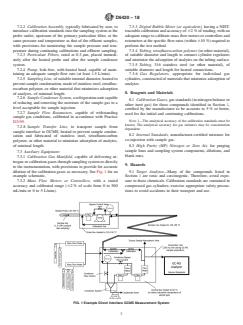
7.3.1 Calibration Gas Manifold, capable of delivering ni-
trogen or calibration gases through sampling system or directly
9. Hazards
to the instrumentation, with provisions to provide for accurate
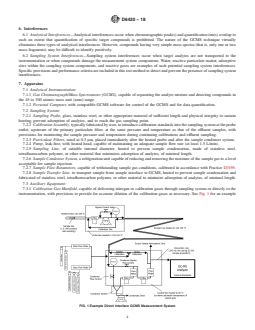
dilution of the calibration gases as necessary. See Fig. 1 for an 9.1 Target Analytes—Many of the compounds listed in
example schematic. Section 1 are toxic and carcinogenic. Therefore, avoid expo-
sure to these chemicals. Calibration standards are contained in
7.3.2 Mass Flow Meters or Controllers, with a stated
accuracy and calibrated range (62 % of scale from 0 to 500 compressed gas cylinders; exercise appropriate safety precau-
mL/min or 0 to 5 L/min). tions to avoid accidents in their transport and use.
FIG. 1 Example Direct Interface GCMS Measurement System
D6420 − 18
TABLE 1 Calibration and Sampling QA/QC Criteria
IS GC Retention
Operational
Recommended Time Extracted Ion Chromatographic Criteria Accuracy and Sensitivity
Mode
Requirements Requirements
Mass Spectrometer See Table 3
Tune
Three-Point See Table 4 RTs for individual VOHAPS %RSDs calculated from the individual RRFs at ARRFs must be >0.25 to ensure proper
Calibration must be within ±6 % of each calibration point must be ±20 % for each instrumental response.
each other from run to target analyte.
run.
The RFs of the internal standards must be within A signal to noise of 10:1 (measured in
–50 – 100 % of the mean for the initial three- accordance with the instrument
point calibration. manufacturer’s procedures) is
recommended for the low concentration
level.
Surrogate Continuing See Table 4 RTs for individual VOHAPS The RFs of the internal standards must be within Surrogate continuing system calibration
Calibration Check must be within ±6 % of –50 – 100 % of their ARFs from the initial results must be within ±20 % of the
(CCC) the initial three-point three-point calibration. manufacturers certified value from
calibration. analysis by the three-point calibration for
valid continuing calibration.
Sampling See Table 4 RTs for detected VOHAPS The RFs of the internal standards must be within Spectral ions of greater than 10 %
must be within ±6 % of –50 – 100 % o
...
This document is not an ASTM standard and is intended only to provide the user of an ASTM standard an indication of what changes have been made to the previous version. Because
it may not be technically possible to adequately depict all changes accurately, ASTM recommends that users consult prior editions as appropriate. In all cases only the current version
of the standard as published by ASTM is to be considered the official document.
Designation: D6420 − 99 (Reapproved 2010) D6420 − 18
Standard Test Method for
Determination of Gaseous Organic Compounds by Direct
Interface Gas Chromatography-Mass Spectrometry
This standard is issued under the fixed designation D6420; the number immediately following the designation indicates the year of
original adoption or, in the case of revision, the year of last revision. A number in parentheses indicates the year of last reapproval. A
superscript epsilon (´) indicates an editorial change since the last revision or reapproval.
1. Scope
1.1 This test method employs a direct interface gas chromatograph/mass spectrometer (GCMS) to identify and quantify the 36
volatile organic compounds (or sub-set of these compounds) listed as follows. The individual Chemical Abstract Service (CAS)
numbers are listed after each compound.
Benzene-71432 Methylene chloride-75092
Bromodichloromethane-75274 1,1,2,2-Tetrachloroethane-79349
Carbon disulfide-75150 1,1,1-Trichloroethane-71556
Chloroform-67663 1,1,2-Trichloroethane-79005
Methyl iso-Butyl ketone-108101 p-Xylene-106423
Styrene-100425 Bromomethane-74839
Tetrachloroethylene-127184 Carbon tetrachloride-56235
Toluene-108883 Chlorobenzene-108907
Bromoform-75252 c-1,3-Dichloropropene-10061015
Vinyl acetate-108054 1,2-Dichloroethane-156592
Vinyl chloride-75014 1,1-Dichloroethene-75354
Chloromethane-74873 t-1,2-Dichloroethene-156605
cis-1,2-Dichloroethene-156592 Methyl ethyl ketone-78933
Dibromochloromethane-124481 2-Hexanone-591786
1,1-Dichloroethane-107062 t-1,3-Dichloropropene-542756
1,2-Dichloropropane-78875 Trichloroethene-79016
Ethylbenzene-100414 m-Xylene-108383
Ethyl chloride-75003 o-Xylene-95476
1.2 The test method incorporates a performance-based approach, which validates each GCMS analysis by placing boundaries
on the instrument response to gaseous internal standards and their specific mass spectral relative abundance. Using this approach,
the test method may be extended to analyze other compounds.
1.3 The test method provides on-site analysis of extracted, unconditioned, and unsaturated (at the instrument) gas samples from
stationary sources. Gas streams with high moisture content may require conditioning to prevent moisture condensation within the
instrument. For these samples, quality assurance (QA) requirements are provided in the test method to validate the analysis of
polar, water-soluble compounds.
1.4 The instrument range should be sufficient to measure the listed volatile organic compounds from 150 ppb(v) to 100 ppm(v),
using a full scan operation (between 45 and 300 atomic mass units). The range may be extended to higher or lower concentrations
using either of the following procedures:
1.4.1 The initial three-point calibration concentrations and the continuing calibration checks are adjusted to match the stack
concentrations, or
1.4.2 The three-point calibration is extended to include additional concentrations to cover the measurement range.
1.5 The minimum quantification level is 50 % of the lowest calibration concentration. Responses below this level are considered
to be estimated concentrations, unless a calibration standard check is conducted at a lower concentration to demonstrate linearity.
The sensitivity of the GCMS measurement system for the individual target analytes depends upon:
1.5.1 The specific instrument response for each target analyte and the number of mass spectral quantification ions available.
1.5.2 The amount of instrument noise, and
1.5.3 The percent moisture content of the sample gas.
This test method is under the jurisdiction of ASTM Committee D22 on Air Quality and is the direct responsibility of Subcommittee D22.03 on Ambient Atmospheres
and Source Emissions.
Current edition approved Oct. 1, 2010Nov. 1, 2018. Published November 2010November 2018. Originally approved in 1999. Last previous edition approved in 20042010
as D6420 – 99 (2004).(2010). DOI: 10.1520/D6420-99R10.10.1520/D6420-18.
Copyright © ASTM International, 100 Barr Harbor Drive, PO Box C700, West Conshohocken, PA 19428-2959. United States
D6420 − 18
1.6 The values stated in SI units are to be regarded as standard. No other units of measurement are included in this standard.
1.7 This standard does not purport to address all of the safety concerns, if any, associated with its use. It is the responsibility
of the user of this standard to establish appropriate safety safety, health, and healthenvironmental practices and determine the
applicability of regulatory limitations prior to use. Additional safety precautions are described in Section 9.
1.8 This international standard was developed in accordance with internationally recognized principles on standardization
established in the Decision on Principles for the Development of International Standards, Guides and Recommendations issued
by the World Trade Organization Technical Barriers to Trade (TBT) Committee.
D6420 − 18
2. Referenced Documents
2.1 ASTM Standards:
D1356 Terminology Relating to Sampling and Analysis of Atmospheres
D3195 Practice for Rotameter Calibration
2.2 EPA Test Methods:
Method 1–Sample1 Sample and Velocity Traverses for Stationary Sources
Method 2–Determination2 Determination of Stack Gas Velocity and Volumetric Flow Rate (Type S Pitot Tube)
Method 3–Gas3 Gas Analysis for Carbon Dioxide, Oxygen, Excess Air, and Dry Molecular Weight
Method 4–Determination4 Determination of Moisture Content in Stack Gases
Method 624–Purgables624 Purgables
3. Terminology
3.1 Definitions—See TerminologyFor definitions D1356 for definition of terms used in this test method.method, see
Terminology D1356.
3.2 Definitions of Terms Specific to This Standard:
3.2.1 blank analysis, n—injecting zero air or nitrogen into the GCMS to determine background levels of the target analytes.
3.2.2 CCC, n—continuing calibration check—injecting calibration gas standards into the GCMS to verify the calibration status.
3.2.2.1 Discussion—
The continuing calibration check is performed before each testing day, before resuming sampling after instrument shutdown or
malfunction, and before resuming sampling after 12 h of continuous instrument operation.
3.2.3 quantification ion, n—a specific ion in the analytes mass spectrum that is used for quantification.
3.2.4 system calibration, n—calibration obtained by injecting the calibration standard(s) through the entire sampling system.
3.2.5 system zero, n—zero obtained by injecting dry nitrogen or zero gas through the entire sampling system to determine the
system background levels of the target analytes.
4. Summary of Test Method
4.1 Analysis—Volatile Organic Hazardous Air Pollutantsorganic hazardous air pollutants (VOHAP) are analyzed using gas
chromatography (GC) to separate the individual compounds and mass spectrometry (MS) to identify the compounds. The MS scans
a defined mass range (usually from 45 to 300 atomic mass units (amu) for combustion sources) to identify the specific fragments
for each molecule. The target analytes are identified positively by: (1) comparing eluting analyte GC peak retention times in the
total ion chromatograph (TIC) to those contained in a three-point calibration, and (2) examining the mass spectral pattern of the
eluted peaks. Internal standards are used to correct for hardware-related errors such as different injection volumes, operational
temperature fluctuations, and electron multiplier drift.
4.2 Sampling—Samples are extracted from the stack or duct at a constant rate, filtered, conditioned (if required), and transported
to the GCMS for analysis. Calibration gases are introduced at the extractive probe outlet, upstream of the primary particulate filter.
All sample extraction components are maintained at temperatures that prevent moisture condensation within the measurement
system components.
5. Significance and Use
5.1 This field test method determines the mass concentration of VOHAPs (or any subset) listed in Section 1.
5.2 Multiplying the mass concentration by the effluent volumetric flow rate (see 2.2) yields mass emission rates.
5.3 This field test method employs the typical laboratory GCMS techniques and QA/QC procedures.QA/quality control (QC)
procedures in common application.
5.4 This field test method provides data with accuracy and precision similar to most laboratory GCMS instrumentation.
NOTE 1—Supporting data are available from ASTM Headquarters Request RR:_______.
For referenced ASTM standards, visit the ASTM website, www.astm.org, or contact ASTM Customer Service at service@astm.org. For Annual Book of ASTM Standards
volume information, refer to the standard’sstandard’s Document Summary page on the ASTM website.
Code of Federal Regulations 40 CFR Part 60, Appendix A, available from Superintendent of Documents, U.S. Government Printing Office, Washington, DC
20402.Superintendent of Documents, 732 N. Capitol St., NW, Washington, DC 20401-0001, http://www.access.gpo.gov.
Code of Federal Regulations 40 CFR Part 136, Appendix A, available from Superintendent of Documents, U.S. Government Printing Office, Washington, DC
20402.Superintendent of Documents, 732 N. Capitol St., NW, Washington, DC 20401-0001, http://www.access.gpo.gov.
D6420 − 18
6. Interferences
6.1 Analytical Interferences—Analytical interferences occur when chromatographic peak(s) and quantification ion(s) overlap to
such an extent that quantification of specific target compounds is prohibited. The nature of the GCMS technique virtually
eliminates these types of analytical interferences. However, compounds having very simple mass spectra (that is, only one or two
mass fragments) may be difficult to identify positively.
6.2 Sampling System Interferences—Sampling system interferences occur when target analytes are not transported to the
instrumentation or when compounds damage the measurement system components. Water, reactive particulate matter, adsorptive
sites within the sampling system components, and reactive gases are examples of such potential sampling system interferences.
Specific provisions and performance criteria are included in this test method to detect and prevent the presence of sampling system
interferences.
7. Apparatus
7.1 Analytical Instrumentation:
7.1.1 Gas Chromatograph/Mass Spectrometer (GCMS), capable of separating the analyte mixture and detecting compounds in
the 45 to 300 atomic mass unit (amu) range.
7.1.2 Personal Computer, with compatible GCMS software for control of the GCMS and for data quantification.
7.2 Sampling System:
7.2.1 Sampling Probe, glass, stainless steel, or other appropriate material of sufficient length and physical integrity to sustain
heating, prevent adsorption of analytes, and to reach the gas sampling point.
7.2.2 Calibration Assembly, typically fabricated by user, to introduce calibration standards into the sampling system at the probe
outlet, upstream of the primary particulate filter, at the same pressure and temperature as that of the effluent samples, with
provisions for monitoring the sample pressure and temperature during continuing calibrations and effluent sampling.
7.2.3 Particulate Filters, rated at 0.3 μm, placed immediately after the heated probe and after the sample condenser system.
7.2.4 Pump, leak-free, with heated head, capable of maintaining an adequate sample flow rate (at least 1.5 L/min).
7.2.5 Sampling Line, of suitable internal diameter, heated to prevent sample condensation, made of stainless steel,
tetrafluorocarbon polymer, or other material that minimizes adsorption of analytes, of minimal length.
7.2.6 Sample Condenser System, a refrigeration unit capable of reducing and removing the moisture of the sample gas to a level
acceptable for sample injection.
7.2.7 Sample Flow Rotameters, capable of withstanding sample gas conditions, calibrated in accordance with Practice D3195.
7.2.8 Sample Transfer Line, to transport sample from sample interface to GCMS, heated to prevent sample condensation and
fabricated of stainless steel, tetrafluorocarbon polymer, or other material to minimize adsorption of analytes, of minimal length.
7.3 Auxiliary Equipment:
7.3.1 Calibration Gas Manifold, capable of delivering nitrogen or calibration gases through sampling system or directly to the
instrumentation, with provisions to provide for accurate dilution of the calibration gases as necessary. See Fig. 1 for an example
FIG. 1 Example Direct Interface GCMS Measurement System
D6420 − 18
schematic.
7.3.2 Mass Flow Meters or Controllers, with a stated accuracy and calibrated range (62 % of scale from 0 to 500 mL/min or
0 to 5 L/min).
7.3.3 Digital Bubble Meter (or equivalent), having a NIST-traceable calibration and accuracy of 62 % of reading, with an
adequate range to calibrate mass flow meters or controllers and rotameters at the specific flow rates (within 610 %) required to
perform the test method.
7.3.4 Tubing, tetrafluorocarbon polymer (or other material), of suitable diameter and length to connect cylinder regulators and
minimize the adsorption of analytes on the tubing surface.
7.3.5 Tubing, 316 stainless steel (or other material), of suitable diameter and length for heated connections.
7.3.6 Gas Regulators, appropriate for individual gas cylinders, constructed of materials that minimize adsorption of analytes.
8. Reagents and Materials
8.1 Calibration Gases, gas standards (in nitrogen balance or other inert gas) for those compounds identified in Section 1,
certified by the manufacturer to be accurate to 5 % or better, used for the initial and continuing calibrations.
NOTE 1—The analytical accuracy of the calibration standards must be known. The analytical accuracy for gas mixtures may be concentration
dependent.
8.2 Internal Standards, manufacturer-certified mixtures for co-injection with sample gas.
8.3 High Purity (HP) Nitrogen or Zero Air, for purging sample lines and sampling system components, dilutions, and blank runs.
9. Hazards
9.1 Target Analytes—Many of the compounds listed in Section 1 are toxic and carcinogenic. Therefore, avoid exposure to these
chemicals. Calibration standards are contained in compressed gas cylinders; exercise appropriate safety precautions to avoid
accidents in their transport and use.
9.2 Sampling Location—This test method may involve sampling locations with high positive or negative pressures, high
temperatures, elevated heights, or high concentrations of hazardous or toxic pollutants.
9.3 Mobile or Remote Laboratory—To avoid exposure to hazardous pollutants and to protect personnel in the laboratory,
perform a leak check of the sampling system and inspect the sample exhaust equipment before sampling the calibration standards
or effluent. Properly vent the exhaust gases.
10. Calibration and Standardization
10.1 Calibration Standards—Because of the incompatibility of some target compounds, many gas blends at each concentration
may be needed to construct a calibration curve for all of the 36 target analytes listed in 1.1. Obtain or generate calibration standards
of each target compound at nominal concentrations of 300 ppb(v), 1 ppm(v), and 10 ppm(v) by either of the following options:
10.1.1 Option 1—Obtain calibration gas standards for the target compounds at the three specified nominal concentrations.
10.1.2 Option 2—Obtain 10 ppm(v) calibration standards for the target analytes. Then successively dilute the 10 ppm(v)
standard with ultra-pure nitrogen using mass flow meters. Dilute the 10 ppm(v) standard to 1 ppm(v) and then the 1 ppm(v) to 300
ppb(v). If Option 2 is used, analyze the calibration check (see Table 5) compounds directly as a QA audit of the dilution technique.
The audit result using the calibrated GCMS must be within 620 % for the calibration to be valid.
10.1.3 Option 2 for preparation of the three-point calibration curve may also generate concentration levels above and below the
suggested concentration range. It is necessary, when using this option, to audit the calibration curve using a certified calibration
standard independent from those used to prepare the curve.
10.1.4 If the QA audit results are not within 20 % of the expected value, corrective action must be taken.
10.2 Mass Flow Meters—For Option 2, calibrate the mass flow meter using a digital bubble meter having a NIST-traceable
calibration at the specific flow rates (610 %) necessary for diluting the calibration standards.
10.3 MS Tune—Follow the manufacturer’smanufacturer’s written instructions for the set-up, tune, operation, and calibration of
the GCMS instrument.
10.3.1 If NIST library searchable mass spectra are needed to identify compounds not included in the three-point calibration or
to facilitate comparison with other mass spectral analyses, the mass spectrometer tune must be able to produce mass spectra for
bromofluorobenzene (BFB) that meet the relative abundance criteria in Table 2.
NOTE 2—BF
...
Questions, Comments and Discussion
Ask us and Technical Secretary will try to provide an answer. You can facilitate discussion about the standard in here.
Loading comments...