


ASTM C357-07(2022)
(Test Method)Standard Test Method for Bulk Density of Granular Refractory Materials
Standard Test Method for Bulk Density of Granular Refractory Materials
SIGNIFICANCE AND USE
3.1 Granular refractory materials may be either refractory grain raw materials that are used in the manufacture of finished refractory products, or bulk granular refractory materials that are sold, with or without some degree of processing, to refractory consumers for various uses. In either case, characterizing the properties of a granular refractory material is essential in evaluating its quality or consistency of quality and in determining suitability for end use. One of the important properties is bulk density because of its relationship to end product quality, usage, and performance.
3.2 The refractories producer can use this test method as one of the quality control tests for his manufactured or mined refractory grain raw materials or for evaluating potential refractory grain raw materials.
3.3 For the refractories consumer, the principal use of this test method is in the evaluation of the quality or the consistency of quality of the granular material in purchased refractory mixes or in bulk granular refractory materials used by the consumer.
3.4 This is a primary test method, and thus is suitable for use in specifications, quality control, and research and development. It can also serve as a referee test method in purchasing contracts or agreements and as a base for development of more rapid, secondary test methods for use in quality control on manufactured refractory raw materials.
3.5 Fundamental assumptions inherent in this test method are that the sample is representative of the material in general, the particle size of the sample is within the range specified by the test method, the material is not readily hydratable, and the size and quantity of pores in the material permits removal of surface water without drainage from the pores themselves. Deviation from any of these assumptions negates the usefulness of the test results.
3.6 In interpreting the results of this test method, it must be recognized that the specific gravity of the materia...
SCOPE
1.1 This test method covers a procedure for determining the bulk density of granular refractory materials, commercial products which usually have particles that are retained on a 0.265 in. (6.7 mm) or coarser sieve.
Note 1: This test method is not suitable for materials that hydrate in boiling water.
1.2 Units—The values stated in inch-pound units are to be regarded as standard. The values given in parentheses are mathematical conversions to SI units that are provided for information only and are not considered standard.
1.2.1 Exceptions—In Sections 4, 7, and 8, the apparatus used is only available in SI units.
1.3 This standard does not purport to address all of the safety concerns, if any, associated with its use. It is the responsibility of the user of this standard to establish appropriate safety, health, and environmental practices and determine the applicability of regulatory limitations prior to use.
1.4 This international standard was developed in accordance with internationally recognized principles on standardization established in the Decision on Principles for the Development of International Standards, Guides and Recommendations issued by the World Trade Organization Technical Barriers to Trade (TBT) Committee.
General Information
Buy Standard
Standards Content (Sample)
NOTICE: This standard has either been superseded and replaced by a new version or withdrawn.
Contact ASTM International (www.astm.org) for the latest information
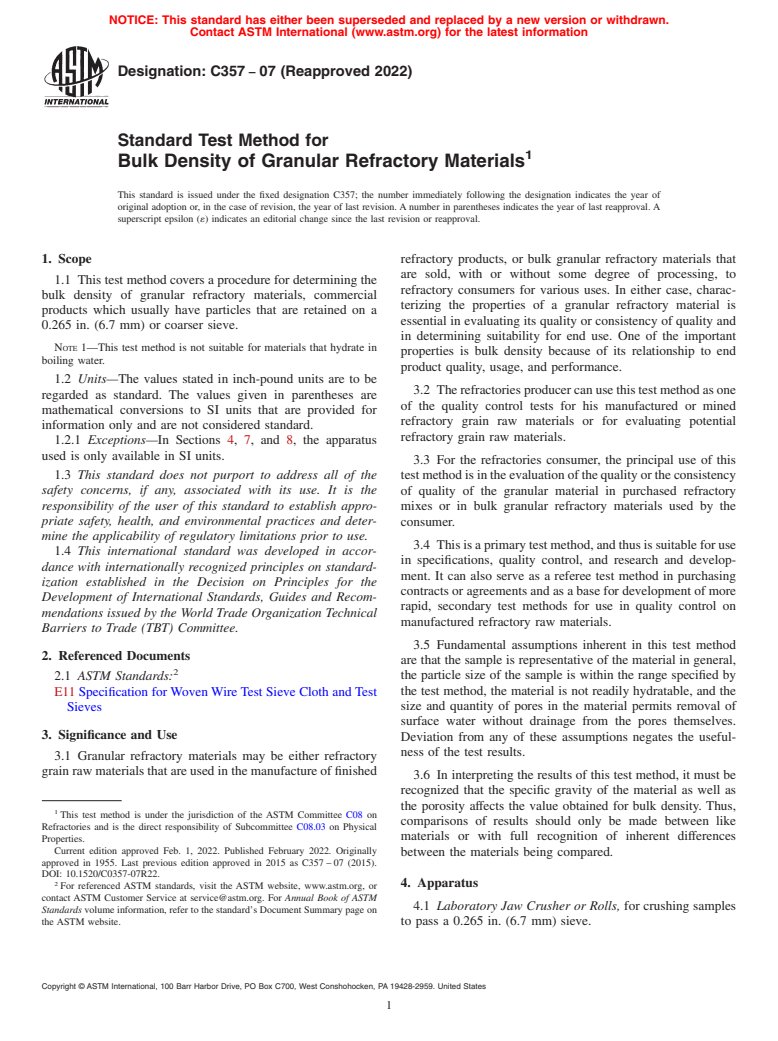
Designation: C357 − 07 (Reapproved 2022)
Standard Test Method for
Bulk Density of Granular Refractory Materials
This standard is issued under the fixed designation C357; the number immediately following the designation indicates the year of
original adoption or, in the case of revision, the year of last revision. A number in parentheses indicates the year of last reapproval. A
superscript epsilon (´) indicates an editorial change since the last revision or reapproval.
1. Scope refractory products, or bulk granular refractory materials that
are sold, with or without some degree of processing, to
1.1 This test method covers a procedure for determining the
refractory consumers for various uses. In either case, charac-
bulk density of granular refractory materials, commercial
terizing the properties of a granular refractory material is
products which usually have particles that are retained on a
essential in evaluating its quality or consistency of quality and
0.265 in. (6.7 mm) or coarser sieve.
in determining suitability for end use. One of the important
NOTE 1—This test method is not suitable for materials that hydrate in
properties is bulk density because of its relationship to end
boiling water.
product quality, usage, and performance.
1.2 Units—The values stated in inch-pound units are to be
3.2 Therefractoriesproducercanusethistestmethodasone
regarded as standard. The values given in parentheses are
of the quality control tests for his manufactured or mined
mathematical conversions to SI units that are provided for
refractory grain raw materials or for evaluating potential
information only and are not considered standard.
refractory grain raw materials.
1.2.1 Exceptions—In Sections 4, 7, and 8, the apparatus
used is only available in SI units.
3.3 For the refractories consumer, the principal use of this
1.3 This standard does not purport to address all of the testmethodisintheevaluationofthequalityortheconsistency
safety concerns, if any, associated with its use. It is the of quality of the granular material in purchased refractory
responsibility of the user of this standard to establish appro-
mixes or in bulk granular refractory materials used by the
priate safety, health, and environmental practices and deter- consumer.
mine the applicability of regulatory limitations prior to use.
3.4 Thisisaprimarytestmethod,andthusissuitableforuse
1.4 This international standard was developed in accor-
in specifications, quality control, and research and develop-
dance with internationally recognized principles on standard-
ment. It can also serve as a referee test method in purchasing
ization established in the Decision on Principles for the
contracts or agreements and as a base for development of more
Development of International Standards, Guides and Recom-
rapid, secondary test methods for use in quality control on
mendations issued by the World Trade Organization Technical
manufactured refractory raw materials.
Barriers to Trade (TBT) Committee.
3.5 Fundamental assumptions inherent in this test method
2. Referenced Documents
are that the sample is representative of the material in general,
2.1 ASTM Standards: the particle size of the sample is within the range specified by
the test method, the material is not readily hydratable, and the
E11 Specification for Woven Wire Test Sieve Cloth and Test
Sieves size and quantity of pores in the material permits removal of
surface water without drainage from the pores themselves.
3. Significance and Use
Deviation from any of these assumptions negates the useful-
ness of the test results.
3.1 Granular refractory materials may be either refractory
grain raw materials that are used in the manufacture of finished
3.6 In interpreting the results of this test method, it must be
recognized that the specific gravity of the material as well as
the porosity affects the value obtained for bulk density. Thus,
This test method is under the jurisdiction of the ASTM Committee C08 on
comparisons of results should only be made between like
Refractories and is the direct responsibility of Subcommittee C08.03 on Physical
materials or with full recognition of inherent differences
Properties.
Current edition approved Feb. 1, 2022. Published February 2022. Originally
between the materials being compared.
approved in 1955. Last previous edition approved in 2015 as C357 – 07 (2015).
DOI: 10.1520/C0357-07R22.
2 4. Apparatus
For referenced ASTM standards, visit the ASTM website, www.astm.org, or
contact ASTM Customer Service at service@astm.org. For Annual Book of ASTM
4.1 Laboratory Jaw Crusher or Rolls, for crushing samples
Standards volume information, refer to the standard’s Document Summary page on
the ASTM website. to pass a 0.265 in. (6.7 mm) sieve.
Copyright © ASTM International, 100 Barr Harbor Drive, PO Box C700, West Conshohocken, PA 19428-2959. United States
C357 − 07 (2022)
4.2 Standard Sieves, 0.265 in. and No. 8 (2.36 mm) with Pan between 60 and 90 g, depending upon the bulk density. Weigh
and Cover (Note 2)—The sieves shall conform to Specification this sample to the nearest 10 mg and record as the dry weight.
E11.
7.2 Place the test sample in a beaker of water and boil for
4.2.1 The coarser sieve may be the No. 4 (4.75 mm) and the
1 h during which the grains shall be completely covered with
finer sieve may be the No. 6 (3.35 mm) or No. 12 (1.70 mm),
water. Cool the sample to room temperature by running cold
if tests indicate that the range in particle size is not critical.
water into the beaker or by a similar method.
NOTE 2—The 0.265 in., No. 4, No. 6, No. 8, and No. 12 ASTM sieves
7.3 Rinse the clean buret (Note 3) thoroughly and introduce
are equivalent to 3, 4, 6, 8, and 10 mesh, respectively, of the Tyler
3 approximately 25 mL of distilled water at room temperature.
Standard Series.
Allowittostanduntildropsofwateronthesidessettleintothe
4.3 Drying Oven, adjustable to 220 to 230 °F (105 to
body of liquid.
110 °C).
NOTE 3—Clean the burette or the Le Chatelier specific gravity bottle
1 3
4.4 Riffle, with six or more ⁄2 to ⁄4 in. (13 to 19 mm)
frequently with a good cleaning solution such as liquid soap to ensure
troughs with pans, or a smooth plate at least 15 in. (381 mm)
complete drainage without drops of water forming on the inside walls.
square and a 300 mm blade spatula or trowel for sample
7.3.1 Alternately rinse the clean specific gravity bottle and
quartering.
fill with distilled water at room temperature as close to the 0
4.5 Balance, capacity 200 g, sensitivity 0.01 g.
mark as possible. Allow it to stand until drops of water on the
sidessettleintothebodyofliquid.Takeacleanpieceofsponge
4.6 Hot Plate.
that is hooked to a stainless steel or copper wire and is long
4.7 Beakers, 250 mL.
enough to reach to the bottom of the straight section. Insert the
4.8 Buret, 50 mL, calibrated to 0.1 mL.
sponge into the bottle and with circular
...
This document is not an ASTM standard and is intended only to provide the user of an ASTM standard an indication of what changes have been made to the previous version. Because
it may not be technically possible to adequately depict all changes accurately, ASTM recommends that users consult prior editions as appropriate. In all cases only the current version
of the standard as published by ASTM is to be considered the official document.
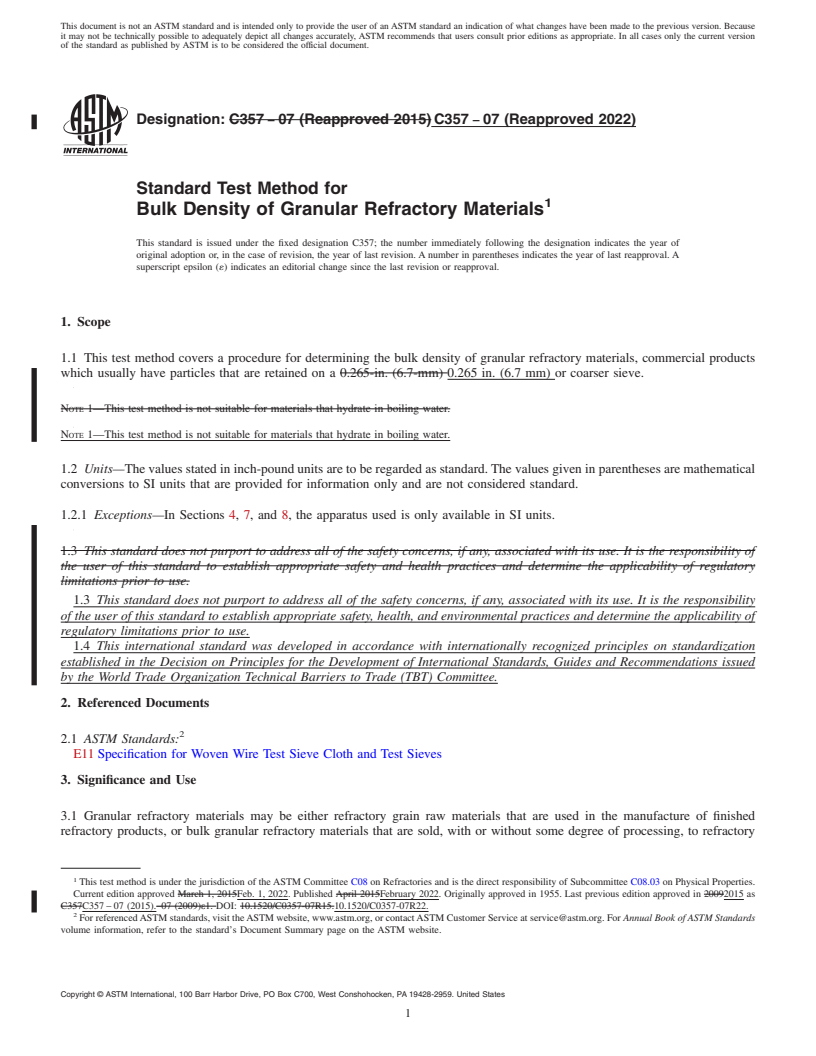
Designation: C357 − 07 (Reapproved 2015) C357 − 07 (Reapproved 2022)
Standard Test Method for
Bulk Density of Granular Refractory Materials
This standard is issued under the fixed designation C357; the number immediately following the designation indicates the year of
original adoption or, in the case of revision, the year of last revision. A number in parentheses indicates the year of last reapproval. A
superscript epsilon (´) indicates an editorial change since the last revision or reapproval.
1. Scope
1.1 This test method covers a procedure for determining the bulk density of granular refractory materials, commercial products
which usually have particles that are retained on a 0.265-in. (6.7-mm) 0.265 in. (6.7 mm) or coarser sieve.
NOTE 1—This test method is not suitable for materials that hydrate in boiling water.
NOTE 1—This test method is not suitable for materials that hydrate in boiling water.
1.2 Units—The values stated in inch-pound units are to be regarded as standard. The values given in parentheses are mathematical
conversions to SI units that are provided for information only and are not considered standard.
1.2.1 Exceptions—In Sections 4, 7, and 8, the apparatus used is only available in SI units.
1.3 This standard does not purport to address all of the safety concerns, if any, associated with its use. It is the responsibility of
the user of this standard to establish appropriate safety and health practices and determine the applicability of regulatory
limitations prior to use.
1.3 This standard does not purport to address all of the safety concerns, if any, associated with its use. It is the responsibility
of the user of this standard to establish appropriate safety, health, and environmental practices and determine the applicability of
regulatory limitations prior to use.
1.4 This international standard was developed in accordance with internationally recognized principles on standardization
established in the Decision on Principles for the Development of International Standards, Guides and Recommendations issued
by the World Trade Organization Technical Barriers to Trade (TBT) Committee.
2. Referenced Documents
2.1 ASTM Standards:
E11 Specification for Woven Wire Test Sieve Cloth and Test Sieves
3. Significance and Use
3.1 Granular refractory materials may be either refractory grain raw materials that are used in the manufacture of finished
refractory products, or bulk granular refractory materials that are sold, with or without some degree of processing, to refractory
This test method is under the jurisdiction of the ASTM Committee C08 on Refractories and is the direct responsibility of Subcommittee C08.03 on Physical Properties.
Current edition approved March 1, 2015Feb. 1, 2022. Published April 2015February 2022. Originally approved in 1955. Last previous edition approved in 20092015 as
C357C357 – 07 (2015).–07 (2009)ε1. DOI: 10.1520/C0357-07R15.10.1520/C0357-07R22.
For referenced ASTM standards, visit the ASTM website, www.astm.org, or contact ASTM Customer Service at service@astm.org. For Annual Book of ASTM Standards
volume information, refer to the standard’s Document Summary page on the ASTM website.
Copyright © ASTM International, 100 Barr Harbor Drive, PO Box C700, West Conshohocken, PA 19428-2959. United States
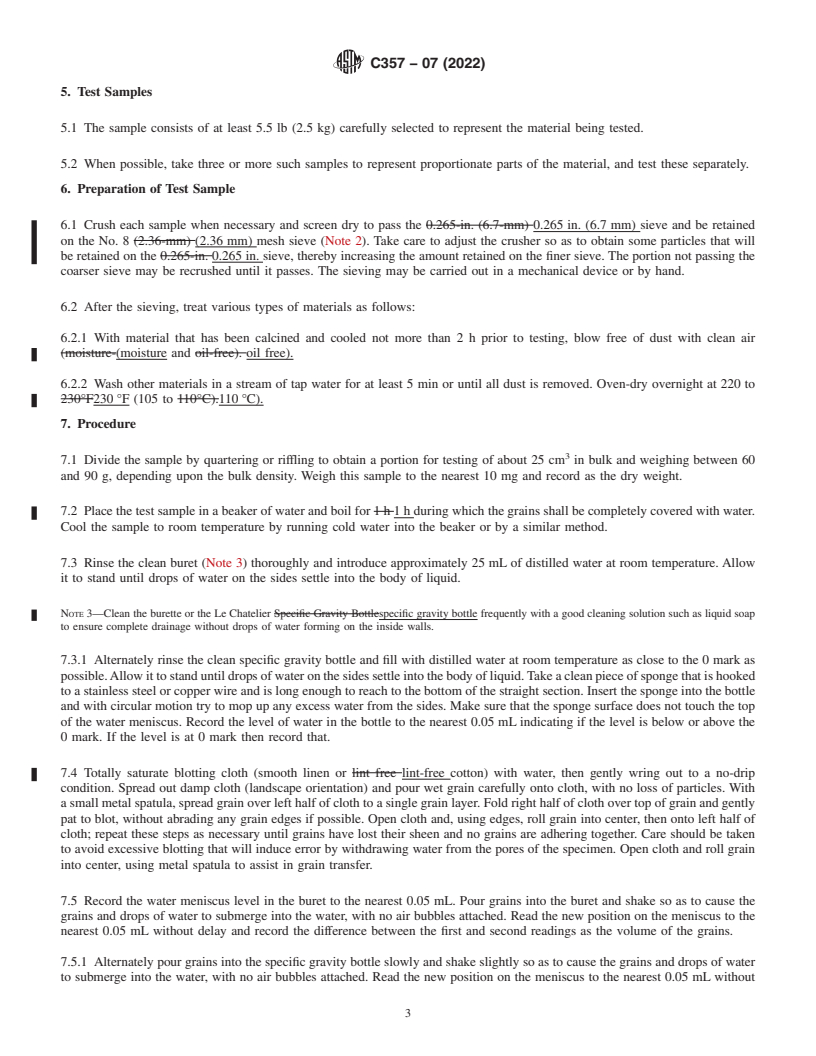
C357 − 07 (2022)
consumers for various uses. In either case, characterizing the properties of a granular refractory material is essential in evaluating
its quality or consistency of quality and in determining suitability for end use. One of the important properties is bulk density
because of its relationship to end product quality, usage, and performance.
3.2 The refractories producer can use this test method as one of the quality-control quality control tests for his manufactured or
mined refractory grain raw materials or for evaluating potential refractory grain raw materials.
3.3 For the refractories consumer, the principal use of this test method is in the evaluation of the quality or the consistency of
quality of the granular material in purchased refractory mixes or in bulk granular refractory materials used by the consumer.
3.4 This is a primary test method, and thus is suitable for use in specifications, quality control, and research and development. It
can also serve as a referee test method in purchasing contracts or agreements and as a base for development of more rapid,
secondary test methods for use in quality control on manufactured refractory raw materials.
3.5 Fundamental assumptions inherent in this test method are that the sample is representative of the material in general, the
particle size of the sample is within the range specified by the test method, the material is not readily hydratable, and the size and
quantity of pores in the material permits removal of surface water without drainage from the pores themselves. Deviation from any
of these assumptions negates the usefulness of the test results.
3.6 In interpreting the results of this test method, it must be recognized that the specific gravity of the material as well as the
porosity affects the value obtained for bulk density. Thus, comparisons of results should only be made between like materials or
with full recognition of inherent differences between the materials being compared.
4. Apparatus
4.1 Laboratory Jaw Crusher or Rolls , Rolls, for crushing samples to pass a 0.265-in. (6.7-mm) 0.265 in. (6.7 mm) sieve.
4.2 Standard Sieves, 0.265-in. 0.265 in. and No. 8 (2.36-mm) (2.36 mm) with Pan and Cover (Note 2)—The sieves shall conform
to Specification E11.
4.2.1 The coarser sieve may be the No. 4 (4.75 mm) and the finer sieve may be the No. 6 (3.35 mm) or No. 12 (1.70 mm), if tests
indicate that the range in particle size is not critical.
NOTE 2—The 0.265-in., 0.265 in., No. 4, No. 6, No. 8, and No. 12 ASTM sieves are equivalent to 3, 4, 6, 8, and 10-mesh, 10 mesh, respectively, of the
Tyler Standard Series.
4.3 Drying Oven, adjustable to 220 to 230°F230 °F (105 to 110°C).110 °C).
1 3
4.4 Riffle, with six or more ⁄2 to ⁄4-in. in. (13 to 19-mm) 19 mm) troughs with pans, or a smooth plate at least 15 in. (381 mm)
square and a 300-mm 300 mm blade spatula or trowel for sample quartering.
4.5 Balance, capacity 200 g, sensitivity 0.01 g.
4.6 Hot Plate.
4.7 Beakers, 250 mL.
4.8 Buret, 50 mL, calibrated to 0.1 mL.
4.9 Le Chatelier Specific Gravity Bottle, 250 mL capacity.
World Screening, Suite 30–148,30-148, Huntsville, AL 35802, Tel: 800-749-7999; Macon Wire, 2913 Joycliff Road, Macon, GA 31211, Tel: 800-768-9155; Gilson
Company, P.O. Box 200, Lewis Center, OH 43035, TelTel: 800-444-1508, www.globalgilson.com; Fisher Scientific, 2000 Park Lane, Pittsburgh, PA 15275, Tel.
412–490–8300,Tel: 412-490-8300, www.fishersci.com.
C357 − 07 (2022)
5. Test Samples
5.1 The sample consists of at least 5.5 lb (2.5 kg) carefully selected to represent the material being tested.
5.2 When possible, take three or more such samples to represent proportionate parts of the material, and test these separately.
6. Preparation of Test Sample
6.1 Crush each sample when necessary and screen dry to pass the 0.265-in. (6.7-mm)
...
Questions, Comments and Discussion
Ask us and Technical Secretary will try to provide an answer. You can facilitate discussion about the standard in here.