

ASTM D4979-19
(Practice)Standard Practice for Physical Description Screening Analysis in Waste
General Information
- Abstract
SIGNIFICANCE AND USE
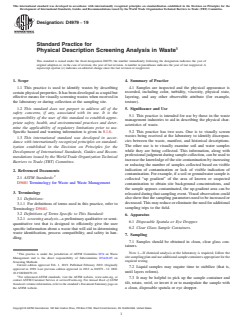
5.1 This practice is intended for use by those in the waste management industries to aid in describing the physical characteristics of waste.
5.2 This practice has two uses. One is to visually screen wastes being received at the laboratory to identify discrepancies between the waste, manifest, and historical descriptions. The other use is to visually examine soil and water samples while they are being collected. This information, along with professional judgment during sample collection, can be used to increase the knowledge of the site contamination by increasing or reducing the number of samples collected based on visible indication of contamination or lack of visible indication of contamination. For example, if a soil or groundwater sample is collected “up gradient” of the area of known or suspected contamination to obtain site background concentrations, and the sample appears contaminated, the up-gradient area can be relocated during that sampling event. Visual observation could also show that the sampling parameters need to be increased or decreased. This may reduce or eliminate the need for additional sampling trips to the field.
SCOPE
1.1 This practice is used to identify wastes by describing certain physical properties. It has been developed as a rapid but effective means for visually screening wastes when received in the laboratory or during collection at the sampling site.
1.2 This standard does not purport to address all of the safety concerns, if any, associated with its use. It is the responsibility of the user of this standard to establish appropriate safety, health, and environmental practices and determine the applicability of regulatory limitations prior to use. Specific hazard and warning information is given in 8.1.6.
1.3 This international standard was developed in accordance with internationally recognized principles on standardization established in the Decision on Principles for the Development of International Standards, Guides and Recommendations issued by the World Trade Organization Technical Barriers to Trade (TBT) Committee.
- Status
- Published
- Publication Date
- 31-Jan-2019
- Technical Committee
- D34 - Waste Management
- Drafting Committee
- D34.01.05 - Screening Methods



Overview
ASTM D4979-19 is the internationally recognized standard practice for conducting physical description screening analysis in waste management. Developed by ASTM International, this standard provides a rapid, effective method for visually inspecting and describing the physical characteristics of waste materials during laboratory receipt or at sampling sites. It plays a crucial role in waste identification and process compatibility, offering essential guidance for professionals in the waste management industry to improve safety, regulatory compliance, and decision-making related to waste handling and site assessments.
Key Topics
- Visual Screening Analysis: The standard outlines a preliminary qualitative or semi-quantitative process to observe and record physical attributes of waste, designed to assist in waste identification and evaluation.
- Physical Properties Observed:
- Color: Noting all present colors and their relative prevalence.
- Turbidity: Describing liquid clarity (clear, cloudy, or opaque).
- Viscosity: Assessing the thickness or flow characteristics, referencing water, syrup, molasses, or solidification.
- Physical State: Categorizing samples as liquid, solid, sludge, powder, or granular.
- Layering: Recording visible layers, their percentages, and physical descriptions.
- Odor: Only obvious, incidental odors are noted for safety purposes.
- Sampling Guidance: Emphasizes the use of clear glass containers and proper sample handling to ensure accurate observation and documentation.
- Data Recording: All characteristics must be concisely and thoroughly documented to support effective waste management decisions.
Applications
ASTM D4979-19 is widely utilized across the waste management sector, including but not limited to:
- Laboratory Waste Receipt: Provides immediate visual screening to verify conformity of waste with manifest and historical records, helping to identify discrepancies and prevent processing errors.
- Field Sampling: Enables real-time decision-making during soil and water sample collection, allowing adjustments based on visual indicators of contamination. This technique can optimize sample numbers, reduce unnecessary sampling trips, and detect unexpected contaminants.
- Site Characterization: Visual descriptions obtained in accordance with this standard are integrated into environmental site assessments, supporting more accurate contamination delineation and facilitating compliance with regulatory frameworks.
- Process Safety: Enhances worker safety by promoting early identification of unexpected hazardous conditions through visual cues.
- Waste Identification: Expedites the identification and classification of waste streams for downstream management, treatment, or disposal.
Related Standards
- ASTM D5681: Terminology for Waste and Waste Management - Provides essential definitions used throughout ASTM D4979-19 and related waste management standards.
- Other relevant ASTM standards may apply to chemical analyses, sampling plans, and specific waste stream testing requirements.
Practical Value
Following ASTM D4979-19 allows waste management professionals to:
- Improve Efficiency: Conduct rapid, low-cost preliminary screenings without the need for advanced instrumentation.
- Increase Safety: Detect unexpected hazards early and adjust handling procedures accordingly.
- Reduce Costs: Minimize unnecessary repeat sampling and laboratory work by making informed decisions in the field.
- Enhance Compliance: Maintain thorough, standardized documentation to meet regulatory and audit requirements.
- Support Environmental Stewardship: Contribute to responsible waste management by enabling better site characterization and informed remediation actions.
By implementing ASTM D4979-19 physical description screening analysis, organizations can strengthen their waste management processes, ensuring higher safety, reliability, and regulatory compliance across diverse environmental settings.
Relations
- Effective Date
- 01-Feb-2019
- Effective Date
- 01-Nov-2023
- Effective Date
- 01-Nov-2018
- Effective Date
- 01-Sep-2017
- Effective Date
- 01-Nov-2016
- Effective Date
- 01-Feb-2016
- Effective Date
- 01-Feb-2013
- Effective Date
- 01-Jul-2009
- Effective Date
- 01-Sep-2008
- Effective Date
- 01-Sep-2004
- Effective Date
- 01-Sep-2004
- Effective Date
- 10-Jun-1998
- Effective Date
- 10-Jun-1998
- Effective Date
- 01-Feb-2019
Get Certified
Connect with accredited certification bodies for this standard

CIS Institut d.o.o.
Personal Protective Equipment (PPE) certification body. Notified Body NB-2890 for EU Regulation 2016/425 PPE.

Kiwa BDA Testing
Building and construction product certification.
Kmetijski inštitut Slovenije
Agricultural Institute of Slovenia. Soil testing, plant health, agricultural product analysis.
Sponsored listings
Frequently Asked Questions
ASTM D4979-19 is a standard published by ASTM International. Its full title is "Standard Practice for Physical Description Screening Analysis in Waste". This standard covers: SIGNIFICANCE AND USE 5.1 This practice is intended for use by those in the waste management industries to aid in describing the physical characteristics of waste. 5.2 This practice has two uses. One is to visually screen wastes being received at the laboratory to identify discrepancies between the waste, manifest, and historical descriptions. The other use is to visually examine soil and water samples while they are being collected. This information, along with professional judgment during sample collection, can be used to increase the knowledge of the site contamination by increasing or reducing the number of samples collected based on visible indication of contamination or lack of visible indication of contamination. For example, if a soil or groundwater sample is collected “up gradient” of the area of known or suspected contamination to obtain site background concentrations, and the sample appears contaminated, the up-gradient area can be relocated during that sampling event. Visual observation could also show that the sampling parameters need to be increased or decreased. This may reduce or eliminate the need for additional sampling trips to the field. SCOPE 1.1 This practice is used to identify wastes by describing certain physical properties. It has been developed as a rapid but effective means for visually screening wastes when received in the laboratory or during collection at the sampling site. 1.2 This standard does not purport to address all of the safety concerns, if any, associated with its use. It is the responsibility of the user of this standard to establish appropriate safety, health, and environmental practices and determine the applicability of regulatory limitations prior to use. Specific hazard and warning information is given in 8.1.6. 1.3 This international standard was developed in accordance with internationally recognized principles on standardization established in the Decision on Principles for the Development of International Standards, Guides and Recommendations issued by the World Trade Organization Technical Barriers to Trade (TBT) Committee.
SIGNIFICANCE AND USE 5.1 This practice is intended for use by those in the waste management industries to aid in describing the physical characteristics of waste. 5.2 This practice has two uses. One is to visually screen wastes being received at the laboratory to identify discrepancies between the waste, manifest, and historical descriptions. The other use is to visually examine soil and water samples while they are being collected. This information, along with professional judgment during sample collection, can be used to increase the knowledge of the site contamination by increasing or reducing the number of samples collected based on visible indication of contamination or lack of visible indication of contamination. For example, if a soil or groundwater sample is collected “up gradient” of the area of known or suspected contamination to obtain site background concentrations, and the sample appears contaminated, the up-gradient area can be relocated during that sampling event. Visual observation could also show that the sampling parameters need to be increased or decreased. This may reduce or eliminate the need for additional sampling trips to the field. SCOPE 1.1 This practice is used to identify wastes by describing certain physical properties. It has been developed as a rapid but effective means for visually screening wastes when received in the laboratory or during collection at the sampling site. 1.2 This standard does not purport to address all of the safety concerns, if any, associated with its use. It is the responsibility of the user of this standard to establish appropriate safety, health, and environmental practices and determine the applicability of regulatory limitations prior to use. Specific hazard and warning information is given in 8.1.6. 1.3 This international standard was developed in accordance with internationally recognized principles on standardization established in the Decision on Principles for the Development of International Standards, Guides and Recommendations issued by the World Trade Organization Technical Barriers to Trade (TBT) Committee.
ASTM D4979-19 is classified under the following ICS (International Classification for Standards) categories: 13.030.40 - Installations and equipment for waste disposal and treatment. The ICS classification helps identify the subject area and facilitates finding related standards.
ASTM D4979-19 has the following relationships with other standards: It is inter standard links to ASTM D4979-12, ASTM D5681-23, ASTM D5681-18, ASTM D5681-17, ASTM D5681-16a, ASTM D5681-16, ASTM D5681-13, ASTM D5681-09, ASTM D5681-08, ASTM D5681-98a(2004)e1, ASTM D5681-98a(2004), ASTM D5681-98ae1, ASTM D5681-98a, ASTM D5232-19. Understanding these relationships helps ensure you are using the most current and applicable version of the standard.
ASTM D4979-19 is available in PDF format for immediate download after purchase. The document can be added to your cart and obtained through the secure checkout process. Digital delivery ensures instant access to the complete standard document.
Standards Content (Sample)
This international standard was developed in accordance with internationally recognized principles on standardization established in the Decision on Principles for the
Development of International Standards, Guides and Recommendations issued by the World Trade Organization Technical Barriers to Trade (TBT) Committee.
Designation: D4979 − 19
Standard Practice for
Physical Description Screening Analysis in Waste
This standard is issued under the fixed designation D4979; the number immediately following the designation indicates the year of
original adoption or, in the case of revision, the year of last revision. A number in parentheses indicates the year of last reapproval. A
superscript epsilon (´) indicates an editorial change since the last revision or reapproval.
1. Scope 4. Summary of Practice
1.1 This practice is used to identify wastes by describing 4.1 Samples are inspected and the physical appearance is
recorded, including color, turbidity, viscosity, physical state,
certain physical properties. It has been developed as a rapid but
layering, and any other observable attribute (for example,
effective means for visually screening wastes when received in
texture).
the laboratory or during collection at the sampling site.
1.2 This standard does not purport to address all of the
5. Significance and Use
safety concerns, if any, associated with its use. It is the
5.1 This practice is intended for use by those in the waste
responsibility of the user of this standard to establish appro-
management industries to aid in describing the physical char-
priate safety, health, and environmental practices and deter-
acteristics of waste.
mine the applicability of regulatory limitations prior to use.
5.2 This practice has two uses. One is to visually screen
Specific hazard and warning information is given in 8.1.6.
wastes being received at the laboratory to identify discrepan-
1.3 This international standard was developed in accor-
cies between the waste, manifest, and historical descriptions.
dance with internationally recognized principles on standard-
The other use is to visually examine soil and water samples
ization established in the Decision on Principles for the
while they are being collected. This information, along with
Development of International Standards, Guides and Recom-
professional judgment during sample collection, can be used to
mendations issued by the World Trade Organization Technical
increase the knowledge of the site contamination by increasing
Barriers to Trade (TBT) Committee.
or reducing the number of samples collected based on visible
indication of contamination or lack of visible indication of
2. Referenced Documents
contamination. For example, if a soil or groundwater sample is
2.1 ASTM Standards:
collected “up gradient” of the area of known or suspected
D5681 Terminology for Waste and Waste Management
contamination to obtain site background concentrations, and
the sample appears contaminated, the up-gradient area can be
3. Terminology
relocated during that sampling event. Visual observation could
also show that the sampling parameters need to be increased or
3.1 Definitions:
decreased.Thismayreduceoreliminatetheneedforadditional
3.1.1 For definitions of terms used in this practice, refer to
sampling trips to the field.
Terminology D5681.
3.2 Definitions of Terms Specific to This Standard:
6. Apparatus
3.2.1 screening analysis—a preliminary qualitative or semi-
6.1 Disposable Spatula or Eye Dropper.
quantitative test that is designed to efficiently give the user
6.2 Clear Glass Sample Containers.
specific information about a waste that will aid in determining
waste identification, process compatibility, and safety in han-
7. Sampling
dling.
7.1 Samples should be obtained in clean, clear glass con-
tainers.
1 NOTE 1—If chemical analysis at the laboratory is required, follow the
This practice is under the jurisdiction of ASTM Committee D34 on Waste
sitesamplingplananduseadditionalsamplecontainersappropriateforthe
Management and is the direct responsibility of Subcommittee D34.01.05 on
required testing.
Screening Methods.
Current edition approved Feb. 1, 2019. Published February 2019. Originally
7.2 Liquid samples may require time to stabilize (that is,
approved in 1989. Last previous edition approved in 2012 as D4979 – 12. DOI:
until layers reform).
10.1520/D4979-19.
For referenced ASTM standards, visit the ASTM website, www.astm.org, or
7.3 It may be helpful to
...
This document is not an ASTM standard and is intended only to provide the user of an ASTM standard an indication of what changes have been made to the previous version. Because
it may not be technically possible to adequately depict all changes accurately, ASTM recommends that users consult prior editions as appropriate. In all cases only the current version
of the standard as published by ASTM is to be considered the official document.
Designation: D4979 − 12 D4979 − 19
Standard Test Method Practice for
Physical Description Screening Analysis in Waste
This standard is issued under the fixed designation D4979; the number immediately following the designation indicates the year of
original adoption or, in the case of revision, the year of last revision. A number in parentheses indicates the year of last reapproval. A
superscript epsilon (´) indicates an editorial change since the last revision or reapproval.
1. Scope
1.1 This test method is used to identify wastes by describing certain physical properties. It has been developed as a rapid but
effective means for visually screening wastes when received in the laboratory or during collection at the sampling site.
1.2 This standard does not purport to address all of the safety concerns, if any, associated with its use. It is the responsibility
of the user of this standard to establish appropriate safety and health practices and determine the applicability of regulatory
limitations prior to use. Specific hazard and warning information is given in 9.1.6.
2. Referenced Documents
2.1 ASTM Standards:
D5681 Terminology for Waste and Waste Management
3. Terminology
3.1 Definitions:
3.1.1 For definition of terms used in the document refer to Terminology D5681.
3.2 Definitions of Terms Specific to This Standard:
3.2.1 screening analysis—a preliminary qualitative or semiquantitative test that is designed to efficiently give the user specific
information about a waste that will aid in determining waste identification, process compatibility, and safety in handling.
4. Summary of Test Method
4.1 Samples are inspected and the physical appearance is recorded, including color, turbidity, viscosity, physical state, layering,
and any other observable attribute (for example, texture).
5. Significance and Use
5.1 This test method is intended for use by those in the waste management industries to aid in describing the physical
characteristics of waste.
5.2 This test method has two uses. One is to visually screen wastes being received at the laboratory to identifying discrepancies
between the waste, manifest, and historical descriptions. The other use is to visually examine soil and water samples while they
are being collected. This information, along with professional judgment during sample collection, can be used to increase the
knowledge of the site contamination by increasing or reducing the number of samples collected based on visible indication of
contamination or lack of visible indication of contamination. For example, if a soil or groundwater sample is collected “up
gradient” of the area of known or suspected contamination to obtain site background concentrations, and the sample appears
contaminated, the up gradient area can be relocated during that sampling event. Visual observation could also show that the
sampling parameters need to be increased or decreased. This may reduce or eliminate the need for additional sampling trips to the
field.
6. Interferences
6.1 Opaque sample containers require removal of a representative sample sufficient for complete observation. It is
recommended that a representative portion be transferred to a clean, dry, clear container.
This test method practice is under the jurisdiction of ASTM Committee D34 on Waste Management and is the direct responsibility of Subcommittee D34.01.05 on
Screening Methods.
Current edition approved Sept. 1, 2012Feb. 1, 2019. Published December 2012February 2019. Originally approved in 1989. Last previous edition approved in 20082012
as D4979 – 08.D4979 – 12. DOI: 10.1520/D4979-12.10.1520/D4979-19.
Copyright © ASTM International, 100 Barr Harbor Drive, PO Box C700, West Conshohocken, PA 19428-2959. United States
D4979 − 19
7. Apparatus
7.1 Disposable Spatula or Eye Dropper.
7.2 Clear Glass Sample Containers.
8. Sampling
8.1 Samples should be obtained in clear glass containers.
8.2 Liquid samples may require time to stabilize (that is, until layers reform).
8.3 It may be helpful to pick up the sample container and tilt, rotate, swirl, invert it or to manipulate the sample with a clean,
disposable spatula or eye dropper.
8.4 In the laboratory, if necessary, allow the sample to come to room temperature in a sealed container. For example, frozen
material should be allowed to thaw completely.
9. Procedures
9.1 Inspect the waste sample and describe the physical attributes noting the following areas.
9.1.1 Color—Describe the visual color of the sample. If more than one color is present, list colors in decreasing order of
prominence. Additional descriptive terms may be useful (for example, purple with swirls of blue and flecks of yellow).
9.1.2 Turbidity—Describe liquid samples or liquid portions of samples in terms of clear (transparent), cloudy (translucent), or
opaque.
9.1.3 Viscosity—Describe the viscosity of liquids and sludges. Describe viscosity in reference to viscosity like water, medium
viscosity like syrup or motor oil, or high viscosity like molasses or warm tar. Tip the container sideways or invert to note the
viscosity. If a sample is tipped 90° for 5 s and has no visible flow, report it as such.
9.1.4 Physical State—Describe as liquid, solid, sludge, powder, granular, etc. Note any unusual physical attributes. Note the
general range of particle size, (fine to coarse) and the presence of larger chunks. The presence of any free liquids must be noted,
as must the presence of (or for stabilized wastes, the absence of) sorbants (absorbants and adsorbents) as a sole treatment. Such
sorbants might include sawdust, ground or whole corn cobs, or vermiculite.
9.1.5 Layering—Describe any layering in terms of rough percentages of the total sample. Record the color, turbidity, and
physical state of each layer. Describe multilayered samples by listing the layers and their percentages from the top downward (that
is, 5 % golden transparent medium-viscosity liquid over 90 % black opaque low-viscosity liquid over 5 % blue translucent
low-viscosity liquid).
NOTE 1—The presence of oil, water, or heavier fractions such as halogenated solvents can be confirmed by noting the solubility or insolubility of each
phase and, if insoluble, noting if it is heavier or lighter than water.
9.1.6 Odor—Note only obvious incidental odors noticed during sample handling. (Warning—Intentional smelling of samples
must not be performed under any circumstances!)
9.2 All descriptions must be recorded in a complete and concise manner.
10. Precision and Bias
10.1 No statement is made about either the precision or bias of this test method since the results of the test are based on visual
observations only.
11. Keywords
11.1 color; physical description; screening analysis; turbidity; viscosity
ASTM International takes no position respecting the validity of any patent rights asserted in connection with any item mentioned
in this standard. Users of this standard are expressly advised that determination of the validity of any such patent rights, and the risk
of infringement of such rights, are entirely their own responsibility.
This standard is subject to revision at any time by the responsible technical committee and must be reviewed every five years and
if not revised, either reapproved or withdrawn. Your comments are invited either for revision of this standard or for additional standards
and should be addressed to ASTM International Headquarters. Your comments will receive careful consideration at a meeting of the
responsible technical committee, which you may attend. If you feel that your comments have not received a fair hearing you should
make your views known to the ASTM Committee on Standards, at the address shown below.
This standard is copyrighted by ASTM International, 100 Barr Harbor Drive, PO Box C7
...