

ASTM D5168-22
(Practice)Standard Practice for Fabrication and Closure of Triple-Wall Corrugated Fiberboard Containers
General Information
- Abstract
SIGNIFICANCE AND USE
4.1 Triple-wall corrugated fiberboard containers are used to unitize products into containers of size and shape suitable for manual or mechanical handling and to protect the contents against environmental, handling, shipping, and storage conditions.
4.2 This practice is intended to cover some of the basic constructions and styles of commercially available triple-wall fiberboard packaging used to unitize and protect contents.
SCOPE
1.1 This practice covers the fabrication and closure of new triple-wall corrugated fiberboard containers.
1.2 This practice indicates the factors and components that must be controlled in the manufacture of triple-wall fiberboard containers.
1.3 The values stated in inch-pound units are to be regarded as standard. The values given in parentheses are mathematical conversions to SI units that are provided for information only and are not considered standard.
1.4 This standard does not purport to address all of the safety concerns, if any, associated with its use. It is the responsibility of the user of this standard to establish appropriate safety, health, and environmental practices and determine the applicability of regulatory limitations prior to use.
1.5 This international standard was developed in accordance with internationally recognized principles on standardization established in the Decision on Principles for the Development of International Standards, Guides and Recommendations issued by the World Trade Organization Technical Barriers to Trade (TBT) Committee.
- Status
- Published
- Publication Date
- 14-Apr-2022
- Technical Committee
- D10 - Packaging
Buy Documents
ASTM D5168-22 - Standard Practice for Fabrication and Closure of Triple-Wall Corrugated Fiberboard Containers
REDLINE ASTM D5168-22 - Standard Practice for Fabrication and Closure of Triple-Wall Corrugated Fiberboard Containers
Overview
ASTM D5168-22: Standard Practice for Fabrication and Closure of Triple-Wall Corrugated Fiberboard Containers establishes best practices for creating and sealing triple-wall corrugated fiberboard containers. This international standard, developed by ASTM International, addresses key construction styles and outlines requirements to ensure containers provide optimal protection and performance during handling, shipping, and storage. Triple-wall corrugated fiberboard containers are commonly used to unitize products, protect goods against harsh environmental conditions, and support manual or mechanical handling.
Key Topics
Container Fabrication and Closure
The standard covers methods for fabricating new triple-wall corrugated fiberboard containers and specifies necessary closure techniques. It defines styles, construction requirements, and eligible closure materials such as staples, strapping, and tape.Performance and Durability
ASTM D5168-22 details essential performance characteristics including puncture resistance, short column crush strength, caliper (thickness), and adherence of facings and corrugated mediums. These requirements safeguard the contents throughout the supply chain.Design Classes and Styles
- Style A: Regular slotted containers
- Style B: Full telescope containers
- Style C: Half slotted containers with removable covers
Each style has specific requirements for dimensions, overlap, and closure methods.
Classes include options for weather resistance (for export or humid conditions), non-weather-resistant uses (domestic/favorable climates), and fire retardancy.
Compliance and Certification
Manufacturers must certify that supplied containers meet the standard’s requirements. Weather-resistant containers require specific marking, including date, grade, and compliance details.Ordering and Customization
The standard specifies procurement information, allowing purchasers to select container class, style, dimensions, closure method, and additional features such as pallet bases or reinforced covers.
Applications
Triple-wall corrugated fiberboard containers fabricated and closed according to ASTM D5168-22 are highly suitable for:
Heavy-duty Industrial Packaging
Used for unitizing bulky, heavy, or irregularly shaped products that require robust protection during shipping and storage.Shipping in Challenging Environments
The weather-resistant and fire-retardant classes support shipments that face exposure to humidity, extreme climates, or regulatory safety requirements, such as for hazardous materials.Automated and Manual Handling
Containers are designed for efficient compatibility with logistics operations, including manual handling, mechanized warehouse systems, and palletization.Government and Regulatory Use
This standard is recognized and approved by agencies such as the U.S. Department of Defense and is compatible with related federal and international shipping regulations.
Related Standards
ASTM D5168-22 references and aligns with several important packaging and material standards, including:
- ASTM D3951: Practice for Commercial Packaging
- ASTM D5639: Selection of Corrugated Fiberboard Materials and Box Construction
- ASTM D6198: Guide for Transport Packaging Design
- ASTM D4727/D4727M: Specification for Corrugated and Solid Fiberboard Sheet Stock
- ASTM D4169: Performance Testing of Shipping Containers
- TAPPI T 803, T 810, T 811, T 812: Fiberboard performance and strength testing
- 49 CFR Parts 107-180: Hazardous Materials Regulations
- ISTA Distribution Simulation: Transit simulation tests for packaging systems
Practical Value
Using ASTM D5168-22 ensures that triple-wall corrugated fiberboard packaging performs reliably under diverse conditions, protecting shipments, minimizing risk, and supporting compliance with commercial and government requirements. This standard guides manufacturers, shippers, and procurement professionals in selecting and specifying packaging that meets rigorous performance, safety, and regulatory needs.
Keywords: ASTM D5168-22, triple-wall corrugated fiberboard containers, fiberboard packaging standard, container fabrication, box closure, packaging performance, heavy-duty shipping containers, packaging compliance, weather-resistant packaging.
Relations
- Refers
ASTM D4169-23e1 - Standard Practice for Performance Testing of Shipping Containers and Systems - Effective Date
- 01-Dec-2023
- Effective Date
- 01-Dec-2023
- Effective Date
- 01-Oct-2023
- Effective Date
- 01-Jul-2023
- Effective Date
- 01-May-2018
- Effective Date
- 01-Mar-2018
- Effective Date
- 01-Sep-2017
- Effective Date
- 15-Mar-2016
- Effective Date
- 01-Dec-2015
- Effective Date
- 01-Oct-2015
- Effective Date
- 01-Oct-2015
- Effective Date
- 01-Oct-2015
- Effective Date
- 01-Nov-2014
- Effective Date
- 01-Apr-2014
- Effective Date
- 01-Apr-2013
Buy Documents
ASTM D5168-22 - Standard Practice for Fabrication and Closure of Triple-Wall Corrugated Fiberboard Containers
REDLINE ASTM D5168-22 - Standard Practice for Fabrication and Closure of Triple-Wall Corrugated Fiberboard Containers
Get Certified
Connect with accredited certification bodies for this standard

BRCGS (Brand Reputation Compliance Global Standards)
Global food safety and quality standards owner.
Sponsored listings
Frequently Asked Questions
ASTM D5168-22 is a standard published by ASTM International. Its full title is "Standard Practice for Fabrication and Closure of Triple-Wall Corrugated Fiberboard Containers". This standard covers: SIGNIFICANCE AND USE 4.1 Triple-wall corrugated fiberboard containers are used to unitize products into containers of size and shape suitable for manual or mechanical handling and to protect the contents against environmental, handling, shipping, and storage conditions. 4.2 This practice is intended to cover some of the basic constructions and styles of commercially available triple-wall fiberboard packaging used to unitize and protect contents. SCOPE 1.1 This practice covers the fabrication and closure of new triple-wall corrugated fiberboard containers. 1.2 This practice indicates the factors and components that must be controlled in the manufacture of triple-wall fiberboard containers. 1.3 The values stated in inch-pound units are to be regarded as standard. The values given in parentheses are mathematical conversions to SI units that are provided for information only and are not considered standard. 1.4 This standard does not purport to address all of the safety concerns, if any, associated with its use. It is the responsibility of the user of this standard to establish appropriate safety, health, and environmental practices and determine the applicability of regulatory limitations prior to use. 1.5 This international standard was developed in accordance with internationally recognized principles on standardization established in the Decision on Principles for the Development of International Standards, Guides and Recommendations issued by the World Trade Organization Technical Barriers to Trade (TBT) Committee.
SIGNIFICANCE AND USE 4.1 Triple-wall corrugated fiberboard containers are used to unitize products into containers of size and shape suitable for manual or mechanical handling and to protect the contents against environmental, handling, shipping, and storage conditions. 4.2 This practice is intended to cover some of the basic constructions and styles of commercially available triple-wall fiberboard packaging used to unitize and protect contents. SCOPE 1.1 This practice covers the fabrication and closure of new triple-wall corrugated fiberboard containers. 1.2 This practice indicates the factors and components that must be controlled in the manufacture of triple-wall fiberboard containers. 1.3 The values stated in inch-pound units are to be regarded as standard. The values given in parentheses are mathematical conversions to SI units that are provided for information only and are not considered standard. 1.4 This standard does not purport to address all of the safety concerns, if any, associated with its use. It is the responsibility of the user of this standard to establish appropriate safety, health, and environmental practices and determine the applicability of regulatory limitations prior to use. 1.5 This international standard was developed in accordance with internationally recognized principles on standardization established in the Decision on Principles for the Development of International Standards, Guides and Recommendations issued by the World Trade Organization Technical Barriers to Trade (TBT) Committee.
ASTM D5168-22 is classified under the following ICS (International Classification for Standards) categories: 55.040 - Packaging materials and accessories. The ICS classification helps identify the subject area and facilitates finding related standards.
ASTM D5168-22 has the following relationships with other standards: It is inter standard links to ASTM D4169-23e1, ASTM D4169-23, ASTM D3951-18(2023), ASTM D3950-23, ASTM D3951-18, ASTM D6198-18, ASTM D3950-17, ASTM D3950-16, ASTM D3951-15, ASTM D4727/D4727M-15e1, ASTM D4727/D4727M-15, ASTM D1968-15, ASTM D4169-14, ASTM D4675-14, ASTM D3953-13. Understanding these relationships helps ensure you are using the most current and applicable version of the standard.
ASTM D5168-22 is available in PDF format for immediate download after purchase. The document can be added to your cart and obtained through the secure checkout process. Digital delivery ensures instant access to the complete standard document.
Standards Content (Sample)
This international standard was developed in accordance with internationally recognized principles on standardization established in the Decision on Principles for the
Development of International Standards, Guides and Recommendations issued by the World Trade Organization Technical Barriers to Trade (TBT) Committee.
Designation: D5168 − 22
Standard Practice for
Fabrication and Closure of Triple-Wall Corrugated
Fiberboard Containers
This standard is issued under the fixed designation D5168; the number immediately following the designation indicates the year of
original adoption or, in the case of revision, the year of last revision. A number in parentheses indicates the year of last reapproval. A
superscript epsilon (´) indicates an editorial change since the last revision or reapproval.
This standard has been approved for use by agencies of the U.S. Department of Defense.
1. Scope* D3953 Specification for Strapping, Flat Steel and Seals
D4169 Practice for Performance Testing of Shipping Con-
1.1 This practice covers the fabrication and closure of new
tainers and Systems
triple-wall corrugated fiberboard containers.
D4675 Guide for Selection and Use of Flat Strapping Ma-
1.2 This practice indicates the factors and components that 1
terials
must be controlled in the manufacture of triple-wall fiberboard
D4727/D4727M Specification for Corrugated and Solid Fi-
containers.
berboard Sheet Stock (Container Grade) and Cut Shapes
D5330/D5330M Specification for Pressure-Sensitive Tape
1.3 The values stated in inch-pound units are to be regarded
as standard. The values given in parentheses are mathematical for Packaging, Filament-Reinforced
D5486/D5486M Specification for Pressure-Sensitive Tape
conversions to SI units that are provided for information only
and are not considered standard. for Packaging, Box Closure, and Sealing
D5639 Practice for Selection of Corrugated Fiberboard Ma-
1.4 This standard does not purport to address all of the
terials and Box Construction Based on Performance Re-
safety concerns, if any, associated with its use. It is the
quirements
responsibility of the user of this standard to establish appro-
D6198 Guide for Transport Packaging Design
priate safety, health, and environmental practices and deter-
SI 10 American National Standard for Use of the Interna-
mine the applicability of regulatory limitations prior to use.
tional System of Units (SI): The Modern Metric System
1.5 This international standard was developed in accor-
dance with internationally recognized principles on standard- 2.2 TAPPI Standards:
ization established in the Decision on Principles for the T411 Test Method for Thickness of Paper and Paperboard
Development of International Standards, Guides and Recom-
T 803 Puncture and Stiffness Test of Container Board
mendations issued by the World Trade Organization Technical T 810 Bursting Strength of Corrugated and Solid Fiberboard
Barriers to Trade (TBT) Committee.
T811 Edgewise Compression Strength of Corrugated Fiber-
board (Short Column Test)
2. Referenced Documents
T 812 Ply Separation of Solid and Corrugated Fiberboard
(Wet)
2.1 ASTM Standards:
D996 Terminology of Packaging and Distribution Environ-
2.3 Code of Federal Regulations:
ments
CFR Parts 107-180 Title 49, Hazardous Materials Regula-
D1968 Terminology Relating to Paper and Paper Products
tions
D3950 Specification for Strapping, Nonmetallic (and Join-
2.4 Other Standards:
ing Methods)
National Motor Freight Classification
D3951 Practice for Commercial Packaging 6
Uniform Freight Classification
This practice is under the jurisdiction ofASTM Committee D10 on Packaging
and is the direct responsibility of Subcommittee D10.27 on Fiberboard Shipping Available from TechnicalAssociation of the Pulp and Paper Industry (TAPPI),
Containers, Containerboard and Related Structures and Materials. 15 Technology Parkway South, Norcross, GA 30092, http://www.tappi.org.
Current edition approved April 15, 2022. Published May 2022. Originally AvailablefromU.S.GovernmentPrintingOfficeSuperintendentofDocuments,
approved in 1991. Last previous edition approved in 2017 as D5168 – 12 (2017). 732 N. Capitol St., NW, Mail Stop: SDE, Washington, DC 20401, http://
DOI: 10.1520/D5168-22. www.access.gpo.gov.
2 5
For referenced ASTM standards, visit the ASTM website, www.astm.org, or Available from National Motor Freight TrafficAssociation (NMFTA), 1001 N.
contact ASTM Customer Service at service@astm.org. For Annual Book of ASTM Fairfax St., Alexandria, VA 22314, http://www.nmfta.org.
Standards volume information, refer to the standard’s Document Summary page on Available from Short Line and Regional Railroad Association, 50 F Street,
the ASTM website. N.W., Suite 7020, Washington, DC 20001–1536.
*A Summary of Changes section appears at the end of this standard
Copyright © ASTM International, 100 Barr Harbor Drive, PO Box C700, West Conshohocken, PA 19428-2959. United States
D5168 − 22
ISTA Distribution Simulation 5.2 Common Triplewall Styles:
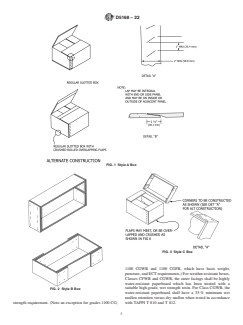
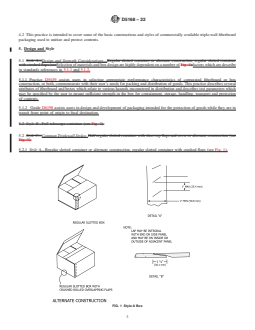
2.5 Use of Other Specifications: 5.2.1 Style A—Regular slotted container or alternate
2.5.1 Nothing in this practice shall be construed to prohibit construction, regular slotted container with crushed flaps (see
the use of containers of special design or of fiberboard Fig. 1).
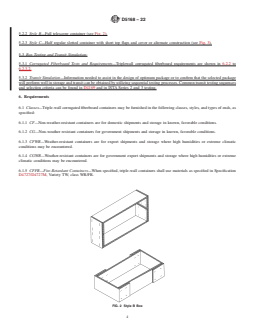
containers identified by package number in the current Uni- 5.2.2 Style B—Full telescope container (see Fig. 2).
form Freight Classification and National Motor Freight Clas- 5.2.3 Style C—Half regular slotted container with short top
sification when in the experience and judgment of the flaps and cover or alternate construction (see Fig. 3).
purchaser, the nature of the articles or material to be shipped
5.3 Box Testing and Transit Simulation:
justifies such containers.
5.3.1 Corrugated Fiberboard Tests and Requirements—
2.5.2 Exceptional commodities may require better contain-
Triplewall corrugated fiberboard requirements are shown in
ers than are specified herein. Containers for explosives and
6.2.2 to 6.2.3.2.
dangerous articles shall comply with the specifications pre-
5.3.2 Transit Simulation—Information needed to assist in
scribed in the Department of Transportation’s (DOT) Office of
the design of optimum package or to confirm that the selected
Hazardous Materials Code of Federal Regulations, Title 49
package will perform well in storage and transit can be
CFR Parts 107-180. In addition, for the particular articles to
obtained by utilizing sequential testing processes. Common
which these regulations apply, if the requirements contained in
transit testing sequences and selection criteria can be found in
this practice are more stringent, then they must also meet the
D4169 and in ISTA Series 2 and 3 testing.
requirements specified herein. (The DOT regulations apply to
such articles as explosives, flammable liquids and solids,
6. Requirements
compressed gases, oxidizing materials, poisons, and so forth).
6.1 Classes—Triple-wall corrugated fiberboard containers
may be furnished in the following classes, styles, and types of
3. Terminology
ends, as specified:
3.1 Definitions:
6.1.1 CF—Non-weather-resistant containers are for domes-
3.1.1 General definitions for packaging are found in Termi-
tic shipments and storage in known, favorable conditions.
nology D996.
6.1.2 CG—Non-weather resistant containers for govern-
3.1.2 Definitions specific to paper and related structures is
ment shipments and storage in known, favorable conditions.
found in D1968.
6.1.3 CFWR—Weather-resistant containers are for export
shipments and storage where high humidities or extreme
4. Significance and Use
climatic conditions may be encountered.
4.1 Triple-wall corrugated fiberboard containers are used to
6.1.4 CGWR—Weather-resistant containers are for govern-
unitize products into containers of size and shape suitable for
ment export shipments and storage where high humidities or
manual or mechanical handling and to protect the contents
extreme climatic conditions may be encountered.
against environmental, handling, shipping, and storage condi-
6.1.5 CFFR—Fire-Retardant Containers—When specified,
tions.
triple-wall containers shall use materials as specified in Speci-
4.2 This practice is intended to cover some of the basic fication D4727/D4727M, Variety TW, class WR/FR.
constructions and styles of commercially available triple-wall 6.1.6 CGFR—Fire-Retardant Containers—When specified,
fiberboard packaging used to unitize and protect contents. triple-wall containers shall use materials as specified in Speci-
fication D4727/D4727M, Variety TW, class WR/FR.
5. Design and Style
6.2 Materials:
5.1 Design and Strength Considerations—Selection of ma-
6.2.1 Fiberboard—The fiberboard shall consist of three
terials and box design are highly dependent on a number of
corrugated mediums and four facings fabricated into a triple-
factors which are describe in standards references in 5.1.1 and
wall structural material.
5.1.2.
6.2.1.1 Corrugating Mediums:
5.1.1 Practice D5639 assists users in selecting appropriate
(1) Weight of Mediums—The weight of material used to
performance characteristics of corrugated fiberboard or box
fabricate the corrugated medium shall be no less than 26
2 2
construction, or both, commensurate with their user’s needs for
lb/1000 ft (127 g/m ), or as otherwise specified.
packing and distribution of goods. This practice describes
(2) Flute Arrangement—There shall be two A Flutes, with
several attributes of fiberboard and boxes which relate to
the remaining flute being either A or C Flute. Flute arrange-
various hazards encountered in distribution and describes test
ment shall be agreed upon between the purchaser and the
parameters which may be specified by the user to ensure
supplier. In accordance with Department of Defense
sufficient strength in the box for containment, storage,
requirements, the flute combination shall be C-A-A (or meet
handling, transport and protection of contents.
equivalent performance levels).
5.1.2 Guide D6198 assists users in design and development
6.2.1.2 Facings—The combined weight of facings for Class
of packaging intended for the protection of goods while they
CG, CGWR and CGFR shall be not less than 264 lb/1000
2 2
are in transit from point of origin to final destination.
ft (1289 g/m ), with the heaviest facings on the outside. For
boxes made to the puncture strength requirement the minimum
combinedweightoffacingsshallbeasshowninTable1.There
Available from International Safe Transit Association (ISTA), 1400 Abbot Rd,
Suite 380, East Lansing, MI 48823, http://www.ISTA.org. is no facing weight requirement for boxes made to the ECT
D5168 − 22
FIG. 1 Style A Box
FIG. 3 Style C Box
1100 CGWR and 1100 CGFR, which have basis weight,
puncture, and ECT requirements.) For weather-resistant boxes,
Classes CFWR and CGWR, the outer facings shall be highly
water-resistant paperboard which has been treated with a
suitable high-grade, wet strength resin. For Class CGWR, the
FIG. 2 Style B Box
water-resistant paperboard shall have a 35 % minimum wet
mullen retention versus dry mullen when tested in accordance
strength requirement. (Note an exception for grades 1100 CG, with TAPPI T 810 and T 812.
D5168 − 22
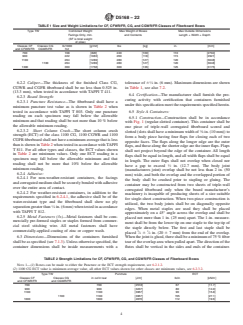
TABLE 1 Size and Weight Limitations for CF, CFWR/FR, CG, and CGWR/FR Classes of Fiberboard Boxes
Type TW Combined Weight Max Weight of Boxes Max Outside Dimensions
Facings Only, min. and Contents Length + Width + Depth
(SF is total weight
of plies)
Classes CF Classes CG lb/1000 [g/m2] lbs [kg] in. [mm]
and CFWR/FR CGWR/FR ft.2
700 168 [820] 240 [109] 110 [2794]
900 222 [1083] 260 [118] 115 [2921]
1100 264 [1289] 280 [127] 120 [3048]
1100 264 [1289] 280 [127] 120 [3048]
1300 360 [1758] 300 [136] 125 [3175]
6.2.2 Caliper—The thickness of the finished Class CG, tolerance of 6 ⁄4 in. (6 mm). Maximum dimensions are shown
CGWR and CGFR fiberboard shall be no less than 0.525 in. in Table 1, see also 7.2.
(13.3 mm), when tested in accordance with TAPPI T 411.
6.4 Certification—The manufacturer shall furnish the pro-
6.2.3 Board Strength:
curing activity with certification that containers furnished
6.2.3.1 Puncture Resistance—The fiberboard shall have a
under this specification meet the requirements specified herein.
minimum puncture test value as is shown in Table 2 when
tested in accordance with TAPPI T 803. Only one puncture
6.5 Style A Containers:
reading on each specimen may fall below the allowable
6.5.1 Construction—Construction shall be in accordance
minimum and that reading shall be not more than 10 % below
with Fig. 1 (regular-slotted container). This container shall be
the allowable minimum reading.
one piece of triple-wall corrugated fiberboard scored and
6.2.3.2 Short Column Crush—The short column crush
slotted (slots shall have a minimum width of ⁄8 in. (10 mm)) to
strength (ECT) of the class 1100 CG, 1100 CGWR and 1100
form a body piece having four flaps for closing each of two
CGFRfiberboardshallnothaveaminimumaveragethatisless
opposite faces. The flaps along the longer edge are the outer
thanisshowninTable2whentestedinaccordancewithTAPPI
flaps,andthosealongtheshorteredgearetheinnerflaps.Flaps
T 811. For all other types and classes, the ECT values shown
shall not project beyond the edge of the container. All length
in Table 2 are minimum values. Only one ECT reading in a
flaps shall be equal in length, and all width flaps shall be equal
specimen may fall below the allowable minimum and that
in length. The outer flaps shall not overlap when closed nor
reading shall not be more that 10% below the allowable
have a gap to exceed ⁄2 in. (12.7 mm). The body joint
minimum reading.
(manufacturers joint) overlap shall be not less than 2 in. (50
6.2.4 Adhesive:
mm) wide, and both the overlap and the overlapped portion of
6.2.4.1 For non-weather-resistant containers, the facings
the body shall be crushed prior to stapling or gluing. The
andcorrugatedmediumshallbesecurelybondedwithadhesive
container may be constructed from two sheets of triple-wall
over the entire area of contact.
corrugated fiberboard only when the board manufacturer’s
6.2.4.2 For weather-resistant containers, in addition to the
machinery is incapable of producing sheets of a size suitable
requirements specified in 6.2.4.1, the adhesive shall be of the
for single-sheet construction. When two-piece construction is
water-resistant type and the fiberboard shall show no ply
utilized, the two body joints shall be on diagonally opposite
separationgreaterthan ⁄4in.(6mm)whentestedinaccordance
edges. When metal staples are used they shall be placed
with TAPPI T 812.
approximately on a 45° angle across the overlap and shall be
6.2.5 Metal Fasteners (3x)—Metal fasteners shall be com-
placed not more than 1 in. (25 mm) apart. The 1-in. measure-
mercially pre-formed staples or staples formed from commer-
ment shall be from the lower tip on one staple to the top tip of
cial steel stitching wire. All metal fasteners shall have
the staple directly below. The first and last staple shall be
commercially-applied coating of zinc or copper wash.
3 1
...
This document is not an ASTM standard and is intended only to provide the user of an ASTM standard an indication of what changes have been made to the previous version. Because
it may not be technically possible to adequately depict all changes accurately, ASTM recommends that users consult prior editions as appropriate. In all cases only the current version
of the standard as published by ASTM is to be considered the official document.
Designation: D5168 − 12 (Reapproved 2017) D5168 − 22
Standard Practice for
Fabrication and Closure of Triple-Wall Corrugated
Fiberboard Containers
This standard is issued under the fixed designation D5168; the number immediately following the designation indicates the year of
original adoption or, in the case of revision, the year of last revision. A number in parentheses indicates the year of last reapproval. A
superscript epsilon (´) indicates an editorial change since the last revision or reapproval.
This standard has been approved for use by agencies of the U.S. Department of Defense.
1. Scope Scope*
1.1 This practice covers the fabrication and closure of new triple-wall corrugated fiberboard containers.
1.2 This practice indicates the factors and components that must be controlled in the manufacture of triple-wall fiberboard
containers.
1.3 The values stated in inch-pound units are to be regarded as standard. The values given in parentheses are mathematical
conversions to SI units that are provided for information only and are not considered standard.
1.4 This standard does not purport to address all of the safety concerns, if any, associated with its use. It is the responsibility
of the user of this standard to establish appropriate safety safety, health, and healthenvironmental practices and determine the
applicability of regulatory limitations prior to use.
1.5 This international standard was developed in accordance with internationally recognized principles on standardization
established in the Decision on Principles for the Development of International Standards, Guides and Recommendations issued
by the World Trade Organization Technical Barriers to Trade (TBT) Committee.
2. Referenced Documents
2.1 ASTM Standards:
D996 Terminology of Packaging and Distribution Environments
D1968 Terminology Relating to Paper and Paper Products
D3950 Specification for Strapping, Nonmetallic (and Joining Methods)
D3951 Practice for Commercial Packaging
D3953 Specification for Strapping, Flat Steel and Seals
D4169 Practice for Performance Testing of Shipping Containers and Systems
D4675 Guide for Selection and Use of Flat Strapping Materials
D4727/D4727M Specification for Corrugated and Solid Fiberboard Sheet Stock (Container Grade) and Cut Shapes
D5330/D5330M Specification for Pressure-Sensitive Tape for Packaging, Filament-Reinforced
D5486/D5486M Specification for Pressure-Sensitive Tape for Packaging, Box Closure, and Sealing
D5639 Practice for Selection of Corrugated Fiberboard Materials and Box Construction Based on Performance Requirements
This practice is under the jurisdiction of ASTM Committee D10 on Packaging and is the direct responsibility of Subcommittee D10.27 on Fiberboard Shipping
Containers, Containerboard and Related Structures and Materials.
Current edition approved April 1, 2017April 15, 2022. Published June 2017May 2022. Originally approved in 1991. Last previous edition approved in 20122017 as
D5168 – 12.D5168 – 12 (2017). DOI: 10.1520/D5168-12R17.10.1520/D5168-22.
For referenced ASTM standards, visit the ASTM website, www.astm.org, or contact ASTM Customer Service at service@astm.org. For Annual Book of ASTM Standards
volume information, refer to the standard’s Document Summary page on the ASTM website.
*A Summary of Changes section appears at the end of this standard
Copyright © ASTM International, 100 Barr Harbor Drive, PO Box C700, West Conshohocken, PA 19428-2959. United States
D5168 − 22
D6198 Guide for Transport Packaging Design
SI 10 American National Standard for Use of the International System of Units (SI): The Modern Metric System
2.2 TAPPI Standards:
T 411 Test Method for Thickness of Paper and Paperboard
T 803 Puncture and Stiffness Test of Container Board
T 810 Bursting Strength of Corrugated and Solid Fiberboard
T 811 Edgewise Compression Strength of Corrugated Fiberboard (Short Column Test)
T 812 Ply Separation of Solid and Corrugated Fiberboard (Wet)
2.3 Code of Federal Regulations:
CFR Parts 107-180 Title 49, Hazardous Materials Regulations
2.4 Other Standards:
National Motor Freight Classification
Uniform Freight Classification
ISTA Distribution Simulation
2.5 Use of Other Specifications:
2.5.1 Nothing in this practice shall be construed to prohibit the use of containers of special design or of fiberboard containers
identified by package number in the current Uniform Freight Classification and National Motor Freight Classification when
in the experience and judgment of the purchaser, the nature of the articles or material to be shipped justifies such containers.
2.5.2 Exceptional commodities may require better containers than are specified herein. Containers for explosives and dangerous
articles shall comply with the specifications prescribed in the Department of Transportation’s (DOT) Office of Hazardous
Materials Code of Federal Regulations, Title 49 CFR Parts 107-180. In addition, for the particular articles to which these
regulations apply, if the requirements contained in this practice are more stringent, then they must also meet the requirements
specified herein. (The DOT regulations apply to such articles as explosives, flammable liquids and solids, compressed gases,
oxidizing materials, poisons, and so forth).
2.5 Use of Other Specifications:
2.5.1 Nothing in this practice shall be construed to prohibit the use of containers of special design or of fiberboard containers
identified by package number in the current Uniform Freight Classification and National Motor Freight Classification when in the
experience and judgment of the purchaser, the nature of the articles or material to be shipped justifies such containers.
2.5.2 Exceptional commodities may require better containers than are specified herein. Containers for explosives and dangerous
articles shall comply with the specifications prescribed in the Department of Transportation’s (DOT) Office of Hazardous Materials
Code of Federal Regulations, Title 49 CFR Parts 107-180. In addition, for the particular articles to which these regulations apply,
if the requirements contained in this practice are more stringent, then they must also meet the requirements specified herein. (The
DOT regulations apply to such articles as explosives, flammable liquids and solids, compressed gases, oxidizing materials, poisons,
and so forth).
3. Terminology
3.1 Definitions—General definitions for packaging are found in Terminology D996.
3.1 Definitions:
3.1.1 General definitions for packaging are found in Terminology D996.
3.1.2 Definitions specific to paper and related structures is found in D1968.
4. Significance and Use
4.1 Triple-wall corrugated fiberboard containers are used to unitize products into containers of size and shape suitable for manual
or mechanical handling and to protect the contents against environmental, handling, shipping, and storage conditions.
Available from Technical Association of the Pulp and Paper Industry (TAPPI), 15 Technology Parkway South, Norcross, GA 30092, http://www.tappi.org.
Available from U.S. Government Printing Office Superintendent of Documents, 732 N. Capitol St., NW, Mail Stop: SDE, Washington, DC 20401, http://
www.access.gpo.gov.
Available from National Motor Freight Traffic Association (NMFTA), 1001 N. Fairfax St., Alexandria, VA 22314, http://www.nmfta.org.
Available from Short Line and Regional Railroad Association, 50 F Street, N.W., Suite 7020, Washington, DC 20001–1536.
Available from International Safe Transit Association (ISTA), 1400 Abbot Rd, Suite 380, East Lansing, MI 48823, http://www.ISTA.org.
D5168 − 22
4.2 This practice is intended to cover some of the basic constructions and styles of commercially available triple-wall fiberboard
packaging used to unitize and protect contents.
5. Design and Style
5.1 Style A—Design and Strength Considerations—Regular slotted container or alternate construction, regular slotted container
with crushed flaps (seeSelection of materials and box design are highly dependent on a number of Fig. 1).factors which are describe
in standards references in 5.1.1 and 5.1.2.
5.1.1 Practice D5639 assists users in selecting appropriate performance characteristics of corrugated fiberboard or box
construction, or both, commensurate with their user’s needs for packing and distribution of goods. This practice describes several
attributes of fiberboard and boxes which relate to various hazards encountered in distribution and describes test parameters which
may be specified by the user to ensure sufficient strength in the box for containment, storage, handling, transport and protection
of contents.
5.1.2 Guide D6198 assists users in design and development of packaging intended for the protection of goods while they are in
transit from point of origin to final destination.
5.2 Style B—Full telescope container (see Fig. 2).
5.2 Style C—Common Triplewall Styles: Half regular slotted container with short top flaps and cover or alternate construction (see
Fig. 3).
5.2.1 Style A—Regular slotted container or alternate construction, regular slotted container with crushed flaps (see Fig. 1).
FIG. 1 Style A Box
D5168 − 22
5.2.2 Style B—Full telescope container (see Fig. 2).
5.2.3 Style C—Half regular slotted container with short top flaps and cover or alternate construction (see Fig. 3).
5.3 Box Testing and Transit Simulation:
5.3.1 Corrugated Fiberboard Tests and Requirements—Triplewall corrugated fiberboard requirements are shown in 6.2.2 to
6.2.3.2.
5.3.2 Transit Simulation—Information needed to assist in the design of optimum package or to confirm that the selected package
will perform well in storage and transit can be obtained by utilizing sequential testing processes. Common transit testing sequences
and selection criteria can be found in D4169 and in ISTA Series 2 and 3 testing.
6. Requirements
6.1 Classes—Triple-wall corrugated fiberboard containers may be furnished in the following classes, styles, and types of ends, as
specified:
6.1.1 CF—Non-weather-resistant containers are for domestic shipments and storage in known, favorable conditions.
6.1.2 CG—Non-weather resistant containers for government shipments and storage in known, favorable conditions.
6.1.3 CFWR—Weather-resistant containers are for export shipments and storage where high humidities or extreme climatic
conditions may be encountered.
6.1.4 CGWR—Weather-resistant containers are for government export shipments and storage where high humidities or extreme
climatic conditions may be encountered.
6.1.5 CFFR—Fire-Retardant Containers—When specified, triple-wall containers shall use materials as specified in Specification
D4727/D4727M, Variety TW, class WR/FR.
FIG. 2 Style B Box
D5168 − 22
FIG. 3 Style C Box
6.1.6 CGFR—Fire-Retardant Containers—When specified, triple-wall containers shall use materials as specified in Specification
D4727/D4727M, Variety TW, class WR/FR.
6.2 Materials:
6.2.1 Fiberboard—The fiberboard shall consist of three corrugated mediums and four facings fabricated into a triple-wall
structural material.
6.2.1.1 Corrugating Mediums:
(1) Weight of Mediums—The weight of material used to fabricate the corrugated medium shall be no less than 26 lb/1000 ft
(127 g/m ), or as otherwise specified.
(2) Flute Arrangement—There shall be two A Flutes, with the remaining flute being either A or C Flute. Flute arrangement shall
be agreed upon between the purchaser and the supplier. In accordance with Department of Defense requirements, the flute
combination shall be C-A-A (or meet equivalent performance levels).
6.2.1.2 Facings—The combined weight of facings for Class CG, CGWR and CGFR shall be not less than 264 lb/1000 ft (1289
g/m ), with the heaviest facings on the outside. For boxes made to the puncture strength requirement the minimum combined
weight of facings shall be as shown in Table 1. There is no facing weight requirement for boxes made to the ECT strength
requirement. (Note an exception for grades 1100 CG, 1100 CGWR and 1100 CGFR, which have basis weight, puncture, and ECT
requirements.) For weather-resistant boxes, Classes CFWR and CGWR, the outer facings shall be highly water-resistant
paperboard which has been treated with a suitable high-grade, wet strength resin. For Class CGWR, the water-resistant paperboard
shall have a 35 % minimum wet mullen retention versus dry mullen when tested in accordance with TAPPI T 810 and T 812.
6.2.2 Caliper—The thickness of the finished Class CG, CGWR and CGFR fiberboard shall be no less than 0.525 in. (13.3 mm),
when tested in accordance with TAPPI T 411.
6.2.3 Board Strength:
TABLE 1 Size and Weight Limitations for CF, CFWR/FR, CG, and CGWR/FR Classes of Fiberboard Boxes
Type TW Combined Weight Max Weight of Boxes Max Outside Dimensions
Facings Only, min. and Contents Length + Width + Depth
(SF is total weight
of plies)
Classes CF Classes CG lb/1000 [g/m2] lbs [kg] in. [mm]
and CFWR/FR CGWR/FR ft.2
700 168 [820] 240 [109] 110 [2794]
900 222 [1083] 260 [118] 115 [2921]
1100 264 [1289] 280 [127] 120 [3048]
1100 264 [1289] 280 [127] 120 [3048]
1300 360 [1758] 300 [136] 125 [3175]
D5168 − 22
6.2.3.1 Puncture Resistance—The fiberboard shall have a minimum puncture test value as is shown in Table 2 when tested in
accordance with TAPPI T 803. Only one puncture reading on each specimen may fall below the allowable minimum and that
reading shall be not more than 10 % below the allowable minimum reading.
6.2.3.2 Short Column Crush—The short column crush strength (ECT) of the class 1100 CG, 1100 CGWR and 1100 CGFR
fiberboard shall not have a minimum average that is less than is shown in Table 2 when tested in accordance with TAPPI T 811.
For all other types and classes, the ECT values shown in Table 2 are minimum values. Only one ECT reading in a specimen may
fall below the allowable minimum and that reading shall not be more that 10% below the allowable minimum reading.
6.2.4 Adhesive:
6.2.4.1 For non-weather-resistant containers, the facings and corrugated medium shall be securely bonded with adhesive over the
entire area of contact.
6.2.4.2 For weather-resistant containers, in addition to the requirements specified in 6.2.4.1, the adhesive shall be of the
water-resistant type and the fiberboard shall show no ply separation greater than ⁄4 in. (6 mm) when tested in accordance with
TAPPI T 812.
6.2.5 Metal Fasteners (3x)—Metal fasteners shall be commercially pre-formed staples or staples formed from commercial steel
stitching wire. All metal fasteners shall have commercially-applied coating of zinc or copper wash.
6.3 Dimensions—Dimensions of the containers furnished shall be as specified (see 7.1.3). Unless otherwise specified, the container
dimensions shall be inside measurements with a tolerance of 6 ⁄4 in. (6 mm). Maximum dimensions are shown in Table 1, see also
7.2.
6.4 Certification—The manufacturer shall furnish the procuring activity with certification that containers furnished under this
specification meet the requirements specified herein.
6.5 Style A Containers:
6.5.1 Construction—Construction shall be in accordance with Fig. 1 (regular-slotted container). This container shall be one piece
of triple-wall corrugated fiberboard scored and slotted (slots shall have a minimum width of ⁄8 in. (10 mm)) to form a body piece
having four flaps for closing each of two opposite faces. The flaps along the longer edge are the outer flaps, and those along the
shorter edge are the inner flaps. Flaps shall not project beyond the edge of the container. All length flaps shall be equal in length,
and all width flaps shall
...