

ASTM D7596-23
(Test Method)Standard Test Method for Automatic Particle Counting and Particle Shape Classification of Oils Using a Direct Imaging Integrated Tester
General Information
- Abstract
SIGNIFICANCE AND USE
5.1 This test method is intended for use in analytical laboratories including on-site in-service oil analysis laboratories. Periodic sampling and analysis of lubricants have long been used as a means to determine overall machinery health. Atomic emission spectroscopy (AES) is often employed for wear metal analysis (Test Methods D5185 and D6595). A number of physical property tests complement wear metal analysis and are used to provide information on lubricant condition (Test Methods D445, D2896, D6304, and D7279). Molecular spectroscopy (Practice E2412) provides direct information on molecular species of interest including additives, lubricant degradation products and contaminating fluids such as water, fuel and glycol. Direct imaging integrated testers provide complementary information on particle count, particle size, particle type, and soot content.
5.2 Particles in lubricating and hydraulic oils are detrimental because they increase wear, clog filters and accelerate oil degradation.
5.3 Particle count may aid in assessing the capability of a filtration system to clean the fluid, determine if off-line recirculating filtration is needed to clean the fluid, or aid in the decision whether or not to change the fluid.
5.4 An increase in the concentration and size of wear particles is indicative of incipient failure or component change out. Predictive maintenance by oil analysis monitors the concentration and size of wear particles on a periodic basis to predict failure.
5.5 High soot levels in diesel engine lubricating oil may indicate abnormal engine operation.
SCOPE
1.1 This test method covers the determination of particle concentration, particle size distribution, particle shape, and soot content for new and in-service oils used for lubrication and hydraulic systems by a direct imaging integrated tester.
1.1.1 The test method is applicable to petroleum and synthetic based fluids. Samples from 2 mm2/s to 150 mm2/s at 40 °C may be processed directly. Samples of greater viscosity may be processed after solvent dilution.
1.1.2 Particles measured are in the range from 4 μm to ≥ 70 μm with the upper limit dependent upon passing through a 100 μm mesh inlet screen.
1.1.3 Particle concentration measured may be as high as 5 000 000 particles per mL without significant coincidence error.
1.1.4 Particle shape is determined for particles greater than approximately 20 µm in length. Particles are categorized into the following categories: sliding, cutting, fatigue, nonmetallic, fibers, water droplets, and air bubbles.
1.1.5 Soot is determined up to approximately 1.5 % by weight.
1.1.6 This test method uses objects of known linear dimension for calibration.
1.2 The values stated in SI units are to be regarded as standard. No other units of measurement are included in this standard.
1.3 This standard does not purport to address all of the safety concerns, if any, associated with its use. It is the responsibility of the user of this standard to establish appropriate safety, health, and environmental practices and determine the applicability of regulatory limitations prior to use.
1.4 This international standard was developed in accordance with internationally recognized principles on standardization established in the Decision on Principles for the Development of International Standards, Guides and Recommendations issued by the World Trade Organization Technical Barriers to Trade (TBT) Committee.
- Status
- Published
- Publication Date
- 31-Dec-2022
- Technical Committee
- D02 - Petroleum Products, Liquid Fuels, and Lubricants
Buy Documents
ASTM D7596-23 - Standard Test Method for Automatic Particle Counting and Particle Shape Classification of Oils Using a Direct Imaging Integrated Tester
REDLINE ASTM D7596-23 - Standard Test Method for Automatic Particle Counting and Particle Shape Classification of Oils Using a Direct Imaging Integrated Tester
Overview
ASTM D7596-23 defines the standard test method for automatic particle counting and particle shape classification in oils using a direct imaging integrated tester. Developed by ASTM International, this method supports routine and in-depth analysis of new and in-service lubricating and hydraulic oils. It enables laboratories and maintenance teams to assess oil cleanliness by quantifying and categorizing particle contamination and soot levels, providing critical insight into machinery health, lubricant condition, contamination levels, and wear mechanisms.
This standard is applicable to petroleum and synthetic based fluids with viscosities ranging from 2 mm²/s to 150 mm²/s at 40°C, extendable to higher viscosity samples via solvent dilution. The method measures particles from 4 μm up to ≥70 μm, and classifies particles larger than approximately 20 μm by type and origin.
Key Topics
- Particle Counting: Quantifies the concentration and size distribution of solid particles in lubricating and hydraulic oils, critical for monitoring system cleanliness and filtration effectiveness.
- Particle Shape Classification: Distinguishes particles into categories such as sliding wear, cutting wear, fatigue wear, nonmetallic particles, fibers, water droplets, and air bubbles to help identify wear mechanisms and sources of contamination.
- Soot Content Measurement: Determines soot levels up to approximately 1.5% by weight, particularly relevant for diesel engine oils where high soot can indicate abnormal operation or combustion.
- Predictive Maintenance: By monitoring changes in particle concentration and size, the method helps predict incipient component failures and optimize maintenance schedules.
- Direct Imaging Integrated Tester: Utilizes advanced imaging, software, and sensors for comprehensive oil testing, ensuring consistency and repeatability in results.
Significance:
- Provides complementary data alongside elemental and molecular spectroscopy and physical property tests, offering a complete lubricant assessment strategy.
- Supports decision-making regarding fluid changes, filtration upgrades, and early detection of abnormal wear or contamination.
Applications
- Analytical and Service Laboratories: Widely used for condition monitoring in both central labs and on-site service labs, supporting maintenance decisions across industries.
- Industrial Machinery & Hydraulic Systems: Enables monitoring of oil health in critical equipment, reducing unplanned downtime and optimizing lubricant usage.
- Fleet and Engine Management: Essential for diesel and gas engine oils, where increased soot and wear particles can indicate necessary engine service or adjustments.
- Filtration System Assessment: Evaluates filtration efficiency, detects filter bypass, and recommends off-line or enhanced filtration if regular particle counts remain elevated.
- Quality Control for New Oils: Ensures cleanliness before oil is charged into equipment or machinery.
Related Standards
For a more comprehensive oil analysis and condition monitoring program, ASTM D7596-23 is often used in conjunction with the following standards:
- ASTM D445: Kinematic viscosity of transparent and opaque liquids
- ASTM D2896: Base number of petroleum products by potentiometric titration
- ASTM D6304: Determination of water by Karl Fischer titration
- ASTM D5185 and D6595: Wear metals and contaminants analysis by atomic emission spectroscopy
- ASTM D7279: Automated viscometry for oils
- ASTM E2412: Condition monitoring using FT-IR spectroscopy
- ISO 4406: Hydraulic fluid contamination coding and reporting
- SAE AS 4059: Cleanliness classification for hydraulic fluids
Keywords: particle count, oil cleanliness, wear particles, soot analysis, direct imaging, hydraulic oil testing, lubricant condition monitoring, predictive maintenance, ASTM D7596-23, filtration assessment, oil analysis standards
Relations
- Effective Date
- 01-Apr-2024
- Refers
ASTM D4175-23a - Standard Terminology Relating to Petroleum Products, Liquid Fuels, and Lubricants - Effective Date
- 15-Dec-2023
- Effective Date
- 01-Nov-2023
- Effective Date
- 01-Nov-2023
- Refers
ASTM D4175-23e1 - Standard Terminology Relating to Petroleum Products, Liquid Fuels, and Lubricants - Effective Date
- 01-Jul-2023
- Effective Date
- 01-Apr-2018
- Refers
ASTM D5967-17 - Standard Test Method for Evaluation of Diesel Engine Oils in T-8 Diesel Engine - Effective Date
- 01-May-2017
- Effective Date
- 15-Dec-2016
- Effective Date
- 01-Jul-2016
- Effective Date
- 01-Nov-2015
- Refers
ASTM D5967-15a - Standard Test Method for Evaluation of Diesel Engine Oils in T-8 Diesel Engine - Effective Date
- 01-Oct-2015
- Refers
ASTM D5967-15 - Standard Test Method for Evaluation of Diesel Engine Oils in T-8 Diesel Engine - Effective Date
- 01-Apr-2015
- Refers
ASTM D5967-14 - Standard Test Method for Evaluation of Diesel Engine Oils in T-8 Diesel Engine - Effective Date
- 01-Oct-2014
- Effective Date
- 01-Oct-2014
- Effective Date
- 01-Jul-2014
Buy Documents
ASTM D7596-23 - Standard Test Method for Automatic Particle Counting and Particle Shape Classification of Oils Using a Direct Imaging Integrated Tester
REDLINE ASTM D7596-23 - Standard Test Method for Automatic Particle Counting and Particle Shape Classification of Oils Using a Direct Imaging Integrated Tester
Get Certified
Connect with accredited certification bodies for this standard

Element Materials Technology
Materials testing and product certification.

ABS Group Brazil
ABS Group certification services in Brazil.

ABS Quality Evaluations Inc.
American Bureau of Shipping quality certification.
Sponsored listings
Frequently Asked Questions
ASTM D7596-23 is a standard published by ASTM International. Its full title is "Standard Test Method for Automatic Particle Counting and Particle Shape Classification of Oils Using a Direct Imaging Integrated Tester". This standard covers: SIGNIFICANCE AND USE 5.1 This test method is intended for use in analytical laboratories including on-site in-service oil analysis laboratories. Periodic sampling and analysis of lubricants have long been used as a means to determine overall machinery health. Atomic emission spectroscopy (AES) is often employed for wear metal analysis (Test Methods D5185 and D6595). A number of physical property tests complement wear metal analysis and are used to provide information on lubricant condition (Test Methods D445, D2896, D6304, and D7279). Molecular spectroscopy (Practice E2412) provides direct information on molecular species of interest including additives, lubricant degradation products and contaminating fluids such as water, fuel and glycol. Direct imaging integrated testers provide complementary information on particle count, particle size, particle type, and soot content. 5.2 Particles in lubricating and hydraulic oils are detrimental because they increase wear, clog filters and accelerate oil degradation. 5.3 Particle count may aid in assessing the capability of a filtration system to clean the fluid, determine if off-line recirculating filtration is needed to clean the fluid, or aid in the decision whether or not to change the fluid. 5.4 An increase in the concentration and size of wear particles is indicative of incipient failure or component change out. Predictive maintenance by oil analysis monitors the concentration and size of wear particles on a periodic basis to predict failure. 5.5 High soot levels in diesel engine lubricating oil may indicate abnormal engine operation. SCOPE 1.1 This test method covers the determination of particle concentration, particle size distribution, particle shape, and soot content for new and in-service oils used for lubrication and hydraulic systems by a direct imaging integrated tester. 1.1.1 The test method is applicable to petroleum and synthetic based fluids. Samples from 2 mm2/s to 150 mm2/s at 40 °C may be processed directly. Samples of greater viscosity may be processed after solvent dilution. 1.1.2 Particles measured are in the range from 4 μm to ≥ 70 μm with the upper limit dependent upon passing through a 100 μm mesh inlet screen. 1.1.3 Particle concentration measured may be as high as 5 000 000 particles per mL without significant coincidence error. 1.1.4 Particle shape is determined for particles greater than approximately 20 µm in length. Particles are categorized into the following categories: sliding, cutting, fatigue, nonmetallic, fibers, water droplets, and air bubbles. 1.1.5 Soot is determined up to approximately 1.5 % by weight. 1.1.6 This test method uses objects of known linear dimension for calibration. 1.2 The values stated in SI units are to be regarded as standard. No other units of measurement are included in this standard. 1.3 This standard does not purport to address all of the safety concerns, if any, associated with its use. It is the responsibility of the user of this standard to establish appropriate safety, health, and environmental practices and determine the applicability of regulatory limitations prior to use. 1.4 This international standard was developed in accordance with internationally recognized principles on standardization established in the Decision on Principles for the Development of International Standards, Guides and Recommendations issued by the World Trade Organization Technical Barriers to Trade (TBT) Committee.
SIGNIFICANCE AND USE 5.1 This test method is intended for use in analytical laboratories including on-site in-service oil analysis laboratories. Periodic sampling and analysis of lubricants have long been used as a means to determine overall machinery health. Atomic emission spectroscopy (AES) is often employed for wear metal analysis (Test Methods D5185 and D6595). A number of physical property tests complement wear metal analysis and are used to provide information on lubricant condition (Test Methods D445, D2896, D6304, and D7279). Molecular spectroscopy (Practice E2412) provides direct information on molecular species of interest including additives, lubricant degradation products and contaminating fluids such as water, fuel and glycol. Direct imaging integrated testers provide complementary information on particle count, particle size, particle type, and soot content. 5.2 Particles in lubricating and hydraulic oils are detrimental because they increase wear, clog filters and accelerate oil degradation. 5.3 Particle count may aid in assessing the capability of a filtration system to clean the fluid, determine if off-line recirculating filtration is needed to clean the fluid, or aid in the decision whether or not to change the fluid. 5.4 An increase in the concentration and size of wear particles is indicative of incipient failure or component change out. Predictive maintenance by oil analysis monitors the concentration and size of wear particles on a periodic basis to predict failure. 5.5 High soot levels in diesel engine lubricating oil may indicate abnormal engine operation. SCOPE 1.1 This test method covers the determination of particle concentration, particle size distribution, particle shape, and soot content for new and in-service oils used for lubrication and hydraulic systems by a direct imaging integrated tester. 1.1.1 The test method is applicable to petroleum and synthetic based fluids. Samples from 2 mm2/s to 150 mm2/s at 40 °C may be processed directly. Samples of greater viscosity may be processed after solvent dilution. 1.1.2 Particles measured are in the range from 4 μm to ≥ 70 μm with the upper limit dependent upon passing through a 100 μm mesh inlet screen. 1.1.3 Particle concentration measured may be as high as 5 000 000 particles per mL without significant coincidence error. 1.1.4 Particle shape is determined for particles greater than approximately 20 µm in length. Particles are categorized into the following categories: sliding, cutting, fatigue, nonmetallic, fibers, water droplets, and air bubbles. 1.1.5 Soot is determined up to approximately 1.5 % by weight. 1.1.6 This test method uses objects of known linear dimension for calibration. 1.2 The values stated in SI units are to be regarded as standard. No other units of measurement are included in this standard. 1.3 This standard does not purport to address all of the safety concerns, if any, associated with its use. It is the responsibility of the user of this standard to establish appropriate safety, health, and environmental practices and determine the applicability of regulatory limitations prior to use. 1.4 This international standard was developed in accordance with internationally recognized principles on standardization established in the Decision on Principles for the Development of International Standards, Guides and Recommendations issued by the World Trade Organization Technical Barriers to Trade (TBT) Committee.
ASTM D7596-23 is classified under the following ICS (International Classification for Standards) categories: 75.100 - Lubricants, industrial oils and related products; 75.120 - Hydraulic fluids. The ICS classification helps identify the subject area and facilitates finding related standards.
ASTM D7596-23 has the following relationships with other standards: It is inter standard links to ASTM D445-24, ASTM D4175-23a, ASTM E2412-23a, ASTM D445-23, ASTM D4175-23e1, ASTM D5185-18, ASTM D5967-17, ASTM D445-16, ASTM D6595-16, ASTM G40-15, ASTM D5967-15a, ASTM D5967-15, ASTM D5967-14, ASTM D7279-14a, ASTM D445-14. Understanding these relationships helps ensure you are using the most current and applicable version of the standard.
ASTM D7596-23 is available in PDF format for immediate download after purchase. The document can be added to your cart and obtained through the secure checkout process. Digital delivery ensures instant access to the complete standard document.
Standards Content (Sample)
This international standard was developed in accordance with internationally recognized principles on standardization established in the Decision on Principles for the
Development of International Standards, Guides and Recommendations issued by the World Trade Organization Technical Barriers to Trade (TBT) Committee.
Designation:D7596 −23
Standard Test Method for
Automatic Particle Counting and Particle Shape
Classification of Oils Using a Direct Imaging Integrated
Tester
This standard is issued under the fixed designation D7596; the number immediately following the designation indicates the year of
original adoption or, in the case of revision, the year of last revision. A number in parentheses indicates the year of last reapproval. A
superscript epsilon (´) indicates an editorial change since the last revision or reapproval.
1. Scope* ization established in the Decision on Principles for the
Development of International Standards, Guides and Recom-
1.1 This test method covers the determination of particle
mendations issued by the World Trade Organization Technical
concentration, particle size distribution, particle shape, and
Barriers to Trade (TBT) Committee.
soot content for new and in-service oils used for lubrication
and hydraulic systems by a direct imaging integrated tester.
2. Referenced Documents
1.1.1 The test method is applicable to petroleum and syn-
2 2
2.1 ASTM Standards:
thetic based fluids. Samples from 2 mm /s to 150 mm /s at
D445 Test Method for Kinematic Viscosity of Transparent
40 °C may be processed directly. Samples of greater viscosity
and Opaque Liquids (and Calculation of Dynamic Viscos-
may be processed after solvent dilution.
ity)
1.1.2 Particles measured are in the range from 4 µm to ≥
D2896 Test Method for Base Number of Petroleum Products
70 µm with the upper limit dependent upon passing through a
by Potentiometric Perchloric Acid Titration
100 µm mesh inlet screen.
D4057 Practice for Manual Sampling of Petroleum and
1.1.3 Particle concentration measured may be as high as
Petroleum Products
5 000 000 particles per mL without significant coincidence
D4175 Terminology Relating to Petroleum Products, Liquid
error.
Fuels, and Lubricants
1.1.4 Particle shape is determined for particles greater than
D4177 Practice for Automatic Sampling of Petroleum and
approximately 20 µm in length. Particles are categorized into
Petroleum Products
the following categories: sliding, cutting, fatigue, nonmetallic,
D5185 Test Method for Multielement Determination of
fibers, water droplets, and air bubbles.
Used and Unused Lubricating Oils and Base Oils by
1.1.5 Soot is determined up to approximately 1.5 % by
Inductively Coupled Plasma Atomic Emission Spectrom-
weight.
etry (ICP-AES)
1.1.6 This test method uses objects of known linear dimen-
D5967 Test Method for Evaluation of Diesel Engine Oils in
sion for calibration.
T-8 Diesel Engine
1.2 The values stated in SI units are to be regarded as
D6304 Test Method for Determination of Water in Petro-
standard. No other units of measurement are included in this
leum Products, Lubricating Oils, and Additives by Cou-
standard.
lometric Karl Fischer Titration
1.3 This standard does not purport to address all of the
D6595 Test Method for Determination of Wear Metals and
safety concerns, if any, associated with its use. It is the
Contaminants in Used Lubricating Oils or Used Hydraulic
responsibility of the user of this standard to establish appro-
Fluids by Rotating Disc ElectrodeAtomic Emission Spec-
priate safety, health, and environmental practices and deter-
trometry
mine the applicability of regulatory limitations prior to use.
D7279 Test Method for Kinematic Viscosity of Transparent
1.4 This international standard was developed in accor-
and Opaque Liquids by Automated Houillon Viscometer
dance with internationally recognized principles on standard-
E2412 Practice for Condition Monitoring of In-Service Lu-
bricants by Trend Analysis Using Fourier Transform
Infrared (FT-IR) Spectrometry
This test method is under the jurisdiction of ASTM Committee D02 on
Petroleum Products, Liquid Fuels, and Lubricants and is the direct responsibility of
Subcommittee D02.96.07 on Integrated Testers, Instrumentation Techniques for
In-Service Lubricants. For referenced ASTM standards, visit the ASTM website, www.astm.org, or
Current edition approved Jan. 1, 2023. Published January 2023. Originally contact ASTM Customer Service at service@astm.org. For Annual Book of ASTM
approved in 2010. Last previous edition approved in 2014 as D7596 – 14. DOI: Standards volume information, refer to the standard’s Document Summary page on
10.1520/D7596-23. the ASTM website.
*A Summary of Changes section appears at the end of this standard
Copyright © ASTM International, 100 Barr Harbor Drive, PO Box C700, West Conshohocken, PA 19428-2959. United States
D7596−23
G40 Terminology Relating to Wear and Erosion 4. Summary of Test Method
2.2 ISO Standards: 4.1 Lubricant samples are acquired periodically from a
ISO 12103-1 1997 Road Vehicles—Test Dust for Filter
machine or engine being monitored. Samples are taken using
Evaluation—Part 1: Arizona Test Dust clean receptacles in order to avoid altering the sample by
ISO 4406 Hydraulic Fluid Power—Fluids—Method for
method or container.
Coding Level of Contamination by Solid Particles
4.2 Particles are counted and sized by processing a sample
2.3 SAE Standards:
through an appropriate particle sizing instrument. Sample size
SAE AS 4059 Aerospace Fluid Power – Cleanliness Clas- is instrument dependent. The instrument determines the size
sification for Hydraulic Fluids
and shape of each particle detected in the sample as described
in Section 1 of this test method. Adjustable cell gap instru-
3. Terminology
ments are set at a fixed gap width that allows for comprehen-
sive analysis. Gap of 100 µm to 300 µm is a common distance,
3.1 Definitions:
however instruments may vary and other gap distances may be
3.1.1 For definitions of terms used in this test method, refer
employed as long as there is no restriction of particle flow into
to Terminology D4175.
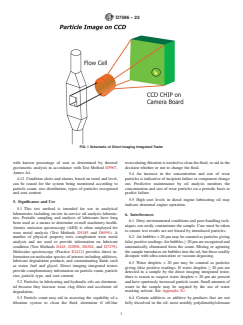
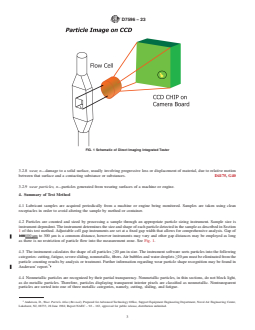
the measurement zone. See Fig. 1.
3.2 Definitions of Terms Specific to This Standard:
3.2.1 contaminant particles, n—particles introduced from 4.3 The instrument calculates the shape of all particles
an extraneous source into the lubricant of a machine or engine. ≥20 µm in size.The instrument software sorts particles into the
following categories: cutting, fatigue, severe sliding,
3.2.2 direct imaging integrated tester, n—an instrument for
nonmetallic, fibers. Air bubbles and water droplets ≥20 µm
counting particles as they flow through a cell by means of
must be eliminated from the particle counting results by
imaging; instrument may also determine particle shape and
analysis or treatment. Further information regarding wear
fluid viscosity.
particle shape recognition may be found in Anderson’report.
3.2.3 ISOCodes,n—standardmethodforcodingthelevelof
4.4 Nonmetallic particles are recognized by their partial
contamination by solid particles. This code simplifies the
transparency. Nonmetallic particles, in thin sections, do not
reporting of particle count data by converting the number of
block light, as do metallic particles. Therefore, particles
particles per mLinto three classes covering≥4 µm,≥6 µm, and
displaying transparent interior pixels are classified as nonme-
≥14 µm. ISO 4406 classifications are used as an option to
tallic. Nontransparent particles are sorted into one of three
report results for this test method.
metallic categories, namely, cutting, sliding, and fatigue.
3.2.4 new oil, n—oil taken from the original manufacturer’s
4.5 Cuttingwearparticlesarerecognizedbytheirelongated,
packaging, prior to being added to the machinery. E2412
curved, or curly shape.
3.2.5 particle size, circular diameter, µm, n—diameter of a
circle with an area equivalent to the projected area of a particle 4.6 Sliding wear particles are recognized by being longer
passing through the direct imaging integrated tester flow cell.
than wide, often with straight edges.
3.2.6 soft particles, n—particles present in the sample that
4.7 Fatigueparticlesarerecognizedbybeingmoreorlessas
are related to undissolved oil additives or additive by-products.
long as they are wide and often with jagged, irregular edges.
Without dilution, at room temperature these particles are likely
4.8 Fibers are recognized by their elongated shape and by
to be counted by an optical particle counter in a similar manner
partial transparency indicating nonmetallic composition.
to dirt and wear metal particles, air bubbles, and free water
4.9 Air bubbles are dark round circles, either completely
droplets. They are not considered contaminants as they are
dark or with small bright centers.
either purposefully left undissolved, or are not harmful to the
fluid system, or both.
4.10 Water droplets are dark round circles with large bright
3.2.7 soot, n—in internal combustion engines, sub-micron centers. The difference in appearance between air bubbles and
water droplets is due to the much different refractive index of
size particles, primarily carbon, created in the combustion
chamber as products of incomplete combustion. D4175 each. When present in oil, air bubbles refract much of the light
passing through them away from the direction of transmission,
3.2.8 wear, n—damage to a solid surface, usually involving
whereas water droplets, having a refractive index more nearly
progressive loss or displacement of material, due to relative
equal to that of oil, allow much of the light incident upon them
motion between that surface and a contacting substance or
to transmit through them to the CCD video chip.
substances. D4175, G40
4.11 Soot is measured by performing an optical extinction
3.2.9 wear particles, n—particles generated from wearing
measurement with reference to new oil.Absorbance of light is
surfaces of a machine or engine.
measured and calibration is made to diesel engine oil samples
Available from International Organization for Standardization (ISO), 1, ch. de
la Voie-Creuse, Case postale 56, CH-1211, Geneva 20, Switzerland, http:// Anderson, D., Wear Particle Atlas (Revised), Prepared for Advanced Technol-
www.iso.ch. ogy Office, Support Equipment Engineering Department, Naval Air Engineering
Available from SAE International (SAE), 400 Commonwealth Dr.,Warrendale, Center,Lakehurst,NJ,08733,28June1982,ReportNAEC–92–163,approvedfor
PA 15096-0001, http://aerospace.sae.org. public release, distribution unlimited.
D7596−23
FIG. 1Schematic of Direct Imaging Integrated Tester
with known percentage of soot as determined by thermal recirculating filtration is needed to clean the fluid, or aid in the
gravimetric analysis in accordance with Test Method D5967, decision whether or not to change the fluid.
Annex A4.
5.4 An increase in the concentration and size of wear
4.12 Condition alerts and alarms, based on trend and level, particles is indicative of incipient failure or component change
can be issued for the system being monitored according to out. Predictive maintenance by oil analysis monitors the
particle count, size distribution, types of particles recognized concentration and size of wear particles on a periodic basis to
and soot content. predict failure.
5.5 High soot levels in diesel engine lubricating oil may
5. Significance and Use
indicate abnormal engine operation.
5.1 This test method is intended for use in analytical
laboratories including on-site in-service oil analysis laborato-
6. Interferences
ries. Periodic sampling and analysis of lubricants have long
6.1 Dirty environmental conditions and poor handling tech-
been used as a means to determine overall machinery health.
niques can easily contaminate the sample. Care must be taken
Atomic emission spectroscopy (AES) is often employed for
to ensure test results are not biased by introduced particles.
wear metal analysis (Test Methods D5185 and D6595). A
6.2 Air bubbles < 20 µm may be counted as particles giving
number of physical property tests complement wear metal
analysis and are used to provide information on lubricant falsepositivereadings.Airbubbles≥20µmarerecognizedand
automatically eliminated from the count. Mixing or agitating
condition (Test Methods D445, D2896, D6304, and D7279).
Molecular spectroscopy (Practice E2412) provides direct in- the sample introduces air bubbles into the oil, but these readily
dissipate with ultra-sonication or vacuum degassing.
formation on molecular species of interest including additives,
lubricant degradation products and contaminating fluids such
6.3 Water droplets < 20 µm may be counted as particles
as water, fuel and glycol. Direct imaging integrated testers
giving false positive readings. If water droplets ≥ 20 µm are
provide complementary information on particle count, particle
detected in a sample by the direct imaging integrated tester,
size, particle type, and soot content.
there is reason to suspect water droplets < 20 µm are present
5.2 Particles in lubricating and hydraulic oils are detrimen- andhavespuriouslyincreasedparticlecount.Smallamountsof
water in the sample may be negated by the use of water
tal because they increase wear, clog filters and accelerate oil
degradation. masking solvent. See Appendix X1.
5.3 Particle count may aid in assessing the capability of a 6.4 Certain additives or additive by-products that are not
filtration system to clean the fluid, determine if off-line fully dissolved in the oil, most notably polydimethylsiloxane
D7596−23
defoamant additive, are known to be present as soft particles 7. Apparatus
thatarenotcontaminantsinthefluidsystem,butarecountedas
7.1 Direct Imaging Integrated Tester, a particle counter and
particles by the direct imaging integrated tester. These may be
shape recognition instrument consisting of a flow through cell,
negated by use of a diluting solvent. See Appendix X1.
illumination source, imaging sensor, software, and readout
6.5 Samples with viscosity greater than approximately system.
150 mm /s at 40 °C when processed by the direct imaging
7.2 Ultrasonic Bath
...
This document is not an ASTM standard and is intended only to provide the user of an ASTM standard an indication of what changes have been made to the previous version. Because
it may not be technically possible to adequately depict all changes accurately, ASTM recommends that users consult prior editions as appropriate. In all cases only the current version
of the standard as published by ASTM is to be considered the official document.
Designation: D7596 − 14 D7596 − 23
Standard Test Method for
Automatic Particle Counting and Particle Shape
Classification of Oils Using a Direct Imaging Integrated
Tester
This standard is issued under the fixed designation D7596; the number immediately following the designation indicates the year of
original adoption or, in the case of revision, the year of last revision. A number in parentheses indicates the year of last reapproval. A
superscript epsilon (´) indicates an editorial change since the last revision or reapproval.
1. Scope*
1.1 This test method covers the determination of particle concentration, particle size distribution, particle shape, and soot content
for new and in-service oils used for lubrication and hydraulic systems by a direct imaging integrated tester.
2 2
1.1.1 The test method is applicable to petroleum and synthetic based fluids. Samples from 22 mm /s to 150 mm /s at 40°C40 °C
may be processed directly. Samples of greater viscosity may be processed after solvent dilution.
1.1.2 Particles measured are in the range from 4 μm to ≥ 70 μm with the upper limit dependent upon passing through a 100 μm
mesh inlet screen.
1.1.3 Particle concentration measured may be as high as 5 000 000 particles per mL without significant coincidence error.
1.1.4 Particle shape is determined for particles greater than approximately 20 μm in length. Particles are categorized into the
following categories: sliding, cutting, fatigue, nonmetallic, fibers, water droplets, and air bubbles.
1.1.5 Soot is determined up to approximately 1.5 % by weight.
1.1.6 This test method uses objects of known linear dimension for calibration.
1.2 The values stated in SI units are to be regarded as standard. No other units of measurement are included in this standard.
1.3 This standard does not purport to address all of the safety concerns, if any, associated with its use. It is the responsibility
of the user of this standard to establish appropriate safety, health, and environmental practices and determine the applicability of
regulatory limitations prior to use.
1.4 This international standard was developed in accordance with internationally recognized principles on standardization
established in the Decision on Principles for the Development of International Standards, Guides and Recommendations issued
by the World Trade Organization Technical Barriers to Trade (TBT) Committee.
This test method is under the jurisdiction of ASTM Committee D02 on Petroleum Products, Liquid Fuels, and Lubricants and is the direct responsibility of Subcommittee
D02.96.07 on Integrated Testers, Instrumentation Techniques for In-Service Lubricants.
Current edition approved June 1, 2014Jan. 1, 2023. Published July 2014January 2023. Originally approved in 2010. Last previous edition approved in 20102014 as
D7596 – 10.D7596 – 14. DOI: 10.1520/D7596-14.10.1520/D7596-23.
*A Summary of Changes section appears at the end of this standard
Copyright © ASTM International, 100 Barr Harbor Drive, PO Box C700, West Conshohocken, PA 19428-2959. United States
D7596 − 23
2. Referenced Documents
2.1 ASTM Standards:
D445 Test Method for Kinematic Viscosity of Transparent and Opaque Liquids (and Calculation of Dynamic Viscosity)
D2896 Test Method for Base Number of Petroleum Products by Potentiometric Perchloric Acid Titration
D4057 Practice for Manual Sampling of Petroleum and Petroleum Products
D4175 Terminology Relating to Petroleum Products, Liquid Fuels, and Lubricants
D4177 Practice for Automatic Sampling of Petroleum and Petroleum Products
D5185 Test Method for Multielement Determination of Used and Unused Lubricating Oils and Base Oils by Inductively
Coupled Plasma Atomic Emission Spectrometry (ICP-AES)
D5967 Test Method for Evaluation of Diesel Engine Oils in T-8 Diesel Engine
D6304 Test Method for Determination of Water in Petroleum Products, Lubricating Oils, and Additives by Coulometric Karl
Fischer Titration
D6595 Test Method for Determination of Wear Metals and Contaminants in Used Lubricating Oils or Used Hydraulic Fluids by
Rotating Disc Electrode Atomic Emission Spectrometry
D7279 Test Method for Kinematic Viscosity of Transparent and Opaque Liquids by Automated Houillon Viscometer
E2412 Practice for Condition Monitoring of In-Service Lubricants by Trend Analysis Using Fourier Transform Infrared (FT-IR)
Spectrometry
G40 Terminology Relating to Wear and Erosion
2.2 ISO Standards:
ISO 12103-1 1997 Road Vehicles—Test Dust for Filter Evaluation—Part 1: Arizona Test Dust
ISO 4406 Hydraulic Fluid Power—Fluids—Method for Coding Level of Contamination by Solid Particles
2.3 SAE Standards:
SAE AS 4059 Aerospace Fluid Power – Cleanliness Classification for Hydraulic Fluids
3. Terminology
3.1 Definitions:
3.1.1 For definitions of terms used in this test method, refer to Terminology D4175.
3.2 Definitions of Terms Specific to This Standard:
3.2.1 contaminant particles, n—particles introduced from an extraneous source into the lubricant of a machine or engine.
3.2.2 direct imaging integrated tester, n—an instrument for counting particles as they flow through a cell by means of imaging;
instrument may also determine particle shape and fluid viscosity.
3.2.3 ISO Codes, n—standard method for coding the level of contamination by solid particles. This code simplifies the reporting
of particle count data by converting the number of particles per mL into three classes covering ≥4 μm, ≥6 μm, and ≥14 μm. ISO
4406 classifications are used as an option to report results for this test method.
3.2.4 new oil, n—oil taken from the original manufacturer’s packaging, prior to being added to the machinery. E2412
3.2.5 particle size, circular diameter, μm, n—diameter of a circle with an area equivalent to the projected area of a particle passing
through the direct imaging integrated tester flow cell.
3.2.6 soft particles, n—particles present in the sample that are related to undissolved oil additives or additive by-products. Without
dilution, at room temperature these particles are likely to be counted by an optical particle counter in a similar manner to dirt and
wear metal particles, air bubbles, and free water droplets. They are not considered contaminants as they are either purposefully
left undissolved, or are not harmful to the fluid system, or both.
3.2.7 soot, n—in internal combustion engines, sub-micron size particles, primarily carbon, created in the combustion chamber as
products of incomplete combustion. D4175
For referenced ASTM standards, visit the ASTM website, www.astm.org, or contact ASTM Customer Service at service@astm.org. For Annual Book of ASTM Standards
volume information, refer to the standard’s Document Summary page on the ASTM website.
Available from International Organization for Standardization (ISO), 1, ch. de la Voie-Creuse, Case postale 56, CH-1211, Geneva 20, Switzerland, http://www.iso.ch.
Available from SAE International (SAE), 400 Commonwealth Dr., Warrendale, PA 15096-0001, http://aerospace.sae.org.
D7596 − 23
FIG. 1 Schematic of Direct Imaging Integrated Tester
3.2.8 wear, n—damage to a solid surface, usually involving progressive loss or displacement of material, due to relative motion
between that surface and a contacting substance or substances. D4175, G40
3.2.9 wear particles, n—particles generated from wearing surfaces of a machine or engine.
4. Summary of Test Method
4.1 Lubricant samples are acquired periodically from a machine or engine being monitored. Samples are taken using clean
receptacles in order to avoid altering the sample by method or container.
4.2 Particles are counted and sized by processing a sample through an appropriate particle sizing instrument. Sample size is
instrument dependent. The instrument determines the size and shape of each particle detected in the sample as described in Section
1 of this test method. Adjustable cell gap instruments are set at a fixed gap width that allows for comprehensive analysis. Gap of
100100 μm to 300 μm is a common distance, however instruments may vary and other gap distances may be employed as long
as there is no restriction of particle flow into the measurement zone. See Fig. 1.
4.3 The instrument calculates the shape of all particles ≥20 μm in size. The instrument software sorts particles into the following
categories: cutting, fatigue, severe sliding, nonmetallic, fibers. Air bubbles and water droplets ≥20 μm must be eliminated from the
particle counting results by analysis or treatment. Further information regarding wear particle shape recognition may be found in
Anderson’ report. .
4.4 Nonmetallic particles are recognized by their partial transparency. Nonmetallic particles, in thin sections, do not block light,
as do metallic particles. Therefore, particles displaying transparent interior pixels are classified as nonmetallic. Nontransparent
particles are sorted into one of three metallic categories, namely, cutting, sliding, and fatigue.
Anderson, D., Wear Particle Atlas (Revised), Prepared for Advanced Technology Office, Support Equipment Engineering Department, Naval Air Engineering Center,
Lakehurst, NJ, 08733, 28 June 1982, Report NAEC – 92 – 163, approved for public release, distribution unlimited.
D7596 − 23
4.5 Cutting wear particles are recognized by their elongated, curved, or curly shape.
4.6 Sliding wear particles are recognized by being longer than wide, often with straight edges.
4.7 Fatigue particles are recognized by being more or less as long as they are wide and often with jagged, irregular edges.
4.8 Fibers are recognized by their elongated shape and by partial transparency indicating nonmetallic composition.
4.9 Air bubbles are dark round circles, either completely dark or with small bright centers.
4.10 Water droplets are dark round circles with large bright centers. The difference in appearance between air bubbles and water
droplets is due to the much different refractive index of each. When present in oil, air bubbles refract much of the light passing
through them away from the direction of transmission, whereas water droplets, having a refractive index more nearly equal to that
of oil, allow much of the light incident upon them to transmit through them to the CCD video chip.
4.11 Soot is measured by performing an optical extinction measurement with reference to new oil. Absorbance of light is measured
and calibration is made to diesel engine oil samples with known percentage of soot as determined by thermal gravimetric analysis
in accordance with Test Method D5967, Annex A4.
4.12 Condition alerts and alarms, based on trend and level, can be issued for the system being monitored according to particle
count, size distribution, types of particles recognized and soot content.
5. Significance and Use
5.1 This test method is intended for use in analytical laboratories including on-site in-service oil analysis laboratories. Periodic
sampling and analysis of lubricants have long been used as a means to determine overall machinery health. Atomic emission
spectroscopy (AES) is often employed for wear metal analysis (Test Methods D5185 and D6595). A number of physical property
tests complement wear metal analysis and are used to provide information on lubricant condition (Test Methods D445, D2896,
D6304, and D7279). Molecular spectroscopy (Practice E2412) provides direct information on molecular species of interest
including additives, lubricant degradation products and contaminating fluids such as water, fuel and glycol. Direct imaging
integrated testers provide complementary information on particle count, particle size, particle type, and soot content.
5.2 Particles in lubricating and hydraulic oils are detrimental because they increase wear, clog filters and accelerate oil
degradation.
5.3 Particle count may aid in assessing the capability of a filtration system to clean the fluid, determine if off-line recirculating
filtration is needed to clean the fluid, or aid in the decision whether or not to change the fluid.
5.4 An increase in the concentration and size of wear particles is indicative of incipient failure or component change out.
Predictive maintenance by oil analysis monitors the concentration and size of wear particles on a periodic basis to predict failure.
5.5 High soot levels in diesel engine lubricating oil may indicate abnormal engine operation.
6. Interferences
6.1 Dirty environmental conditions and poor handling techniques can easily contaminate the sample. Care must be taken to ensure
test results are not biased by introduced particles.
6.2 Air bubbles < 20 μm may be counted as particles giving false positive readings. Air bubbles ≥ 20 μm are recognized and
automatically eliminated from the count. Mixing or agitating the sample introduces air bubbles into the oil, but these readily
dissipate with ultra-sonication or vacuum degassing.
6.3 Water droplets < 20 μm may be counted as particles giving false positive readings. If water droplets ≥ 20 μm are detected in
D7596 − 23
a sample by the direct imaging integrated tester, there is reason to suspect water droplets < 20 μm are present and have spuriously
increased particle count. Small amounts of water in the sample may be negated by the use of water masking solvent. See Appendix
X1.
6.4 Certain additives or additive by-products that are not fully dissolved in the oil, most notably polydimethylsiloxane defoamant
additive, are known to be present as soft particles that are not contaminants in the fluid system, but are counted as particles by the
direct imaging integrated tester. These may be negated by use of a diluting solvent. See Appendix X1.
6.5 Samples with viscosity greater than approximately 150 mm /s at 40°C40 °C when processed by the direct imaging integrated
tester at room temperature (approximately 20°C)20 °C) may flow through the tester too slowly causing the same particle to be
imaged twice. This effect may be negated by diluting the sample with clean solvent to lower viscosity. The tester software makes
provision for input of the dilution factor so that particle counts are adjusted and reported for undiluted sa
...