

ASTM D665-23
(Test Method)Standard Test Method for Rust-Preventing Characteristics of Inhibited Mineral Oil in the Presence of Water
General Information
- Abstract
SIGNIFICANCE AND USE
5.1 In many instances, such as in the gears of a steam turbine, water can become mixed with the lubricant, and rusting of ferrous parts can occur. This test indicates how well inhibited mineral oils aid in preventing this type of rusting. This test method is also used for testing hydraulic and circulating oils, including heavier-than-water fluids. It is used for specification of new oils and monitoring of in-service oils.
Note 3: This test method was used as a basis for Test Method D3603. Test Method D3603 is used to test the oil on separate horizontal and vertical test rod surfaces, and can provide a more discriminating evaluation.
SCOPE
1.1 This test method covers the evaluation of the ability of inhibited mineral oils, particularly steam-turbine oils, to aid in preventing the rusting of ferrous parts should water become mixed with the oil. This test method is also used for testing other oils, such as hydraulic oils and circulating oils. Provision is made in the procedure for testing heavier-than-water fluids.
Note 1: For synthetic fluids, such as phosphate ester types, the plastic holder and beaker cover should be made of chemically resistant material suitable for the type of fluid tested.
1.2 The values stated in SI units are to be regarded as standard. No other units of measurement are included in this standard.
1.3 This standard does not purport to address all of the safety concerns, if any, associated with its use. It is the responsibility of the user of this standard to establish appropriate safety, health, and environmental practices and determine the applicability of regulatory limitations prior to use. For specific warning statements, see 7.4 – 7.6.
1.4 This international standard was developed in accordance with internationally recognized principles on standardization established in the Decision on Principles for the Development of International Standards, Guides and Recommendations issued by the World Trade Organization Technical Barriers to Trade (TBT) Committee.
- Status
- Published
- Publication Date
- 30-Nov-2023
- Technical Committee
- D02 - Petroleum Products, Liquid Fuels, and Lubricants
- Drafting Committee
- D02.C0.02 - Corrosion and Water/Air Separability
Buy Documents
ASTM D665-23 - Standard Test Method for Rust-Preventing Characteristics of Inhibited Mineral Oil in the Presence of Water
REDLINE ASTM D665-23 - Standard Test Method for Rust-Preventing Characteristics of Inhibited Mineral Oil in the Presence of Water
Overview
ASTM D665-23 is the internationally recognized standard test method for evaluating the rust-preventing characteristics of inhibited mineral oils in the presence of water. Developed by ASTM International, this standard is crucial for industries where lubricants, particularly steam-turbine, hydraulic, and circulating oils, may be exposed to water and risk rusting ferrous (iron-based) components. This test method is integral for both specifying new oils and monitoring the condition of in-service lubricants, helping organizations to ensure optimal protection against corrosion and maintain equipment reliability.
Key Topics
Rust Prevention with Inhibited Mineral Oils:
The ASTM D665-23 test assesses the ability of inhibited mineral oils to prevent rust formation when water is mixed with the oil. In applications like steam turbines, where water ingress is common, this property is critical.Applicability to Various Oils:
The method applies not only to steam-turbine oils but also to hydraulic and circulating oils, including those that are heavier than water.Test Procedures:
- The oil sample is tested by immersing a steel rod in a mixture of oil and either distilled or synthetic sea water.
- For heavier-than-water fluids, specialized adaptation of the procedure ensures proper mixing and evaluation.
- The presence of any rust, visually detectable on the steel rod after the test period, indicates the oil’s performance.
Precision and Reporting:
The test requires duplicate samples, with results reported as "pass" or "fail" depending on whether rust is detected on both, one, or neither of the test rods.
Severity of rusting may also be assessed for more detailed evaluation.Sample Collection and Preparation:
Representative samples may be obtained from various points in the system, including tanks, drums, or operating equipment, and must be prepared according to standardized guidelines.
Applications
ASTM D665-23 is widely used in several industrial settings where lubricants face exposure to water, including:
- Power Generation:
Evaluating steam-turbine oils to prevent the rusting of gears and other critical ferrous components. - Hydraulics and Fluid Power:
Ensuring hydraulic and circulating oils protect system internals from corrosion, even in challenging environments. - Maintenance and Monitoring:
Routine monitoring of in-service oils to assess ongoing rust protection, supporting preventative maintenance strategies and minimizing downtime. - Quality Specification:
Specification of new oils by manufacturers and purchasers to verify compliance with rust-prevention standards. - Oil Blending and Formulation:
Essential for formulators of industrial lubricants aiming to meet client and regulatory requirements for corrosion prevention.
Related Standards
- ASTM D3603:
Test Method for Rust-Preventing Characteristics of Steam Turbine Oil in the Presence of Water - provides a more discriminating evaluation on separate horizontal and vertical surfaces. - ASTM D2422:
Classification of Industrial Fluid Lubricants by Viscosity System. - ASTM D4057:
Practice for Manual Sampling of Petroleum and Petroleum Products, ensuring correct sample collection procedures. - ASTM D91:
Test Method for Precipitation Number of Lubricating Oils. - ASTM D1193:
Specification for Reagent Water, relevant for the preparation of test solutions.
Keywords: rust-preventing characteristics, inhibited mineral oil, ASTM D665-23, hydraulic oils, circulating oils, steam-turbine oils, corrosion prevention, lubricant testing, in-service oil monitoring.
ASTM D665-23 remains a critical standard for industries seeking reliable protection of their equipment and assurance of lubricant quality in the presence of water.
Relations
- Effective Date
- 01-Dec-2023
- Effective Date
- 01-Mar-2024
- Effective Date
- 01-Nov-2018
- Effective Date
- 01-Dec-2023
- Effective Date
- 01-Dec-2023
- Effective Date
- 01-Dec-2023
- Effective Date
- 01-Dec-2023
- Effective Date
- 01-Dec-2023
- Effective Date
- 01-Dec-2023
- Referred By
ASTM D8029-23 - Standard Specification for Biodegradable, Low Aquatic Toxicity Hydraulic Fluids - Effective Date
- 01-Dec-2023
- Effective Date
- 01-Dec-2023
- Effective Date
- 01-Dec-2023
- Effective Date
- 01-Dec-2023
- Effective Date
- 01-Dec-2023
- Effective Date
- 01-Dec-2023
Buy Documents
ASTM D665-23 - Standard Test Method for Rust-Preventing Characteristics of Inhibited Mineral Oil in the Presence of Water
REDLINE ASTM D665-23 - Standard Test Method for Rust-Preventing Characteristics of Inhibited Mineral Oil in the Presence of Water
Get Certified
Connect with accredited certification bodies for this standard

Element Materials Technology
Materials testing and product certification.

ABS Group Brazil
ABS Group certification services in Brazil.

ABS Quality Evaluations Inc.
American Bureau of Shipping quality certification.
Sponsored listings
Frequently Asked Questions
ASTM D665-23 is a standard published by ASTM International. Its full title is "Standard Test Method for Rust-Preventing Characteristics of Inhibited Mineral Oil in the Presence of Water". This standard covers: SIGNIFICANCE AND USE 5.1 In many instances, such as in the gears of a steam turbine, water can become mixed with the lubricant, and rusting of ferrous parts can occur. This test indicates how well inhibited mineral oils aid in preventing this type of rusting. This test method is also used for testing hydraulic and circulating oils, including heavier-than-water fluids. It is used for specification of new oils and monitoring of in-service oils. Note 3: This test method was used as a basis for Test Method D3603. Test Method D3603 is used to test the oil on separate horizontal and vertical test rod surfaces, and can provide a more discriminating evaluation. SCOPE 1.1 This test method covers the evaluation of the ability of inhibited mineral oils, particularly steam-turbine oils, to aid in preventing the rusting of ferrous parts should water become mixed with the oil. This test method is also used for testing other oils, such as hydraulic oils and circulating oils. Provision is made in the procedure for testing heavier-than-water fluids. Note 1: For synthetic fluids, such as phosphate ester types, the plastic holder and beaker cover should be made of chemically resistant material suitable for the type of fluid tested. 1.2 The values stated in SI units are to be regarded as standard. No other units of measurement are included in this standard. 1.3 This standard does not purport to address all of the safety concerns, if any, associated with its use. It is the responsibility of the user of this standard to establish appropriate safety, health, and environmental practices and determine the applicability of regulatory limitations prior to use. For specific warning statements, see 7.4 – 7.6. 1.4 This international standard was developed in accordance with internationally recognized principles on standardization established in the Decision on Principles for the Development of International Standards, Guides and Recommendations issued by the World Trade Organization Technical Barriers to Trade (TBT) Committee.
SIGNIFICANCE AND USE 5.1 In many instances, such as in the gears of a steam turbine, water can become mixed with the lubricant, and rusting of ferrous parts can occur. This test indicates how well inhibited mineral oils aid in preventing this type of rusting. This test method is also used for testing hydraulic and circulating oils, including heavier-than-water fluids. It is used for specification of new oils and monitoring of in-service oils. Note 3: This test method was used as a basis for Test Method D3603. Test Method D3603 is used to test the oil on separate horizontal and vertical test rod surfaces, and can provide a more discriminating evaluation. SCOPE 1.1 This test method covers the evaluation of the ability of inhibited mineral oils, particularly steam-turbine oils, to aid in preventing the rusting of ferrous parts should water become mixed with the oil. This test method is also used for testing other oils, such as hydraulic oils and circulating oils. Provision is made in the procedure for testing heavier-than-water fluids. Note 1: For synthetic fluids, such as phosphate ester types, the plastic holder and beaker cover should be made of chemically resistant material suitable for the type of fluid tested. 1.2 The values stated in SI units are to be regarded as standard. No other units of measurement are included in this standard. 1.3 This standard does not purport to address all of the safety concerns, if any, associated with its use. It is the responsibility of the user of this standard to establish appropriate safety, health, and environmental practices and determine the applicability of regulatory limitations prior to use. For specific warning statements, see 7.4 – 7.6. 1.4 This international standard was developed in accordance with internationally recognized principles on standardization established in the Decision on Principles for the Development of International Standards, Guides and Recommendations issued by the World Trade Organization Technical Barriers to Trade (TBT) Committee.
ASTM D665-23 is classified under the following ICS (International Classification for Standards) categories: 75.080 - Petroleum products in general. The ICS classification helps identify the subject area and facilitates finding related standards.
ASTM D665-23 has the following relationships with other standards: It is inter standard links to ASTM D665-19, ASTM A108-24, ASTM A108-18, ASTM D5534-94(2018), ASTM D5969-21, ASTM D8324-21, ASTM D8506-23, ASTM D7973-19, ASTM D3603-20, ASTM D8029-23, ASTM D6158-23, ASTM D4006-22, ASTM D7577-12(2021), ASTM D7155-20, ASTM D6224-23. Understanding these relationships helps ensure you are using the most current and applicable version of the standard.
ASTM D665-23 is available in PDF format for immediate download after purchase. The document can be added to your cart and obtained through the secure checkout process. Digital delivery ensures instant access to the complete standard document.
Standards Content (Sample)
This international standard was developed in accordance with internationally recognized principles on standardization established in the Decision on Principles for the
Development of International Standards, Guides and Recommendations issued by the World Trade Organization Technical Barriers to Trade (TBT) Committee.
Designation: D665 − 23
Designation: 135/23
Standard Test Method for
Rust-Preventing Characteristics of Inhibited Mineral Oil in
the Presence of Water
This standard is issued under the fixed designation D665; the number immediately following the designation indicates the year of
original adoption or, in the case of revision, the year of last revision. A number in parentheses indicates the year of last reapproval. A
superscript epsilon (´) indicates an editorial change since the last revision or reapproval.
This standard has been approved for use by agencies of the U.S. Department of Defense.
1. Scope* 2. Referenced Documents
2.1 ASTM Standards:
1.1 This test method covers the evaluation of the ability of
A108 Specification for Steel Bar, Carbon and Alloy, Cold-
inhibited mineral oils, particularly steam-turbine oils, to aid in
Finished
preventing the rusting of ferrous parts should water become
A240/A240M Specification for Chromium and Chromium-
mixed with the oil. This test method is also used for testing
Nickel Stainless Steel Plate, Sheet, and Strip for Pressure
other oils, such as hydraulic oils and circulating oils. Provision
Vessels and for General Applications
is made in the procedure for testing heavier-than-water fluids.
D91 Test Method for Precipitation Number of Lubricating
Oils
NOTE 1—For synthetic fluids, such as phosphate ester types, the plastic
holder and beaker cover should be made of chemically resistant material D1193 Specification for Reagent Water
suitable for the type of fluid tested.
D2422 Classification of Industrial Fluid Lubricants by Vis-
cosity System
1.2 The values stated in SI units are to be regarded as
D3603 Test Method for Rust-Preventing Characteristics of
standard. No other units of measurement are included in this
Steam Turbine Oil in the Presence of Water (Horizontal
standard.
Disk Method)
1.3 This standard does not purport to address all of the
D4057 Practice for Manual Sampling of Petroleum and
safety concerns, if any, associated with its use. It is the
Petroleum Products
responsibility of the user of this standard to establish appro- E1 Specification for ASTM Liquid-in-Glass Thermometers
priate safety, health, and environmental practices and deter- 2.2 Other Documents:
Motor Fuels, Section I, Annex A2, Table 32, Reference
mine the applicability of regulatory limitations prior to use.
Materials and Blending Accessories
For specific warning statements, see 7.4 – 7.6.
Specifications-IP Standard Thermometers, Vol 2, Appendix
1.4 This international standard was developed in accor-
A
dance with internationally recognized principles on standard-
Specifications for IP Standard Reference Liquids, Appendix
ization established in the Decision on Principles for the
B
Development of International Standards, Guides and Recom-
SAE Standard J405 Chemical Composition of SAE Wrought
mendations issued by the World Trade Organization Technical
Stainless Steels
Barriers to Trade (TBT) Committee.
BS 871 Specification for abrasive papers and cloths
BS 970 Part 1: Carbon and Carbon Manganese Steels
Including Free Cutting Steels
This test method is under the jurisdiction of ASTM International Committee
D02 on Petroleum Products, Liquid Fuels, and Lubricants and is the direct
responsibility of ASTM Subcommittee D02.C0.02 on Corrosion and Water/Air For referenced ASTM standards, visit the ASTM website, www.astm.org, or
Separability. The technically equivalent standard as referenced is under the contact ASTM Customer Service at service@astm.org. For Annual Book of ASTM
jurisdiction of the Energy Institute Subcommittee SC-C-4. Standards volume information, refer to the standard’s Document Summary page on
Current edition approved Dec. 1, 2023. Published January 2024. Originally the ASTM website.
approved in 1942. Last previous edition approved in 2019 as D665 – 19. DOI: See 1996 Annual Book of ASTM Standards, Vol 05.04.
10.1520/D0665-23. Annual Book of IP Standard Methods for Analysis and Testing of Petroleum and
This test method has been developed through the cooperative effort between Related Products, Vol 2. Available from Energy Institute, 61 New Cavendish St.,
ASTM and the Energy Institute, London. ASTM and IP standards were approved by London, WIG 7AR, U.K.
ASTM and EI technical committees as being technically equivalent but that does not 1995 SAE Handbook, Vol 1. Available from Society of Automotive Engineers
imply both standards are identical. (SAE), 400 Commonwealth Dr., Warrendale, PA 15096-0001.
*A Summary of Changes section appears at the end of this standard
Copyright © ASTM International, 100 Barr Harbor Drive, PO Box C700, West Conshohocken, PA 19428-2959. United States
D665 − 23
3. Terminology and the other, on the opposite side of the center of the cover, for
the test rod assembly (see Section 9), 18 mm in diameter with
3.1 Definitions of Terms Specific to This Standard:
its center 16 mm from the center of the cover. In addition, a
3.1.1 rust, n—a special case of corrosion that can be visually
third hole 12 mm in diameter shall be provided for a tempera-
observed on the surface of round steel test rods as reddish-
ture measuring device, with its center 22.5 mm from the center
brown discoloration or small black spots.
of the cover and on a diameter of the cover at right angles to
4. Summary of Test Method
the diameter through the other two holes.
4.1 A mixture of 300 mL of the oil under test is stirred with
NOTE 5—An inverted petri dish makes a suitable cover, as the sides of
30 mL of distilled water or synthetic sea water, as required, at
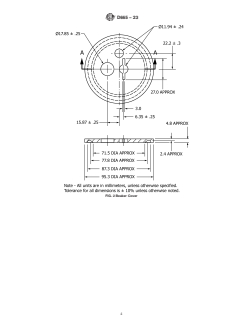
the dish aid in keeping it in position. Fig. 2 shows a PMMA resin cover
a temperature of 60 °C 6 1 °C with a cylindrical steel test rod
for the beaker which has been found to be suitable. An optional feature is
completely immersed therein. It is recommended to run the test
shown, consisting of a slot, 1.6 mm by 27 mm, which is centered on a
for 4 h; however, the test period may, at the discretion of the diameter of the stirrer hole at right angles to the cover diameter through
the test rod hole and stirrer hole. This feature allows withdrawal of the
contracting parties, be for a shorter or longer period. The test
stirrer while the beaker cover is in place. When the test method test is used
rod is observed for signs of rusting and, if desired, degree of
for other fluids such as synthetics, the beaker cover should be made from
rusting.
chemically resistant material such as polymonochlorotrifluoroethylene
(PCTFE).
NOTE 2—Until 1999 it was customary to run the test for 24 h. A round
robin with comparisons of different test times showed that no statistically
6.4 The plastic holder shall be made of PMMA resin in
significant differences in rating were found for any sample, between the
4 h and 24 h results. accordance with the dimensions shown in Fig. 3 (two types of
holders are illustrated). When testing synthetic fluids, the
5. Significance and Use
plastic holder should be made from chemically resistant
5.1 In many instances, such as in the gears of a steam
material such as polytetrafluoroethylene (PTFE).
turbine, water can become mixed with the lubricant, and
6.5 Stirrer—A stirrer constructed entirely from stainless
rusting of ferrous parts can occur. This test indicates how well
steel (Note 6 and Note 7) in the form of an inverted T. A flat
inhibited mineral oils aid in preventing this type of rusting.
blade (25 by 6) mm by 0.6 mm shall be attached to a rod with
This test method is also used for testing hydraulic and
a diameter of 6 mm in such a way that the blade is symmetrical
circulating oils, including heavier-than-water fluids. It is used
with the rod and has its flat surface in the vertical plane.
for specification of new oils and monitoring of in-service oils.
NOTE 3—This test method was used as a basis for Test Method D3603. NOTE 6—A suitable material is an 18 % chromium, 8 % nickel alloy
Test Method D3603 is used to test the oil on separate horizontal and
steel conforming to Type 304, of Specification A240/A240M, or SAE No.
vertical test rod surfaces, and can provide a more discriminating evalua-
30304 (see SAE J405), or BS 970: Part 1: 1983: 302S31.
tion.
NOTE 7—If stainless steel is not obtainable, stirrers made of heat-
resistant glass and having approximately the same dimensions as the
6. Apparatus
stainless steel stirrers specified can be used.
6.1 Liquid Bath—A thermostatically controlled liquid bath
6.6 Stirring Apparatus—Any convenient form of stirring
capable of maintaining the test sample at a temperature of
apparatus capable of maintaining a speed of 1000 r/min 6
60 °C 6 1 °C (see Note 4). The bath shall have a cover with
50 r ⁄min.
holes to accommodate the test beakers.
6.7 Grinding and Polishing Equipment—A CAMI 150 grit
NOTE 4—When using an oil bath, an oil having a viscosity of
approximately ISO VG 32 (see Classification D2422) is suitable. When
(99 μm) and a CAMI 240 grit (53.5 μm) in accordance with BS
using a water bath, monitoring of the water level and limiting evaporation
871 or its equivalent, metalworking aluminum oxide abrasive
is recommended. ASTM Thermometer 9C, as prescribed in Specification
cloth coat on a jeans backing (the corresponding European
E1, or IP Thermometer 21C in accordance with IP Standard
grades (FEPA) are P150J and P280J, respectively), a suitable
Thermometers, Volume 2, Appendix A, is suitable to indicate the
temperature. Alternatively, calibrated thermocouples may be used.
chuck (see Fig. 4) for holding the test rod, and a means of
rotating the test rod at a speed of 1700 r/min to 1800 r/min.
6.2 Beaker—A Berzelius-type, tall-form heat-resistant glass
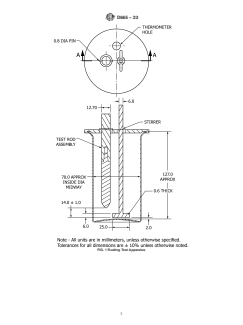
beaker without pour-out, as shown in Fig. 1, approximately
NOTE 8—CAMI (Coated Abrasives Manufacturers Institute) is a United
127 mm in height measured from the inside bottom center and
States organization and FEPA (Federation of European Producers of
approximately 70 mm inside diameter measured at the middle.
Abrasives) is a European organization.
6.3 Beaker Cover—A flat beaker cover of glass or poly
6.8 A suitable mean to dispense 30 mL 6 1 mL of water.
(methyl methacrylate) (PMMA) (Note 5), kept in position by
suitable means such as a rim or groove. Two holes shall be 6.9 Oven, capable of maintaining a temperature of 65 °C.
provided on any diameter of the cover; one for a stirrer 12 mm
in diameter with its center 6.4 mm from the center of the cover;
7. Reagents and Materials
7.1 Purity of Reagents—Reagent grade chemicals shall be
Supporting data (results of the cooperative test program with modified test
used in all tests. Unless otherwise indicated, it is intended that
duration) have been filed at ASTM International Headquarters and may be obtained
all reagents conform to the specifications of the Committee on
by requesting Research Report RR:D02-1474. Contact ASTM Customer Service at
service@astm.org. Analytical Reagents of the American Chemical Society where
D665 − 23
FIG. 1 Rusting Test Apparatus
D665 − 23
FIG. 2 Beaker Cover
D665 − 23
FIG. 3 Test Rod and Holders
D665 − 23
FIG. 4 Chuck for Polishing Test Rods
D665 − 23
such specifications are available. Other grades may be used, 7.7 Steel Test Rod, as specified in Section 9.
provided it is first ascertained that the reagent is of sufficiently
8. Sampling
high purity to permit its use without lessening the accuracy of
the determination.
8.1 Sample for this test can come from tanks, drums, small
containers, or even operating equipment, and they should be
7.2 Purity of Water—Unless otherwise indicated, references
truly representative of the entire quantity. Therefore, use the
to water shall be understood to mean reagent water as defined
applicable apparatus and techniques described in Practice
by Type II of Specification D1193.
D4057, or other comparable standard practice.
7.3 The synthetic sea water shall have the following com-
position:
9. Test Rod and Its Preparation
Salt
9.1 For each test oil, prepare two steel test rods. These may
either be new or from a previous test (see Note 9) and shall be
NaCl 24.54 g/L
MgCl ·6H O 11.10 g/L
2 2
prepared in accordance with 9.2 and 9.3.
Na SO 4.09 g/L
2 4
CaCl ·2H O 1.54 g/L
9.2 The test rod assembly shall consist of a round steel test
2 2
KCl 0.69 g/L
rod fitted to a plastic holder. The round steel test rod, when
NaHCO 0.20 g/L
new, shall be 12.7 mm in diameter and approximately 68 mm
KBr 0.10 g/L
H BO 0.03 g/L
3 3 in length exclusive of the threaded portion which screws into
SrCl ·6H O 0.04 g/L
2 2
the plastic holder and shall be tapered at one end as shown in
NaF 0.003 g/L
Fig. 3. It shall be made of steel conforming to Grade 10180 of
7.3.1 The solution can be conveniently prepared as follows.
Specification A108 or to BS 970 Part I: 1983-070M20. If these
This procedure avoids any precipitation in concentrated solu-
steels are not available, other equivalent steels may be used,
tions with subsequent uncertainty of complete resolution.
provided they are found to be satisfactory by comparative test
Using certified pure (cp) chemicals and distilled water, prepare
using this Test Method D665 – IP 135.
the following stock solutions:
NOTE 9—When making a check test, the steel test rod that showed rust
Stock Solution No. 1:
should not be reused. Test rods that repeatedly show rust in tests of various
MgCl ·6H O 3885 g
2 2
oils can be imperfect. Such test rods should be used with oils known to
CaCl ·2H O 538 g
2 2
pass the test. If rusting occurs in repeat tests, these test rods should be
SrCl ·6H O 14 g
2 2
Dissolve and dilute to 7 L discarded.
9.3 Preliminary Grinding—If the test rod has been used
Stock Solution No. 2:
KCl 483 g previously and is free of rust or other irregularities, the
NaHCO 140 g
preliminary grinding may be omitted, and it may be subjected
KBr 70 g
only to final polishing as prescribed in 9.4. If the test rod is new
H BO 21 g
3 3
NaF 2.1 g or if any part of its surface shows rust or other irregularities,
Dissolve and dilute to 7 L
clean it with ASTM precipitation naphtha or isooctane or IP
7.3.2 Commercially available synthetic sea water can be
60/80 petroleum spirit and grind with medium 150 grit
used if certified to meet requirements specified in 7.3.1.
aluminum oxide cloth to remove all irregularities, pits, and
7.3.3 To prepare the synthetic sea water, dissolve 245.4 g of
scratches, as determined by visual inspection (Note 10).
NaCl and 40.94 g of Na SO in a few litres of distilled water,
Perform the grindings by mounting the test rod in the chuck of
2 4
add 200 mL of Stock Solution No. 1 and 100 mL of Stock
the grinding and polishing apparatus, and turning it at a speed
Solution No. 2 and dilute to 10 L, stir and add 0.1 N Na CO
of 1700 r ⁄min to 1800 r/min while applying the 150 grit
2 3
solution until the pH is between 7.8 and 8.2. One or two
aluminum oxide cloth. Old 150 grit aluminum oxide cloth may
millilitres of the carbonate solution will be required. be used to remove rust or major irregularities, but complete the
grinding with new cloth. Proceed at once with the final
7.4 Pr
...
This document is not an ASTM standard and is intended only to provide the user of an ASTM standard an indication of what changes have been made to the previous version. Because
it may not be technically possible to adequately depict all changes accurately, ASTM recommends that users consult prior editions as appropriate. In all cases only the current version
of the standard as published by ASTM is to be considered the official document.
Designation: D665 − 19 D665 − 23
Designation: 135/06135/23
Standard Test Method for
Rust-Preventing Characteristics of Inhibited Mineral Oil in
the Presence of Water
This standard is issued under the fixed designation D665; the number immediately following the designation indicates the year of
original adoption or, in the case of revision, the year of last revision. A number in parentheses indicates the year of last reapproval. A
superscript epsilon (´) indicates an editorial change since the last revision or reapproval.
This standard has been approved for use by agencies of the U.S. Department of Defense.
1. Scope*
1.1 This test method covers the evaluation of the ability of inhibited mineral oils, particularly steam-turbine oils, to aid in
preventing the rusting of ferrous parts should water become mixed with the oil. This test method is also used for testing other oils,
such as hydraulic oils and circulating oils. Provision is made in the procedure for testing heavier-than-water fluids.
NOTE 1—For synthetic fluids, such as phosphate ester types, the plastic holder and beaker cover should be made of chemically resistant material suitable
for the type of fluid tested.
1.2 The values stated in SI units are to be regarded as standard. No other units of measurement are included in this standard.
1.3 This standard does not purport to address all of the safety concerns, if any, associated with its use. It is the responsibility
of the user of this standard to establish appropriate safety, health, and environmental practices and determine the applicability of
regulatory limitations prior to use. For specific warning statements, see 7.4 – 7.6.
1.4 This international standard was developed in accordance with internationally recognized principles on standardization
established in the Decision on Principles for the Development of International Standards, Guides and Recommendations issued
by the World Trade Organization Technical Barriers to Trade (TBT) Committee.
2. Referenced Documents
2.1 ASTM Standards:
A108 Specification for Steel Bar, Carbon and Alloy, Cold-Finished
A240/A240M Specification for Chromium and Chromium-Nickel Stainless Steel Plate, Sheet, and Strip for Pressure Vessels and
for General Applications
D91 Test Method for Precipitation Number of Lubricating Oils
D1193 Specification for Reagent Water
This test method is under the jurisdiction of ASTM International Committee D02 on Petroleum Products, Liquid Fuels, and Lubricants and is the direct responsibility
of ASTM Subcommittee D02.C0.02 on Corrosion and Water/Air Separability. The technically equivalent standard as referenced is under the jurisdiction of the Energy Institute
Subcommittee SC-C-4.
Current edition approved Dec. 1, 2019Dec. 1, 2023. Published January 2020January 2024. Originally approved in 1942. Last previous edition approved in 20142019 as
ɛ1
D665 – 14D665 – 19. . DOI: 10.1520/D0665-19.10.1520/D0665-23.
This standard test method has been developed through the cooperative effort between ASTM International and the Energy Institute, London. The EI and ASTM
International logos imply that the ASTM International and EI standards are technically equivalent, but ASTM and IP standards were approved by ASTM and EI technical
committees as being technically equivalent but that does not imply that both standards are editorially identical.
For referenced ASTM standards, visit the ASTM website, www.astm.org, or contact ASTM Customer Service at service@astm.org. For Annual Book of ASTM Standards
volume information, refer to the standard’s Document Summary page on the ASTM website.
*A Summary of Changes section appears at the end of this standard
Copyright © ASTM International, 100 Barr Harbor Drive, PO Box C700, West Conshohocken, PA 19428-2959. United States
D665 − 23
D2422 Classification of Industrial Fluid Lubricants by Viscosity System
D3603 Test Method for Rust-Preventing Characteristics of Steam Turbine Oil in the Presence of Water (Horizontal Disk Method)
D4057 Practice for Manual Sampling of Petroleum and Petroleum Products
E1 Specification for ASTM Liquid-in-Glass Thermometers
2.2 Other Documents:
Motor Fuels, Section I, Annex A2, Table 32, Reference Materials and Blending Accessories
Specifications-IP Standard Thermometers, Vol 2, Appendix A
Specifications for IP Standard Reference Liquids, Appendix B
SAE Standard J405 Chemical Composition of SAE Wrought Stainless Steels
BS 871 Specification for abrasive papers and cloths
BS 970 Part 1: Carbon and Carbon Manganese Steels Including Free Cutting Steels
3. Terminology
3.1 Definitions of Terms Specific to This Standard:
3.1.1 rust, n—a special case of corrosion that can be visually observed on the surface of round steel test rods as reddish-brown
discoloration or small black spots.
4. Summary of Test Method
4.1 A mixture of 300 mL of the oil under test is stirred with 30 mL of distilled water or synthetic sea water, as required, at a
temperature of 60 °C 6 1 °C with a cylindrical steel test rod completely immersed therein. It is recommended to run the test for
4 h; however, the test period may, at the discretion of the contracting parties, be for a shorter or longer period. The test rod is
observed for signs of rusting and, if desired, degree of rusting.
NOTE 2—Until 1999 it was customary to run the test for 24 h. A round robin with comparisons of different test times showed that no statistically significant
differences in rating were found for any sample, between the 4 h and 24 h results.
5. Significance and Use
5.1 In many instances, such as in the gears of a steam turbine, water can become mixed with the lubricant, and rusting of ferrous
parts can occur. This test indicates how well inhibited mineral oils aid in preventing this type of rusting. This test method is also
used for testing hydraulic and circulating oils, including heavier-than-water fluids. It is used for specification of new oils and
monitoring of in-service oils.
NOTE 3—This test method was used as a basis for Test Method D3603. Test Method D3603 is used to test the oil on separate horizontal and vertical test
rod surfaces, and can provide a more discriminating evaluation.
6. Apparatus
6.1 Liquid Bath—A thermostatically controlled liquid bath capable of maintaining the test sample at a temperature of 60 °C 6 1 °C
(see Note 4). The bath shall have a cover with holes to accommodate the test beakers.
NOTE 4—When using an oil bath, an oil having a viscosity of approximately ISO VG 32 (see Classification D2422) is suitable. When using a water bath,
monitoring of the water level and limiting evaporation is recommended. ASTM Thermometer 9C, as prescribed in Specification E1, or IP Thermometer
21C in accordance with IP Standard Thermometers, Volume 2, Appendix A, is suitable to indicate the temperature. Alternatively, calibrated thermocouples
may be used.
6.2 Beaker—A Berzelius-type, tall-form heat-resistant glass beaker without pour-out, as shown in Fig. 1, approximately 127 mm
in height measured from the inside bottom center and approximately 70 mm inside diameter measured at the middle.
See 1996 Annual Book of ASTM Standards, Vol 05.04.
Annual Book of IP Standard Methods for Analysis and Testing of Petroleum and Related Products, Vol 2. Available from Energy Institute, 61 New Cavendish St., London,
WIG 7AR, U.K.
1995 SAE Handbook, Vol 1. Available from Society of Automotive Engineers (SAE), 400 Commonwealth Dr., Warrendale, PA 15096-0001.
Supporting data (results of the cooperative test program with modified test duration) have been filed at ASTM International Headquarters and may be obtained by
requesting Research Report RR:D02-1474. Contact ASTM Customer Service at service@astm.org.
D665 − 23
FIG. 1 Rusting Test Apparatus
D665 − 23
6.3 Beaker Cover—A flat beaker cover of glass or poly (methyl methacrylate) (PMMA) (Note 5), kept in position by suitable
means such as a rim or groove. Two holes shall be provided on any diameter of the cover; one for a stirrer 12 mm in diameter
with its center 6.4 mm from the center of the cover; and the other, on the opposite side of the center of the cover, for the test rod
assembly (see Section 9), 18 mm in diameter with its center 16 mm from the center of the cover. In addition, a third hole 12 mm
in diameter shall be provided for a temperature measuring device, with its center 22.5 mm from the center of the cover and on a
diameter of the cover at right angles to the diameter through the other two holes.
NOTE 5—An inverted petri dish makes a suitable cover, as the sides of the dish aid in keeping it in position. Fig. 2 shows a PMMA resin cover for the
beaker which has been found to be suitable. An optional feature is shown, consisting of a slot, 1.6 mm by 27 mm, which is centered on a diameter of
the stirrer hole at right angles to the cover diameter through the test rod hole and stirrer hole. This feature allows withdrawal of the stirrer while the beaker
cover is in place. When the test method test is used for other fluids such as synthetics, the beaker cover should be made from chemically resistant material
such as polymonochlorotrifluoroethylene (PCTFE).
6.4 The plastic holder shall be made of PMMA resin in accordance with the dimensions shown in Fig. 3 (two types of holders
are illustrated). When testing synthetic fluids, the plastic holder should be made from chemically resistant material such as
polytetrafluoroethylene (PTFE).
6.5 Stirrer—A stirrer constructed entirely from stainless steel (Note 6 and Note 7) in the form of an inverted T. A flat blade (25
by 6) mm by 0.6 mm shall be attached to a rod with a diameter of 6 mm in such a way that the blade is symmetrical with the rod
and has its flat surface in the vertical plane.
NOTE 6—A suitable material is an 18 % chromium, 8 % nickel alloy steel conforming to Type 304, of Specification A240/A240M, or SAE No. 30304
(see SAE J405), or BS 970: Part 1: 1983: 302S31.
NOTE 7—If stainless steel is not obtainable, stirrers made of heat-resistant glass and having approximately the same dimensions as the stainless steel
stirrers specified can be used.
6.6 Stirring Apparatus—Any convenient form of stirring apparatus capable of maintaining a speed of 1000 r/min 6 50 r ⁄min.
6.7 Grinding and Polishing Equipment—A CAMI 150 grit (99 μm) and a CAMI 240 grit (53.5 μm) in accordance with BS 871
or its equivalent, metalworking aluminum oxide abrasive cloth coat on a jeans backing (the corresponding European grades (FEPA)
are P150J and P280J, respectively), a suitable chuck (see Fig. 4) for holding the test rod, and a means of rotating the test rod at
a speed of 1700 r/min to 1800 r/min.
NOTE 8—CAMI (Coated Abrasives Manufacturers Institute) is a United States organization and FEPA (Federation of European Producers of Abrasives)
is a European organization.
6.8 A suitable mean to dispense 30 mL 6 1 mL of water.
6.9 Oven, capable of maintaining a temperature of 65 °C.
7. Reagents and Materials
7.1 Purity of Reagents—Reagent grade chemicals shall be used in all tests. Unless otherwise indicated, it is intended that all
reagents conform to the specifications of the Committee on Analytical Reagents of the American Chemical Society where such
specifications are available. Other grades may be used, provided it is first ascertained that the reagent is of sufficiently high purity
to permit its use without lessening the accuracy of the determination.
7.2 Purity of Water—Unless otherwise indicated, references to water shall be understood to mean reagent water as defined by Type
II of Specification D1193.
ACS Reagent Chemicals, Specifications and Procedures for Reagents and Standard-Grade Reference Materials, American Chemical Society, Washington, DC. For
suggestions on the testing of reagents not listed by the American Chemical Society, see Analar Standards for Laboratory Chemicals, BDH Ltd., Poole, Dorset, U.K., and
the United States Pharmacopeia and National Formulary, U.S. Pharmacopeial Convention, Inc. (USPC), Rockville, MD.
D665 − 23
FIG. 2 Beaker Cover
D665 − 23
FIG. 3 Test Rod and Holders
D665 − 23
FIG. 4 Chuck for Polishing Test Rods
D665 − 23
7.3 The synthetic sea water shall have the following composition:
Salt
NaCl 24.54 g/L
MgCl ·6H O 11.10 g/L
2 2
Na SO 4.09 g/L
2 4
CaCl ·2H O 1.54 g/L
2 2
KCl 0.69 g/L
NaHCO 0.20 g/L
KBr 0.10 g/L
H BO 0.03 g/L
3 3
SrCl ·6H O 0.04 g/L
2 2
NaF 0.003 g/L
7.3.1 The solution can be conveniently prepared as follows. This procedure avoids any precipitation in concentrated solutions with
subsequent uncertainty of complete resolution. Using certified pure (cp) chemicals and distilled water, prepare the following stock
solutions:
Stock Solution No. 1:
MgCl ·6H O 3885 g
2 2
CaCl ·2H O 538 g
2 2
SrCl ·6H O 14 g
2 2
Dissolve and dilute to 7 L
Stock Solution No. 2:
KCl 483 g
NaHCO 140 g
KBr 70 g
H BO 21 g
3 3
NaF 2.1 g
Dissolve and dilute to 7 L
7.3.2 Commercially available synthetic sea water can be used if certified to meet requirements specified in 7.3.1.
7.3.3 To prepare the synthetic sea water, dissolve 245.4 g of NaCl and 40.94 g of Na SO in a few litres of distilled water, add
2 4
200 mL of Stock Solution No. 1 and 100 mL of Stock Solution No. 2 and dilute to 10 L, stir and add 0.1 N Na CO solution until
2 3
the pH is between 7.8 and 8.2. One or two millilitres of the carbonate solution will be required.
7.4 Precipitation Naphtha, as specified in Test Method D91. (Warning—Flammable. Health hazard.)
7.5 Isooctane, as specified in Motor Fuels, Section I, Annex A2, Table 32, Reference Materials and Blending Accessories.
(Warning—Flammable. Health hazard.)
7.6 IP 60/80 Petroleum Spirit, as specified by IP Standard Reference Liquids, Appendix B. (Warning—Flammable. Health
hazard.)
7.7 Steel Test Rod, as specified in Section 9.
8. Sampling
8.1 Sample for this test can come from tanks, drums, small containers, or even operating equipment, and they should be truly
representative of the entire quantity. Therefore, use the applicable apparatus and techniques described in Practice D4057, or other
comparable standard practice.
9. Test Rod and Its Preparation
9.1 For each test oil, prepare two steel test rods. These may either be new or from a previous test (see Note 9) and shall be prepared
in accordance with 9.2 and 9.3.
D665 − 23
9.2 The test rod assembly shall consist of a round steel test rod fitted to a plastic holder. The round steel test rod, when new, shall
be 12.7 mm in diameter and approximately 68 mm in length exclusive of the threaded portion which screws into the plastic holder
and shall be tapered at one end as shown in Fig. 3. It shall be made of steel conforming to Grade 10180 of Specification A108
or to BS 970 Part I: 1983-070M20. If these steels are not available, other equivalent steels may be used, provided they are found
to be satisfactory by comparative test using this Test Method D665 – IP 135.
NOTE 9—When making a check test, the steel test rod that showed rust should not be reused. Test rods that repeatedly show rust in tests of various oils
can be imperfect. Such test rods should be used with oils known to pass the test. If rusting occurs in repeat tests, these test rods should be discarded.
9.3 Preliminary Grinding—If the test rod has be
...