

ASTM C650-20
(Test Method)Standard Test Method for Determination of Resistance to Chemical Substances
General Information
- Abstract
SIGNIFICANCE AND USE
3.1 This test method is intended for testing tiles that are to be used for food counters, lavatories, and similar residential, medical, and commercial installations, where they may come in contact with food, chemical, and waste substances and for tile in areas where they may be exposed to contact with strong cleaning agents.
SCOPE
1.1 This test method covers a procedure for determining whether, and to what degree, ceramic tiles and glass tiles are affected by prolonged exposure to chemical substances that are commonly used in the household or for cleaning purposes as well as other more severe conditions.
1.2 The values stated in SI units are to be regarded as standard. No other units of measurement are included in this standard.
1.2.1 The units used for concentration in this standard are v/v, which refers to the volume of reagent/1 L of solution, and g/L, which refers to the weight of reagent, in g, to be dissolved in 1 L of water.
1.3 This standard does not purport to address all of the safety concerns, if any, associated with its use. It is the responsibility of the user of this standard to establish appropriate safety, health, and environmental practices and determine the applicability of regulatory limitations prior to use.
1.4 This international standard was developed in accordance with internationally recognized principles on standardization established in the Decision on Principles for the Development of International Standards, Guides and Recommendations issued by the World Trade Organization Technical Barriers to Trade (TBT) Committee.
- Status
- Published
- Publication Date
- 31-May-2020
- Technical Committee
- C21 - Ceramic Whitewares and Related Products
- Drafting Committee
- C21.06 - Ceramic Tile


Overview
ASTM C650-20: Standard Test Method for Determination of Resistance to Chemical Substances provides a standardized procedure for assessing the chemical resistance of ceramic and glass tiles. This test method is vital for evaluating tiles intended for use in environments where they are exposed to food, chemicals, waste substances, or strong cleaning agents, such as food counters, lavatories, medical facilities, and commercial settings. By following this procedure, stakeholders can verify tile performance and ensure long-term durability under exposure to common household, industrial, and cleaning chemicals.
Key keywords: ASTM C650-20, chemical resistance, ceramic tile, glass tile, acid resistance, alkali resistance, cleaning agents, durability, laboratory testing
Key Topics
Purpose of ASTM C650-20
- Determines the extent of chemical resistance of ceramic and glass tiles.
- Assesses suitability for use in environments subject to chemical exposure.
Testing Procedure
- Tiles are exposed to specific chemical substances for a defined time and temperature.
- Visual assessment of the tile surface for changes in appearance, color, and texture.
- Use of a pencil test to confirm visual results.
Types of Chemicals Tested
- Common household and cleaning chemicals such as acetic acid (3%, 10%), ammonium chloride, citric acid, lactic acid, phosphoric acid, and sulfamic acid.
- Swimming pool chemicals like sodium hypochlorite.
- Acids and bases including hydrochloric acid and potassium hydroxide.
Evaluation and Reporting
- Results are classified as “affected” or “not affected” based on visual and pencil test outcomes.
- All test conditions and results must be reported, providing clear certification of tile resistance.
Applications
ASTM C650-20 serves several practical applications across various industries:
Product Qualification and Quality Control
- Manufacturers subject ceramic and glass tiles to C650-20 testing to ensure compliance with chemical resistance requirements before market release.
- Quality assurance teams use the results to support product claims and performance guarantees.
Facility Design and Specification
- Specifiers and architects use the standard to select appropriate tiles for environments prone to chemical exposure, such as laboratories, hospitals, food preparation areas, and restrooms.
- Ensures safe, hygienic, and long-lasting surfaces in residential, medical, and commercial settings.
Regulatory Compliance
- Meets requirements for safety and durability under internationally recognized principles, supporting global trade and acceptance.
- Contributes to regulatory documentation and validates material selection for project submittals.
Maintenance and Performance Evaluations
- Enables facility managers to assess existing installations for chemical damage and inform maintenance strategies.
Related Standards
For comprehensive evaluation and specification of ceramic and glass tiles, the following ASTM and related standards may also be relevant:
- ASTM C373 - Standard Test Method for Water Absorption, Bulk Density, Apparent Porosity, and Apparent Specific Gravity of Fired Whiteware Products
- ASTM C1026 - Standard Test Method for Measuring the Resistance of Ceramic Tiles to Freeze-Thaw Cycling
- ASTM C482 - Standard Test Method for Bond Strength of Ceramic Tile to Portland Cement Paste
- EN ISO 10545-13 - Ceramic Tiles: Determination of Chemical Resistance (for international equivalence)
- ANSI A137.1 - American National Standard Specifications for Ceramic Tile
By adhering to ASTM C650-20 and related standards, manufacturers, specifiers, and facility owners can ensure high-quality, chemically resistant, and durable tile installations that meet stringent industry and safety requirements.
Get Certified
Connect with accredited certification bodies for this standard

DIBt (Deutsches Institut für Bautechnik)
German Institute for Building Technology.
DIN CERTCO
DIN Group product certification.

Aboma Certification B.V.
Specialized in construction, metal, and transport sectors.
Sponsored listings
Frequently Asked Questions
ASTM C650-20 is a standard published by ASTM International. Its full title is "Standard Test Method for Determination of Resistance to Chemical Substances". This standard covers: SIGNIFICANCE AND USE 3.1 This test method is intended for testing tiles that are to be used for food counters, lavatories, and similar residential, medical, and commercial installations, where they may come in contact with food, chemical, and waste substances and for tile in areas where they may be exposed to contact with strong cleaning agents. SCOPE 1.1 This test method covers a procedure for determining whether, and to what degree, ceramic tiles and glass tiles are affected by prolonged exposure to chemical substances that are commonly used in the household or for cleaning purposes as well as other more severe conditions. 1.2 The values stated in SI units are to be regarded as standard. No other units of measurement are included in this standard. 1.2.1 The units used for concentration in this standard are v/v, which refers to the volume of reagent/1 L of solution, and g/L, which refers to the weight of reagent, in g, to be dissolved in 1 L of water. 1.3 This standard does not purport to address all of the safety concerns, if any, associated with its use. It is the responsibility of the user of this standard to establish appropriate safety, health, and environmental practices and determine the applicability of regulatory limitations prior to use. 1.4 This international standard was developed in accordance with internationally recognized principles on standardization established in the Decision on Principles for the Development of International Standards, Guides and Recommendations issued by the World Trade Organization Technical Barriers to Trade (TBT) Committee.
SIGNIFICANCE AND USE 3.1 This test method is intended for testing tiles that are to be used for food counters, lavatories, and similar residential, medical, and commercial installations, where they may come in contact with food, chemical, and waste substances and for tile in areas where they may be exposed to contact with strong cleaning agents. SCOPE 1.1 This test method covers a procedure for determining whether, and to what degree, ceramic tiles and glass tiles are affected by prolonged exposure to chemical substances that are commonly used in the household or for cleaning purposes as well as other more severe conditions. 1.2 The values stated in SI units are to be regarded as standard. No other units of measurement are included in this standard. 1.2.1 The units used for concentration in this standard are v/v, which refers to the volume of reagent/1 L of solution, and g/L, which refers to the weight of reagent, in g, to be dissolved in 1 L of water. 1.3 This standard does not purport to address all of the safety concerns, if any, associated with its use. It is the responsibility of the user of this standard to establish appropriate safety, health, and environmental practices and determine the applicability of regulatory limitations prior to use. 1.4 This international standard was developed in accordance with internationally recognized principles on standardization established in the Decision on Principles for the Development of International Standards, Guides and Recommendations issued by the World Trade Organization Technical Barriers to Trade (TBT) Committee.
ASTM C650-20 is classified under the following ICS (International Classification for Standards) categories: 91.100.25 - Terracotta building products. The ICS classification helps identify the subject area and facilitates finding related standards.
ASTM C650-20 is available in PDF format for immediate download after purchase. The document can be added to your cart and obtained through the secure checkout process. Digital delivery ensures instant access to the complete standard document.
Standards Content (Sample)
This international standard was developed in accordance with internationally recognized principles on standardization established in the Decision on Principles for the
Development of International Standards, Guides and Recommendations issued by the World Trade Organization Technical Barriers to Trade (TBT) Committee.
Designation: C650 − 20
Standard Test Method for
Determination of Resistance to Chemical Substances
This standard is issued under the fixed designation C650; the number immediately following the designation indicates the year of
original adoption or, in the case of revision, the year of last revision. A number in parentheses indicates the year of last reapproval. A
superscript epsilon (´) indicates an editorial change since the last revision or reapproval.
1. Scope in contact with food, chemical, and waste substances and for
tile in areas where they may be exposed to contact with strong
1.1 This test method covers a procedure for determining
cleaning agents.
whether, and to what degree, ceramic tiles and glass tiles are
affected by prolonged exposure to chemical substances that are
4. Apparatus
commonly used in the household or for cleaning purposes as
4.1 Glass Test Tubes or PVC Tubes, plain-end flint glass test
well as other more severe conditions.
tubes or PVC tubes with a diameter of approximately 20 mm
1.2 The values stated in SI units are to be regarded as
and a length sufficient to contain the required amount of test
standard. No other units of measurement are included in this
solution.
standard.
4.2 Oven, capable of maintaining a constant temperature of
1.2.1 The units used for concentration in this standard are
at least 110 °C.
v/v, which refers to the volume of reagent/1 L of solution, and
g/L, which refers to the weight of reagent, in g, to be dissolved
4.3 Pencil, HB hardness grade.
in 1 L of water.
4.4 Cloths, a supply of lintless, absorbent cloths or paper
1.3 This standard does not purport to address all of the
towels.
safety concerns, if any, associated with its use. It is the
4.5 Distilled or Deionized Water, for preparation of the
responsibility of the user of this standard to establish appro-
solutions.
priate safety, health, and environmental practices and deter-
mine the applicability of regulatory limitations prior to use. 4.6 Light Source, standard, that supplies a minimum of
1.4 This international standard was developed in accor- 300 lux illumination.
dance with internationally recognized principles on standard-
5. Reagents
ization established in the Decision on Principles for the
Development of International Standards, Guides and Recom-
5.1 Purity of Reagents—Reagent grade chemicals shall be
mendations issued by the World Trade Organization Technical
used in all tests. Unless otherwise indicated, it is intended that
Barriers to Trade (TBT) Committee.
all reagents conform to the specifications of the Committee on
Analytical Reagents of the American Chemical Society where
2. Summary of Test Method
such specifications are available. Other grades may be used,
2.1 This test method calls for one or more tests, each provided it is first ascertained that the reagent is of sufficiently
high purity to permit its use without lessening the accuracy of
consisting of exposing flat pieces of tile to the action of a
specific chemical substance for a definite period of time.After the determination.
exposure, the surfaces of the tile are rinsed with water and
5.2 The required dilutions for the preparation of each test
inspected for effect.
solution is found in Table 1 of this test method.
5.2.1 Common Household and Cleaning Chemicals:
3. Significance and Use
5.2.1.1 Acetic acid, 3 % (v/v).
3.1 This test method is intended for testing tiles that are to
5.2.1.2 Acetic acid, 10 % (v/v).
be used for food counters, lavatories, and similar residential,
5.2.1.3 Ammonium chloride, 100 g/L.
medical, and commercial installations, where they may come
5.2.1.4 Citric acid solution, 30 g/L.
1 2
This test method is under the jurisdiction ofASTM CommitteeC21 on Ceramic Reagent Chemicals, American Chemical Society Specifications, American
Whitewares and Related Productsand is the direct responsibility of Subcommittee Chemical Society, Washington, DC. For suggestions on the testing of reagents not
C21.06 on Ceramic Tile. listed by the American Chemical Society, see Analar Standards for Laboratory
Current edition approved June 1, 2020. Published June 2020. Originally Chemicals, BDH Ltd., Poole, Dorset, U.K., and the United States Pharmacopeial
approved in 1970. Last previous edition approved in 2019 as C650 – 04 (2019). and National Formulary, U.S. Pharmacopeial Convention, Inc. (USPC), Rockville,
DOI: 10.1520/C0650-20. MD.
Copyright © ASTM International, 100 Barr Harbor Drive, PO Box C700, West Conshohocken, PA 19428-2959. United States
C650 − 20
TABLE 1 Preparation of Test Solutions
NOTE 1—When mixing solutions using solid reagents, the reagent should be dissolved in a small amount of water first, and then water should be added
to the solution such that the final volume of the solution is 1000 mL. For example, when mixing the citric acid solution, 30 g/L, dissolve 30.2 g of 99.5 %
citric acid in 250 mL of water. After the reagent is dissolved, continue adding water until the solution has a final volume of 1000 mL.
Amount of Reagent
Distilled Water
Required
Test Solution Reagent Source Required for
for Test Solution
Test Solution
(See Note 1)
Common Household and Cleaning Chemicals
acetic acid, 3 % (v/v) 99.7 % glacial acetic acid 30.1 mL 969.9 mL
acetic acid, 10 % (v/v) 99.7 % glacial acetic acid 100.3 mL 899.7 mL
ammonium chloride, 100 g/L 99.5 % ammonium chloride 100.5 g 1000 mL
citric acid solution, 30 g/L 99.5 % citric acid 30.2 g 1000 mL
citric acid solution, 100 g/L 99.5 % citric acid 100.5 g 1000 mL
lactic acid, 5 % (v/v) 85 % lactic acid 58.8 mL 941.2 mL
phosphoric acid, 3 % (v/v) 85 % phosphoric acid 35.3 mL 964.7 mL
phosphoric acid, 10 % (v/v) 85 % phosphoric acid 117.6 mL 882.4 mL
sulfamic acid, 30 g/L 99 % sulfamic acid 30.3 g 1000 mL
sulfamic acid, 100 g/L 99 % sulfamic acid 101 g 1000 mL
Swimming Pool Chemicals
sodium hypochlorite solution, 20 mg/L technical grade sodium hypochlorite with 13 % active chlorine 0.15 mL 999.85 mL
Acids and Bases
hydrochloric acid solution, 3 % (v ⁄v) 38 % hydrochloric acid 78.9 mL 921.1 mL
hydrochloric acid solution, 18 % (v ⁄v) 38 % hydrochloric acid 473.7 mL 526.3 mL
potassium hydroxide, 30 g/L 90 % potassium hydroxide 33.33 g 1000 mL
potassium hydroxide, 100 g/L 90 % potassium hydroxide 111.1 g 1000 mL
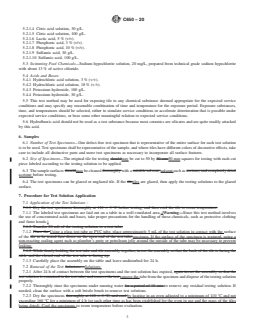
5.2.1.5 Citric acid solution, 100 g/L. 6.2 Size of Specimens—The original tile for testing may be
5.2.1.6 Lactic acid, 5 % (v/v). cut to 50 by
...
This document is not an ASTM standard and is intended only to provide the user of an ASTM standard an indication of what changes have been made to the previous version. Because
it may not be technically possible to adequately depict all changes accurately, ASTM recommends that users consult prior editions as appropriate. In all cases only the current version
of the standard as published by ASTM is to be considered the official document.
Designation: C650 − 04 (Reapproved 2019) C650 − 20
Standard Test Method for
ResistanceDetermination of Ceramic Tile Resistance to
Chemical Substances
This standard is issued under the fixed designation C650; the number immediately following the designation indicates the year of
original adoption or, in the case of revision, the year of last revision. A number in parentheses indicates the year of last reapproval. A
superscript epsilon (´) indicates an editorial change since the last revision or reapproval.
1. Scope
1.1 This test method covers a procedure for determining whether, and to what degree, ceramic tiles and glass tiles are affected
by prolonged exposure to chemical substances that are commonly used in the household or for cleaning purposes as well as other
more severe conditions.
1.2 The values stated in SI units are to be regarded as standard. No other units of measurement are included in this standard.
1.2.1 The units used for concentration in this standard are v/vv/v, which refers to the volume of reagent/1 L of solution, and
g/Lg/L, which refers to the weight of reagent, in g, to be dissolved in 1 L of water.
1.3 This standard does not purport to address all of the safety concerns, if any, associated with its use. It is the responsibility
of the user of this standard to establish appropriate safety, health, and environmental practices and determine the applicability of
regulatory limitations prior to use.
1.4 This international standard was developed in accordance with internationally recognized principles on standardization
established in the Decision on Principles for the Development of International Standards, Guides and Recommendations issued
by the World Trade Organization Technical Barriers to Trade (TBT) Committee.
2. Summary of Test Method
2.1 This test method calls for one or more tests, each consisting of exposing flat pieces of ceramic tile to the action of a specific
chemical substance for a definite period of time at a prescribed temperature. time. After exposure, the surfaces of the tile are rinsed
with water and inspected for effect.
3. Significance and Use
3.1 This test method is intended for testing ceramic tile tiles that are to be used for food counters, lavatories, and similar
residential, medical, and commercial installations, where they may come in contact with food, chemical, and waste substances and
for tile in areas where they may be exposed to contact with strong cleaning agents.
3.2 The specification of 10 % hydrochloric acid solution and 10 % potassium hydroxide solution as normal testing fluids, and
the length of exposure time and temperature are based on experimental laboratory work and interlaboratory tests, where it was
indicated that resistance to these two substances probably assures resistance also to any other acidic or alkaline substance coming
in contact with tile, except hydrofluoric acid.
3.3 The validity of using color difference as means of determining the degree to which tile surfaces are affected by acids and
alkalies has been established by interlaboratory test and was found to be more reliable than the determination of loss of gloss,
particularly for unglazed tile and mat or semimat glazed surfaces. Lack of coordination between instrumental value and visual
effect was noted only in the case of minute surface changes, detectable only by oblique viewing.
4. Apparatus
4.1 Test Glass Test Tubes or PVC Tubes, plain-end flint glass test tubes or PVC tubes with a diameter of approximately 20 mm
and a length of 150 mm.sufficient to contain the required amount of test solution.
4.2 Pipets, glass with a volume of at least 50 mL with gradations in 1-mL increments.
This test method is under the jurisdiction of ASTM Committee C21 on Ceramic Whitewares and Related Productsand is the direct responsibility of Subcommittee C21.06
on Ceramic Tile.
Current edition approved Aug. 1, 2019June 1, 2020. Published August 2019June 2020. Originally approved in 1970. Last previous edition approved in 20142019 as
C650 – 04 (2014).(2019). DOI: 10.1520/C0650-04R19.10.1520/C0650-20.
Copyright © ASTM International, 100 Barr Harbor Drive, PO Box C700, West Conshohocken, PA 19428-2959. United States
C650 − 20
4.2 Oven, capable of maintaining a constant temperature of 110 6 5 °C.at least 110 °C.
4.3 Pencil, HB hardness grade.
4.4 Cloths, a supply of lintless, absorbent cloths or paper towels.
4.5 Distilled or Deionized Water , Water, for preparation of the solutions.
4.6 Light Source, standard, that supplies a 300 lux minimum of 300 lux illumination.
5. Reagents
5.1 Purity of Reagents—Reagent grade chemicals shall be used in all tests. Unless otherwise indicated, it is intended that all
reagents conform to the specifications of the Committee on Analytical Reagents of the American Chemical Society where such
specifications are available. Other grades may be used, provided it is first ascertained that the reagent is of sufficiently high purity
to permit its use without lessening the accuracy of the determination.
5.2 The required dilutions for the preparation of each test solution is found in Table 1 of this test method.
5.2.1 Common Household and Cleaning Chemicals:
5.2.1.1 Acetic acid, 3 % (v/v).
5.2.1.2 Acetic acid, 10 % (v/v).
5.2.1.3 Ammonium chloride, 100 g/L.
TABLE 1 Preparation of Test Solutions
NOTE 1—When mixing solutions using solid reagents, the reagent should be dissolved in a small amount of water first, and then water should be added
to the solution such that the final volume of the solution is 1000 mL. For example, when mixing the citric acid solution, 30 g/L, dissolve 30.2 g of 99.5 %
citric acid in 250 mL of water. After the reagent is dissolved, continue adding water until the solution has a final volume of 1000 mL.
Amount of Reagent
Distilled Water
Required
Test Solution Reagent Source Required for
for Test Solution
Test Solution
(See Note 1)
Common Household and Cleaning Chemicals
Acetic acid, 3 % (v/v) 99.7 % glacial acetic acid 30 mL 970 mL
acetic acid, 3 % (v/v) 99.7 % glacial acetic acid 30.1 mL 969.9 mL
Acetic acid, 10 % (v/v) 99.7 % glacial acetic acid 100 mL 900 mL
acetic acid, 10 % (v/v) 99.7 % glacial acetic acid 100.3 mL 899.7 mL
Ammonium chloride, 100 g/L 99.5 % ammonium chloride 100 g 900 mL
ammonium chloride, 100 g/L 99.5 % ammonium chloride 100.5 g 1000 mL
Citric acid solution, 30 g/L 99.5 % citric acid 30 g 970 mL
citric acid solution, 30 g/L 99.5 % citric acid 30.2 g 1000 mL
Citric acid solution, 100 g/L 99.5 % citric acid 100 g 900 mL
citric acid solution, 100 g/L 99.5 % citric acid 100.5 g 1000 mL
Lactic acid, 5 % (v/v) 85 % lactic acid 50 mL 950 mL
lactic acid, 5 % (v/v) 85 % lactic acid 58.8 mL 941.2 mL
Phosphoric acid, 3 % (v/v) 85 % phosphoric acid 30 mL 970 mL
phosphoric acid, 3 % (v/v) 85 % phosphoric acid 35.3 mL 964.7 mL
Phosphoric acid, 10 % (v/v) 85 % phosphoric acid 100 mL 900 mL
phosphoric acid, 10 % (v/v) 85 % phosphoric acid 117.6 mL 882.4 mL
Sulfamic acid, 30 g/L 99 % sulfamic acid 30 g 970 mL
sulfamic acid, 30 g/L 99 % sulfamic acid 30.3 g 1000 mL
Sulfamic acid, 100 g/L 99 % sulfamic acid 101 g 899 mL
sulfamic acid, 100 g/L 99 % sulfamic acid 101 g 1000 mL
Swimming pool chemicals
Swimming Pool Chemicals
Sodium hypochlorite solution, 20 mg/L technical grade sodium hypochlorite with 13 % active clorine 20 mg 980 mL
sodium hypochlorite solution, 20 mg/L technical grade sodium hypochlorite with 13 % active chlorine 0.15 mL 999.85 mL
Acids and Bases
Hydrochloric acid solution, 3 % (v ⁄v) 38 % hydrochloric acid 30 mL 970 mL
hydrochloric acid solution, 3 % (v ⁄v) 38 % hydrochloric acid 78.9 mL 921.1 mL
Hydrochloric acid solution, 18 % (v ⁄v) 38 % hydrochloric acid 180 mL 820 mL
hydrochloric acid solution, 18 % (v ⁄v) 38 % hydrochloric acid 473.7 mL 526.3 mL
Potassium hydroxide, 30 g/L 90 % potassium hydroxide 33.33 g 967 mL
potassium hydroxide, 30 g/L 90 % potassium hydroxide 33.33 g 1000 mL
Potassium hydroxide, 100 g/L 90 % potassium hydroxide 111 g 889 mL
potassium hydroxide, 100 g/L 90 % potassium hydroxide 111.1 g 1000 mL
Reagent Chemicals, American Chemical Society Specifications Specifications, , American Chemical Society, Washington, DC. For suggestions on the testing of reagents
not listed by the American Chemical Society, see Analar Standards for Laboratory Chemicals, BDH Ltd., Poole, Dorset, U.K., and the United States Pharmacopeial and
Natio
...