

ASTM C1243-23
(Test Method)Standard Test Method for Relative Resistance to Deep Abrasive Wear of Unglazed Ceramic Tile by Rotating Disc
General Information
- Abstract
SIGNIFICANCE AND USE
4.1 This test method provides the means to measure the potential resistance to wear of unglazed ceramic tile intended for floor coverings. This test method does not consider physical appearance but is intended to measure durability. See Test Method C1027 for the determination of visible abrasion resistance of glazed ceramic tile.
4.1.1 See Test Method C501 for an alternative method to determine deep abrasion.
SCOPE
1.1 This test method covers the deep abrasive wear by measuring the loss of volume resulting from abrasion of unglazed ceramic tile under given conditions by means of a rotating disc and the use of abrasive material.
1.2 The values stated in SI units are to be regarded as standard. No other units of measurement are included in this standard.
1.3 This standard does not purport to address all of the safety concerns, if any, associated with its use. It is the responsibility of the user of this standard to establish appropriate safety, health, and environmental practices and determine the applicability of regulatory limitations prior to use.
1.4 This international standard was developed in accordance with internationally recognized principles on standardization established in the Decision on Principles for the Development of International Standards, Guides and Recommendations issued by the World Trade Organization Technical Barriers to Trade (TBT) Committee.
- Status
- Published
- Publication Date
- 30-Sep-2023
- Technical Committee
- C21 - Ceramic Whitewares and Related Products
- Drafting Committee
- C21.06 - Ceramic Tile
Buy Documents


ASTM C1243-23 - Standard Test Method for Relative Resistance to Deep Abrasive Wear of Unglazed Ceramic Tile by Rotating Disc
REDLINE ASTM C1243-23 - Standard Test Method for Relative Resistance to Deep Abrasive Wear of Unglazed Ceramic Tile by Rotating Disc
Overview
ASTM C1243-23, "Standard Test Method for Relative Resistance to Deep Abrasive Wear of Unglazed Ceramic Tile by Rotating Disc," establishes a procedure to evaluate the durability of unglazed ceramic tiles intended for floor coverings. This ASTM standard, developed in accordance with internationally recognized principles, provides a reliable means to assess the volume of material lost due to deep abrasion under specified conditions using a rotating disc apparatus and abrasive material. The standard focuses specifically on quantifying wear resistance, not visual appearance, to determine the functional longevity of ceramic tiles in demanding environments.
Key Topics
- Deep Abrasive Wear Evaluation: The test quantifies the volume of tile material removed under controlled abrasion, offering a direct measure of durability.
- Rotating Disc Method: Utilizes an abrasion apparatus with a rotating steel disc and calibrated pressure to ensure consistent test results.
- Test Precision: Specifies the use of defined grain size abrasive materials and measurement tools for high repeatability and accuracy.
- International Compliance: Developed following WTO TBT Committee principles, facilitating global trade and standardization in ceramic tile products.
- Exclusive Use of SI Units: All results and measurements are stated exclusively in SI units, ensuring clarity and consistency.
- User Responsibility: Emphasizes the importance of adherence to safety, health, and environmental practices in conducting tests.
Applications
- Quality Control in Manufacturing: Ceramic tile producers use ASTM C1243-23 to verify that unglazed tiles meet minimum abrasion resistance requirements for use in floor applications.
- Product Specification and Comparison: Architects, specifiers, and builders reference this standard when selecting tiles for high-traffic areas to ensure long-term durability.
- Performance Benchmarking: Enables objective comparison between different unglazed ceramic tile products based on their measured resistance to deep abrasive wear.
- Regulatory Compliance: Assists industry professionals in demonstrating conformity with international and local building codes concerning flooring material performance.
- Research and Development: Laboratories and research institutions apply the method for product development and improvement of ceramic tiles.
- Alternative Test Options: Directs users to alternative and complementary methods, such as ASTM C501 and C1027, for other aspects of tile wear resistance.
Related Standards
For comprehensive ceramic tile performance evaluations, the following related ASTM standards are referenced:
- ASTM C501 - Test Method for Relative Resistance to Wear of Unglazed Ceramic Tile by the Taber Abraser, for alternative deep abrasion testing technique.
- ASTM C1027 - Test Method for Determining Visible Abrasion Resistance of Glazed Ceramic Tile, focusing on surface appearance after wear.
- ASTM C242 - Terminology of Ceramic Whitewares and Related Products, providing key definitions for clarity and consistency in testing.
- ASTM C448 - Test Methods for Abrasion Resistance of Porcelain Enamels, relevant for specific applications and materials.
Practical Value
Using ASTM C1243-23 ensures that unglazed ceramic tiles are fit for purpose in projects where deep abrasion resistance is critical, such as commercial and industrial floors. Adhering to this method supports manufacturers in producing reliable, durable floor coverings and helps end users select appropriate products for their intended use. By providing objective, repeatable data, ASTM C1243-23 facilitates informed material selection and long-term project performance.
Relations
- Effective Date
- 01-Oct-2023
Buy Documents
ASTM C1243-23 - Standard Test Method for Relative Resistance to Deep Abrasive Wear of Unglazed Ceramic Tile by Rotating Disc
REDLINE ASTM C1243-23 - Standard Test Method for Relative Resistance to Deep Abrasive Wear of Unglazed Ceramic Tile by Rotating Disc
Get Certified
Connect with accredited certification bodies for this standard

DIBt (Deutsches Institut für Bautechnik)
German Institute for Building Technology.
DIN CERTCO
DIN Group product certification.

Aboma Certification B.V.
Specialized in construction, metal, and transport sectors.
Sponsored listings
Frequently Asked Questions
ASTM C1243-23 is a standard published by ASTM International. Its full title is "Standard Test Method for Relative Resistance to Deep Abrasive Wear of Unglazed Ceramic Tile by Rotating Disc". This standard covers: SIGNIFICANCE AND USE 4.1 This test method provides the means to measure the potential resistance to wear of unglazed ceramic tile intended for floor coverings. This test method does not consider physical appearance but is intended to measure durability. See Test Method C1027 for the determination of visible abrasion resistance of glazed ceramic tile. 4.1.1 See Test Method C501 for an alternative method to determine deep abrasion. SCOPE 1.1 This test method covers the deep abrasive wear by measuring the loss of volume resulting from abrasion of unglazed ceramic tile under given conditions by means of a rotating disc and the use of abrasive material. 1.2 The values stated in SI units are to be regarded as standard. No other units of measurement are included in this standard. 1.3 This standard does not purport to address all of the safety concerns, if any, associated with its use. It is the responsibility of the user of this standard to establish appropriate safety, health, and environmental practices and determine the applicability of regulatory limitations prior to use. 1.4 This international standard was developed in accordance with internationally recognized principles on standardization established in the Decision on Principles for the Development of International Standards, Guides and Recommendations issued by the World Trade Organization Technical Barriers to Trade (TBT) Committee.
SIGNIFICANCE AND USE 4.1 This test method provides the means to measure the potential resistance to wear of unglazed ceramic tile intended for floor coverings. This test method does not consider physical appearance but is intended to measure durability. See Test Method C1027 for the determination of visible abrasion resistance of glazed ceramic tile. 4.1.1 See Test Method C501 for an alternative method to determine deep abrasion. SCOPE 1.1 This test method covers the deep abrasive wear by measuring the loss of volume resulting from abrasion of unglazed ceramic tile under given conditions by means of a rotating disc and the use of abrasive material. 1.2 The values stated in SI units are to be regarded as standard. No other units of measurement are included in this standard. 1.3 This standard does not purport to address all of the safety concerns, if any, associated with its use. It is the responsibility of the user of this standard to establish appropriate safety, health, and environmental practices and determine the applicability of regulatory limitations prior to use. 1.4 This international standard was developed in accordance with internationally recognized principles on standardization established in the Decision on Principles for the Development of International Standards, Guides and Recommendations issued by the World Trade Organization Technical Barriers to Trade (TBT) Committee.
ASTM C1243-23 is classified under the following ICS (International Classification for Standards) categories: 91.100.25 - Terracotta building products. The ICS classification helps identify the subject area and facilitates finding related standards.
ASTM C1243-23 has the following relationships with other standards: It is inter standard links to ASTM C1243-93(2015)e2. Understanding these relationships helps ensure you are using the most current and applicable version of the standard.
ASTM C1243-23 is available in PDF format for immediate download after purchase. The document can be added to your cart and obtained through the secure checkout process. Digital delivery ensures instant access to the complete standard document.
Standards Content (Sample)
This international standard was developed in accordance with internationally recognized principles on standardization established in the Decision on Principles for the
Development of International Standards, Guides and Recommendations issued by the World Trade Organization Technical Barriers to Trade (TBT) Committee.
Designation: C1243 − 23
Standard Test Method for
Relative Resistance to Deep Abrasive Wear of Unglazed
Ceramic Tile by Rotating Disc
This standard is issued under the fixed designation C1243; the number immediately following the designation indicates the year of
original adoption or, in the case of revision, the year of last revision. A number in parentheses indicates the year of last reapproval. A
superscript epsilon (´) indicates an editorial change since the last revision or reapproval.
1. Scope 3.1.1 For definitions of terms used in this test method, see
Terminology C242.
1.1 This test method covers the deep abrasive wear by
measuring the loss of volume resulting from abrasion of
4. Significance and Use
unglazed ceramic tile under given conditions by means of a
4.1 This test method provides the means to measure the
rotating disc and the use of abrasive material.
potential resistance to wear of unglazed ceramic tile intended
1.2 The values stated in SI units are to be regarded as
for floor coverings. This test method does not consider physical
standard. No other units of measurement are included in this
appearance but is intended to measure durability. See Test
standard.
Method C1027 for the determination of visible abrasion
1.3 This standard does not purport to address all of the
resistance of glazed ceramic tile.
safety concerns, if any, associated with its use. It is the
4.1.1 See Test Method C501 for an alternative method to
responsibility of the user of this standard to establish appro-
determine deep abrasion.
priate safety, health, and environmental practices and deter-
mine the applicability of regulatory limitations prior to use. 5. Apparatus
1.4 This international standard was developed in accor-
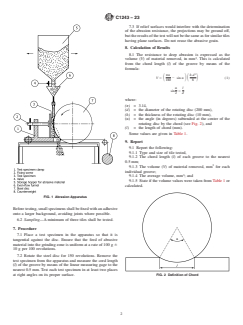
5.1 Abrasion apparatus (see Fig. 1) consisting essentially of
dance with internationally recognized principles on standard-
a rotating disc, a storage hopper with a dispensing device for
ization established in the Decision on Principles for the
the abrasive material, a test specimen support, and a counter-
Development of International Standards, Guides and Recom-
weight. The disc is made of Fe 360A steel (ISO 630-1980) with
mendations issued by the World Trade Organization Technical
a diameter of 200 mm 6 0.2 mm and thickness at the edge of
Barriers to Trade (TBT) Committee.
10 mm 6 0.1 mm, and with a rate of revolution of 75 r/min.
The pressure with which test specimens are held against the
2. Referenced Documents
steel disc is determined by calibrating the apparatus against
2.1 ASTM Standards:
fused silica. The pressure is adjusted such that, after 150
C242 Terminology of Ceramic Whitewares and Related
revolutions, a chord of 24 mm 6 0.5 mm is produced.
Products
5.1.1 When the disc diameter has worn to 199 mm, the steel
C448 Test Methods for Abrasion Resistance of Porcelain
disc shall be replaced.
Enamels
5.2 A linear measuring gage capable of measuring to
C501 Test Method for Relative Resistance to Wear of
0.1 mm.
Unglazed Ceramic Tile by the Taber Abraser
C1027 Test Method for Determining Visible Abrasion Re-
5.3 Abrasive Material—White fused aluminum oxide of
sistance of Glazed Ceramic Tile
grain size 80 (32 GB 1971) FEPA Bonded Abrasive Grain Size
Standard Grits 8-220.
3. Terminology
3.1 Definitions:
6. Test Specimen
6.1 Types of Test Specimens—Tests shall be carried out
This test method is under the jurisdiction of ASTM Committee C21 on Ceramic
using whole tiles or test specimens of suitable dimensions.
Whitewares and Related Productsand is the direct responsibility of Subcommittee
C21.06 on Ceramic Tile.
Current edition approved Oct. 1, 2023. Published October 2023. Originally
ɛ2
approved in 1993. Last previous edition approved in 2015 as C1243 – 93 (2015) . The sole source of supply of the apparatus known to the committee at this time
DOI: 10.1520/C1243-23. is Gabrielli S.R.L., Box 218, 50019 Sesto Florentino, Florence, Italy, Fax:
For referenced ASTM standards, visit the ASTM website, www.astm.org, or 55-42-15-654. If you are aware of alternative suppliers, please provide this
contact ASTM Customer Service at service@astm.org. For Annual Book of ASTM information to ASTM International Headquarters. Your comments will receive
Standards volume information, refer to the standard’s Document Summary page on careful consideration at a meeting of the responsible technical committee, which
the ASTM website. you may attend.
Copyright © ASTM International, 100 Barr Harbor Drive, PO Box C700, West Conshohocken, PA 19428-2959. United States
C1243 − 23
7.3 If relief surfaces would interfere with the determination
of the abrasion resistance, the projections may be ground off,
but t
...
This document is not an ASTM standard and is intended only to provide the user of an ASTM standard an indication of what changes have been made to the previous version. Because
it may not be technically possible to adequately depict all changes accurately, ASTM recommends that users consult prior editions as appropriate. In all cases only the current version
of the standard as published by ASTM is to be considered the official document.
´2
Designation: C1243 − 93 (Reapproved 2015) C1243 − 23
Standard Test Method for
Relative Resistance to Deep Abrasive Wear of Unglazed
Ceramic Tile by Rotating Disc
This standard is issued under the fixed designation C1243; the number immediately following the designation indicates the year of
original adoption or, in the case of revision, the year of last revision. A number in parentheses indicates the year of last reapproval. A
superscript epsilon (´) indicates an editorial change since the last revision or reapproval.
ε NOTE—Corrected Eq 1 editorially in Nov. 2019.
1. Scope
1.1 This test method covers the deep abrasive wear by measuring the loss of volume resulting from abrasion of unglazed ceramic
tile under given conditions by means of a rotating disc and the use of abrasive material.
1.2 The values stated in SI units are to be regarded as standard. No other units of measurement are included in this standard.
1.3 This standard does not purport to address all of the safety concerns, if any, associated with its use. It is the responsibility
of the user of this standard to establish appropriate safety, health, and environmental practices and determine the applicability of
regulatory limitations prior to use.
1.4 This international standard was developed in accordance with internationally recognized principles on standardization
established in the Decision on Principles for the Development of International Standards, Guides and Recommendations issued
by the World Trade Organization Technical Barriers to Trade (TBT) Committee.
2. Referenced Documents
2.1 ASTM Standards:
C242 Terminology of Ceramic Whitewares and Related Products
C448 Test Methods for Abrasion Resistance of Porcelain Enamels
C501 Test Method for Relative Resistance to Wear of Unglazed Ceramic Tile by the Taber Abraser
C1027 Test Method for Determining Visible Abrasion Resistance of Glazed Ceramic Tile
3. Terminology
3.1 Definitions:
3.1.1 For definitions of terms used in this test method, see Terminology C242.
4. Significance and Use
4.1 This test method provides the means to measure the potential resistance to wear of unglazed ceramic tile intended for floor
This test method is under the jurisdiction of ASTM Committee C21 on Ceramic Whitewares and Related Productsand is the direct responsibility of Subcommittee C21.06
on Ceramic Tile.
Current edition approved Dec. 15, 2015Oct. 1, 2023. Published December 2015October 2023. Originally approved in 1993. Last previous edition approved in 2015 as
ɛ2
C1243 – 93 (2015).(2015) . DOI: 10.1520/C1243-93R15E02.10.1520/C1243-23.
For referenced ASTM standards, visit the ASTM website, www.astm.org, or contact ASTM Customer Service at service@astm.org. For Annual Book of ASTM Standards
volume information, refer to the standard’s Document Summary page on the ASTM website.
Copyright © ASTM International, 100 Barr Harbor Drive, PO Box C700, West Conshohocken, PA 19428-2959. United States
C1243 − 23
coverings. This test method does not consider physical appearance but is intended to measure durability. See Test Method C1027
for the determination of visible abrasion resistance of glazed ceramic tile.
4.1.1 See Test Method C501 for an alternative method to determine deep abrasion.
5. Apparatus
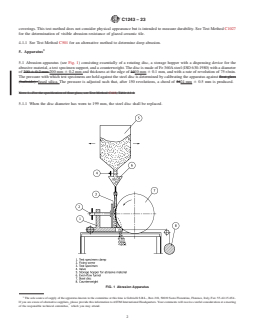
5.1 Abrasion apparatus (see Fig. 1) consisting essentially of a rotating disc, a storage hopper with a dispensing device for the
abrasive material, a test specimen support, and a counterweight. The disc is made of Fe 360A steel (ISO 630-1980) with a diameter
of 200 6 0.2 mm 200 mm 6 0.2 mm and thickness at the edge of 1010 mm 6 0.1 mm, and with a rate of revolution of 75 r/min.
The pressure with which test specimens are held against the steel disc is determined by calibrating the apparatus against float glass
(bathside). fused silica. The pressure is adjusted such that, after 150 revolutions, a chord of 2424 mm 6 0.5 mm is produced.
NOTE 1—For the specification of float glass, see Test Method C448, Table A1.4.
5.1.1 When the disc diameter has worn to 199 mm, the steel disc shall be replaced.
FIG. 1 Abrasion Apparatus
The sole source of supply of the apparatus known to the committee at this time is Gabrielli S.R.L., Box 218, 50019 Sesto Florentino, Florence, Italy, Fax: 55-42-15-654.
If you are aware of alternative suppliers, please provide this information to ASTM International Headquarters. Your comments will receive careful consideration at a meeting
of the responsible technical committee, which you may attend.
C1243 − 23
5.2 A linear measuring gage capable of measuring to 0.1 mm.0.1 mm.
5.3 Abrasive Material—White fused aluminum oxide of grain size 80 (32 GB 1971) FEPA Bonded Abrasive Grain Size Standard
Grits 8-220.
6. Test Specimen
6.1 Types of Test Specimens—Tests shall be carried out using whole tiles or test specimens of suit
...